Renewable Energy Storage Solutions 2025: A Comprehensive Performance Comparison for a Resilient Grid
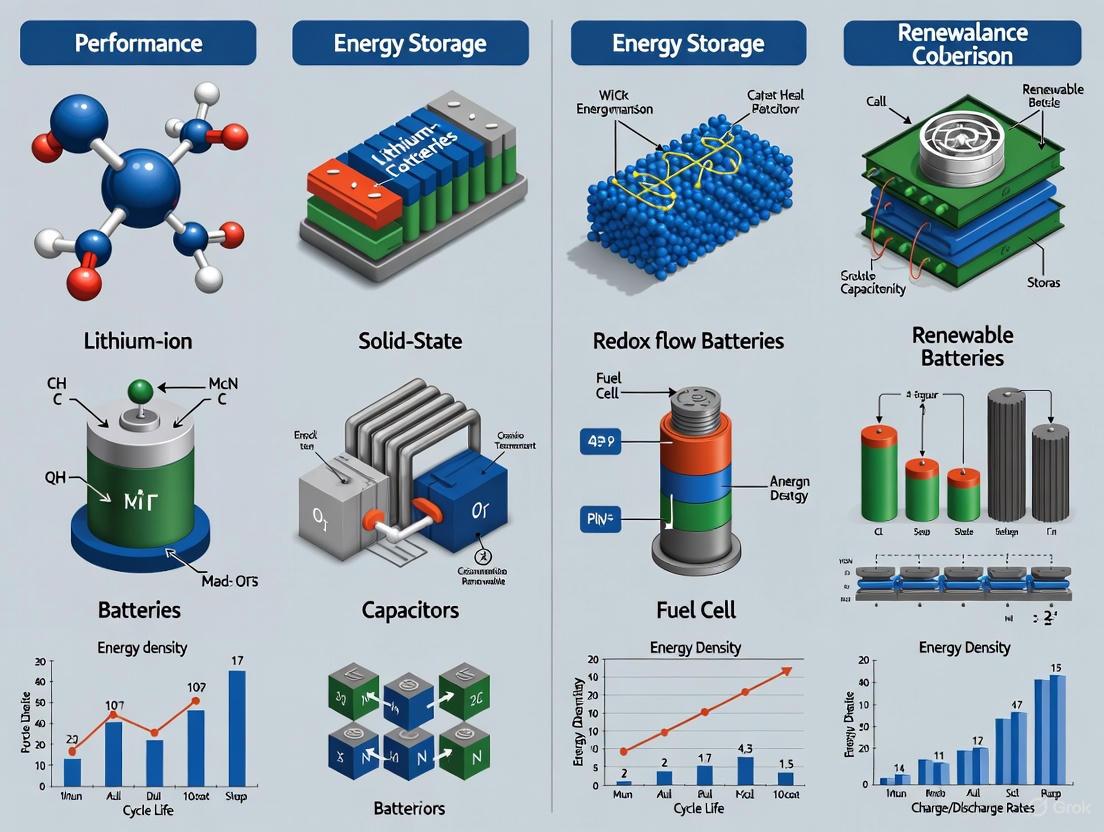
This article provides a systematic performance comparison of contemporary renewable energy storage solutions, tailored for energy researchers, system designers, and policy professionals.
Renewable Energy Storage Solutions 2025: A Comprehensive Performance Comparison for a Resilient Grid
Abstract
This article provides a systematic performance comparison of contemporary renewable energy storage solutions, tailored for energy researchers, system designers, and policy professionals. It establishes a foundational understanding of key storage technologies—from dominant lithium-ion batteries to mature pumped hydro and emerging long-duration solutions—by defining critical performance metrics like Levelized Cost of Storage (LCOS), cycle life, and round-trip efficiency. The analysis then explores advanced optimization methodologies and control strategies that enhance economic and operational outcomes, including AI-driven management and shared storage models. A detailed, data-driven comparative analysis validates technologies against application-specific criteria such as duration, response time, and scalability, offering actionable insights for selecting optimal storage configurations to improve grid stability, maximize renewable integration, and achieve decarbonization goals.
Understanding the Energy Storage Landscape: Core Technologies and Performance Metrics
The global transition to a sustainable energy future is inherently dependent on the ability to store energy effectively, bridging the gap between intermittent renewable energy supply and constant demand. Energy storage systems (ESS) have thus become a cornerstone technology, enabling grid stability, renewable energy integration, and backup power. The modern energy storage ecosystem encompasses a diverse portfolio of technologies, each with unique performance characteristics tailored for specific durations and applications, from milliseconds of grid stabilization to seasonal shifts in energy availability. This guide provides an objective, data-driven comparison of contemporary energy storage solutions, framing the analysis within the critical context of matching technology capabilities to application requirements for researchers and scientists driving innovation in this field.
Classification of Energy Storage Technologies
Energy storage systems are fundamentally classified by the form of energy they utilize, which dictates their inherent characteristics, optimal applications, and scalability. Understanding this classification framework is essential for appropriate technology selection.
The classification tree above illustrates the technological diversity within the modern energy storage ecosystem. Mechanical storage systems, including pumped hydro storage (PHS) and compressed air energy storage (CAES), dominate utility-scale applications due to their massive storage capacity and long duration capabilities [1]. Electrochemical storage, particularly lithium-ion and flow batteries, has revolutionized residential, commercial, and grid-scale applications with their versatility and declining costs [2]. Electrical storage technologies like supercapacitors provide ultra-fast response for power quality applications, while thermal and chemical storage offer solutions for long-duration and seasonal energy shifting challenges [1].
Performance Comparison of Energy Storage Technologies
Selecting an appropriate energy storage technology requires careful evaluation of multiple performance metrics against specific application requirements. The following comprehensive comparison synthesizes experimental data and operational characteristics across the major technology categories.
Quantitative Performance Metrics Comparison
Table 1: Comprehensive performance comparison of major energy storage technologies [2] [1]
| Technology | Efficiency (%) | Energy Density | Cycle Life | Discharge Duration | Response Time | Typical Capacity |
|---|---|---|---|---|---|---|
| Lithium-ion (Li-ion) | 85-95% | High (200-400 Wh/L) | 1,000-10,000 cycles | Minutes to 8 hours | Seconds to minutes | kWh to 100+ MWh |
| Flow Batteries | 70-85% | Medium (20-70 Wh/L) | 10,000+ cycles | 4-12+ hours | Seconds | MWh to GWh scale |
| Pumped Hydro (PHS) | 70-85% | Low | 30+ years | 6-20 hours | Minutes to hours | 500-3000+ MWh |
| Compressed Air (CAES) | 40-70% | Low | 20+ years | 2-20 hours | Minutes to hours | 100-500+ MWh |
| Supercapacitors | 90-95% | Very low | 1,000,000+ cycles | Seconds to minutes | Milliseconds | Wh to kWh |
| Hydrogen Fuel Cells | 30-50% (round trip) | High | Unlimited (depends on fuel) | Days to months | Minutes to hours | MWh to GWh scale |
| Lead-Acid | 70-85% | Low | 500-2,000 cycles | Minutes to hours | Seconds | kWh to MWh |
| Nickel-Metal Hydride | 70-80% | Medium | 300-500 cycles | Minutes to hours | Seconds | kWh scale |
Safety and Environmental Profile Comparison
Table 2: Safety, cost, and environmental characteristics of energy storage technologies [2]
| Technology | Fire Risk | Environmental Impact | Cost Trend | Material Constraints | Typical Application |
|---|---|---|---|---|---|
| Lithium-ion (Li-ion) | High (thermal runaway) | Moderate (mining impact) | Declining | Lithium, cobalt, nickel | EVs, grid storage, residential |
| Flow Batteries | Low (non-flammable electrolyte) | Low to moderate | Declining rapidly | Vanadium (for VRFB) | Long-duration grid storage |
| Pumped Hydro | Low | High (land use) | Stable high CAPEX | Geographical constraints | Utility-scale storage |
| Compressed Air | Low | Moderate (geological) | High CAPEX | Geological formations | Large-scale storage |
| Supercapacitors | Low | Low (no toxic waste) | Moderate | Specialty materials | Power quality, regeneration |
| Hydrogen Fuel Cells | Low (with protocols) | Low (if green H₂) | Very high | Platinum group metals | Seasonal storage, transportation |
| Lead-Acid | Low | High (lead contamination) | Stable low cost | Lead availability | Automotive, UPS |
| Nickel-Metal Hydride | Medium | Moderate (mining impact) | Stable | Rare earth elements | Hybrid vehicles, electronics |
Technology Selection Guidance by Application
Different energy storage technologies excel in specific applications based on their discharge duration, power rating, and cycle life characteristics. The following diagram illustrates the optimal application space for major technologies based on discharge duration and power requirements.
The technology selection workflow demonstrates that supercapacitors excel for sub-second to second duration applications requiring very high power, such as power quality management and frequency regulation [2] [1]. Lithium-ion batteries dominate the minutes to hours duration range with medium to high power capabilities, making them ideal for electric vehicles, residential storage, and partial grid support [2]. Flow batteries and pumped hydro storage cover the hours to days duration category, with flow batteries offering better scalability for medium power applications and PHS providing very high power for utility-scale needs [3] [1]. For seasonal storage requirements spanning days to months, hydrogen fuel cells represent the only commercially viable technology, despite efficiency challenges [2].
Deep-Dive Analysis: Flow Batteries for Long-Duration Storage
Flow batteries represent a particularly promising technology for long-duration energy storage requirements, offering unique advantages for grid-scale applications. Their architecture fundamentally differs from conventional solid-electrode batteries by storing energy in liquid electrolytes contained in external tanks.
Flow Battery Chemistry Comparison and Commercial Landscape
Table 3: Major flow battery chemistries and key commercial players [3]
| Chemistry Type | Leading Companies | Core Advantages | Limitations | Commercial Status |
|---|---|---|---|---|
| All-Vanadium Redox (VRFB) | Dalian Rongke (China), VRB Energy (China), Invinity Energy Systems (UK), Sumitomo Electric (Japan) | Long cycle life (20,000+), proven commercial technology, high efficiency | Vanadium price volatility, lower energy density | Commercial with >1GWh projects |
| Iron-Chromium | ESS Inc. (USA) | Abundant low-cost materials, avoid vanadium dependence | Lower efficiency, cross-contamination challenges | Early commercial deployment |
| Zinc-Bromine | Redflow (Australia) | Higher energy density, good temperature stability | Zinc dendrite formation, complex management | Niche commercial applications |
| Iron-Air | Form Energy (USA) | Ultra-low theoretical cost (~$20/kWh), abundant materials | Very low efficiency, early development stage | Pilot projects (2024) |
Regional Development Trends and Market Insights
The global flow battery market exhibits distinct regional characteristics and competitive advantages. Chinese companies, led by Dalian Rongke and VRB Energy, have achieved dominant market positioning through vertical integration strategies, controlling approximately 70% of global vanadium flow battery production capacity as of 2023 [3]. This dominance is reinforced by substantial government support, including tax exemptions and equipment purchase subsidies. European and American companies have pursued technological differentiation strategies, with companies like ESS Inc. focusing on iron-chromium chemistry to avoid vanadium supply dependencies, while Form Energy innovates with ultra-low-cost iron-air systems [3]. Japanese firms, particularly Sumitomo Electric, maintain strong intellectual property positions, holding 387 core flow battery patents and charging licensing fees to other manufacturers [3].
Experimental Protocols for Flow Battery Performance Validation
Standardized experimental protocols are essential for validating flow battery performance claims and enabling direct comparison between different systems. The following methodology outlines key testing procedures for assessing critical performance parameters.
Electrolyte Stability and Cycle Life Testing Protocol
Objective: Determine electrochemical stability, cycle life, and capacity retention of flow battery electrolytes under controlled conditions.
Materials and Equipment:
- Test Cell: Symmetrical flow cell with graphite bipolar plates, carbon felt electrodes, and Nafion membrane
- Electrolyte: 1.6 M VOSO₄ in 2 M H₂SO₄ (positive) and 1.6 M VOSO₄ in 2 M H₂SO₄ (negative) for VRFB systems
- Pumping System: Peristaltic pumps with precise flow rate control (50-200 mL/min)
- Potentiostat/Galvanostat: Biologic VMP-300 or equivalent with 5 A current booster
- Environmental Chamber: Temperature control capability (±0.5°C) from 15°C to 45°C
Methodology:
- Cell Assembly: Assemble flow cell with predetermined compression on carbon felt electrodes (typically 20-30%)
- Electrolyte Preparation: Prepare 500 mL each of positive and negative electrolytes, recording initial vanadium concentrations
- Initial Characterization:
- Perform cyclic voltammetry at 5 mV/s between voltage limits specific to chemistry
- Measure electrochemical impedance spectrum from 100 kHz to 100 mHz at 50% state of charge
- Determine initial energy efficiency via charge-discharge cycling at 50 mA/cm²
- Cycle Life Testing:
- Implement continuous charge-discharge cycling between 10-90% state of charge
- Apply constant current density of 80 mA/cm² with voltage cutoffs
- Record capacity, efficiency, and pressure drop measurements every 50 cycles
- Maintain temperature at 25±2°C throughout testing
- Post-Test Analysis:
- Measure final vanadium concentrations in both electrolytes
- Inspect membrane for crossover or degradation
- Analyze electrode morphology changes via SEM
Data Analysis: Calculate capacity decay rate per cycle, round-trip energy efficiency, voltage efficiency, and coulombic efficiency. Compare beginning-of-life (BOL) and end-of-life (EOL) performance parameters.
Research Reagent Solutions for Flow Battery Development
Table 4: Essential research materials for flow battery experimentation [4] [5]
| Research Reagent | Function | Technical Specifications | Application Notes |
|---|---|---|---|
| Vanadium Electrolyte | Active energy storage material | 1.5-2.0 M VOSO₄ in 2-3 M H₂SO₄ | Stability enhanced with phosphoric acid additives; concentration affects energy density |
| Nafion Membrane | Proton-selective separator | 50-180 μm thickness, 0.9-1.1 meq/g exchange capacity | Pretreatment required (boiling in H₂O₂, H₂SO₄, DI water); primary cost driver |
| Carbon Felt Electrodes | Reaction surface for redox reactions | 0.3-0.5 mm thickness, 95-99% porosity, 5-20 μm fiber diameter | Thermal activation (400°C air, 2h) enhances surface functionality |
| Graphite Bipolar Plates | Current collection and flow field structure | 2-5 mm thickness, 1.8-2.0 g/cm³ density, <50 μΩ·m resistivity | Machined flow patterns critical for electrolyte distribution |
| Perfluorinated Sulfonic Acid (PPSA) | Alternative membrane material | 50-150 μm thickness, 1.1-1.3 meq/g exchange capacity | Lower cost alternative to Nafion with comparable performance |
| Electrolyte Additives | Stability and performance enhancement | 1-3% w/w bismuth, 2-5% w/w phosphoric acid | Suppress gas evolution, improve thermal stability |
Emerging Trends and Future Research Directions
The energy storage landscape continues to evolve rapidly, with several emerging technologies and improvement pathways shaping the future ecosystem. Solid-state batteries represent a promising advancement in lithium-ion technology, offering enhanced safety through non-flammable solid electrolytes and potentially higher energy densities exceeding 500 Wh/L [2]. While currently at the research and early commercialization stage, solid-state batteries demonstrate cycle lives potentially exceeding 10,000 cycles with significantly reduced fire risks compared to conventional lithium-ion chemistries [2].
Vanadium redox flow batteries are experiencing substantial cost reductions, with system costs declining from approximately $600/kWh in 2018 to $350/kWh in 2023, a 42% reduction driven by manufacturing scale and electrolyte optimization [3]. Research initiatives focused on novel electrolyte systems, including mixed acid supports and organic chelating agents, aim to enhance operating temperature ranges and energy density while maintaining the inherent safety advantages of aqueous systems [4] [5].
Supply chain security and material sustainability represent critical research priorities. The concentration of vanadium production (over 60% from China) has prompted initiatives to develop alternative flow battery chemistries using more abundant materials, as well as resource leasing models and dynamic database development to improve market transparency [4]. Similar efforts focus on reducing lithium-ion dependence on cobalt through advanced cathode chemistries like lithium iron phosphate (LFP), which offers improved safety and sustainability profiles [2] [6].
The increasing diversification of energy storage technologies reflects a maturation of the industry, with different solutions finding optimal applications based on technical characteristics rather than one-size-fits-all approaches. This technology-specific optimization pathway promises enhanced overall system economics and reliability as the global energy transition accelerates.
The global transition to renewable energy has fundamentally increased the demand for efficient and reliable energy storage solutions. While lithium-ion batteries (LIBs) currently dominate the market, their suitability for every application is being re-evaluated. This guide provides a performance comparison of the established LIB technology against three emerging alternatives: Lithium Iron Phosphate (LFP), sodium-ion (Na-ion), and vanadium redox flow batteries (VRFBs). Framed within a broader thesis on renewable energy storage research, this analysis synthesizes technical data and experimental findings to offer researchers and scientists a clear, objective comparison of these technologies' characteristics, applications, and future potential.
The energy storage landscape is diversifying, with each technology offering a distinct profile of advantages and trade-offs. The following table provides a high-level comparison of the key technologies examined in this guide.
Table 1: Core Technology Overview and Primary Applications
| Technology | Key Characteristics | Primary Research & Application Focus |
|---|---|---|
| Lithium-ion (NMC/LCO) | High energy density, compact size, established supply chain [7] | Portable electronics, EVs where space/weight are critical [8] [7] |
| LFP (LiFePO₄) | Exceptional safety, long cycle life, cobalt-free chemistry [9] [8] | Stationary storage (solar, UPS), EVs prioritizing safety/lifespan [9] [10] |
| Sodium-ion (SIB) | Abundant raw materials, lower cost, safer operation [11] [12] | Cost-sensitive grid storage, backup power; emerging EV applications [11] |
| Vanadium Flow (VRFB) | Decoupled power/energy, extremely long cycle life, non-flammable [13] [14] [15] | Long-duration (4+ hours) utility-scale storage, renewable integration [13] [14] |
The Incumbent: Lithium-ion Batteries and the LFP Variant
Lithium-ion is an umbrella term for batteries with cathodes made from various lithium metal oxides, such as Lithium Cobalt Oxide (LCO) and Nickel Manganese Cobalt (NMC) [7]. These chemistries are valued for their high energy density, which is crucial for portable electronics and electric vehicles (EVs) [9] [7]. However, they carry safety risks like thermal runaway and use scarce materials like cobalt [9] [13].
Lithium Iron Phosphate (LFP), a subtype of LIB, has a different cathode chemistry that uses iron and phosphate. Its stable olivine structure with strong covalent bonds makes it inherently safer and virtually eliminates the risk of thermal runaway [9] [8]. LFP batteries also boast a much longer cycle life—typically 3,000 to 7,000 cycles, compared to 1,000 to 2,500 for conventional NMC batteries [8] [7]. The trade-off is a lower energy density, making LFP batteries larger and heavier for the same energy capacity [9] [7]. This makes LFP ideal for stationary storage where safety and longevity are more critical than compact size.
The Challengers: Sodium-ion and Flow Batteries
Sodium-ion batteries (SIBs) operate on a similar "rocking-chair" principle as LIBs but use sodium ions, which are derived from far more abundant resources [11] [12]. The primary advantage of SIBs is lower cost, with raw material savings making them 20-30% cheaper than LFP cells [11] [10]. They also exhibit enhanced safety and better performance at extreme temperatures [11] [12]. Their main limitation is lower energy density (100-160 Wh/kg), though this is expected to exceed 200 Wh/kg with future advancements [11].
Vanadium Redox Flow Batteries (VRFBs) represent a fundamental architectural shift. Energy is stored in liquid electrolytes held in external tanks, which are pumped through a stack to charge or discharge [13] [15]. This decouples power (stack size) and energy (tank volume) [14]. VRFBs offer an exceptionally long cycle life of over 10,000 cycles with minimal degradation, non-flammable electrolytes, and excellent recyclability [13] [14] [15]. Their low energy density makes them unsuitable for mobility but ideal for long-duration, grid-scale storage [13].
Quantitative Performance Data
For research and development decisions, quantitative data is critical. The following tables summarize key performance metrics and economic indicators for the discussed battery technologies.
Table 2: Key Electrochemical and Performance Metrics for Energy Storage Technologies
| Parameter | Lithium-ion (NMC) | LFP | Sodium-ion | Vanadium Flow (VRFB) |
|---|---|---|---|---|
| Energy Density (Wh/kg) | 150-250 [7] | ~90-160 [7] | 100-160 [11] | Low (System-level) |
| Cycle Life (to 80% capacity) | 1,000 - 2,500 cycles [8] [7] | 3,000 - 7,000+ cycles [9] [8] | 2,000 - 6,000 cycles [11] [10] | 10,000 - 20,000+ cycles [13] [14] [10] |
| Round-Trip Efficiency | 85-95% [10] | 85-95% [10] | Comparable to LIB [12] | 70-85% [10] |
| Nominal Voltage | 3.6-3.7V [9] | 3.2V [9] | Lower than LIB [11] | Cell: 1.15-1.55V [13] |
| Operational Temp. Range | 32°F to 113°F (0°C to 45°C) [9] | -4°F to 140°F (-20°C to 60°C) [9] | Wider than LIB [12] | Ambient [15] |
| Self-Discharge Rate (per month) | Low | 1-3% [9] | Low | Negligible [13] |
Table 3: Cost, Safety, and Sustainability Comparison
| Aspect | Lithium-ion (NMC) | LFP | Sodium-ion | Vanadium Flow (VRFB) |
|---|---|---|---|---|
| Cost per kWh (System) | ~$115/kWh (pack) [10] | Slightly higher than NMC [9] | 20-30% lower than LFP [11] [10] | $130-$600/kWh [12] |
| Safety & Thermal Runaway Risk | Moderate to High [9] [13] | Very Low [9] [8] | Low, more stable [11] [12] | Very Low (non-flammable) [13] [15] |
| Key Materials & Abundance | Lithium, Cobalt, Nickel (Limited) [9] [13] | Lithium, Iron, Phosphate (Abundant) [9] | Sodium (Extremely Abundant) [11] [12] | Vanadium (Recyclable) [13] |
| Environmental Impact | Higher due to mining [13] | Lower, no cobalt/nickel [9] | Lower, abundant sodium [11] | Recyclable components, lower manufacturing impact [13] [15] |
Experimental Protocols for Performance Validation
Standardized testing protocols are essential for the objective comparison of battery technologies. The following experimental workflows and methodologies are critical for validating manufacturer claims and advancing research.
Cycle Life Testing and Degradation Analysis
The cycle life is a key metric for determining a battery's economic viability, especially for stationary storage. The standard protocol involves repeated charge and discharge cycles under controlled conditions.
Diagram 1: Battery Cycle Life Test Workflow
Key Experimental Parameters:
- Depth of Discharge (DoD): The percentage of the battery's capacity that is used. Testing at 100% DoD is more stressful than 80% DoD [8].
- C-rate: The rate of charge and discharge. A 1C rate means a full battery is discharged in one hour. Higher C-rates can accelerate aging [12].
- Temperature Control: Tests are conducted in thermal chambers, as temperature significantly impacts degradation [9].
Data Analysis: The State of Health (SoH) is tracked, typically defined as the ratio of current maximum capacity to initial capacity (C/C₀). The experiment concludes when SoH drops to 80% [8]. The total cycles achieved are the reported cycle life.
Techno-Economic-Environmental Assessment (TEEA) for Grid Storage
For large-scale applications, a more holistic assessment framework is required. The TEEA model integrates technical performance, cost, and environmental impact over the system's lifetime.
Diagram 2: Techno-Economic-Environmental Assessment Framework
Core Methodologies:
- Iterative Sizing Framework: For a given application (e.g., a standalone PV system), the minimum battery size meeting daily demand is calculated [12].
- Techno-Economic Modeling: Key metrics include Levelized Cost of Storage (LCOES), which accounts for capital, operational, and replacement costs over the system's lifetime, divided by total energy discharged [12].
- Life Cycle Assessment (LCA): This evaluates environmental impact from cradle to grave, including manufacturing, operation, and recycling. A key output is the Levelized Carbon Emission of Storage (LCEOS), measuring CO₂ emissions per kWh of stored electricity delivered [12].
- Economic-Ecological Efficiency: This combined metric identifies technologies that deliver the greatest environmental benefit (e.g., carbon reduction) at the lowest cost [12].
The Scientist's Toolkit: Research Reagents and Materials
The development and testing of these storage technologies rely on a suite of specialized materials and reagents.
Table 4: Key Research Reagents and Materials in Battery Development
| Category | Specific Material/Reagent | Primary Function in R&D |
|---|---|---|
| Cathode Materials | NMC (LiNiₓMnᵧCo₂O₂), LCO (LiCoO₂) [7] | Provides the source of lithium ions; key determinant of energy density and stability in conventional LIBs. |
| LiFePO₄ (Lithium Iron Phosphate) [9] [7] | Provides stable olivine structure for LFP cathodes; enables safety and long cycle life. | |
| Prussian White (Sodium Ferrous Ferrocyanide) [12] | A leading cathode material for SIBs; symmetric structure enables fast charging and long life. | |
| Anode Materials | Graphite (Carbon) [9] [11] | Standard anode material for LIBs; hosts lithium/sodium ions in layered structure. |
| Hard Carbon [11] | The preferred anode material for SIBs due to its larger interlayer spacing accommodating sodium ions. | |
| Electrolytes & Solvents | Lithium Hexafluorophosphate (LiPF₆) in Organic Solvents [9] | Common lithium salt electrolyte for LIBs; conducts ions between cathode and anode. |
| Sodium Salts (e.g., NaClO₄) in Organic Solvents [11] | Electrolyte salts for SIBs; function similarly to LIB electrolytes but with sodium ions. | |
| Vanyl Sulfate / Vanadium in Sulfuric Acid [13] | The electroactive electrolyte for VRFBs; contains V⁴⁺/V⁵⁺ and V²⁺/V³⁺ redox couples. | |
| Cell Components | Nafion Membrane [13] | A common proton-exchange membrane used in VRFBs; allows selective ion passage while preventing electrolyte mixing. |
| Carbon Felt/Paper [13] [15] | Used as electrodes in VRFBs; provides surface for redox reactions without participating in them. | |
| Polypropylene (PP) / Polyethylene (PE) Separators [9] | Porous polymer film preventing electrical short circuits between anode and cathode in LIBs/SIBs. |
The era of lithium-ion dominance is evolving into a period of strategic diversification. No single battery technology is optimal for all applications. Lithium-ion NMC remains the leader for applications where high energy density is paramount. LFP has established itself as the superior choice for stationary storage and safety-critical applications due to its longevity and stability. Sodium-ion batteries present a compelling, cost-effective alternative for grid storage, with a rapidly growing manufacturing base. Vanadium Flow Batteries are unmatched for long-duration, utility-scale storage where a 25-year lifespan and absolute safety are required.
The future energy storage ecosystem will not be a winner-take-all market. Instead, it will be a heterogeneous landscape where the "best" battery is defined by the specific application—be it cost, longevity, energy density, or power scaling. As one industry expert succinctly stated, "It's not a matter of sodium versus lithium, we need both" [16]—a sentiment that extends to the entire portfolio of electrochemical storage technologies. Continued research, guided by rigorous experimental protocols and holistic assessment frameworks, is crucial to optimizing each technology and integrating them into a resilient, renewable-powered grid.
The global transition to a sustainable energy future is intrinsically linked to the efficient integration of variable renewable sources such as wind and solar power. The inherent intermittency of these resources creates critical challenges for grid stability and reliability, necessitating robust, large-scale, and long-duration energy storage solutions [17]. Among the available technologies, mechanical and thermal storage systems—particularly pumped hydro storage, compressed air energy storage, and emerging gravity-based systems—offer the capacity, longevity, and scale required to support this transition. This guide provides a performance comparison of these technologies, framing them within a broader thesis on renewable energy storage solutions. It is designed to equip researchers, scientists, and energy development professionals with objective, data-driven insights into the operational principles, performance metrics, and experimental validations of each system, thereby informing research directions and technology selection.
Pumped Hydro Storage (PHS)
Pumped Hydro Storage is the most mature and widely deployed grid-scale energy storage technology, representing over 90% of the world's installed storage capacity [18] [19]. Its operating principle involves using surplus electrical energy to pump water from a lower reservoir to an upper reservoir, thereby converting electrical energy into gravitational potential energy. When electricity is needed, water is released back to the lower reservoir, passing through turbines to generate power [20]. PHS systems are characterized by long lifetimes (50-60 years), high round-trip efficiencies (70-85%), and immense power and energy capacities, often reaching gigawatt-scale and multiple gigawatt-hours [19]. Recent developments focus on closed-loop systems, which do not connect to natural waterways and are therefore less environmentally intrusive; in the United States, over 95% of new PHS projects in the development pipeline are closed-loop configurations [18].
Compressed Air Energy Storage (CAES)
Compressed Air Energy Storage functions by using electrical energy to compress air, which is stored under high pressure in underground geological formations such as salt caverns, depleted gas fields, or aquifers. During discharge, the pressurized air is released, heated, and expanded through a turbine to generate electricity [21]. Two primary configurations exist:
- Diabatic CAES (D-CAES): The heat generated during compression is vented and not stored. Upon expansion, the air is reheated using natural gas, resulting in lower round-trip efficiencies (42-55%) and carbon emissions [21] [19].
- Adiabatic CAES (A-CAES): The compression heat is captured and stored in a Thermal Energy Storage (TES) unit, then reused to heat the air during expansion. This eliminates the need for fossil fuels and can achieve higher round-trip efficiencies, with demonstration projects reaching over 70% [22] [21]. A-CAES represents the current research and development frontier for this technology.
Emerging Gravity Energy Storage (GES)
Gravity Energy Storage is an emerging technology that shares the fundamental principle of PHS—converting between electrical energy and gravitational potential energy—but uses solid masses instead of water [20]. Key configurations include:
- Tower-Based (T-SGES): A crane system stacks and lowers composite bricks or concrete blocks within a tall structure.
- Rail-Mounted (R-SGES): Heavy weights are transported on rail vehicles along an incline.
- Shaft-Type (S-SGES): A heavy piston is raised and lowered within a deep, sealed borehole, often leveraging abandoned mine shafts for infrastructure reuse [23] [20]. These systems aim to offer the large-scale, long-duration storage benefits of PHS with reduced geographical constraints and a smaller environmental footprint. Their projected lifespans are comparable to PHS, with round-trip efficiencies potentially exceeding 80% [20].
Table 1: Fundamental Principles and Characteristics of Mechanical Storage Technologies
| Technology | Storage Medium | Energy Conversion Process | Primary Configurations | Typical Project Scale |
|---|---|---|---|---|
| Pumped Hydro (PHS) | Water | Electrical Kinetic Gravitational Potential | Open-Loop, Closed-Loop [18] | 100 MW - 3,600 MW [20] |
| Compressed Air (CAES) | Air | Electrical Kinetic (Pressure) + Thermal | Diabatic (D-CAES), Adiabatic (A-CAES) [21] | 100 MW - 500 MW [17] [21] |
| Gravity Storage (GES) | Solid Masses (Concrete, Composite) | Electrical Kinetic Gravitational Potential | Tower, Rail, Shaft [20] | < 100 MWh (pilots) [24] |
Performance Comparison and Experimental Data
Quantitative Performance Metrics
A comprehensive performance assessment requires evaluating key techno-economic metrics, including efficiency, cost, lifespan, and energy density. The following table synthesizes data from operational facilities, pilot projects, and technical literature.
Table 2: Techno-Economic Performance Metrics for Mechanical Storage Systems
| Performance Parameter | Pumped Hydro Storage (PHS) | Compressed Air Energy Storage (CAES) | Gravity Energy Storage (GES) |
|---|---|---|---|
| Round-Trip Efficiency (RTE) | 70% - 85% [20] [19] | 42% - 55% (D-CAES); 60% - 70%+ (A-CAES) [22] [21] [19] | Projected: 80% - 90% [20] |
| Typical Lifespan (Years) | 50 - 60 years [19] | 20 - 40 years [21] | Projected: > 50 years [20] |
| Energy Density (Wh/m³) | Low (Site Dependent) | Low (Site Dependent) | Low [20] |
| Capital Cost (CAPEX) | High; Closed-loop: ~$3,000-4,500/kW [25] | Moderate-High [17] | Moderate-High (Projected) [23] |
| Levelized Cost of Storage (LCOS) | Low-Moderate [19] | Low (lowest among technologies) [19] | To be determined (Technology immature) |
| Technology Readiness Level (TRL) | 9 (Commercial) | 9 (D-CAES); 6-7 (A-CAES) [17] | 4-7 (Pilot/Demonstration) [20] |
Analysis of Comparative Performance
- Efficiency and Lifespan: PHS demonstrates the highest and most proven round-trip efficiency, alongside an exceptionally long operational lifespan, making it a benchmark for reliability and long-term performance. Advanced Adiabatic CAES aims to bridge the efficiency gap with PHS while GES projections are promising but require validation through commercial deployment [22] [20].
- Cost Considerations: While PHS has high upfront capital costs, its long life results in a competitive Levelized Cost of Storage (LCOS). CAES, particularly using existing geological formations, offers the lowest LCOS among major technologies, providing a significant economic advantage for large-scale, long-duration storage [19]. The economic viability of GES remains a key research question, pending further scale-up and learning curves [23].
- Geographical and Environmental Constraints: PHS requires specific topography and faces significant permitting hurdles. CAES is limited to regions with suitable geology for underground caverns [21]. In contrast, solid-mass GES can be deployed in a wider range of locations with a potentially smaller environmental footprint, representing its primary potential advantage [20].
Experimental Protocols and Validation
Protocol: Performance Testing of a Variable-Speed Contra-Rotating Pump-Turbine for Low-Head PHS
Objective: To experimentally determine the hydraulic efficiency and optimal operating range of a novel contra-rotating pump-turbine (CR RPT) for low-head pumped hydro storage applications [26].
- Methodology:
- Test Rig Configuration: A model-scale test rig is established using two open water surface tanks to simulate variable low heads, unlike conventional rigs that use recirculating pumps. The CR RPT is installed between them.
- Instrumentation: Sensors are deployed to measure:
- Head (m): Differential pressure sensors across the turbine.
- Flow Rate (m³/s): Electromagnetic or ultrasonic flow meters.
- Rotational Speed (RPM): Tachometers on both rotors.
- Torque (Nm): Shaft torque meters.
- Electrical Power (W): Power analyzers on the motor/generator terminals.
- Data Acquisition: For both pump and turbine modes, the rotational speed and flow rate are systematically varied. At each set point, all sensor readings are recorded after the system reaches steady state.
- Efficiency Calculation:
- Turbine Mode Efficiency (ηₜ): ηₜ = (Electrical Power Output) / (Hydraulic Power Input) = (Pelec) / (ρ ⋅ g ⋅ Q ⋅ H)
- Pump Mode Efficiency (ηₚ): ηₚ = (Hydraulic Power Output) / (Electrical Power Input) = (ρ ⋅ g ⋅ Q ⋅ H) / (Pelec) where ρ is water density, g is gravity, Q is flow rate, and H is head.
- Key Findings from Cited Experiment: The CR RPT achieved peak efficiencies of 88.6% in pump mode and 86.1% in turbine mode, maintaining efficiencies over 80% across a wide operating range. This demonstrates the technology's potential for high-performance, low-head PHS applications [26].
Protocol: Thermodynamic and Economic Performance Comparison of CAES vs. CCES
Objective: To conduct a comprehensive thermodynamic and economic comparison between Adiabatic Compressed Air Energy Storage (A-CAES) and Vapor-Liquid Compressed CO₂ Energy Storage (VL-CCES) under a given energy storage capacity [22].
- Methodology:
- System Modeling: Detailed dynamic models of both A-CAES and VL-CCES systems are developed, incorporating all key components (compressors, expanders, thermal stores, gas storage).
- Parameter Definition: Key performance parameters are defined for evaluation:
- Round-Trip Efficiency (RTE): (Total Electrical Energy Discharged) / (Total Electrical Energy Charged).
- Energy Density (kWh/m³): Stored energy per unit volume of the storage medium.
- Capital Cost: Estimated from major equipment costs.
- Transient Simulation: Unlike steady-state models, the systems are simulated over complete charge-discharge cycles to capture the impact of sliding pressures in storage tanks on performance.
- Techno-Economic Analysis: The models are used to calculate RTE, energy density, and estimate costs for a standardized storage capacity, enabling a direct comparison.
- Key Findings from Cited Experiment: The study highlighted that while A-CAES benefits from mature component technology, VL-CCES can achieve higher round-trip efficiencies (exceeding 75% in some designs) and significantly higher energy density due to the ease of liquefying CO₂, which reduces storage volume and cost. The trade-off is the increased complexity of the CCES system and the need for both high- and low-pressure storage vessels [22].
Visualization of System Workflows
The following diagrams, generated using Graphviz DOT language, illustrate the core operational workflows and energy flows for each storage technology.
Pumped Hydro Storage (PHS) Operational Workflow
PHS Energy Flow
Adiabatic Compressed Air (A-CAES) Workflow
A-CAES Energy Flow
Solid Gravity Energy Storage (GES) Workflow
GES Energy Flow
The Scientist's Toolkit: Key Research Reagents and Materials
Table 3: Essential Materials and Components for Experimental Research
| Component / Material | Primary Function in Research | Associated Technology |
|---|---|---|
| Variable-Speed Contra-Rotating Pump-Turbine | Enables high-efficiency energy conversion at variable low heads for PHS. Critical for testing operational flexibility and performance [26]. | PHS |
| Thermal Energy Storage (TES) Unit | Stores heat of compression for reuse. Core component for achieving high round-trip efficiency in A-CAES; research focuses on media (molten salts, ceramics) and design [22] [21]. | A-CAES |
| High-Pressure Vessel / Artificial Cavern | Stores the working fluid (air/CO₂) at high pressure. Used in CAES/CCES experiments to study containment, pressure dynamics, and energy density [22] [17]. | CAES, CCES |
| Composite Mass Blocks | Serve as the gravity medium in solid GES. Research focuses on optimizing mass-to-volume ratio, durability, and cost for commercial viability [20]. | GES |
| Motor/Generator System | The primary electromechanical interface. Used across all technologies to convert between electrical and mechanical energy; key for efficiency measurements [26] [20]. | PHS, CAES, GES |
| Programmable Logic Controller (PLC) & Sensors | Provides automated control and real-time data acquisition (e.g., pressure, temperature, flow, position, power). Essential for precise experimental control and performance validation [26]. | All |
Pumped Hydro Storage remains the undisputed cornerstone of grid-scale energy storage, offering unparalleled capacity, efficiency, and technological maturity. Its future growth lies in closed-loop systems that mitigate environmental concerns. Compressed Air Energy Storage, particularly the advancing Adiabatic CAES, presents a compelling alternative with a lower Levelized Cost of Storage and reduced geographical limitations, provided suitable geology is available. Emerging Gravity Energy Storage technologies offer a promising path to replicating the benefits of PHS with greater siting flexibility, though they must still overcome challenges related to capital costs and demonstration at full scale.
The optimal choice among these technologies is not universal but depends heavily on specific local factors: geography, geology, grid requirements, and cost constraints. For researchers, the frontier involves enhancing the round-trip efficiency and energy density of CAES, reducing the capital costs and proving the long-term reliability of GES, and developing advanced materials and controls for all systems. The continued development and integration of these mechanical storage systems are indispensable for building a resilient, renewable-powered grid.
The global transition to a renewable energy future is fundamentally dependent on the advancement of energy storage technologies. As power systems increasingly integrate variable renewable sources like solar and wind, the ability to store energy for later use has become essential for grid stability and reliability [27]. For researchers and industry professionals, evaluating the performance and economic viability of energy storage solutions requires a deep understanding of four critical performance indicators: Levelized Cost of Storage (LCOS), round-trip efficiency, cycle life, and degradation. These metrics provide a comprehensive framework for comparing diverse storage technologies across different applications and time horizons.
The unprecedented growth in energy storage deployment underscores the importance of these metrics. Global battery storage additions reached 42 GW in 2023 alone—more than double the previous year's installations—with projections of 80 GW of new additions in 2025, representing an eightfold increase from 2021 levels [28]. This rapid scaling, coupled with dramatic cost reductions of 97% since 1991 for battery technologies, makes rigorous performance comparison essential for guiding research priorities and investment decisions [28]. This article provides a systematic comparison of these critical performance indicators across major energy storage technologies, supported by experimental data and methodological frameworks for researchers.
Defining the Critical Performance Indicators
Levelized Cost of Storage (LCOS)
The Levelized Cost of Storage (LCOS) represents the average net present cost of storing and discharging one unit of electricity (typically kWh or MWh) over the entire lifetime of a storage system [29]. Unlike simple upfront capital cost metrics, LCOS provides a more comprehensive economic assessment by accounting for all lifetime costs and energy delivery. The calculation of LCOS converts the total capital expenditure from project construction to retirement with a discount rate, then divides this by the number of roundtrips, effectively considering the time value of money to present cost-effectiveness more accurately [30].
The standard formula for LCOS calculation is: LCOS = (Total Lifetime Costs) / (Total Lifetime Electricity Discharged) Where total lifetime costs include capital expenditure (CAPEX), operational expenditure (OPEX), charging electricity cost, and any end-of-life costs, minus any residual value [30] [29]. This metric has become the primary benchmark for comparing the economic performance of different energy storage technologies and project designs, enabling investors to identify the true cost per kWh stored and delivered [29].
Round-Trip Efficiency (RTE)
Round-trip efficiency (RTE) is the percentage of electricity put into a storage system that can be retrieved later for useful work [31]. It is calculated as: RTE (%) = (Energy Discharged / Energy Charged) × 100 For example, if 10 kWh of electricity is stored and only 8 kWh can be retrieved, the round-trip efficiency is 80% [31]. This 20% energy loss occurs as heat during conversion processes, standby power consumption, and system auxiliary loads.
RTE becomes increasingly critical at grid scale, where efficiency losses translate to massive infrastructure costs and environmental impacts [32]. As one analysis notes, "Losing 50% of the energy stored in a home battery system is inconvenient but manageable; a 50% loss of stored energy at the grid scale—amounting to gigawatt-hours of stored energy—is catastrophic" [32]. The U.S. Department of Energy analysis finds that for cost-effective grid decarbonization, long-duration energy storage must achieve a levelized cost of storage below $0.05/kWh, with 70% RTE emerging as the target for grid-scale applications [32].
Cycle Life and Degradation
Cycle life refers to the number of complete charge-discharge cycles a storage system can undergo before its capacity falls below a specified percentage of its original capacity (typically 80%) [10]. Different technologies exhibit substantially different cycle lives, from 3,000-5,000 cycles for lithium Nickel Manganese Cobalt (NMC) batteries to 10,000+ cycles for flow batteries and 20,000+ cycles for pumped hydro storage [10].
Degradation is the gradual loss of storage capacity or reduction in performance over time and use. The degradation rate determines how quickly a system loses its ability to store and deliver energy at its initial capacity. Both cycle life and degradation rate directly impact the lifetime energy delivery of a storage system, which in turn affects the LCOS—systems with longer cycle lives and slower degradation can deliver more total energy over their operational lifetimes, spreading the initial capital investment over more units of energy [29].
Comparative Performance Data Across Technologies
Table 1: Comparative Performance Indicators for Major Energy Storage Technologies
| Technology | LCOS Range (USD/MWh) | Round-Trip Efficiency (%) | Cycle Life (cycles) | Typical Degradation Rate |
|---|---|---|---|---|
| Lithium-ion (NMC) | $115 - $277 (utility-scale) [33] | 85-95% [10] | 3,000 - 5,000 [10] | ~2-3% per year [29] |
| LFP Batteries | RMB 0.3-0.4/kWh (~$40-55/MWh) [30] | 90-95% [31] | 4,000 - 8,000 [10] | Lower than NMC [10] |
| Vanadium Flow Battery | RMB 0.2/kWh (~$28/MWh) for some projects [30] | 60-80% [32] | 10,000+ [10] | Minimal capacity fade over 25+ years [10] |
| Pumped Hydro | RMB 0.213/kWh (~$30/MWh) [30] | 70-85% [10] | 20,000+ [10] | Very low; decades-long operation [10] |
| Sodium-ion | Projected 20% lower than LFP [10] | 85-90% (emerging) [10] | 2,000 - 4,000 (current) [10] | Similar to early lithium-ion [10] |
Table 2: U.S. LCOS Ranges for Battery Storage (Lazard 2025 Analysis)
| System Configuration | LCOS Range (USD/MWh) | Key Applications |
|---|---|---|
| 100MW/200MWh (2-hour) | $129 - $277 [33] | Peak shaving, frequency regulation |
| 100MW/400MWh (4-hour) | $115 - $254 [33] | Energy arbitrage, capacity firming |
| 1MW/2MWh (C&I) | $319 - $506 [33] | Demand charge reduction, backup power |
| With Investment Tax Credit | $83 - $192 (4-hour) [33] | All applications with policy support |
Table 3: Round-Trip Efficiency Breakdown by Technology and Loss Components
| Technology | Typical RTE Range | Primary Loss Sources |
|---|---|---|
| Lithium-ion (LFP) | 90-95% [31] | Internal resistance, inverter losses, thermal management |
| Flow Batteries | 60-80% [32] | Pumping losses, stack inefficiencies, power conversion |
| Pumped Hydro | 70-85% [10] | Turbine/generator losses, evaporation, seepage |
| Compressed Air | 60-80% [10] | Compression heat losses, storage losses, expansion |
The comparative data reveals several key insights. First, while lithium-ion batteries (particularly LFP chemistry) offer excellent round-trip efficiency, flow batteries and pumped hydro provide superior cycle life, making them potentially more economical for applications requiring frequent cycling over long durations [30] [10]. Second, the LCOS advantage of pumped hydro storage is evident, though this technology faces geographical constraints [30]. Third, emerging technologies like sodium-ion batteries promise lower costs but currently trail in cycle life performance [10].
The impact of the Investment Tax Credit (ITC) on LCOS is particularly noteworthy, reducing the levelized cost of 4-hour utility-scale storage to as low as $83/MWh—making storage highly competitive with conventional peaking power plants [33]. This highlights how policy support can accelerate the economic viability of emerging storage technologies.
Experimental Protocols for Performance Measurement
Standardized LCOS Calculation Methodology
For researchers comparing storage technologies, a standardized LCOS calculation protocol ensures comparable results:
Define System Boundaries: Clearly specify what components are included in the analysis (battery packs, power conversion system, balance of plant, etc.) [29].
Establish Key Parameters:
- Capital expenditures (CAPEX): Include equipment, installation, and grid connection costs
- Operational expenditures (OPEX): Include maintenance, monitoring, and replacement costs
- System lifetime: Define by years or throughput cycles
- Discount rate: Apply appropriate rate (typically 5-10%) for net present value calculation
- Charging electricity cost: Specify assumed electricity price for charging [29]
Calculate Total Lifetime Energy Delivery:
- Account for cycle life, depth of discharge, and degradation effects
- Include round-trip efficiency losses in net energy delivery
- Model capacity fade over time using established degradation models [29]
Compute LCOS: Apply standard formula: LCOS = (Total Lifetime Costs) / (Total Lifetime Electricity Discharged) [30]
Researchers should document all assumptions and conduct sensitivity analyses on key variables such as cycle life, degradation rate, and electricity prices to provide robust comparison across technologies.
Round-Trip Efficiency Testing Protocol
Standardized experimental testing for round-trip efficiency should follow these procedures:
Test Conditions Establishment:
- Stabilize battery at 25°C (±2°C) in temperature chamber
- Set C-rate between C/3 and C/2 for representative conditions
- Define state of charge (SOC) window (e.g., 10-90% for lithium-ion)
Efficiency Measurement Cycle:
- Charge to upper SOC limit at specified C-rate
- Implement rest period of 30 minutes
- Discharge to lower SOC limit at same C-rate
- Implement second rest period of 30 minutes
- Record energy in (during charge) and energy out (during discharge)
Calculation: RTE = (Discharge Energy / Charge Energy) × 100 [31]
Multiple Cycle Testing: Repeat for multiple cycles (typically 100) to establish stabilized efficiency values, as initial cycles may show variation
This protocol ensures comparable RTE measurements across different technologies and research laboratories.
Cycle Life and Degradation Testing
Standardized cycle life testing requires controlled laboratory conditions:
Test Cell Preparation:
- Assemble cells under controlled environment (dry room for lithium-ion)
- Perform formation cycles according to manufacturer specifications
- Measure initial capacity and impedance as baseline
Cycling Protocol:
- Apply standardized depth of discharge (e.g., 80% DoD for comparable results)
- Use specified C-rates for charge and discharge (typically 1C)
- Maintain temperature control throughout testing (±2°C of setpoint)
- Implement periodic reference performance tests (e.g., every 100 cycles) to measure capacity retention and impedance growth
Endpoint Definition: Continue cycling until capacity fade reaches 20% of initial capacity (80% retention) or power capability falls below specification
Degradation Modeling: Fit capacity fade data to established models (linear, square-root of time, etc.) to extrapolate long-term performance
For flow batteries and other novel technologies, researchers should adapt these protocols to account for technology-specific degradation mechanisms, such as membrane fouling or electrolyte cross-contamination.
Visualization of Performance Indicator Relationships
Essential Research Reagents and Materials for Energy Storage Testing
Table 4: Essential Research Materials and Equipment for Energy Storage Performance Testing
| Research Material/Equipment | Function in Performance Testing | Application Notes |
|---|---|---|
| Potentiostat/Galvanostat | Controls voltage/current during cycling tests; measures electrochemical response | Essential for half-cell and full-cell testing; enables precise charge/discharge profiling |
| Battery Cycler | Automates charge-discharge cycling for cycle life testing | Must accommodate various chemistry-specific voltage windows and current densities |
| Environmental Chamber | Maintains precise temperature control during testing | Critical for degradation studies at various temperatures; typically -20°C to +60°C range |
| Impedance Analyzer | Measures internal resistance and impedance spectroscopy | Detects degradation mechanisms; identifies interface changes |
| Reference Electrodes | Enables half-cell testing and potential measurement | Technology-specific (Li metal for lithium-ion, Hg/HgO for aqueous systems) |
| Electrolyte Solutions | Ion conduction medium specific to storage technology | Composition critically affects cycle life and efficiency; must be purity-controlled |
| Active Materials | Electrode materials for specific storage technologies | Include cathodes (NMC, LFP, vanadium oxides) and anodes (graphite, lithium titanium oxide) |
| Separators/Membranes | Prevent short circuits while enabling ion transport | Key component affecting safety and performance (polyolefin, ceramic-coated, ion-exchange) |
| Thermal Imaging Camera | Monitors temperature distribution during operation | Identifies hot spots and thermal management issues |
| Calorimeters | Measures heat generation during operation | Quantifies efficiency losses and thermal runaway risks |
The systematic comparison of LCOS, round-trip efficiency, cycle life, and degradation across energy storage technologies reveals a complex landscape with clear trade-offs. No single technology currently dominates all performance metrics, highlighting the need for application-specific technology selection. Lithium-ion batteries, particularly LFP chemistry, offer excellent round-trip efficiency and rapidly declining LCOS, making them suitable for daily cycling applications [30] [10] [31]. Flow batteries provide exceptional cycle life with minimal degradation, ideal for frequent deep-cycle applications [10]. Pumped hydro remains economically competitive for large-scale applications where geography permits [30].
For researchers, the standardized testing protocols and performance metrics outlined in this primer provide a framework for consistent technology evaluation. The interrelationships between these indicators—particularly how round-trip efficiency, cycle life, and degradation collectively determine the ultimate LCOS—underscore the importance of a systems-level approach to storage technology development [29]. As the global energy storage market continues its rapid expansion, with projections to reach $114 billion by 2030, these critical performance indicators will guide research priorities, investment decisions, and policy support toward the most promising technologies for a renewable energy future [10].
The global energy storage landscape is undergoing a fundamental transformation driven by a decisive milestone: lithium-ion battery pack prices falling to a record low of $115 per kilowatt-hour (kWh) in 2024. This represents the largest annual drop since 2017, a 20% decrease from 2023 levels [34]. This price threshold is not merely a statistical benchmark but represents a critical economic viability point that is actively reshaping deployment strategies across the renewable energy sector. For researchers and scientists developing next-generation energy storage solutions, understanding this new cost environment is paramount. The declining cost curve, which has seen an 85% reduction in pack prices from 2010 to 2018, is accelerating the transition of storage technologies from laboratory curiosities to commercially viable assets [35]. This analysis provides a performance comparison of contemporary storage solutions within this evolving economic context, detailing the experimental protocols and material considerations essential for rigorous research in the field.
Quantitative Analysis of Cost and Performance Metrics
The Evolving Cost Landscape
The historical and projected costs for lithium-ion batteries demonstrate a consistent downward trajectory, fundamentally altering the economic calculus for energy storage deployment.
Table 1: Historical and Projected Lithium-ion Battery Pack Prices (Global Average)
| Year | Average Price per kWh (USD) | Notes |
|---|---|---|
| 2010 | ~$1,000+ | Base year for tracking cost reduction [35] |
| 2013 | ~$668 | Significant improvement from 2010 [36] |
| 2018 | ~$176 | 85% reduction from 2010 [36] [35] |
| 2023 | ~$139 | Continuation of long-term trend [36] |
| 2024 | $115 | 20% year-over-year drop, largest since 2017 [34] |
| 2025 (Projected) | ~$100-$113 | Expected continued decline, though potentially at slower rate [36] [34] |
Regional variations in cost are significant, reflecting differing levels of market maturity, production costs, and manufacturing scale. In 2024, pack prices were lowest in China at $94/kWh, while packs in the U.S. and Europe were 31% and 48% higher, respectively [34]. These disparities highlight the impact of localized supply chains and production expertise on final cost.
Performance Comparison of Dominant Battery Chemistries
The economic viability of energy storage solutions cannot be evaluated on cost alone. Performance characteristics, particularly energy density and cycle life, directly influence the total cost of ownership and application suitability. The following table provides a comparative analysis of the two dominant lithium-ion battery chemistries.
Table 2: Performance and Cost Comparison of Key Lithium-ion Battery Chemistries
| Parameter | Lithium Iron Phosphate (LFP) | Nickel Manganese Cobalt (NMC 811) |
|---|---|---|
| Average Cell Price (2024) | Just under $60/kWh [37] | Higher than LFP; ~$103/kWh pack price in China [37] |
| Cathode Active Material Cost | 43% less expensive per kWh than NMC811 [38] | Higher due to nickel and cobalt content [38] |
| Energy Density | Lower (~65-70% of NMC811) [38] | Higher; enables greater range in less space [38] |
| Cycle Life | Long; ideal for applications requiring frequent cycling [36] | Shorter than LFP, but improving [36] |
| Thermal Stability & Safety | Excellent; more stable and safer chemistry [36] [39] | Good; but more prone to thermal issues than LFP [40] |
| Key Raw Materials | Iron, Phosphorus (Abundant, low-cost) [36] | Nickel, Manganese, Cobalt (Supply chain risks) [41] [37] |
| Primary Applications | Stationary storage, buses, cost-sensitive EVs [38] [39] | High-performance EVs, consumer electronics [38] |
The data reveals a clear trade-off between cost and performance. LFP chemistry sacrifices energy density for lower cost, enhanced safety, and longer cycle life, making it particularly suitable for stationary storage where space constraints are less critical than in electric vehicles (EVs) [38] [39]. The adoption of cell-to-pack (CTP) technology, which reduces the number of components and simplifies assembly, has further improved the volumetric efficiency and reduced the cost of LFP packs [38] [37].
Experimental Protocols for Battery Performance Evaluation
For researchers validating new energy storage materials and chemistries, standardized experimental protocols are critical for generating comparable and reproducible data. The following methodologies are foundational to performance evaluation.
Protocol for Cycle Life and Durability Testing
Objective: To determine the number of charge-discharge cycles a battery can undergo before its capacity falls below 80% of its initial rated capacity.
- Cell Formation: Subject fresh cells to 3-5 initial formation cycles at low C-rates (e.g., 0.1C) to stabilize the solid-electrolyte interphase (SEI) layer.
- Baseline Capacity Measurement: At 25°C, fully charge the cell to its upper voltage cutoff using a Constant Current-Constant Voltage (CC-CV) protocol. Then, discharge at a 1C rate to the lower voltage cutoff to measure the initial discharge capacity.
- Cycling Regimen: Place the cell in a temperature-controlled chamber (25°C ± 2°C). Continuously cycle the cell by:
- Charging at a specified C-rate (e.g., 1C) using a CC-CV method until the upper voltage limit is reached, with a current cutoff at C/20.
- Discharging at a specified C-rate (e.g., 1C) using a constant current method until the lower voltage limit is reached.
- Periodic Check-up Cycles: Every 100 cycles, interrupt the cycling regimen to perform a baseline capacity measurement (as in step 2) to track capacity fade.
- Endpoint Determination: The test concludes when the discharge capacity measured during the check-up cycle drops below 80% of the initial capacity. The total number of cycles completed is recorded as the cycle life.
Protocol for Thermal Abuse and Safety Testing
Objective: To evaluate the thermal stability, safety margins, and failure mechanisms of battery cells under abusive conditions, as guided by research from the National Renewable Energy Laboratory (NREL) [40].
- Accelerating Rate Calorimetry (ARC): Place instrumented cells in an ARC chamber. The test protocol follows a heat-wait-seek sequence to identify the cell's self-heating temperature and subsequently characterize its thermal runaway behavior under adiabatic conditions.
- State of Charge (SOC) Variation: Perform tests on cells at different states of charge (e.g., 0%, 50%, 100% SOC) to understand how energy content influences failure severity [40].
- Abuse Condition Application: Subject cells to defined abuse conditions, including:
- External Short Circuit: Apply a low-resistance connection across the cell terminals.
- Overcharge: Charge the cell beyond its specified voltage limit at a controlled rate.
- Nail Penetration: Use a standardized nail to internally short-circuit the cell.
- Data Collection: Monitor and record cell voltage, surface temperature, and internal pressure (if instrumented). High-speed video may be used to document the failure event.
- Post-Mortem Analysis: After the test, disassemble the cell in a controlled environment for visual inspection and material analysis to identify failure initiation points and propagation pathways [40].
Protocol for Round-Trip Efficiency Measurement
Objective: To measure the energy efficiency of a battery system by comparing the discharge energy to the charge energy over a full cycle.
- Initialization: Fully charge the battery, then allow it to rest for 1 hour.
- Discharge Phase: Discharge the battery at a constant power level (e.g., its rated power) to its minimum state of charge (SOC), recording the total energy output (in Wh).
- Rest Period: Allow the battery to rest for 1 hour.
- Charge Phase: Charge the battery back to 100% SOC using the same constant power level, recording the total energy input (in Wh).
- Calculation: Calculate the round-trip efficiency (η) as: η (%) = (Discharge Energy / Charge Energy) × 100.
This test should be repeated at different C-rates and temperatures to characterize efficiency across a range of operating conditions.
Visualization of Battery Technology Selection Logic
The decision-making process for selecting an appropriate battery technology involves weighing key performance and cost parameters against application requirements. The following diagram maps this logical pathway, providing a framework for researchers and developers.
Figure 1: Battery Chemistry Selection Logic. This decision tree outlines the primary technical and economic considerations for selecting between dominant lithium-ion battery chemistries, LFP and NMC, based on application requirements and priorities [36] [38] [39].
The Scientist's Toolkit: Key Research Reagents and Materials
Research into next-generation batteries requires a suite of specialized materials and analytical tools. The following table details essential components for a research laboratory focused on energy storage.
Table 3: Essential Research Materials and Reagents for Battery Development
| Material/Reagent | Function in Research & Development |
|---|---|
| Lithium Iron Phosphate (LiFePO₄) | Cathode active material for LFP chemistry; valued for its stable olivine structure, safety, and long cycle life in experimental cell testing [36] [38]. |
| High-Nickel NMC (e.g., NMC811, NMCA) | Cathode active material for high-energy-density cells; research focuses on stabilizing the structure and reducing cobalt dependency [38] [37]. |
| Silicon or Lithium Metal Anode Materials | Next-generation anode materials under investigation to significantly increase energy density compared to traditional graphite anodes [34] [35]. |
| Solid-State Electrolytes | Enabling material for solid-state batteries; research aims to overcome challenges related to ionic conductivity and interfacial stability [40] [34]. |
| Lithium Hexafluorophosphate (LiPF₆) | Common lithium salt used in the formulation of conventional liquid electrolytes for laboratory-scale cell testing. |
| Carbon Additives (e.g., Super P, Carbon Black) | Conductive agents mixed with active materials to enhance the electronic conductivity of electrodes in research cells. |
| Polyvinylidene Fluoride (PVDF) | Binder polymer used in the fabrication of electrodes for laboratory cells to hold active material particles together. |
| N-Methyl-2-pyrrolidone (NMP) | Solvent used in the slurry process for electrode coating during R&D cell manufacturing. |
The descent of lithium-ion battery pack prices to approximately $115/kWh represents a definitive crossing of an economic viability threshold, fundamentally reshaping the landscape for renewable energy deployment [34]. This analysis demonstrates that the choice between leading battery chemistries like LFP and NMC is not a matter of superiority but of application-specific optimization, balancing the competing demands of cost, energy density, safety, and longevity [36] [38]. For researchers and scientists, the path forward involves a dual focus: refining the performance and reducing the cost of existing technologies through advanced manufacturing and supply chain maturation, while simultaneously pioneering next-generation materials and architectures, such as solid-state electrolytes and silicon anodes [40] [34] [35]. The experimental frameworks and material toolkit detailed herein provide a foundation for the rigorous, comparable research required to drive this innovation. As the industry moves beyond this cost threshold, the focus of research and development will increasingly shift toward maximizing lifetime value, enhancing safety protocols, and integrating storage seamlessly into a decarbonized grid.
Optimization and Deployment: Methodologies for Maximizing Storage Value in Real-World Systems
Techno-economic modeling provides a critical analytical framework for evaluating the financial viability and technical performance of energy storage systems within modern power grids. These models are indispensable for comparing diverse storage technologies—from lithium-ion batteries to pumped hydro storage—based on their lifecycle costs and operational value. As the global energy landscape shifts towards variable renewable sources like solar and wind, the role of storage in balancing supply and demand has become paramount [42]. Frameworks such as the Storage Futures Study (SFS) led by the National Renewable Energy Laboratory (NREL) offer a visionary structure for the storage industry's evolution, outlining a phased deployment from short-duration to seasonal storage solutions [43]. For researchers and engineers, these models deliver the quantitative foundation needed to determine the cost-optimal mix of storage technologies that will ensure a resilient, flexible, and low-carbon power system through 2050 and beyond.
Comparative Analysis of Energy Storage Technologies
Selecting an appropriate energy storage technology requires a multi-faceted comparison across performance metrics, financial parameters, and operational characteristics. The following tables summarize key quantitative data for major grid-scale storage options, providing a basis for techno-economic analysis.
Table 1: Performance and operational characteristics of energy storage technologies [1] [42]
| Technology | Efficiency (Round-trip) | Cycle Life | Energy Density | Typical Response Time | Discharge Duration |
|---|---|---|---|---|---|
| Lithium-ion Batteries | 85-95% | 1,000-10,000 cycles | High (200-400 Wh/L) | Seconds to minutes | Minutes to 8 hours |
| Pumped Hydro Storage | 70-85% | 40-60 year lifespan | Low | Minutes | 6-20 hours |
| Flow Batteries | 70-85% | 10,000+ cycles | Medium (20-70 Wh/L) | Seconds to minutes | 4-12 hours |
| Compressed Air (CAES) | 40-70% | 20-60 year lifespan | Low | Minutes | 2-20 hours |
| Supercapacitors | 90-95% | 1,000,000+ cycles | Very low | Milliseconds | Seconds to minutes |
| Hydrogen Storage | 30-40% | 20-30 year lifespan | Low (volumetric) | Minutes | 100+ hours (seasonal) |
Table 2: Cost characteristics and projected trends for energy storage systems [42]
| Technology | 2021 Capital Cost (100 MW, 10-hr system) | Projected 2030 Capital Cost | Key Cost Drivers |
|---|---|---|---|
| Lithium-ion (LFP) | $356/kWh | $291/kWh | Raw materials, manufacturing scale, cycle life limitations |
| Pumped Hydro | $263/kWh | $83/kWh (for 24-hour systems) | Geography, permitting, long construction timelines |
| Vanadium Flow Battery | ~$385/kWh | Not projected | Vanadium supply constraints, system complexity |
| Compressed Air (CAES) | $122/kWh | $18/kWh (for 100-hour systems) | Suitable geologic formations, system efficiency |
| Hydrogen Storage | Not specified | ~$15/kWh (100 MW, 100-hour system) | Electrolyzer costs, storage infrastructure, efficiency losses |
| Thermal Energy Storage | $295/kWh (8-hour) | Not projected | Tank assembly, insulation quality, temperature retention |
The data reveals distinctive techno-economic profiles across storage options. Lithium-ion batteries, particularly lithium iron phosphate (LFP), offer an excellent balance of efficiency and cost for short-duration applications (up to 8 hours), with prices declining from $800/kWh in 2013 to under $140/kWh in 2023 [42]. For long-duration storage, pumped hydro remains the most established technology with the lowest levelized costs at scale, though geographical constraints limit new development. Compressed air and hydrogen storage present compelling economics for very long durations (multi-day to seasonal), albeit with significant efficiency trade-offs [42].
NREL's REopt and Modeling Framework Methodology
The REopt platform is NREL's techno-economic decision support model that evaluates the economic viability of renewable energy, storage, and conventional generation technologies at a single site or across distributed systems. Integrated within NREL's broader Storage Futures Study (SFS) analysis framework, REopt employs a lifecycle cost optimization approach to determine optimal technology selection, sizing, and dispatch strategies [43]. The model evaluates storage technologies against multiple value streams—including energy time-shift, capacity deferral, ancillary services, and resilience benefits—to identify cost-optimal investment pathways.
The SFS outlines a conceptual framework for storage deployment organized into four sequential phases, each characterized by distinct primary services, duration requirements, and deployment triggers [43]:
- Phase 1 (Prior to 2010): Dominated by pumped hydro storage providing peaking capacity and energy time-shifting with 8-12 hour duration
- Phase 1 (Present-Near Future): Focused on operating reserves with less than 1 hour duration and millisecond to second response requirements
- Phase 2 (Emerging): Peaking capacity applications with 2-6 hour duration, strongly linked to solar PV deployment
- Phase 3 (Development): Diurnal storage with 4-12 hour duration for capacity and energy time-shifting
- Phase 4 (Future): Multi-day to seasonal storage with greater than 12 hour duration requirements
This phased framework provides researchers with a structured approach to modeling storage deployment trajectories and understanding how technology requirements evolve with increasing renewable penetration.
Table 3: NREL's four-phase framework for energy storage deployment [43]
| Phase | Primary Services | National Deployment Potential | Duration | Response Speed |
|---|---|---|---|---|
| Phase 1 | Operating reserves | <30 GW | <1 hour | Milliseconds to seconds |
| Phase 2 | Peaking capacity | 30-100 GW | 2-6 hours | Minutes |
| Phase 3 | Diurnal capacity and energy time-shifting | 100+ GW | 4-12 hours | Minutes |
| Phase 4 | Multiday to seasonal capacity and energy time-shifting | 0->250 GW | >12 hours | Minutes |
Experimental Protocols for Techno-Economic Analysis
A standardized methodology for conducting techno-economic assessments of energy storage systems ensures comparable results across research studies. The following protocol outlines key steps for modeling storage technologies using frameworks like NREL's REopt.
Input Definition Phase
- Scenario Horizon & Objectives: Define the analysis timeframe (typically 20-30 years for storage assets), regional focus, and specific research questions (e.g., technology comparison, policy impacts, or renewable integration studies) [43].
- Technology Selection: Identify storage technologies for evaluation based on application requirements—lithium-ion for short-duration (2-6 hours), flow batteries for medium-duration (6-12 hours), and pumped hydro/CAES/hydrogen for long-duration (>12 hours) applications [1] [42].
- Parameter Compilation: Gather technical performance data including round-trip efficiency, cycle life, degradation rates, energy and power density, and response times from laboratory tests and field demonstrations [42].
- Economic Assumptions: Establish capital costs, operation and maintenance expenses, discount rates, financing structures, and projected cost reductions through learning curves. Include policy inputs such as tax credits and carbon prices where applicable [42].
Model Execution Phase
- Optimization Algorithm: Implement linear or mixed-integer programming to minimize total system costs while meeting technical and reliability constraints. The objective function typically minimizes net present value of total lifecycle costs [43].
- Lifecycle Cost Calculation: Compute net present value using the formula: NPC = CAPEX + ∑(OPEXₜ - Revenueₜ)/(1+d)ᵗ where CAPEX is initial capital cost, OPEX is annual operating cost, Revenue is annual value streams, d is discount rate, and t is year.
- Performance Simulation: Model system operation over representative time periods (typically hourly for a full year) to capture seasonal variations and technology-specific performance characteristics including degradation over the project lifetime [43].
Output Analysis Phase
- Sensitivity Analysis: Identify key cost and performance drivers through one-at-a-time variation or Monte Carlo simulation across uncertain parameters such as future cost reductions, policy changes, and fuel price volatility [42].
- Scenario Comparison: Evaluate storage deployment across multiple future scenarios—such as NREL's Standard Scenarios—varying renewable energy costs, load growth, and decarbonization policies [43].
- Policy Implications: Translate modeling results into actionable insights for storage deployment barriers, research priorities, and market design recommendations to capture full storage value streams [43].
Table 4: Key research reagents and computational tools for energy storage modeling
| Tool/Resource | Type | Primary Function | Application in Techno-Economic Analysis |
|---|---|---|---|
| NREL REopt | Optimization Model | Lifecycle cost minimization for energy systems | Determines optimal storage sizing and dispatch to meet cost and resilience goals [43] |
| NREL Storage Futures Study | Analytical Framework | Long-term storage deployment scenarios | Provides phased framework for storage adoption and capacity projections through 2050 [43] |
| Lithium-ion Cost Projections | Performance & Cost Data | Technology characterization | Inputs for modeling lithium-ion battery economics and deployment potential [42] |
| Pumped Hydro Cost Data | Performance & Cost Data | Technology characterization | Enables comparison of established long-duration storage with emerging technologies [42] |
| Long-Duration Storage Assessment | Methodology Framework | Evaluation of extended storage duration | Analyzes technologies for multi-day and seasonal storage applications [43] |
| Production Cost Models (e.g., PLEXOS) | Simulation Software | Grid operations modeling | Simulates hourly system operations with high storage penetration [43] |
| Capacity Expansion Models (e.g., ReEDS) | Optimization Software | Generation and transmission planning | Identifies least-cost storage portfolios under renewable energy scenarios [43] |
Techno-economic modeling frameworks like NREL's REopt and the Storage Futures Study provide indispensable tools for optimizing energy storage deployment and lifecycle costs in increasingly renewable-powered grids. Through systematic comparison of storage technologies—from mature options like pumped hydro to emerging solutions like flow batteries and compressed air storage—these models reveal distinctive roles for different duration and service requirements. The experimental protocols and analytical toolkit presented here offer researchers standardized methodologies for conducting comparable assessments across technology options and scenarios. As storage deployment accelerates globally—with projections of 123 GW/360 GWh of non-pumped hydro storage additions in 2026 alone—these modeling frameworks will grow increasingly critical for guiding investment decisions, research priorities, and policy development to achieve cost-effective decarbonization [44]. Future modeling efforts should focus on refining representations of storage degradation, quantifying resilience value, and incorporating novel storage technologies as they advance toward commercial viability.
The integration of renewable energy sources presents significant challenges for market operation and asset management, primarily due to the inherent intermittency of generation and the physical degradation of storage assets. Within this context, Artificial Intelligence (AI) and Machine Learning (ML) have emerged as transformative tools. By leveraging predictive analytics, these technologies enhance decision-making, optimize market participation, and extend the operational lifespan of critical infrastructure like battery energy storage systems (BESS). This guide provides a performance comparison of AI-driven approaches, detailing experimental protocols and offering a scientific toolkit for researchers developing next-generation renewable energy storage solutions.
Performance Comparison of AI-Driven Predictive Models
The application of AI predictive models varies significantly based on the operational objective. The following section provides a structured comparison of different approaches, supported by experimental data and methodologies.
Comparative Analysis of Predictive Maintenance Types
Three distinct architectural approaches have matured for predictive maintenance, each with unique performance characteristics, resource demands, and suitability for energy asset management [45].
Table 1: Comparison of Predictive Maintenance Types for Energy Assets
| Comparison Parameter | Indirect Failure Prediction | Anomaly Detection | Remaining Useful Life (RUL) |
|---|---|---|---|
| Core Objective | Generate a machine health score based on operational specs and history [45]. | Identify deviations from a established "normal" asset profile [45]. | Estimate the remaining time or cycles before a machine requires repair/replacement [45]. |
| Primary ML Method | Supervised or general analysis [45]. | Unsupervised machine learning [45]. | Supervised learning and regression models [45]. |
| Key Strength | High scalability and cost-effectiveness using existing sensors [45]. | Low data requirements; no need for prior failure data [45]. | Provides a failure prediction time-window for advanced planning [45]. |
| Key Limitation | Does not provide a timeline for failure [45]. | Can produce false positives; no failure timeline [45]. | High resource demand; low model transferability across assets [45]. |
| Ideal Use Case in Energy | Fleet-wide monitoring of solar inverters or wind turbine generators. | Early fault detection in novel grid-scale battery technologies. | Critical asset management for large-scale BESS and turbine drive trains. |
Quantitative Performance of AI in Forecasting and Optimization
Experimental implementations of AI models demonstrate tangible benefits over traditional methods in key energy domains.
Table 2: Experimental Performance Data of AI Models in Energy Applications
| Application Domain | AI Model / Technique | Compared Against | Key Performance Outcome | Experimental Context |
|---|---|---|---|---|
| PV System Control | PSO-based Integral Backstepping with ANN [46]. | Perturb & Observe (P&O), PSO-Terminal Sliding Mode [46]. | Superior performance, reduced oscillations around Maximum Power Point [46]. | Numerical simulations of a PV module with boost converter and load [46]. |
| Industrial Energy Efficiency | Artificial Neural Networks (ANN) [46]. | Traditional process control. | 15% energy efficiency improvement; 22% reduction in sludge disposal costs [46]. | Optimization of sewage sludge incineration using >10,000 process entries [46]. |
| Manufacturing Uptime | AI-based Predictive Maintenance [47]. | Preventative maintenance schedules. | 12 hours of avoided downtime per event; ROI within 3 months [47]. | Monitoring of robots at an aluminum smelting plant [47]. |
| Labor Productivity | AI Predictive Maintenance Tools [47]. | Non-AI assisted operations. | 5-20% labor productivity increase; up to 15% reduction in downtime [47]. | Analysis across manufacturing sectors [47]. |
Experimental Protocols for AI Model Validation
To ensure the reliability and applicability of AI models, rigorous experimental validation is required. The following protocols outline standard methodologies for key applications.
Protocol for Remaining Useful Life (RUL) Estimation of Battery Assets
Objective: To accurately predict the remaining useful life of a grid-scale lithium-ion battery system.
Methodology:
- Data Acquisition & Instrumentation: Cycle the BESS under controlled charge/discharge profiles, simulating real-world frequency regulation and energy arbitrage duties. Collect high-fidelity time-series data from integrated sensors, including voltage, current, and operating temperature [47] [48]. Periodically conduct Electrochemical Impedance Spectroscopy (EIS) to track internal electrochemical changes.
- Feature Engineering & Data Preprocessing: Calculate key state-of-health (SOH) indicators from raw data, such as capacity fade, increase in internal resistance, and changes in coulombic efficiency [45]. These derived features serve as the primary inputs for the ML model. The data is then normalized and segmented into sequences for time-series analysis.
- Model Training & Validation: Employ a Recurrent Neural Network (RNN) or Long Short-Term Memory (LSTM) model, which are suited for sequential data. The model is trained on the initial 80% of the degradation data to learn the mapping between the extracted features and the capacity degradation trajectory. The remaining 20% is used for testing. Model performance is evaluated using metrics like Root Mean Square Error (RMSE) and Mean Absolute Percentage Error (MAPE) for the predicted RUL versus the actual cycle life.
- RUL Prediction & Deployment: The validated model is deployed to make predictions on new, unseen battery data. It ingests real-time operational data, processes it through the trained network, and outputs a probability distribution for the RUL, enabling proactive maintenance scheduling [45].
Protocol for Energy Market Price Forecasting
Objective: To forecast day-ahead electricity market prices to optimize BESS charge/discharge schedules.
Methodology:
- Multi-Source Data Fusion: Aggregate a comprehensive dataset from diverse sources. This includes historical and forecasted weather data (solar irradiance, wind speed, temperature), historical market data (day-ahead and real-time prices, system load, renewable generation mix), and fundamental data (scheduled generator outages, fuel prices) [46] [49].
- Feature Selection & Engineering: Identify the most predictive features, such as hour-of-day, day-of-week, scheduled outages, and forecasted renewable generation. Create lagged variables (e.g., prices from the same hour on the previous day) and rolling statistics to help the model capture temporal patterns.
- Model Training with Cross-Validation: Train multiple model architectures, such as Gradient Boosting Machines (e.g., XGBoost) for capturing non-linear relationships and LSTMs for modeling long-term temporal dependencies. Use a time-series-aware cross-validation method (e.g., rolling forward validation) to prevent data leakage and ensure a robust evaluation. The models are trained to minimize the error between forecasted and actual market prices.
- Strategy Optimization & Backtesting: Integrate the most accurate price forecasts into a BESS dispatch optimization model. This model considers battery efficiency, degradation costs, and market rules to determine the most profitable charge/discharge schedule. The entire pipeline is rigorously backtested over a historical period to evaluate its financial performance and reliability [48].
The Scientist's Toolkit: Research Reagents & Essential Materials
This section details critical hardware, software, and data components required for developing and deploying predictive analytics solutions in energy research.
Table 3: Essential Research Tools for AI-Driven Energy Storage Research
| Tool / Material | Function & Application | Exemplars & Notes |
|---|---|---|
| IoT Sensor Suite | Captures real-time physical asset data for condition monitoring [47] [48]. | Voltage/current transducers, thermocouples, vibrometers, humidity sensors. Critical for building historical datasets. |
| Data Acquisition (DAQ) System | Synchronizes, normalizes, and timestamps data from multiple sensor sources [45]. | Systems like Predictronics PDX DAQ. Ensures data integrity for time-series analysis. |
| Predictive Maintenance Software Platform | Provides environment for analytics, model development, and deployment [45]. | Platforms like Falkonry Time Series AI or AspenTech Mtell. Often include pre-trained models for common assets. |
| Machine Learning Framework | Open-source libraries for building and training custom predictive models [46]. | TensorFlow, PyTorch, Scikit-learn. Essential for developing ANN, RNN, and LSTM models. |
| Cloud/High-Performance Computing (HPC) | Provides computational power for training complex models on large datasets [48]. | AWS, Azure, Google Cloud. Necessary for deep learning and large-scale simulations. |
| Battery Cycling & Test Equipment | Generates controlled degradation data for energy storage assets under test protocols. | Potentiostats, battery cyclers, environmental chambers. Used for RUL model development and validation. |
| Digital Twin Platform | Creates a virtual replica of a physical asset for simulation and model-based prediction [47]. | Allows for risk-free testing of control algorithms and failure scenario analysis. |
Regional Integrated Energy Systems (RIES) represent a transformative approach to energy management, integrating multiple energy vectors—including electricity, heat, cooling, and natural gas—to improve efficiency, reliability, and sustainability. The inherent intermittency of renewable energy sources, however, presents significant challenges to RIES stability and economic viability. Energy storage has emerged as a critical solution to these challenges, yet high investment costs and suboptimal utilization rates have hindered widespread deployment [50]. In response, the shared energy storage paradigm has gained prominence as an innovative business and operational model that leverages the principles of the sharing economy.
This guide provides a systematic comparison of shared energy storage against traditional dedicated storage configurations within RIES. For researchers and scientists in the energy field, we present quantitative performance data, detailed experimental methodologies, and analytical frameworks drawn from recent peer-reviewed studies. The analysis demonstrates how shared energy storage, typically operated by a third-party Energy Storage Aggregator (ESA) or Energy Storage Operator (ESO), centralizes distributed storage resources to provide on-demand services to multiple energy systems [51] [52]. This model fundamentally shifts the economic and operational dynamics of storage, offering a pathway to accelerated decarbonization and enhanced grid flexibility.
Performance Comparison: Shared vs. Dedicated Energy Storage
A comparative analysis of operational modes reveals significant advantages for the shared storage model in terms of economics, asset utilization, and renewable energy integration. The following table synthesizes key performance indicators from multiple studies.
Table 1: Comparative Performance of Shared vs. Dedicated Energy Storage in RIES
| Performance Indicator | Dedicated Storage Model | Shared Storage Model | Improvement | Research Context |
|---|---|---|---|---|
| RIES Operating Cost Reduction | Baseline | $2.91 million | N/A | Case study demonstrating shared storage participation [51] [52] |
| Total System Cost Reduction | Baseline | 3.87% - 12.5% | 3.87% - 12.5% | Multi-RIES collaborative planning and operation [53] [54] |
| Energy Storage Operator Revenue | Baseline | Increased by 20.6% | +20.6% | Two-stage game-based trading model [55] |
| User-Side Energy Cost Reduction | Baseline | Increased by 6.3% | +6.3% | Two-stage game-based trading model [55] |
| Overall System Economic Benefit | Baseline | Increased by 5.4% | +5.4% | Two-stage game-based trading model [55] |
| Equipment Configuration Capacity | Baseline | Reduced by 16.9% | +16.9% | Station-network synergy planning [54] |
| Renewable Energy Utilization Rate | Baseline | Increased by 0.76% - 5.3% | +0.76% - 5.3% | Multi-RIES collaboration and shared storage [53] [54] |
The tabulated data underscores the multi-faceted value proposition of shared energy storage. The primary economic driver is the significant reduction in RIES operating costs, exemplified by a case study showing savings of \$2.91 million through shared storage participation [51] [52]. Furthermore, the model creates a more favorable value distribution among stakeholders; one study reports a 20.6% increase in revenue for the Energy Storage Operator alongside a 6.3% reduction in costs for energy users [55]. From a capital efficiency perspective, collaborative planning that incorporates shared storage can reduce the required station equipment configuration by 16.9% without compromising system reliability [54].
Analytical Frameworks and Experimental Protocols
Evaluating the performance of shared storage systems requires sophisticated modeling that captures the complex interactions between multiple stakeholders and energy flows. The following experimental protocols are commonly employed in the field.
Bi-Objective Modeling and Optimization
Objective: To minimize the total operating costs of both the RIES and the Energy Storage Aggregator (ESA) simultaneously [51] [52].
Core Methodology:
- System Structure Definition: A foundational RIES structure is constructed, integrating shared energy storage. This system typically includes a source layer (grid, PV, wind turbines, gas network), a conversion layer (heat pumps, electric chillers, boilers), and a storage layer (batteries, thermal storage) [52].
- Objective Function Formulation: The model defines a composite objective function to minimize the total operating cost (
F_all):F_all = C_RE + C_MT + C_IL + C_ESS + C_M + C_pen + C_CO2 + F_LCC - C_leasewhere cost components include renewable energy maintenance (C_RE), fuel and unit ramping (C_MT), interruptible load response (C_IL), payments to the ESA (C_ESS), energy purchases (C_M), penalties for curtailment (C_pen), carbon emissions (C_CO2), and life-cycle costs (F_LCC), minus revenue from leasing storage (C_lease) [52]. - Algorithmic Solution: The complexity of this multi-objective, multi-variable problem often necessitates advanced algorithms. The Chaos Sparrow Search Algorithm (COSSA), which enhances the traditional sparrow search algorithm by incorporating Tent chaos and Gaussian mutation, has been employed to solve this model effectively [51] [52].
- Validation: The model's efficacy is tested via illustrative case studies that simulate a typical summer day, comparing operational outcomes under independent versus shared energy storage modes.
Multi-Level Game-Theoretic Analysis
Objective: To model the strategic interactions and economic transactions between the Integrated Energy Operator (IEO), Energy Storage Operator (ESO), and users in a shared storage context [55] [50].
Core Methodology:
- Stakeholder Identification: The key entities are defined: the IEO (manages energy supply and conversion), the ESO (operates the shared storage), and the users (consume energy and may have self-generation) [50].
- Game Structure Definition: A multi-level master-slave game is constructed. The IEO acts as the "head leader," setting energy selling prices. The ESO acts as both a follower to the IEO and a "secondary leader" to the users, determining its charging/discharging strategy and selling price. Users are followers who adjust their energy purchasing and consumption strategies based on the received price signals [50].
- Model Solving: The model is solved to find a Stackelberg Equilibrium, where no player can benefit by unilaterally changing their strategy. This is often achieved using a combination of optimization solvers (e.g., Gurobi) and evolutionary algorithms (e.g., adaptive differential evolution - JADE) implemented in platforms like MATLAB [50].
- Outcome Analysis: The equilibrium solutions are analyzed to determine the dynamic electricity prices, the operational schedule of the shared storage, and the resulting economic benefits for each stakeholder.
System Architecture and Stakeholder Interaction Logic
The logical relationships and energy-information flows between the primary stakeholders in a shared storage-based RIES are complex. The diagram below elucidates this operational framework.
Figure 1: Shared Energy Storage RIES Operational Framework. The diagram shows the flow of energy (solid lines) and information/control (dashed lines) between the source, conversion, storage, and regulatory layers, with the ESA acting as the central orchestrator.
The Researcher's Toolkit: Key Models and Reagents
To replicate or build upon the studies cited in this guide, researchers require a set of analytical "reagents." The following table details the essential computational tools, models, and algorithms used in this field.
Table 2: Essential Research Tools for RIES with Shared Storage Analysis
| Tool Category | Specific Tool/Model | Primary Function in Analysis | Exemplary Application |
|---|---|---|---|
| Optimization Algorithm | Chaos Sparrow Search Algorithm (COSSA) | Solves complex bi-objective optimization problems for RIES and ESA cost minimization. | Enhanced with Tent chaos and Gaussian mutation for improved performance [51] [52]. |
| Game-Theoretic Model | Multi-Level Stackelberg Game | Models the sequential decision-making and pricing strategies between IEO, ESO, and users. | Used to determine equilibrium energy prices and storage schedules [55] [50]. |
| Cooperative Game Model | Nash Bargaining | Facilitates fair benefit allocation among cooperating entities in a coalition (e.g., multiple IEMs). | Achieves Pareto-optimal and fair outcomes in decentralized systems [56]. |
| Distributed Optimization Solver | Adaptive Alternating Direction Method of Multipliers (A-ADMM) | Solves distributed optimization problems while preserving the data privacy of independent agents. | Applied in cooperative games with multiple prosumers and a storage agent [56]. |
| Mathematical Solver | Gurobi Optimizer | A commercial solver for mathematical programming (LP, QP, MIP). | Often combined with metaheuristic algorithms in MATLAB for case study analysis [53] [50]. |
| Simulation Platform | MATLAB/Simulink | Provides an integrated environment for algorithm development, numerical computation, and system simulation. | The primary platform for implementing models and running simulations in multiple studies [53] [50]. |
The evidence compiled in this guide firmly establishes the shared energy storage paradigm as a superior alternative to dedicated storage for Regional Integrated Energy Systems. The model demonstrates compelling advantages across multiple dimensions: it delivers significant economic benefits by reducing system operating costs and enabling new revenue streams, enhances planning efficiency by optimizing asset utilization and reducing redundant capacity, and improves technical performance by increasing renewable energy consumption and providing critical grid services.
For researchers and scientists, the future of this field lies in refining the presented analytical frameworks—particularly in addressing the uncertainties of renewable generation and multi-energy demand, enhancing the privacy and security of distributed optimization methods, and developing standardized models for the integration of emerging long-duration storage technologies. The experimental protocols and tools outlined here provide a foundational toolkit for advancing this critical research and accelerating the transition to a more flexible, resilient, and economical integrated energy infrastructure.
This guide compares the performance of a Battery Energy Storage System (BESS) operating under a single revenue stream against one employing a value stacking strategy, quantifying the financial and operational impact of combining energy arbitrage, frequency regulation, and capacity payments.
Table: Financial Performance Comparison of Single-Stream vs. Value-Stacking Strategy
| Performance Metric | Single Revenue Stream (Arbitrage-Only) | Value Stacking Strategy | Performance Improvement |
|---|---|---|---|
| Annual Revenue (per kW) | ~$110 - $130 | ~$182 - $300 (Best-in-class) | Up to 60% higher [57] |
| Revenue Source Contribution | ~80-100% from one source | 20-50% Arbitrage, 50-80% Ancillary Services, 20-30% Capacity [57] | Highly diversified |
| Operational Strategy | Simple charge/discharge for price spreads | Complex, optimized dispatch across multiple markets | Maximizes asset utilization |
| Revenue Stability | High exposure to market volatility (e.g., price cannibalization) [58] | Risk spread across uncorrelated markets [57] [59] | Enhanced predictability for financing |
| Market Dependency | Heavily dependent on wholesale price volatility | Resilient to saturation in any single market (e.g., ancillary services) [57] | Adaptable to evolving market structures |
For researchers and developers, the experimental data and protocols below provide a framework for modeling and validating value-stacking strategies in specific market contexts.
Experimental & Modeling Protocols
Core Hypothesis
A BESS that dynamically allocates its capacity across multiple, non-exclusive revenue streams—specifically energy arbitrage, frequency regulation, and capacity markets—will achieve a significantly higher internal rate of return (IRR) and improved risk-adjusted returns compared to a system optimized for any single revenue stream [57] [59].
Fundamental Stochastic Modeling for Revenue Assessment
Objective: To project future revenue potential by simulating hundreds of thousands of possible market scenarios, capturing the impact of extreme but rare price spikes that can disproportionately impact total revenue [57].
Protocol:
- Input Variable Definition: Identify key stochastic variables, including:
- Weather patterns (e.g., solar irradiance, wind speed)
- Commodity prices (e.g., natural gas)
- Forced outage rates of generation assets
- Evolving supply-demand mix [57]
- Data Generation: Randomize the input variables to generate a wide distribution of potential outcomes for day-ahead and intraday electricity prices at hourly granularity [57].
- Price Scenario Creation: Run numerous simulations (e.g., 100,000+) to create a probability-weighted distribution of future power prices. This model is particularly effective at capturing price asymmetry and upside potential [57].
- Revenue Calculation: For each simulated price path, calculate the optimal BESS dispatch to maximize revenue across the targeted streams.
Techno-Economic Dispatch Simulation
Objective: To determine the optimal day-to-day operational strategy for a BESS, factoring in market prices, technical constraints, and battery degradation [59].
Protocol:
- Market Price Input: Feed historical or simulated market prices for target products (e.g., day-ahead energy, real-time energy, regulation up/down, capacity) into the model [59].
- Bid Optimization: Run a dispatch simulation that considers:
- Market-specific participation rules (e.g., which products can be stacked).
- BESS technical specifications (e.g., power rating (MW), energy capacity (MWh), round-trip efficiency, ramp rate) [59].
- Net Power Flow & Degradation Modeling: Simulate the state of charge (SOC) over the period. The model must account for efficiency losses during charging/discharging and estimate battery degradation as a function of utilization patterns (e.g., depth of discharge, cycle frequency) [59].
- Revenue Attribution: Benchmark total revenue and attribute it to different market products to inform future bidding strategies [59].
Data Presentation: Quantitative Revenue Stream Analysis
Table: Detailed Breakdown of BESS Revenue Streams
| Revenue Stream | Current Contribution to Stack | Projected Contribution (2030) | Key Characteristics & Experimental Considerations |
|---|---|---|---|
| Energy Arbitrage | 20 - 50% [57] | >60% in some markets [57] | Mechanism: Buy low (charge), sell high (discharge).Modeling Focus: Forecast day-ahead and intraday price spreads, which are widening with renewable penetration [57].Risk: Price cannibalization as more storage enters the market [58]. |
| Frequency Regulation | Major component of the 50-80% from Ancillary Services [57] | <40% (due to market saturation) [57] | Mechanism: Provide fast-response service to maintain grid frequency.Modeling Focus: Requires modeling of fast-cycle, shorter-duration operation. Often involves shorter cycles that are less degrading than deep arbitrage cycles [58].Market Note: Saturation is expected; value is shifting to other services [57]. |
| Capacity Payments | 20 - 30% (in selected geographies) [57] | Highly variable by policy | Mechanism: Payment for guaranteed availability during system peaks.Modeling Focus: Analyze capacity auction results and derating factors for storage. Assess performance penalties for non-availability [59] [58].Note: Can reach nearly 100% of revenue in infrastructure-like incentive schemes (e.g., Italy's MACSE) [57]. |
BESS Value Stacking Optimization Workflow
The following diagram maps the logical workflow and decision points for optimizing a BESS value stack, from market analysis to operational execution.
The Researcher's Toolkit: Essential Components for BESS Analysis
Table: Key Research Reagent Solutions for BESS Valuation Studies
| Research Component | Function in Analysis | Representative Examples & Notes |
|---|---|---|
| Fundamental Stochastic Model | Projects long-term revenue potential by simulating thousands of future market scenarios, capturing price spikes and volatility [57]. | Custom models built in Python/R; critical for assessing hidden upside potential and informing investment cases [57]. |
| Techno-Economic Optimization Model | Simulates optimal BESS dispatch across multiple markets, factoring in technical limits and degradation [59]. | Commercial or proprietary software; essential for monthly/annual revenue forecasting and lifecycle analysis (see Protocol 2.3) [59]. |
| Battery Degradation Model | Predicts capacity fade and power decline over time based on usage patterns (temperature, SOC, cycle count) [58]. | Integrated within techno-economic models. Accuracy is vital for projecting long-term financial performance and planning augmentation [58]. |
| Market Data Feeds | Provides historical and real-time price data for target markets (energy, ancillary services, capacity). | Sources: ISO/RTO public data (e.g., ERCOT, CAISO, PJM), BloombergNEF, S&P Capital [59] [39]. |
| Battery Chemistry Specifications | Defines core performance parameters: energy density, cycle life, safety profile, and degradation curves [58]. | LFP (Lithium Iron Phosphate): Safer, longer cycle life, displacing NMC. NMC (Nickel Manganese Cobalt): Higher energy density [58]. |
The integration of complementary energy storage technologies represents a paradigm shift in addressing the complex demands of modern power systems and electric mobility. Hybrid Energy Storage Systems (HESS) that combine batteries and supercapacitors capitalize on their complementary characteristics: batteries provide high energy density for sustained power delivery, while supercapacitors offer exceptionally high power density for rapid charge/discharge cycles [60]. This synergy creates a multi-technology portfolio capable of optimizing performance across diverse load profiles, from the consistent energy draw of household appliances to the highly transient demands of electric vehicle (EV) acceleration and regenerative braking [60] [61].
The fundamental driver for HESS adoption stems from the inherent limitations of either technology operating independently. Batteries, particularly lithium-ion, suffer from reduced lifespan and thermal runaway risks when subjected to frequent, high-rate charging cycles [60]. Supercapacitors, while offering high-power output and excellent cycle durability, traditionally lag in energy density and add complexity to system design [60]. By strategically allocating power requirements based on frequency content—directing low-frequency components to batteries and high-frequency transients to supercapacitors—HESS implementations significantly enhance overall system efficiency, driving range, acceleration capabilities, and battery longevity [60] [62].
HESS Configurations and Operational Principles
System Topologies and Architectures
Three primary architectural paradigms dominate HESS implementations, each offering distinct trade-offs between cost, complexity, and control fidelity. The passive HESS represents the simplest configuration, connecting batteries and supercapacitors directly without power electronic interfaces. While this architecture offers high efficiency and low cost due to minimal component count, it functions as an uncontrolled system whose operational characteristics depend entirely on the inherent parameters of the storage devices [62]. This configuration provides limited optimization capability for specific load profiles.
The semi-active HESS employs a more sophisticated approach, connecting one storage technology directly to the DC bus while interfacing the other through a bidirectional DC/DC converter. Research indicates this configuration strikes an optimal balance between performance and cost [62]. A prominent implementation connects the battery directly to the DC bus while managing the supercapacitor through a Sepic/Zeta converter, which offers the distinct advantage of accommodating voltage relationships where the supercapacitor voltage can be lower, equal to, or higher than the battery/DC bus voltage [62]. This flexibility expands commercial component options and enables more sophisticated power management strategies.
The most advanced fully active HESS utilizes bidirectional converters for both storage technologies, completely decoupling them from the DC bus. This architecture enables maximum control over each component's power flow, allowing operators to precisely define operating points for both battery and supercapacitor [62]. However, this comes at the expense of higher costs, increased system complexity, and reduced overall efficiency due to multiple conversion stages [62]. The fully active topology typically employs bidirectional boost converters or similar power electronic interfaces to achieve comprehensive control over both energy sources [62].
Control Strategies and Power Management Algorithms
Advanced control systems form the intelligent core of effective HESS implementations, determining real-time power allocation between components. These algorithms can be categorized into three primary approaches: rule-based control strategies, optimization-based control strategies, and intelligence-based control strategies [62]. Rule-based methods employ predefined conditions and thresholds to direct power flow, while optimization-based techniques use mathematical models to achieve specific objectives like loss minimization. Intelligence-based strategies leverage machine learning and artificial intelligence to adapt to changing operating conditions.
Recent research demonstrates innovative control methodologies, including Linear Quadratic Gaussian (LQG) controllers with adaptive gain-scheduling approaches that maintain performance across step-up, step-down, and unitary gain operations [62]. Comparative analyses show these advanced controllers can outperform classical PI controllers by up to 84% in tracking performance [62]. Other investigations have employed bio-inspired optimization algorithms like the COOT bird algorithm to tune cascade PI-PID controllers, achieving significant reductions in total harmonic distortion (THD)—30% for current and 81% for voltage—when integrated into renewable energy systems [63]. For applications requiring robust uncertainty management, Information Gap Decision Theory (IGDT) provides a non-probabilistic framework for maintaining system resilience against production and demand fluctuations [64].
Experimental Analysis of HESS Performance
Methodology for HESS Performance Validation
Rigorous experimental protocols are essential for quantifying HESS performance across different load profiles. A representative methodology involves implementing a semi-active HESS utilizing a bidirectional Sepic/Zeta converter to interface the supercapacitor with the battery/DC bus [62]. This configuration specifically aims to avoid high-frequency current variations in the battery, a primary factor in battery degradation. The experimental setup typically employs an adaptive LQG controller structured with two control loops: an internal current loop and an external voltage loop, requiring only two sensors for implementation [62].
To validate system adaptability, testing should encompass the complete operational range including step-up (boost), step-down (buck), and unitary gain conversion modes, with changes up to 67% in the operating range [62]. Performance metrics typically include current tracking error, settling time, overshoot, and harmonic distortion measurements compared against benchmark controllers like traditional PI and non-adaptive LQG implementations [62]. For comprehensive analysis, researchers often incorporate frequency-domain analysis to validate control-oriented models against both circuital and switched models [62].
Table 1: Key Research Reagent Solutions for HESS Experimental Implementation
| Component/Reagent | Function/Application | Specification Notes |
|---|---|---|
| Bidirectional Sepic/Zeta Converter | Interfaces supercapacitor with battery/DC bus | Enables operation with any voltage relationship between components [62] |
| Lithium-ion Capacitors | High energy density storage elements | 44.8% market share in 2024 due to thermal stability and cycle life [65] |
| Supercapacitor Electrodes | Charge retention under high thermal conditions | Carbon composites and nanostructures enhance conductivity/stability [65] |
| Metal-Organic Frameworks (MOFs) | Electrode material for enhanced performance | High surface area and customizable porosity [66] |
| LQG Controller with State Observer | Power management and current regulation | Two-loop control structure (current/voltage) with minimal sensing [62] |
Quantitative Performance Comparison Across Configurations
Empirical data reveals distinct performance characteristics across HESS configurations and component technologies. The adaptive LQG controller implementation for semi-active HESS demonstrates 68% better performance than standard LQG controllers and 84% improvement over classical PI controllers in reference tracking tasks [62]. In grid-connected renewable systems, optimized PI-PID controllers using the COOT algorithm achieve 30% reduction in current THD and 81% reduction in voltage THD compared to conventional approaches [63].
Advanced materials significantly enhance supercapacitor performance, with novel composites like Ba-MOF/Nd₂O₃ demonstrating exceptional specific capacity of 718 C g⁻¹ at 1.9 A g⁻¹ current density [66]. When deployed in full hybrid supercapacitor devices, these materials enable impressive energy density of 96 Wh kg⁻¹ with power density of 765 W kg⁻¹, while maintaining 92% capacity retention after 5000 charge-discharge cycles [66]. From a safety perspective, hybrid supercapacitors show 60% lower risk of thermal runaway under fault conditions compared to lithium-ion batteries, and 70% lower failure rates in extreme environments [65].
Table 2: Performance Comparison of Energy Storage Technologies and HESS Configurations
| Technology/Configuration | Energy Density (Wh/kg) | Power Density (W/kg) | Cycle Life | Key Advantages |
|---|---|---|---|---|
| Conventional Li-ion Battery | 100-265 | 250-340 | 500-1,500 | High energy density, mature technology [60] |
| Electric Double-Layer Capacitors | 4-10 | 10,000-30,000 | 100,000-1M | Extreme power density, long cycle life [67] |
| Hybrid Supercapacitors | 15-100 | 1,000-20,000 | 10,000-100,000 | Balanced performance characteristics [67] |
| Ba-MOF/Nd₂O₃ Composite | 96 | 7,650-9,350 | >5,000 (92% retention) | High specific capacity (718 C g⁻¹) [66] |
| Semi-Active HESS with Adaptive LQG | System-dependent | System-dependent | Extends battery life 2-3x | 84% better than PI control, continuous battery current [62] |
Application-Specific Optimization for Load Profiles
Electric Vehicles and Transportation Systems
The automotive sector represents a dominant application for HESS technologies, accounting for 36.4% of the hybrid supercapacitor market share in 2024 [65]. In EV applications, HESS configurations specifically optimize for load profiles characterized by rapid acceleration demands and regenerative braking events. The supercapacitor component handles high-frequency power transients during acceleration, reducing stress on the battery and improving vehicle performance, while capturing up to 30% of energy during braking through regenerative systems [65]. This allocation strategy significantly extends battery cycle life, potentially doubling or tripling operational lifespan under demanding driving conditions [60].
The semi-active HESS topology predominates in automotive applications due to its favorable cost-performance balance, with the supercapacitor interfaced through a bidirectional converter while the battery connects directly to the DC bus [62]. This configuration demonstrates particular effectiveness in urban driving profiles with frequent start-stop cycles, where power demands fluctuate rapidly. Implementation data show such systems can reduce battery current stress by up to 68% compared to battery-only configurations while improving overall system efficiency by 15-20% in city driving conditions [65] [62].
Renewable Energy Integration and Grid Support
Renewable energy integration presents distinctly different load profile challenges characterized by intermittent generation and unpredictable fluctuations. HESS implementations in grid applications must smooth power output from photovoltaic and wind sources while providing frequency regulation services [61] [63]. The complementary characteristics of batteries and supercapacitors prove particularly valuable for these applications, with batteries managing medium-to-long-term energy balance and supercapacitors handling instantaneous power quality issues [61].
Research demonstrates that optimized HESS configurations using algorithms like Chaos Game Optimization (CGO) can achieve superior performance in renewable integration scenarios [61]. In one implementation, such systems reduced power fluctuations by 25% in smart grid applications, significantly enhancing grid stability [68]. Furthermore, HESS deployments for grid support have shown remarkable resilience in uncertainty management, maintaining system stability despite 44.53% reductions in renewable production and 22.18% increases in network demand under worst-case scenarios [64].
Uninterruptible Power Supply (UPS) and Critical Backup Systems
UPS applications represent a growing market for HESS technologies, particularly for data centers and industrial units where power reliability is paramount. In these applications, supercapacitors provide instantaneous power during grid interruptions until longer-term battery systems or generators activate [65]. This hybrid approach combines the supercapacitor's rapid response with the battery's sustained energy delivery, creating a comprehensive solution for critical power backup.
Studies indicate that integrating hybrid supercapacitors into UPS systems can reduce unplanned downtime risk by up to 40% compared to traditional battery-only solutions [65]. The supercapacitor component specifically addresses the first few seconds of power outages, protecting sensitive equipment during the critical transition to backup power. For data centers and semiconductor manufacturing facilities, where even millisecond power interruptions can result in significant financial losses, this HESS approach provides essential protection against grid instability [65] [67].
Hybrid Energy Storage Systems combining battery and supercapacitor technologies represent a sophisticated approach to optimizing multi-technology portfolios for specific load profiles. The experimental evidence confirms that properly configured HESS implementations significantly outperform single-technology solutions across metrics including efficiency, reliability, lifespan, and performance [60] [62]. The semi-active topology with advanced adaptive controllers like LQG with gain scheduling currently offers the most favorable balance between performance and cost for many applications [62].
Future research directions should focus on several critical areas. Advanced materials science continues to enhance supercapacitor energy density, with metal-organic frameworks and composite electrodes showing particular promise for bridging the performance gap between components [66]. Control algorithm refinement using machine learning and artificial intelligence approaches will enable more sophisticated real-time optimization across increasingly complex load profiles [63]. Standardization efforts around HESS architectures and interfaces will accelerate commercial adoption across automotive, grid storage, and industrial applications [65] [68].
As renewable energy penetration increases and electric vehicles become ubiquitous, the optimization of multi-technology storage portfolios through HESS configurations will play an increasingly critical role in global energy sustainability. The continued refinement of these systems for specific load profiles represents a key research trajectory with significant implications for the future of energy storage across transportation, grid management, and distributed power applications.
Overcoming Operational Hurdles: Degradation, Safety, and Grid Integration Challenges
The global transition toward renewable energy sources is fundamentally dependent on advanced energy storage solutions, with lithium-ion battery energy storage systems (BESS) playing a pivotal role in grid stabilization and energy time-shifting [69]. However, the economic viability and operational reliability of these systems are critically challenged by battery degradation—the gradual loss of capacity and power capability over time. Understanding, predicting, and mitigating this degradation through advanced lifecycle modeling and degradation-aware dispatch strategies has emerged as a central research focus in renewable energy storage optimization. These approaches are particularly valuable for researchers and professionals seeking to compare the performance and longevity of different storage solutions under various operational regimes.
Degradation manifests through complex electrochemical mechanisms including loss of lithium inventory (LLI) and loss of active material (LAM) [70], which are influenced by operational factors such as temperature, charge/discharge rates, depth of discharge, and cycling patterns. The research community has responded with two primary methodological approaches: physics-based models grounded in first-principles equations of electrochemical, thermal, and mechanical processes, and data-driven methods that leverage machine learning to forecast degradation from operational data [70]. A third, hybrid approach is now emerging that combines the strengths of both methodologies. This guide provides a comparative analysis of these modeling paradigms and their integration into dispatch strategies, supported by experimental data and implementation protocols for the research community.
Comparative Analysis of Battery Degradation Modeling Approaches
Physics-Based Degradation Modeling
Physics-based modeling of lithium-ion batteries aims to describe internal electrochemical, thermal, and mechanical processes governing battery behavior using first-principles equations [70]. The most foundational physics-based model is the pseudo-two-dimensional (P2D) model, also known as the Doyle-Fuller-Newman model or Porous Electrode Theory model. This approach represents the battery cell as a one-dimensional domain in the through-plane direction while resolving lithium diffusion in spherical particles in the electrode materials [70]. It includes coupled partial differential equations for the underlying intra-cell electrochemical dynamics governing mass and charge transport, potential distributions, and chemical reactions across the electrolyte and solid-phases.
These models can be extended to include additional physics such as side reactions (SEI layer growth, lithium plating) and particle/binder fracture due to mechanical strain and stress [70]. The primary advantage of physics-based models is their physically interpretable parameters that often generalize well across operating conditions and battery types. However, they require sophisticated numerical solutions, are computationally expensive, and have stringent data requirements for parameterization [70].
Table 1: Comparison of Primary Battery Degradation Modeling Approaches
| Model Characteristic | Physics-Based Models | Data-Driven Models | Hybrid Approaches |
|---|---|---|---|
| Fundamental Basis | First-principles equations (electrochemistry, thermodynamics) | Historical operational data patterns | Combines physical principles with data patterns |
| Key Examples | Pseudo-2D (P2D), Single Particle Model (SPM) | LSTM networks, CNNs, Kalman filters | ACCEPT framework, Physics-Informed Neural Networks (PINNs) |
| Interpretability | High – provides physically meaningful parameters | Low – often "black box" solutions | Medium to High – combines physical insights with data patterns |
| Data Requirements | Extensive laboratory testing for parameterization | Large historical datasets of operational data | Moderate – can leverage simulated and experimental data |
| Computational Demand | High – complex numerical solutions | Variable – depends on model architecture | Moderate to High – training can be computationally intensive |
| Generalization Capability | Strong across operating conditions | Limited to training data domains | Strong – transfers well across battery types and conditions |
| Degradation Forecasting | Mechanistically based on physical processes | Pattern-based extrapolation from historical data | Combines mechanistic understanding with pattern recognition |
| Knee-Point Prediction | Limited without complex extensions | Often fails to predict knee-points | Improved through physical constraints in learning architecture |
Data-Driven and Machine Learning Approaches
Data-driven methods for battery degradation modeling have gained significant traction with advances in machine learning. These approaches include recursive algorithms such as Kalman filters and Sequential Monte Carlo methods, though recent research has increasingly shifted toward time-series machine learning models including recurrent neural networks (RNNs), long short-term memory (LSTM) networks, and convolutional neural networks (CNNs) [70]. These models typically use operational characteristics like voltage, current, temperature, and cycling history to predict future capacity fade and estimate remaining useful life (RUL).
While deep-learning models have achieved some success in forecasting battery degradation, most studies focus primarily on estimating RUL or capacity curves and face significant limitations. They often generalize poorly to conditions not represented in the training data and frequently fail to predict "knee-points"—accelerated degradation phases that are crucial to anticipate accurately [70]. Additionally, they typically make no attempt to diagnose degradation by quantifying the underlying LLI and LAM, limiting their utility for fundamental understanding of degradation mechanisms.
Hybrid Approaches: Combining Strengths
Hybrid approaches that combine physics-based and data-driven methods are emerging as promising solutions that leverage the complementary strengths of both paradigms. The ACCEPT (Adaptive Contrastive Capacity Estimation Pre-Training) framework represents one such approach, using contrastive learning to map relationships between underlying physical degradation parameters and observable operational quantities [70]. This model employs a retrieval-based method where operational data is encoded and matched to the closest simulated degradation curve from a physics-based model, enabling both diagnosis of historic degradation and forecasting of future capacity fade.
Another innovative hybrid approach is the Physics-Informed Neural Network (PINN) developed by NREL, which replaces traditional resource-intensive battery physics models with AI approaches that analyze nonlinear, complex datasets while respecting physical laws [71]. This PINN surrogate model can predict battery health nearly 1,000 times faster than traditional models while maintaining physical consistency, enabling real-time insights into battery health previously achievable only with complex, time-intensive models [71].
Table 2: Performance Comparison of Degradation Modeling Approaches Based on Experimental Validation
| Performance Metric | Physics-Based P2D Model | LSTM Networks | ACCEPT Framework | NREL PINN Surrogate |
|---|---|---|---|---|
| Capacity Prediction Error (RMSE) | <2% (with proper parameterization) | 3-5% (within training domain) | <2.5% (across multiple chemistries) | <3% (with 1000x speedup) |
| Knee-Point Prediction Accuracy | Limited | 40-50% false negative rate | >80% detection rate | Under investigation |
| Computational Time | Hours to days | Minutes to hours | Minutes | Seconds (after training) |
| Training Data Requirements | Extensive lab testing | 100-500 full cycles | 100+ cycles for fine-tuning | 100+ cycles for training |
| Multi-Chemistry Generalization | Requires reparameterization | Limited transferability | Zero-shot inference demonstrated | Architecture allows transfer |
| Degradation Mechanism Diagnosis | Directly provides LLI/LAM | Limited interpretability | Quantifies LLI and LAM | Provides degradation parameters |
Degradation-Aware Dispatch Strategies: Experimental Implementation
Multi-Level Simulation Framework
A multi-level simulation framework for degradation-aware operation of large-scale BESS represents a significant advancement in dispatch optimization. This approach combines day-ahead (DA) and intraday (ID) dispatch levels with 15-minute time steps and FEC-based degradation costs, along with a simulation level that uses 1-second time steps for accurately representing the state of the BESS [69]. The framework creates a digital model of a large-scale BESS where the use of its power and energy capacity for electricity market participation is optimized, and the resulting operation is then simulated to evaluate performance.
The implementation typically involves participation in multiple electricity markets, including day-ahead markets where electric energy is traded in time blocks of one hour, intraday markets with 15-minute products, and frequency containment reserve (FCR) markets for short-term grid frequency stabilization [69]. This multi-market approach, known as revenue stacking, is crucial for profitable BESS operation as relying on a single revenue source often proves insufficient [69]. The degradation-aware aspect is incorporated through various degradation cost calculations in the objective function, with studies comparing full equivalent cycle (FEC)-based and state-of-health (SoH)-based degradation models.
Market Implementation and Revenue Optimization
In experimental implementations, degradation-aware dispatch algorithms have demonstrated significant improvements in battery lifespan and economic returns. Research focusing on the German electricity market, where frequency containment reserve provision is combined with DA and ID trading, has shown that using FEC-based degradation costs for dispatch decision-making provides advantages over SoH-based models [69]. The simulated revenue in these studies is typically validated by a battery revenue index, with results emphasizing the importance of accurate degradation cost accounting in optimization models.
The global market for degradation-aware dispatch algorithms reached USD 1.15 billion in 2024 and is projected to expand at a robust CAGR of 18.4% through 2033, reaching USD 5.87 billion [72]. This growth is driven by increasing demand for intelligent resource management in energy systems, rapid adoption of electric vehicles, and heightened focus on asset longevity across industrial and commercial sectors. Algorithm types are categorized into rule-based, machine learning-based, optimization-based, and hybrid approaches, with hybrid solutions increasingly dominating advanced implementations [72].
Table 3: Comparison of Degradation-Aware Dispatch Algorithm Types
| Algorithm characteristic | Rule-Based | Machine Learning-Based | Optimization-Based | Hybrid |
|---|---|---|---|---|
| Core Methodology | Predefined rules and thresholds | Historical data pattern recognition | Mathematical optimization | Combines multiple approaches |
| Implementation Complexity | Low | Medium to High | High | Highest |
| Adaptability to Changing Conditions | Low | High | Medium | High |
| Degradation Forecasting Approach | Simplified cycle counting | Predictive modeling based on historical data | Multi-objective optimization with degradation constraints | Ensemble methods with physical constraints |
| Computational Requirements | Low | High during training, lower during inference | High for real-time applications | Variable depending on architecture |
| Typical Applications | Basic energy management | EV fleet management, adaptive systems | Grid-scale BESS, industrial automation | Complex multi-asset systems |
| Market Readiness | Mature | Emerging | Commercialization phase | Research to early commercial |
Experimental Protocols for Dispatch Strategy Evaluation
For researchers seeking to implement and compare degradation-aware dispatch strategies, the following experimental protocol provides a standardized methodology:
Setup and Instrumentation:
- Configure a battery energy storage system with comprehensive monitoring capabilities, including voltage, current, temperature sensors at the cell, module, and system levels.
- Implement a battery cycler with programmable charge/discharge profiles.
- Establish a data acquisition system capable of logging at minimum 1 Hz frequency, synchronized across all measurement points.
- Install environmental chambers for temperature control if evaluating thermal effects.
Baseline Characterization:
- Perform initial capacity calibration using standardized cycles (e.g., C/3 discharge from 100% to 0% SOC).
- Conduct electrochemical impedance spectroscopy at multiple SOC points and temperatures.
- Establish beginning-of-life (BOL) parameters for equivalent circuit model or physics-based model.
Dispatch Strategy Implementation:
- Define multiple dispatch scenarios (e.g., energy arbitrage only, frequency regulation only, multi-market participation).
- Implement degradation cost models in the optimization objective function, including at least FEC-based and SoH-based approaches.
- Configure optimization horizons (e.g., 24-hour for day-ahead, 1-hour for real-time adjustment).
- Set operational constraints (SOC limits, power limits, temperature limits).
Testing and Data Collection:
- Execute dispatch strategies over extended periods (minimum 100 equivalent full cycles per strategy).
- Record detailed operational data including current profiles, voltage responses, temperature distributions.
- Track capacity fade and power capability degradation through periodic reference performance tests.
- Document any anomalous events or constraint violations.
Analysis Methodology:
- Calculate key performance indicators: revenue, degradation cost, net profit, cycle efficiency.
- Quantify degradation using multiple metrics: capacity retention, resistance growth, FEC count.
- Perform post-test analysis including differential voltage analysis or incremental capacity analysis if possible.
- Compare experimental results with model predictions to validate accuracy.
Essential Research Tools and Reagents
Table 4: Research Reagent Solutions for Battery Degradation Experiments
| Research Tool | Function in Degradation Studies | Example Implementation |
|---|---|---|
| BLAST Tool Suite | Paired high-fidelity battery degradation model with electrical and thermal performance models | NREL's open-source models for exploring battery life research questions [73] |
| AI-Batt Tool | Machine learning identification of accurate battery lifetime models with uncertainty quantification | Rapid fitting of complex battery degradation trends with visualization capabilities [73] |
| Physics-Informed Neural Networks | Surrogate models that combine AI with physics-based modeling for rapid diagnostics | NREL's PINN for nearly 1000x faster health predictions [71] |
| Dual Kalman Filters | Simultaneous estimation of state-of-charge and state-of-health from operational data | NREL's implementation updating parameters from voltage responses [73] |
| Accelerated Aging Test Protocols | Standardized procedures for generating degradation data under controlled conditions | Thermal aging (50-60°C), high C-rate cycling, extreme SOC windows |
| Reference Electrode Cells | Three-electrode configurations for monitoring individual electrode potentials | Detection of anode vs. cathode degradation contributions |
| Electrochemical Impedance Spectroscopy | Non-invasive technique for identifying degradation mechanisms | Tracking charge transfer resistance, SEI growth, lithium diffusion changes |
| Incremental Capacity Analysis | Differential analysis of charge/discharge curves for degradation mode identification | Quantifying peak shifts associated with LLI and LAM |
Workflow Visualization of Integrated Modeling and Dispatch
Integrated Workflow for Degradation Modeling and Dispatch
The comparative analysis of degradation modeling approaches reveals distinctive performance characteristics across methodologies. Physics-based models provide superior interpretability and generalization but face computational challenges in real-time applications. Data-driven methods offer implementation advantages when extensive historical data exists but struggle with predicting crucial degradation events like knee-points and extrapolating beyond training conditions. Hybrid approaches such as the ACCEPT framework and PINN surrogates demonstrate promising capabilities in balancing accuracy, computational efficiency, and generalization across battery chemistries and operating conditions [70] [71].
For degradation-aware dispatch, experimental results indicate that multi-level frameworks incorporating FEC-based degradation costs outperform simpler rule-based approaches or strategies that ignore degradation effects [69]. The integration of high-resolution simulation (1-second time steps) with optimization-based dispatch (15-minute time steps) enables more accurate accounting of degradation effects during frequency regulation services where power profiles change rapidly [69]. Market analysis further confirms the growing adoption of these advanced approaches, with the degradation-aware dispatch algorithms market projected to expand at 18.4% CAGR through 2033 [72].
Future research directions include improved knee-point prediction through multi-modal data fusion, enhanced transfer learning capabilities for application across diverse battery chemistries, and development of standardized degradation cost metrics for dispatch optimization. Additionally, the integration of real-time adaptive learning into dispatch algorithms represents a promising avenue for further enhancing both economic returns and battery longevity in renewable energy storage applications.
Battery Energy Storage Systems (BESS) have become indispensable for grid stability, peak load management, and enabling the transition to a low-carbon future by providing steady power flow despite fluctuations from renewable energy generation [74] [75]. As the global adoption of renewable energy accelerates, the safe and reliable operation of these systems has become a critical research focus. The USA BESS market, valued at approximately $2 billion, is primarily driven by increasing demand for renewable energy integration and advancements in battery technologies [76]. However, the growing reliance on BESS underscores a significant safety challenge: thermal runaway in lithium-ion batteries [74].
Thermal runaway is a hazardous process where an uncontrolled rise in temperature triggers a self-reinforcing feedback loop, releasing more energy and causing further temperature spikes that can lead to catastrophic failures, including fires and explosions [77]. High-profile incidents, such as the January 2025 event at the Moss Landing Energy Storage Facility in California that led to the evacuation of 1,500 residents, highlight the severe consequences and growing concerns over large-scale BESS safety [77]. Another fire in May 2024 at the Gateway Energy Storage Facility in San Diego experienced continued flare-ups for seven days, illustrating the persistent nature of these fires [78]. For researchers and professionals developing energy storage solutions, understanding and mitigating thermal runaway through multi-layered protection systems is paramount to ensuring system safety and reliability.
Understanding Thermal Runaway: Mechanisms and Contributing Factors
The Thermal Runaway Chain Reaction
Thermal runaway in lithium-ion batteries occurs when a damaged or abused battery cell releases flammable or toxic gases, triggering a chain reaction that spreads to adjacent cells [77]. The fundamental process begins when heat accumulates within a battery cell faster than it can dissipate. A key component in this process is the separator, a porous membrane that keeps the anode and cathode apart while allowing ion transfer. If this separator degrades due to excessive heat, the battery short-circuits, initiating the thermal runaway sequence [77]. This process escalates rapidly, causing the electrolyte to transition from a liquid to a gas, which dramatically increases internal pressure. If venting mechanisms fail, this pressure buildup can lead to rupture and catastrophic failure [77].
Primary Initiating Factors
Several abuse conditions can initiate thermal runaway in BESS, broadly categorized as follows:
- Electrical Abuse: Overcharging is a prevalent form of electrical abuse. When a Battery Management System (BMS) fails to cut off the charging current after the battery is full, continued charging causes excessive lithium embedding in the negative electrode, leading to lithium dendrite formation, structural collapse of the positive electrode, and accelerated heat generation [79]. External short circuits can also generate significant current, producing substantial ohmic heat [79].
- Thermal Abuse: Local temperature spikes in a battery pack, often resulting from high-resistance connections, non-uniform pressure distribution, or tab overheating, can push cells beyond their safe operating temperature window, initiating decomposition reactions [79].
- Mechanical Abuse: Physical deformation of battery cells from external forces, such as those experienced in collisions or compression, can compromise internal components and lead to internal short circuits [79].
- Internal Defects: Manufacturing flaws, such as latent cell defects or microscopic metallic particles, can create internal short circuits over time. Physical damage sustained during handling or installation can also compromise cell integrity [77] [79].
The State of Charge (SOC) significantly influences the severity of a thermal runaway event. Experimental studies on 18650 lithium-ion batteries have demonstrated that a high SOC (100%) accelerates lattice oxygen release from the cathode, promotes the formation of highly reactive compounds like LiNiO, and intensifies electrolyte combustion. This results in a significantly higher peak temperature (up to 508.4 °C) and pressure (0.531 MPa) compared to batteries at lower SOC levels [80].
Multi-Layered Safety Framework for BESS
A single protection method is insufficient to address the complex, multi-stage nature of thermal runaway incidents. A robust, multi-layered safety architecture incorporating detection, suppression, passive protection, and intelligent design is essential for effective risk mitigation [74]. This defense-in-depth strategy ensures that if one layer fails, subsequent layers contain the threat.
Table 1: Pillars of a Multi-Layered BESS Safety Framework
| Safety Layer | Core Objective | Key Technologies & Strategies |
|---|---|---|
| 1. Early Detection & Monitoring | Identify cell failure at its earliest stage, before the separator is compromised [77]. | Battery Management System (BMS), carbon monoxide detection [77], off-gas monitoring (e.g., for hydrogen, VOCs) [74], voltage and temperature sensors. |
| 2. Fire Suppression | Rapidly extinguish flames and cool adjacent cells to prevent propagation. | Water mist systems [74] [81], clean agents (e.g., Novec 1230) [74], perfluorohexanone [81], aerosol-based systems [74]. |
| 3. Explosion Protection | Safely vent flammable gases to prevent pressure buildup and explosion. | Deflagration (blast) panels [74], calculated ventilation systems [77], CFD modeling for gas dispersion analysis [74]. |
| 4. Passive Fire Protection & Containment | Physically contain thermal events and prevent fire spread to other modules or structures. | Fire-resistant enclosures [77] [74], thermal barriers and compartmentalization [74], use of non-combustible materials [77]. |
Layer 1: Early Detection and Monitoring
The goal of early detection is to intervene before the battery cell separator is compromised. The Battery Management System (BMS) serves as the first line of defense, continuously monitoring performance data such as voltage, current, and internal temperature [77] [75]. However, specialized gas detection systems are often more sensitive to impending failure than the BMS alone. Off-gassing—the release of flammable gases like methane, ethylene, and hydrogen during electrolyte decomposition—is frequently the earliest warning sign of imminent cell failure [77] [74]. Industry leaders increasingly rely on dedicated carbon monoxide detection to identify the beginning of cell failure, as CO is a primary product of the electrolyte decomposition process that precedes smoke and fire [77]. Upon detecting critical abnormalities, the system must execute a rapid and controlled shutdown of the failing battery unit to prevent a chain reaction [77].
Layer 2: Fire Suppression Systems
Once ignition occurs, rapid and effective fire suppression is critical. Lithium-ion battery fires are intense, persistent, and prone to re-ignition because the chemical chain reaction within the cells generates its own oxygen [74]. This makes traditional suppression methods less effective. Research has compared various extinguishing agents, with water mist often showing superior performance.
Table 2: Comparison of Fire Suppression Agent Efficacy in Experimental Studies
| Extinguishing Agent | Experimental Context | Key Performance Findings | Source |
|---|---|---|---|
| Water Mist | Module-level test on 150Ah ternary LIB pack; 94Ah ternary LIB fire. | Effectively suppressed fire in power LIB box; prevented early-stage TR; better flame suppression than CO₂ or heptafluoropropane [81]. | [81] |
| Perfluorohexanone | Module-level test on 150Ah ternary LIB pack. | Significantly extended the TR interval time between failing cells; effective but less so than water mist in the tested configuration [81]. | [81] |
| Clean Agents (e.g., Novec 1230) | Large-scale BESS facility design. | Used in integrated systems with sensor fusion (temperature, gas, smoke) to trigger suppression precisely, reducing false activations [74]. | [74] |
These suppression systems are most effective when integrated with the BMS and SCADA platforms, allowing for sensor fusion—combining temperature, gas, smoke, and system data—to trigger suppression precisely when required [74].
Layer 3: Explosion Relief Mechanisms
If flammable gases like hydrogen accumulate, the risk of explosion becomes severe. Passive explosion protection, such as deflagration panels, is a critical safety layer. These panels are engineered to rupture at predetermined pressures, safely venting overpressure and preserving the enclosure's structural integrity [74]. Proper design, sizing, and placement of these vents are based on cell-level gas emission data, Computational Fluid Dynamics (CFD) modeling, and standards like NFPA 68 and NFPA 69 [74]. The upcoming 2026 edition of NFPA 855 is expected to emphasize partial volume deflagration analysis, allowing for smarter venting designs based on realistic gas dispersion scenarios [74].
Layer 4: Passive Fire Protection
Passive fire protection includes physical design features that prevent fire spread and safeguard adjacent modules. This includes fire-resistant enclosures, thermal barriers, and modular compartmentalization [74]. For instance, fire-resistant materials can delay ignition transfer, while compartmentalized layouts isolate battery modules, preventing cascade failures [74]. Building BESS facilities with non-combustible materials and proper ventilation prevents the fire from spreading to the building itself and prevents the accumulation of highly flammable gases [77].
Experimental Data and Protocol Comparison
Key Experimental Models and Suppression Methodologies
Experimental research is crucial for validating the efficacy of safety protocols. Studies range from single-cell analyses to full module and pack-level tests, providing data on thermal runaway propagation (TRP) and suppression.
- Single-Cell Thermal Runaway Characterization: As detailed in studies on 18650 cells, experiments involve placing a single battery in an adiabatic test chamber and subjecting it to thermal abuse, often by wrapping the cell in a ceramic heater with a controlled heating rate (e.g., 5 °C/min) [80]. Key parameters monitored include the self-exothermic onset temperature (T₁), thermal runaway trigger temperature (T₂), peak temperature, and internal pressure. Gas composition is analyzed post-test using Gas Chromatography-Mass Spectrometry (GC-MS), which consistently shows that CO₂ and H₂ constitute over 80% of the total gas volume, with their proportions regulated by the battery's SOC [80].
- Module-Level Propagation Suppression: To evaluate suppression agents, researchers construct modules of multiple cells (e.g., 4 cells in series) within an authentic power battery pack test platform [81]. Thermal runaway is triggered in one cell via a heating wire, and the subsequent propagation to adjacent cells is monitored with and without the application of a suppression agent. High-definition cameras and infrared thermal imagers document the combustion phenomenon and temperature distribution, while thermocouples measure the TRP duration, peak temperatures, and rate of temperature decrease [81].
The Scientist's Toolkit: Essential Research Reagents and Materials
Table 3: Key Materials and Equipment for BESS Safety Research
| Item / Reagent | Function in Experimental Protocol |
|---|---|
| 18650 or Prismatic Li-ion Cell (e.g., NCM, LFP) | The fundamental unit under test; provides the reactive medium for studying thermal runaway mechanisms [80]. |
| Adiabatic Test Chamber | Provides an environment with minimal heat loss to the surroundings, ensuring all heat generated by the cell's reactions is contained and measured [80]. |
| K-type Thermocouple Array | Measures temperature at critical points on the battery surface (e.g., positive pole, negative pole, side wall) with high accuracy [80]. |
| Perfluorohexanone | A clean agent fire extinguishing chemical used in experimental setups to evaluate its efficacy in suppressing LIB fires and delaying TRP [81]. |
| Water Mist System | A fire suppression system that cools and suffocates fires through fine water droplets; a benchmark agent in comparative suppression studies [81]. |
| Gas Chromatography-Mass Spectrometry (GC-MS) | Analyzes the composition and concentration of flammable, toxic, or corrosive gases (e.g., H₂, CO, CO₂, VOCs) emitted during thermal runaway [80]. |
| High-Speed Camera & Infrared Thermal Imager | Visually captures the flame ejection characteristics, dynamic failure process, and surface temperature distribution of the battery during thermal runaway [81] [80]. |
Addressing the risk of thermal runaway is a fundamental requirement for the continued deployment and acceptance of Battery Energy Storage Systems. The complex nature of battery failures demands a defense-in-depth strategy that integrates early detection, rapid suppression, explosion relief, and robust physical containment. Experimental research provides critical quantitative data, demonstrating that suppression agents like water mist can effectively delay propagation and that system designs incorporating compartmentalization and venting are vital for safety.
While high-profile incidents understandably raise concerns, the industry has responded with rigorous standards like UL 9540A and NFPA 855, which mandate systematic testing and risk assessment [77] [78]. Furthermore, the incident rate for BESS failures has decreased by more than 50% since 2020, indicating that safety engineering and improved protocols are having a positive impact [78] [82]. For researchers and industry professionals, the path forward involves a continued commitment to this multi-layered safety philosophy, leveraging innovation in gas detection, predictive analytics, and cell design to build increasingly resilient BESS that can safely underpin the global renewable energy transition.
The global transition to renewable energy has unveiled a critical operational challenge: the inherent intermittency of solar and wind power. This intermittency manifests visually in the "duck curve"—a graphical representation of the daily mismatch between renewable generation and electricity demand [83]. First identified by the California Independent System Operator (CAISO), this phenomenon features a deep midday dip in net load (the "belly") as solar generation peaks, followed by a steep evening ramp (the "neck") as the sun sets but demand remains high [84] [83]. The duck curve presents two fundamental problems for grid operators. First, the deep midday trough often leads to renewable energy curtailment, where solar or wind generation is intentionally reduced because supply exceeds demand or transmission capacity is constrained [83]. Second, the evening ramp requires a rapid increase in dispatchable power generation, which can strain conventional power plants and increase reliance on fossil fuels [84]. Within this context, energy storage systems have emerged as critical solutions for smoothing the duck curve, reducing curtailment, and enhancing grid reliability amidst growing renewable penetration.
Understanding the Duck Curve and Curtailment
The Anatomy of the Duck Curve
The duck curve illustrates the divergence between total electricity demand and the amount supplied by renewable sources, typically solar power. Its distinctive shape comprises three key segments [83]:
- The Tail: Morning hours when electricity demand rises as daily activities begin, but solar generation remains low.
- The Belly: Midday hours when net load drops steeply due to high solar generation, often creating an oversupply situation.
- The Neck: Evening hours when solar generation drops precipitously at sunset, but electricity demand remains high, requiring a rapid ramp-up of other power sources.
This phenomenon is no longer confined to California. The Electric Reliability Council of Texas (ERCOT) has experienced a pronounced shift in its net demand peak from the traditional 5:00 PM to approximately 9:00 PM during summer months, directly attributable to significant solar growth [84]. Notably, ERCOT's net demand surge has grown over 300% since 2021, compared to CAISO's 67%, highlighting the accelerated pace of change in certain markets [84].
Renewable Energy Curtailment as a Grid Management Tool
Curtailment refers to the intentional reduction of electricity generation from renewable sources, primarily employed to maintain grid balance [83]. It occurs through two primary mechanisms:
- Economic/Market-Based Curtailment: Triggered when oversupply drives electricity prices down, making generation unprofitable [83].
- Reliability/Grid-Based Curtailment: Implemented when supply exceeds demand to the point of threatening grid stability, potentially causing equipment failure or rolling blackouts [83].
Curtailment statistics highlight the scale of this challenge. CAISO has curtailed in excess of 2 million MWh of utility-scale wind and solar output annually, with more than 738,000 MWh curtailed in just the first four months of 2025 [83]. Similarly, ERCOT has experienced increasing curtailments as its wind and solar capacity has expanded [83].
Table 1: Comparison of Duck Curve Characteristics in Major U.S. Regions
| Characteristic | CAISO | ERCOT |
|---|---|---|
| Net Demand Peak Shift | Established late afternoon to evening transition | Rapid shift from 5:00 PM to ~9:00 PM [84] |
| Solar Growth Impact | 67% net demand growth since 2021 [84] | 300%+ net demand growth since 2021 [84] |
| Curtailment Volume | >2 million MWh annually [83] | Increasing significantly with renewable growth [83] |
| Primary Challenge | Deep midday dip with steep evening ramp [83] | Evening peak with potential low wind periods [84] |
Energy Storage Technologies: A Comparative Analysis
Multiple energy storage technologies have emerged to address renewable intermittency, each with distinct operational characteristics, advantages, and optimal applications for duck curve mitigation.
Battery Energy Storage Systems (BESS)
Lithium-ion batteries currently dominate the grid-scale storage landscape due to their declining costs and technological maturity. Real-world data demonstrates their effectiveness in hybrid operations with wind farms, where battery integration has reduced imbalance costs by 15-40% while increasing total revenue by approximately 8-10% [85]. In certain strategies, net positive total profit reached up to 60,000 USD, with combined benefits from imbalance and revenue gains exceeding 12,000 USD under optimal conditions [85].
Battery deployment has seen explosive growth in leading markets. CAISO's battery storage capacity expanded from 500 MW in 2020 to more than 13 GW in early 2025, while ERCOT nearly doubled its battery capacity between 2023 and 2025, approaching 10 GW [83]. This rapid deployment underscores batteries' crucial role in absorbing excess solar energy during midday and discharging it during peak demand periods.
Flywheel Energy Storage
Flywheel systems specialize in high-power, short-duration applications, operating by accelerating a rotor to very high speeds and maintaining the energy in the system as rotational energy [86]. Their key advantages include:
- Rapid Response: Sub-second response times ideal for frequency regulation [86]
- High Cycling Capability: Ability to undergo hundreds of thousands of charge/discharge cycles with minimal degradation [86]
- High Efficiency: 85%-95% round-trip efficiency [86]
- Environmental Advantages: No toxic chemicals or rare earth elements, high recyclability [86]
The global flywheel energy storage market is projected to grow from USD 1.3 billion in 2024 to USD 1.9 billion by 2034, at a CAGR of 4.2% [86]. Utilities represent the largest application segment (55.3% in 2024), particularly for real-time frequency balancing enabled by flywheels' instantaneous response times [86].
Redox Flow Batteries
Redox flow batteries store energy in liquid electrolyte solutions contained in external tanks, enabling independent scaling of power and energy capacity [87]. This architecture offers distinct advantages for long-duration storage:
- Long Duration Capability: Well-suited for 4+ hours of storage duration
- Deep Cycling: Minimal degradation with deep discharge cycles
- Long Lifespan: 20+ years operational life
- Enhanced Safety: Non-flammable electrolytes in many chemistries
Flow batteries are increasingly deployed for renewable firming, microgrid applications, and grid support services, with adoption expected to accelerate through 2025 driven by declining costs and technological improvements [87].
Concentrated Solar Power (CSP) with Thermal Storage
Concentrated Solar Power represents a hybrid approach, integrating generation and storage through thermal energy systems. CSP plants concentrate sunlight to heat a transfer fluid, which can either generate electricity immediately or be stored in molten salt for later use [88]. Key advantages include:
- Built-in Storage: Thermal Energy Storage (TES) can provide 6-15 hours of dispatchable power [88]
- Grid Stability: Synchronous generators provide essential grid services and inertia [88]
- Cost-Effective Duration: Long-duration storage (8+ hours) more economical than batteries [88]
Despite higher Levelized Cost of Energy (LCOE) of $0.10-0.118/kWh compared to PV's $0.035/kWh, CSP's dispatchability provides increasingly valuable grid services as renewable penetration grows [88].
Table 2: Comparative Performance Metrics of Energy Storage Technologies
| Technology | Power Rating | Discharge Duration | Round-Trip Efficiency | LCOE/LCOST | Primary Applications |
|---|---|---|---|---|---|
| Lithium-ion BESS | 1-1000+ MW | 2-6 hours [88] | 85-95% [88] | $0.045-0.065/kWh (PV + 4-h storage) [88] | Frequency regulation, energy shifting, backup power |
| Flywheel | 100 kW-20 MW | Seconds-15 minutes | 85-95% [86] | N/A | Frequency regulation, UPS, voltage support |
| Redox Flow Battery | 100 kW-100 MW | 4-12+ hours | 75-85% | N/A | Renewable firming, long-duration storage |
| CSP with TES | 50-500 MW | 6-15 hours [88] | 95-98% (thermal storage) [88] | $0.10-0.118/kWh [88] | Dispatchable solar, peak shaving, grid inertia |
Experimental Protocols and Methodologies
Wind-BESS Integration Study Protocol
A 2025 study published in Scientific Reports investigated the techno-economic benefits of integrating BESS into wind power plants [85]. The research methodology included:
Experimental Setup: Real-world data from a 70 MW wind farm was utilized, with battery capacity optimized in the range of 5-70 MW [85].
Operational Strategies: Ten distinct operational strategies were simulated, incorporating approaches such as:
- Peak shaving
- Time-shifted dispatch
- Imbalance cost minimization [85]
Performance Metrics: The study evaluated:
- Imbalance cost reduction
- Total revenue increase
- Net positive total profit
- Combined benefits from imbalance and revenue gains [85]
Optimization Framework: Battery capacity was optimized through iterative simulation to identify the most economically beneficial configuration for hybrid operation [85].
Battery SOC Range Optimization Methodology
Research published in PLOS ONE (2025) developed a protocol for determining the optimal State of Charge (SoC) range for battery storage co-located with wind turbines [89]. The experimental approach included:
System Modeling: Wind turbine and battery storage in micro-grid and on-grid conditions were implemented in MATLAB software [89].
Power Fluctuation Metric: A roughness and smoothing index was developed to quantify output power variability.
Battery Usage Scenarios: Multiple scenarios with different SoC operating windows were simulated to identify optimal ranges that reduce power fluctuations while maximizing energy exchange and preserving battery lifespan [89].
Capacity Determination: Battery capacity was sized based on peak demand requirements, with Required Energy calculated as: P_Peak × time [89].
The methodology specifically addressed the trade-off between fluctuation reduction and battery longevity, recognizing that frequent charge-discharge cycles at high power can reduce equipment lifespan [89].
The Researcher's Toolkit: Essential Solutions for Storage Studies
Table 3: Key Research Reagents and Materials for Energy Storage Investigation
| Research Solution | Function/Application | Experimental Context |
|---|---|---|
| MATLAB/Simulink | Modeling and simulation of hybrid renewable-storage systems [89] | Used for implementing wind turbine and battery storage in micro-grid and on-grid conditions [89] |
| Battery Management System (BMS) | Monitoring and control of battery State of Charge (SoC), temperature, and health [85] | Critical for implementing optimized SoC range strategies to extend battery lifespan [89] |
| Real-time Monitoring Platform | High-frequency data collection on generation output and transmission flows [83] | Enables identification of and response to curtailment events as they occur (e.g., Yes Energy Live Power) [83] |
| Predictive Analytics Software | Forecasting market prices, renewable generation, and curtailment risks [83] | Informs bidding strategies and operational planning for storage assets (e.g., Yes Energy EnCompass) [83] |
| Waveform Analysis Tools | Quantification of power quality and fluctuation metrics | Essential for calculating roughness and smoothing indices in wind-storage hybridization studies [89] |
The simultaneous challenges of duck curve management and renewable curtailment reduction demand a diversified approach to energy storage deployment. Our analysis reveals that no single storage technology presents a universal solution; rather, technology complementarity is essential for addressing the full spectrum of grid flexibility requirements. Lithium-ion batteries excel at intra-day energy shifting and frequency response, flywheels provide unparalleled power quality services, flow batteries offer long-duration storage capabilities, and CSP with thermal storage delivers dispatchable renewable energy with inherent grid inertia.
The experimental protocols and performance data presented demonstrate that strategic storage deployment can simultaneously address multiple grid challenges—reducing curtailment by 15-40% [85], improving renewable economics by 8-10% revenue increase [85], and providing essential grid services during critical ramping periods. Future research directions should focus on hybrid storage systems that combine multiple technologies to leverage their complementary strengths, advanced control algorithms for optimized operation across value streams, and standardized testing protocols for comparing performance across technologies and applications. As renewable penetration continues to accelerate globally, the integrated deployment of diverse storage solutions will be essential for building resilient, reliable, and cost-effective decarbonized energy systems.
The global push for renewable energy is increasingly shaped by two powerful and interconnected forces: industrial policy and supply chain security. For researchers and scientists developing energy storage solutions, success now depends not only on technical performance but also on navigating a complex web of Foreign Entity of Concern (FEOC) restrictions, tariff impacts, and strategic safe-harbor planning. These policy mechanisms are fundamentally altering the research, development, and commercialization landscape, creating both constraints and opportunities for innovation. This guide provides a comparative analysis of how these factors influence the viability and performance of different energy storage technologies within the current geopolitical context, offering a framework for strategic decision-making in research and development.
The recent "One Big Beautiful Bill Act" (OBBBA) has dramatically expanded FEOC restrictions—now often termed Prohibited Foreign Entity (PFE) rules—applying them to crucial tax credits for clean electricity and advanced manufacturing [90] [91]. Simultaneously, a shifting tariff environment has introduced significant cost uncertainties for imported components, particularly those sourced from or linked to certain foreign nations [92] [93]. For research professionals, understanding these dynamics is essential for designing competitive storage solutions that can meet both performance metrics and policy requirements for commercial success.
FEOC Restrictions: A Comparative Analysis of Impact on Storage Technologies
Understanding the FEOC Framework
FEOC restrictions are designed to reduce reliance on entities from nations of concern, primarily affecting supply chains with connections to China, Russia, North Korea, and Iran [94]. The rules operate at two levels: entity-based restrictions (who can claim credits) and material assistance restrictions (what components can be used) [91]. For researchers, the material assistance provisions are particularly critical, as they mandate minimum percentages of non-FEOC content in manufactured products and components used in clean energy facilities [94].
The definition of a Prohibited Foreign Entity (PFE) encompasses both Specified Foreign Entities (SFE) and Foreign-Influenced Entities (FIE). An entity can be classified as an FIE through formal control (e.g., a single SFE owning ≥25% of stock, SFEs collectively owning ≥40% of stock, or SFEs holding ≥15% of debt) or effective control, which can be established through contractual agreements that give an SFE counterparty specific authority over key operational aspects [91]. This broad definition means researchers must scrutinize not only direct ownership but also licensing agreements and service contracts within their supply chains.
Technology-Specific Material Assistance Requirements
The OBBBA establishes escalating material assistance cost ratios that vary by technology type and construction start date. These ratios represent the percentage of non-PFE content required for a facility to remain eligible for tax credits. The following table summarizes these requirements for power generation versus energy storage projects:
Table: Material Assistance Requirements for Power vs. Storage Projects
| Project Type | Construction Start in 2026 | Construction Start After 2029 | Key Components Affected |
|---|---|---|---|
| Power Projects (e.g., solar, wind) | 40% minimum non-PFE content [94] | 60% minimum non-PFE content [94] | Solar modules, inverters, nacelles, structural components [94] |
| Storage Projects (BESS) | 55% minimum non-PFE content [94] | 75% minimum non-PFE content [94] | Battery cells, battery management systems, power conversion systems |
The higher thresholds for Battery Energy Storage Systems (BESS) reflect particular policy concerns about battery supply chain concentration. With China currently accounting for approximately 75% of global battery production and 90% of rare earths refining [93], meeting these requirements presents significant challenges for storage researchers. This creates a comparative advantage for technologies that utilize more diverse supply chains or can more easily substitute materials and components.
Compliance Workflow for Storage Technology Development
The following diagram illustrates the sequential compliance analysis that storage technology developers must undertake to navigate FEOC restrictions:
This compliance workflow highlights the sequential gatekeeping function of FEOC rules. A technology failing at either the entity or material assistance level becomes ineligible for crucial tax incentives, regardless of its technical merits. For storage researchers, this means supply chain mapping must become an integral part of the R&D process from the earliest stages.
Tariff Impacts: Cost-Benefit Analysis Across Storage Technologies
Scenario-Based Tariff Projections
Current trade policies have created a volatile environment for imported clean energy components. Various tariff scenarios present distinct challenges for different storage technologies, as shown in the following comparative analysis:
Table: Tariff Impact Scenarios on Energy Storage Technologies
| Technology | Productivity Acceleration Scenario | Global Tensions Escalate Scenario | Key Vulnerabilities |
|---|---|---|---|
| Solar PV | 50% tariff on Chinese panels [92] | 9% less US capacity by 2035 [92] | Aluminum frames (costly component) [93] |
| Battery Storage (BESS) | 25% tariff on Chinese batteries [92] | 4-10% less capacity by 2035 [92] | Critical minerals (Li, Co) & cell manufacturing [93] |
| Onshore Wind | Limited direct impact | Minimal capacity effect [92] | Imported specialty steels & magnets |
| Offshore Wind | Moratorium on new US projects [92] | 6% less EU capacity by 2035 [92] | Specialized vessels & foundation materials |
The "Global Tensions Escalate" scenario projects tariffs of 60% on all Chinese goods entering the U.S. and 20% on goods from other trading partners, with the EU imposing an average 47.7% tariff on Chinese solar panels and batteries [92]. Under these conditions, analysis suggests the U.S. could achieve only a 68% clean-energy mix by 2035 compared to 69% in a lower-tariff scenario, with natural gas filling the gap [92].
Supply Chain Concentration Risk Assessment
The vulnerability of storage technologies to tariffs correlates strongly with supply chain concentration. Technologies dependent on geographically concentrated inputs face greater cost volatility and policy risk:
- Lithium-ion Batteries: Extreme vulnerability due to 75% of global production and 90% of rare earths refining located in China [93]. Tariffs directly increase costs for the dominant storage technology.
- Solar PV: High vulnerability with manufacturing concentrated in China and Southeast Asia, though some diversification exists [92].
- Wind Power: Moderate vulnerability with manufacturing more distributed across China, EU, Mexico, and the U.S. [92].
- Emerging Technologies (e.g., flow batteries, compressed air): Lower current vulnerability but face challenges scaling without accessing existing supply chains.
This risk assessment suggests researchers should prioritize technologies that utilize more geographically diverse supply chains or alternative chemistries with better distributed critical minerals.
Safe-Harbor Strategies: Experimental Protocols for Compliance
Beginning of Construction Requirements
The IRS recently updated critical "beginning of construction" requirements through Notice 2025-42, eliminating the 5% Safe Harbor test for most wind and solar projects and making the Physical Work Test the primary method for establishing qualification [95] [96]. This has significant implications for storage projects coupled with generation assets.
To qualify for pre-FEOC rules, projects must begin construction by July 4, 2026, with ideal timing before December 31, 2025 to avoid FEOC compliance requirements [95]. The continuity safe harbor requires projects to be placed in service by the end of the fourth calendar year following when construction began [95].
Documentation Methodology for Physical Work Test
Establishing the beginning of construction date requires meticulous documentation following this experimental protocol:
Table: Documentation Protocol for Physical Work Test
| Documentation Category | Specific Requirements | Evidentiary Standard |
|---|---|---|
| On-Site Work Documentation | Time-stamped construction photos; excavation records; foundation work logs; rack installation reports [95] | Visual proof of physical work of a significant nature |
| Off-Site Work Documentation | Binding written contracts before manufacturing; manufacturing work orders; component shipment records [95] | Contracts + proof of custom manufacturing (not inventory) |
| Component Tracking | Supplier certificates of non-PFE status; cost allocation records; labor and materials invoices [94] | Audit-ready supply chain tracing |
For research professionals developing storage technologies, implementing this documentation protocol from the earliest pilot stage creates crucial optionality for future commercial deployment under more favorable policy terms.
Research Reagent Solutions: Essential Compliance Tools
Navigating the complex policy landscape requires specialized "research reagents" – in this case, compliance and documentation tools essential for successful technology development:
Table: Essential Research Tools for Policy Compliance
| Tool Category | Specific Application | Research Function |
|---|---|---|
| Supply Chain Mapping | Tier-1 through Tier-N supplier identification; material tracing systems [94] | Identifying PFE exposure in technology components |
| Component Certification | Standardized supplier certificates of non-PFE status; cost attribution methodologies [94] | Documenting material assistance ratios for compliance |
| Contract Review Protocols | Effective control assessment checklists; licensing term audits [91] [94] | Preventing FIE classification through contractual terms |
| Project Timing Trackers | Physical work documentation systems; continuity requirement monitoring [95] | Establishing and maintaining safe-harbor eligibility |
These tools function similarly to laboratory reagents – essential components that enable researchers to extract meaningful results (in this case, policy-compliant technology pathways) from complex systems.
The interplay of FEOC restrictions, tariff policies, and safe-harbor strategies creates a complex performance landscape for energy storage technologies. Technologies with inherent supply chain diversity or alternative chemistries less dependent on geographically concentrated critical minerals may demonstrate significant comparative advantage in this new policy environment. The research imperative is clear: technical performance must be evaluated within the context of policy compliance and supply chain resilience.
For scientists and research professionals, this means expanding traditional R&D metrics to include supply chain vulnerability indices, domestic content optimization, and policy compliance pathways. The technologies that will dominate future markets will be those that excel not only in laboratory performance but also in navigating the complex intersection of technological innovation, supply chain security, and energy policy. Success requires treating policy compliance not as an administrative afterthought but as a fundamental design parameter from the earliest research stages.
The transition to a decarbonized energy system hinges on the effective integration of variable renewable energy sources like solar and wind power. While lithium-ion batteries have emerged as a dominant solution for short-duration storage (typically 2-4 hours), optimizing for long-duration needs spanning multiple days or even seasons presents distinct technological challenges and opportunities. This guide provides a performance comparison of emerging long-duration energy storage (LDES) technologies, framing the analysis within broader research on renewable energy storage solutions. We objectively evaluate alternatives using quantitative data and experimental results, addressing the critical technology gaps that must be closed to achieve a reliable, fully renewable grid.
The performance comparison landscape reveals that no single technology dominates across all metrics. Instead, researchers face a portfolio of options with complementary strengths in areas such as duration, efficiency, cost, and technological maturity. This analysis synthesizes experimental data and demonstration project results to inform research and development priorities for scientists and engineers working to overcome the fundamental physical and chemical constraints of multi-day and seasonal storage.
Long-duration energy storage technologies can be classified into three primary categories based on their underlying energy storage mechanisms: electrochemical, thermodynamic, and thermal storage systems. Each category addresses different segments of the duration spectrum and presents unique research and development challenges.
Electrochemical systems utilize chemical reactions to store and release energy. While lithium-ion batteries currently dominate short-duration applications, emerging electrochemical technologies like flow batteries and metal-air batteries are being developed specifically for extended discharge durations. For instance, iron-air batteries operate on a reversible rusting mechanism that enables potentially days of storage capacity.
Thermodynamic systems store energy through physical processes involving gases or liquids under pressure or at cryogenic temperatures. This category includes compressed air energy storage (CAES), compressed CO₂ energy storage (CCES), and liquid air energy storage (LAES). These technologies typically excel at providing storage for hours to days, with some configurations capable of seasonal storage.
Thermal energy storage (TES) systems capture energy in the form of heat for later conversion to electricity or direct use for heating. Seasonal thermal energy storage (STES) represents a particularly promising approach for bridging the summer-winter energy gap in heating-dominated climates, with storage efficiencies reaching 80-85% in demonstrated systems.
Table 1: Classification of Long-Duration Energy Storage Technologies
| Storage Category | Representative Technologies | Typical Duration Range | Primary Energy Form |
|---|---|---|---|
| Electrochemical | Iron-air batteries, Flow batteries, Advanced lead batteries | Hours to days | Chemical |
| Thermodynamic | Compressed Air (CAES), Compressed CO₂ (CCES), Liquid Air (LAES) | Hours to weeks | Mechanical/Thermal |
| Thermal | Pit Thermal, Borehole, Tank Seasonal Storage | Hours to seasons | Thermal |
Performance Comparison of LDES Technologies
Electrochemical Storage Systems
Electrochemical systems for long-duration storage are evolving beyond conventional lithium-ion chemistry to address cost and duration limitations. Iron-air batteries represent a promising approach that leverages low-cost, abundant materials. These batteries operate through a reversible oxidation (rusting) process, delivering energy when iron reacts with oxygen to form Fe(OH)₂ and charging when an electrical current converts the rust back to iron [97]. Form Energy's iron-air battery claims durations of at least 100 hours, making it suitable for overcoming multi-day weather-related generation shortfalls [97].
Advanced lead batteries are also being developed for long-duration applications. The Consortium for Lead Battery Leadership in Long Duration Energy Storage, supported by the U.S. Department of Energy, is researching improvements in cycle life, capacity utilization, and crystallization behavior to achieve targets of 10+ hours of storage with a pathway to $0.05/kWh levelized cost of storage by 2030 [98]. Current levelized costs for lead batteries can reach $0.38/kWh, indicating substantial research is needed to improve cost-effectiveness [98].
Table 2: Performance Metrics of Electrochemical LDES Technologies
| Technology | Round-Trip Efficiency | Duration Capability | Projected LCOS | Technology Readiness |
|---|---|---|---|---|
| Iron-Air Battery | Not specified | ≥100 hours [97] | Not specified | Pilot stage (141.5 MW projects announced) [97] |
| Advanced Lead Battery | Not specified | Target: 10+ hours [98] | Current: ~$0.38/kWh, Target: $0.05/kWh [98] | Research and development phase |
Thermodynamic Storage Systems
Thermodynamic storage technologies offer compelling advantages for large-scale, long-duration applications, though they differ significantly in their operational characteristics and development status.
Compressed Air Energy Storage (CAES) systems store energy by compressing air into underground caverns or containers. The 290 MW Huntorf plant in Germany (commissioned in 1978) and the 110 MW McIntosh plant in the US (1991) represent first-generation CAES technology with round-trip efficiencies of 42% and 53%, respectively [99]. More recent adiabatic CAES (A-CAES) demonstrations have achieved significantly better performance. A 100 MW/400 MWh system in Zhangjiakou, China, achieved 70.2% round-trip efficiency, while a 10 MW/40 MWh system in Bijie reached 60.2% efficiency [99].
Compressed CO₂ Energy Storage (CCES) operates on similar principles but uses carbon dioxide as the working fluid. The thermodynamic properties of CO₂, including its easier liquefaction characteristics, offer potential advantages. Theoretical analyses suggest vapor-liquid CCES (VL-CCES) systems can achieve round-trip efficiencies exceeding 75% [99]. A 10 MW/20 MWh demonstration project commissioned in 2023 reported theoretical round-trip efficiency exceeding 60% [99].
Liquid Air Energy Storage (LAES) takes a different approach by cooling ambient air to cryogenic temperatures (-196°C) to liquefy it, storing the liquid air in insulated tanks at low pressure. When electricity is needed, the liquid air is pumped to high pressure, heated, and expanded through turbines. LAES systems typically achieve 50-70% round-trip efficiency, with a levelized cost of storage of approximately $60 per MWh—about one-third that of lithium-ion batteries and half that of pumped hydro [100]. These systems have long operational lives (20-30 years) with minimal degradation [101].
Table 3: Performance Comparison of Thermodynamic LDES Technologies
| Technology | Round-Trip Efficiency | Duration Capability | Storage Density | Demonstration Scale |
|---|---|---|---|---|
| Traditional CAES | 42-53% [99] | Hours to days | Low (requires large caverns) | 290 MW (Huntorf), 110 MW (McIntosh) [99] |
| Adiabatic CAES | 60.2-70.2% [99] | 1-8 hours (demonstrated) | Low (requires large caverns) | 100 MW (Zhangjiakou) [99] |
| CCES (Vapor-Liquid) | >75% (theoretical), >60% (demonstrated) [99] | Hours to days | Moderate (liquid CO₂ storage) | 10 MW (demonstration project) [99] |
| Liquid Air ES | 50-70% [100] [101] | Hours to days | Moderate | 50 MW/300 MWh (UK, operational) [101] |
Thermal Storage Systems
Seasonal thermal energy storage (STES) represents a particularly mature approach for addressing the seasonal mismatch between solar availability and heating demands. These systems typically collect thermal energy from solar thermal collectors during summer months and store it for use during winter.
A solar heating system with seasonal storage in Langkazi, Tibet, achieved a remarkable 95% solar fraction—the percentage of total heating demand supplied by solar energy—using a 15,000 m³ pit thermal energy storage (PTES) system [102]. Another system in Lanzhou, China, utilizing a 2,000 m³ tank thermal energy storage (TTES), achieved a 75% solar fraction with 85% annual storage efficiency [102]. These results demonstrate the significant potential of thermal storage to provide seasonal energy shifting for heating applications.
European projects have shown similar success. A pilot system at the University of Stuttgart achieved a 62% solar fraction during heating season with 80% storage efficiency [102]. Overall, systems with seasonal storage can increase solar fraction from 10-20% (with diurnal storage only) to 50-70% [102].
Experimental Protocols and Methodologies
Electrochemical Storage Experimental Framework
Research on iron-air batteries focuses on optimizing the reversible oxidation process. Experimental setups typically involve:
Cell Configuration: Iron anode and air cathode separated by an aqueous electrolyte (typically potassium hydroxide). The air cathode must allow oxygen from ambient air to enter while preventing CO₂ ingress [97].
Cycling Protocol: Repeated charge-discharge cycles with discharge involving iron oxidation (rusting) and charge involving electrochemical reduction back to metallic iron. Researchers monitor voltage profiles, capacity retention, and round-trip efficiency over hundreds of cycles [97].
Performance Metrics: Key measurements include cycle life (number of cycles before significant capacity degradation), capacity utilization (actual vs. theoretical capacity), and round-trip energy efficiency [97] [98].
For advanced lead batteries, research addresses crystallization behavior (lead sulfate passivation) that reduces capacity over time. Experimental approaches include:
Accelerated Cycling Tests: High-rate charge-discharge cycles to simulate long-term operation in compressed timeframes.
Material Characterization: Scanning electron microscopy to analyze electrode morphology changes and crystal formation during cycling.
Electrochemical Analysis: Electrochemical impedance spectroscopy to understand resistance changes during battery aging [98].
Thermodynamic Storage Testing Methodologies
Compressed Air Energy Storage research employs both theoretical modeling and experimental validation:
System Modeling: Thermodynamic modeling of charge-discharge cycles using engineering software (e.g., EBSILON, ASPEN, EXCEL-based models) to predict performance parameters including round-trip efficiency [99].
Pilot Validation: Demonstration plants instrumented with flow, pressure, and temperature sensors to validate model predictions. For example, the 500 kW/1 h A-CAES demonstration in Wuhu, China, confirmed a round-trip efficiency of 33.3%, highlighting the gap between theoretical and achieved performance in early-stage systems [99].
Liquid Air Energy Storage experimental protocols focus on cryogenic system performance:
Component Testing: Individual testing of compressors, heat exchangers, and expanders under cryogenic conditions.
Integrated System Analysis: Monitoring of full-system performance during charge (liquefaction), storage (hold time with boil-off measurement), and discharge (regasification and expansion) phases.
Thermal Integration: Evaluation of waste heat utilization from external sources to improve efficiency. Research indicates that using industrial waste heat can significantly boost round-trip efficiency [100] [101].
Thermal Storage Experimental Approaches
Seasonal Thermal Energy Storage research employs both laboratory studies and field measurements:
Field Monitoring: Long-term monitoring of operational systems with sensors measuring temperatures at multiple locations within the storage volume, heat flux, and system inputs/outputs. For example, research on a pilot solar heating system with STES in Huangdicheng, China, tracked performance metrics including collector efficiency, storage losses, and solar fraction throughout an entire annual cycle [102].
Stratification Analysis: Measurement of temperature stratification within storage tanks or pits, as maintaining stratification improves system efficiency.
Storage Efficiency Calculation: Comparison of energy extracted from storage to energy input, with corrections for ambient heat loss [102].
Research Reagent Solutions and Essential Materials
The development and testing of long-duration energy storage technologies require specialized materials and research reagents. The following table details key materials and their research applications.
Table 4: Essential Research Materials for LDES Investigation
| Material/Reagent | Function in Research | Application Examples |
|---|---|---|
| Iron electrodes | Anode material for metal-air batteries | Iron-air battery development [97] |
| Aqueous electrolyte (e.g., KOH solution) | Ionic conduction medium in metal-air batteries | Iron-air and zinc-air battery research [97] |
| Bifunctional air cathodes | Oxygen reduction and evolution reaction site | Metal-air battery development [97] |
| Lead electrodes | Anode and cathode material for advanced lead batteries | Long-duration lead battery research [98] |
| Sulfuric acid electrolyte | Ionic conduction in lead batteries | Lead battery performance testing [98] |
| Carbon dioxide (high purity) | Working fluid for CCES systems | Thermodynamic performance testing [99] |
| Cryogenic fluids (LN₂) | Process fluid for LAES component testing | Heat exchanger and turbine testing [101] |
| Molten salts (e.g., nitrate salts) | High-temperature thermal energy storage medium | Carnot battery and thermal storage research [17] |
| Phase change materials | Thermal energy storage with high energy density | Temperature stabilization in thermal storage [102] |
Technology Gaps and Research Needs
Despite promising developments, significant technology gaps remain in the quest for cost-effective, multi-day and seasonal energy storage:
Duration-Cost Tradeoffs: While several technologies offer long duration capability, they often do so at higher costs or lower efficiencies than required for widespread deployment. No current technology simultaneously optimizes for duration, efficiency, and cost [97] [100] [98].
Seasonal Storage Efficiency: True seasonal storage (summer to winter) remains challenging with electrochemical and most thermodynamic approaches. While thermal storage has demonstrated seasonal capability, its application is primarily limited to heating rather than electricity generation [102].
Material Science Limitations: Electrochemical systems face challenges with cycle life and material degradation over time. For example, lead batteries suffer from crystallization issues that reduce capacity, while iron-air batteries require improved catalyst materials to enhance efficiency [98].
System Integration: Integrating long-duration storage with existing grids requires better power electronics, control systems, and market structures that appropriately value long-duration services [103].
The optimization of energy storage for multi-day and seasonal needs requires a diverse technology portfolio rather than a single solution. Electrochemical systems like iron-air batteries show promise for multi-day storage, thermodynamic approaches offer scalable solutions for daily to weekly storage, and thermal storage provides the most practical path for genuine seasonal energy shifting.
Based on the performance comparison presented, researchers should prioritize:
- Improving the round-trip efficiency and reducing the levelized cost of electrochemical LDES technologies
- Scaling up demonstration projects for thermodynamic systems to validate real-world performance and costs
- Developing hybrid approaches that combine the strengths of multiple technologies
- Advancing materials science to address degradation mechanisms in all storage types
The experimental protocols and methodological frameworks outlined provide researchers with standardized approaches for evaluating new developments in this rapidly evolving field. As the energy transition accelerates, closing these technology gaps will be essential for building a reliable, fully decarbonized energy system.
Data-Driven Technology Showdown: A Quantitative Comparison of Storage Solutions
The rapid integration of variable renewable energy sources has made energy storage a cornerstone of modern grid reliability and economic viability. This guide provides a objective, data-driven comparison of over ten energy storage technologies, focusing on three critical performance indicators: the Levelized Cost of Storage (LCOS), storage duration, and round-trip efficiency. Understanding the interplay of these metrics is essential for researchers and engineers to select the optimal storage solution for specific grid applications, from frequency regulation to seasonal storage. The analysis reveals a clear performance trade-off: no single technology excels in all metrics, but each finds its competitive niche in the evolving energy landscape.
Table 1: Key Performance Indicators for Energy Storage Technologies
| Technology | LCOS (USD/MWh) | Typical Duration | Round-Trip Efficiency | Primary Application(s) |
|---|---|---|---|---|
| Pumped Hydro (PHES) [104] [105] | Low (Data Varies) | 8-12+ hours [43] | 70-90% [105] | Large-scale energy time-shifting, seasonal storage |
| Lithium-Ion (Li-ion) Battery [105] [106] | ~218 [106] | 2-6 hours [43] | 80-95% [105] | Peaking capacity, diurnal storage, frequency regulation |
| Vanadium Redox Flow (VRF) Battery [106] | ~402 [106] | 4-12 hours [43] | Data Incomplete | Diurnal energy time-shifting |
| Lead-Acid (LA) Battery [106] | ~325 [106] | 1-4 hours | Data Incomplete | Backup power, short-duration storage |
| Flywheel [104] [105] [106] | ~210 [106] | Seconds to Minutes [104] | 85-90% [105] | Frequency regulation, short-duration balancing |
| Compressed Air (CAES) [104] [105] | Medium (Data Varies) | Hours to Days | 60-75% [105] | Large-scale storage, bulk energy management |
| Gravitational (LEM-GESS) [106] | ~137 [106] | Seconds to 30 min [106] | Data Incomplete | Primary response, frequency regulation |
| Supercapacitor [107] [108] | High (per kWh) [104] | Seconds to Minutes | Data Incomplete | Ultrafast response, power quality, regenerative braking |
| Hydrogen Energy Storage [109] | Data Incomplete | Days to Seasons [104] | Data Incomplete | Long-duration, seasonal energy storage |
| Thermal Energy Storage [104] [105] | Data Incomplete | Hours to Days | 50-90% [105] | Concentrated solar power, heating/cooling applications |
Note: LCOS values are highly dependent on project-specific parameters, system configuration, and financial assumptions. The values presented are for comparative illustration based on available data and may not represent all installations. "Data Incomplete" indicates that a specific, consensus-based value for that metric was not available in the search results.
Evaluating energy storage systems requires a multifaceted approach that goes beyond simple upfront cost. The following metrics provide a comprehensive framework for comparison [110]:
- Levelized Cost of Storage (LCOS): This is the paramount metric for economic comparison. LCOS represents the net-present value of the total cost of building and operating an energy storage system over its lifetime, divided by the total energy output it is expected to deliver (typically in $/MWh or $/kWh) [111] [106]. It provides a more complete picture than capital cost alone because it incorporates cycle life, degradation, operational expenditures (OPEX), and round-trip efficiency [111].
- Round-Trip Efficiency: This measures the energy lost during a full charge-discharge cycle. It is calculated as the ratio of energy output to energy input, expressed as a percentage [105] [110]. A higher efficiency means less energy is wasted as heat, making the system more economical and reducing the amount of input energy required.
- Storage Duration: This indicates the length of time a storage system can discharge at its rated power before depleting its stored energy. Different technologies naturally serve different application niches based on their duration, from seconds for frequency regulation to months for seasonal storage [43] [106].
Other critical technical parameters include cycle life (the number of charge-discharge cycles before significant degradation), response time (how quickly the system can begin injecting power), and energy density (the amount of energy stored per unit volume or mass) [110] [108].
Detailed Performance Matrix and Technology Analysis
Economic and Technical Breakdown by Technology Category
Table 2: Expanded Technical and Economic Specifications
| Technology | Power Rating | Energy Density | Cycle Life | Response Time | Key Advantages | Key Limitations |
|---|---|---|---|---|---|---|
| Pumped Hydro (PHES) | 1,000+ MW [104] | Low | 50+ years | Minutes | Proven, large-scale, long-duration | Geographic constraints, high capex, environmental impact |
| Lithium-Ion Battery | kW to 100s of MW | High | 1,000 - 10,000 [110] | Milliseconds | High efficiency, high energy density, modular | Degradation with cycling/time, thermal runaway risk, resource constraints |
| Vanadium Redox Flow | kW to 100s of MW | Low | 10,000+ | Milliseconds | Long cycle life, power/energy independent | Lower energy density, high LCOS for some applications [106] |
| Lead-Acid Battery | kW to MW | Medium | 500 - 1,500 [110] | Milliseconds | Mature, low capital cost | Short cycle life, low DoD, environmental concerns (lead) |
| Flywheel | kW to MW | Low | 100,000+ [105] | Milliseconds | Very high cycle life, instant response, high power | High self-discharge, short duration, high capex |
| Compressed Air (CAES) | 100s of MW | Low | Decades | Minutes | Very large-scale, long-duration | Geographic constraints, lower efficiency, may use gas |
| Gravitational (LEM-GESS) | MW scale [106] | Low | Data Incomplete | Seconds [106] | Low LCOS for PR [106], long service life | Limited duration, specific site/height requirements |
| Supercapacitor | kW to MW | Very Low | 1,000,000+ [108] | Milliseconds | Extremely fast, ultra-high cycle life | Very low energy density, high self-discharge |
| Hydrogen Energy Storage | kW to GW | Low (volumetric) | Data Incomplete | Seconds to Minutes | Very long-duration, seasonal storage | Very low round-trip efficiency, high cost, safety concerns |
| Thermal Energy Storage | kW to 100s of MW | Medium | Data Incomplete | Minutes | Cost-effective with CSP/solar heat [104] | Thermal losses, application-specific |
Application-Based Technology Selection
The optimal choice of storage technology is dictated by the required service. The following diagram illustrates the decision framework for matching storage technologies to grid applications based on discharge duration and response time requirements.
Diagram 1: A framework for selecting energy storage technologies based on application requirements. Adapted from the Storage Futures Study and related LCOS analyses [43] [106].
Experimental Protocols for Techno-Economic Analysis
Standardized LCOS Calculation Methodology
To ensure fair and reproducible comparisons between technologies, researchers rely on a standardized LCOS calculation framework. The following workflow outlines the core process for conducting a techno-economic assessment based on established methodologies from national laboratories [111] [106].
Diagram 2: Standardized workflow for calculating the Levelized Cost of Storage (LCOS).
The core LCOS formula used in this methodology is [106]:
LCOS = [Total Lifetime Cost (NPV)] / [Total Lifetime Energy Discharged (NPV)]
Where Total Lifetime Cost includes:
- Capital Expenditure (CAPEX): Initial investment in system components, balance of plant, and installation [106].
- Operational Expenditure (OPEX): Annual costs for maintenance, operating labor, and insurance [106].
- Replacement Costs (ARMO): Costs for augmentations, replacements, and major overhauls of components (e.g., battery stacks) that have a shorter lifespan than the core project [111].
- Decommissioning Costs: End-of-life costs for system removal and disposal/recycling (though often excluded due to data gaps [111]).
Total Lifetime Energy Discharged is the sum of all energy delivered by the system over its financial analysis period, discounted to its net-present value. This is heavily influenced by round-trip efficiency and cycle life degradation [111].
Performance Testing Protocols
Laboratory and field testing to determine the parameters for the LCOS model follow rigorous protocols:
- Round-Trip Efficiency Testing: A standard test involves charging the storage system to its maximum capacity at a specified C-rate (charge/discharge rate relative to its capacity), allowing for a brief rest period, then discharging it at the same C-rate back to its initial state of charge. The ratio of output to input energy, accounting for auxiliary loads, is calculated. This is repeated at different C-rates and ambient temperatures to build a performance profile [110].
- Cycle Life Testing: Systems undergo repeated charge-discharge cycles under controlled conditions, often to a defined Depth of Discharge (DoD). The cycle life is typically defined as the number of cycles completed before the system's usable capacity degrades to 80% of its original nameplate capacity [110]. This data is critical for forecasting long-term performance and replacement schedules in the LCOS model.
Table 3: Key Research Reagents, Tools, and Databases
| Tool / Resource Name | Function / Application | Key Features / Notes |
|---|---|---|
| LCOS Workbook (PNNL) [111] | Financial Modeling | A standardized tool for calculating and comparing LCOS across technologies, incorporating CAPEX, OPEX, and performance decay. |
| NREL's ReEDS Model [43] | System Deployment Modeling | A capacity expansion model used to project future deployment of generation and storage technologies under various scenarios. |
| Energy Storage Cost & Performance Database (PNNL) [111] | Cost & Performance Benchmarking | A comprehensive database providing curated, technology-specific cost and performance parameters for input into models. |
| Electrochemical Impedance Spectroscopy (EIS) [110] | Material & Cell Diagnostics | Used to probe internal resistance and degradation mechanisms in electrochemical systems like batteries and fuel cells. |
| Cycle Life Tester | Durability & Lifetime Testing | Automated equipment that performs repeated charge-discharge cycles on storage devices to empirically determine cycle life. |
| Calorimeters | Thermal Management & Safety | Measures heat generation and dissipation in storage systems, critical for safety analysis and thermal management system design. |
| Lifecycle Assessment (LCA) Software | Sustainability Analysis | Quantifies environmental impacts (e.g., GHG emissions, resource depletion) across the entire lifecycle of a storage system [110]. |
This performance matrix elucidates the clear trade-offs inherent in selecting energy storage technologies. Pumped hydro remains the workhorse for long-duration storage, while lithium-ion batteries currently dominate the diurnal (daily) storage market due to their high efficiency and declining costs, though questions about longevity and resources remain. For ultrafast response services like frequency regulation, flywheels and the emerging LEM-GESS show compelling economic potential [106]. The future energy system will not be served by a single technology but by a diverse portfolio where the cost and performance characteristics of each storage method are matched to specific grid needs. Continued research, reflected in the experimental protocols and tools outlined here, is critical to driving down costs, improving performance, and enabling a resilient, low-carbon power grid.
The global transition to a decarbonized energy system is fundamentally dependent on the integration of advanced energy storage solutions. These technologies serve as critical enablers for managing the intermittent nature of renewable generation and enhancing grid resilience. This guide provides a systematic, application-based benchmarking of energy storage systems across three critical domains: data centers, microgrids, and utility-scale renewable farms. The analysis presented herein establishes a rigorous performance comparison framework grounded in experimental data and standardized testing protocols, providing researchers and energy professionals with validated methodologies for technology selection.
Application-Specific Requirements Analysis
The optimal selection of an energy storage system is inherently application-dependent, with varying priorities across different use cases. The table below synthesizes core requirements derived from current market analysis and operational paradigms.
Table 1: Primary Performance Requirements by Application
| Application | Core Requirements | Performance Priorities | Key Industry Drivers |
|---|---|---|---|
| Data Centers | - Uninterruptible Power Supply (UPS) [112]- Load balancing during peak demand [112]- Power reliability for AI/cloud computing [112] | - Reliability & Uptime [112]- Fast Response Time [113]- Energy Density [113]- Safety | - AI and hyperscale expansion [112] [114]- Sustainability commitments [115]- Grid stability concerns [114] |
| Microgrids | - Integration of renewable sources [116] [117]- Peak shaving & VAR services [116]- Islanding capability for grid independence [118] | - Cycle Life [113]- Round-Trip Efficiency [113]- Cost-effectiveness [116]- Operational flexibility | - Grid resilience [116] [117]- Rural electrification [118]- Renewable energy integration [116] |
| Utility-Scale Renewable Farms | - Energy arbitrage [39]- Grid frequency regulation [39]- Firm capacity for renewable output [39] | - Long-Duration Storage [39]- Capacity & Scalability- Levelized Cost of Storage (LCOS)- Durability | - Hyperscaler demand for clean power [39]- Market participation opportunities [39]- Renewable portfolio standards [119] |
Energy Storage Technology Benchmarking
This section provides a comparative analysis of predominant energy storage technologies based on quantifiable performance metrics. The data serves as a foundation for objective comparison and initial technology screening.
Table 2: Quantitative Performance Benchmarking of Energy Storage Technologies
| Technology | Energy Density (Wh/L) | Round-Trip Efficiency (%) | Cycle Life (cycles) | Response Time | Capital Cost (USD/kWh) | Key Applications |
|---|---|---|---|---|---|---|
| Lithium-Ion (NMC) | 200-680 | 90-95 [113] | 2,000-5,000 [113] | Milliseconds | 350-700 [116] | Data Center UPS [112], Peak Shaving [116] |
| LFP Batteries | 150-220 | 90-95 | 3,000-7,000 | Milliseconds | 300-600 [39] | Microgrids [117], Commercial ESS [113] |
| Flow Batteries | 15-50 | 75-85 | >10,000 [113] | Seconds | 400-900 (system) | Long-Duration Storage [39], Utility-Scale [116] |
| Advanced Lead-Acid | 50-90 | 70-80 [113] | 500-1,500 | Milliseconds | 150-300 | Cost-Sensitive Backup [116] |
| Nickel-Hydrogen | 40-75 | 80-85 | >30,000 | Milliseconds | High (emerging) | Mission-Critical Microgrids [117] |
Technology Selection Workflow
The following diagram illustrates a systematic decision-making workflow for selecting energy storage technology based on application requirements and performance characteristics.
Experimental Protocols for Performance Validation
Standardized Cycle Life Testing Protocol
Objective: Determine the aging characteristics and operational lifespan of battery energy storage systems under controlled laboratory conditions.
Methodology:
- Test Setup: Place the battery cell or system in a thermal chamber maintained at 25°C ± 2°C [113].
- Charge Procedure: Apply constant current-constant voltage (CC-CV) charging at the manufacturer's specified C-rate until the upper voltage limit is reached, followed by holding at the voltage limit until current drops to C/20.
- Discharge Procedure: Discharge at a constant current (1C rate) to the lower voltage cutoff specified by the manufacturer.
- Rest Periods: Implement a 10-minute rest period between charge and discharge cycles.
- Cycle Repetition: Repeat steps 2-4 until the battery's discharge capacity falls below 80% of its initial rated capacity [113].
- Data Recording: Record capacity, efficiency, and internal resistance every 50 cycles.
Deliverables: Cycle life curve (capacity retention vs. cycle count), degradation rate calculation, and end-of-life determination.
Round-Trip Efficiency Measurement Protocol
Objective: Quantify the energy efficiency of a complete charge-discharge cycle.
Methodology:
- Initial Conditioning: Fully charge the system according to manufacturer specifications, then discharge at 1C rate to 100% Depth of Discharge (DOD).
- Charge Cycle: Charge the system with a specific energy amount (E_in) while measuring the actual energy input using a precision power analyzer.
- Rest Period: Allow a 5-minute rest period.
- Discharge Cycle: Discharge the system back to its initial state while measuring the energy output (E_out).
- Calculation: Compute round-trip efficiency as η = (Eout / Ein) × 100% [113].
- Repetition: Perform measurements at multiple C-rates (0.2C, 0.5C, 1C) and at different states of charge (20%, 50%, 80%).
Deliverables: Round-trip efficiency matrix across various C-rates and states of charge.
Peak Shaving Performance Validation Protocol
Objective: Validate the effectiveness of energy storage systems in reducing peak power demand in microgrid and data center applications.
Methodology:
- Load Profile Simulation: Program an electronic load to replicate a typical commercial/industrial daily load profile with distinct peak demand periods.
- Baseline Measurement: Measure and record the peak demand without storage system intervention.
- Controller Configuration: Program the energy management system (EMS) to discharge the storage system when load exceeds a predetermined threshold.
- Test Execution: Run the simulated load profile with the storage system active and controller engaged.
- Performance Analysis: Calculate the percentage reduction in peak demand and the resulting cost savings based on time-of-use electricity rates.
Deliverables: Peak demand reduction percentage, economic savings calculation, and controller response time characterization.
Essential Research Reagent Solutions and Materials
The experimental protocols require specific research-grade equipment and analytical tools to ensure accurate, reproducible results.
Table 3: Essential Research Reagents and Materials for Storage System Testing
| Category | Item | Specification Guidelines | Primary Function |
|---|---|---|---|
| Test Equipment | Battery Cycler | 5-10 kW range, ±0.1% current/voltage accuracy | Precisely controls charge/discharge cycles and measures electrical parameters [113] |
| Thermal Chamber | -40°C to +85°C range, ±1°C stability | Maintains precise temperature control for thermal performance testing [113] | |
| Data Acquisition System | 16+ channels, 1 Hz minimum sampling rate | Logs voltage, current, and temperature data during experiments | |
| Safety Systems | Thermal Imaging Camera | <50 mK thermal sensitivity | Detects hot spots and thermal anomalies during abuse testing |
| Fire Suppression System | Clean agent, zero residue | Provides safety containment for thermal runaway events [112] | |
| Analytical Tools | Electrochemical Impedance Spectrometer | 10 µHz to 1 MHz frequency range | Measures internal resistance and characterizes degradation mechanisms |
| Battery Management System | Cell balancing, SOC estimation | Monitors cell-level parameters and ensures safe operating limits [113] |
Results and Comparative Analysis
Application-Based Technology Performance Matrix
The following table synthesizes experimental data and market analysis into a definitive performance scoring matrix across critical application parameters.
Table 4: Application-Based Technology Performance Matrix (Score: 1-5, 5=Best)
| Technology | Data Center Applications | Microgrid Applications | Utility-Scale Applications | ||||||
|---|---|---|---|---|---|---|---|---|---|
| Evaluation Metric | Reliability | Response | Energy Density | Cycle Life | Efficiency | Capital Cost | Duration | Scalability | LCOS |
| Lithium-Ion (NMC) | 5 [112] | 5 [113] | 5 [113] | 3 [113] | 5 [113] | 2 | 3 | 4 | 3 |
| LFP Batteries | 4 | 5 | 4 | 4 | 5 | 3 | 3 | 4 | 4 |
| Flow Batteries | 3 | 2 | 2 | 5 [113] | 3 | 2 | 5 [39] | 5 | 5 [113] |
| Advanced Lead-Acid | 2 | 4 | 2 | 2 | 2 | 5 [116] | 2 | 3 | 2 |
| Nickel-Hydrogen | 5 [117] | 4 | 3 | 5 [117] | 4 | 1 | 4 | 4 | 4 |
Emerging Technology Assessment
Solid-State Batteries: While not yet commercially widespread, solid-state technology represents the next frontier for data center applications, promising enhanced safety and higher energy density compared to conventional lithium-ion batteries [112].
AI-Driven Energy Management: The integration of artificial intelligence and machine learning for predictive energy management represents a software-based performance multiplier across all storage technologies, optimizing battery utilization based on real-time power demand and grid conditions [112] [117].
This application-based benchmarking guide establishes a rigorous framework for evaluating energy storage technologies across three critical domains. The experimental protocols and performance matrices provide researchers and energy professionals with validated methodologies for technology selection. The results demonstrate that optimal storage solution identification requires matching specific application requirements with technology capabilities, with lithium-ion variants dominating where power density and efficiency are paramount, while flow batteries excel in long-duration utility applications. Future research should focus on accelerating the development of solid-state batteries and standardized AI-driven management platforms to further enhance the performance and economic viability of energy storage across all applications.
The transition to a renewable energy infrastructure is critically dependent on advanced energy storage solutions, with lithium-ion batteries serving as a cornerstone technology. Among the various chemistries, Lithium Iron Phosphate (LFP) and Lithium Nickel Manganese Cobalt Oxide (NMC) have emerged as the two dominant candidates for grid-scale and residential storage applications [120]. Selecting the appropriate chemistry requires a nuanced understanding of the inherent trade-offs between safety, cost, energy density, and longevity. This guide provides an objective, data-driven comparison of LFP and NMC batteries, framing the analysis within the context of performance optimization for renewable energy storage systems. It is designed to support researchers and industry professionals in making evidence-based decisions tailored to specific application requirements.
Core Chemical Composition and Fundamental Properties
The fundamental differences between LFP and NMC batteries originate from their cathode chemistries, which dictate their electrochemical behavior, structural stability, and overall performance.
LFP (LiFePO₄): This chemistry utilizes lithium iron phosphate in an olivine crystal structure [121]. The strong phosphorus-oxygen covalent bonds create an exceptionally stable framework that is highly resistant to breakdown, even at elevated temperatures [121]. This structure is the primary source of LFP's renowned safety and long cycle life. Furthermore, LFP is cobalt-free, avoiding the economic and ethical concerns associated with this metal [122] [123].
NMC (LiNiMnCoO₂): NMC employs a layered oxide structure comprising nickel, manganese, and cobalt [121]. The specific ratio of these metals (e.g., NMC 811, 622, or 523) can be adjusted to prioritize energy density or power output [123]. The nickel content enhances energy density, while manganese improves stability, and cobalt ensures structural integrity [124]. However, this layered structure is less thermally stable than LFP's olivine structure, which influences its safety profile and lifespan [121].
Comparative Performance Analysis
A holistic comparison of LFP and NMC requires examining quantitative data across multiple performance indicators. The following table synthesizes key metrics critical for evaluating their suitability for energy storage applications.
Table 1: Comprehensive Performance Comparison of LFP and NMC Batteries
| Performance Indicator | LFP (Lithium Iron Phosphate) | NMC (Nickel Manganese Cobalt) |
|---|---|---|
| Energy Density (Wh/kg) | 90–160 Wh/kg [124]; High-performance versions up to 205 Wh/kg [124] | 150–250 Wh/kg [124]; Advanced cells can reach over 300 Wh/kg [124] |
| Cycle Life (to 80% capacity) | 3,000 – 6,000 cycles [122]; Up to 10,000 cycles in some high-quality systems [121] | 1,000 – 2,000 cycles [124] [122]; Up to ~3,000 cycles under comparable conditions [125] |
| Typical Cost per kWh | $70 – $100 [124]; Prices dropping below $60/kWh in China [126] | $100 – $130 [124] |
| Thermal Runaway Onset | ~270°C [121] | ~210°C [121] |
| Low-Temperature Performance | Poor; significant capacity loss in cold environments [123] | Better; retains more capacity in low temperatures [123] |
| Calendar Aging (Annual Capacity Loss) | Slower; ~3–5% per year at room temperature [123] | Faster; ~5–8% per year at room temperature [123] |
| Key Material Constraints | Iron, Phosphorus (Abundant, low-cost) [123] | Cobalt, Nickel (Limited, volatile supply chains) [124] [127] |
Interpretation of Comparative Data
Safety Profile (Thermal Stability): LFP's significant advantage in thermal stability, with a higher thermal runaway onset temperature, makes it inherently safer [121]. Its robust olivine structure does not release oxygen easily, substantially reducing fire risk [121]. This is a paramount consideration for stationary storage installed in or near residences.
Cycle Life and Long-Term Value: The cycle life disparity is substantial. LFP's ability to endure several thousand more cycles than NMC translates directly into a lower levelized cost of storage (LCOS) over the system's lifetime [122]. For applications with daily charge/discharge cycles, this longevity makes LFP a more durable and financially sound investment.
Energy Density vs. Application Fit: NMC's superior energy density is its most defining advantage, making it the preferred choice for electric vehicles where weight and space are critical constraints [124] [123]. For stationary storage, where footprint is less consequential, LFP's lower density is often an acceptable trade-off for gains in safety and lifespan [122].
Cost and Material Sourcing: LFP batteries benefit from the absence of cobalt, an expensive and geopolitically concentrated material [124] [121]. This results in not only lower and more stable costs but also a simpler environmental and social governance profile [126].
Experimental Protocols for Performance Validation
Robust experimental methodologies are essential for validating manufacturer claims and independently assessing battery performance. The following protocols outline standard tests for key parameters.
Cycle Life Testing Protocol
Objective: To determine the number of complete charge-discharge cycles a battery can undergo before its capacity degrades to 80% of its initial rated capacity [122].
Methodology:
- Initial Capacity Confirmation: Perform three full formation cycles at a 0.2C rate to establish the baseline discharge capacity (C₀).
- Accelerated Cycling: Place the battery in a temperature-controlled chamber at a standard temperature (e.g., 25°C). Subject the battery to continuous charge-discharge cycles at a specified C-rate (e.g., 1C) and a defined Depth of Discharge (DoD), such as 100% or 80%.
- Periodic Capacity Check: At every 100-cycle interval, perform a reference performance test using a 0.2C discharge to measure the current maximum capacity (Cₙ).
- Endpoint Determination: Continue cycling until the measured capacity Cₙ ≤ 0.8 * C₀. The total number of cycles completed at this point is the cycle life.
Key Control Parameters: Temperature, C-rate, Depth of Discharge (DoD), and charging cutoff voltage must be strictly controlled and documented, as they significantly impact the results [122].
Thermal Runaway Characterization
Objective: To evaluate the thermal stability of the cell chemistry and determine the onset temperature of thermal runaway.
Methodology:
- Sample Preparation: Place a single cell (in a coin or pouch format) inside an adiabatic calorimeter, such as an Accelerating Rate Calorimeter (ARC).
- Heat-Wait-Seek Algorithm: The ARC maintains an adiabatic environment, meaning the sample's heat loss is prevented. The instrument raises the temperature in steps, waiting at each step to detect if the cell begins to self-heat.
- Data Collection: Once self-heating is detected, the calorimeter tracks the cell's temperature and pressure rise. The onset of thermal runaway is identified as the point where the self-heating rate exceeds a critical threshold (e.g., 10°C/min) and becomes uncontrollable [121].
- Key Metrics: The thermal runaway onset temperature and the maximum achieved temperature are recorded.
Safety Note: This test is inherently destructive and must be conducted in a specialized laboratory with appropriate safety enclosures.
The following diagram illustrates the logical relationship between battery chemistry and their resulting performance characteristics, which are validated through these experimental protocols.
Essential Research Reagents and Materials
Battery research and development rely on a suite of specialized materials and analytical tools. The following table details key components and their functions in the experimental evaluation of lithium-ion cells.
Table 2: Key Research Reagents and Materials for Battery Electrode Fabrication and Testing
| Material / Reagent | Function in Research & Development |
|---|---|
| NMC Powder (e.g., NMC 811, NMC 622) | Active cathode material. The specific ratio of Ni, Mn, and Co is varied to study its impact on energy density, stability, and cycle life [123]. |
| LFP Powder (LiFePO₄) | Active cathode material. Used to fabricate electrodes for evaluating the performance of this cobalt-free, safer chemistry [121]. |
| Carbon Conductive Additives (e.g., Carbon Black, Super P) | Mixed with the active material to enhance the electrical conductivity of the electrode, facilitating electron transport. |
| Polyvinylidene Fluoride (PVDF) Binder | A polymer binder used to cohesively link active material particles and the conductive additive to the current collector. |
| N-Methyl-2-pyrrolidone (NMP) Solvent | An organic solvent used to dissolve the PVDF binder and create a homogeneous slurry for electrode coating. |
| Celgard Separator | A microporous polymer membrane (e.g., polypropylene) placed between the anode and cathode. It prevents electrical short circuits while allowing ionic transport. |
| Lithium Hexafluorophosphate (LiPF₆) Electrolyte | The most common lithium salt dissolved in organic carbonates to form the liquid electrolyte. It serves as the medium for lithium-ion transport between electrodes. |
| Coin Cell Hardware (CR2032) | Stainless steel casings used to assemble small-scale test cells for primary electrochemical characterization of electrode materials. |
The choice between LFP and NMC is not a matter of declaring a universal winner but of aligning chemistry strengths with application-specific priorities. For renewable energy storage systems, where long-term operational lifespan, inherent safety, and low lifetime cost are paramount, LFP presents a compelling and often superior profile [122] [121] [125]. Its exceptional cycle life, high thermal runaway threshold, and cobalt-free chemistry make it ideally suited for the demanding duty cycle of stationary storage.
Conversely, NMC remains the dominant solution for applications where maximizing energy density in a compact, lightweight form factor is the primary driver, such as in electric vehicles and portable electronics [124] [123]. The ongoing research and development in both chemistries—aimed at increasing the energy density of LFP and improving the safety and reducing the cobalt content of NMC—will continue to narrow the performance gaps. For researchers and engineers, a deep understanding of these trade-offs is essential for innovating and deploying the most effective, sustainable, and economically viable energy storage solutions for the future renewable grid.
The integration of renewable energy sources into the global power grid is contingent upon solving the dual challenges of cost and reliability. While the levelized cost of electricity (LCOE) for renewables continues to fall—with solar photovoltaics (PV) now 41% cheaper and onshore wind 53% cheaper than the lowest-cost fossil fuel alternatives—the inherent intermittency of these sources necessitates advanced energy storage solutions [128]. This guide objectively compares the performance of two emerging paradigms: shared storage models (including community and large-scale utility batteries) and AI-optimized storage systems. Framed within a broader thesis on renewable energy storage performance, this analysis provides researchers and scientists with experimental data, methodological protocols, and key technical resources critical for evaluating the next generation of energy storage technologies.
Comparative Performance Data: Shared Storage vs. AI-Optimized Systems
The following tables synthesize quantitative findings from recent case studies and market analyses, comparing the performance and financial metrics of shared storage models against systems enhanced by artificial intelligence.
Table 1: Performance and Economic Metrics of Shared Storage Solutions
| Storage Project / Type | Location | Capacity | Key Performance Findings | Experimental / Observed Outcome |
|---|---|---|---|---|
| Hornsdale Power Reserve (Large-Scale) | South Australia | 150 MW / 193.5 MWh | Grid Cost Savings: Achieved over USD $150 million in consumer savings in first 2 years [129]. | Method: Real-world grid services provision; Result: Proved large-scale batteries can provide grid stability & store excess renewable energy [129]. |
| Neoen Collie Battery (Large-Scale) | Collie, Australia | 560 MW | Grid Support: Can charge/discharge 20% of average demand on WA's transmission network [129]. | Method: Deployment in a coal-dependent region; Result: Supports grid reliability during transition to renewables [129]. |
| Community Battery (Theoretical Model) | N/A | Shared / Neighborhood | Cost Reduction: ~30% discount on upfront cost for households via programs like Cheaper Home Batteries [129]. | Method: Centralized battery shared by multiple households; Result: Lowers overall grid infrastructure costs and improves clean energy access [129]. |
Table 2: Performance and Economic Metrics of AI-Optimized Storage Systems
| Optimization Focus / Technology | Key Performance Findings | Experimental / Observed Outcome |
|---|---|---|
| AI for Battery Management (BESS) | Cost Reduction: Global benchmark for battery storage LCOE fell by 33% in 2024 to $104/MWh [130]. Performance Gain: AI optimizes charging/discharging cycles based on weather, demand, and grid conditions [131]. | Method: Machine learning analysis of real-time operational data (temp, voltage, cycles); Result: Predictive maintenance extends battery life and maximizes efficiency [132]. |
| AI for Energy Forecasting | Accuracy Gain: AI analyzes weather, historical production, and consumption patterns for >95% forecasting accuracy [131]. | Method: AI systems use multiple data streams (satellite imagery, local micro-climates); Result: Enables proactive grid adjustments and accurate customer performance guarantees [131]. |
| AI for Grid Management | Revenue Optimization: AI models predict market conditions to optimize battery dispatch for energy arbitrage [39]. Output Boost: Weather forecasting can boost solar and wind output by up to 20% [39]. | Method: AI-driven predictive analytics for demand and generation; Result: Balances supply/demand in real-time, reducing reliance on non-renewable backup [133]. |
Experimental Protocols and Methodologies
To validate the performance claims of modern energy storage solutions, researchers employ a variety of rigorous experimental and observational protocols. Below are detailed methodologies for key areas of investigation.
Protocol for Analyzing Shared Storage Economic Impact
1. Objective: To quantify the macroeconomic impact of a large-scale battery storage system on regional energy costs and grid reliability. 2. Case Study: Hornsdale Power Reserve (South Australia) [129]. 3. Methodology:
- Data Collection: Gather historical data on regional wholesale electricity prices, frequency control ancillary service (FCAS) costs, and grid incident reports for a period prior to and following the battery's commissioning.
- Counterfactual Modeling: Establish a baseline model simulating grid operations and market costs without the Hornsdale battery's interventions. This model must account for fuel costs for potential gas-powered peaker plants and grid stabilization services.
- Comparative Analysis: Calculate the cost difference between the observed market outcomes (with the battery) and the modeled counterfactual scenario (without the battery). The primary metric is the total cumulative saving in wholesale and FCAS markets.
- Grid Stability Metrics: Analyze the battery's response time to grid frequency deviations and its ability to prevent load-shedding events during peak demand or generation shortfalls.
4. Key Metrics:
- Total reduction in consumer electricity costs (USD).
- Number and duration of prevented blackouts.
- Battery response time to frequency events (milliseconds).
Protocol for Testing AI-Driven Predictive Maintenance
1. Objective: To evaluate the efficacy of AI-powered predictive maintenance in extending the lifespan and reducing downtime of battery energy storage systems (BESS). 2. Methodology:
- Sensor Network Setup: Instrument a BESS with a comprehensive sensor network to continuously monitor real-time operational parameters, including cell voltage, temperature, internal resistance, and charge-discharge cycles [132] [133].
- Data Acquisition & Labeling: Collect a historical dataset of sensor readings over several months or years. Time-synchronize this data with recorded maintenance events and any recorded cell or module failures to create a labeled dataset for supervised machine learning.
- Algorithm Training: Train machine learning models (e.g., regression models for remaining useful life, classification models for failure type) on the historical dataset. The models learn to identify subtle patterns in the sensor data that precede specific failure modes.
- Validation & Testing: Validate the trained model on a held-out portion of the data not used during training. Subsequently, deploy the model in a live, real-time environment to monitor a BESS.
- Outcome Measurement: Compare key performance indicators (KPIs)—such as unplanned downtime, frequency of catastrophic failures, and total maintenance costs—against a control group of BESS units maintained on a traditional schedule-based or run-to-failure protocol [133].
3. Key Metrics:
- Reduction in unplanned downtime (%).
- Increase in predicted battery lifespan (cycles/years).
- Reduction in annual operations and maintenance (O&M) costs (%).
Protocol for Validating AI-Based Energy Generation Forecasting
1. Objective: To assess the accuracy of AI models in forecasting solar and wind energy generation for optimized grid dispatch and storage operation. 2. Methodology:
- Input Data Aggregation: Compile a multimodal dataset for a specific time horizon (e.g., 24-48 hours). This includes:
- Historical time-series data of energy generation from the target asset(s).
- Numerical weather prediction (NWP) data from public and private sources (e.g., temperature, irradiance, wind speed, cloud cover).
- Satellite and sky imagery for nowcasting and cloud movement tracking [131].
- Model Selection & Training: Implement a machine learning model, such as a recurrent neural network (RNN) or convolutional neural network (CNN), capable of processing sequential and spatial data. Train the model on several years of historical input data to learn the complex, non-linear relationships between weather inputs and power output.
- Forecasting & Accuracy Measurement: Generate power generation forecasts and compare them against the actual, measured generation. Calculate accuracy using standard statistical metrics.
- Grid Integration Simulation: Use the forecasted generation data as an input for a grid dispatch or battery optimization model. The economic value of the forecast is determined by its ability to reduce energy imbalance costs and optimize the timing of battery charge/discharge cycles [133].
4. Key Metrics:
- Mean Absolute Error (MAE) and Root Mean Square Error (RMSE) of forecast vs. actual generation.
- Improvement in forecast accuracy over a persistence model or traditional physical model (%).
- Increase in revenue from optimized energy trading ($/MWh).
Visualization of System Architectures and Workflows
To elucidate the logical relationships and data flows within AI-optimized storage systems, the following diagrams were generated using Graphviz.
AI-Optimized BESS Operational Workflow
Control Layers in an AI-Driven Storage System
The Scientist's Toolkit: Key Research Reagent Solutions
For researchers designing experiments in renewable energy storage, the following "reagents"—or essential technical components and data solutions—are critical for constructing a valid and reproducible study.
Table 3: Essential Research Components for Storage & AI Performance Analysis
| Research Reagent Solution | Function & Explanation |
|---|---|
| Battery Energy Storage System (BESS) | The core unit under test. Functions as the physical platform for applying AI optimization and measuring performance parameters like efficiency, degradation, and response time [132] [129]. |
| Sensor Suite for BMS | A network of precision sensors to measure voltage, current, temperature, and internal impedance at the cell, module, and pack level. This high-fidelity data is the essential input for any AI/ML model [132] [133]. |
| Energy Management System (EMS) | The supervisory software platform that controls the BESS. In AI-optimized research, the EMS is integrated with machine learning modules to execute optimized dispatch strategies and log performance data [132] [39]. |
| Grid Emulator/Simulator | A hardware-in-the-loop (HIL) or software platform that simulates real-world grid conditions (e.g., frequency fluctuations, variable pricing, renewable generation profiles). This allows for safe, repeatable testing of storage system performance and AI algorithms under controlled but realistic scenarios. |
| Machine Learning Framework | Software libraries such as TensorFlow or PyTorch. These are used to develop, train, and validate custom predictive models for forecasting, predictive maintenance, and trading optimization [133] [131]. |
| Historical & Real-Time Data Feeds | Curated datasets including historical weather data, electricity market prices, and renewable generation data. These are crucial for training models and conducting back-testing of AI strategies [133] [131]. |
The landscape of renewable energy storage is undergoing a rapid transformation, driven by significant cost reductions and continuous performance enhancements across a spectrum of technologies. By 2030, energy storage is projected to be a cornerstone of a resilient, low-carbon power grid, with global capacity expected to grow at least five-fold from 2020 levels [43]. This guide provides an objective comparison of key storage technologies—including lithium-ion batteries, emerging long-duration solutions, and mechanical storage—framed within a broader thesis on performance comparison. The analysis is supported by current cost data, detailed experimental methodologies from leading research institutions, and projections that underscore the evolving competitiveness of storage solutions for deep decarbonization.
Technology Performance and Cost Benchmarking
Current and Projected Levelized Cost of Electricity (LCOE) and Capital Costs
Quantitative data from authoritative sources such as Lazard, BloombergNEF, and the National Renewable Energy Laboratory (NREL) provide a foundation for comparing the cost-competitiveness of various generation and storage technologies. The tables below summarize key cost metrics.
Table 1: Levelized Cost of Electricity (LCOE) Comparison (USD/MWh)
| Technology | Current / 2025 LCOE (Range) | Projected 2030/2035 LCOE | Key Drivers for Future Cost Reduction |
|---|---|---|---|
| Utility-Scale Solar PV | $37 (Middle East & Africa) [134] | 31% reduction by 2035 (global benchmark) [130] | Module efficiency gains, supply chain optimization, economies of scale [134] [130] |
| Onshore Wind | $25-$70 (Asia Pacific) [134] | 26% reduction by 2035 (global benchmark) [130] | Manufacturing scale, turbine technology improvements [134] [130] |
| Battery Storage (Standalone) | $104 (global benchmark, 2024) [130] | ~50% reduction by 2035 (global benchmark) [130] | Cheaper battery packs, technological advancements (increased cell capacity, energy density) [135] [130] |
| Gas-Fired Generation | Reached 10-year high [135] | Subject to fuel price volatility and supply chain costs | Turbine shortages, rising costs, long delivery times [135] |
Table 2: Energy Storage Technology Cost and Performance Projections
| Technology | Primary Duration | Key Applications | Current Cost & Status | 2030 Outlook & Key Enhancements |
|---|---|---|---|---|
| Lithium-ion (Li-ion) | 1-4 hours [136] | Energy shifting, frequency regulation, behind-the-meter [27] | Installed cost: $192/kWh (2024, down 93% since 2010) [27] | Dominance in short-duration; shift to LFP chemistry for safety & cycle life [27] [39] |
| Long-Duration Energy Storage (LDES) | >12 hours to seasonal [43] | Multiday energy time-shifting, seasonal balancing [43] | Piloting stage (e.g., 48-hour hydrogen-li hybrids, 100-hour iron-air) [39] | Bridging the gap for deep decarbonization; new chemistries (e.g., zinc-ion, redox flow) [136] [137] |
| Pumped Hydro | 8-12 hours [43] | Peaking capacity, energy time-shifting [43] | ~23 GW capacity in U.S. (2020) [43] | Mature technology; limited new greenfield deployment potential [43] |
Market Deployment and Technology Adoption Phases
The evolution of storage deployment can be conceptualized in a multi-phase framework, as outlined by NREL's Storage Futures Study. The progression is from short-duration services toward seasonal storage, with deployment potential expanding significantly in each phase [43].
Diagram: Framework for Evolving Storage Deployment Phases. The framework illustrates the progression from short-duration services to seasonal storage, with expanding capacity potential, as defined by NREL's Storage Futures Study [43].
Experimental Protocols and Methodologies for Cost and Performance Analysis
Researchers and analysts rely on standardized methodologies to project costs and evaluate technology performance. The following protocols are central to generating the comparative data in this guide.
Levelized Cost of Electricity (LCOE) Calculation Protocol
The LCOE is a fundamental metric for comparing the cost-competitiveness of different generation technologies over their lifetime.
- Purpose: To calculate the average net present cost of electricity generation for a plant over its operational lifetime, allowing for a consistent comparison across diverse technologies [135].
- Key Input Parameters:
- Capital Expenditures (CAPEX): The total upfront cost to build the plant, including hardware, construction, and permitting [138].
- Operational Expenditures (OPEX): Annual costs for fuel (if any), maintenance, and operations [135].
- Capacity Factor: The ratio of the plant's actual output over a period to its potential output if it operated at full nameplate capacity continuously [134].
- Discount Rate / Weighted Average Cost of Capital (WACC): The rate used to discount future cash flows to their present value, reflecting the risk and cost of financing [135].
- Technology Lifetime: The economic operating life of the plant [138].
- Standardized Formula:
LCOE = [Total Lifetime Cost] / [Total Lifetime Electricity Generation]This is typically calculated as:LCOE = (CAPEX + Σ OPEXₜ / (1+WACC)ᵗ) / (Σ Electricityₜ / (1+WACC)ᵗ)where t is the year of operation [135]. - Data Sources and Harmonization: As demonstrated in large-scale data compilation efforts, inputs are gathered from a wide range of sources, including peer-reviewed journals, governmental reports, commercial white papers, and NGO outlooks [138]. Data undergoes geographical averaging and standardization of component inclusions (e.g., ensuring consistent DC/AC ratios for PV CAPEX) to ensure comparability [138].
Energy System Modeling and Storage Deployment Analysis
To understand the future role of storage, research institutions use sophisticated modeling frameworks.
- Purpose: To identify cost-optimal generation, storage, and transmission portfolios for the future power system under various scenarios [43].
- Methodology Overview (e.g., NREL's Storage Futures Study):
- Tools: Utilizes models like the Regional Energy Deployment System (ReEDS) for long-term capacity expansion planning, followed by production cost models like PLEXOS to simulate grid operations in detail [43].
- Scenario Design: Analysts define multiple scenarios with different assumptions about technology cost trajectories (e.g., for storage, wind, solar, and natural gas), fuel prices, and policy environments [43] [138].
- Output Analysis: The models output least-cost portfolios, projected deployment levels for storage and other technologies, and operational data that reveals the value of storage in applications like peak shaving and improving generator efficiency [43].
- Uncertainty Assessment: The use of minimum, average, and maximum cost projections from over 100 studies enables robust risk and uncertainty assessment, supporting stochastic modeling and sensitivity analyses [138].
Diagram: Workflow for Energy Storage Cost and Deployment Analysis. This workflow outlines the standardized methodology used in major studies to project storage futures, from data collection to modeling and reporting [43] [138].
The Scientist's Toolkit: Key Analytical and Reagent Solutions
This section details essential tools, datasets, and model inputs critical for researchers conducting techno-economic analysis of energy storage.
Table 3: Essential Research Toolkit for Energy Storage Analysis
| Item / Solution | Function in Analysis | Application Note |
|---|---|---|
| Harmonized Cost Projection Datasets [138] | Provides standardized CAPEX and LCOE/LCOH trajectories for key technologies to 2050. | Critical for ensuring comparability across studies; includes metadata for source type and region to assess uncertainty. |
| Energy System Models (e.g., ReEDS, PLEXOS) [43] | Models for long-term capacity expansion and detailed operational simulation of the power grid. | Enables analysis of how storage interacts with other generation and transmission assets in least-cost futures. |
| Battery Performance Degradation Models | Predicts decay in storage capacity and power output over time and cycling. | Essential for accurate lifetime cost calculations and profitability assessments of storage assets. |
| Levelized Cost of Storage (LCOS) Framework | A comprehensive metric analogous to LCOE that captures all lifetime costs of a storage system per unit of discharged electricity. | Provides a more complete economic picture than simple $/kWh CAPEX, including cycling, degradation, and efficiency. |
| Policy & Market Signal Data [39] | Information on tax credits, renewable portfolio standards, and wholesale market rules. | Key input for modeling, as policy shifts can dramatically reshape renewable and storage economics and deployment timelines. |
The trajectory for renewable energy storage technologies through 2030 is defined by sustained cost reduction, performance enhancements, and a critical expansion in deployment duration. Lithium-ion batteries will continue to dominate the short-duration market, but the most significant innovation will occur in the long-duration space, where new chemistries and designs are bridging a vital gap for deep decarbonization. The experimental protocols and benchmarking data presented in this guide provide a foundation for researchers to objectively compare these rapidly evolving technologies. The continued decline in costs, supported by policy evolution and manufacturing scale, firmly positions energy storage as a cornerstone of a resilient, low-carbon, and cost-effective future power system.
Conclusion
The performance comparison of renewable energy storage solutions reveals a rapidly maturing ecosystem where no single technology dominates all applications. The choice of an optimal storage solution is highly context-dependent, requiring a careful balance of cost, duration, safety, and operational lifespan. Key takeaways indicate that lithium-ion batteries, particularly LFP, are economically viable for short- to medium-duration applications, while mechanical storage like pumped hydro remains crucial for long-duration needs. The integration of sophisticated optimization methodologies and shared business models is proving essential for maximizing economic value and system flexibility. Looking ahead, future success hinges on continued R&D to reduce long-duration storage costs, the development of robust supply chains resilient to geopolitical pressures, and the creation of adaptive market structures that recognize the full value stack of storage services. The strategic deployment of these diverse storage technologies is the cornerstone for building a resilient, secure, and decarbonized energy system.
References
- 1. The Great Energy Storage Debate: Technology Comparisons [https://compassenergystorage.com/energy-storage-technologies-comparison/]
- 2. The Best Battery Types for Energy Storage: A Guide [https://eticaag.com/best-battery-types-for-energy-storage-guide/]
- 3. Global Flow Battery Development Trends in 2025 [https://www.cescexpo.com/global-flow-battery-development-trends-in-2025]
- 4. Data for a better vanadium flow | News & Events | PSI [https://www.psi.ch/en/news/media-releases/data-for-a-better-vanadium-flow]
- 5. A state-of-the-art review of electrolyte systems for ... [https://www.sciencedirect.com/science/article/pii/S2590174525003125]
- 6. Lithium-ion batteries and the future of sustainable energy [https://www.sciencedirect.com/science/article/pii/S1364032125006446]
- 7. LiFePO₄ vs Lithium-Ion Battery - A Complete Comparison [https://changansouth.com/lifepo%E2%82%84-vs-lithium-ion-battery/]
- 8. LiFePO4 vs Li-Ion Long-Term Value & ROI [https://www.anernstore.com/blogs/diy-solar-guides/lifepo4-vs-li-ion-value-guide?srsltid=AfmBOooXYObOIE4hkBfxCldr5ymMtDRwS_XqGX_hAVbiFK1grd-RXAfp]
- 9. LiFePO4 vs. Lithium Ion Batteries: What's the Best Choice ... [https://www.ecoflow.com/us/blog/lifepo4-vs-lithium-ion-batteries]
- 10. Renewable Energy Storage: Complete Guide to Technologies ... [https://solartechonline.com/blog/renewable-energy-storage-guide/]
- 11. Sodium-Ion vs Lithium-Ion Batteries Differences and ... [https://www.large-battery.com/blog/na-ion-vs-li-ion-batteries-2025/]
- 12. Lithium-ion battery, sodium-ion battery, or redox-flow battery [https://www.sciencedirect.com/science/article/abs/pii/S0378775323008029]
- 13. The rise of vanadium redox flow batteries: A game-changer ... [https://www.sciencedirect.com/science/article/abs/pii/S0925838825044305]
- 14. What Are Flow Batteries and Why They Matter for Energy ... [https://www.thebatteryshow.asia/what-are-flow-batteries-and-why-they-matter-for-energy-storage/]
- 15. Go with the flow: redox batteries for massive energy storage [https://etech.iec.ch/node/921]
- 16. 'It's not a matter of sodium versus lithium, we need both' – ... [https://pv-magazine-usa.com/2025/11/17/its-not-a-matter-of-sodium-versus-lithium-we-need-both/]
- 17. Comparison of Compressed Air Energy Storage ... [https://www.mdpi.com/2227-9717/13/9/2882]
- 18. Pumped Hydro Storage Market Report [https://www.datamintelligence.com/research-report/pumped-hydro-storage-market]
- 19. U.S. Grid Energy Storage Factsheet [https://css.umich.edu/publications/factsheets/energy/us-grid-energy-storage-factsheet]
- 20. A Review of Gravity Energy Storage [https://www.mdpi.com/1996-1073/18/7/1812]
- 21. Compressed Air Energy Storage (CAES) [https://www.linkedin.com/pulse/compressed-air-energy-storage-caes-comprehensive-2025-joe-macdonald-q9d2e]
- 22. A comprehensive performance comparison between ... [https://www.sciencedirect.com/science/article/abs/pii/S0196890424009130]
- 23. Life-cycle assessment of gravity energy storage systems for ... [https://www.sciencedirect.com/science/article/abs/pii/S2352152X2100551X]
- 24. Gravity Energy Storage Market Report 2025 (Global Edition) [https://www.cognitivemarketresearch.com/gravity-energy-storage-market-report]
- 25. Pumped Storage Hydropower | Electricity | 2024 [https://atb.nrel.gov/electricity/2024/pumped_storage_hydropower]
- 26. Performance evaluation of a variable-speed contra-rotating ... [https://www.sciencedirect.com/science/article/pii/S2590174525001412]
- 27. Battery Energy Storage Systems: Key to Renewable Power ... [https://www.irena.org/News/articles/2025/Aug/Battery-energy-storage-systems-key-to-renewable-power-supply-demand-gaps]
- 28. Future of energy storage: 7 Powerful Trends in 2025 [https://compassenergystorage.com/future-of-energy-storage/]
- 29. Full Life-Cycle Cost Analysis of Energy Storage Systems [https://ffdpower.com/full-life-cycle-cost-analysis-of-energy-storage-projects/]
- 30. Key to cost reduction: Energy storage LCOS broken down [https://www.infolink-group.com/energy-article/energy-storage-topic-key-cost-reduction-ess-life-cycle-lcoe-fundamentals]
- 31. Round-Trip Efficiency Explained: Why Your Energy Storage ... [https://www.sunpal-energy.com/round-trip-efficiency-explained-why-your-energy-storage-system-loses-20-of-your-power/]
- 32. The era of 'free' excess renewable energy is over [https://www.utilitydive.com/news/the-era-of-free-excess-renewable-energy-is-over/804471/]
- 33. Lazard says US energy storage cost reduction in 2025 ... [https://www.energy-storage.news/lazard-says-us-energy-storage-cost-reduction-in-2025-offsets-prior-pandemic-driven-increases/]
- 34. Lithium-Ion Battery Pack Prices See Largest Drop Since ... [https://about.bnef.com/insights/commodities/lithium-ion-battery-pack-prices-see-largest-drop-since-2017-falling-to-115-per-kilowatt-hour-bloombergnef/]
- 35. A Behind the Scenes Take on Lithium-ion Battery Prices [https://about.bnef.com/insights/clean-energy/behind-scenes-take-lithium-ion-battery-prices/]
- 36. Why Lithium-Ion Battery Prices Are Dropping: 2025 Analysis [https://www.anernstore.com/blogs/diy-solar-guides/lithium-ion-battery-price-trends-2025?srsltid=AfmBOooGLe-cYOr0n0uLz-zzS4IGCTDjK3ta_8p5kH_VowbJjn1WaYwh]
- 37. Where are EV battery prices headed in 2025 and beyond? [https://www.spglobal.com/automotive-insights/en/blogs/2025/01/where-are-ev-battery-prices-headed-in-2025-and-beyond]
- 38. Battle of the batteries - cost versus performance [https://nickelinstitute.org/en/blog/2020%E5%B9%B4/june/battle-of-the-batteries-cost-versus-performance/]
- 39. 2026 Renewable Energy Industry Outlook [https://www.deloitte.com/us/en/insights/industry/renewable-energy/renewable-energy-industry-outlook.html]
- 40. Safer Batteries, Reliable Power: Guiding Research for Next ... [https://www.nrel.gov/news/detail/program/2025/safer-batteries-reliable-power-guiding-research-for-next-generation-energy-storage]
- 41. How Lithium Battery Prices Are Changing In 2025 - BSLBATT [https://bslbatt.com/blogs/lithium-battery-price-2025-current-costs-trends-and-changes/]
- 42. In Depth Research | Comparing Grid Energy Storage Tech [https://www.larkscientific.org/in-depth-research/comparing-grid-energy-storage-tech]
- 43. Energy Systems Analysis - Storage Futures Study [https://www.nrel.gov/analysis/storage-futures]
- 44. US energy storage market looks resilient amid global growth [https://www.utilitydive.com/news/us-energy-storage-market-looks-resilient-amid-global-growth-bnef/803368/]
- 45. Predictive maintenance market: 5 highlights for 2024 and ... [https://iot-analytics.com/predictive-maintenance-market/]
- 46. Machine learning applications in energy systems [https://energyinformatics.springeropen.com/articles/10.1186/s42162-025-00524-6]
- 47. Using AI in Predictive Maintenance: What You Need to Know [https://www.oracle.com/scm/ai-predictive-maintenance/]
- 48. Predictive AI Use Cases, Architecture, and Business Value [https://aerospike.com/blog/predictive-ai/]
- 49. Beyond Forecasting: How AI-Driven Predictive Analytics ... [https://superagi.com/beyond-forecasting-how-ai-driven-predictive-analytics-can-revolutionize-your-revenue-growth-model/]
- 50. Optimization Operation Strategy for Shared Energy Storage ... [https://www.mdpi.com/1996-1073/17/7/1770]
- 51. Bi-objective operation optimization of regional ... integrated energy [https://pubmed.ncbi.nlm.nih.gov/41193627/]
- 52. Bi-objective operation optimization of regional integrated ... [https://www.nature.com/articles/s41598-025-22502-4]
- 53. Regional collaborative planning equipped with shared ... [https://www.sciencedirect.com/science/article/abs/pii/S0360544223010745]
- 54. collaborative planning equipped with Regional ... shared energy storage [https://econpapers.repec.org/article/eeeenergy/v_3a277_3ay_3a2023_3ai_3ac_3as0360544223010745.htm]
- 55. A game model based optimisation approach for generalised shared ... [https://jeas.springeropen.com/articles/10.1186/s44147-024-00506-7]
- 56. Cooperative optimization of shared energy storage in ... [https://www.sciencedirect.com/science/article/abs/pii/S2352152X25028610]
- 57. Evaluating energy storage tech revenue potential [https://www.mckinsey.com/industries/electric-power-and-natural-gas/our-insights/evaluating-the-revenue-potential-of-energy-storage-technologies]
- 58. Battery energy storage systems: The foundations of a ... [https://www.rabobank.com/knowledge/d011469763-battery-energy-storage-systems-the-foundations-of-a-resilient-energy-future-in-the-us]
- 59. Battery storage: Strategies for revenue stacking and ... [https://www.macquarie.com/us/en/about/company/macquarie-asset-management/institutional-investor/insights/battery-storage-strategies-for-revenue-stacking-and-investment-success.html]
- 60. Review of battery-supercapacitor hybrid energy storage ... [https://www.sciencedirect.com/science/article/pii/S2590123024018413]
- 61. Optimizing energy Dynamics: A comprehensive analysis of ... [https://www.sciencedirect.com/science/article/abs/pii/S0196890424005016]
- 62. Design and Experimental Validation of a Battery ... [https://www.mdpi.com/2571-5577/8/1/1]
- 63. Optimizing control and management of hybrid power ... [https://www.nature.com/articles/s41598-025-12585-4]
- 64. Hybrid energy system optimization integrated with battery ... [https://www.nature.com/articles/s41598-024-73808-8]
- 65. Hybrid Supercapacitor Market Size, Share & Trends, 2025- ... [https://www.snsinsider.com/reports/hybrid-supercapacitor-market-7914]
- 66. Optimizing hybrid supercapacitor performance through ... [https://pubs.rsc.org/en/content/articlehtml/2025/ra/d5ra00911a]
- 67. Supercapacitors 2026-2036: Technologies, Applications ... [https://www.idtechex.com/en/research-report/supercapacitors/1115]
- 68. Supercapacitors Market Growth & Forecast 2025-2032 [https://www.persistencemarketresearch.com/market-research/supercapacitors-market.asp]
- 69. Multi-Level Simulation Framework for Degradation-Aware ... [https://www.mdpi.com/1996-1073/18/11/2708]
- 70. Diagnostic forecasting of battery degradation through ... [https://www.nature.com/articles/s41598-025-17183-y]
- 71. Artificial Intelligence Models Improve Efficiency of Battery ... [https://www.nrel.gov/news/detail/program/2025/artificial-intelligence-models-improve-efficiency-of-battery-diagnostics]
- 72. Degradation-aware Dispatch Algorithms Market Research ... [https://dataintelo.com/report/degradation-aware-dispatch-algorithms-market/amp]
- 73. Battery Lifespan | Transportation and Mobility Research [https://www.nrel.gov/transportation/battery-lifespan]
- 74. Ensuring Safety in Battery Energy Storage Systems ... [https://www.nacleanenergy.com/energy-storage/ensuring-safety-in-battery-energy-storage-systems-through-a-multi-layered-approach]
- 75. BESS System: What It Is, How It Works, and Why It's Essential [https://www.archimede-energia.com/en/how-a-bess-system-works-and-why-its-key-to-the-energy-transition/]
- 76. USA Battery Energy Storage System Outlook Report 2025 ... [https://www.businesswire.com/news/home/20251015233000/en/USA-Battery-Energy-Storage-System-Outlook-Report-2025-2029-%242-Billion-Market-Driven-by-Innovation-Sustainability-Focus-and-Key-Players-Including-Tesla-LG-Chem-Fluence-Panasonic-and-AES---ResearchAndMarkets.com]
- 77. BESS Thermal Runaway: Fire Risk & Mitigation Strategies [https://www.greenlancer.com/post/thermal-runaway]
- 78. Battery Energy Storage Systems: Main Considerations for ... [https://www.epa.gov/electronics-batteries-management/battery-energy-storage-systems-main-considerations-safe]
- 79. Experimental and simulation investigation on suppressing ... [https://www.nature.com/articles/s41598-024-62408-1]
- 80. Experimental and Simulation-Based Study on Thermal ... [https://www.mdpi.com/2313-0105/11/5/202]
- 81. Experimental study of thermal runaway propagation ... [https://www.sciencedirect.com/science/article/abs/pii/S0957582023011059]
- 82. EPA Issues BESS Safety Guidance to Reduce Battery Fire Risk [https://www.exponent.com/article/epa-issues-bess-safety-guidance-reduce-battery-fire-risk]
- 83. The Duck Curve Explained: Impacts, Renewable ... [https://blog.yesenergy.com/yeblog/the-duck-curve-explained-impacts-renewable-energy-curtailments]
- 84. The Rise of the Duck Curve in ERCOT: A Shift in Net ... [https://www.amperon.co/blog/the-rise-of-the-duck-curve-in-ercot-a-shift-in-net-demand-peak-and-the-future-of-solar-power-integration]
- 85. Strategic design of wind energy and battery storage for ... [https://www.nature.com/articles/s41598-025-18863-5]
- 86. Flywheel Energy Storage Market Statistics, 2025-2034 ... [https://www.gminsights.com/industry-analysis/flywheel-energy-storage-market]
- 87. How Redox Flow Battery Works — In One Simple ... [https://www.linkedin.com/pulse/how-redox-flow-battery-works-one-simple-2025-marketsavant-research-sywjf/]
- 88. Concentrated Solar Power Vs PV: Complete 2025 ... - SolarTech [https://solartechonline.com/blog/concentrated-solar-power-vs-pv-comparison-guide/]
- 89. Optimal SoC range determination for battery storage to ... [https://pmc.ncbi.nlm.nih.gov/articles/PMC12551890/]
- 90. Clean Energy Sector Awaits Guidance on New Foreign ... [https://tax.thomsonreuters.com/news/clean-energy-sector-awaits-guidance-on-new-foreign-entity-of-concern-restrictions/]
- 91. Understanding the New Prohibited Foreign Entity Rules for ... [https://www.klgates.com/Understanding-the-New-Prohibited-Foreign-Entity-Rules-for-Clean-Energy-Tax-Credits-9-18-2025]
- 92. How might tariffs affect the energy transition? [https://www.mckinsey.com/industries/electric-power-and-natural-gas/our-insights/how-might-tariffs-affect-the-energy-transition]
- 93. Policy Brief: How Tariffs are Undermining U.S. Energy and ... [https://www.catf.us/resource/policy-brief-how-tariffs-undermining-us-energy-economic-security/]
- 94. Working Through The FEOC Maze | Norton Rose Fulbright [https://www.projectfinance.law/publications/2025/july/working-through-the-feoc-maze/]
- 95. Five key insights for meeting end-of-year safe-harbor ... [https://www.bakertilly.com/insights/five-key-insights-for-safe-harbor-under-notice-2025-42]
- 96. IRS Updates Wind & Solar Credit Construction Rules [https://www.ey.com/en_us/insights/tax/irs-updates-wind-solar-credit-construction-rules]
- 97. The search for long-duration energy storage - C&EN [https://cen.acs.org/energy/energy-storage-/search-long-duration-energy-storage/103/i5]
- 98. BCI Long Duration Energy Storage Group Begins [https://batterycouncil.org/news/bci-long-duration-energy-storage-group-begins-multi-year-project-with-doe/]
- 99. A comprehensive performance comparison between ... [https://www.sciencedirect.com/science/article/pii/S0196890424009130]
- 100. Using liquid air for grid-scale energy storage [https://news.mit.edu/2025/using-liquid-air-grid-scale-energy-storage-0410]
- 101. Liquid Air Energy Storage Market Size, 2025-2034 Forecast [https://www.gminsights.com/industry-analysis/liquid-air-energy-storage-market]
- 102. Experimental analysis of a solar heating system with ... [https://www.sciencedirect.com/science/article/abs/pii/S1359431125006246]
- 103. The energy transition in 2025: Taking stock of progress [https://www.mckinsey.com/mgi/our-research/the-hard-stuff-2025-taking-stock-of-progress-on-the-physical-challenges-of-the-energy-transition]
- 104. Comparative Analysis of Energy Storage Methods for ... [https://www.mdpi.com/1996-1073/15/24/9541]
- 105. energy storage system efficiency comparison [https://eszoneo.com/info-detail/energy-storage-system-efficiency-comparison]
- 106. Levelised cost of storage comparison of energy ... [https://www.sciencedirect.com/science/article/abs/pii/S2352152X22025622]
- 107. Metrics and methods for moving from research to ... [https://www.nature.com/articles/s41467-022-29257-w]
- 108. Review on Comparison of Different Energy Storage ... [https://pmc.ncbi.nlm.nih.gov/articles/PMC8428241/]
- 109. Comparative techno-economic analysis of large-scale ... [https://www.sciencedirect.com/science/article/pii/S266654682300054X]
- 110. How Is Energy Storage Performance Measured? → Question [https://energy.sustainability-directory.com/question/how-is-energy-storage-performance-measured/]
- 111. LCOS Estimates | PNNL [https://www.pnnl.gov/projects/esgc-cost-performance/lcos-estimates]
- 112. Data Center Energy Storage Market Analysis Report 2025 ... [https://finance.yahoo.com/news/data-center-energy-storage-market-100700893.html]
- 113. A Comprehensive Comparison of Energy Storage Systems in ... [https://www.pilotech.ai/blog/comparison-of-energy-storage-systems-in-microgrid-applications/]
- 114. US data centers' energy use amid the artificial intelligence ... [https://www.pewresearch.org/short-reads/2025/10/24/what-we-know-about-energy-use-at-us-data-centers-amid-the-ai-boom/]
- 115. In focus: Data centres – an energy-hungry challenge [https://energy.ec.europa.eu/news/focus-data-centres-energy-hungry-challenge-2025-11-17_en]
- 116. Energy Storage for Microgrids 2025 Market Trends and ... [https://www.marketreportanalytics.com/reports/energy-storage-for-microgrids-230696]
- 117. Microgrid Innovations Transforming Resilient Energy [https://powersecure.com/blog/microgrid-innovations-transforming-resilient-energy-10-latest-trends-in-microgrid-technology?hsLang=en]
- 118. Microgrid Market Report 2025-2035 | Trends, Forecasts & ... [https://www.rootsanalysis.com/microgrid-market]
- 119. Solar Market Insight Report Q3 2025 – SEIA [https://seia.org/research-resources/solar-market-insight-report-q3-2025/]
- 120. How Lithium Is Powering the Renewable Energy Revolution [https://lithiumharvest.com/knowledge/energy-transition/how-lithium-is-powering-the-renewable-energy-revolution/]
- 121. LFP vs. NMC Safety: A Deep Dive Into Battery Chemistries [https://www.anernstore.com/blogs/diy-solar-guides/lfp-vs-nmc-battery-chemistry-safety?srsltid=AfmBOopBkpYN64oWq8qzsv0z11L3jheig-CzWGlUa8nbxVr3XmOEPqs2]
- 122. LFP vs NMC for Residential Storage: Cycle-Life Tradeoffs [https://www.anernstore.com/blogs/diy-solar-guides/lfp-vs-nmc-cycle-life-ess?srsltid=AfmBOoo1NdzrI_od4t1esCb3WYNgwWiavJToaUbEKXdfDv_Bxplh2tYk]
- 123. LFP vs NMC battery: The ultimate battle for EVs, which one is ... [https://batteryswapcabinet.com/lfp-vs-nmc-battery/]
- 124. NMC vs LFP vs LTO Batteries: Complete Comparison Guide [https://www.evlithium.com/Blog/nmc-vs-lfp-vs-lto-batteries-comparison.html]
- 125. LFP vs NMC Batteries: Safety, Lifespan, and Value in 2025 [https://www.ankersolix.com/uk/blogs/solar-generator/lfp-vs-nmc-batteries]
- 126. NMC vs LFP Costs [https://www.batterydesign.net/nmc-vs-lfp-costs/]
- 127. Safety Concerns for the Management of End‐of‐Life Lithium ... [https://pmc.ncbi.nlm.nih.gov/articles/PMC9749076/]
- 128. 91% of New Renewable Projects Now Cheaper Than ... [https://www.irena.org/News/pressreleases/2025/Jul/91-Percent-of-New-Renewable-Projects-Now-Cheaper-Than-Fossil-Fuels-Alternatives]
- 129. Storing renewable energy: battery storage | nzea [https://www.netzero.gov.au/storing-renewable-energy-battery-storage]
- 130. Global Cost of Renewables to Continue Falling in 2025 as ... [https://about.bnef.com/insights/clean-energy/global-cost-of-renewables-to-continue-falling-in-2025-as-china-extends-manufacturing-lead-bloombergnef/]
- 131. Solar AI Technology: Top AI Trends In 2025 [https://energyscaperenewables.com/post/solar-ai-technology-top-ai-trends-in-2025/]
- 132. AI in Energy Storage Optimization Market Size 2025 to 2034 [https://www.precedenceresearch.com/ai-in-energy-storage-optimization-market]
- 133. AI in Renewable Energy: Top Use Cases You Need To Know [https://smartdev.com/ai-use-cases-in-renewable-energy/]
- 134. Renewable levelized cost of electricity competitiveness ... [https://www.woodmac.com/press-releases/renewable-levelized-cost-of-electricity-competitiveness-reaches-new-milestone-across-global-markets-in-2025/]
- 135. Lazard Releases 2025 Levelized Cost of Energy+ Report [https://www.lazard.com/news-announcements/lazard-releases-2025-levelized-cost-of-energyplus-report-pr/]
- 136. The Future of Energy Storage: 7 Trends to Follow [https://www.enerpoly.com/article/the-future-of-energy-storage-7-trends-to-follow]
- 137. Emerging Trends in Renewable Energy Storage [https://www.gza.com/insights/emerging-trends-renewable-energy-storage-what-expect]
- 138. Clean technology cost projections: investment and ... [https://www.nature.com/articles/s41597-025-05951-4]