Observational vs Experimental vs Theoretical Ecology: A Synergistic Framework for Robust Biomedical Research
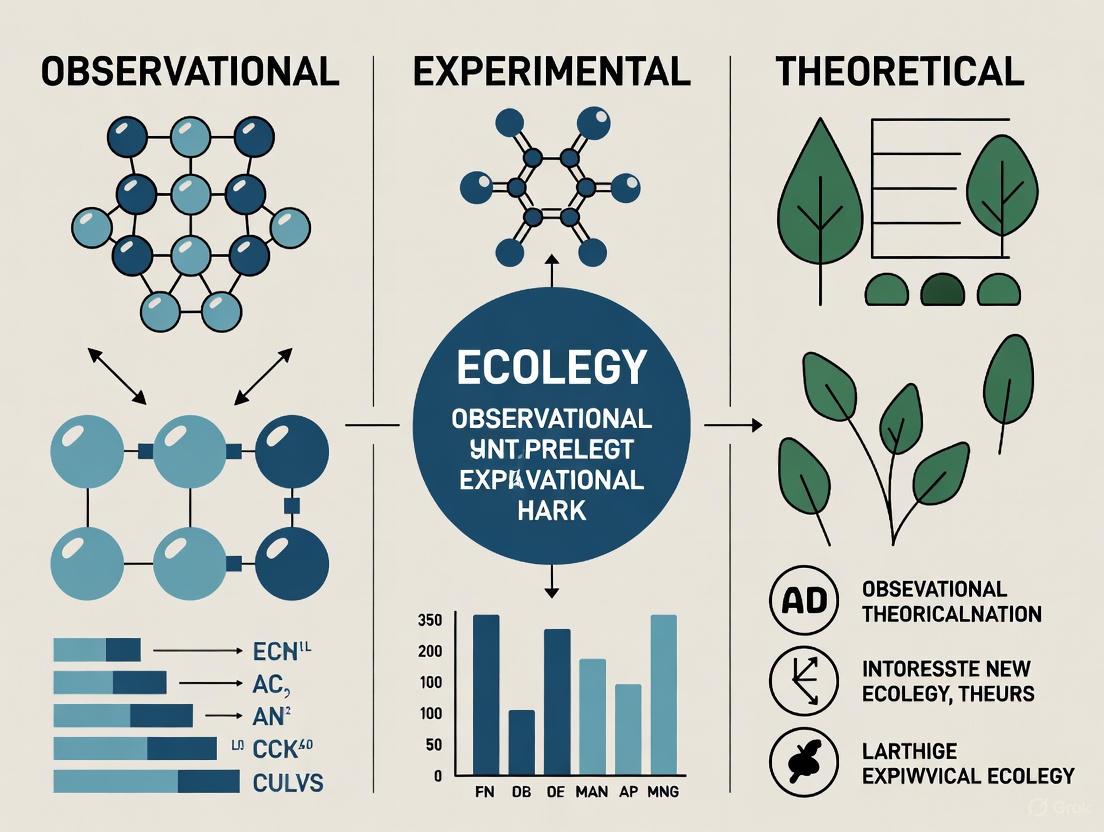
This article provides a comprehensive analysis of the three core approaches in ecology—observational, experimental, and theoretical—and their critical applications in biomedical and clinical research.
Observational vs Experimental vs Theoretical Ecology: A Synergistic Framework for Robust Biomedical Research
Abstract
This article provides a comprehensive analysis of the three core approaches in ecology—observational, experimental, and theoretical—and their critical applications in biomedical and clinical research. Aimed at researchers, scientists, and drug development professionals, it explores the foundational principles of each method, their specific methodological applications from drug safety to microbiome research, and strategies to overcome their inherent limitations, such as confounding bias and lack of realism. By presenting a comparative validation of these approaches and highlighting integrative frameworks, the article demonstrates how their synergy generates robust, predictive insights for addressing complex challenges in rare disease therapeutics, personalized medicine, and ecological forecasting.
The Ecological Toolkit: Core Principles and Purposes of Observational, Experimental, and Theoretical Approaches
Ecology, the scientific discipline studying interactions between organisms and their environment, relies on three distinct but complementary methodological approaches: observational, experimental, and theoretical [1] [2]. These approaches form a cohesive triad that enables ecologists to describe natural patterns, identify causal mechanisms, and develop predictive frameworks. The ongoing challenge in ecological research involves strategically integrating these approaches to address complex, multidimensional questions about how biological systems respond to environmental change [3] [4]. This guide examines the core philosophies, objectives, and applications of each approach, providing researchers with a comprehensive framework for selecting and combining methodologies based on specific research questions.
Each approach offers unique strengths and addresses different aspects of ecological complexity. Observational ecology documents patterns in natural settings, experimental ecology isolates causal mechanisms under controlled conditions, and theoretical ecology synthesizes these insights into predictive models [1]. The most significant advances in ecological understanding often emerge from research programs that strategically combine these approaches, leveraging their complementary strengths while acknowledging their individual limitations [4]. As ecological systems face increasing pressure from human activities and global change, this integrative approach becomes increasingly vital for both basic understanding and applied conservation [5] [3].
Philosophical Foundations and Epistemological Frameworks
Observational Ecology: Documenting Natural Patterns
Core Philosophy: Observational ecology operates on the philosophical premise that understanding ecological systems begins with accurate description of patterns as they occur naturally, without researcher manipulation [1]. This approach embraces the complexity of natural systems, recognizing that phenomena emerge from numerous interacting factors that may be difficult to disentangle [2]. The epistemological stance values discovery and description as essential first steps in scientific inquiry, providing the foundational patterns that subsequent approaches seek to explain.
Historical Context and Key Thinkers: The roots of observational ecology trace back to early naturalists who meticulously documented species distributions and behaviors [2]. George Evelyn Hutchinson's work on ecological niches exemplifies how careful observation of natural systems can generate profound ecological theory [2]. Modern observational ecology has evolved from simple descriptive accounts to sophisticated analyses of large-scale and long-term datasets, often incorporating advanced statistical methods to detect patterns across spatial and temporal scales [1].
Experimental Ecology: Establishing Causal Mechanisms
Core Philosophy: Experimental ecology is grounded in the philosophy of scientific realism, which asserts that causal mechanisms can be identified through systematic manipulation and control [5] [3]. This approach employs manipulation of factors of interest while controlling for confounding variables to test specific hypotheses about ecological processes [5]. The epistemological framework prioritizes causal inference and mechanistic understanding, operating on the principle that carefully designed interventions can reveal the underlying structure of ecological systems.
Historical Context and Key Thinkers: Experimental approaches gained prominence in ecology during the mid-20th century, as researchers sought to move beyond correlation to establish causation [3]. Seminal work includes Robert Paine's experimental manipulations in intertidal systems that established the keystone species concept [3] and David Tilman's experiments on resource competition and coexistence [1]. These approaches demonstrated how deliberate manipulation could reveal ecological mechanisms that were inaccessible through observation alone.
Theoretical Ecology: Developing Predictive Frameworks
Core Philosophy: Theoretical ecology operates on the philosophical foundation that complex ecological systems can be understood through abstraction and mathematical representation [1] [2]. This approach emphasizes generality and prediction, seeking to identify fundamental principles that operate across different systems and scales [2]. The epistemological stance values model-building as a way to synthesize knowledge, identify key processes, and generate testable predictions about ecological dynamics.
Historical Context and Key Thinkers: Theoretical ecology emerged from early mathematical models of population growth, such as the Lotka-Volterra equations for predator-prey dynamics [1]. The field expanded significantly through the work of ecologists like Robert MacArthur, who developed theories of island biogeography and resource partitioning [2]. Modern theoretical ecology encompasses a diverse toolkit of mathematical and computational approaches for representing ecological complexity across hierarchical levels.
Comparative Analysis: Objectives, Strengths, and Limitations
Table 1: Core Characteristics of the Three Ecological Approaches
| Aspect | Observational Ecology | Experimental Ecology | Theoretical Ecology |
|---|---|---|---|
| Primary Objective | Document patterns in natural contexts [1] | Establish causal mechanisms through manipulation [5] | Develop general predictive frameworks [1] |
| Data Collection | Field surveys, direct/indirect observation, long-term monitoring [1] [4] | Controlled manipulations in lab or field [3] | Mathematical models, computer simulations [1] |
| Key Strengths | Contextual realism, large spatial/temporal scales, hypothesis generation [1] [6] | Causal inference, control of confounding variables, mechanistic insight [5] | Generalizability, prediction, synthesis of knowledge [1] |
| Major Limitations | Correlation ≠ causation, confounding variables, ecological fallacy [7] [6] | Artificial conditions, scale limitations, potential artifacts [3] | Abstraction from reality, validation challenges, mathematical complexity [2] |
| Typical Outputs | Species distributions, population trends, correlation patterns [1] | Cause-effect relationships, response thresholds, mechanism validation [5] | Conceptual frameworks, predictive models, theoretical principles [1] |
| Temporal Scope | Often long-term (years to decades) [4] | Typically short-term (days to years) [3] | Variable (instantaneous to evolutionary time scales) [1] |
Table 2: Applications and Methodological Considerations
| Aspect | Observational Ecology | Experimental Ecology | Theoretical Ecology |
|---|---|---|---|
| Ideal Use Cases | Long-term monitoring, rare species, large-scale patterns, initial exploration [1] [6] | Testing specific mechanisms, establishing causality, parameter estimation [5] [3] | Synthesizing knowledge, predicting under novel conditions, identifying knowledge gaps [1] |
| Scale of Inquiry | Broad scales (landscape to global) [1] | Fine to intermediate scales (microcosms to mesocosms) [3] | All scales (individual to biogeographic) [1] |
| Control Over System | Minimal (natural conditions) [1] | High to moderate (controlled conditions) [3] | Complete (conceptual abstraction) [1] |
| Replication Challenges | Often limited by system uniqueness [1] | Can be controlled through experimental design [5] | Unlimited in principle [1] |
| Statistical Approaches | Correlation, regression, multivariate statistics [1] | Analysis of variance, experimental design principles [5] | Analytical solutions, numerical simulation, sensitivity analysis [1] |
Methodological Protocols and Technical Implementation
Observational Research Protocols
Field Survey Methodologies: Direct surveys involve systematic observation and recording of organisms in their natural habitats using standardized protocols [1]. For mobile or elusive species, indirect surveys document traces such as scat, footprints, or vocalizations [1]. Modern approaches increasingly incorporate technologies like camera traps, acoustic monitors, and environmental DNA sampling to expand observational capacity.
Long-Term Monitoring Frameworks: Established protocols include permanent plot establishment, standardized census techniques, and voucher specimen collection [4]. Programs such as the Long-Term Ecological Research (LTER) network employ rigorous standardization to enable cross-site comparisons and detection of temporal trends [4]. These approaches prioritize consistency in methodology to facilitate detection of change against background variability.
Data Quality Assurance: Observational studies address quality through randomization of sampling efforts, replication across sites or times, and careful documentation of potential biases [1]. Metadata standards ensure proper interpretation of collected data, particularly when integrating information from multiple sources or historical records [4].
Experimental Research Protocols
Experimental Design Principles: Robust ecological experiments incorporate three key elements: randomization, replication, and control [5]. Randomization distributes confounding factors evenly across treatment groups, replication provides estimates of variability and statistical power, and controls establish baseline conditions for comparison [5]. The specific implementation varies based on the experimental context (laboratory vs. field) and system constraints.
Scale Considerations: Experimental ecology operates across a continuum of scales, from microcosms (<1m²) examining single processes to mesocosms (intermediate scale) capturing community interactions, to whole-ecosystem manipulations addressing integrated responses [3]. Selection of appropriate scale involves balancing experimental control against environmental realism, with different scales offering complementary insights [3].
Causal Inference Framework: Experimental ecology strengthens causal inference through careful manipulation of hypothesized drivers while controlling for potential confounders [5]. The strength of causal inference depends on experimental design, with fully randomized designs providing the strongest evidence when feasible [5]. In field settings, before-after-control-impact (BACI) designs help account for natural temporal variation [5].
Diagram 1: Conceptual relationships between ecological approaches
Theoretical Research Protocols
Model Development Workflow: Theoretical ecology follows a structured process beginning with clear conceptual specification of the system, translation into mathematical formalism, analytical or numerical solution, parameterization with empirical data, and validation against independent observations [1]. The process is iterative, with discrepancies between model predictions and empirical observations driving model refinement.
Model Selection Framework: Ecological models exist along a continuum from purely conceptual to highly parameterized, with selection based on research goals [2]. Conceptual models organize thinking and identify key variables, strategic models reveal general principles through simplification, and tactical models incorporate system-specific details for precise prediction [2]. The appropriate level of complexity depends on the specific research question and available data.
Integration with Empirical Approaches: Effective theoretical ecology maintains strong connections to observational and experimental work [1]. Parameter estimation relies on empirical data, model validation requires comparison with real-world patterns, and model predictions inform future empirical studies [1]. This integration creates a cycle where theory and empirical work mutually inform and strengthen each other.
Integrated Research Frameworks and Applications
Strategic Integration Across Approaches
The most powerful ecological research programs strategically combine observational, experimental, and theoretical approaches [4]. This integration can follow multiple pathways:
Observation-Theory Integration: Observational data reveal patterns that inspire theoretical development, while theory generates predictions that guide targeted observational studies [1]. For example, species distribution patterns observed in nature have inspired theoretical models of niche differentiation and competitive exclusion, which in turn predict where specific distribution patterns should occur [2].
Experiment-Theory Integration: Experiments test specific model assumptions and predictions, while theory helps design experiments that distinguish between competing mechanistic explanations [3]. Microcosm experiments with microbial systems, for instance, have tested theoretical predictions about predator-prey dynamics and metabolic scaling relationships [3].
Observation-Experiment Integration: Observational studies identify potential causal relationships in natural systems, while experiments test whether these relationships persist under controlled conditions [5]. For example, observational studies correlating nutrient concentrations with algal blooms led to whole-lake fertilization experiments that confirmed causal relationships [5].
Diagram 2: Iterative research cycle integrating multiple approaches
The Scientist's Toolkit: Essential Research Solutions
Table 3: Key Methodologies and Instrumentation Across Ecological Approaches
| Methodology Category | Specific Techniques | Primary Applications | Key Considerations |
|---|---|---|---|
| Field Observation Tools | Transects, quadrats, camera traps, acoustic monitors, GPS tracking [1] | Species distribution mapping, behavior studies, population monitoring [1] | Sampling design, detection probability, spatial autocorrelation [1] |
| Experimental Systems | Microcosms, mesocosms, field manipulations, whole-ecosystem experiments [3] | Testing species interactions, environmental stress responses, ecosystem processes [3] | Scale appropriateness, replication feasibility, control of confounders [3] |
| Theoretical Approaches | Population models, community network analysis, ecosystem models, spatial simulations [1] | Predicting population dynamics, food web stability, biogeochemical cycling, range shifts [1] | Model complexity, parameter estimation, validation methods [1] |
| Analytical Methods | Multivariate statistics, time series analysis, structural equation modeling, meta-analysis [5] | Identifying patterns, analyzing experimental results, synthesizing across studies [5] | Statistical power, assumption validation, causal interpretation limits [5] |
| Emerging Technologies | Environmental DNA, remote sensing, sensor networks, genomic tools [3] [4] | Biodiversity assessment, ecosystem monitoring, evolutionary ecology [3] | Data management, technical standardization, interdisciplinary collaboration [4] |
The triad of observational, experimental, and theoretical approaches represents the epistemological foundation of ecology, with each approach contributing distinct but complementary insights [1] [2]. Observational ecology provides the essential descriptive foundation and contextual realism, experimental ecology establishes causal mechanisms and tests specific hypotheses, and theoretical ecology synthesizes knowledge and generates predictions [1]. The ongoing challenge for ecological researchers involves strategically selecting and integrating these approaches based on specific research questions and system constraints [4].
Future advances in ecology will increasingly depend on research programs that transcend traditional methodological boundaries [3]. Technological innovations such as high-resolution environmental sensors, molecular tools, and computational methods are creating new opportunities for integration across the observational-experimental-theoretical spectrum [3] [4]. Simultaneously, the urgent need to understand and predict ecological responses to global change provides compelling motivation for more integrative approaches that leverage the unique strengths of all three methodological traditions [5] [3]. By consciously designing research programs that combine pattern detection, mechanistic testing, and predictive modeling, ecologists can accelerate progress toward both fundamental understanding and effective environmental solutions.
Observational studies form a critical component of ecological research, enabling scientists to capture natural patterns and generate hypotheses without manipulating the system under study. Within the broader framework of ecological methodologies—which includes experimental and theoretical approaches—observational research provides unique insights into complex environmental relationships as they exist in nature. Unlike manipulative experiments, observational methods involve systematically watching, inspecting, and taking note of behaviors and the environment [8]. This approach is particularly valuable for documenting phenomena at large spatial and temporal scales, establishing correlations between variables, and forming the foundational understanding necessary for subsequent hypothesis testing [1]. For researchers and drug development professionals, understanding these methods is crucial, as the principles of ecological observation parallel long-term observational studies in epidemiology and clinical research.
Observational Studies Within the Ecological Research Framework
Ecological research employs three primary methodological approaches: observational studies, experimental studies, and theoretical modeling. Each offers distinct advantages and addresses different types of research questions, yet they function best as complementary rather than competing approaches [9] [1].
Observational studies examine the effect of a risk factor, diagnostic test, treatment, or other intervention without trying to change who is or isn't exposed to it [10]. This approach provides high ecological realism and captures complex, natural interactions, though it offers limited control over environmental variables [9].
Experimental studies involve manipulating variables to test hypotheses about ecological processes, either in controlled laboratory settings that isolate specific factors or through field manipulations that alter conditions in natural settings [9]. These studies allow for precise control over variables and establish causal relationships, though they may lack the complexity of natural ecosystems [9] [1].
Theoretical models use mathematical or computational representations to simulate and predict ecological outcomes, helping to integrate data from field and laboratory studies and enabling predictions across various scales and scenarios [9].
Table 1: Comparison of Primary Ecological Research Approaches
| Approach | Key Characteristics | Strengths | Limitations | Primary Use Cases |
|---|---|---|---|---|
| Observational Studies | Systematic data collection without manipulation | High ecological realism; Captures natural variability; Reveals unexpected phenomena | Limited control over variables; Correlation ≠ causation; Potential for confounding biases | Documenting large-scale patterns; Long-term monitoring; Initial exploration of systems [9] [10] |
| Experimental Studies | Direct manipulation of variables to test hypotheses | Establishes causal relationships; Precise control; Facilitates replication | May oversimplify ecological relationships; Artificial conditions; Scale limitations | Testing specific mechanisms; Isolating individual factors; Verifying predictions [9] [1] |
| Theoretical Modeling | Mathematical/ computational simulations | Predicts outcomes under different scenarios; Integrates multiple data sources; Explores impossible experiments | Risk of oversimplification; Dependent on accurate parameterization; Requires validation | Synthesizing empirical data; Projecting future states; Exploring complex systems [9] |
The integration of these approaches provides the most comprehensive understanding of ecological systems. For instance, field observations can identify patterns that generate hypotheses for experimental testing, while models can synthesize both observational and experimental data to generate new research directions [9].
Fundamental Principles and Methodologies of Observational Studies
Qualitative and Quantitative Observational Approaches
Observational studies in ecology employ both qualitative and quantitative data collection methods, each serving distinct research purposes [8] [1].
Qualitative or Unstructured Observation involves recognizing and recording behaviors without a predetermined hypothesis. This approach relies on the observer's skills to identify relevant patterns and is typically used to obtain an initial understanding of a situation. In ecological research, this might include descriptive accounts of animal behavior or ecosystem characteristics [8] [1].
Quantitative or Structured Observation requires a specific hypothesis before research begins. Observers are trained to count, record, and summarize data about predetermined behaviors or phenomena, reducing potential for bias through systematic protocols. This approach often follows unstructured observation to increase reliability and provide accurate reporting [8].
Core Observational Study Designs
Two primary observational study designs are commonly employed in ecological and environmental health research:
Cohort Studies involve tracking groups of people (or organisms) who are linked in some way over time. Researchers compare outcomes between cohort members exposed to a particular variable and those not exposed. In ecology, this might involve monitoring a birth cohort of organisms to understand development under different environmental conditions [10].
Case Control Studies identify subjects with an existing condition ("cases") and a similar group without the condition ("controls"), then compare their exposure histories. This approach is particularly efficient for studying rare conditions or phenomena [10].
Data Collection Techniques in Observational Ecology
Field Observation Methods
Ecologists employ various field techniques to collect observational data, selecting methods based on research questions, study organisms, and ecosystem characteristics [1]:
Direct Surveys involve scientists directly observing animals and plants in their natural environments. These can range from visual counts in terrestrial ecosystems to sophisticated underwater imaging systems for marine environments, such as video sledges, water curtain cameras, and Ham-Cams attached to sampling devices like the Hamon Grab, which collects sediment from the seafloor for laboratory analysis [1].
Indirect Surveys are used when direct observation is impractical. These methods involve observing traces that species leave behind, such as animal scat, footprints, nests, feeding signs, or other indicators of presence and activity [1].
Field Site Considerations vary significantly based on the organisms studied. Small organisms like spiders or soil invertebrates may require field sites as small as 15×15 meters, while herbaceous plants and small mammals might need up to 30 square meters. Studying trees, birds, or large mobile animals like deer or bears could require several hectares to adequately capture their ranges and behaviors [1].
Sampling Strategies and Data Types
Ecologists use various sampling techniques to ensure representative and unbiased data collection [9]:
- Random Sampling: Gives each unit in the population an equal chance of selection
- Stratified Sampling: Divides the population into subgroups before sampling
- Transect Methods: Sample along a line or environmental gradient
These methods yield two primary data types [1]:
- Qualitative Data: Descriptive information about qualities or characteristics (colors, shapes, behaviors)
- Quantitative Data: Numerical measurements that can be statistically analyzed (population counts, chemical concentrations, physical measurements)
Experimental Protocols for Observational Research
Standardized Observation Protocol
Purpose: To systematically document natural patterns and behaviors without manipulation or interference. Application: Initial exploration of ecological systems; long-term monitoring programs; documenting species interactions.
Methodology:
- Site Selection: Choose field sites that represent the ecosystem of interest, considering size requirements appropriate to the study organisms [1].
- Baseline Documentation: Record abiotic factors including temperature, precipitation, soil chemistry, and topography [1].
- Systematic Observation: Implement observation protocols using predetermined methods (direct surveys, indirect surveys, remote sensing) [9] [1].
- Data Recording: Utilize standardized field data sheets or digital recording systems to ensure consistent data collection across observations [1].
- Temporal Replication: Conduct observations across multiple time intervals to account for natural variation [9].
Key Considerations:
- Maintain minimal disturbance to avoid influencing natural behaviors [8]
- Implement "unobtrusive observation" by being quiet, watching, and understanding without explaining, defending, or suggesting [8]
- Ensure adequate replication with the "rule of 10" - collecting 10 observations for each category to achieve statistical significance [1]
Comparative Observational Protocol
Purpose: To analyze patterns across different species, habitats, or ecosystems to infer ecological principles. Application: Comparing leaf traits across plant species in different biomes; analyzing predator-prey relationships across marine and terrestrial ecosystems [9].
Methodology:
- Variable Identification: Select specific traits or interactions for comparison.
- Stratified Sampling: Implement sampling across predefined categories or gradients.
- Standardized Measurement: Apply consistent measurement techniques across all observation units.
- Controlled Comparison: Document co-varying environmental factors that might influence observed patterns.
Signaling Pathways: The Logical Flow of Observational Research
The following diagram illustrates the conceptual workflow and logical relationships in observational research, from initial design through hypothesis generation:
Observational Research Workflow and Methodology Selection
Comparative Analysis: Quantitative Findings from Observational vs. Experimental Approaches
Research comparing observational and experimental approaches reveals significant differences in their findings and implications. A meta-analysis of 1421 data points from 182 experimental studies and 1346 sites from 141 observational studies found that soil nutrients responded differentially to drivers of climate change depending on the approach used [11].
Table 2: Contrasting Results from Observational vs. Experimental Studies on Climate Change Impacts
| Climate Factor | Nutrient Measured | Observational Study Results (Environmental Gradients) | Experimental Study Results (Manipulative Experiments) | Interpretation of Discrepancies |
|---|---|---|---|---|
| Water Addition/ Precipitation | Soil Carbon | Increased with annual precipitation | Decreased with water addition | Short-term experiments vs. long-term ecosystem adaptation [11] |
| Water Addition/ Precipitation | Soil Nitrogen | Increased with annual precipitation | Decreased with water addition | Differential response times of nutrient cycling processes [11] |
| Water Addition/ Precipitation | Soil Phosphorus | Increased with annual precipitation | Decreased with water addition | Disruption of co-evolved system relationships in experiments [11] |
| Temperature Increase | Multiple Soil Nutrients | Varied responses across temperature gradients | Varied responses to warming experiments | Timescale differences (months to years vs. centuries to millennia) [11] |
These contrasting patterns highlight how short-term manipulative experiments may better predict causal impacts of immediate climate change, while environmental gradients may provide more relevant information for long-term correlations between nutrients and climatic features [11]. The discrepancies likely arise because ecosystems respond simultaneously to slow climatic changes over centuries, with co-varying factors like plant cover, diversity, and soil properties adjusting together, whereas rapid experimental changes disrupt these synchronized relationships [11].
The Scientist's Toolkit: Essential Materials for Observational Research
Table 3: Research Reagent Solutions and Essential Materials for Observational Ecology
| Tool/Category | Specific Examples | Function/Application | Research Context |
|---|---|---|---|
| Field Sampling Equipment | Hamon Grab, Beam Trawl | Collecting sediment and larger sea animals from aquatic environments [1] | Marine benthic community surveys |
| Imaging Technology | Video sledges, Water curtain cameras, Ham-Cams | Capturing visual data of organisms in their natural habitats [1] | Direct observation in inaccessible environments |
| Plot Sampling Tools | Transects, Quadrats, Plotless sampling methods | Defining sampling areas and ensuring representative data collection [9] [1] | Vegetation surveys, population density estimates |
| Data Recording Systems | Field data sheets, Digital recorders, GPS units | Standardized documentation of observations and precise location tracking [1] | All field observation protocols |
| Remote Sensing Platforms | Satellite imagery, Aerial photography, Drones | Monitoring large-scale ecosystem changes and patterns [9] | Landscape-level vegetation analysis |
| Molecular Analysis Tools | DNA sequencing equipment, Stable isotope analyzers | Identifying cryptic species, population structure, and tracing energy flow [9] | Food web analysis, population genetics |
Advanced Applications and Current Research Frontiers
Modern observational ecology incorporates increasingly sophisticated technologies and interdisciplinary approaches. Molecular and genetic techniques now allow researchers to study ecological interactions and evolutionary relationships through DNA sequencing and stable isotope analysis [9]. Paleoecological methods reconstruct past ecological conditions using fossil analysis and sediment cores, providing critical baselines for understanding current environmental changes [9].
Recent research has explored innovative observational assessment methods, including visual alternatives to traditional textual rating scales. Studies comparing decision trees with visual components against text anchor scales found that professionals using visual decision trees showed comparable reliability and user experience, suggesting potential for developing more feasible observational assessment tools for daily practice [12].
The integration of modeling approaches with observational data represents another advancing frontier. Statistical models, population dynamics models, and ecosystem simulations help researchers interpret complex ecological relationships and predict outcomes under different scenarios, bridging the gap between observation and experimentation [9].
Observational studies serve as a fundamental approach in ecological research, providing essential insights into natural patterns and generating hypotheses for further testing. When strategically implemented within a broader research framework that includes experimental and theoretical approaches, observational methods offer unique advantages for understanding complex ecological systems across multiple spatial and temporal scales. By carefully selecting appropriate observational protocols, maintaining methodological rigor, and acknowledging the inherent limitations of correlation-based inference, researchers can leverage observational studies to build a comprehensive understanding of ecological relationships and processes. The continued refinement of observational methodologies, coupled with technological advances in monitoring and analysis, ensures that this approach will remain indispensable for addressing pressing ecological challenges and informing evidence-based conservation decisions.
Ecology, the study of relationships between living organisms and their environment, employs three principal methodologies to advance knowledge: observational studies, theoretical modeling, and experimental approaches. While observational ecology documents patterns in natural systems and theoretical ecology uses conceptual and mathematical models to address ecological problems, experimental ecology serves as the critical bridge between them by testing mechanistic hypotheses through controlled manipulation [13] [3]. This triad forms a continuous cycle of discovery, wherein observations generate hypotheses, theory provides predictive frameworks, and experiments validate causal relationships [3]. Experimental ecology specifically manipulates biotic and abiotic factors across various scales to isolate causation—a capability lacking in purely observational studies [3]. By examining mechanisms underlying natural dynamics, experimental ecology not only tests theoretical predictions but also provides parameterized models with empirical validation, making it indispensable for predicting ecological responses to anthropogenic changes [3].
Foundational Principles of Experimental Ecology
The Spectrum of Experimental Approaches
Experimental ecology encompasses a range of methodologies balancing control with realism, from highly controlled laboratory microcosms to semi-controlled field manipulations [3]. These approaches form a continuum where researchers trade varying degrees of environmental authenticity for methodological rigor:
- Microcosms: Small-scale, highly controlled laboratory systems that isolate specific mechanisms
- Mesocosms: Intermediate-scale systems that bridge laboratory and natural conditions
- Field Manipulations: In-situ experiments that retain natural environmental complexity
- Whole-Ecosystem Manipulations: Large-scale interventions that examine integrated responses
This gradient allows ecologists to address different types of questions, with microcosms providing mechanistic insights and larger-scale experiments capturing emergent complexity [3].
Establishing Causality Through Manipulation
The fundamental strength of experimental ecology lies in its ability to establish causality through intentional manipulation of hypothesized drivers while controlling for confounding variables. This manipulative approach enables researchers to:
- Isolate the effects of individual factors from the complex web of natural correlations
- Determine the direction of influence in ecological relationships
- Test predictions generated by theoretical models under controlled conditions
- Quantify effect sizes through replicated treatment designs
Without this experimental validation, ecological theories remain speculative and observational correlations remain potentially spurious.
Experimental Designs and Methodologies Across Scales
Hierarchical Experimental Approaches
Ecological experiments operate across multiple spatial and temporal scales, each with distinct advantages and limitations. The most informative research programs often integrate findings across this hierarchy to build robust conclusions.
Table 1: Ecological Experimental Approaches Across Scales
| Experimental Scale | Typical Research Questions | Key Advantages | Common Limitations |
|---|---|---|---|
| Laboratory Microcosms | Mechanism testing, predator-prey dynamics, competition, evolutionary responses [3] | High control, replication, and precision; reveals mechanisms [3] | Limited realism; simplified communities [3] |
| Mesocosms | Multi-species interactions, nutrient cycling, community assembly | Intermediate realism with some control; bridges lab-field gap [3] | Artifacts of enclosure; limited spatial scale [3] |
| Field Manipulations | Keystone species effects, habitat fragmentation, resource addition | Natural environmental context; realistic species interactions [14] [3] | Limited replication; confounding variables [3] |
| Whole-Ecosystem | Watershed function, landscape-level processes, climate impacts [15] | Complete natural complexity; emergent properties [3] | Logistically challenging; rarely replicated [3] |
Detailed Experimental Protocol: Extinction Time Scaling with Habitat Size
A recent microcosm study with Daphnia magna populations provides an exemplary protocol for testing theoretical predictions about extinction dynamics [16]. This experiment exemplifies the direct testing of theoretical models through controlled manipulation.
Experimental Design and Setup
- Organism: Freshwater crustacean Daphnia magna was selected for its rapid reproduction, ease of culturing, and well-understood biology
- Habitat Structure: 35 experimental populations distributed across chambers consisting of 1, 2, 4, 8, 16, or 32 patches
- Monitoring Protocol: Populations monitored daily until extinction to record precise time-to-extinction data
- Environmental Controls: Standardized temperature, light conditions, and food supply to isolate habitat size effects
Theoretical Framework and Statistical Analysis
The experiment tested two competing theoretical frameworks for extinction time scaling:
- Exponential relationship: ( T \propto e^{aK} ) (predicted under demographic stochasticity)
- Power law relationship: ( T \propto K^c ) (predicted under environmental stochasticity) [16]
The statistical analysis employed:
- Nonlinear regression models for both exponential and power law functions
- Model comparison using mean squared error and bootstrapping (p < 0.00001)
- Evaluation of scaling relationships between mean extinction time (T) and carrying capacity (K)
Key Findings and Interpretation
The results demonstrated stronger support for power law scaling (( T \propto K^c )) than exponential relationships, indicating environmental stochasticity dominates extinction dynamics in these experimental populations [16]. This finding has crucial implications for conservation biology, suggesting that earlier models based primarily on demographic stochasticity may substantially underestimate extinction risk in natural populations [16].
Figure 1: Experimental Workflow: Testing Extinction Time Scaling Theories
The Researcher's Toolkit: Essential Methods and Reagents
Research Reagent Solutions for Ecological Experiments
Table 2: Essential Research Reagents and Materials for Ecological Experimentation
| Reagent/Material | Primary Function | Application Examples | Technical Considerations |
|---|---|---|---|
| Chemostat Systems | Continuous culture maintenance; precise population control [3] | Microbial ecology; predator-prey dynamics; experimental evolution [16] [3] | Enables exact dilution rates; constant environmental conditions |
| Dormant Stage Banks | Resurrection ecology; evolutionary trajectories | Revival of dormant stages from sediment cores | Provides historical baselines; reveals responses to past changes |
| Environmental DNA Kits | Biodiversity assessment; community composition | Non-invasive species detection; temporal community dynamics | Requires careful contamination control; quantitative limitations |
| Stable Isotope Tracers | Nutrient flow quantification; trophic interactions | Food web studies; nutrient cycling; resource partitioning | Analytical precision requires mass spectrometry |
| Molecular Markers | Genetic diversity assessment; population structure | Landscape genetics; dispersal estimation; adaptation studies | Various marker types (microsatellites, SNPs) for different resolutions |
Methodological Framework for Multi-Scale Inference
The most robust ecological insights emerge from integrating multiple experimental approaches. The following diagram illustrates how these methodologies interrelate within a comprehensive research program:
Figure 2: Multi-Scale Integration in Ecological Research
Modern Challenges and Future Directions
Experimental ecology faces several critical challenges as it addresses anthropogenic environmental changes. Researchers must develop innovative approaches to overcome these limitations while maintaining scientific rigor.
Key Challenges in Contemporary Experimental Ecology
Multidimensional Ecological Dynamics: Natural systems experience simultaneous variation across multiple environmental factors, yet most experiments historically tested single stressors [3]. Future experiments must embrace multifactorial designs that capture interactive effects and potential synergisms between stressors like warming, acidification, and pollution .
Expanding Model Systems: Research has overrelied on a limited set of model organisms, potentially limiting generalizability [3]. Future work should incorporate greater taxonomic diversity and consider intraspecific variation to enhance ecological realism and predictive capacity across systems.
Incorporating Environmental Variability: Most experiments apply constant treatment levels, yet natural environments fluctuate across multiple temporal scales [3]. Designing experiments that incorporate realistic variability patterns is essential for predicting responses to increasingly variable climate conditions.
Integrative Biology: Breaking disciplinary barriers remains challenging yet essential [3]. Fully understanding ecological responses requires integrating physiology, genetics, behavior, and evolutionary biology within experimental frameworks.
Technological Innovation: Emerging technologies like high-resolution sensing, automated monitoring, and molecular tools offer unprecedented opportunities to expand the scale and precision of ecological experiments [3].
Emerging Approaches in Experimental Design
- Experimental Evolution: Using controlled selection experiments to examine evolutionary responses to environmental manipulations
- Resurrection Ecology: Reviving dormant propagules from sediment cores to directly compare ancestral and contemporary populations
- Space-for-Time Substitutions: Using natural environmental gradients as proxies for temporal change when long-term experiments are impractical
- Eco-Evolutionary Dynamics: Integrated approaches that examine ecological and evolutionary processes simultaneously across generations
Experimental ecology provides the critical mechanistic foundation for understanding and predicting ecological dynamics in a changing world. By formally testing hypotheses through controlled manipulation, it establishes causal relationships that observational studies can only suggest and provides empirical validation for theoretical models [3]. The ongoing challenge for experimental ecologists lies in designing feasible studies that capture sufficient realism to be meaningful while maintaining the controlled conditions necessary for causal inference [3]. As environmental challenges intensify, the integration of experimental approaches across scales—from microcosms to whole ecosystems—will be essential for developing effective conservation strategies and mitigating anthropogenic impacts on ecological systems. The continued refinement of experimental methods, coupled with technological advances and interdisciplinary collaboration, ensures that experimental ecology will remain indispensable for both basic understanding and applied solutions in an increasingly human-modified world.
Theoretical ecology constitutes a foundational pillar of modern ecological science, operating in synergy with observational and experimental approaches to advance our understanding of complex biological systems. This discipline is devoted to the study of ecological systems using theoretical methods such as simple conceptual models, mathematical models, computational simulations, and advanced data analysis [17]. Effective theoretical models improve comprehension of the natural world by revealing how population dynamics emerge from fundamental biological processes, thereby unifying diverse empirical observations through common mechanistic principles [17]. The power of theoretical ecology lies in its ability to generate novel, non-intuitive insights about natural processes based on biologically realistic assumptions, with theoretical predictions frequently verified through empirical and observational studies [17].
Within the broader research landscape, theoretical ecology provides a complementary approach to observational and experimental methods. While observational studies document natural patterns without intervention, and experimental studies manipulate variables to establish causation, theoretical ecology synthesizes insights from both approaches into formalized mathematical frameworks that can predict system behavior under novel conditions [18] [19] [20]. This tripartite methodology forms a complete scientific cycle: observational studies identify natural patterns, theoretical models conceptualize these patterns into general principles, and experimental studies test predictions generated by these models, leading to refined theoretical understanding.
The advent of powerful computing resources has dramatically expanded the scope and capability of theoretical ecology, enabling the analysis and visualization of large-scale computational simulations that would previously have been intractable [17]. These advanced modeling tools provide quantitative predictions about critical environmental issues, including species invasions, climate change impacts, fisheries management, and global biogeochemical cycles [17] [21]. As such, theoretical ecology has evolved from a primarily conceptual endeavor to an indispensable tool for addressing pressing conservation challenges and informing evidence-based management decisions.
Comparative Research Frameworks in Ecology
Ecological research employs three primary methodological approaches—observational, experimental, and theoretical—each with distinct strengths, limitations, and applications. Understanding their interrelationships is essential for effective ecological research design and interpretation.
Table 1: Comparison of Ecological Research Approaches
| Aspect | Observational Research | Experimental Research | Theoretical Research |
|---|---|---|---|
| Core Objective | Identify patterns and associations in natural settings [19] [20] | Establish cause-effect relationships through manipulation [18] [20] | Explain mechanisms and generate testable predictions through abstraction [17] |
| Control Over Variables | No manipulation; variables observed as they naturally occur [19] | Active manipulation and control of independent variables [18] [20] | Complete control through mathematical specification and parameterization [17] |
| Causality Inference | Limited to suggesting correlations and associations [19] [20] | Direct establishment of causality through controlled manipulation [18] | Deductive reasoning about potential causal mechanisms [17] [21] |
| Setting & Context | Natural environments with real-world complexity [19] [20] | Controlled environments that may lack ecological realism [20] | Abstract mathematical space independent of specific physical settings [17] |
| Primary Outputs | Descriptions of patterns, correlations, and natural associations [18] [19] | Causal evidence for specific relationships under controlled conditions [18] [20] | General principles, models, and predictions applicable across systems [17] [21] |
| Common Limitations | Prone to confounding variables and sampling biases [18] [19] | Artificial conditions may limit real-world applicability [20] | Requires validation and may involve simplifying assumptions [17] [21] |
| Typical Applications | Long-term ecological monitoring, case-control studies of risk factors [18] [19] | Hypothesis testing, intervention efficacy assessment [18] [20] | Exploring system dynamics, predicting responses to novel conditions [17] [21] |
The integration of these three approaches creates a powerful framework for ecological understanding. Observational studies provide the initial patterns and relationships detected in natural systems, which theoretical models formalize into general principles and mechanistic explanations. These theoretical frameworks then generate specific, testable predictions that experimental studies can evaluate under controlled conditions, with experimental results subsequently refining theoretical models [17] [21]. This iterative cycle drives scientific progress in ecology, with each approach compensating for the limitations of the others to build a more comprehensive understanding of ecological systems.
Fundamental Modeling Approaches in Theoretical Ecology
Theoretical ecology employs diverse modeling approaches, each with distinct mathematical foundations and applications. These approaches can be categorized along several axes, including their treatment of biological mechanisms, temporal dynamics, and uncertainty.
Phenomenological vs. Mechanistic Models
Phenomenological models distill functional relationships and distributional patterns directly from observed data, using mathematical forms that are sufficiently flexible to match empirical patterns [17]. These models prioritize predictive accuracy over process description, making them particularly valuable for identifying empirical relationships and generating short-term forecasts. Examples include species distribution models that correlate environmental variables with occurrence data, and regression approaches that describe population trends without explicitly representing underlying mechanisms.
Mechanistic models directly represent underlying biological processes based on theoretical reasoning about ecological dynamics [17]. These models explicitly describe mechanisms such as reproduction, mortality, competition, and predation, allowing researchers to test hypotheses about system functioning and predict responses to novel conditions. The Lotka-Volterra predator-prey equations represent a classic mechanistic approach, explicitly modeling population interactions through encounter rates and conversion efficiencies [17]. Mechanistic models typically provide greater theoretical insight and better extrapolation to novel conditions, though they often require more parameters and structural assumptions than phenomenological approaches.
Deterministic vs. Stochastic Models
Deterministic models always evolve in exactly the same manner from a given starting point, representing the average, expected behavior of a system without random variation [17]. These models are typically formulated as systems of differential or difference equations that can be analyzed using mathematical techniques from dynamical systems theory. Deterministic approaches are powerful for understanding general system behavior and identifying equilibrium states and long-term dynamics, but they cannot capture the random perturbations that characterize real ecological systems.
Stochastic models incorporate random variation directly into their structure, allowing researchers to model the inherent unpredictability of ecological processes [17]. These approaches are essential when studying small populations (where demographic stochasticity is important), environmental variability, or processes with inherent probabilistic elements. Stochastic models can be analyzed using statistical techniques and provide probability distributions of possible outcomes rather than single predictions, offering more realistic uncertainty characterization [17].
Continuous vs. Discrete Time Models
Continuous-time models typically employ differential equations to represent ecological processes as unfolding smoothly through time [17]. The exponential and logistic growth models in population ecology are classic examples, formulated as differential equations that describe instantaneous rates of change. Continuous-time approaches are particularly appropriate for systems with overlapping generations and continuous reproduction, or when the timing of events is not naturally discrete.
Discrete-time models use difference equations to represent ecological processes that occur in distinct time steps [17]. These models are naturally applied to systems with seasonal breeding, annual life cycles, or regular census intervals. Matrix population models (such as Leslie matrices for age-structured populations) represent a powerful discrete-time approach that can track multiple demographic stages simultaneously [17]. Discrete-time models often facilitate numerical simulation and can capture important threshold behaviors that may be obscured in continuous-time formulations.
Core Quantitative Models in Theoretical Ecology
Population Ecology Foundations
Population ecology represents one of the most developed domains of theoretical ecology, providing fundamental mathematical frameworks for understanding how populations change over time and space.
Exponential Growth Model
The exponential growth model represents the simplest population dynamic, assuming unconstrained growth under constant conditions. The model is formulated as a differential equation:
dN(t)/dt = rN(t)
where N(t) is population size at time t, and r is the intrinsic growth rate (per capita birth rate minus death rate) [17]. The solution to this equation yields the familiar exponential trajectory:
N(t) = N(0)e^(rt)
where N(0) is the initial population size. This model provides a reasonable approximation for populations growing without limitations, such as microorganisms in rich media or invasive species colonizing new habitats, but becomes unrealistic over longer time scales as resources become limiting [17].
Logistic Growth Model
The logistic growth model extends the exponential framework by incorporating density-dependent regulation, assuming that per capita growth rates decline as population size approaches the environment's carrying capacity. The model is described by the differential equation:
dN(t)/dt = rN(t)(1 - N(t)/K)
where K represents the carrying capacity—the maximum population size sustainable by available resources [17]. The logistic equation produces sigmoidal growth curves, with population growth slowing as N approaches K, and reaching equilibrium at N = K. Analysis reveals that N = 0 is an unstable equilibrium, while N = K is stable, explaining why small populations can grow rapidly while populations at carrying capacity remain relatively stable [17].
Table 2: Core Population Models in Theoretical Ecology
| Model Type | Mathematical Formulation | Key Parameters | Ecological Interpretation | Applications & Limitations |
|---|---|---|---|---|
| Exponential Growth | dN/dt = rN |
r = intrinsic growth rate | Population grows at constant per capita rate independent of density | Short-term colonization, ideal conditions; unrealistic long-term [17] |
| Logistic Growth | dN/dt = rN(1 - N/K) |
r = intrinsic growth rate, K = carrying capacity | Density-dependent growth with maximum sustainable population | Single populations with resource limitations; assumes instantaneous adjustment [17] |
| Structured Population | N_{t+1} = L × N_t |
L = projection matrix with stage-specific vital rates | Tracks multiple life stages with different demographic rates | Species with complex life histories; requires detailed demographic data [17] |
| Lotka-Volterra Predator-Prey | dN/dt = N(r - αP) dP/dt = P(cαN - d) |
α = attack rate, c = conversion efficiency, d = predator mortality | Oscillatory dynamics from consumer-resource interactions | Classic predator-prey cycles; may be unstable without additional factors [17] |
Community and Ecosystem Models
Theoretical ecology extends beyond single populations to model interactions between species and ecosystem-level processes.
Predator-Prey Interactions
The Lotka-Volterra model represents the classic theoretical framework for understanding consumer-resource dynamics, formulated as a pair of coupled differential equations:
dN/dt = N(r - αP) [Prey population]
dP/dt = P(cαN - d) [Predator population]
where N is prey density, P is predator density, r is prey intrinsic growth rate, α is predator attack rate, c is conversion efficiency (prey to predator), and d is predator mortality rate [17]. This model produces characteristic oscillations in population sizes, with predator peaks following prey peaks, and has been fundamental to understanding how consumption can generate cyclic dynamics in natural systems.
Structured Population Models
Structured population models track individuals in different age, stage, or size classes, recognizing that demographic rates often vary substantially within populations. These models typically employ matrix formulations:
N_{t+1} = L × N_t
where N_t is a vector of the number of individuals in each class at time t, and L is a projection matrix (Leslie matrix for age-structured models, Lefkovitch matrix for stage-structured models) containing transition probabilities between classes and class-specific fecundities [17]. When parameterized with empirical demographic data, structured models can predict population growth rates, stable stage distributions, and the relative contributions of different vital rates to population dynamics, making them invaluable for conservation planning and population viability analysis [17].
Model Development Workflow: A Structured Approach
Developing effective theoretical models requires a systematic approach that integrates biological knowledge, mathematical representation, and empirical validation. The following workflow outlines key phases in ecological model development.
Design and Specification Phases
The initial phases of model development focus on clearly defining objectives and selecting appropriate mathematical structures.
Define Research Question and Modeling Objectives: Explicitly articulate the specific ecological questions the model will address and its intended purpose, whether theoretical exploration, prediction, or informing management decisions [21]. This stage requires collaboration between modelers and potential end-users to ensure the model will be fit-for-purpose and address relevant ecological problems.
Select Appropriate Modeling Framework: Choose between alternative modeling approaches (mechanistic vs. phenomenological, deterministic vs. stochastic, etc.) based on the research question, available data, and intended model applications [17] [21]. This decision involves trade-offs between model complexity, biological realism, and parameter estimation feasibility.
Specify Model Structure and Mathematical Form: Formalize the ecological processes to be included in the model and their mathematical representations, explicitly stating all assumptions and their biological justifications [21]. This phase transforms conceptual understanding of ecological mechanisms into precise mathematical relationships that can be analyzed computationally or analytically.
Parameterization, Evaluation, and Application
Once the model structure is defined, subsequent phases focus on implementation, assessment, and application.
Parameterize Model Using Available Data: Estimate parameter values using empirical data from observational studies, experiments, or literature synthesis, balancing model complexity with data availability [21]. Modern approaches often use Bayesian methods that formally incorporate prior knowledge and quantify parameter uncertainty.
Evaluate Model Performance and Uncertainty: Assess model fit to empirical data using appropriate diagnostic measures and quantify uncertainty from parameter estimates, model structure, and ecological stochasticity [21]. Sensitivity analysis identifies which parameters most strongly influence model outputs, guiding future data collection efforts.
Iteratively Refine Model Based on Assessment: Modify model structure, parameters, or underlying assumptions based on performance evaluation, potentially returning to earlier development phases in an iterative refinement process [21]. This cycle continues until the model achieves sufficient performance for its intended purpose while maintaining biological plausibility.
Apply Model for Prediction or Theoretical Exploration: Use the validated model to address the original research questions through simulation, scenario analysis, or analytical investigation, clearly communicating limitations and uncertainties associated with model inferences [21]. Effective communication includes contextualizing results within the model's assumptions and identifying critical knowledge gaps.
Essential Tools for Theoretical Ecology Research
Theoretical ecologists employ diverse computational and mathematical tools to develop, parameterize, and analyze ecological models. The following research reagents represent essential resources for contemporary theoretical research.
Table 3: Research Reagent Solutions for Theoretical Ecology
| Tool Category | Specific Examples | Primary Functions | Application Context |
|---|---|---|---|
| Mathematical Software | R, Python (NumPy/SciPy), MATLAB | Numerical computation, statistical analysis, model simulation | Parameter estimation, model fitting, sensitivity analysis [21] |
| Specialized Modeling Packages | R packages (dplyr, lme4), Maxent | Implementation of specific model classes (e.g., mixed effects, species distributions) | Structured population models, species distribution modeling [21] |
| Computational Frameworks | Individual-based modeling platforms, Bayesian inference tools | Simulation of complex systems, uncertainty quantification | Agent-based models, integrated population models [17] [21] |
| Model Evaluation Metrics | AIC, BIC, cross-validation, posterior predictive checks | Model selection, performance assessment, goodness-of-fit evaluation | Comparing alternative model structures, validation against independent data [21] |
| Uncertainty Quantification Methods | Bayesian credible intervals, bootstrap resampling, sensitivity analysis | Characterizing parameter and structural uncertainty | Risk assessment, conservation decision-making [21] |
| Data Integration Tools | State-space models, integrated population models | Combining multiple data sources within unified modeling frameworks | Leveraging heterogeneous data from observations and experiments [21] |
These research reagents enable theoretical ecologists to transform conceptual understanding into quantitative frameworks that can generate testable predictions and inform conservation decisions. The increasing accessibility of sophisticated modeling tools has expanded the practice of theoretical ecology beyond specialized modelers to include conservation managers and applied researchers [21]. However, this democratization requires careful attention to model assumptions, appropriate application, and uncertainty communication to avoid misinterpretation and misapplication [21].
Applications in Conservation and Management
Theoretical ecology provides powerful approaches for addressing pressing conservation challenges and informing evidence-based management decisions. Quantitative models play three key roles in conservation management: assessing the extent of conservation problems, providing insights into complex social-ecological system dynamics, and evaluating proposed conservation interventions [21].
Model-based conservation decision-making follows a structured process that integrates ecological theory, empirical data, and management objectives. This approach begins with clearly defining the conservation problem and decision context, then developing quantitative models that represent key ecological processes and management actions [21]. These models project system responses to alternative management strategies, incorporating uncertainties through sensitivity analysis and probabilistic forecasting. The final step involves identifying management strategies that optimally balance ecological outcomes, costs, and risks, creating an explicit framework for decision-making that can be updated as new information becomes available [21].
Successful applications of theoretical ecology to conservation problems include population viability analysis for endangered species, optimal control strategies for invasive species, spatial prioritization for protected area networks, and sustainable harvest policies for fisheries and wildlife populations [17] [21]. In each case, theoretical models provide a structured approach for synthesizing available information, projecting future scenarios, and evaluating trade-offs between alternative management actions, ultimately improving conservation outcomes through more informed decision-making.
Theoretical ecology provides an essential framework for simplifying ecological complexity to explore fundamental principles and generate testable predictions. By abstracting essential features of ecological systems into mathematical formulations, theoretical models reveal general patterns and mechanisms that operate across diverse taxa and ecosystems. The integration of theoretical approaches with observational and experimental methods creates a powerful cycle of scientific inquiry, with each approach compensating for the limitations of the others.
As ecological challenges become increasingly complex in the face of global environmental change, theoretical models offer indispensable tools for projecting system responses, evaluating intervention strategies, and informing evidence-based conservation decisions. The continued development and refinement of theoretical approaches, coupled with enhanced integration across empirical and theoretical domains, will be essential for advancing ecological understanding and addressing pressing conservation problems in an increasingly human-modified world.
Ecology, as a discipline, advances through a continuous cycle of observation, experimentation, and theorizing [3]. This whitepaper examines the historical context and foundational insights derived from the three primary methodological approaches in ecological research: observational, experimental, and theoretical ecology. Each methodology has contributed distinct pieces to our understanding of ecological dynamics, from documenting basic patterns to revealing mechanistic processes and generating predictive frameworks. Experimental ecology, ranging from fully-controlled laboratory experiments to semi-controlled field manipulations, enhances our understanding of the mechanisms underlying natural dynamics and species responses to global change [3]. Observational studies capture patterns as they naturally occur, providing essential descriptive foundations and revealing correlations. Theoretical ecology synthesizes these empirical findings into conceptual models and mathematical frameworks that can predict ecological behavior across systems and scales. Understanding the historical contributions and limitations of each approach provides researchers with a comprehensive toolkit for addressing complex ecological questions, particularly those relevant to drug development professionals working with natural products and environmental impacts on health.
Foundational Insights from Observational Ecology
Historical Context and Key Contributions
Observational ecology represents the earliest approach to understanding the natural world, predating formal experimental science. This methodology involves collecting data on organisms and their environments without intentional manipulation or intervention [20]. Historically, observational approaches established fundamental baselines of species distributions, behavioral patterns, and ecosystem characteristics that formed the cornerstone of ecological thinking.
The keystone species concept, crucial to modern conservation biology, originated from Robert Paine's pioneering observational work in the intertidal zone, which revealed how a single species could disproportionately maintain community structure [3]. Similarly, Alexander von Humboldt's detailed documentation of vegetation patterns across elevational and latitudinal gradients established foundational principles of biogeography that continue to inform predictions of species responses to climate change. These and other observational discoveries provided the essential descriptive foundations that generated hypotheses for experimental testing and parameters for theoretical models.
Methodological Approaches and Protocols
Observational ecology encompasses several distinct methodological approaches, each with specific protocols for data collection:
Cross-sectional studies: Researchers compare different population groups at a single point in time, documenting correlations between environmental exposures and ecological outcomes [22]. For example, a researcher might document tree species diversity across multiple forest fragments of different sizes to understand habitat fragmentation effects.
Time-trend studies: Scientists track changes in exposures and outcomes within the same population over extended periods [22]. The resurrection ecology approach, which revives dormant stages of planktonic taxa from sediment cores to study evolutionary responses to historical environmental changes, exemplifies this method [3].
Descriptive studies: These investigations document patterns of exposure and outcomes without explicit comparisons, often serving as hypothesis-generating exercises [22]. Jane Goodall's seminal work on chimpanzee behavior began as purely descriptive observation before evolving into more comparative frameworks.
Table 1: Strengths and Limitations of Observational Ecology
| Aspect | Strengths | Limitations |
|---|---|---|
| Ecological Validity | High - captures data in natural, real-world environments [20] | Cannot establish causality, only correlations [20] |
| Practical Considerations | Generally less costly and time-consuming than experimental research [20] | Potential for confounding variables that influence observed outcomes [20] |
| Ethical Dimensions | Can study phenomena that would be unethical or impractical to manipulate [20] | Issues of observer bias or subjective interpretation can affect results [20] |
| Temporal Scope | Enables study of long-term patterns and processes through paleoecological approaches [3] | Limited in ability to isolate specific mechanisms driving observed patterns |
Foundational Insights from Experimental Ecology
Historical Context and Key Contributions
Experimental ecology emerged as scientists sought to move beyond correlation to establish causation in ecological systems. This approach involves the deliberate manipulation of variables to observe their effects, enabling researchers to test specific hypotheses about mechanisms underlying observed patterns [3] [20]. Many key ecological principles originated from experimental work in aquatic and terrestrial systems, establishing ecology as a predictive science.
Microcosm experiments provided the empirical evidence for fundamental ecological theories including competitive exclusion [23], predator-prey dynamics [24], and coexistence mechanisms [3]. The enzymatic rate dynamics still used today to describe physiological underpinnings of ecological interactions were initially characterized through small laboratory experiments [3]. Joseph Connell's experimental manipulations in the intertidal zone demonstrated how biotic and abiotic factors collectively shape organismal distributions, establishing the conceptual foundation for niche theory [3]. More recently, experimental evolution studies using chemostats have revealed how rapid evolutionary adaptation interacts with ecological dynamics to shape predator-prey oscillations [24].
Methodological Approaches and Protocols
Experimental ecology encompasses approaches across a spectrum of control and realism:
Laboratory microcosms: These highly controlled systems use simplified communities to isolate specific mechanisms. A typical protocol involves establishing replicate populations of model organisms (e.g., algae and rotifers [24]) under controlled environmental conditions, manipulating a variable of interest (e.g., temperature, nutrient availability), and tracking population and community responses over multiple generations.
Mesocosms: Intermediate in scale and complexity, mesocosms bridge the gap between laboratory simplicity and field complexity. Experimental protocols might involve enclosing sections of natural ecosystems or assembling semi-natural communities in outdoor facilities to examine responses to multifactorial stressors like warming and acidification [3].
Field experiments: These manipulations occur in natural environments with minimal control over external variables. Protocols include nutrient additions to whole lakes [25], predator exclosures, or temperature manipulations using heating cables or open-top chambers to simulate climate change impacts.
Whole-ecosystem manipulations: The largest and most complex experimental approach involves manipulating entire ecosystems. The Hubbard Brook Experimental Forest deforestation study, which clear-cut a watershed and monitored subsequent biogeochemical changes, exemplifies this method [22].
Diagram 1: Experimental ecology approaches range from highly controlled microcosms to realistic whole-ecosystem manipulations, with an inherent trade-off between control and realism.
Table 2: Comparison of Experimental Approaches in Ecology
| Approach | Scale | Key Historical Insights | Technical Requirements |
|---|---|---|---|
| Laboratory Microcosms | Small (ml to L) | Competitive exclusion principle; predator-prey dynamics [3] | Controlled environment chambers; sterile technique; model organisms |
| Mesocosms | Intermediate (L to m³) | Multi-stressor effects on communities; eco-evolutionary dynamics [3] | Outdoor containment facilities; environmental monitoring equipment |
| Field Experiments | Plot to landscape | Keystone species concepts; nutrient limitation [3] | Field sites with experimental controls; replication across gradients |
| Whole-Ecosystem Manipulations | Ecosystem to regional | Biogeochemical responses to disturbance; landscape-level trophic cascades [22] | Large-scale intervention capacity; long-term monitoring networks |
The Scientist's Toolkit: Essential Research Reagents and Materials
Experimental ecologists rely on specialized reagents and materials tailored to their study systems and questions:
Table 3: Essential Research Reagents and Materials in Experimental Ecology
| Item | Function | Application Examples |
|---|---|---|
| Chemostats | Maintain microbial populations in steady-state growth through continuous culture | Studying predator-prey dynamics and experimental evolution [24] |
| Environmental Sensors | Monitor and record abiotic conditions (temperature, light, pH, etc.) | Quantifying environmental variability in mesocosm and field experiments [3] |
| Sediment Cores | Extract historical records of dormant stages and environmental conditions | Resurrection ecology to compare historical and contemporary populations [3] |
| Isotopic Tracers (e.g., ¹⁵N, ¹³C) | Track nutrient pathways and energy flow through food webs | Quantifying trophic relationships and biogeochemical cycling in ecosystem experiments |
| Molecular Biology Kits (DNA/RNA extraction, sequencing) | Characterize genetic diversity and gene expression | Studying evolutionary responses to environmental manipulations [3] |
Foundational Insights from Theoretical Ecology
Historical Context and Key Contributions
Theoretical ecology developed as mathematicians and scientists began formulating quantitative frameworks to explain ecological patterns and processes. This approach uses conceptual models, mathematical equations, and computational simulations to generalize empirical findings and generate testable predictions about ecological systems. While our search results focus primarily on experimental and observational approaches, theoretical ecology provides the essential framework that connects these empirical approaches.
The foundational models of population growth (exponential and logistic equations) originated in theoretical work by Thomas Malthus, Pierre Verhulst, and others. The Lotka-Volterra equations provided the first formal mathematical description of predator-prey dynamics, generating hypotheses about population cycles that were later tested experimentally in microcosm systems [24]. More recently, modern theoretical ecology has expanded to include individual-based models, network theory, and complex systems approaches that better capture the multidimensional nature of ecological dynamics [3].
Methodological Approaches and Protocols
Theoretical ecology employs diverse methodological approaches:
Mathematical modeling: Researchers formulate systems of differential or difference equations to represent ecological processes, then analyze their behavior analytically or numerically. A typical protocol involves defining state variables and parameters, writing equations describing their interactions, analyzing equilibrium states and stability, and comparing model predictions with empirical data.
Statistical modeling: Ecologists develop statistical models to identify patterns in observational and experimental data, accounting for covariance and hierarchical structure. Modern protocols often involve Bayesian approaches that incorporate prior knowledge and quantify uncertainty explicitly.
Computer simulation: Complex systems that resist analytical solutions are studied through computational approaches like individual-based models, which simulate the behavior of many autonomous agents and emergent system properties.
Neural networks and machine learning: These novel approaches can detect complex patterns in large ecological datasets without requiring a priori specification of functional relationships [23].
Integrative Approaches: The Path Forward
Combining Methodologies to Address Modern Challenges
Modern ecology increasingly recognizes that the most powerful insights emerge from integrating observational, experimental, and theoretical approaches [3]. This integration is particularly crucial for addressing complex, multidimensional ecological challenges such as climate change, biodiversity loss, and ecosystem degradation. The emerging framework of macrosystems ecology exemplifies this integration, focusing on large-scale ecological patterns and processes that cannot be understood through any single methodological approach [24].
The National Ecological Observatory Network (NEON) represents a monumental effort to support integrative ecology by providing comprehensive, standardized data from 81 field sites across the United States [25]. These observational data create a foundation for designing targeted experiments and parameterizing theoretical models at continental scales. Similarly, the growing culture of data sharing and collaboration enables researchers to combine results from multiple experimental approaches—from microcosms to whole-ecosystem manipulations—to develop more robust generalizations about ecological dynamics [3].
Emerging Technologies and Future Directions
Several technological and conceptual advances are shaping the future of ecological methodology:
Novel technologies: Automated sensors, environmental DNA sequencing, and remote sensing are revolutionizing data collection across scales, providing unprecedented resolution on ecological patterns and processes [3] [25].
Multidimensional experiments: Researchers are increasingly designing experiments that manipulate multiple stressors simultaneously to better represent realistic environmental conditions [3].
Expanded model organisms: Moving beyond classical model organisms to include a greater diversity of species, particularly those from underrepresented taxa and ecosystems, improves the generalizability of ecological insights [3].
Cross-disciplinary integration: Collaboration between ecologists, mathematicians, computer scientists, and engineers is generating novel methodological approaches to complex ecological problems [3] [23].
Diagram 2: The continuous cycle of ecological understanding, showing how observational, experimental, and theoretical approaches inform and reinforce one another.
Table 4: Integrated Methodological Framework for Modern Ecology
| Research Phase | Observational Approaches | Experimental Approaches | Theoretical Approaches |
|---|---|---|---|
| Hypothesis Generation | Document natural patterns and correlations across environmental gradients [20] | Preliminary manipulative studies to identify potential causal relationships [3] | Formalize conceptual models and derive testable predictions |
| Mechanistic Testing | Monitor system responses to natural perturbations (e.g., extreme weather events) | Controlled manipulations of hypothesized drivers in lab and field settings [20] | Develop mathematical representations of proposed mechanisms |
| Prediction and Validation | Long-term monitoring of system trajectories against forecasts | Multi-factorial experiments to test interactive effects under future scenarios [3] | Parameterize models with empirical data and validate predictions |
| Generalization | Space-for-time substitutions across biogeographic gradients [3] | Distributed experiments with standardized protocols across sites (e.g., NEON [25]) | Identify unifying principles and scaling relationships across systems |
The historical development of ecology reveals how observational, experimental, and theoretical methodologies have each contributed essential insights to our understanding of natural systems. Observational approaches documented the patterns that define ecological systems, experimental approaches revealed the mechanistic processes underlying these patterns, and theoretical approaches provided the conceptual frameworks to generalize and predict ecological dynamics. Modern ecological research increasingly transcends these traditional methodological boundaries, embracing integrative approaches that combine the realism of observation, the causal inference of experimentation, and the predictive power of theory. This integration is particularly vital as ecologists address the complex, multidimensional challenges posed by global environmental change. By understanding the historical context, strengths, and limitations of each methodological approach, researchers can more effectively design research programs that generate robust insights with applications ranging from basic science to drug development and ecosystem management.
From Theory to Practice: Applying Ecological Methods in Biomedical and Clinical Research
Observational Studies in Pharmacovigilance and Real-World Evidence (RWE) Generation
In the broader framework of ecological research, observational studies represent a fundamental approach for understanding phenomena in their natural settings without experimental intervention. This paradigm directly translates to pharmacovigilance, where researchers observe the effects of medicinal products in real-world clinical practice, contrasting with the controlled conditions of randomized controlled trials (RCTs). Observational studies in pharmacovigilance systematically monitor drug safety and generate real-world evidence (RWE) from data collected during routine healthcare delivery [26]. According to the US FDA, real-world data (RWD) encompasses "data relating to patient health status and/or the delivery of health care routinely collected from a variety of sources," while RWE is "the clinical evidence regarding a medical product's use and potential benefits or risks derived from analysis of RWD" [27]. The European Medicines Agency similarly recognizes the importance of RWE, with initiatives like the DARWIN‐EU network linking data from approximately 180 million European patients to support regulatory studies [28]. This observational approach fills critical evidence gaps left by experimental trials, particularly for long-term safety assessment, rare adverse events, and special populations typically excluded from RCTs.
Foundational Concepts and Definitions
Observational Versus Experimental Studies
In the spectrum of research methodologies, observational and experimental studies serve complementary roles with distinct strengths and limitations:
Observational Studies: Researchers observe the effect of a risk factor, diagnostic test, or treatment without trying to change who is or isn't exposed to it [10]. In pharmacovigilance, this means monitoring drugs as they are prescribed in routine medical practice. The investigator plays no role in determining which patients receive which treatments [29].
Experimental Studies: Researchers introduce an intervention and study its effects, typically through randomized controlled trials (RCTs) where subjects are randomly assigned to treatment groups [10]. In these studies, exposure is assigned by the investigator [29].
The hierarchical relationship between these approaches is illustrated in Figure 1, which maps their classification within research methodology.
Figure 1: Classification of Research Study Designs. This diagram illustrates the position of observational studies within the broader research methodology framework, contrasting them with experimental approaches.
Key Epidemiological Concepts
Valid observational studies must address three fundamental factors that can distort effect estimates [29]:
Random Error (Chance): The observed effect may be explained by natural variation in the population. Confidence intervals help estimate the range within which the actual effect is likely to fall.
Systematic Error (Bias): Systematic errors in selecting study populations or measuring exposures and outcomes can skew results. Major bias categories include:
- Selection Bias: Results from procedures used to select subjects and factors influencing study participation
- Information Bias: Occurs from errors in measuring subject characteristics, including recall bias where patients with adverse outcomes may remember exposures differently
Confounding: Occurs when an external factor is associated with both the exposure and outcome, distorting the observed relationship. Confounding can be addressed through study design and analytical techniques like restriction, stratification, matching, and regression.
Categories of Real-World Data
Multiple RWD sources support pharmacovigilance activities, each with distinct characteristics and applications:
Table 1: Real-World Data Sources for Pharmacovigilance
| Data Source | Description | Key Applications | Limitations |
|---|---|---|---|
| Electronic Health Records (EHRs) | Digital records from clinics and hospitals containing clinical details, diagnoses, procedures, lab results, and physician notes [28] [26] | Rich patient phenotyping, disease history, safety signal detection, longitudinal follow-up [30] | Unstructured data, missing entries, non-standardized documentation across systems [28] |
| Claims & Administrative Data | Billing and insurance claims datasets (e.g., Medicare, Hospital Episode Statistics) [28] | Healthcare utilization tracking, medication fills, coded diagnoses, large population studies [30] | Lack clinical nuances, delayed availability, primarily collected for payment purposes [28] [30] |
| Disease & Product Registries | Organized systems collecting data on patients with specific conditions or treatments [28] [26] | Natural history studies, long-term outcomes, rare disease monitoring, post-market surveillance [31] [30] | Potential limited generalizability, often focused on tertiary care centers [28] |
| Patient-Generated Data | Data from wearable devices, mobile apps, and patient surveys [28] | Symptom monitoring, quality of life, behavioral health, continuous physiological monitoring [30] | Recall bias, inter-individual variability, data integration challenges [30] |
Emerging Data Networks and Initiatives
Large-scale collaborative networks have emerged to harmonize RWD for regulatory-grade evidence generation:
- FDA's Sentinel Initiative: A system linking healthcare data from multiple US databases for active real-time safety monitoring of medical products [26]
- European Health Data and Evidence Network (EHDEN): Aims to build a merged network of databases standardized to a common data model across Europe [26]
- EMA's DARWIN-EU: Provides timely and reliable evidence on medicines from real-world healthcare databases across the European Union [28]
These initiatives use common data models and reproducible analytical workflows to enable robust multi-center analyses while preserving data privacy [32].
Methodological Approaches and Study Designs
Core Observational Study Designs
Table 2: Core Observational Study Designs in Pharmacovigilance
| Study Design | Description | Key Methodological Considerations | Common Applications |
|---|---|---|---|
| Cohort Studies | Groups of people (cohorts) linked by exposure status are followed to compare outcome incidence [10] | - Clear temporal sequence- Can measure multiple outcomes- Requires large sample size for rare outcomes- Vulnerable to loss to follow-up | Post-authorization safety studies (PASS), long-term follow-up studies, risk evaluation and mitigation strategies (REMS) [31] |
| Case-Control Studies | People with a health problem ("cases") are compared to similar people without the problem ("controls") with respect to prior exposures [10] | - Efficient for rare outcomes- Can study multiple exposures- Vulnerable to recall and selection biases- Challenging to establish temporality | Signal evaluation for rare adverse events, pregnancy and lactation studies, initial safety signal assessment [31] |
| Cross-Sectional Studies | Measurement of exposure and outcome at the same time point in a defined population | - Provides prevalence estimates- Cannot establish causality- Efficient for resource allocation- Vulnerable to prevalence-incidence bias | Disease burden assessment, healthcare utilization studies, initial signal detection [31] |
Advanced Methodological Frameworks
Target Trial Emulation
Target trial emulation applies trial design principles to observational data by precisely specifying the target randomized trial's components: inclusion/exclusion criteria, treatment strategies, assignment procedures, outcomes, follow-up periods, and statistical analysis [30]. This approach helps draw valid causal inferences from RWD when randomized trials are not feasible [29]. The process involves:
- Protocol Development: Defining the study protocol as if for a randomized trial
- Data Curation: Preparing RWD to align with the target trial structure
- Emulation Implementation: Applying appropriate analytical methods to mimic randomization
- Sensitivity Analysis: Testing robustness of findings to key assumptions
Pragmatic Clinical Trials
Pragmatic trials test intervention effectiveness in real-world clinical settings, leveraging integrated healthcare systems and often using data from EHRs, claims, and patient-reported outcomes [30]. These trials address whether interventions work in real life and prioritize patient-centered outcomes over traditional biomarkers.
The Scientist's Toolkit: Essential Research Reagents
Table 3: Essential Methodological Tools for Observational Pharmacovigilance Research
| Tool Category | Specific Methods/Techniques | Function/Purpose | Application Context |
|---|---|---|---|
| Bias Mitigation Methods | Propensity Score Matching, Weighting, Stratification | Balance measured confounders between exposed and unexposed groups to reduce selection bias [28] | Comparative effectiveness research, safety comparative studies |
| Causal Inference Frameworks | Target Trial Emulation, Marginal Structural Models, Instrumental Variable Analysis | Address confounding and establish causal relationships from observational data [29] [30] | Regulatory submissions, effectiveness research, label expansions |
| Data Quality Assurance | Common Data Models (CDM), Validation Substudies, Data Quality Dashboards | Ensure RWD completeness, accuracy, and fitness for purpose [32] | Distributed network analyses, multi-database studies |
| Statistical Software Platforms | R, Python, SAS, STATA with specialized packages | Implement complex statistical analyses and data management procedures | All analytical phases from data preparation to result generation |
| Signal Detection Algorithms | Proportional Reporting Ratio (PRR), Bayesian Confidence Propagation Neural Network (BCPNN), Sequential Pattern Detection | Identify potential safety signals from disproportionate reporting patterns [32] | Routine pharmacovigilance screening, large-scale safety surveillance |
Applications in Pharmacovigilance Signal Management
Observational studies and RWE play increasingly important roles throughout the pharmacovigilance signal management process, which encompasses detection, validation, prioritization, and assessment of potential medication risks [32]. The workflow for integrating RWE into this process is illustrated in Figure 2.
Figure 2: Integration of RWE in Pharmacovigilance Signal Management. This workflow illustrates how observational studies and real-world evidence contribute to the systematic process of medication risk identification and evaluation.
Key Application Areas
Post-Authorization Safety Studies (PASS): These studies are conducted after a medicine has been approved to identify, characterize, or quantify safety hazards; confirm the safety profile of the medicine; or measure the effectiveness of risk minimization activities [31].
Post-Market Surveillance: Ongoing monitoring of marketed products to identify adverse events not detected in pre-approval clinical trials due to limited sample sizes or restricted populations [31].
Comparative Effectiveness and Safety: Assessing how medications perform relative to alternatives in real-world practice, including diverse patient populations typically excluded from RCTs [31] [33].
External Control Arms: Providing comparator data for single-arm studies when RCTs are not feasible or ethical, particularly in oncology and rare diseases [31].
Comparative Performance: Observational Studies vs. RCTs
A systematic review of 30 systematic reviews across 7 therapeutic areas compared relative treatment effects from observational studies and RCTs, analyzing 74 pairs of pooled effect estimates [33]. The findings demonstrated:
- No statistically significant difference in relative effect estimates between RCTs and observational studies in 79.7% of comparisons
- Extreme differences (ratio < 0.7 or > 1.43) occurred in 43.2% of pairs
- Significant differences with opposite directions of effect occurred in 17.6% of pairs
These results highlight that while majority of observational studies produce results comparable to RCTs, significant variation exists in a substantial minority of cases, emphasizing the need for rigorous methodology and careful interpretation [33].
Observational studies in pharmacovigilance and RWE generation represent a crucial methodological approach within the broader research ecosystem, complementing experimental and theoretical approaches. As regulatory agencies increasingly accept RWE for decision-making, with the FDA having issued a series of RWE guidances and the EMA incorporating RWE into its 2025 strategy, the importance of methodologically rigorous observational studies continues to grow [28] [27]. The field is advancing through large-scale data networks, sophisticated analytical methods, and frameworks like target trial emulation that enhance the validity of causal inferences from observational data. For researchers and drug development professionals, mastering these observational approaches is essential for generating comprehensive evidence on medication safety and effectiveness throughout the product lifecycle. Future directions include expanded use of digital health technologies, advanced causal inference methods, and international harmonization of RWE standards to support robust regulatory and clinical decision-making.
Leveraging Cohort and Case-Control Studies for Long-Term Drug Safety and Effectiveness
The assessment of a drug's profile does not conclude with the randomized controlled trial (RCT). While RCTs represent the gold standard for establishing causal efficacy under controlled conditions, their relatively short duration, selective patient populations, and limited sample size often render them inadequate for detecting rare or long-term adverse events that manifest in real-world clinical practice [34] [35]. This evidence gap is filled by observational studies, a cornerstone of pharmacoepidemiology—the study of the use and effects of medications in large populations [36]. Within the broader framework of scientific inquiry, which spans experimental, observational, and theoretical approaches, observational studies provide the critical "real-world" lens through which the long-term safety and effectiveness of pharmaceuticals are monitored.
The ICH E9(R1) estimand framework, though developed for clinical trials, offers a structured approach to ensure alignment among a study's objective, design, and analysis. This framework's principles are increasingly recognized as relevant to observational studies, bringing clarity to the definition of treatment exposures, outcomes, target populations, and strategies for handling intercurrent events such as treatment discontinuation or switching [37]. This review serves as a technical guide for researchers, detailing the core designs of cohort and case-control studies, their application in long-term drug safety and effectiveness research, and their synergy with emerging causal inference frameworks.
Fundamental Designs: Cohort and Case-Control Studies
The Cohort Study Design
A cohort study is defined by the identification and concurrent follow-up of groups of individuals based on their exposure status to a drug or other intervention [36] [34]. The design's temporal sequence—exposure preceding outcome—is one of its greatest strengths, allowing for the direct calculation of incidence rates and risk proportions [34].
- Design and Sampling: A cohort is a group of individuals sharing a common characteristic, most commonly the initiation of a specific drug [36]. The study cohort is derived from a source population by applying inclusion and exclusion criteria. A critical design element is the restriction to new users of a medication ("active comparator, new user" design) to avoid biases associated with including prevalent users, who may have already tolerated the drug or experienced early adverse effects [34].
- Follow-up and Person-Time: Participants are followed from a defined cohort entry date until the occurrence of the outcome, end of data availability, or a censoring event (e.g., death, loss to follow-up) [36]. The analysis focuses not just on the number of individuals, but on the concept of person-time—the sum of time each person contributes while at risk of the outcome. This allows for the calculation of incidence rates, which are essential for comparing outcomes between groups followed for different durations [36].
- Outcome Measures: The primary comparison in a cohort study is the rate or risk of an outcome between exposed and unexposed (or differently exposed) groups. The association is typically quantified as a relative risk (RR), incidence rate ratio (IRR), or hazard ratio (HR) [36] [34]. Advanced statistical methods, including multivariable regression and propensity score techniques, are used to control for confounding by ensuring comparability between the exposure groups [37] [34].
The Case-Control Study Design
A case-control study proceeds in reverse of a cohort study. It begins by identifying individuals based on their outcome status and then compares their prior exposure histories [36] [34]. This design is exceptionally efficient for studying rare outcomes or those with long induction periods [34].
- Design and Sampling: Individuals with the disease or outcome of interest are designated as "cases." Individuals without the outcome are sampled from the same underlying population that gave rise to the cases to serve as "controls" [36] [34]. A modern conceptual view holds that a case-control study can be thought of as an efficient version of a cohort study, where all cases from a cohort are selected, but only a sample of non-cases (controls) are used for comparison [36].
- Efficiency and Analysis: By sampling based on the outcome, the case-control design avoids the need to follow an entire cohort for a long time to observe a small number of events, making it highly cost-effective [34]. The measure of association is the odds ratio (OR), which, under certain sampling conditions (e.g., risk-set sampling for a rare outcome), provides a valid estimate of the relative risk or hazard ratio that would have been obtained from a full cohort study [36] [38].
- Nested Case-Control Design: A powerful variant is the nested case-control study, conducted within a defined cohort [37] [34]. This design combines the efficiency of a case-control approach with the reduced selection bias of a pre-defined cohort. A simulation study demonstrated that with appropriate statistical methods to handle tied event times, nested case-control designs can yield estimates very similar to those from a full cohort analysis [39].
Table 1: Key Characteristics of Cohort and Case-Control Studies
| Feature | Cohort Study | Case-Control Study |
|---|---|---|
| Direction of Inquiry | Forward in time (exposure to outcome) | Backward in time (outcome to exposure) |
| Sampling Basis | Exposure status | Outcome status |
| Ideal for | Common outcomes, rare exposures, multiple outcomes from a single exposure | Rare outcomes, long latency periods, outcomes with acute onset |
| Incidence Calculation | Direct calculation of incidence rates/risks possible | Incidence cannot be directly calculated (unless nested in a cohort) |
| Primary Measure of Association | Relative Risk (RR), Hazard Ratio (HR) | Odds Ratio (OR) |
| Efficiency & Cost | Can be inefficient and costly for rare outcomes | Highly efficient and cost-effective for rare outcomes |
| Key Biases | Loss to follow-up, information bias | Selection bias, recall bias |
Methodological Protocols and Advanced Applications
The Estimand Framework in Pharmacoepidemiology
The ICH E9(R1) estimand framework provides a structured approach to link study objectives with design and analysis. A review of recent pharmacoepidemiologic studies found that while the term "intercurrent event" (ICE) is not yet used, the concepts are often addressed. ICEs are events like drug discontinuation, treatment modification, or terminal events that occur after treatment initiation and affect the interpretation of the outcome [37]. The framework outlines strategies to handle ICEs:
- Treatment Policy Strategy: The outcome is analyzed regardless of the ICE, reflecting the effect of treatment initiation.
- Hypothetical Strategy: Estimates the effect that would have been observed had the ICE not occurred.
- Composite Strategy: The ICE is incorporated into the outcome definition (e.g., treatment discontinuation due to toxicity is considered a failure).
- While-on-Treatment Strategy: Focuses on the outcome occurring only before the ICE.
- Principal Stratum Strategy: Focuses on the effect in a subpopulation defined by post-baseline characteristics (e.g., those who would adhere to treatment) [37].
Matching and Confounder Control
A primary challenge in observational studies is confounding, where the apparent association between an exposure and outcome is distorted by a third factor associated with both [36] [34].
- Matching in Case-Control Studies: To increase efficiency, controls are often matched to cases on key confounders like age, sex, or clinic site [38]. This ensures the distribution of these factors is similar between cases and controls. However, matching itself introduces a selection bias that must be accounted for in the analysis using fixed-effect models like the Mantel-Haenszel estimator or conditional logistic regression, which stratifies by the matched sets [38].
- Matching in Cohort Studies: In cohort studies, exposed and unexposed individuals can be matched on confounders (e.g., using propensity score matching) to create a more balanced comparison group, directly reducing confounding in the design phase [38].
Comparison with Randomized Controlled Trials (RCTs)
Evidence on the comparability of results from observational studies and RCTs is mixed but generally supportive when studies are well-designed. A large 2021 landscape review of 74 paired comparisons from 29 systematic reviews found that in the majority of cases (79.7%), there was no statistically significant difference in relative treatment effect estimates between RCTs and observational studies [35]. However, a significant variation (extreme differences or estimates in opposite directions) occurred in a notable minority of comparisons, underscoring the need for rigorous methodology in observational research [35]. Similarly, a 2016 meta-epidemiological study found no significant difference, on average, between treatment effect estimates derived from cohort versus case-control studies [40].
The Researcher's Toolkit for Observational Drug Safety Studies
Table 2: Essential Methodological Components for Observational Drug Safety Studies
| Component | Function & Purpose | Key Considerations |
|---|---|---|
| Data Sources (Claims, EHR, Registries) | Provide longitudinal, real-world data on drug exposure, patient characteristics, and clinical outcomes. | Data completeness, accuracy of diagnosis/procedure codes, ability to link data sources (e.g., EHR with claims) is common [37]. |
| Propensity Score Methods | A statistical technique to control for confounding by creating a balanced comparison group, mimicking some aspects of randomization. | Used in cohort studies to adjust for measured confounders via matching, weighting, or stratification [37]. |
| Conditional Logistic Regression | The primary statistical model for analyzing matched case-control data. | Accounts for the matched design by stratifying on matched sets, removing the bias introduced by matching [38]. |
| Time-to-Event Analysis (e.g., Cox Model) | Models the time until an event (e.g., adverse drug reaction) occurs, handling censored data. | Commonly used in cohort studies; allows for adjustment for confounders and provides a hazard ratio [37]. |
| New-User Active Comparator Design | A specific cohort design that reduces confounding by indication and selection bias. | Restricts the cohort to new initiators of a drug and uses initiators of a different, active drug as the comparator [34]. |
Workflow and Analytical Pathways
The following diagram illustrates the fundamental structural and temporal differences between the cohort and case-control study designs, which dictates their respective analytical pathways.
Discussion: Synergy with Modern Causal Inference Frameworks
Observational studies of drug effects are not standalone endeavors but are significantly strengthened when integrated with modern causal inference frameworks. The estimand framework adds precision to the definition of the scientific question, particularly regarding intercurrent events [37]. Furthermore, the target trial emulation framework, proposed by Hernán and Robins, involves explicitly designing an observational study to mimic the protocol of a hypothetical RCT that would answer the same question [37]. This process forces clarity on all key design elements—eligibility criteria, treatment strategies, outcomes, and follow-up—before analysis begins, thereby reducing methodological ambiguity and potential for bias.
Recent pharmacoepidemiologic templates like STaRT-RWE and HARPER provide structured guidance for documenting these design parameters, promoting transparency and reproducibility [37]. When these frameworks are combined with the robust design principles of cohort and case-control studies, they generate real-world evidence on long-term drug safety and effectiveness that is both scientifically rigorous and highly relevant to clinical and regulatory decision-making.
Ecology, as a discipline, advances through a continuous cycle of observational studies, theoretical modeling, and experimental validation. Observational ecology identifies patterns in natural systems, while theoretical ecology develops models to explain these patterns. Experimental ecology serves as the critical bridge between the two, testing hypotheses and establishing causal relationships under controlled conditions [3]. In microbiome research, this same tripartite framework is essential for moving beyond correlational observations toward mechanistic understanding and clinical application.
Experimental models in microbiome research range from highly controlled gnotobiotic systems to complex clinical trials, each occupying a distinct position on the spectrum of realism versus feasibility. As noted in experimental ecology, "The most efficient and effective approach for developing predictions is through experimental investigations" [3]. This technical guide examines the progression of experimental models used to decipher host-microbiota interactions, detailing their applications, methodologies, and integration into the broader ecological research framework.
Foundational Gnotobiotic Model Systems
Germ-Free and Gnotobiotic Mouse Models
Germ-free (GF) mice, which lack all microorganisms, provide a foundational "blank slate" for microbiome research. These models enable researchers to introduce specific microbial communities and observe their effects on host physiology without confounding variables from existing microbiota [41] [42]. The derivation and maintenance of GF mice requires specialized isolator technology and strict protocols to prevent microbial contamination throughout experimentation.
Gnotobiotic mice ("known life") are GF animals colonized with defined microbial consortia, ranging from a single bacterial strain to a complex human-derived community. This approach allows for reductionist experimental design to establish causality between specific microbes and host phenotypes [42] [43]. The ability to control microbial composition makes gnotobiotic models particularly valuable for dissecting the mechanisms underlying microbiota-associated diseases.
Table 1: Key Gnotobiotic Model Systems and Applications
| Model Type | Definition | Key Applications | Technical Considerations |
|---|---|---|---|
| Germ-Free | Animals completely free of all microorganisms | • Establish causal relationships• Study host physiology without microbiota• Serve as baseline for colonization studies | • Require sterile isolators• Have immune system abnormalities• Need specialized breeding facilities |
| Humanized Gnotobiotic | GF mice colonized with human fecal microbiota | • Model human microbial ecosystems• Study human-specific pathogens• Test microbiome-based therapeutics | • Donor selection critically impacts results• Human microbes may not fully adapt to mouse environment• Requires careful matching of murine context to human donors |
| * Defined Consortia* | GF animals colonized with specific, known microbial strains | • Pinpoint individual microbial functions• Study microbial community assembly• Test synthetic microbial communities | • Consortium design affects ecological stability• May oversimplify complex communities• Enables precise mechanistic studies |
Humanized Gnotobiotic Mouse Models
Humanized gnotobiotic mouse models are created through fecal microbiota transplantation (FMT) of human donor feces into germ-free mice, providing a powerful tool to study human-relevant microbial ecosystems in a controlled laboratory setting [41]. These models have significantly advanced our understanding of how human gut microbes influence diverse physiological processes, including immune development, metabolic function, and neurological responses [41] [44].
Critical considerations in designing humanized models include:
- Donor selection: Demographic factors (geography, ethnicity, diet), health status, and specific microbial signatures dramatically impact transplantation outcomes [41]
- Murine host genetics: The genetic background of mouse strains affects how human microbes colonize and function [41]
- Environmental conditions: Diet, housing, and experimental timing influence microbial engraftment and stability [42]
Methodological Approaches and Quantitative Analysis
Establishing Gnotobiotic Models: Core Protocols
Protocol 1: Humanized Gnotobiotic Mouse Generation
- Donor screening and fecal sample collection: Select healthy human donors based on specific criteria (e.g., disease status, microbiome composition). Collect fresh fecal samples anaerobically and process within 1-2 hours of collection [41]
- Sample preparation: Homogenize fecal material in anaerobic phosphate-buffered saline (PBS) with glycerol (15% v/v) as cryoprotectant. Filter through sterile mesh to remove large particles [41]
- Germ-free mouse verification: Confirm germ-free status through regular monitoring including bacterial culture of feces, PCR for universal 16S rRNA genes, and visual inspection of sterile indicators [42]
- Fecal transplantation: Administer prepared fecal suspension (typically 100-200 μL) to GF mice via oral gavage or natural consumption. Multiple doses may be required for stable engraftment [41] [42]
- Engraftment verification: Monitor microbial colonization through longitudinal fecal sampling and 16S rRNA sequencing until stable community structure is achieved (typically 2-3 weeks post-inoculation) [41]
Protocol 2: Absolute Quantitative Metagenomic Sequencing Absolute quantification provides critical advantages over relative methods by measuring actual microbial abundances rather than proportions [45]:
- DNA extraction with spike-in standards: Add known quantities of synthetic internal standards (exogenous microbial DNA with predefined quantities) to samples prior to DNA extraction [45]
- Library preparation and sequencing: Amplify target regions (e.g., V3-V4 of 16S rRNA gene) using barcoded primers. Sequence on appropriate platform (PacBio Sequel II or Illumina) [45]
- Absolute abundance calculation: Calculate absolute counts using the formula:
Absolute abundance = (Target read count / Spike-in read count) × Known spike-in copies[45] - Data normalization and analysis: Normalize counts to sample weight or volume. Compare absolute versus relative abundance results to identify potential misinterpretations [45]
Figure 1: Absolute Quantitative Sequencing Workflow
Quantitative Methodologies in Microbiome Analysis
Absolute versus relative quantification represents a critical methodological distinction in microbiome analysis. While most studies report relative abundance (proportions of total sequenced reads), this approach can be misleading when total microbial load varies between samples [45]. For example, a microbe may appear to increase in relative abundance while actually decreasing in absolute numbers if other community members decrease more dramatically.
Recent research demonstrates that absolute quantitative sequencing provides more accurate representations of microbial community dynamics, particularly when evaluating interventional effects. A 2025 study comparing berberine and metformin effects on metabolic disorder models found that "while some relative quantitative sequencing results contradicted the absolute sequencing data, the latter was more consistent with the actual microbial community composition" [45]. Both methods showed upregulation of Akkermansia, but absolute quantification provided a more accurate picture of the overall microbial shifts [45].
Table 2: Comparison of Microbiome Quantification Methods
| Parameter | Relative Quantification | Absolute Quantification |
|---|---|---|
| Definition | Measures proportion of each taxon within a sample | Measures actual abundance or concentration of taxa |
| Methodology | Normalizes sequencing reads to total reads per sample | Uses spike-in standards, flow cytometry, or qPCR for calibration |
| Advantages | • Standard methodology• No additional reagents needed• Well-established bioinformatics pipelines | • Reflects true population dynamics• Detects total load changes• More accurate for low-abundance taxa |
| Limitations | • Obscures changes in total microbial load• Compositional data constraints• Can produce misleading interpretations | • Requires additional controls/standards• More complex protocol• Higher cost and technical demand |
| Best Applications | • Initial exploratory studies• When total load is stable• Large-scale population screenings | • Pharmacological interventions• Disease progression studies• When total biomass varies significantly |
Bridging Experimental Models and Clinical Translation
The Translational Pathway in Microbiome Research
Moving from gnotobiotic models to clinical application requires an iterative, multi-stage process. As outlined by Turjeman and Koren (2025), this involves: "(1) from clinical patterns to data-driven hypotheses; (2) from hypotheses to mechanisms: experimental validation; and (3) from mechanisms to clinical translation" [44].
This translational loop begins with clinical observations that inform hypothesis generation, progresses through experimental validation in gnotobiotic systems, and returns to clinical settings for verification. Successful examples of this approach include the identification of specific microbiota-derived metabolites that modulate host weight gain and the use of FMT to improve immunotherapy responses in melanoma patients [44].
Figure 2: Iterative Translational Research Framework
Designing Clinical Trials for Microbiome-Based Therapies
Clinical trials for microbiome-based products present unique design challenges compared to conventional drug trials. Key considerations include [46]:
- Engraftment as a critical endpoint: Unlike traditional drugs, living microbiome therapies must successfully colonize the recipient, making engraftment a crucial efficacy measure [46]
- Defining appropriate endpoints: Efficacy endpoints should align with the product's intended function and site of action, such as symptom improvement, disease-specific marker reduction, or metabolic output changes [46]
- Accounting for ecological dynamics: Microbiome interventions involve complex ecological interactions that may require different dose-response relationships than conventional drugs [46]
- Strategic use of placebo controls: Essential for robust efficacy assessment, particularly in later-phase trials, though early-phase studies may focus on proof-of-concept without placebo groups [46]
Recent trials highlight the importance of these design considerations. For metabolic interventions, FMT from lean donors in human trials produced more modest effects than predicted from mouse models, underscoring the physiological differences between species and the need for human-relevant models [44].
Essential Research Tools and Reagent Solutions
Table 3: Research Reagent Solutions for Microbiome Experiments
| Reagent/Resource | Function | Application Notes |
|---|---|---|
| Spike-in DNA Standards | Internal controls for absolute quantification | Artificially synthesized DNA sequences with known concentrations; added prior to DNA extraction [45] |
| Anaerobic Culture Media | Maintain oxygen-sensitive microbes during processing | Essential for preserving obligate anaerobes during fecal sample preparation and transplantation [41] |
| Defined Microbial Consortia | Standardized communities for gnotobiotic studies | Commercially available or custom-designed mixtures of characterized bacterial strains [44] [43] |
| Sterile Isolator Systems | Maintain germ-free status | Flexible film or rigid isolators with transfer systems; require regular sterilization monitoring [42] |
| 16S rRNA Primers | Target amplification for community profiling | Full-length (PacBio) or variable region-specific (Illumina) designs affect taxonomic resolution [45] |
| Cryopreservation Media | Long-term storage of microbial communities | Typically contain glycerol (15-20%) as cryoprotectant; critical for preserving viability [41] |
Experimental models in microbiome research exemplify the broader ecological principle that "experimental ecology plays a key role in generating our mechanistic understanding of the world around us" [3]. The progression from simple gnotobiotic systems to complex clinical trials mirrors the ecological approach of scaling from laboratory microcosms to natural ecosystems.
The future of microbiome research lies in embracing multidimensional experimental designs that account for the complex interactions between hosts, their microbial communities, and environmental factors [3]. This requires integrating insights across biological scales—from molecules to ecosystems—and continuing the iterative dialogue between observational patterns, theoretical models, and experimental validation that defines rigorous ecological science. As the field advances, the ongoing refinement of gnotobiotic systems and quantitative methodologies will remain essential for translating microbiome research into effective clinical applications.
Theoretical ecology, traditionally focused on understanding the dynamics of natural populations and communities through mathematical models, computational simulations, and statistical analysis, has emerged as a critical discipline for addressing complex challenges in drug development [17]. This field provides a robust framework for predicting complex biological systems behavior, enabling more efficient pharmaceutical development processes. The integration of theoretical ecology into drug discovery represents a paradigm shift from purely empirical approaches toward predictive, model-informed drug development.
This whitepaper examines how theoretical ecology principles, particularly population models and predictive forecasting, are transforming pharmaceutical development. We frame this discussion within the broader context of ecological research methodologies—contrasting observational studies (which document natural patterns without intervention), experimental studies (which manipulate systems to establish causation), and theoretical approaches (which develop conceptual and mathematical frameworks to explain and predict phenomena) [10] [3] [11]. This synthesis offers researchers a comprehensive toolkit for enhancing drug development efficiency and success rates.
Ecological Research Frameworks: Observational, Experimental, and Theoretical Approaches
Ecological research employs three complementary methodologies, each with distinct strengths and limitations in both ecological science and pharmaceutical applications.
Observational Studies in Ecology and Drug Development
Observational approaches involve monitoring systems without intentional manipulation, seeking to identify natural patterns and correlations [10]. In ecology, this includes tracking animal populations over time; in drug development, it encompasses analyzing patient records or epidemiological data.
- Cohort studies follow groups sharing common characteristics (e.g., patients on a particular drug) to observe outcomes over time [10].
- Case-control studies compare subjects with a specific condition to those without, looking back to identify potential causative factors [10].
These studies are particularly valuable when experimental manipulation is unethical or impractical, such as studying potential harmful exposures [10]. However, their primary limitation is confounding bias—the inability to establish definitive causation due to unmeasured variables that might explain observed relationships [10]. For instance, a cohort study might find that people who meditate regularly have less heart disease, but this could be explained by meditators also exercising more and having healthier diets rather than meditation itself causing the benefit [10].
Experimental Studies in Ecology and Drug Development
Experimental approaches actively manipulate systems to establish causal relationships [10]. In ecology, this includes field experiments that modify environmental conditions; in drug development, the gold standard is the randomized controlled trial (RCT) [10].
In RCTs, participants are randomly assigned to intervention or control groups, allowing researchers to isolate the effect of the drug from other factors [10]. While RCTs provide the most reliable evidence for causal effects, they have limitations: they are time-consuming, expensive, may not represent real-world conditions, and are often impractical for studying rare outcomes or long-term effects [10]. Experimental ecology faces similar challenges in balancing realism with experimental control [3].
Theoretical Ecology: Models and Predictions
Theoretical ecology develops mathematical and computational models to explain ecological patterns and predict system behavior [17]. These approaches range from simple conceptual models to complex simulations incorporating stochasticity and spatial dynamics. Theoretical ecology aims to unify diverse empirical observations by identifying common mechanistic processes across ecological systems [17].
This methodology provides a powerful approach for:
- Integrating data from both observational and experimental studies
- Identifying knowledge gaps through model sensitivity analysis
- Predicting system behavior under novel conditions
- Generating testable hypotheses for future research
Theoretical approaches are particularly valuable when direct experimentation is impossible, such as forecasting long-term ecosystem responses to climate change or predicting drug effects across diverse human populations [17] [11].
Table 1: Comparison of Ecological Research Approaches and Their Pharmaceutical Applications
| Approach | Key Features | Strengths | Limitations | Drug Development Applications |
|---|---|---|---|---|
| Observational | Documents natural patterns without intervention; identifies correlations [10] | Reflects real-world conditions; ethical for harmful exposures; efficient for rare conditions [10] | Cannot establish causation; confounding biases; limited control [10] | Pharmacoepidemiology; post-market surveillance; identifying drug repurposing opportunities |
| Experimental | Actively manipulates systems; controls variables; establishes causation [10] | Gold standard for causal inference; controlled conditions; randomized assignment [10] | Time-consuming; expensive; may lack realism; ethical constraints [10] | Randomized controlled trials; preclinical studies; proof-of-concept studies |
| Theoretical | Develops mathematical models; predicts system behavior; integrates mechanisms [17] | Unifies diverse observations; predicts novel scenarios; identifies knowledge gaps [17] | Model uncertainty; simplification of reality; validation challenges [17] | Population pharmacokinetics; disease progression modeling; clinical trial simulation |
Population Models: From Ecological Dynamics to Pharmacokinetics
Theoretical ecology and drug development share a common foundation in population modeling, though they traditionally apply these approaches to different systems—ecological models focus on species populations, while pharmaceutical models focus on drug and disease dynamics within patient populations.
Foundational Population Models in Ecology
Ecological population models form the basis for understanding how populations change over time and have direct parallels in pharmaceutical modeling:
Exponential growth models describe population change according to the differential equation:
where N(t) is population size at time t, and r is the intrinsic growth rate [17]. The solution N(t) = N(0)e^(rt) represents Malthusian growth, applicable to populations growing without limitations [17].
Logistic growth models incorporate density-dependence using the equation:
where K represents carrying capacity—the maximum population size sustainable by available resources [17]. This model describes S-shaped growth approaching a stable equilibrium.
Structured population models account for differences among individuals using matrix approaches:
where N_t is a vector of individuals in different classes (e.g., age, stage) at time t, and L is a matrix containing survival probabilities and fecundities for each class [17]. The Leslie matrix (for age-structured populations) and Lefkovitch matrix (for stage-structured populations) enable more realistic projections of population dynamics [17].
Population Pharmacokinetic (PopPK) Models in Drug Development
In pharmaceutical research, population pharmacokinetic (PopPK) models represent the direct application of population modeling approaches to understand drug behavior across individuals [47]. These models identify and quantify variability in drug exposure, helping to optimize dosing strategies for different patient subpopulations [47].
PopPK models use non-linear mixed-effects (NLME) models that characterize drug concentration-time profiles while accounting for both fixed effects (average population parameters) and random effects (individual variability) [47] [48]. The development of PopPK modeling in the 1970s addressed limitations of earlier approaches (naive pooling and two-stage methods) by allowing researchers to pool sparse data from many subjects to estimate population means, between-subject variability, and covariate effects [47].
Table 2: Types of Models Used in Drug Development with Ecological Parallels
| Model Type | Key Components | Ecological Parallel | Drug Development Application |
|---|---|---|---|
| Pharmacokinetic (PK) Models | Compartments representing body regions; rate constants for drug transfer [47] | Multi-patch metapopulation models with migration between habitat patches | Predicting drug concentration-time profiles after different dosing regimens |
| Physiology-Based PK (PBPK) Models | Anatomically-defined compartments representing specific organs; connected by blood flow [47] | Landscape ecology models with explicit spatial structure | Predicting drug disposition in specific tissues; translation from preclinical to clinical settings |
| PK/PD Models | Links drug concentration (PK) to effect (PD) using functions (e.g., Emax, sigmoid Emax) [47] | Functional response models in predator-prey systems | Quantifying relationship between drug exposure and therapeutic response |
| Disease Progression Models | Describes time course of disease metrics with/without treatment [47] | Population dynamics models with environmental drivers | Differentiating symptomatic drug effects from disease-modifying effects; understanding placebo response |
Predictive Forecasting: From Ecosystems to Clinical Outcomes
Predictive forecasting represents a core application of theoretical ecology that has direct relevance to drug development. Just as ecologists forecast species responses to environmental change, pharmaceutical researchers forecast drug behavior and treatment outcomes across diverse patient populations.
Machine Learning and Automation in Population Modeling
Recent advances have introduced machine learning approaches to automate PopPK model development, addressing the traditional limitation of manual, time-intensive processes [48]. These automated systems can explore vast model spaces efficiently, evaluating complex absorption behaviors and non-linear mechanisms that are challenging for human modelers to navigate systematically [48].
The pyDarwin framework exemplifies this approach, using Bayesian optimization with random forest surrogates combined with exhaustive local search to identify optimal model structures [48]. This automated approach has demonstrated capability to identify model structures comparable to manually developed expert models in less than 48 hours on average while evaluating fewer than 2.6% of models in the search space [48].
Diagram 1: Automated PopPK Model Development Workflow
Integrative Forecasting Approaches
The most effective forecasting in both ecology and drug development integrates multiple approaches. Experimental studies provide mechanistic understanding and causal evidence but may lack realism or long-term perspective [11]. Observational studies capture real-world complexity and long-term correlations but cannot establish causation [11]. Theoretical models integrate both to generate robust predictions.
This integration is particularly important for understanding complex, multifactorial systems. For example, a meta-analysis comparing experimental and observational studies of climate change impacts on soil nutrients found inconsistent results: water addition in experiments typically decreased soil carbon, nitrogen, and phosphorus, while higher natural precipitation along environmental gradients was associated with increased soil nutrients [11]. These differences likely reflect timescale variations—experiments capture short-term responses (months to years), while environmental gradients reflect long-term ecosystem adjustments (centuries to millennia) [11].
Similar considerations apply to drug development, where short-term trials may not capture long-term drug effects or real-world effectiveness across diverse populations. Integrative modeling that combines experimental, observational, and theoretical approaches provides the most comprehensive understanding for drug development decision-making.
Experimental Protocols and Methodologies
Protocol for Automated PopPK Model Development
The automated PopPK model development process follows these key steps [48]:
Data Preparation: Collect and curate drug concentration-time data from phase 1 clinical trials, including patient demographics, dosing history, and sampling times. Ensure data quality through rigorous cleaning procedures.
Model Space Definition: Define a search space containing plausible model structures. For extravascular drugs, this space may include:
- 1-, 2-, and 3-compartment models
- Various absorption models (zero-order, first-order, mixed, parallel, transit compartment)
- Different elimination models (linear and nonlinear)
- Multiple residual error models (additive, proportional, combined)
Search Algorithm Implementation: Apply optimization algorithms (e.g., Bayesian optimization with random forest surrogates) to efficiently explore the model space. This global search is complemented by exhaustive local search to refine promising candidates.
Model Evaluation: Assess candidate models using a penalty function that balances goodness-of-fit with model plausibility. This function typically includes:
- Akaike Information Criterion (AIC) term to prevent overparameterization
- Parameter plausibility term to penalize abnormal values (e.g., high relative standard errors, unrealistic inter-subject variability, high shrinkage)
Model Validation: Validate selected models using diagnostic plots, visual predictive checks, and bootstrap techniques to ensure robustness and predictive performance.
Protocol for Ecology-Informed Drug Discovery
Ecological insights can directly inform drug discovery processes, particularly in natural products research [49]:
Field Observation: Conduct ecological field studies in biodiverse regions (e.g., coral reefs) to identify species interactions that may indicate chemical defenses [49].
Defense Induction: Use ecological understanding of predator-prey relationships to "turn on" prey defenses, increasing production of bioactive compounds. For example, expose marine organisms to cues from predators or competitors to induce chemical defense production [49].
Sample Collection: Collect organisms showing induced defense responses, using careful preservation techniques to maintain compound integrity during transport from field to laboratory [49].
Bioactivity Screening: Extract compounds and screen for desired bioactivities (e.g., antibacterial, anti-cancer, anti-malarial) using standardized assays [49].
Compound Isolation and Characterization: Isactive active compounds using chromatographic techniques, determine chemical structures through spectroscopic methods (NMR, MS), and conduct mechanistic studies to understand biological activity [49].
Diagram 2: Ecology-Informed Drug Discovery Workflow
The Scientist's Toolkit: Essential Research Reagents and Solutions
Table 3: Essential Research Reagents and Computational Tools for Ecology-Informed Drug Development
| Tool/Reagent | Category | Function | Example Applications |
|---|---|---|---|
| NONMEM | Software | Non-linear mixed effects modeling for population PK/PD analysis [48] | PopPK model development; covariate analysis; simulation |
| pyDarwin | Library | Optimization algorithms for automated model selection [48] | Efficient exploration of PopPK model spaces; machine learning-assisted development |
| Callophycus sp. | Marine Organism | Source of novel bioactive compounds with pharmaceutical potential [49] | Anti-malarial, antibiotic, and anti-cancer drug discovery |
| Chemostats | Laboratory System | Continuous culture apparatus for experimental evolution studies [3] | Investigating eco-evolutionary dynamics; microbial model systems |
| Resurrected Dormant Stages | Paleoecological Material | Revived dormant propagules from sediment cores for resurrection ecology [3] | Studying historical evolutionary responses to environmental change |
| Mesocosms | Experimental System | Semi-controlled outdoor experimental setups bridging lab and field conditions [3] | Testing ecological and evolutionary responses to environmental manipulations |
Theoretical ecology provides powerful approaches for enhancing drug development through population modeling and predictive forecasting. The integration of observational, experimental, and theoretical approaches offers a robust framework for addressing complex challenges in pharmaceutical research, from early drug discovery through clinical development and post-market optimization.
Population models originally developed for ecological systems have direct applications in understanding drug behavior across diverse patient populations, while predictive forecasting approaches from ecology can improve clinical trial design and dose optimization. The ongoing integration of machine learning and automation into these modeling processes promises to further enhance the efficiency and effectiveness of drug development.
By embracing the complementary strengths of observational, experimental, and theoretical approaches, and by leveraging insights from ecological systems, drug development researchers can accelerate the delivery of new medicines while optimizing their use across diverse patient populations. This interdisciplinary approach represents a promising frontier in pharmaceutical research with potential to address some of the most pressing challenges in modern drug development.
The evaluation of drugs for rare diseases represents a profound methodological challenge that mirrors core problems in ecological research. With approximately 7,000 distinct rare diseases collectively affecting an estimated 300-400 million people globally, and only about 5% having an approved treatment, the field demands innovative approaches to evidence generation [50]. This case study examines how integrating observational, experimental, and theoretical methodologies—concepts borrowed directly from ecological research—can create a more robust framework for rare disease drug development.
In ecology, researchers balance controlled experiments, field observations, and theoretical modeling to understand complex systems. Similarly, rare disease drug development requires a multidimensional approach that acknowledges the constraints of small populations, disease heterogeneity, and ethical considerations. The FDA's recent regulatory innovations, including the Rare Disease Evidence Principles (RDEP) and increased acceptance of real-world evidence, formally recognize that traditional randomized controlled trials (RCTs) are often impossible for conditions affecting very small populations [51] [52]. This paradigm shift enables the application of integrated methodological frameworks similar to those used in ecology, where practical constraints often prevent purely experimental approaches.
Methodological Foundations: An Ecological Perspective
Experimental Approaches: Controlled Investigations
Experimental methods in rare disease research maintain the same fundamental principles as controlled experiments in ecology: hypothesis testing through manipulation and control. The randomized controlled trial (RCT) represents the ideal, but practical constraints often necessitate adaptations that remain scientifically rigorous while acknowledging practical limitations.
Key adaptations include single-arm trials where patients serve as their own controls, particularly valuable when diseases demonstrate universal degeneration and treatment-driven improvement is expected [53]. The FDA's Innovative Designs Draft Guidance specifically acknowledges the value of Bayesian trial designs that incorporate external data, adaptive designs that allow pre-planned modifications based on accumulating evidence, and master protocols enabling multiple sub-studies within a single trial framework [53]. These approaches parallel strategies in experimental ecology where researchers use mesocosms—semi-controlled environments that bridge laboratory and field conditions—to study complex systems despite constraints of scale and diversity [3].
Observational Methods: Real-World Evidence
Observational research methods, long established in ecology for studying systems that cannot be manipulated, have emerged as a crucial component of rare disease drug evaluation. Real-world evidence (RWE) derived from observational studies addresses fundamental limitations of traditional RCTs, including generalizability concerns and feasibility constraints in small populations [54].
The primary strength of observational approaches lies in their ability to capture drug performance in routine clinical practice across diverse patient populations and care settings. Recent methodological advancements aim to address inherent limitations such as confounding and selection bias through techniques including:
- Prospective and retrospective cohort designs
- Case-control methodologies
- Cross-sectional studies
- Registry-based analyses [54] [55]
A planned scoping review of observational methods in rare disease drug evaluation aims to identify which specific methodologies have been successfully applied over the past five years to account for confounders and small sample sizes [54]. This systematic assessment parallels approaches in ecology where observational methods are rigorously evaluated for their ability to establish causal inference in complex, multivariate systems.
Theoretical Modeling: In Silico Investigations
Theoretical approaches, including disease modeling and simulation studies, provide a powerful complement to empirical methods in rare disease research. Just as ecological modelers use mathematical frameworks to understand population dynamics and ecosystem responses to change, drug developers can leverage in silico modeling to optimize trial design, extrapolate treatment effects, and understand disease progression.
The emerging paradigm of "modeling as experimentation" reframes computational work as organized inquiry with explicit treatments, levels, and responses [56]. This perspective creates a formal framework for theoretical approaches, enhancing their rigor and credibility. In practice, disease progression modeling uses quantitative approaches to characterize a disease's natural history by integrating biomarkers, clinical endpoints, and covariates such as baseline severity and demographics [53]. These models can inform endpoint selection, power assumptions, and subgroup evaluations, creating a theoretical foundation for empirical investigation.
Table 1: Methodological Strengths and Limitations in Rare Disease Drug Evaluation
| Method Type | Key Strengths | Primary Limitations | Ecological Parallel |
|---|---|---|---|
| Experimental (RCTs) | High internal validity; establishes causality | Often infeasible in small populations; generalizability concerns | Controlled laboratory experiments |
| Observational (RWE) | Real-world clinical practice; larger potential samples; longitudinal data | Potential confounding; selection bias; data quality variability | Field observation in natural habitats |
| Theoretical Modeling | Explores scenarios beyond empirical data; integrates multiple data sources | Dependent on model assumptions; validation challenges | Theoretical ecology and simulation models |
Integrated Framework Development
Regulatory Foundations for Methodological Integration
Recent regulatory advancements have created a structured pathway for integrating multiple methodological approaches in rare disease drug development. The FDA's Rare Disease Evidence Principles (RDEP) process, introduced in 2025, provides formal recognition that "substantial evidence of effectiveness" for certain rare disease treatments may be established based on one adequate and well-controlled study supported by robust confirmatory evidence [51] [52].
The RDEP framework specifically addresses the challenges of developing treatments for very small patient populations (generally fewer than 1,000 persons in the U.S.) with known genetic defects that drive disease pathophysiology [52]. To be eligible, investigative therapies must target conditions characterized by progressive deterioration leading to significant disability or death, with no adequate alternative therapies [52]. This structured approach creates regulatory certainty for sponsors developing integrated evidence packages that combine methodologies.
The types of confirmatory evidence recognized under RDEP include:
- Strong mechanistic or biomarker evidence linking the treatment to the disease pathophysiology
- Evidence from relevant non-clinical models demonstrating biological plausibility
- Clinical pharmacodynamic data showing expected biological effects
- Case reports, expanded access data, or natural history studies providing clinical context [51]
This regulatory framework enables the formal integration of observational and theoretical evidence to support experimental findings, creating a multidimensional evidence base that acknowledges the practical constraints of rare disease research.
Practical Integration Strategies
Successful integration of methodological approaches requires strategic planning throughout the drug development lifecycle. The following workflow diagram illustrates how experimental, observational, and theoretical methods can be combined throughout the drug development process:
Figure 1: Integrated Methodological Workflow for Rare Disease Drug Development. This diagram illustrates how theoretical, observational, and experimental methods contribute to an integrated evidence package for regulatory review and patient access.
Specific integration tactics include:
Pre-Experimental Phase: Theoretical-Observational Integration Before designing clinical trials, researchers should develop comprehensive disease progression models informed by natural history studies and observational registries. These models help identify meaningful endpoints, understand disease heterogeneity, and establish historical controls for future trials [53]. This approach parallels ecology's use of long-term observational data to inform experimental designs.
Experimental Phase: Experimental-Theoretical Integration During trial execution, adaptive designs allow for modifications based on accumulating data, while Bayesian approaches incorporate external information to improve efficiency [53]. These methods acknowledge the limited data available in rare diseases and formally incorporate theoretical frameworks to maximize learning from small sample sizes.
Post-Approval Phase: Observational-Experimental Integration After drug approval, post-marketing requirements often include continued observational monitoring to confirm long-term safety and effectiveness [57]. This creates a feedback loop where real-world evidence reinforces or refines initial experimental findings, similar to how ecologists use field observations to validate and refine theoretical models.
Implementation Protocols and Technical Considerations
Experimental Protocol: Single-Arm Trial with External Controls
For rare diseases with well-characterized natural history, single-arm trials with external controls represent a feasible alternative to traditional randomized designs. The following protocol outlines key methodological considerations:
Objectives and Endpoints
- Define primary endpoints that are clinically meaningful, objectively measurable, and demonstrate expected change based on natural history
- Establish key secondary endpoints that capture additional dimensions of treatment effect
- Specify safety outcomes for comprehensive adverse event monitoring
External Control Selection
- Identify historical control groups from natural history studies with matched entry criteria
- Ensure comparable assessment methods and measurement frequency between treatment and control groups
- Implement statistical adjustments for known prognostic factors using propensity score methods or disease progression modeling
Statistical Analysis Plan
- Pre-specify primary analysis comparing treated patients to external controls with adjustment for baseline covariates
- Define sensitivity analyses to assess robustness of findings to different statistical assumptions and control group definitions
- Establish stopping rules for efficacy and futility based on pre-specified interim analyses [53]
This design is particularly appropriate when the disease has predictable progression and substantial historical data exists to create well-matched external controls. The ethical advantages are significant when investigating treatments for severe diseases with no available alternatives.
Observational Protocol: Registry-Based Cohort Study
Disease registries provide valuable platforms for generating real-world evidence about rare disease treatments. The following protocol outlines a robust approach to registry-based studies:
Data Quality Assurance
- Implement standardized data collection forms with explicit variable definitions
- Establish source data verification procedures to ensure accuracy
- Create data validation rules within electronic capture systems
- Document missing data patterns and implement appropriate statistical handling
Confounding Control
- Collect comprehensive baseline characteristics including demographic, clinical, and disease-specific factors
- Measure and adjust for known prognostic factors through multivariable regression
- Consider propensity score methods to balance treated and untreated groups
- Implement sensitivity analyses to assess potential impact of unmeasured confounding
Outcome Ascertainment
- Define objective endpoint definitions aligned with clinical trial standards
- Establish adjudication processes for subjective outcomes using blinded committees
- Document follow-up procedures to minimize missing outcome data
- Plan for long-term assessment of outcomes beyond typical trial durations [54]
Registry-based studies are particularly valuable for understanding long-term treatment effects and safety profiles in broader patient populations than those included in clinical trials.
Theoretical Protocol: Disease Progression Modeling
Quantitative disease progression models integrate multiple data sources to characterize the natural history of rare diseases and predict treatment effects:
Model Structure Development
- Identify key disease components and their interrelationships through literature review and expert consultation
- Specify mathematical relationships between disease components based on biological plausibility
- Define system parameters and their estimated values from available data
- Establish model outputs relevant to clinical endpoints
Data Integration
- Incorporate individual-level data from natural history studies
- Integrate aggregate data from published literature
- Include covariate effects on disease progression
- Account for between-patient variability in disease course
Model Validation
- Compare model predictions to observed data not used in model development
- Assess predictive performance across relevant patient subgroups
- Evaluate sensitivity to key assumptions and parameter values
- Establish face validity through clinical expert review [53]
Disease progression models are particularly valuable for informing trial designs, identifying enrichment strategies, and supporting evidence synthesis across multiple data sources.
Table 2: Quantitative Landscape of Rare Diseases and Drug Development (2025)
| Metric Category | Specific Measure | Value | Source/Context |
|---|---|---|---|
| Disease Burden | Global prevalence | 300-400 million people | [50] |
| Number of distinct rare diseases | 6,000-7,000 conditions | [54] [50] | |
| Proportion with genetic origin | 72-80% | [50] | |
| Diagnostic Challenges | Average diagnostic delay | 4.5 years | EURORDIS survey [50] |
| Patients waiting >8 years for diagnosis | 25% | [50] | |
| Number of doctors consulted pre-diagnosis | 8 or more | [50] | |
| Therapeutic Landscape | Rare diseases with approved treatments | ~5% | [50] |
| FDA new drug approvals for rare diseases (2022) | ~50% | [50] | |
| Orphan drug share of global prescription market | ~20% (projected 2030) | [50] | |
| Regulatory Innovation | RDEP population size threshold | <1,000 patients in US | [52] |
| Orphan Drug Act population threshold | <200,000 patients in US | [50] |
Successful integration of methodologies requires specialized tools and resources. The following table details key solutions for rare disease drug evaluation:
Table 3: Essential Research Tools and Resources for Rare Disease Drug Evaluation
| Tool Category | Specific Solution | Function/Application | Methodological Domain |
|---|---|---|---|
| Data Platforms | Disease registries | Longitudinal natural history data collection | Observational |
| Electronic health records | Real-world treatment patterns and outcomes | Observational | |
| Biorespositories | Biological samples for biomarker research | All domains | |
| Analytical Frameworks | Bayesian statistical methods | Incorporating external information | Theoretical-Experimental |
| Propensity score approaches | Confounding control in observational studies | Observational | |
| Disease progression models | Quantitative natural history characterization | Theoretical | |
| Regulatory Tools | RDEP process | Pathway for single-study approvals | Regulatory-Experimental |
| Complex innovative designs | Adaptive trial methodologies | Experimental | |
| RWE guidance frameworks | Standards for real-world evidence generation | Observational-Regulatory | |
| Technical Capabilities | Genetic sequencing platforms | Patient stratification and biomarker identification | All domains |
| Biomarker assay development | Target engagement and pharmacodynamic assessment | Experimental | |
| Data standardization tools | Interoperability across data sources | All domains |
The integration of observational, experimental, and theoretical methods represents a paradigm shift in rare disease drug evaluation that closely mirrors successful approaches in ecological research. This multidimensional framework acknowledges the practical constraints of studying small populations while maintaining scientific rigor through methodological diversity.
The emerging regulatory landscape, characterized by initiatives such as the FDA's RDEP process and innovative trial design guidance, creates formal pathways for accepting integrated evidence packages [51] [53]. This evolution enables more efficient drug development for rare conditions while maintaining standards for safety and effectiveness assessment.
For researchers, successful implementation of integrated approaches requires:
- Early engagement with regulatory agencies to align on evidence requirements
- Strategic investment in natural history studies and disease registries
- Methodological flexibility to adapt approaches to specific disease contexts
- Cross-disciplinary collaboration among clinicians, statisticians, and disease biologists
As rare disease research continues to evolve, the further development and refinement of integrated methodologies will be essential to address the significant unmet need that remains. By learning from ecological research and other fields that successfully balance multiple methodological approaches, the rare disease community can accelerate the development of transformative treatments for patients with these devastating conditions.
Navigating Research Challenges: Limitations and Advanced Solutions in Ecological Methods
Overcoming Confounding and Bias in Observational Research with Propensity Score Matching
In ecological research, the gold standard for establishing causal relationships is the randomized controlled trial (RCT), where researchers randomly assign experimental units to treatment and control groups [58]. This randomization ensures that, on average, all known and unknown confounding variables are balanced between groups, allowing any observed differences in outcomes to be attributed to the treatment. However, many critical ecological questions—from the impact of climate change on species distribution to the effects of human disturbance on ecosystem function—are not amenable to random assignment for practical or ethical reasons [10]. For these questions, observational studies are the only feasible approach, but they introduce the significant challenge of confounding bias, where treated and untreated units differ systematically in ways that affect the outcome [58].
The propensity score, defined as the probability of a unit receiving treatment given its observed baseline characteristics, offers a powerful statistical tool to address this fundamental challenge [58]. By using propensity scores to design and analyze observational studies, ecologists can approximate the conditions of a randomized experiment, thereby reducing selection bias and producing more reliable causal inferences. This guide provides a comprehensive technical overview of propensity score methods, with specific applications to ecological research and the unique confounding challenges it presents.
Table: Key Terminology in Causal Inference for Ecology
| Term | Definition | Ecological Example |
|---|---|---|
| Confounding | A situation where a variable is associated with both the treatment and the outcome | Soil type affects both fertilizer application (treatment) and plant growth (outcome) |
| Propensity Score | Probability of treatment assignment conditional on observed covariates | Probability a forest patch receives conservation status based on its accessibility, biodiversity, and size |
| Strong Ignorability | Assumption that all common causes of treatment and outcome are measured | All factors affecting both pesticide use and pollinator health have been recorded |
| Average Treatment Effect (ATE) | The average effect of treatment across the entire population | The effect of a warming climate on the migration timing of a bird species across its entire range |
| Average Treatment Effect on the Treated (ATT) | The average effect of treatment on those who actually received it | The effect of a restoration program on the water quality of streams where it was implemented |
Theoretical Foundation: From Randomization to Observational Balance
The Potential Outcomes Framework
The potential outcomes framework, also known as the Rubin Causal Model, provides the formal foundation for causal inference [58]. For each experimental unit i, there exists a pair of potential outcomes: Y~i~(1) and Y~i~(0), representing the outcomes under treatment and control conditions, respectively. The fundamental problem of causal inference is that we can only observe one of these potential outcomes for each unit [58]. The individual treatment effect is defined as Y~i~(1) - Y~i~(0), but since this cannot be observed, we typically estimate average treatment effects, such as the population average treatment effect (ATE) or the average treatment effect on the treated (ATT) [58].
In randomized experiments, random assignment ensures that the treatment assignment Z is independent of the potential outcomes: Y(1), Y(0) ╨ Z. This independence allows for unbiased estimation of the ATE by simply comparing the average outcomes between treatment and control groups. In observational studies, this independence does not hold, as treatment assignment is typically influenced by covariates X that also affect the outcome, creating confounding [58].
The Propensity Score as a Balancing Score
The propensity score, formally defined as e(X) = Pr(Z=1|X), is the probability that a unit with covariates X receives the treatment [58]. Rosenbaum and Rubin's seminal 1983 work demonstrated that the propensity score is a balancing score, meaning that conditional on the propensity score, the distribution of observed baseline covariates is similar between treated and untreated units [58]. This property holds regardless of whether the propensity score is known or estimated, making it exceptionally useful for observational studies where the true treatment assignment mechanism is unknown [58].
Under the assumption of strong ignorability—which requires that (1) all common causes of treatment and outcome are measured (Y(1), Y(0) ╨ Z | X) and (2) every unit has a nonzero probability of receiving either treatment (0 < P(Z=1|X) < 1)—conditioning on the propensity score allows for unbiased estimation of average treatment effects [58]. This theoretical foundation enables observational studies to mimic key characteristics of randomized experiments.
Diagram Title: Role of Propensity Score in Causal Pathway
Implementing Propensity Score Matching: A Step-by-Step Methodology
Estimating the Propensity Score
The first step in implementing PSM is to estimate the propensity score for each unit in the study. While logistic regression is the most commonly used method, where treatment status is regressed on observed baseline characteristics, researchers may also employ machine learning approaches such as random forests, boosting, or neural networks [58]. The goal is to achieve a model that accurately predicts treatment assignment based on the observed covariates.
Variable selection for the propensity score model should include all covariates that are theoretically related to both the treatment assignment and the outcome, regardless of their statistical significance [58]. Excluding potentially relevant covariates can increase bias in the treatment effect estimate. However, including variables that are only related to treatment assignment but not the outcome will not bias the estimate but may reduce precision [58].
Table: Common Methods for Propensity Score Estimation
| Method | Description | Advantages | Disadvantages |
|---|---|---|---|
| Logistic Regression | Models treatment probability using a linear combination of covariates via the logit link function | Simple to implement and interpret; most widely used | Assumes linearity in the logit; may not capture complex relationships |
| Random Forests | Ensemble method using multiple decision trees | Captures complex interactions and nonlinearities without overfitting | Computationally intensive; less transparent |
| Boosting Methods | Sequentially combines weak predictors to create a strong predictor | Often excellent predictive performance; handles various data types | Can be prone to overfitting without proper tuning |
| Neural Networks | Flexible nonlinear models with multiple layers | Extremely flexible functional forms | Requires large samples; computationally demanding; "black box" nature |
Matching Algorithms and Implementation
Once propensity scores are estimated, researchers employ matching algorithms to pair treated units with untreated units having similar propensity scores. Several matching methods are commonly used, each with distinct advantages and limitations [59]:
- Nearest Neighbor Matching: Each treated unit is matched with the control unit having the closest propensity score. This can be done with or without replacement, with the latter being more efficient but potentially resulting in poorer matches if the control pool is limited.
- Caliper Matching: A variation of nearest neighbor matching that imposes a maximum allowable distance (caliper) between matched units, preventing poor matches. A common caliper width is 0.2 times the standard deviation of the logit of the propensity score [60].
- Optimal Matching: Algorithms that find the matching configuration that minimizes the total absolute distance across all matched pairs, often resulting in better balance than greedy nearest neighbor approaches.
- Full Matching: Creates a series of matched sets, each containing at least one treated unit and one or more control units (or vice versa), which can be more efficient than pair matching in terms of using available data.
- Kernel Matching: Uses weighted averages of all units in the control group, with weights inversely proportional to the distance between propensity scores, effectively creating a weighted control group for each treated unit.
After matching, it is essential to assess the quality of the matching by examining the balance of covariates between treatment and control groups in the matched sample. Common balance diagnostics include standardized mean differences (which should be <0.1 after matching), variance ratios, and graphical assessments such as quantile-quantile plots [58].
Diagram Title: Propensity Score Matching Workflow
Alternative Propensity Score Methods
While matching is the most familiar application of propensity scores, several other methods can be employed:
- Stratification/Subclassification: Units are divided into strata (typically 5-10) based on the quantiles of the propensity score distribution. Treatment effects are estimated within each stratum and then combined across strata [58].
- Inverse Probability of Treatment Weighting (IPTW): Units are weighted by the inverse of their probability of receiving the treatment they actually received, creating a pseudo-population in which treatment assignment is independent of covariates [58].
- Covariate Adjustment: The propensity score is simply included as a covariate in a regression model of the outcome on the treatment, though this approach requires correct specification of the functional form and offers less protection against bias than matching or weighting [58].
Applications in Ecological Research: Addressing Bias and Confounding
Recognizing and Mitigating Biases in Ecology
Ecological research is particularly susceptible to various biases that can affect research outcomes. A 2021 survey of ecology scientists revealed that while 98% were aware of the importance of biases in science, there was a significant optimism bias, with respondents believing their own studies were less prone to bias than studies by other scientists [61]. The most recognized biases in ecological research include:
- Observer/Confirmation Bias: The tendency to search for, interpret, and publish information that confirms pre-existing beliefs or hypotheses [61].
- Selection Bias: Systematic differences in how subjects are selected for study or how treatments are assigned [61].
- Publication Bias: The preferential publication of statistically significant results [61].
Quantitative observational methods, while valuable for gathering numerical data on ecological phenomena, are particularly susceptible to these biases if not carefully designed and implemented [62]. Propensity score methods offer a statistical approach to address selection bias, but other methodological considerations—such as blinding during data collection and analysis, and true randomization when possible—are also essential for reducing cognitive biases [61].
Case Examples in Ecological Applications
Propensity score methods have been successfully applied across various ecological research domains:
- Conservation Effectiveness: Evaluating the impact of protected areas on biodiversity outcomes, where the designation of protection is not random but influenced by factors such as accessibility, biodiversity value, and political considerations [63].
- Climate Change Impacts: Assessing the effects of climate warming on species phenology or distribution, where "treatment" and "control" sites differ systematically in ways that might confound climate effects [63].
- Land Management: Studying the consequences of different agricultural or forestry practices on ecosystem services, where adoption of practices is correlated with farmer characteristics, land quality, and economic factors [58].
In each of these applications, propensity score methods help create more comparable treatment and control groups by explicitly accounting for the factors that influence "treatment" assignment in these natural experiments.
Table: Propensity Score Applications to Ecological Bias Types
| Bias Type | Description | How PSM Addresses It | Limitations |
|---|---|---|---|
| Selection Bias | Systematic differences between treatment and control groups due to non-random assignment | Creates balanced comparison groups by matching on observed covariates | Cannot address selection on unobserved variables |
| Confounding Bias | Mixing of treatment effects with effects of other variables | Statistically removes the association between confounders and treatment | Relies on measuring all relevant confounders |
| Observer Bias | Conscious or unconscious influence of researcher expectations on data collection | Not directly addressed by PSM; requires blinding in data collection | PSM alone is insufficient without study design changes |
| Publication Bias | Selective publication of statistically significant results | Not addressed by PSM; requires study registration and reporting standards | Must be addressed at the literature synthesis level |
Comparative Methodological Framework: PSM in Context
Observational vs. Experimental Approaches
Understanding where propensity score methods fit within the broader spectrum of research methodologies is essential for appropriate application. The fundamental distinction between observational and experimental studies lies in researcher control over the treatment assignment [18]:
- Experimental Studies: Researchers actively assign interventions to subjects and have control over the treatment regimen. Randomized controlled trials (RCTs) represent the gold standard, where random assignment balances both known and unknown confounders [10].
- Observational Studies: Researchers observe the effect of risk factors, diagnostic tests, or treatments without assigning interventions or changing who is exposed [10]. These studies are subject to confounding but are often the only ethical or practical approach for many research questions.
Propensity score methods occupy a crucial middle ground—using statistical adjustment to approximate the balance achieved by randomization in experimental studies, while working within the constraints of observational data [58].
Comparison with Other Causal Inference Methods
Propensity score methods are one of several approaches for addressing confounding in observational studies. Alternatives include:
- Multivariate Regression: Adjusting for confounders by including them as covariates in a regression model. This requires correct specification of the functional form and can be unstable with many covariates.
- Instrumental Variables: Using a variable that influences treatment but is independent of the outcome except through its effect on treatment. This addresses unmeasured confounding but requires a valid instrument, which can be difficult to find.
- Regression Discontinuity: Exploiting a discrete cutoff in a continuous assignment variable to compare units just above and below the threshold. This provides strong internal validity but estimates effects only for a specific subpopulation.
- Difference-in-Differences: Comparing changes in outcomes over time between treatment and control groups. This addresses time-invariant unobserved confounding but requires multiple time periods and parallel trends assumptions.
Each method has distinct assumptions and applicability, with propensity score approaches being particularly valuable when the goal is to create a transparent, balanced comparison group that mimics a randomized experiment.
Diagram Title: PSM in the Causal Inference Toolkit
Current Methodological Debates and the "PSM Paradox"
Recent methodological research has identified a phenomenon termed the "PSM paradox"—as propensity score matching approaches exact matching by progressively pruning unmatched units, it can potentially increase covariate imbalance, model dependence, and bias under certain conditions [60]. This apparent paradox has sparked debate about the appropriate use of PSM in observational studies.
However, further examination suggests this paradox may stem from questionable practices in PSM implementation rather than inherent flaws in the method itself [60]. Key considerations include:
- Excessive Pruning: The paradox typically emerges only with excessive caliper narrowing after initial balance is achieved, unnecessarily discarding valuable data [60].
- Inappropriate Balance Metrics: Some metrics used to demonstrate the paradox fail to account for the random nature of covariate mismatches in balanced designs [60].
- Model Dependence Concerns: Claims of increased model dependence often use biased estimation approaches that ignore PSM's robustness to model misspecification [60].
When properly implemented—using reasonable calipers, appropriate balance diagnostics, and matched-pair analyses—PSM remains a valid and powerful approach for reducing confounding in observational studies [60]. The method continues to be widely used across ecology, epidemiology, and social sciences when randomization is not feasible.
The Scientist's Toolkit: Essential Materials for Implementation
Table: Research Reagent Solutions for Propensity Score Analysis
| Tool/Software | Primary Function | Application in PSM | Implementation Considerations |
|---|---|---|---|
| R Statistical Software | Comprehensive statistical programming environment | Primary platform for PSM implementation with specialized packages | Steep learning curve but maximum flexibility |
| MatchIt Package (R) | Nonparametric preprocessing for parametric causal models | Implements various matching methods (nearest neighbor, optimal, full, etc.) | User-friendly interface; excellent documentation |
| Python SciKit-Learn | Machine learning library in Python | Propensity score estimation using logistic regression, random forests, etc. | Integrates well with data preprocessing pipelines |
| Stata teffects Package | Treatment effects estimation in Stata | Implements PSM, IPTW, and other causal methods | Popular in economics and social sciences |
| Caliper Width Calculator | Determines optimal matching tolerance | Prevents poor matches while retaining sample size | Typically 0.2 SD of logit(PS) is recommended [60] |
| Balance Diagnostics | Assesses covariate balance after matching | Includes standardized differences, variance ratios, visualizations | Critical step for validating PSM implementation |
Propensity score matching represents a powerful methodological approach for addressing the fundamental challenge of confounding in observational ecological research. When implemented with careful attention to balance diagnostics, sensitivity analyses, and appropriate matching techniques, PSM enables ecologists to draw more valid causal inferences from non-experimental data. However, it remains an observational method that relies on the critical assumption of strongly ignorable treatment assignment—that all common causes of treatment and outcome have been measured and appropriately included in the propensity score model.
The most dangerous bias, as noted by one ecological researcher, "is if we believe there is no bias" [61]. Propensity score methods offer a systematic approach to acknowledging and addressing selection biases, but they work most effectively as part of a broader methodological framework that includes thoughtful study design, transparent reporting, and appropriate humility about the limitations of observational data. As ecological research continues to address increasingly complex questions about environmental change, species interactions, and conservation effectiveness, rigorous methods for causal inference from observational data will remain essential tools for both scientists and policymakers.
Addressing the 'Combinatorial Explosion' in Multi-Factorial Ecological Experiments
Ecological research rests on a triad of complementary approaches: observational studies, theoretical models, and experimental manipulations. Observational studies document patterns in natural systems but struggle to establish causation [64]. Theoretical models generate predictions and conceptual frameworks but require empirical validation. Experimental ecology tests specific hypotheses about mechanisms underlying observed patterns, serving as a crucial bridge between observation and theory [3]. This integrative cycle of experimentation, observation, and theorizing is fundamental for developing a mechanistic understanding of ecological dynamics, particularly in predicting responses to global change [3] [65].
Modern ecology faces the challenge of understanding systems governed by multiple interacting factors, from climate change components to anthropogenic stressors. While traditional experimental approaches often tested single-stressor effects, there is growing recognition that this simplification may fail to capture the complexity of natural systems [3] [65]. Multi-factorial experiments that simultaneously manipulate several variables provide a more realistic perspective but introduce substantial methodological challenges, chief among them being the problem of combinatorial explosion [65].
Understanding Combinatorial Explosion
Definition and Basic Concept
Combinatorial explosion describes the rapid increase in the number of possible treatment combinations that occurs as additional experimental factors are introduced. This phenomenon occurs when the number of unique sets of environmental conditions created from a fixed number of factors increases exponentially with each additional factor considered [65]. The term originates from formal logic and computer science, where it describes how problem complexity can grow exponentially with input size [66].
In ecological terms, if an experiment investigates k factors, each with l levels, the number of unique treatment combinations equals l^k. For example, examining 5 factors each at 3 levels requires 3^5 = 243 distinct experimental conditions. This exponential growth presents formidable challenges for ecological research, where replication, controls, and adequate sample sizes are essential for statistical power and inference.
Consequences for Experimental Design
The practical implications of combinatorial explosion for experimental ecology include:
- Logistical constraints: The required resources (time, space, materials) quickly exceed feasible limits
- Statistical challenges: Maintaining adequate replication becomes increasingly difficult
- Interpretive complexity: Disentangling main effects from higher-order interactions grows more challenging
- Resource allocation: Trade-offs emerge between factor inclusion, replication, and experimental realism
These challenges are particularly acute in ecological systems, where environmental variability, species interactions, and spatial heterogeneity introduce additional complexity that must be accounted for in experimental design [3] [64].
Methodological Approaches for Managing Combinatorial Explosion
Response Surface Methodology
Response surface methodology offers a promising approach for addressing combinatorial explosion when two primary stressors can be identified. This technique builds on classic one-dimensional response curves but extends them to multiple dimensions [65]. Rather than testing all possible combinations of factor levels, response surface methods use statistical modeling to estimate the functional relationship between factors and responses across a continuous gradient.
Table 1: Comparison of Traditional Factorial vs. Response Surface Designs
| Design Characteristic | Traditional Factorial Design | Response Surface Methodology |
|---|---|---|
| Factor coverage | Discrete factor levels | Continuous gradients |
| Treatment number | Grows exponentially with factors | Grows polynomially with factors |
| Interaction detection | Directly tests all interactions | Models interaction surfaces |
| Optimal region identification | Limited to tested levels | Can interpolate between points |
| Experimental efficiency | Low for many factors | Higher for many factors |
The experimental workflow for response surface methodology involves:
- Identifying key factors through preliminary experiments
- Establishing appropriate ranges for each factor
- Selecting experimental points using statistical designs (e.g., central composite, Box-Behnken)
- Fitting mathematical models to the response data
- Validating model predictions with independent tests
Strategic Factor Selection and Prioritization
Not all possible factors contribute equally to ecological outcomes. Strategic approaches to factor selection include:
- Hierarchical experimentation: Conducting sequential experiments that build on previous results
- Preliminary screening: Using smaller, focused experiments to identify dominant factors
- Biological relevance: Prioritizing factors with known or suspected ecological importance
- Factorial design principles: Implementing fractional factorial designs that test subsets of possible combinations
For microbiome assembly studies, researchers have successfully investigated priority effects by manipulating key factors such as species arrival order, frequency, phylogenetic relatedness, and host selectivity rather than attempting to test all possible combinations simultaneously [67].
Embracing Technological Solutions
Novel technologies can help overcome the constraints imposed by combinatorial explosion:
- High-throughput automated systems: Enable testing of more conditions with less manual effort
- 'Omics technologies: Provide detailed mechanistic insights from limited experiments
- Remote sensing and monitoring: Allow continuous data collection across multiple parameters
- Advanced statistical modeling: Extracts maximum information from limited replication
These technologies expand what's feasible within logistical constraints, though researchers must maintain rigorous experimental design and avoid over-reliance on correlation without causation [65].
Experimental Protocols for Multi-Factorial Ecology
Protocol 1: Response Surface Examination of Multiple Stressors
Objective: To determine the combined effects of temperature variability and nutrient loading on phytoplankton community structure while managing combinatorial complexity.
Materials and Methods:
- Experimental units: 48 aquatic mesocosms (50L)
- Factors and levels:
- Temperature regime (3 patterns: constant, low variability, high variability)
- Nutrient concentration (4 gradients: ambient to 3× ambient)
- Inoculum diversity (2 levels: low, high)
- Experimental design: A response surface design with 24 unique treatment combinations, each replicated twice
- Measurements: Daily chlorophyll-a, weekly community composition via microscopy, final biovolume estimates
- Statistical analysis: Generalized additive models to fit response surfaces
Implementation Considerations: This design tests 3 factors but requires only 24 unique conditions (with replication) rather than the 3×4×2=24 full factorial that would need substantially more replication for equivalent power. The response surface approach allows modeling of continuous responses across nutrient gradients rather than simple pairwise comparisons.
Protocol 2: Investigating Priority Effects in Microbial Assembly
Objective: To understand how arrival timing and nutrient environment interact to shape microbial community composition.
Materials and Methods:
- Experimental units: 96 sterile microcosms with defined media
- Factors:
- Species arrival sequence (4 timing treatments)
- Carbon source (3 different substrates)
- Environmental variability (2 regimes: constant, fluctuating)
- Experimental design: A fractional factorial design focusing on key interactions of interest
- Measurements: Daily optical density, terminal community composition via 16S rRNA sequencing, metabolite profiles
- Statistical analysis: Multivariate analyses (PERMANOVA) with interaction terms
This approach acknowledges that not all possible interactions are equally interesting or biologically relevant, allowing researchers to focus experimental effort on the most ecologically meaningful combinations [67].
Visualization of Experimental Approaches
The following diagram illustrates the key decision points in designing multi-factorial ecological experiments while managing combinatorial complexity:
Table 2: Key Research Reagent Solutions for Multi-Factorial Experiments
| Reagent/Resource | Primary Function | Application Examples |
|---|---|---|
| Gnotobiotic systems | Provides controlled host environment for microbial studies | Investigating priority effects in gut microbiome assembly [67] |
| Resurrection ecology | Revives dormant stages from sediment archives | Studying evolutionary responses to historical environmental changes [3] |
| Flow cytometry/cell sorting | Enables quantification and separation of microbial populations | Quantifying ecological drift in simplified communities [67] |
| Mesocosm systems | Bridges lab-field realism gap | Testing multiple stressors in semi-natural conditions [3] |
| Environmental sensor networks | Monitors fluctuation regimes | Incorporating natural environmental variability into experiments [65] |
| Metagenomic sequencing | Provides strain-level resolution | Understanding subspecies-level dynamics in communities [67] |
Integrating Multi-Factorial Approaches in Ecological Research
Effectively addressing combinatorial explosion requires integrative approaches that combine insights from observational studies, theoretical models, and carefully designed experiments. Observational data can help identify the most relevant factors to test experimentally, while theoretical models provide frameworks for interpreting complex results [3] [67].
The future of multi-factorial ecology lies in breaking down disciplinary barriers and embracing novel technologies while maintaining rigorous experimental design. Networks of ecological experiments that facilitate collaboration and data sharing can help address combinatorial challenges by distributing effort across research groups [65]. Furthermore, explicitly considering environmental variability rather than focusing solely on average conditions will produce more realistic understanding of ecological responses to change.
By strategically managing combinatorial explosion rather than avoiding multi-factorial complexity, experimental ecologists can develop more predictive understanding of how natural systems respond to simultaneous environmental changes, ultimately improving our ability to mitigate anthropogenic impacts on ecological systems.
Experimental ecology operates within a fundamental tension: the need for controlled, replicable studies versus the desire to understand ecological processes as they occur in complex, natural systems. This framework serves as a critical bridge between observational studies that document patterns in nature and theoretical models that attempt to predict ecological dynamics [3]. The central challenge lies in designing experiments that are both logistically feasible and sufficiently realistic to generate meaningful insights about ecological processes [3]. This balance is not merely practical but conceptual, influencing how we ask questions, design studies, and interpret results across the spectrum of ecological research.
The relationship between observational, experimental, and theoretical approaches represents a continuous cycle of discovery in ecology [3]. Observational studies identify patterns and generate hypotheses; experimental approaches test mechanisms and validate causal relationships; and theoretical models synthesize these insights into predictive frameworks. Experimental ecology, particularly through manipulations ranging from highly controlled laboratory microcosms to semi-controlled field manipulations, has established the foundations for much of our modern understanding of ecological principles [3]. As we face increasing pressure to predict and mitigate the effects of global change, the strategic selection of experimental approaches becomes increasingly critical to advancing ecological science.
Theoretical Framework: Observational, Experimental, and Theoretical Synergy
Ecological understanding advances through the integration of three complementary approaches: observational studies, experimental manipulations, and theoretical modeling. Each contributes uniquely to revealing ecological processes, yet each possesses distinct limitations that the others help address.
Observational ecology documents patterns in natural systems without researcher manipulation, taking advantage of natural gradients, disturbances, or variation [68]. While offering high realism and contextual relevance, observational approaches struggle to establish causation and may be confounded by covarying factors [67]. Experimental ecology systematically manipulates factors of interest to test specific hypotheses about mechanisms underlying observed patterns [3]. By isolating variables through controlled conditions, experiments can demonstrate causation but often sacrifice realism for feasibility [3] [68]. Theoretical ecology develops mathematical and conceptual models to synthesize empirical observations into general principles and predictive frameworks [3]. Models can explore dynamics across scales impossible to study empirically but require parameterization and validation through observational and experimental studies [67].
The most powerful insights emerge when these approaches are integrated—when models are parameterized with observational data, experiments test model predictions, and observations validate experimental findings in natural contexts [3]. This integrative approach is particularly valuable for addressing complex, multidimensional ecological problems such as global change impacts on community dynamics [3].
The Experimental Spectrum: From Microcosms to Landscapes
Experimental approaches in aquatic systems and beyond encompass studies manipulating biotic and abiotic factors across different scales, each with distinct advantages and limitations in the realism-feasibility trade-off [3].
Table: Characteristics of Experimental Approaches Along the Realism-Feasibility Spectrum
| Experimental Approach | Spatial Scale | Level of Control | Ecological Realism | Replication Potential | Primary Applications |
|---|---|---|---|---|---|
| Laboratory Microcosms | Small (cm to m) | High | Low | High | Mechanism testing, preliminary investigations, high replication needs [3] |
| Natural Microcosms | Small to medium | Moderate | Moderate to High | High | Bridging lab-field gap, metacommunity studies [69] |
| Mesocosms | Medium (m) | Moderate | Moderate | Moderate | Multispecies interactions, eco-evolutionary dynamics [3] |
| Field Manipulations | Large (m to km) | Low | High | Low | Whole-ecosystem responses, applied management questions [3] |
| Whole-System Manipulations | Very large (km) | Very Low | Very High | Very Low | Landscape-scale processes, anthropogenic impacts [3] |
Laboratory Microcosms: Precision at the Cost of Realism
Laboratory microcosms represent highly simplified and controlled experimental systems where researchers can isolate specific mechanisms with minimal external interference. These systems typically involve artificial containers (beakers, bottles, Petri dishes) with defined media and manipulated species compositions [69]. The tremendous advantage of laboratory microcosms lies in their high replication potential, precise environmental control, and ability to detect subtle effects that would be obscured in more complex systems [3].
The limitations of laboratory microcosms are equally significant. Their simplified nature often fails to capture essential aspects of natural systems, including environmental heterogeneity, species diversity, and spatial complexity [3]. The very features that make them tractable—small size, simplified communities, and environmental stability—may make them ecological "oddballs" that limit generalizability to larger, more complex systems [69]. Despite these limitations, microcosm experiments have fundamentally contributed to theoretical and empirical understanding of competitive exclusion, predator-prey dynamics, and coexistence mechanisms [3].
Natural Microcosms: Bridging Laboratory and Field Realms
Natural microcosms are small, naturally contained habitats that offer a middle ground between artificial laboratory systems and open field experiments [69]. Examples include water-filled tree holes, pitcher plants, tank bromeliads, and rock pools. These systems retain much of the environmental complexity and biological interactions of natural ecosystems while maintaining the practical advantages of contained, replicable units [69].
The particular strength of natural microcosms lies in their suitability for addressing specific theoretical questions, particularly in metacommunity ecology and biodiversity-ecosystem function research [69]. Their inherent spatial structure—existing as discrete habitat patches distributed across landscapes—makes them ideal for testing metacommunity theory, which examines how local communities are affected by dispersal and dynamics in surrounding patches [69]. Additionally, natural microcosms typically contain multitrophic food webs of coevolved species, providing more realistic testing grounds for biodiversity-ecosystem function relationships than monotrophic laboratory assemblages [69].
Mesocosms: Intermediate Complexity
Mesocosms represent intermediate-scale experimental systems that attempt to balance control and realism by containing subsets of natural ecosystems [3]. Aquatic mesocosms typically range from 1 to 100 liters in volume and contain natural water, sediments, and biologically complex communities [69]. These systems allow researchers to manipulate environmental factors (e.g., temperature, nutrient levels) or community composition while retaining considerable biological complexity and some environmental heterogeneity.
Mesocosms have proven particularly valuable for studying ecological and evolutionary responses to environmental change [3]. For example, mesocosm experiments have provided insights into the occurrence of toxic cyanobacterial blooms, future phytoplankton diversity and productivity, and the evolutionary capacity of populations to respond to environmental manipulations [3]. While mesocosms offer improved realism over microcosms, they still represent bounded, simplified versions of natural ecosystems and may not fully capture large-scale processes or rare events [3].
Field Manipulations: Realism with Logistical Constraints
Field manipulations involve experimental interventions in naturally functioning ecosystems, ranging from small-scale nutrient additions or predator exclosures to large-scale ecosystem manipulations [3] [68]. These approaches offer the highest ecological realism by working within intact environmental contexts, complete with natural levels of complexity, heterogeneity, and species interactions [68].
The primary challenges of field manipulations include logistical complexity, limited replication, and reduced control over environmental conditions and confounding factors [68]. Whole-ecosystem experiments, while highly realistic, are particularly difficult to replicate and may involve ethical considerations when manipulating functioning ecosystems [3]. Nevertheless, field manipulations have provided foundational insights into keystone species concepts, trophic cascades, and ecosystem responses to anthropogenic pressures [3].
Methodological Guide: Experimental Protocols Across Scales
Laboratory Microcosm Protocol: Microbial Community Assembly
Microbial Microcosm Experimental Workflow
Objective: To quantify the effects of ecological drift (demographic stochasticity) on microbial community assembly [67].
Materials and Reagents:
- Model microbial strains (2-5 species with differentiable traits)
- Defined growth media (liquid or solid, composition standardized)
- Sterile culture vessels (test tubes, multi-well plates, or flasks)
- Environmental control chamber (precise temperature, light control)
- Inoculation equipment (sterile pipettes, loops)
- Monitoring equipment (spectrophotometer, flow cytometer, microscope)
- Sampling tools (for DNA extraction and subsequent sequencing)
Methodology:
- Prepare replicate cultures with identical initial conditions (species composition, density, media volume)
- Maintain cultures under controlled environmental conditions (constant temperature, shaking if liquid)
- Apply serial transfer protocol (regular dilution into fresh media to maintain exponential growth phase)
- Sample replicates destructively at predetermined time points to track community composition
- Monitor population densities using optical density measurements, cell counts, or flow cytometry
- Analyze community composition through amplicon sequencing or strain-specific quantification
- Quantify drift effects by measuring variance in community composition among replicates over time
Key Considerations: High replication (dozens to hundreds of replicates) is essential to distinguish drift from measurement error. Treatment with and without dispersal among replicates can isolate drift effects [67].
Natural Microcosm Protocol: Metacommunity Dynamics
Objective: To test metacommunity theory by examining how dispersal affects community structure in spatially structured habitats [69].
Materials and Reagents:
- Natural microcosm units (pitcher plants, bromeliads, rock pools)
- Dispersal manipulation equipment (transfer pipettes, mesh barriers)
- Environmental monitoring sensors (temperature, pH, conductivity loggers)
- Sampling equipment (cores, nets, filters appropriate to system)
- Preservation solutions (for molecular analysis or specimen preservation)
- Identification resources (microscopes, field guides, DNA barcoding)
Methodology:
- Select and map natural microcosm network (identify discrete habitat patches and measure spatial arrangement)
- Characterize initial conditions (environmental parameters, community composition in all patches)
- Establish dispersal treatments (manipulate connectivity among patches using natural or artificial dispersal)
- Monitor communities longitudinally (regular sampling of composition and environmental conditions)
- Measure response variables (species richness, composition, abundance, ecosystem processes)
- Analyze spatial and temporal dynamics (distance decay, community convergence/divergence)
Key Considerations: Natural microcosms are particularly valuable when they naturally form spatially discrete arrays, allowing tests of spatial ecology theory with natural communities while maintaining replication [69].
Mesocosm Protocol: Multi-Stressor Effects
Objective: To examine interactive effects of multiple stressors (e.g., warming and nutrient enrichment) on community dynamics [3].
Materials and Reagents:
- Mesocosm containers (tanks, ponds, stream channels)
- Environmental manipulation equipment (heaters, chillers, nutrient dosing systems)
- Water quality instrumentation (dissolved oxygen, pH, temperature sensors)
- Sampling equipment (plankton nets, sediment corers, water samplers)
- Organism source (natural inoculum or defined community)
- Data logging systems (continuous environmental monitoring)
Methodology:
- Establish mesocosms with natural substrates and communities (collect and standardize across units)
- Apply factorial treatments (e.g., temperature × nutrient levels in full factorial design)
- Maintain treatment conditions (continuous monitoring and adjustment)
- Sample communities regularly (multiple trophic levels, from microbes to macroorganisms)
- Measure ecosystem processes (primary production, respiration, nutrient cycling)
- Analyze responses (community composition, biodiversity, ecosystem functioning)
Key Considerations: Mesocosms allow testing of complex interactions but require careful balancing of replication with realism. Partial factorial designs can maximize information gain when full factorial replication is prohibitive [3].
Data Presentation and Analysis in Ecological Experiments
Effective data presentation and analysis are essential for interpreting ecological experiments and communicating findings. Ecological data typically falls into four categories based on whether it is objective/subjective and quantitative/qualitative [70].
Table: Data Types in Ecological Research
| Measurement Type | Quantitative | Qualitative |
|---|---|---|
| Objective | The chemical reaction produced 5cm of bubbles | The chemical reaction produced a lot of bubbles |
| Subjective | I give the amount of bubbles a score of 7 on a scale of 1-10 | I think the bubbles are pretty |
Descriptive Statistics for Ecological Data
Ecological data is summarized using measures of central tendency and variability [71]:
Measures of Central Tendency:
- Mean (average): Sum of all values divided by total number of values ( \bar{x} = \frac{\Sigma x_{i}}{n} ), most appropriate for symmetrical distributions
- Median: Middle value when data are ordered sequentially, resistant to outliers
- Mode: Most frequently occurring value, less common in ecological studies
Measures of Variability:
- Range: Difference between largest and smallest values
- Standard deviation: Quantifies variation around the mean ( s = \sqrt{\frac{\Sigma(x_{i}-\bar{x})^{2}}{n-1}} )
- Standard error: Measures precision of sample mean estimate ( SE = \frac{s}{\sqrt{n}} )
Data Visualization Strategies
Graphical representation of ecological data follows specific conventions based on the nature of the variables [70]:
- Line graphs: Display change in continuous variables over time or space
- Bar graphs: Compare measurements across categorical groups
- Scatter plots: Evaluate relationships between two continuous variables
All figures should include descriptive captions that allow interpretation without reference to external text, typically following the format "The effect of [independent variable] on [dependent variable]" [70].
The Scientist's Toolkit: Essential Research Reagents and Materials
Table: Essential Research Reagents and Materials for Ecological Experimentation
| Category | Specific Items | Function/Application |
|---|---|---|
| Containment Systems | Microcosms (beakers, test tubes), Mesocosms (tanks, aquaria), Field enclosures (cages, exclosures) | Creating defined experimental units at appropriate scales [3] [69] |
| Environmental Control | Growth chambers, Temperature control systems, Light regimes, Nutrient dosing equipment | Manipulating and maintaining abiotic conditions [3] |
| Organism Sources | Model organisms, Microbial strains, Field-collected specimens, Synthetic communities | Providing biological material for experimentation [3] [67] |
| Monitoring Equipment | Environmental sensors (temperature, pH, light), Flow cytometers, Spectrophotometers, Microscopes | Tracking environmental conditions and biological responses [67] |
| Sampling Tools | Water samplers, Sediment corers, Plankton nets, Filtration systems, DNA/RNA preservation kits | Collecting and preserving samples for analysis [67] |
| Analytical Approaches | DNA sequencing technologies, Microscopy, Mass spectrometry, Stable isotope analysis | Characterizing community composition and ecosystem processes [67] |
Conceptual Framework: Integrating Across Scales
Integrating Ecological Research Approaches
The most significant insights in ecology emerge from integrating across methodological approaches and spatial scales. Five key challenges represent frontiers in experimental ecology [3]:
Tackling multidimensional ecological dynamics - Natural systems involve multi-species assemblages experiencing spatial and temporal variation across multiple environmental factors simultaneously. Single-stressor approaches are increasingly recognized as insufficient for understanding complex ecological responses [3].
Expanding beyond classical model organisms - Most ecological principles derive from a limited set of model organisms and systems. Incorporating non-model organisms and recognizing intraspecific diversity is essential for generalizable understanding [3].
Incorporating environmental variability - Most experiments maintain constant conditions, yet natural environments fluctuate across multiple temporal scales. Incorporating realistic environmental variation is crucial for predicting responses to change [3].
Breaking disciplinary barriers - Integrating across ecology, evolution, microbiology, and computational science reveals insights inaccessible to any single discipline [3].
Leveraging novel technologies - New tools from molecular biology, remote sensing, and bioinformatics expand the scope and precision of ecological experimentation [3] [67].
The fundamental challenge in experimental ecology—balancing realism and feasibility—is not a problem to be solved but a strategic consideration to be managed across research programs. Different experimental approaches serve different purposes in the ecological toolkit: microcosms for identifying mechanisms, mesocosms for studying interactions under moderate realism, and field manipulations for validating findings in natural contexts [3] [69] [68]. The most robust ecological understanding emerges not from any single approach but from the coordinated integration across methodological scales, with observations informing experiments, experiments parameterizing models, and models guiding further empirical work [3].
This integrative approach is particularly crucial as ecologists address increasingly complex challenges such as global change impacts on ecological systems [3]. By strategically selecting and combining experimental approaches across the realism-feasibility spectrum, ecologists can generate insights that are both mechanistically rigorous and ecologically relevant, advancing both fundamental understanding and applied solutions to pressing environmental problems.
The use of model organisms (MOs) has long served as a foundational pillar across biological sciences, enabling standardized experimentation under controlled laboratory conditions. In neuroscience alone, MOs are widely used to study brain processes, behavior, and the biological foundations of human diseases [72]. However, this approach has faced increasing criticism for its low reliability and insufficient success rate in developing therapeutic approaches, creating a significant dilemma for modern researchers [72]. The very success of MO use has led to overoptimistic and simplistic applications that sometimes result in incorrect conclusions, revealing fundamental limitations in our current research paradigms.
This dilemma exists precisely at the intersection of the three primary approaches to ecological research: observational, experimental, and theoretical. Observational ecology documents patterns in natural systems, theoretical ecology develops models to explain these patterns, and experimental ecology tests mechanistic hypotheses—often using model organisms. Within this framework, MOs are best understood as tools used to gain information about a group of species or a particular biological phenomenon [72]. The challenge arises when the information gained from these tools fails to translate meaningfully to natural systems or human applications, creating what philosophers of science term epistemic risks—the potential for incorrect generalizations despite epistemic benefits [72].
The Conceptual Framework: Advantages and Limitations of Model Organisms
Epistemic Benefits and Practical Advantages
Model organisms offer distinct advantages that explain their enduring popularity in experimental ecology. They function as powerful tools because of specific epistemic benefits that facilitate knowledge acquisition:
- Controlled Experimentation: MOs enable carefully designed manipulations that would be impossible in natural systems, allowing researchers to isolate specific variables and establish causal relationships [3].
- Genetic Standardization: The use of inbred strains (e.g., C57BL/6 mice) reduces genetic variability, increasing statistical power and experimental reproducibility [72].
- Practical Efficiency: Short generation times, ease of laboratory maintenance, and established protocols make MOs logistically feasible for rapid experimentation [72].
- Information Transfer: The fundamental premise of MO research is the possibility of transferring knowledge from the model to a target species or broader biological phenomenon [72].
Representational Limitations and Epistemic Risks
The conceptual framework for understanding MOs must also acknowledge their significant limitations, which represent the core of the model organism dilemma:
- Simplified Systems: The highly controlled nature of MO studies creates artificial environments that lack the complexity of natural systems, potentially leading to low ecological validity [3].
- Generalization Challenges: Information transfer between species remains fraught with uncertainty, and incorrect generalizations represent a significant side-effect of the epistemic benefits [72].
- Evolutionary Distance: The phylogenetic gap between traditional MOs (e.g., fruit flies, zebrafish) and humans can limit translational relevance, particularly for complex traits and behaviors [72].
- Limited Biological Diversity: Over-reliance on a handful of established MOs constrains our understanding of life's true diversity and evolutionary potential [3].
Table 1: Epistemic Trade-offs in Model Organism Research
| Epistemic Benefit | Corresponding Limitation | Representational Risk |
|---|---|---|
| Genetic standardization | Reduced genetic diversity | Limited generalizability across diverse populations |
| Controlled environments | Lack of ecological complexity | Low translational success to natural systems |
| Practical efficiency | Artificial laboratory conditions | Behavioral and physiological artifacts |
| Established protocols | Resistance to methodological innovation | Persistence of suboptimal experimental approaches |
The Shift Toward Non-Model Systems: Theoretical and Practical Imperatives
Theoretical Foundations in Ecological Research
The movement toward non-model systems finds strong theoretical support within the framework of ecological research methodologies. Experimental ecology has historically relied on approaches ranging from fully-controlled laboratory experiments to semi-controlled field manipulations to understand mechanisms underlying natural dynamics [3]. This spectrum of methodologies acknowledges that while laboratory experiments with MOs provide control and precision, they often sacrifice realism and broader relevance.
Modern ecology recognizes the necessity of integrative approaches that combine observation, experimentation, and theory. As one 2025 perspective notes, "The search for generalizable mechanisms and principles in ecology has always required a continuous cycle of experimentation, observation, and theorizing" [3]. Within this cycle, non-model systems offer crucial opportunities to validate findings from MO studies in more complex, realistic contexts, serving as an essential bridge between highly controlled experiments and theoretical models.
Practical Drivers for Expanding Beyond Traditional Models
Several pressing practical concerns are accelerating the shift toward non-model systems:
- Global Change Biology: Predicting ecological responses to anthropogenic changes requires understanding how diverse species, not just laboratory models, respond to environmental challenges [3].
- Eco-Evolutionary Dynamics: There is growing recognition that ecological and evolutionary processes interact on contemporary timescales, necessitating studies of diverse organisms in their natural contexts [3].
- Multidimensional Ecology: Ecological dynamics in natural systems are inherently multidimensional, involving multi-species assemblages simultaneously experiencing spatial and temporal variation across multiple environmental factors [3].
- Failure Rates in Translation: The high failure rate in translating findings from model organisms to human applications, particularly in neuroscience and drug development, has created urgency for more relevant systems [72].
Methodological Frameworks: Implementing Non-Model System Research
Experimental Design Considerations
Transitioning to non-model systems requires careful methodological planning to balance realism with feasibility:
Diagram 1: Experimental Design Workflow for Non-Model Systems
Essential Research Reagent Solutions for Non-Model Systems
Working with non-model organisms often requires adapting or developing specialized research tools. The following table outlines key reagent categories and their applications in non-model system research:
Table 2: Research Reagent Solutions for Non-Model System Studies
| Reagent Category | Specific Examples | Function in Research | Application Notes |
|---|---|---|---|
| Genome Editing Tools | CRISPR-Cas9 systems, TALENs | Genetic manipulation in novel species | Requires species-specific optimization of delivery and efficiency |
| Transcriptomic Profiling | RNAseq reagents, single-cell RNAseq kits | Gene expression analysis without prior genome annotation | Enables study of species with unsequenced genomes via de novo assembly |
| Cellular Lineage Tracing | Fluorescent dyes, transgenic constructs | Cell fate mapping and developmental studies | Varies in effectiveness across species; requires empirical testing |
| Protein Detection | Cross-reactive antibodies, proximity ligation assays | Protein localization and interaction studies | Limited antibody cross-reactivity often necessitates new antibody development |
| Metabolic Labeling | Stable isotope tracers, fluorescent metabolic probes | Tracking nutrient utilization and metabolic pathways | Generally applicable across broad phylogenetic distances |
| Field Sampling Equipment | Portable environmental sensors, biopsy collection kits | Sample collection in natural habitats | Critical for maintaining sample integrity under field conditions |
Technical Approaches and Analytical Frameworks
Modern Experimental Ecology Approaches
Contemporary experimental ecology employs diverse approaches to study non-model systems, each offering distinct advantages for balancing realism and control:
Resurrection Ecology: This approach revives dormant stages (e.g., seeds, eggs) from natural archives like sediment cores to directly study evolutionary responses to environmental changes over decades or centuries [3]. The power of resurrection ecology lies in its ability to provide "direct evidence for ecological changes over the past decades" by comparing ancestral and contemporary populations [3].
Experimental Evolution: By establishing replicate populations under controlled environmental manipulations, researchers can study evolutionary processes in real-time [3]. This approach is particularly valuable because it "allows researchers to examine how ecological perturbations can induce an evolutionary response, as well as how evolutionary adaptation may alter the underlying mechanisms driving observed ecological effects" [3].
Multidimensional Experiments: Modern experimental design increasingly incorporates multiple environmental factors that vary in tandem or asynchronously, better representing the complex selective pressures organisms face in natural systems [3].
Cross-System Validation Framework
A critical component of expanding beyond model organisms is implementing robust validation frameworks that test whether findings generalize across systems:
Diagram 2: Cross-System Validation Workflow
Quantitative Assessment: Measuring Success Across Systems
Success Metrics in Model Organism vs. Non-Model System Research
Evaluating the effectiveness of research approaches requires considering multiple dimensions of success. The following table compares key performance metrics across research systems:
Table 3: Quantitative Comparison of Research System Effectiveness
| Performance Metric | Traditional Model Organisms | Non-Model Systems | Integrated Approaches |
|---|---|---|---|
| Experimental Throughput | High (standardized protocols, specialized equipment) | Variable (often medium to low) | Medium (balance of efficiency and relevance) |
| Translational Success Rate | Low (particularly in neuroscience and drug development) | Promising but not fully quantified | Expected to be higher due to cross-validation |
| Ecological Validity | Low (highly artificial laboratory conditions) | High (natural contexts and conditions) | Medium to High (dependent on design) |
| Genetic Tool Availability | Extensive (well-characterized genomes, numerous reagents) | Limited (often requires de novo development) | Improving (with technological advances) |
| Statistical Power | Typically high (genetic homogeneity, controlled conditions) | Variable (often limited by sample size constraints) | Context-dependent |
| Publication Impact | Established track record | High for novel insights | Emerging as prestigious approach |
| Funding Availability | Strong existing infrastructure | Growing interest from agencies | Increasingly favored by forward-looking funders |
Future Directions and Implementation Guidelines
Strategic Implementation for Research Programs
For research programs transitioning toward inclusion of non-model systems, several strategic approaches can facilitate successful implementation:
- Phased Integration: Begin by incorporating limited studies with non-model systems alongside established model organism research, gradually building expertise and infrastructure.
- Collaborative Networks: Establish partnerships between researchers with complementary expertise in model systems and those with knowledge of particular non-model organisms or natural systems.
- Tool Development: Prioritize adaptation of core research tools (e.g., genome editing, imaging techniques) for promising non-model systems to overcome technical barriers.
- Hybrid Experimental Designs: Develop studies that strategically combine elements of controlled laboratory experiments with field-based observations to balance precision and realism.
Technological Advances Enabling the Shift
Emerging technologies are progressively reducing the barriers to working with non-model systems:
- Portable Sequencing Technologies: Devices like Oxford Nanopore's MinION enable real-time genomic characterization in field settings, rapidly providing essential genetic information for non-model species.
- Advanced Imaging Platforms: Light-sheet and portable microscopy systems allow detailed phenotypic characterization without requiring extensive specimen preparation.
- Environmental DNA (eDNA) Methods: These approaches facilitate non-invasive monitoring of species distributions and community composition, providing critical ecological context.
- Open-Source Hardware: The proliferation of custom-built, low-cost research equipment through initiatives like OpenLabTools makes specialized instrumentation more accessible.
The movement toward incorporating non-model systems represents not an abandonment of traditional approaches, but rather an essential evolution in biological research methodology. By embracing the complexity and diversity of life beyond traditional model organisms, researchers can develop more robust, generalizable understanding of biological principles while maintaining the rigor and precision that have defined the most successful aspects of model organism research. This integrated approach promises to enhance the relevance and impact of ecological research across its observational, experimental, and theoretical dimensions.
Incorporating Natural Environmental Variability into Experimental Designs
A core challenge in modern ecological research lies in bridging the gap between the controlled conditions of experimental science and the complex, fluctuating reality of natural systems. This guide examines the strategic incorporation of natural environmental variability into experimental designs, framed within the broader context of observational, experimental, and theoretical research approaches. While controlled experiments excel at establishing causal relationships through direct manipulation and randomization, they often achieve this control by eliminating the very environmental heterogeneity that characterizes natural systems [18]. Conversely, observational studies document patterns and correlations within real-world settings but cannot definitively establish causation [19]. Theoretical models provide a framework for prediction and understanding, but their utility depends on parameterization with empirically derived data that reflects realistic conditions [21].
The integration of natural variability is therefore not merely a technical improvement but a fundamental requirement for generating ecologically relevant insights and robust predictions about how systems will respond to global change [3]. This guide provides a comprehensive technical framework for achieving this integration, ensuring that experimental ecology can effectively inform conservation and management decisions in an increasingly variable world.
The Realism-Control Spectrum: Placing Your Research
Ecological research operates along a spectrum from highly controlled laboratory studies to observational studies of natural systems. Each approach offers distinct advantages and suffers from specific limitations regarding environmental variability.
Table 1: Comparison of Major Ecological Research Approaches Regarding Environmental Variability
| Research Approach | Level of Control | Handling of Environmental Variability | Primary Strength | Primary Limitation |
|---|---|---|---|---|
| Observational Studies [18] [19] | Minimal (no manipulation) | Measures variability as it naturally occurs in the field. | High real-world relevance and external validity. | Cannot establish causation; prone to confounding variables. |
| Theoretical Models [21] | Abstract (simulated control) | Variability can be included or excluded as a model parameter. | Useful for exploring general principles and making predictions. | Can be overly simplistic; requires validation with empirical data. |
| Laboratory Experiments [18] [3] | High (full control over conditions) | Typically eliminates or tightly constrains environmental variability. | High internal validity; can establish cause-effect relationships. | Low external validity; results may not translate to natural settings. |
| Mesocosm & Field Experiments [3] | Intermediate (semi-controlled) | Can incorporate key dimensions of natural variability in a controlled manner. | Balances realism with replicability and causal inference. | Logistically challenging; may not capture all relevant variables. |
As noted in a recent perspective, "The inherent complexity of most systems is challenging to represent in a model, and is instead best captured by larger-scale experiments and long-term experimental manipulations of natural communities" [3]. The most powerful research programs often integrate multiple approaches, using observations to identify patterns, models to generate hypotheses, and experiments to test mechanisms.
Quantitative Assessment of Variability: From Observation to Integration
Before variability can be incorporated into experiments, it must first be quantified through observational studies. This process involves measuring temporal and spatial fluctuations in key environmental drivers.
Methodologies for Quantifying Variability
- Long-Term Monitoring Programs: These are essential for capturing temporal variability, including diel, seasonal, and inter-annual cycles. For example, long-term data on water temperature, nutrient concentrations, and species abundance provide the empirical foundation for designing realistic experimental treatments [73] [3].
- Space-for-Time Substitutions: This approach uses spatial gradients (e.g., along latitudinal or elevation transects) as proxies for temporal processes. It allows researchers to study the effects of environmental factors that vary over timeframes too long for direct experimental manipulation [3].
- High-Frequency Sensor Technology: Deploying automated sensors that log data at fine temporal resolutions (e.g., minutes or hours) can reveal environmental fluctuations (e.g., dissolved oxygen, pH, temperature) that are missed by traditional weekly or monthly sampling [3].
- Environmental DNA (eDNA) Metagenomics: eDNA sampling can efficiently track spatial and temporal variation in biodiversity across multiple taxa simultaneously, providing a comprehensive view of community-level responses to environmental gradients [73].
Data Analysis for Experimental Design
Once collected, observational data must be analyzed to inform experimental design. Key steps include:
- Identifying Key Drivers: Using statistical analyses (e.g., regression, ordination) to determine which environmental variables most strongly correlate with the biological response of interest.
- Characterizing Distributions: Determining the natural range, mean, median, and variance of these key drivers. This avoids testing extreme values that are ecologically irrelevant.
- Quantifying Rates of Change: Measuring the frequency and magnitude of fluctuations (e.g., storm events, heatwaves) to design realistic perturbation experiments.
Table 2: Key Statistical Metrics for Characterizing Environmental Variability from Observational Data
| Metric | Description | Application in Experimental Design |
|---|---|---|
| Mean & Median | Central tendency of the environmental factor. | Sets the baseline level for control and experimental treatments. |
| Variance & Standard Deviation | Measures the dispersion or spread of values around the mean. | Informs the magnitude of fluctuations to introduce in variable treatments. |
| Coefficient of Variation | Standard deviation normalized by the mean. | Allows comparison of variability between different types of factors (e.g., temperature vs. nutrient concentration). |
| Temporal Autocorrelation | The correlation of a signal with a delayed copy of itself over time. | Informs the frequency of experimental manipulations (e.g., pulsed vs. press disturbances). |
| Cross-Correlation | Measures the correlation between two different environmental factors over time. | Guides the design of multi-stressor experiments, indicating which factors vary together in nature. |
Experimental Protocols for Incorporating Variability
Moving from quantification to application, below are detailed methodologies for designing experiments that explicitly incorporate environmental variability.
Protocol 1: Multifactorial Experiment with Realistic Gradients
This design moves beyond traditional "single-stressor" experiments to test the interactive effects of multiple, co-varying environmental factors.
- Define Treatment Levels: Based on observational data, select at least three levels for each environmental factor (e.g., temperature: low, medium, high; nutrient: low, medium, high). The levels should reflect the natural range, not just extreme values.
- Cross Factors: Implement a full-factorial design where every level of one factor is combined with every level of the other factors. This is resource-intensive but is the only way to detect interactive effects.
- Replicate: Include a sufficient number of independent replicates (e.g., mesocosms, microcosms, or field plots) for each treatment combination to ensure statistical power. The required replication can be estimated from the variance observed in preliminary data.
- Randomize: Randomly assign experimental units to treatment groups to avoid confounding effects of spatial heterogeneity.
- Measure Response Variables: Track a suite of biological responses at multiple levels of organization, from physiological (e.g., growth rates) to ecological (e.g., species interactions, community composition).
Protocol 2: Temporal Fluctuation Experiment
This protocol tests whether the pattern of environmental change is as important as its mean intensity.
- Establish Baselines: Maintain a set of control units under constant, average conditions.
- Design Fluctuation Regimes:
- Pulsed: Create short, intense periods of change (e.g., a 48-hour heat spike or nutrient pulse) interspersed with baseline periods.
- Cyclic: Impose regular, sinusoidal fluctuations (e.g., diel temperature cycles).
- Stochastic: Introduce random variations within a defined range and frequency, mimicking unpredictable natural events.
- Match Total Dosage: Ensure that the total "dose" of the environmental factor (e.g., degree-days, total nutrient load) is equivalent between fluctuating and constant high/low treatments. This isolates the effect of variability itself.
- Monitor Acclimation and Recovery: Measure responses not only during the fluctuations but also during recovery periods to assess resilience.
The following workflow diagram illustrates the process of designing and executing an experiment that incorporates natural variability, from initial observation to data interpretation.
The Scientist's Toolkit: Research Reagent Solutions
Successfully implementing these advanced experimental designs requires a specific set of tools and technologies. The table below details key solutions for manipulating and monitoring environmental conditions.
Table 3: Essential Research Tools for Variability-Focused Experiments
| Tool / Reagent | Primary Function | Application in Variability Experiments |
|---|---|---|
| Environmental Chambers | Precise control of temperature, light, and humidity. | To simulate diel/seasonal cycles or heatwaves with programmable, fluctuating regimes. |
| Dosing Pumps & Controllers | Automated delivery of liquids at set intervals and concentrations. | To create pulsed or press additions of nutrients, pollutants, or other chemical stressors. |
| Multi-Parameter Sondes | In-situ, high-frequency logging of water quality parameters (e.g., pH, DO, conductivity). | To continuously monitor experimental conditions and validate that treatment fluctuations are applied correctly. |
| Mesocosm Facilities | Enclosed, semi-natural experimental ecosystems (tanks, ponds, stream channels). | To bridge the gap between lab and field, allowing manipulation of variables within a complex community context. |
| DNA Extraction Kits & Sequencing | Extraction and analysis of genetic material from environmental samples. | To measure biodiversity responses (via eDNA metabarcoding) across different experimental treatments [73]. |
| Data Loggers | Small, portable devices for recording data from sensors over time. | To track environmental variability within experimental units and in the field for baseline data. |
A Unified Workflow: From Theory to Data Interpretation
The most robust approach to ecological research is an iterative one that connects theory, observation, and experimentation. The following diagram maps this integrated workflow, highlighting how knowledge flows between different research paradigms to improve predictions about ecological dynamics under global change.
This iterative cycle is crucial for developing a predictive understanding. As one review of quantitative models in conservation noted, "All models are wrong, but some are useful," underscoring the need for continuous refinement through empirical testing [21]. Experiments that incorporate realistic variability provide the most robust data for this refinement process, leading to models that can more accurately forecast ecosystem responses to complex, multifaceted environmental change.
Integrating natural environmental variability into experimental designs is no longer an optional refinement but a core requirement for producing ecologically meaningful science. By systematically quantifying variability through observation, deliberately incorporating it into controlled manipulations, and using the resulting data to refine theoretical models, researchers can significantly enhance the predictive power of their work. This integrated approach ensures that experimental ecology will continue to provide the robust, mechanistic insights needed to understand and mitigate the effects of global change on natural systems [3].
Comparative Insights and Validation: When Ecological Methods Converge and Diverge
Empirical ecology relies primarily on two approaches: manipulative experiments and observational studies along environmental gradients. A critical meta-analysis reveals that these methods often produce divergent predictions regarding the impacts of climate change on fundamental nutrient cycles [11]. These discrepancies are not merely academic but reflect profound differences in temporal scale, confounding factors, and the ability to establish causation. This whitepaper synthesizes these contrasting findings, provides a framework for their interpretation, and outlines methodological best practices to bridge the gap between association and causation in ecological research, with implications for predictive modeling and environmental management.
Ecological research is built upon a tripod of theoretical, observational, and experimental approaches. While theoretical models provide a conceptual framework, empirical validation comes from two primary sources: manipulative experiments, which actively control variables to establish causation over short timescales, and observational studies, which document correlations along natural environmental gradients, representing long-term ecosystem adjustments [11] [3]. The central thesis of this paper is that these methods are complementary, not interchangeable, and that the apparent contradictions in their findings offer deeper insights into ecological mechanisms across temporal scales.
This distinction is critical for applied fields, including drug development from natural products, where understanding the true drivers of biological activity—whether short-term physiological responses or long-term evolutionary adaptations—is paramount. The challenge for modern ecology is to integrate these approaches to predict ecosystem responses to global change accurately [3].
Quantitative Contrasts: A Meta-Analysis of Soil Nutrient Responses
A comprehensive meta-analysis of 1421 data points from manipulative experiments and 1346 sites from observational gradient studies highlights stark contrasts in predicted soil nutrient responses to climate drivers [11].
Table 1: Contrasting Responses of Soil Nutrients to Climate Drivers from Different Study Approaches [11]
| Climate Driver | Nutrient | Response in Manipulative Experiments | Response in Observational Gradients |
|---|---|---|---|
| Water Addition / ↑ Precipitation | Soil Carbon | Decrease | Increase |
| Soil Nitrogen | Decrease | Increase | |
| Soil Phosphorus | Decrease | Increase | |
| Warming / ↑ Temperature | Soil Carbon | Variable / Slight Decrease | Increase with long-term warming |
| Soil Nitrogen | Variable / Slight Decrease | Increase with long-term warming |
These divergent patterns can be interpreted as a function of time. Manipulative experiments (e.g., drought simulations or irrigation) capture immediate, direct effects on processes like leaching and mineralization. In contrast, observational gradients (e.g., across aridity indexes) reflect the integrated, long-term co-evolution of vegetation, soil properties, and nutrient pools over centuries to millennia [11]. Consequently, neither approach is "incorrect"; they answer different questions about ecological timescales.
Methodological Protocols for Experimental and Observational Approaches
To contextualize the findings above, this section details the standard protocols for the cited studies.
Protocol for Manipulative Climate Experiments
A. Objective: To isolate and quantify the causal effect of a single climate variable (e.g., precipitation, temperature) on soil nutrients over short timescales (months to years) [11].
B. Key Methodologies:
- Precipitation Manipulation: Utilizing rainfall exclusion shelters to simulate drought or sprinkler systems to increase water input. Plots are typically small (1-10 m²), replicated, and randomly assigned to treatment or control groups.
- Warming Experiments: Employing open-top chambers (OTCs) or infrared heaters to elevate surface and soil temperatures in situ while controlling for other microclimatic variables.
- Soil Sampling: Sequential coring from fixed depths within experimental plots at regular intervals pre- and post-treatment initiation.
- Nutrient Analysis: Total soil C and N are typically measured using dry combustion on an elemental analyzer. Total P is often determined via acid digestion followed by spectrophotometric analysis.
Protocol for Observational Gradient Studies
A. Objective: To correlate long-term climatic conditions with soil nutrient status by leveraging natural spatial variation as a proxy for temporal change [11].
B. Key Methodologies:
- Site Selection: Identifying a transect along a strong, well-defined environmental gradient (e.g., aridity, mean annual temperature). Sites are selected to minimize variation in other confounding factors like soil type and land-use history.
- Field Survey: A one-time comprehensive survey at each site to measure soil nutrients, vegetation cover, and microbial community structure.
- Climate Data: Using long-term (e.g., 30-year) averages for climatic variables from nearby meteorological stations or spatial climate databases.
- Statistical Control: Employing techniques like multiple regression or structural equation modeling to account for the effects of co-varying factors (e.g., temperature across a precipitation gradient).
Conceptual Framework and Workflows
The following diagrams, generated with Graphviz, illustrate the logical relationships and workflows underlying the two research approaches and their integration.
Diagram 1: The Cyclical Workflow Integrating Observation, Experimentation, and Theory.
Diagram 2: Contrasting Pathways of Experimental vs. Observational Approaches.
The Scientist's Toolkit: Essential Reagent Solutions
Ecological research, like biomedical science, relies on a suite of standardized reagents and tools to ensure reproducibility and accuracy.
Table 2: Key Research Reagent Solutions and Essential Materials in Ecological Research
| Tool / Reagent | Function & Application | Technical Notes |
|---|---|---|
| Elemental Analyzer | Quantifies total carbon and nitrogen content in soil and plant tissue via dry combustion. | The gold standard for total C and N measurement. Requires homogenized, powdered samples. |
| Spectrophotometer | Measures phosphate concentration in soil digests (e.g., for total P) and other solution-based analytes. | Often used with the molybdenum-blue method for phosphate detection. |
| Open-Top Chambers (OTCs) | Passive warming devices used in field experiments to increase local air and soil temperature. | A low-cost method for warming experiments; can alter other microclimatic variables like wind. |
| Rainfall Manipulation Structures | Active (irrigation) or passive (diversion) systems to alter precipitation regimes in field plots. | Must account for edge effects and ensure water is distributed evenly. |
| Ecological Metadata Language (EML) | A structured, XML-based format for documenting ecological data [74]. | Critical for data reuse and synthesis. Can be generated from tabular templates using R packages. |
| Sediment Cores | Natural archives used in "resurrection ecology" to revive dormant stages of organisms from the past [3]. | Allows direct study of evolutionary responses to past environmental change. |
| Stable Isotope Tracers (e.g., ¹⁵N, ¹³C) | Used to track the flow and transformation of nutrients through food webs and ecosystems. | Provides unparalleled insight into process rates and biogeochemical pathways. |
The head-to-head comparison of manipulative experiments and observational gradients reveals a paradigm where short-term causality and long-term correlation are both essential, yet distinct, pieces of the ecological puzzle. The consistent contrast in their findings—particularly regarding soil nutrient cycling under climate change—underscores that the choice of method dictates the temporal scale and nature of the inference. The future of predictive ecology lies not in favoring one approach over the other, but in their deliberate integration, aided by robust metadata practices [74], multi-factorial experiments [3], and conceptual frameworks that embrace the complementary strengths of each. For researchers in drug development and other applied fields, this ecological principle is a powerful reminder that mechanism (experiment) and pattern (observation) must be united to build a true understanding of any complex biological system.
In ecological research, a fundamental tension exists between the need for mechanistic understanding and the necessity to document patterns that unfold over decades. This tension is embodied in the methodological divide between controlled, short-term experiments and long-term observational studies. The former provides robust evidence for causation under controlled conditions, while the latter captures the complexity of natural systems across ecologically relevant timescales [75]. This whitepaper examines the theoretical foundations, practical applications, and methodological bridges between these approaches, framing them within the broader context of observational, experimental, and theoretical ecology.
The critical importance of timescales in ecology cannot be overstated. Many ecological and evolutionary processes unfold over periods that far exceed typical grant cycles or doctoral research. As shown in Table 1, key ecological processes operate across vastly different temporal dimensions, from the hourly generation times of microbes to the century-long successional processes in plant communities [76]. This creates a fundamental "timescale gap" where short-term experiments may fail to capture the full expression of ecological processes, while long-term correlations often lack the mechanistic explanation needed for predictive understanding.
Table 1: Key Temporal Scales in Ecological Research
| Process Category | Specific Process | Typical Timescale |
|---|---|---|
| Organism Generation Times | Microbes | Hours to weeks |
| Arthropods | Weeks to months | |
| Vertebrates | Years to decades | |
| Woody plants | Decades to centuries | |
| Climate Oscillations | El Niño Southern Oscillation (ENSO) | 2-7 year periodicity |
| Pacific Decadal Oscillation (PDO) | 20-30 year periodicity | |
| Atlantic Multidecadal Oscillation (AMO) | 60-80 year periodicity | |
| Ecological Processes | Secondary succession in perennial plant communities | 20-300 years |
| Evolutionary responses to selective pressure | 10-50 generations | |
| Research Timeframes | Typical major grant | 1-2 years |
| Long-term research grant | 5-10 years | |
| Very long-term study | 20-50 years |
Methodological Foundations: Observational vs. Experimental Approaches
Theoretical Frameworks and Definitions
The ecological research spectrum encompasses three primary approaches: theoretical, observational, and experimental. Theoretical ecology provides conceptual and mathematical frameworks that generate testable predictions about ecological patterns and processes. Observational studies involve the passive observation of subjects without intervention or manipulation, allowing researchers to examine variables that cannot be ethically or feasibly manipulated [18]. These "mensurative experiments" (a term coined by Hurlbert) test hypotheses about patterns through careful observation and sampling rather than through manipulation [75]. In contrast, experimental studies actively introduce interventions or treatments to study their effects on specific variables, deliberately manipulating independent variables to examine their impact on dependent variables [18] [20].
The philosophical underpinnings of these approaches differ significantly. Observational studies often operate within a falsificationist framework where observations are used to test predictions derived from conceptual models of ecological processes [75]. Experimental studies typically employ a hypothetico-deductive approach where specific causal hypotheses are tested through deliberate manipulation of system components. Both approaches face challenges related to statistical uncertainty, with risks of both Type I (rejecting a true null hypothesis) and Type II (retaining a false null hypothesis) errors that can lead to incorrect ecological inferences [75].
Comparative Analysis of Research Approaches
Table 2: Fundamental Differences Between Observational and Experimental Studies
| Aspect | Observational Studies | Experimental Studies |
|---|---|---|
| Research Objectives | Explore associations and correlations between variables without manipulation [20] | Determine cause-and-effect relationships by manipulating variables [20] |
| Researcher Control | Low level of control; researcher observes but does not intervene [20] [77] | High level of control; researcher determines and adjusts conditions and variables [20] [77] |
| Causality Establishment | Cannot establish causality, only correlations due to lack of variable manipulation [20] | Able to establish causality due to direct manipulation of variables [20] |
| Environmental Setting | Natural, real-world settings [77] | Controlled, often artificial environments [77] |
| Randomization | Not used; subjects are observed in their natural settings [77] | Commonly used; participants randomly assigned to groups [77] |
| Susceptibility to Bias | Risk of observer bias, selection bias, and confounding variables [18] [20] | Risk of demand characteristics or experimenter bias [20] |
| Temporal Scope | Can extend across decades to centuries [76] | Typically limited to months or years due to practical constraints |
| Ethical Considerations | Fewer ethical concerns as there's no manipulation [20] | Ethical limitations due to direct manipulation of variables [20] |
| Implementation Resources | Generally less time-consuming and costly [20] | Can be costly and time-consuming to implement and control all variables [20] |
Short-Term Experimental Approaches: Protocols and Applications
Core Methodologies in Experimental Ecology
Randomized Controlled Trials (RCTs) represent the gold standard in experimental ecology. In this design, participants or experimental units are randomly allocated to different groups to ensure that every experimental unit has an equal chance of being in either group [18] [20]. This process minimizes the risk of confounding variables and increases the likelihood that results are attributable to the independent variable rather than another factor. Key components include:
- Control Groups: These serve as a baseline for comparison, enabling researchers to assess the true impact of the intervention being studied [18].
- Blinding Techniques: Both single-blind and double-blind techniques prevent biases from influencing outcomes. Single-blind studies keep either the subjects or the researchers unaware of certain aspects, while double-blind studies extend this blindness to both parties [18].
- Manipulation of Variables: Researchers actively manipulate one or more independent variables to study their effect on a dependent variable [77].
Factorial designs represent another powerful experimental approach, particularly when investigating multiple interacting variables. These designs involve more than one independent variable to examine interaction effects, allowing researchers to understand how different factors jointly influence ecological outcomes [19].
Experimental Protocol: Neighbourhood Tree Interactions
Objective: To examine how neighbourhood functional composition and diversity affect tree growth responses to climate anomalies in tropical forests.
Site Selection: Select 15 established forest plots (e.g., 1-ha each) in Amazonian forest with pre-existing tree inventory data.
Pre-treatment Data Collection:
- Measure and tag all trees >10 cm diameter at breast height (DBH)
- Collect functional trait data for all species (e.g., wood density, leaf mass per area, drought tolerance)
- Map tree positions within plots to determine neighbourhood associations
Experimental Measurements:
- Conduct annual DBH measurements for all trees over 3-5 years
- Record annual climate data (maximum temperature, vapour pressure deficit, climatic water deficit)
- Calculate neighbourhood indices for each focal tree:
- Functional diversity (trait dissimilarity among neighbours)
- Functional composition (mean trait values of neighbours)
Statistical Analysis:
- Use mixed-effects models with tree growth as response variable
- Include neighbourhood indices, climate variables, and their interactions as fixed effects
- Incorporate random effects for plot, species, and individual tree
This protocol, adapted from Nemetschek et al. (2025), demonstrates how carefully designed experiments can elucidate complex ecological interactions, though it remains constrained to shorter timeframes of 3-5 years [76].
Long-Term Observational Approaches: Patterns and Processes
Methodologies for Long-Term Ecological Research
Long-term observational studies employ several distinct methodological approaches, each with specific applications in ecological research:
Cohort Studies: These studies track a group of individuals over an extended period, identifying potential causes or risk factors for specific outcomes [18]. For example, a zoologist might document the social structure and mating behaviors of a wolf pack over multiple years [20].
Case-Control Studies: These investigations compare individuals with a particular condition to those without it (the control group) to discern potential causal factors or associations [18]. This approach is particularly valuable for studying rare events or conditions.
Cross-Sectional Studies: These studies take a snapshot of a diverse group of individuals at a single point in time, providing insights into the prevalence of specific conditions or the relationships between variables at that precise moment [18].
The power of long-term datasets lies in their ability to capture ecological responses to rare events and climate oscillations that operate on decadal scales. As shown in Table 1, phenomena like the Pacific Decadal Oscillation (20-30 year periodicity) and Atlantic Multidecadal Oscillation (60-80 year periodicity) require datasets spanning multiple decades to properly characterize their ecological impacts [76].
Observational Protocol: Phenological Shifts Across Trophic Levels
Objective: To quantify phenological shifts across trophic levels and identify potential trophic mismatches in response to climate change.
Study System: Estuarine ecosystems with existing monitoring programs.
Data Collection Framework:
- Compile existing long-term time series (≥30 years) of monthly abundance data
- Include multiple trophic levels: phytoplankton, zooplankton, and fish
- Collect concurrent environmental data: temperature, salinity, precipitation
Taxon Selection:
- Identify >2000 time series across three major estuarine ecosystems
- Ensure representation across multiple functional groups within each trophic level
Phenological Metric Calculation:
- For each taxon and year, identify seasonal timing of peak abundance
- Calculate annual phenological indicators (e.g., center of abundance)
Statistical Analysis:
- Use linear mixed-effects models to quantify phenological trends over time
- Include temperature and salinity as covariates
- Assess synchrony and asynchrony within and among trophic levels
- Quantify proportion of taxa showing significant advances or delays in phenology
This protocol, based on Fournier et al. (2024), demonstrates how long-term observational data can reveal critical ecosystem-level responses to climate change that would be impossible to detect in shorter-term studies [76].
Integrating Approaches: Bridging the Timescale Gap
Conceptual Framework for Multi-Scale Research
The integration of short-term experiments and long-term observations requires a conceptual framework that recognizes the complementary strengths of each approach. The following diagram illustrates this integrative approach:
This framework emphasizes the iterative nature of ecological understanding, where theoretical models generate testable predictions, long-term observations identify emergent patterns, and short-term experiments elucidate underlying mechanisms. The integration of these approaches leads to robust predictive ecology capable of addressing complex environmental challenges.
Sequential Integration Protocol
A powerful approach to bridging the timescale gap involves the sequential integration of observational and experimental methods:
Hypothesis Generation Phase: Use long-term observational data to identify patterns and generate hypotheses about underlying processes. For example, long-term monitoring of butterfly populations might reveal phenological shifts suggesting voltinism changes [76].
Mechanistic Testing Phase: Design targeted experiments to test hypotheses generated from observational data. For instance, controlled temperature manipulations could test whether observed phenological shifts in butterflies represent adaptive responses to warming [76].
Model Validation Phase: Use subsequent long-term observational data to validate predictions derived from experimental results and theoretical models.
This sequential approach leverages the respective strengths of each methodology: the ecological realism and long-term perspective of observational studies, combined with the causal inference strength of experimental approaches.
Essential Research Tools and Reagent Solutions
Table 3: Research Reagent Solutions for Ecological Studies
| Tool/Category | Specific Examples | Primary Function/Application |
|---|---|---|
| Data Visualization Tools | Microsoft Excel, ChartExpo, Ajelix BI | Basic statistical analysis, pivot tables, and charts for data visualization [78] |
| Statistical Analysis Software | SPSS, R Programming, Python (Pandas, NumPy, SciPy) | Advanced statistical modeling, research, and in-depth statistical computing [78] |
| Field Monitoring Equipment | LiDAR (Light Detection and Ranging), Heart rate monitors, EEG | Collect physiological and environmental data in field conditions [79] |
| Molecular Analysis Tools | RNA sequencing, DNA sequence analysis, X-ray crystallography | Gene expression analysis, phylogenetic relationships, protein structure [79] |
| Climate Monitoring Instruments | Temperature sensors, Salinity meters, Air quality monitors | Long-term climate data collection for correlation with ecological patterns [79] [76] |
| Experimental Manipulation Equipment | Temperature-controlled chambers, Moisture regulation systems | Controlled manipulation of environmental variables in field and lab settings |
The dichotomy between short-term experiments and long-term observations represents a false choice in modern ecology. Rather than opposing approaches, they constitute complementary elements of a comprehensive ecological research program. Short-term experiments provide the mechanistic understanding and causal inference necessary to explain ecological phenomena, while long-term observations capture the emergent patterns and context-dependence that characterize natural systems across relevant temporal scales.
The most significant advances in ecology will come from research programs that strategically integrate these approaches, using long-term observations to identify critical patterns and generate hypotheses, short-term experiments to test mechanistic explanations, and theoretical frameworks to synthesize these insights into predictive understanding. This integrated approach is particularly crucial for addressing pressing environmental challenges such as climate change, biodiversity loss, and ecosystem degradation, where both mechanistic understanding and long-term perspective are essential for effective prediction and management.
As ecological research moves forward, fostering institutional support for long-term studies while maintaining robust programs of experimental research will be essential. Only by bridging the timescale gap can ecology realize its potential as a predictive science capable of addressing the complex environmental challenges of the 21st century.
Validating Theoretical Predictions with Empirical Data from Experiments and Observations
Ecology advances through a continuous, integrative cycle of observation, theory, and experimentation. Observational studies document patterns in natural systems, theoretical models generate testable predictions to explain these patterns, and controlled experiments provide the empirical data needed to validate or refine these theoretical frameworks [3]. This tripartite approach is fundamental to progressing from descriptive knowledge to a mechanistic understanding of ecological dynamics, which is especially critical for predicting responses to global change [3] [76]. Each methodology possesses inherent strengths: observational studies provide realism and context, theoretical work offers generalization and hypothesis structure, and experiments establish causality. The challenge and goal for modern researchers lie in effectively bridging these approaches, using empirical data from experiments and observations to rigorously test and improve theoretical predictions. This guide details the protocols and analytical tools for conducting this crucial validation process.
Frameworks for Validation: Connecting Theory and Data
The Role of Different Experimental Scales
Ecological experiments exist on a spectrum from highly controlled laboratory settings to semi-controlled field manipulations, each playing a distinct role in validating theory [3].
- Microcosms and Laboratory Experiments: These fully-controlled systems are powerful for testing fundamental mechanisms derived from theory, such as competitive exclusion, predator-prey dynamics, and coexistence mechanisms [3]. Their strength lies in isolating causal relationships, but their simplicity can sacrifice realism.
- Mesocosms and Field Experiments: These semi-controlled manipulations (e.g., nutrient additions to enclosures) increase ecological realism. They have been instrumental in understanding the effects of anthropogenic activities, such as how deforestation impacts watershed function or how nutrients affect trophic webs [3].
- Whole-System Manipulations and Long-Term Studies: These approaches provide the highest level of realism. Large-scale field experiments and long-term observational studies are indispensable for capturing complex system dynamics, including the effects of extreme events and the emergence of ecological tipping points that are invisible in shorter studies [76].
The Scientific Research Cycle
Validation follows a systematic cycle, which can be effectively applied in both field and laboratory settings [80]:
- Observation and Description: Initial data collection through surveys and mapping establishes a baseline and documents patterns. This includes describing the research site's physical attributes and history [80].
- Question and Hypothesis: Patterns in the initial data lead to specific questions. A hypothesis is formulated as a testable, possible explanation for the observed pattern [80].
- Experimental Design: An experiment is designed to test the hypothesis, focusing on key organisms and environmental factors. A strong design includes replication to account for variability and increase confidence in the results [80].
- Data Analysis and Conclusion: Experimental data are analyzed (e.g., calculating means and ranges) to draw conclusions about whether the hypothesis is supported or rejected [80]. This step often involves quantitative data analysis methods to uncover significant relationships [78].
This cycle embodies the process of using empirical work to validate and refine theoretical ideas, with the end of one experiment often generating new questions and hypotheses [80].
Conceptual Workflow for Validation
The following diagram illustrates the logical workflow for validating theoretical predictions, integrating the roles of observation, experimentation, and different data analysis methods.
Quantitative Data Analysis for Empirical Validation
Transforming raw empirical data into actionable insights requires robust quantitative analysis methods. These techniques are the critical link between collected data and the statistical testing of theoretical predictions [78].
Table 1: Core Quantitative Data Analysis Methods for Ecological Validation
| Method Category | Specific Technique | Primary Function in Validation | Key Considerations |
|---|---|---|---|
| Descriptive Statistics [78] | Measures of Central Tendency (Mean, Median, Mode) | Summarizes and describes the basic features of a dataset. Provides a snapshot of empirical results. | Describes central tendency and spread; first step in analysis. |
| Measures of Dispersion (Range, Variance, Standard Deviation) | Quantifies variability within empirical data, informing the reliability of measurements. | Crucial for understanding data reliability and natural variation. | |
| Inferential Statistics [78] | Hypothesis Testing (e.g., t-tests, ANOVA) | Formally tests for significant differences between groups (e.g., control vs. treatment) as predicted by theory. | Determines if observed effects are statistically significant or due to chance. |
| Regression Analysis | Examines relationships between dependent and independent variables to test predictive models. | Can be used to parameterize models for future projections [76]. | |
| Correlation Analysis | Measures the strength and direction of a relationship between two variables. | Caution: Correlation does not imply causation; experimental tests are needed for causal inference [81]. | |
| Cross-Tabulation | Analyzes relationships between two or more categorical variables (e.g., species presence vs. habitat type). | Useful for analyzing survey data and identifying patterns in categorical data [78]. |
Long-term studies are particularly valuable for validation, as they capture processes that unfold over decades, such as evolutionary responses or the impacts of slow climate oscillations like the Pacific Decadal Oscillation (20-30 year periodicity) [76]. Meta-analyses confirm that long-term studies are essential for correctly detecting the direction of population trends and the true effects of experimental treatments [76].
Essential Experimental Protocols for Ecological Research
Adhering to standardized protocols ensures that data are comparable, reproducible, and usable for future research, which is a cornerstone of the scientific method [80].
Protocol for Site Characterization and Mapping
Before initiating experiments, a thorough characterization of the research site is essential for contextualizing empirical findings [80].
- Map the Research Area: Establish boundaries and document major living and nonliving features. The map should include:
- Direction (North arrow)
- Human-made structures (buildings, sidewalks)
- Water sources and topography
- Vegetation locations (trees, shrubs)
- Scale
- Conduct Ground Verification: Verify that preliminary maps (e.g., aerial photographs) match current conditions on the ground. Add new features not present on old maps.
- Describe Site History: Investigate the past ecological and human influences on the site (e.g., last fire, land-use changes, planting decisions) to understand current conditions.
- Document Present Use and Maintenance: Record how the site is used by people and wildlife, and its maintenance schedule (e.g., watering, mowing, pesticide use), as these factors can be critical explanatory variables.
Protocol for a Manipulative Field Experiment
This general protocol outlines the steps for testing a hypothesis about plant growth using a manipulative experiment, a common approach in ecology [80].
- Define Hypothesis and Variables:
- Hypothesis: "More vegetation grows on the north side of a building because there is less evaporation from direct sun, providing more water for the plants."
- Independent Variable: Location (North side vs. South side).
- Dependent Variable: Plant biomass, soil moisture, evaporation rate.
- Establish Replication: Identify multiple sampling locations on both the north and south sides of the building. Do not rely on a single measurement per side.
- Implement Controls: The "south side" plots act as the experimental counterpart to the "north side" treatment plots in this comparative study.
- Data Collection: At each replicated plot, measure:
- Plant biomass (e.g., using clip plots).
- Soil moisture at a standardized depth.
- Evaporation rate (e.g., using evaporation pans).
- Sun exposure (e.g., using light meters).
- Data Analysis and Conclusion: Calculate average measures and variation for both sides. Use inferential statistics (e.g., a t-test) to determine if observed differences are statistically significant. Conclude whether the data supports or rejects the initial hypothesis.
The Scientist's Toolkit: Key Research Reagents and Materials
Ecological research relies on a suite of tools and conceptual "reagents" to conduct empirical studies and connect them to theory.
Table 2: Essential Toolkit for Ecological Validation Research
| Tool / Solution | Category | Primary Function |
|---|---|---|
| Long-Term Datasets [76] | Data Resource | Enable the study of processes that unfold over decades (e.g., evolution, climate responses); critical for detecting trends misperceived in short-term studies. |
| Resurrection Ecology [3] | Method | Revives dormant stages (e.g., seeds, eggs) from sediment layers to provide direct empirical evidence of past evolutionary and ecological changes. |
| Mesocosm Systems [3] | Experimental Setup | Bridge the gap between lab simplicity and field complexity; semi-controlled environments for testing ecological mechanisms with moderate realism. |
| R Programming / Python (Pandas, SciPy) [78] | Analytical Software | Perform advanced statistical computing, data visualization, and handle large datasets for robust analysis of empirical data. |
| Cross-Tabulation [78] | Analytical Technique | Analyze relationships between categorical variables (e.g., species vs. habitat); useful for identifying patterns in survey data. |
| The Scientific Research Cycle [80] | Conceptual Framework | Provides a structured protocol for moving from observation to hypothesis, experimentation, and conclusion, ensuring rigorous empirical testing. |
Visualizing Data for Validation and Communication
Effective data visualization is not merely for presentation; it is an integral part of the analytical process, helping to reveal patterns, trends, and outliers in empirical data [78]. The choice of visualization should be guided by the type of data and the question being asked.
When presenting tabular data, several principles enhance clarity [82]:
- Avoid Excessive Grid Lines: The human eye uses white space to separate columns; vertical lines are rarely needed.
- Avoid Arbitrary Ordering: Sort rows by a meaningful criterion (e.g., magnitude of effect) rather than alphabetically, to provide immediate context.
- Use Tables Over Pie Charts: Tables are often more efficient for comparative analysis than pie charts, as the human eye decodes linear information more accurately than angles [82].
For multidimensional data, more sophisticated layouts can be powerful. For instance, when comparing two treatments (e.g., Coating A vs. Coating B for corrosion resistance), plotting paired data points and connecting them with lines can make the direction and magnitude of the treatment effect immediately visually accessible, a technique advocated by data visualization experts like Tufte [82].
Assessing Predictive Accuracy vs. Conceptual Success in Ecological Models
Ecological models are indispensable tools for addressing complex scientific and societal questions, from forecasting the impacts of global change to managing natural resources. The evaluation of these models, however, often pivots on two distinct but interconnected concepts: predictive accuracy and conceptual success. Predictive accuracy refers to the quantitative agreement between model outputs and observed data, often measured by statistical metrics. Conceptual success, in contrast, pertains to a model's utility in advancing ecological understanding, testing theoretical principles, and providing reliable decision-support, even when its numerical predictions are imperfect. This guide examines the frameworks for assessing both dimensions of model performance, situating them within the broader context of ecological research methodologies—observational, experimental, and theoretical.
The tension between these assessment criteria mirrors a long-standing dialogue within ecology. As noted by [75], a narrow focus on manipulative experiments can undervalue the role of careful observation in identifying ecological patterns, which are a necessary precursor to theory building. Conversely, the rise of ecological forecasting demands models that can make accurate, testable predictions for societal application [83]. This guide provides researchers with the protocols and tools needed to navigate these complementary demands, ensuring that models are both scientifically insightful and practically useful.
Core Concepts and Definitions
Predictive Accuracy
Predictive accuracy is the degree to which a model's predictions match empirical observations. It is a cornerstone of model evaluation in contexts where quantitative precision is critical, such as short-term forecasting.
- Accuracy: The difference between an observed value and a predicted value. High accuracy implies good prediction [83].
- Forecast Horizon: The dimensional distance (in space or time) for which useful forecasts can be made [83].
- Key Metrics: Standard statistics include R², root mean square error (RMSE), and information criteria (AIC, BIC) [83].
Conceptual Success
Conceptual success assesses a model's value beyond numerical fit. It evaluates whether the model provides a coherent explanation of ecological processes and contributes to theory.
- Theoretical Insight: The model's ability to encapsulate core ecological mechanisms and generate testable hypotheses.
- Explanatory Power: Its utility in elucidating observed patterns, even when predictive accuracy is limited by system complexity [75].
- Decision Support: Its effectiveness in informing management decisions, which involves balancing different types of errors and their associated costs, not just maximizing raw accuracy [83].
Methodologies for Assessment
A robust evaluation of ecological models integrates multiple methodologies. The OPE (Objectives, Patterns, Evaluation) protocol provides a standardized framework for this process [84].
The OPE Protocol for Model Evaluation
The OPE protocol ensures that model evaluation is transparent, thorough, and aligned with the model's purpose. It is organized around three major parts:
- Objectives: Clearly define the scientific or societal question the model is intended to address.
- Patterns: Identify the key ecological patterns (e.g., spatial, temporal, structural) the model is expected to reproduce.
- Evaluation: Apply a suite of quantitative and qualitative methods to assess the model's performance against the stated objectives and patterns.
This protocol promotes a deeper understanding of a model's strengths and limitations and should ideally be considered early in the modelling process, not just as a final reporting step [84].
Quantitative Assessment of Predictive Accuracy
Quantitative assessments involve comparing model outputs with empirical data using a range of statistical metrics. The following table summarizes the core quantitative metrics and their applications.
Table 1: Key Metrics for Assessing Predictive Accuracy
| Metric | Definition | Interpretation | Best Use Cases |
|---|---|---|---|
| R² (R-squared) | Proportion of variance in the observed data explained by the model. | Higher values (closer to 1) indicate better explanatory power. Sensitive to outliers. | Overall goodness-of-fit for linear models. |
| AIC/BIC (Akaike/Bayesian Information Criterion) | Estimates model quality relative to other models, penalizing for complexity. | Lower values indicate a better balance of fit and parsimony. Used for model selection. | Comparing multiple competing models. |
| Confusion Matrix Analysis | A table classifying predictions against observations for binary outcomes. | Calculates False Positives (FP) and False Negatives (FN), which are critical for decision-making [83]. | Presence-absence models; any model with a decision threshold. |
| Matthews Correlation Coefficient (MCC) | A balanced measure for binary classification, robust to unbalanced datasets. | A value of +1 represents a perfect prediction, 0 no better than random, -1 total disagreement. | Superior to accuracy for binary classification with class imbalance [83]. |
Qualitative Assessment of Conceptual Success
Qualitative assessment judges the model's theoretical and heuristic value.
- Pattern Reproduction: Can the model reproduce key emergent patterns observed in nature? This is a primary form of evidence that a model "works" [84].
- Independent Prediction: Can the model make and pass tests against data not used in its construction or calibration? [83]
- Theoretical Coherence: Are the model's mechanisms and structure consistent with established ecological theory?
- Utility in Decision-Making: Does the model provide actionable insights, considering the costs of different decision errors (false positives vs. false negatives) [83]?
Experimental and Observational Validation
Validation requires data derived from both observational studies and controlled experiments.
- Mensurative Experiments: Well-designed observational studies to test specific hypotheses about patterns are valid scientific tests and are crucial for validating model-predicted patterns [75].
- Manipulative Experiments: Controlled experiments, such as those conducted in infrastructures like AnaEE France, are essential for testing causal mechanisms represented in models [4]. These facilities provide graded levels of environmental control, from highly controlled Ecotrons to semi-natural field mesocosms.
- Long-Term and Large-Scale Data: Networks like LTER (Long-Term Ecological Research) and NEON (National Ecological Observatory Network) provide data at scales necessary to validate model predictions concerning global change [4].
The Scientist's Toolkit: Research Reagent Solutions
Ecological modelling and validation rely on a suite of "research reagents"—both conceptual and physical. The following table details essential components for a modern ecological modelling research program.
Table 2: Essential Research Reagent Solutions for Ecological Modelling
| Item/Platform | Type | Primary Function |
|---|---|---|
| AIC/BIC | Analytical Criterion | Statistical metrics to compare multiple models and select the best one, balancing fit and complexity. |
| Confusion Matrix | Analytical Framework | A table to visualize model performance for binary decisions, central to calculating error rates and costs [83]. |
| Ecotron Facilities | Experimental Infrastructure | Highly controlled environments to test model mechanisms and predictions at a small scale [4]. |
| Field Mesocosms | Experimental Infrastructure | Semi-natural experimental systems to bridge the gap between highly controlled lab conditions and complex natural ecosystems [4]. |
| LTER/NEON Data | Observational Data | Long-term, large-scale observational data from research networks used for model parameterization and validation [4]. |
| OPE Protocol | Evaluation Framework | A standard protocol (Objectives, Patterns, Evaluation) to document and guide model evaluation [84]. |
Integrating Approaches: Visualization of Workflows
The following diagrams, generated using Graphviz, illustrate the logical relationships and workflows for model evaluation and the integration of research approaches.
Model Evaluation and Decision Workflow
This diagram outlines the core process of building, evaluating, and using an ecological model, highlighting the points where predictive accuracy and conceptual success are assessed.
Ecology Research Paradigms Integration
This diagram situates ecological modelling at the confluence of three core research paradigms, showing how each contributes to model development and assessment.
A comprehensive assessment of ecological models requires a dual focus on predictive accuracy and conceptual success. Predictive accuracy, quantified through statistical metrics, is essential for forecasting and specific decision-making contexts. Conceptual success, evaluated through pattern reproduction, theoretical coherence, and practical utility, ensures models advance fundamental ecological understanding. Frameworks like the OPE protocol provide a standardized approach to this multi-faceted evaluation. Ultimately, the most robust and valuable ecological models emerge from a synergistic cycle, where theoretical principles, observational patterns, and experimental tests continuously inform and refine one another. By explicitly acknowledging and integrating these different forms of evidence, ecologists can build models that are not only statistically sound but also scientifically profound and managerially relevant.
Ecology, the study of the relationships between living organisms and their environment, relies on a triad of methodological approaches: observational, experimental, and theoretical research [3]. Each approach offers distinct strengths and addresses different types of research questions, yet their power is greatest when used in an integrated, cyclical manner. Observational studies document natural patterns, experimental approaches test hypothesized mechanisms underlying these patterns, and theoretical methods use conceptual, mathematical, and computational tools to generalize and predict ecological dynamics [13]. This framework provides a structured guide for researchers to align their specific research questions with the most appropriate methodological approach, considering the objectives, strengths, and practical constraints of each. The success of modern ecology depends upon selecting methods that are not only scientifically rigorous but also standardized and quality-controlled to ensure data comparability across studies [85].
Defining the Methodological Approaches
Observational Ecology
Observational ecology involves systematically documenting ecological patterns and relationships in natural settings without actively manipulating the system. This approach captures the complexity of natural ecosystems and can reveal correlations across spatial and temporal scales that are logistically or ethically challenging to study experimentally.
Primary Objectives:
- Document natural patterns and correlations
- Establish baseline data for long-term monitoring
- Generate hypotheses about ecological relationships
- Study systems at scales impractical for experimentation
Common Data Collection Methods:
- Field surveys and inventories
- Long-term monitoring programs
- Remote sensing and spatial analysis
- Behavioral observations in natural contexts
Experimental Ecology
Experimental ecology manipulates biotic or abiotic factors to establish cause-and-effect relationships and test specific hypotheses. As noted in a recent Nature Communications perspective, experimental work "enhances our understanding of the mechanisms underlying natural dynamics and species responses to global change" [3]. This approach ranges from fully-controlled laboratory experiments to semi-controlled field manipulations.
Primary Objectives:
- Test causal relationships and mechanisms
- Isolate specific factors driving ecological processes
- Validate theoretical predictions
- Investigate eco-evolutionary dynamics
Common Data Collection Methods:
- Laboratory microcosms and mesocosms [3]
- Field manipulations (e.g., nutrient additions, species removals)
- Resurrection ecology (reviving dormant stages to study evolutionary responses) [3]
- Multi-factorial stressor experiments [3]
Theoretical Ecology
Theoretical ecology uses conceptual, mathematical and computational methods to address ecological problems that are often intractable to experimental or observational investigation alone [13]. It employs idealized representations of ecological systems, frequently parameterized with real data, to generalize across specific cases and predict system behavior.
Primary Objectives:
- Develop general principles and unifying theories
- Generate testable predictions
- Explore ecological dynamics across temporal and spatial scales
- Integrate knowledge from multiple empirical studies
Common Methodological Approaches:
- Mathematical modeling (e.g., differential equations for population dynamics)
- Statistical and machine learning models
- Computer simulations and individual-based models
- Network analysis and spatial modeling
Method Selection Framework
Decision Matrix for Method Selection
The following matrix provides a structured approach for selecting the most appropriate methodological approach based on key criteria derived from your research question and context.
Table 1: Method Selection Decision Matrix
| Selection Criterion | Observational Approach | Experimental Approach | Theoretical Approach |
|---|---|---|---|
| Primary Research Goal | Documenting patterns, generating hypotheses, monitoring | Establishing causality, testing mechanisms | Generalizing principles, making predictions, integrating knowledge |
| Question Specificity | Broad, exploratory questions | Specific, focused hypotheses | Abstract, general questions |
| System Manipulation | Not feasible or ethical | Possible and controlled | Not required (system abstracted) |
| Temporal Scale | Long-term, retrospective | Short to medium-term | Any scale (model-dependent) |
| Spatial Scale | Large, landscape to global | Contained (lab to field plots) | Scalable (conceptual to global) |
| Control Over Variables | Limited (natural variation) | High to moderate | Complete (in model framework) |
| Realism vs. Precision | High realism, lower precision | Balanced realism-precision tradeoff | Lower realism, high precision |
| Data Requirements | Extensive field data | Specific experimental measurements | Existing data for parameterization |
| Resource Requirements | Often high (fieldwork) | Variable (lab to large-scale) | Typically lower (computation) |
| Generalizability | Context-dependent | Context-dependent with replication | High (if model structure valid) |
Methodological Integration and Hybrid Approaches
The most powerful ecological research often integrates multiple approaches in a cyclic manner: observations generate hypotheses, which inform experiments, the results of which feed into theoretical models that then generate new predictions to test with observations [3]. This integration is particularly valuable for addressing complex challenges such as predicting ecological responses to global change.
Promising Integrated Approaches:
- Observation-Informed Experiments: Using long-term monitoring data to design realistic experimental treatments [3]
- Model-Experiment Feedback Loops: Iteratively refining theoretical models with experimental results [3]
- Resurrection Ecology: Combining paleo-observations (from revived dormant stages) with experiments on evolutionary responses [3]
Practical Implementation Guide
Experimental Protocols and Standardized Methods
Standardized protocols are essential for ensuring data quality, comparability, and reproducibility across ecological studies. The National Ecological Observatory Network (NEON) emphasizes that "the success of NEON relies upon standardized and quality-controlled data collection methods and processing systems" [85], a principle that applies broadly to ecological research.
Table 2: Key Protocol Resources for Ecological Research
| Resource | Scope and Content | Access | Applications |
|---|---|---|---|
| NEON Protocols [85] | Highly detailed field protocols for aquatic and terrestrial measurements | Publicly available | Standardized sampling and measurements across ecosystems |
| Springer Nature Experiments [86] | Database of >60,000 protocols from Nature Protocols, Nature Methods, and Springer Protocols | Subscription | Molecular biology, biomedical, and laboratory methods |
| Current Protocols Series [86] | 20,000+ updated, peer-reviewed laboratory protocols | Subscription (13 series at UC Davis) | Specialized laboratory techniques across biological disciplines |
| Methods in Ecology and Evolution [86] | Journal dedicated to protocols and field methods | Subscription | Development and dissemination of new methods in ecology |
| protocols.io [86] | Platform for creating, organizing, and sharing research protocols | Open access (premium for UC Davis) | Creating and publishing reproducible research protocols |
| Bio-Protocol [86] | Peer-reviewed life science protocols organized by field and organism | Open access | Detailed guides for reproducing experiments |
Essential Research Reagents and Materials
The following table details key reagents, materials, and technological solutions essential for implementing the methodological approaches discussed in this framework.
Table 3: Essential Research Reagent Solutions for Ecological Research
| Item/Category | Function/Application | Methodological Context |
|---|---|---|
| Environmental DNA (eDNA) | Detecting species presence from environmental samples | Observational: Biodiversity monitoring without direct observation |
| Dormant Propagules (e.g., seeds, eggs) | Studying evolutionary responses via resurrection ecology | Experimental: Comparing ancestral and contemporary populations [3] |
| Mesocosms | Enclosed experimental systems that bridge lab and field | Experimental: Testing mechanisms under semi-natural conditions [3] |
| Chemostats | Continuous culture systems for microbial ecology | Experimental: Maintaining steady-state populations for dynamics studies [3] |
| Sensor Networks | Automated environmental monitoring | Observational: High-resolution temporal data collection [85] |
| Stable Isotopes | Tracing nutrient flows, food web studies | Experimental/Observational: Tracking element movement through ecosystems |
| Remote Sensing Platforms | Satellite, aerial, and UAV-based data collection | Observational: Landscape to global-scale pattern documentation |
| Molecular Markers | Genetic identification, population genetics | All approaches: Species identification, diversity assessment, gene flow |
Methodological Workflow and Decision Pathways
The following diagram illustrates the integrated workflow for aligning research questions with appropriate methodologies and implementing the research design:
Addressing Contemporary Research Challenges
Modern ecological research faces several key challenges that influence methodological selection. A recent Nature Communications perspective highlights five critical areas where methodological innovation is needed [3]:
Multidimensional Ecology
Ecological dynamics in natural systems are inherently multidimensional, with multi-species assemblages simultaneously experiencing spatial and temporal variation across different scales and in multiple environmental factors [3]. This complexity necessitates:
- Multi-factorial experiments that move beyond single-stressor approaches
- Advanced statistical models capable of handling high-dimensional data
- Integrated observational networks that capture interacting environmental drivers
Scaling and Integration
A major challenge for experimental ecologists has been scaling findings from controlled experiments to natural systems [3]. Effective approaches include:
- Hierarchical designs linking microcosms, mesocosms, and field observations
- Mechanistic models parameterized with experimental data
- Long-term experimental manipulations of natural communities [3]
Technological Innovation
Novel technologies are expanding methodological possibilities across all approaches:
- High-throughput sequencing for biodiversity assessment
- Environmental sensor networks for continuous monitoring [85]
- Remote sensing platforms for large-scale pattern detection
- Computational tools for analyzing complex datasets and running simulations
Selecting the appropriate methodological approach requires careful alignment between research questions, practical constraints, and the fundamental strengths of each method. The framework presented here provides a structured pathway for this selection process while emphasizing the power of methodological integration. As ecological questions grow increasingly complex in the face of global change, the strategic combination of observational, experimental, and theoretical approaches will be essential for developing mechanistic understanding and predictive capacity. By applying this framework and leveraging emerging technologies and standardized protocols, researchers can design more robust research programs that effectively address the pressing ecological challenges of our time.
Conclusion
Observational, experimental, and theoretical approaches in ecology are not mutually exclusive but are fundamentally complementary. Observational studies provide indispensable real-world context and generate hypotheses, experimental research tests causal mechanisms and underlying processes, and theoretical modeling offers a framework for generalization and prediction. The future of robust biomedical research, particularly in complex areas like rare diseases, microbiome-based therapies, and personalized medicine, lies in the intentional integration of these methods. By adopting a synergistic cycle—where theoretical models guide experimental design, experimental results validate observational correlations, and real-world data grounds theoretical assumptions—researchers can build a more comprehensive and predictive understanding of biological systems, ultimately leading to more effective therapeutic interventions and health policies.
References
- 1. Ecological Research Methods: Observing, Experimenting & Modeling - Sciencing [https://www.sciencing.com/ecological-research-methods-observing-experimenting-modeling-13719222/]
- 2. Ecology (Stanford Encyclopedia of Philosophy/Fall 2025 Edition) [https://plato.stanford.edu/archives/fall2025/entries/ecology/]
- 3. Experimental ecology and the balance between realism ... [https://www.nature.com/articles/s41467-025-60470-5]
- 4. How to Integrate Experimental Research Approaches in ... [https://www.frontiersin.org/journals/ecology-and-evolution/articles/10.3389/fevo.2018.00043/full]
- 5. How experimental biology and ecology can support ... [https://pmc.ncbi.nlm.nih.gov/articles/PMC5550808/]
- 6. The design, applications, strengths and weaknesses of descriptive studies and ecological studies | Health Knowledge [https://www.healthknowledge.org.uk/public-health-textbook/research-methods/1a-epidemiology/descriptive-studies-ecological-studies]
- 7. Ecological Study - an overview | ScienceDirect Topics [https://www.sciencedirect.com/topics/pharmacology-toxicology-and-pharmaceutical-science/ecological-study]
- 8. | PPTX Observational Studies [https://www.slideshare.net/slideshow/observational-studies-13440447/13440447]
- 9. 1.3 Ecological Methods and Research Approaches [https://fiveable.me/fundamentals-ecology/unit-1/ecological-methods-research-approaches/study-guide/nl5OsltwBnfO1on6]
- 10. Observational vs. experimental studies [https://www.iwh.on.ca/what-researchers-mean-by/observational-vs-experimental-studies]
- 11. Experimental and observational studies find contrasting ... [https://pmc.ncbi.nlm.nih.gov/articles/PMC5453695/]
- 12. Visuals versus textual scales: Optimizing reliability and user ... [https://pmc.ncbi.nlm.nih.gov/articles/PMC11847522/]
- 13. Theoretical ecology - Latest research and news | Nature [https://www.nature.com/subjects/theoretical-ecology]
- 14. HTML Color Codes [https://htmlcolorcodes.com/]
- 15. Text has minimum contrast[proposed] | ACT Rule | WAI [https://www.w3.org/WAI/standards-guidelines/act/rules/afw4f7/proposed/]
- 16. Scaling of Extinction Time With Habitat Size in Experimental Populations - PMC [https://pmc.ncbi.nlm.nih.gov/articles/PMC12288443/]
- 17. Theoretical ecology [https://en.wikipedia.org/wiki/Theoretical_ecology]
- 18. Observational vs. Experimental Study: A Comprehensive ... [https://www.santosresearch.com/observational-vs-experimental-study/]
- 19. Observational vs Experimental Studies Explained [https://www.assignnmentinneed.com/blog/what-is-the-difference-between-an-observational-study-and-experimental-studies]
- 20. Experiment vs Observational Study: Similarities & Differences [https://helpfulprofessor.com/experiment-vs-observational-study/]
- 21. A concise guide to developing and using quantitative models ... [https://pmc.ncbi.nlm.nih.gov/articles/PMC6949132/]
- 22. Ecological study - Which study type is that? A ... - Library Guides [https://unimelb.libguides.com/whichstudytype/Ecological]
- 23. No need for niches in new ecology [https://www.sciencedirect.com/science/article/pii/S1146609X25000190]
- 24. Macrosystems ecology: A new engine and frontier in ... [https://www.sciencedirect.com/science/article/pii/S2666683925000732]
- 25. Home | NSF NEON | Open Data to Understand our Ecosystems [https://www.neonscience.org/]
- 26. Real-World Evidence: A Primer - PMC - PubMed Central - NIH [https://pmc.ncbi.nlm.nih.gov/articles/PMC9815890/]
- 27. CBER and CDER Real-World Evidence (RWE) [https://www.fda.gov/science-research/real-world-evidence/center-biologics-evaluation-and-research-center-drug-evaluation-and-research-real-world-evidence]
- 28. Real-World Evidence: A Guide to RWE Analysis & ... [https://intuitionlabs.ai/articles/real-world-evidence-analysis]
- 29. Chapter 4: Study design - ENCePP - European Union [https://encepp.europa.eu/encepp-toolkit/methodological-guide/chapter-4-study-design_en]
- 30. Real-world data: a brief review of the methods, applications ... [https://bmcmedresmethodol.biomedcentral.com/articles/10.1186/s12874-022-01768-6]
- 31. Observational Studies RWE [https://www.ppd.com/our-solutions/clinical/real-world-evidence/observational-studies/]
- 32. Recommendations to Enable Broader Use of Real‐World ... [https://pmc.ncbi.nlm.nih.gov/articles/PMC12508715/]
- 33. Comparative effectiveness and safety of pharmaceuticals ... [https://pmc.ncbi.nlm.nih.gov/articles/PMC8647453/]
- 34. An Introduction to the Fundamentals of Cohort and Case– ... [https://pmc.ncbi.nlm.nih.gov/articles/PMC4214579/]
- 35. Comparative effectiveness and safety of pharmaceuticals ... [https://bmcmedicine.biomedcentral.com/articles/10.1186/s12916-021-02176-1]
- 36. Fundamentals of the cohort and case–control study designs [https://pmc.ncbi.nlm.nih.gov/articles/PMC9545534/]
- 37. Review of Recent Pharmacoepidemiologic Post-Market ... [https://pmc.ncbi.nlm.nih.gov/articles/PMC12446131/]
- 38. Introduction to Matching in Case-Control and Cohort Studies [https://www.jstage.jst.go.jp/article/ace/4/2/4_22005/_html/-char/en]
- 39. Comparison of cohort and nested case-control designs for ... [https://pubmed.ncbi.nlm.nih.gov/36846937/]
- 40. Comparison of Estimates between Cohort and Case–Control ... [https://journals.plos.org/plosone/article?id=10.1371/journal.pone.0154877]
- 41. Of men in mice: the development and application of a humanized... [https://www.nature.com/articles/s12276-020-0473-2?error=cookies_not_supported&code=f03da22b-2924-4bce-aa46-7c98fdf84b3c]
- 42. A guide to germ-free and gnotobiotic mouse technology to study... [https://pubmed.ncbi.nlm.nih.gov/38523409/]
- 43. Employing Experimental to Decipher the... Gnotobiotic Models [https://www.frontiersin.org/research-topics/8989/employing-experimental-gnotobiotic-models-to-decipher-the-host-microbiota-cross-talk-in-health-and-disease/magazine]
- 44. Bridging the bench‐to‐bedside divide in microbiome ... [https://pmc.ncbi.nlm.nih.gov/articles/PMC12122186/]
- 45. Absolute quantitative metagenomic analysis reveals ... [https://pmc.ncbi.nlm.nih.gov/articles/PMC12403899/]
- 46. Designing Effective Clinical Trials for Microbiome-Based ... [https://www.sgs.com/en/news/2025/01/designing-effective-clinical-trials-for-microbiome-based-products]
- 47. Basic Concepts in Population Modeling, Simulation, and ... [https://pmc.ncbi.nlm.nih.gov/articles/PMC3606044/]
- 48. A machine learning approach to population ... [https://www.nature.com/articles/s43856-025-01054-8]
- 49. From Marine Ecology to Drug Discovery [https://archive.nytimes.com/scientistatwork.blogs.nytimes.com/2011/10/24/from-marine-ecology-to-drug-discovery/]
- 50. in Rare : Diagnosis, Treatment & Policy | IntuitionLabs Diseases 2025 [https://intuitionlabs.ai/articles/rare-disease-landscape-2025]
- 51. FDA Advances Rare Disease Drug Development with New ... [https://www.fda.gov/news-events/press-announcements/fda-advances-rare-disease-drug-development-new-evidence-principles]
- 52. FDA's Rare Disease Evidence Principles Process Provides ... [https://www.cooley.com/news/insight/2025/2025-09-19-the-correct-clinical-study-for-ultra-rare-diseases-involving-genetic-defects-fdas-rare-disease-evidence-principles-process-provides-guidance-for-applications-supported-by-a-single-pivotal-trial]
- 53. Rare Disease Focus: FDA's Trio of Cell and Gene Therapy ... [https://www.ropesgray.com/en/insights/alerts/2025/11/rare-disease-focus-fdas-trio-of-cell-and-gene-therapy-draft-guidances-highlight-expedited-programs]
- 54. Application of observational research methods to... | PLOS One [https://journals.plos.org/plosone/article?id=10.1371/journal.pone.0304540]
- 55. Assessing Rare Treatments Through Observational Research Disease [https://scisimple.com/en/articles/2025-07-28-assessing-rare-disease-treatments-through-observational-research--a30z5wd]
- 56. Modelling Like an Experimentalist - PMC [https://pmc.ncbi.nlm.nih.gov/articles/PMC12589851/]
- 57. How the FDA Is Shaping the Future of Rare Disease ... [https://premier-research.com/perspectives/how-the-fda-is-shaping-the-future-of-rare-disease-regulation/]
- 58. An Introduction to Propensity Score Methods for Reducing the ... [https://pmc.ncbi.nlm.nih.gov/articles/PMC3144483/]
- 59. Propensity score matching [https://en.wikipedia.org/wiki/Propensity_score_matching]
- 60. Propensity Score Matching: should we use it in designing ... [https://bmcmedresmethodol.biomedcentral.com/articles/10.1186/s12874-025-02481-w]
- 61. Biases in ecological research: attitudes of scientists and ... [https://www.nature.com/articles/s41598-020-80677-4]
- 62. Research methods: Quantitative observation [https://wounds-uk.com/journal-articles/research-methods-quantitative-observation/]
- 63. Untangling Bias in Science and Conservation [https://www.woodwellclimate.org/bias-in-science-and-conservation/]
- 64. Sampling design of ecological experiments [https://www.davidzeleny.net/anadat-r/doku.php/en:sampling_design]
- 65. Challenges of experimental ecology [https://www.igb-berlin.de/en/news/challenges-experimental-ecology]
- 66. Combinatorial Explosion - (Formal Logic II) [https://fiveable.me/key-terms/formal-logic-ii/combinatorial-explosion]
- 67. Experimental systems are essential for strengthening ... [https://pmc.ncbi.nlm.nih.gov/articles/PMC12363228/]
- 68. A review of landscape ecology experiments to understand ... [https://ecologicalprocesses.springeropen.com/articles/10.1186/s13717-022-00401-0]
- 69. Are natural microcosms useful model systems for ecology? [https://www.sciencedirect.com/science/article/abs/pii/S0169534704001223]
- 70. Presenting Data – Graphs and Tables – Principles of Biology [https://openoregon.pressbooks.pub/mhccmajorsbio/chapter/presenting-data/]
- 71. 1.5.2: Summarizing data--Descriptive statistics [https://bio.libretexts.org/Courses/Gettysburg_College/01%3A_Ecology_for_All/01%3A_Introduction_to_Ecology/1.05%3A_An_Overview_of_Essential_Mathematics_Used_in_Science/1.5.02%3A_Summarizing_data--Descriptive_statistics]
- 72. Towards a Conceptual Framework to Better Understand ... [https://pubmed.ncbi.nlm.nih.gov/40165014/]
- 73. Frontiers | A Systematic Review of Sources of Variability and Uncertainty in eDNA Data for Environmental Monitoring [https://www.frontiersin.org/journals/ecology-and-evolution/articles/10.3389/fevo.2020.00135/full]
- 74. Tabular strategies for metadata in ecology, evolution, and ... [https://pmc.ncbi.nlm.nih.gov/articles/PMC9405493/]
- 75. Observations in ecology: you can't make progress on ... [https://www.sciencedirect.com/science/article/abs/pii/S0022098100001817]
- 76. Insights Into Ecology, Evolution and Global Change ... [https://pmc.ncbi.nlm.nih.gov/articles/PMC11963833/]
- 77. Observational Study vs Experiment [https://www.uopeople.edu/blog/observational-study-vs-experiment/]
- 78. Top 6 Visualizations for Quantitative Data Analysis Methods [https://chartexpo.com/blog/quantitative-data-analysis-methods]
- 79. 332. Examples of scientific data visualization with ... [https://medium.com/@ilakk2023/examples-of-scientific-data-visualization-with-quantitative-components-77ec53b7ce43]
- 80. Scientific protocols for research - Global Futures Laboratory [https://globalfutures.asu.edu/caplter/study-like-a-scientist/]
- 81. Experimental Design in Ecology | Ecological Rants [https://www.zoology.ubc.ca/~krebs/ecological_rants/category/experimental-design-in-ecology/]
- 82. 1.7. Tables as a form of data visualization [https://learnche.org/pid/data-visualization/tables-as-a-form-of-data-visualization]
- 83. Ecological forecasting models: Accuracy versus decisional ... [https://www.sciencedirect.com/science/article/abs/pii/S0304380023001230]
- 84. A standard protocol for describing the evaluation of ... [https://www.sciencedirect.com/science/article/pii/S0304380022001685]
- 85. Protocols & Standardized Methods [https://www.neonscience.org/data-collection/protocols-standardized-methods]
- 86. Ecology & Conservation Biology: Protocols and Methods [https://guides.library.ucdavis.edu/ecology-conservation-biology/protocols-methods]