GPU-Accelerated Bayesian Methods for Population Dynamics: Accelerating Inference from Genetics to Drug Development
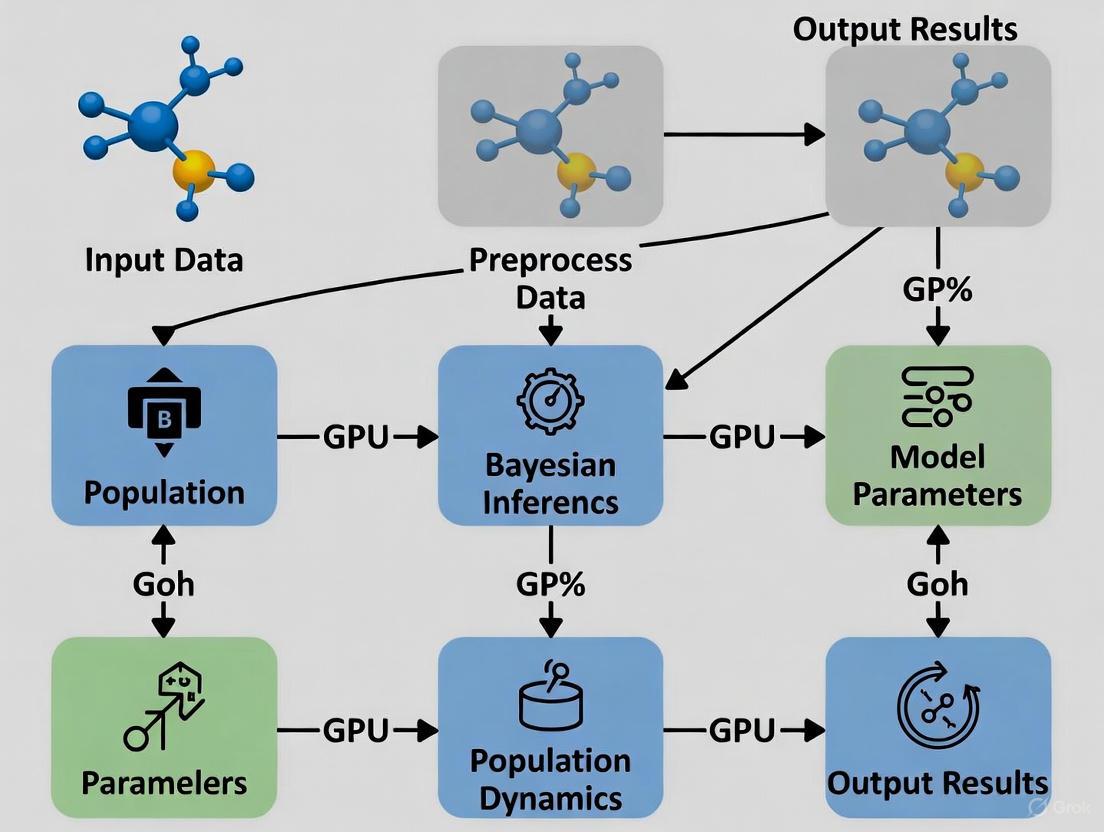
This article explores the transformative impact of Graphics Processing Unit (GPU) acceleration on Bayesian inference for population dynamics models.
GPU-Accelerated Bayesian Methods for Population Dynamics: Accelerating Inference from Genetics to Drug Development
Abstract
This article explores the transformative impact of Graphics Processing Unit (GPU) acceleration on Bayesian inference for population dynamics models. We cover the foundational principles that make these computationally intensive problems suitable for parallel processing, detail cutting-edge methodological implementations across fields like population genetics and epidemiology, and provide practical guidance for troubleshooting and optimization. By examining validation studies and comparative performance benchmarks, we demonstrate how GPU-accelerated Bayesian methods are enabling faster, more accurate, and scalable analyses, ultimately advancing research in drug development and clinical applications.
The Core Challenge: Why Population Dynamics Demand Bayesian Inference and GPU Power
Bayesian population dynamics provides a powerful statistical framework for inferring how populations change over time, whether tracking the genetic history of species or forecasting the spread of infectious diseases. By combining prior knowledge with observed data, these methods quantify uncertainty in dynamic processes, from millennia of evolutionary history to real-time epidemic trajectories. The computational intensity of Bayesian inference has traditionally limited its application to large datasets; however, GPU acceleration is now enabling complex, high-dimensional models to be deployed at scale, transforming our ability to model population systems with unprecedented speed and precision [1] [2] [3].
Bayesian population dynamics refers to a class of statistical models that treat population processes as latent, dynamic systems about which researchers make probabilistic inferences. These models are uniquely powerful for several reasons: they formally incorporate prior knowledge from previous studies or expert opinion; they represent all unknown quantities—including parameters, model structures, and predictions—with full probability distributions, thereby explicitly quantifying uncertainty; and they can be hierarchically structured to share information across related datasets or population subgroups [4] [5].
The core application domains within this field are diverse. In evolutionary biology, Bayesian methods reconstruct historical population sizes from genetic sequences. In epidemiology, they estimate critical parameters like the basic reproduction number (R₀) and forecast outbreak trajectories. In ecology, they model species abundance and spatial spread. The unifying thread is the treatment of population change as a stochastic process, with observed data (e.g., genetic variants, case reports, species counts) providing incomplete, noisy glimpses of the underlying dynamics [4] [2] [6].
The adoption of GPU computing addresses the primary bottleneck in this field: computation. Bayesian inference typically relies on Markov Chain Monte Carlo (MCMC) sampling or sequential Monte Carlo methods, which can be prohibitively slow for large populations or complex models. GPUs, with their massively parallel architecture, excel at executing the myriad independent calculations required for these algorithms, offering speedups of orders of magnitude and making previously intractable analyses feasible [1] [2] [3].
Core Methodologies and Quantitative Comparisons
Foundational Model Families
Bayesian approaches to population dynamics are built upon several foundational model families, each tailored to specific data types and scientific questions.
- Coalescent-Based Genetic Models: Methods like the Pairwise Sequentially Markovian Coalescent (PSMC) and its Bayesian extensions (e.g., PHLASH) use genome sequence data to infer historical effective population size (Nₑ). These models treat the Time to the Most Recent Common Ancestor (TMRCA) across genomic loci as a latent variable in a Hidden Markov Model (HMM), linking patterns of genetic variation to past demographic events [2].
- Compartmental Epidemic Models: For infectious diseases, models such as the Susceptible-Exposed-Infectious-Removed (SEIR) framework are used as process models within a Bayesian state-space formulation. These models describe the underlying transmission dynamics, while an observation model accounts for the fact that reported case data are typically incomplete and noisy [4] [7] [6].
- Branching Process Models: To model heterogeneous transmission, such as super-spreading events, stochastic branching processes can be embedded within a Bayesian framework. These models infer the offspring distribution—the number of secondary cases generated by an infected individual—from incidence time-series data, providing insights into the over-dispersion of contagion [8].
- Spatio-Temporal Point Process Models: For data with a geographic component, such as the locations of infected individuals, Bayesian hierarchical models can quantify spatial correlations and forecast the spread of a pathogen or invasive species across a landscape, even with very limited local data [9].
Quantitative Performance of Select Models
The table below summarizes the reported performance and scope of several Bayesian models discussed in the literature, highlighting the role of GPU acceleration.
Table 1: Performance and Scope of Selected Bayesian Population Dynamics Models
| Model / Software | Primary Application | Reported Performance | Key Computational Features |
|---|---|---|---|
| CUDAHM [1] | Cosmic population density estimation | Accurate deconvolution for 300,000 objects in ~1 hour | NVIDIA Tesla K40c GPU; massively parallel Metropolis-within-Gibbs sampling |
| PHLASH [2] | Population size history from whole genomes | Faster and lower error vs. SMC++, MSMC2, FITCOAL | GPU-accelerated; novel score function algorithm for HMMs (O(M²) time) |
| SIMPLE [7] | Epidemic prevalence from survey data | Orders-of-magnitude faster runtime in some cases | Sequential Monte Carlo (SMC); compared to Bayesian P-splines & Gaussian Processes |
| PMCMC for SEIR [6] | Onset time and R₀ for emerging diseases | Accurate estimates consistent with empirical studies | Particle Markov Chain Monte Carlo; integrates MCMC with particle filtering |
Application Notes & Protocols
This section provides detailed methodologies for implementing Bayesian population dynamics analyses, with a focus on GPU-accelerated inference.
Protocol 1: Inferring Population History from Genomic Data using PHLASH
Application Note: This protocol details the process of estimating a population's effective size through time using whole-genome sequence data. The PHLASH method is designed for scalability and accuracy, leveraging GPU hardware to perform full Bayesian inference efficiently [2].
- Objective: To infer the historical effective population size function, η(t), from a sample of whole-genome sequences.
- Experimental Principles: The method is based on a coalescent HMM. It models the local TMRCA along the genome, which carries information about past population size. PHLASH places a non-parametric prior on η(t) and uses a novel, efficient algorithm to compute the gradient of the log-likelihood, enabling rapid posterior exploration [2].
Step-by-Step Workflow:
- Data Preparation: Input a multiple sequence alignment (FASTA format) or variant calls (VCF format) from a diploid individual or a population sample.
- Preprocessing: Calculate the density of heterozygous sites or pairwise differences within a sliding window across the genome.
- Model Configuration:
- Specify the recombination rate (ρ) and mutation rate (θ). These can be estimated from the data or taken from literature.
- Define the prior distribution for the population size history. PHLACH uses a prior that encourages smoothness without enforcing a pre-defined parametric form.
- GPU-Accelerated Inference:
- The algorithm draws random, low-dimensional projections of the coalescent intensity function.
- The key computational kernel involves forward-backward algorithms for the underlying HMM, which are parallelized across the GPU's many cores.
- Samples from the posterior distribution of η(t) are generated by averaging these projections.
- Post-processing and Output:
- The output is a posterior distribution over population size histories.
- Summarize the posterior to obtain a point estimate (e.g., the posterior mean) and credible intervals at each time point.
- Visualize the estimated population trajectory, plotting time (generations ago) against effective population size (Nₑ).
Protocol 2: Real-Time Bayesian Forecasting of Disease Spread
Application Note: This protocol addresses the critical need for rapid assessment during the early stages of an epidemic. It demonstrates how to use a Bayesian state-space model with limited local data, leveraging informative priors from previous outbreaks in similar populations or regions to make statistically valid predictions and forecasts [9] [6].
- Objective: To estimate the onset time, basic reproduction number (R₀), and other key epidemiological parameters, and to forecast short-term case incidence.
- Experimental Principles: A stochastic SEIR model serves as the process model for the underlying transmission dynamics. An observation model links the true, unobserved incidence to the reported case data, accounting for under-reporting and noise. Parameters are inferred using Particle MCMC (PMCMC), which combines the flexibility of MCMC with the ability of particle filters to handle complex state dynamics [6].
Step-by-Step Workflow:
- Data Preparation: Collect a time series of early reported cases (e.g., daily or weekly incidence). Gather informative prior distributions for parameters (e.g., R₀, latent period) from literature on similar diseases or populations [9].
- Model Specification:
- Process Model: Define a stochastic SEIR model with states S(susceptible), E(exposed), I(infectious), R(removed). Incorporate noise on the transmission rate β to capture stochasticity.
- Observation Model: Specify a distribution for the reported cases (e.g.,
zt ~ Normal(ρ * Δct, τ * ρ * Δct)), whereρis the reporting rate andΔctis the true number of new infections [6].
- Prior Elicitation: Assign priors to all unknown parameters (β, γ, α, ρ, τ, onset time d). Use strongly informative priors from previous studies where available, and weakly informative or vague priors otherwise.
- PMCMC Inference:
- Initialization: Initialize the MCMC chain with plausible parameter values.
- Particle Filtering (Inside MCMC): For each proposed set of parameters in the MCMC chain, run a particle filter to compute an estimate of the model likelihood. This involves simulating multiple trajectories (particles) of the state-space model.
- MCMC Acceptance: Use the likelihood estimate from the particle filter to accept or reject the proposed parameters.
- Forecasting and Output:
- After convergence, the MCMC output provides a posterior distribution for all parameters (R₀, onset time, etc.).
- To forecast, simulate the state-space model forward in time using parameters drawn from the posterior, generating a predictive distribution of future cases.
The Scientist's Toolkit: Research Reagent Solutions
This table catalogues essential computational tools, models, and data types that constitute the "reagent solutions" for experimental research in Bayesian population dynamics.
Table 2: Essential Research Reagents for Bayesian Population Dynamics
| Category | Reagent / Solution | Function / Explanation |
|---|---|---|
| Computational Tools | GPU-Accelerated Libraries (e.g., CUDA) | Provides the parallel computing framework to execute millions of simultaneous operations, drastically reducing inference time for complex models [1] [3]. |
| Particle MCMC (PMCMC) | A hybrid algorithm that enables Bayesian parameter inference for complex, non-linear state-space models with latent variables, which are common in epidemiology [6]. | |
| Core Model Components | Coalescent Hidden Markov Model (HMM) | The foundational statistical model for relating genetic variation data to historical population size; the latent states represent time to most recent common ancestor [2]. |
| Stochastic SEIR Compartmental Model | A generative model for the underlying transmission dynamics of an infectious disease, serving as the process model in a state-space framework [4] [6]. | |
| Bayesian P-splines / Gaussian Processes | Flexible priors used for smoothing noisy time-series data, such as infection prevalence from repeated cross-sectional surveys [7]. | |
| Data & Priors | Informative Prior Distributions | Probability distributions derived from previous studies or expert knowledge, used to constrain model parameters when local data are scarce or non-existent [9]. |
| Time Series of Reported Incidence | The primary observation data for epidemiological models, representing the noisy, real-world measurement of the underlying epidemic process [6]. | |
| Whole Genome Sequence Data | The primary data source for coalescent-based inference, containing the signal of historical population processes in patterns of variation and linkage [2]. |
Markov Chain Monte Carlo (MCMC) methods represent a cornerstone of modern Bayesian inference, enabling researchers to estimate complex posterior distributions for models where analytical solutions are intractable. Despite their theoretical robustness, traditional MCMC methods face a significant computational bottleneck, particularly as models grow in complexity and datasets increase in size. This bottleneck severely impacts research workflows in fields like drug development and population genetics, where iterative model refinement is essential. The sequential nature of traditional MCMC sampling, typically executed on central processing units (CPUs), creates fundamental performance constraints that limit practical application to real-world problems. However, recent advancements in hardware and software, particularly the adoption of graphics processing units (GPUs) and specialized sampling algorithms, are demonstrating promising pathways to overcome these limitations and make Bayesian inference tractable for large-scale problems.
The Inherent Computational Limitations of Traditional MCMC
The computational cost of traditional MCMC stems from several inherent algorithmic characteristics. First, MCMC methods are fundamentally sequential—each sample in the Markov chain depends on the previous state, creating a critical path that prevents trivial parallelization [10]. Second, each iteration typically requires evaluating the likelihood function across the entire dataset, which becomes prohibitively expensive with large data volumes [11]. Third, convergence often requires drawing thousands or millions of samples, with additional "warm-up" iterations discarded to ensure the chain reaches its stationary distribution.
The efficiency of MCMC is commonly measured by the effective sample size (ESS), which quantifies the number of independent samples equivalent to the autocorrelated MCMC samples, and the effective sample size per second (ESS/s), which incorporates computational time [12] [13]. For a function f, the variance of the MCMC estimator is given by:
$$\text{Var}{\text{MCMC}}[\hat{\theta}f] = \frac{\text{Var}{p(\theta|y)}[f(\theta)]}{\text{ESS}f}$$
This relationship demonstrates that to reduce estimation error, one must increase ESS, which typically requires longer runtimes. Alternative metrics like Expected Squared Jump Distance (ESJD) are used during adaptation to optimize sampler hyperparameters, as they are easier to compute from adjacent states [12].
Quantitative Assessment of Computational Costs
Table 1: Comparative Performance of MCMC Implementations on Different Hardware
| Implementation | Hardware | Dataset Size | Sampling Time | Speed-up Factor | Minimum ESS/s |
|---|---|---|---|---|---|
| PyMC (CPU) | Intel i7-9750H | 160,420 matches | ~12 minutes | 1x (baseline) | Baseline |
| Stan (CPU) | Intel i7-9750H | 160,420 matches | ~20 minutes | 0.6x | Comparable to PyMC |
| PyMC + JAX (CPU) | Intel i7-9750H | 160,420 matches | ~12 minutes | ~1x | 2.9x |
| PyMC + JAX (GPU) - Sequential | NVIDIA RTX 2070 | 160,420 matches | >2.7 minutes | >4.4x | >11x |
| PyMC + JAX (GPU) - Vectorized | NVIDIA RTX 2070 | 160,420 matches | 2.7 minutes | ~4.4x | ~11x |
| bedpostx (CPU) | Intel Xeon X5670 | Brain voxel data | Baseline | 1x (baseline) | Not reported |
| bedpostx_gpu (GPU) | NVIDIA Tesla C2075 | Brain voxel data | ~1/100 of CPU time | ~100x | Not reported |
| Custom MH (GPU) | GPU | Large datasets | 1/68 of CPU time | 68x (DP), 136x (SP) | Not reported |
Table 2: Performance Scaling with Dataset Size for Bradley-Terry Model Inference
| Start Year | Number of Matches | CPU Time (minutes) | GPU Time (minutes) | GPU Efficiency Advantage |
|---|---|---|---|---|
| 2020 | Small subset | ~1 | ~1.5 | CPU superior for small data |
| 2015 | ~50,000 | ~4 | ~1.8 | GPU becomes favorable |
| 2010 | ~80,000 | ~6 | ~2.0 | GPU significantly faster |
| 2000 | ~120,000 | ~8 | ~2.3 | GPU 3.5x faster |
| 1968 | 160,420 | ~12 | ~2.7 | GPU 4.4x faster |
The quantitative data reveals several important patterns. First, GPU acceleration provides minimal benefit for small datasets due to hardware initialization and memory transfer overheads [13]. Second, the performance advantage of GPUs becomes substantial as data size increases, with 4-100x speedups commonly achieved for moderately large to very large datasets [13] [14]. Third, specialized GPU implementations can achieve even greater speedups (68-136x) for specific algorithms like Metropolis-Hastings [11]. Fourth, beyond raw time savings, GPU-accelerated sampling often produces higher effective sample size per second, indicating not just faster but statistically more efficient sampling [13].
Protocol for GPU-Accelerated MCMC Implementation
Experimental Setup and Software Configuration
Research Reagent Solutions: Table 3: Essential Software and Hardware Components for GPU-Accelerated MCMC
| Component | Example Options | Function/Role |
|---|---|---|
| GPU Computing Framework | JAX, PyTorch | Provides automatic differentiation, JIT compilation, and GPU/TPU support |
| Probabilistic Programming | PyMC, NumPyro, Stan | Defines Bayesian models and implements samplers |
| Sampling Algorithms | HMC, NUTS, ChEES-HMC | Generates samples from posterior distributions |
| Hardware Accelerators | NVIDIA GPUs, Google TPUs | Provides massive parallelization for numerical computations |
| Visualization & Analysis | ArviZ | Computes diagnostics like ESS, R-hat for convergence |
Implementation Protocol:
Model Definition Phase: Implement the statistical model using a GPU-compatible framework. For example, specify a hierarchical Bayesian model using PyMC with JAX backend:
Hardware Configuration: Ensure proper installation of GPU drivers and computing frameworks (CUDA, cuDNN for NVIDIA GPUs). Configure the software environment to utilize available accelerators, typically through environment variables or framework-specific commands.
Sampler Selection: Choose appropriate sampling algorithms based on model characteristics and hardware:
- For models with many parameters and differentiable log-posterior, Hamiltonian Monte Carlo (HMC) and No-U-Turn Sampler (NUTS) are preferred [12]
- For GPU efficiency, consider alternatives to NUTS like ChEES-HMC when possible, as NUTS' adaptive trajectory length can create synchronization overhead [15]
- Implement multiple chains in parallel using vectorized mapping (
vmapin JAX) rather than running chains asynchronously [12]
Execution and Monitoring: Run sampling with appropriate warm-up iterations, typically 1,000-2,000, followed by sampling iterations. Monitor chain convergence using diagnostics like R-hat (potential scale reduction factor) and effective sample size, computed using tools like ArviZ [13].
Validation: For critical applications, validate GPU results against CPU implementations to ensure algorithmic equivalence, particularly when using reduced precision (e.g., single-precision instead of double-precision) [14].
Workflow Visualization
Advanced Strategies for Computational Efficiency
Algorithmic Optimizations
Beyond hardware acceleration, several algorithmic strategies can mitigate computational bottlenecks:
Alternative Inference Methods: For extremely large datasets, Stochastic Variational Inference (SVI) provides a compelling alternative to MCMC, transforming Bayesian inference into an optimization problem. SVI can achieve speedups of 3-5 orders of magnitude (1000x-100,000x) compared to traditional MCMC, though it comes with different approximation trade-offs and may underestimate posterior uncertainty [16].
Precision Adjustment: Implementing MCMC in single-precision rather than double-precision floating-point arithmetic can provide approximately 2x speedup on GPUs with minimal impact on results for many applications [11].
Specialized Samplers: New GPU-friendly sampling algorithms like ChEES-HMC are designed specifically to minimize control flow divergence and synchronization overhead, addressing fundamental limitations of adaptive samplers like NUTS on parallel hardware [15].
Method Selection Framework
Application to Population Dynamics and Pharmacological Research
The computational advances in MCMC sampling have particular significance for Bayesian population dynamics models in ecological and drug development contexts. For example, in phylodynamic inference of pathogen population dynamics, specialized MCMC samplers enable estimation of previously intractable parameters related to dormancy and evolutionary dynamics [17]. Similarly, Bayesian integrated population models (BIPMs) for wildlife monitoring can now accommodate complex state-space structures and changing information needs through efficient sampling [18].
In drug development, GPU-accelerated Bayesian inference enables rapid fitting of hierarchical models to clinical trial data, particularly valuable for dose-response modeling and pharmacokinetic/pharmacodynamic analysis. The ability to quickly refit models with new data (reducing time from 20 minutes to 2.7 minutes in one benchmark) supports iterative model refinement and adaptive trial designs [13].
For demographic inference in population genetics, where likelihood evaluations are exceptionally computationally expensive, alternative optimization approaches like Bayesian optimization can complement MCMC methods when dealing with four or more populations, demonstrating the ongoing innovation in computational Bayesian methods [19].
The computational bottleneck of traditional MCMC sampling represents a significant challenge in applied Bayesian statistics, but one that is being aggressively addressed through hardware and algorithmic innovations. GPU acceleration, specialized sampling algorithms, and alternative inference methods collectively provide a pathway to make Bayesian inference tractable for increasingly complex models and larger datasets. For researchers in population dynamics and drug development, adopting these advanced computational approaches can transform Bayesian methods from theoretical tools to practical solutions for modeling complex biological systems. The protocols and comparisons provided here offer a foundation for selecting appropriate implementation strategies based on specific research requirements, dataset characteristics, and available computational resources.
Bayesian inference provides a powerful, principled framework for modeling complex biological systems, such as those encountered in population dynamics and drug discovery. It allows researchers to estimate unknown parameters of a model and quantify the uncertainty in those estimates. However, a significant obstacle often prevents its full potential from being realized in practice: computational intractability. The core of Bayesian analysis involves calculating the posterior distribution, which requires solving high-dimensional integrals that are frequently impossible to compute directly [16]. For sophisticated models, like those analyzing whole-genome sequence data to infer historical population sizes, this process can be prohibitively slow, taking days or even months on conventional hardware [20].
Massively parallel inference on Graphics Processing Units (GPUs) has emerged as a transformative solution to this bottleneck. Unlike Central Processing Units (CPUs) with a few powerful cores, GPUs contain thousands of smaller cores capable of performing simultaneous calculations. This architecture is ideally suited for the repetitive, parallel operations inherent in many Bayesian inference algorithms. By leveraging GPU acceleration, researchers can achieve speedups of several orders of magnitude, reducing computation times from months to minutes and making previously intractable analyses feasible [16]. This paradigm shift opens new frontiers in research, from scaling demographic inference to thousands of genomic samples [20] to enabling large-scale, active learning-driven drug combination screens [21].
Core Inference Methods & Their GPU Parallelization
The two primary families of algorithms for Bayesian inference are Markov Chain Monte Carlo (MCMC) and Variational Inference (VI). Their different computational characteristics influence how they are adapted for GPU parallelism.
Table 1: Core Bayesian Inference Methods and Their Parallelization
| Method | Core Principle | Computational Bottleneck | GPU Parallelization Strategy |
|---|---|---|---|
| Markov Chain Monte Carlo (MCMC) | Draws correlated samples from the posterior distribution by constructing a Markov chain. | Sequential nature of chain; evaluating likelihood for entire dataset at each step [16]. | Batched likelihood evaluations: Computing likelihoods for multiple samples or chains simultaneously [22]. |
| Stochastic Variational Inference (SVI) | Posits a simpler family of distributions and optimizes to find the best approximation to the true posterior. | Optimization process; calculating gradients over many data subsets [16]. | Massively parallel gradient computation: Using data parallelism across thousands of cores to accelerate optimization [16]. |
| Nested Sampling | Computes the Bayesian evidence by evolving a set of "live points" through progressively higher likelihood regions [22]. | Evaluating likelihoods for many live points and drawing new samples from constrained priors [22]. | Parallel live point evolution: Using many GPU threads to advance multiple live points simultaneously [22]. |
Application Protocol: Demographic Inference with PHLASH
The Population History Learning by Averaging Sampled Histories (PHLASH) algorithm provides a state-of-the-art example of GPU-accelerated Bayesian inference for population dynamics.
- Objective: To infer the historical effective population size (Nₑ) from whole-genome sequence data.
- Key Innovation: A new algorithm for efficiently computing the score function (gradient of the log-likelihood) of a coalescent hidden Markov model, which has the same computational cost as evaluating the log-likelihood itself. This gradient enables highly efficient exploration of the posterior distribution [20].
- GPU Acceleration: The PHLASH software package is implemented to leverage GPU acceleration where available. The parallelism is exploited in the low-dimensional projections of the coalescent intensity function and the averaging of sampled histories, leading to an estimator that is both accurate and computationally efficient [20].
- Performance: In benchmarks, PHLASH demonstrated a tendency to be faster and have lower error than several competing methods (SMC++, MSMC2, FITCOAL) across a panel of 12 different demographic models from the stdpopsim catalog [20].
Quantitative Performance Benchmarks
The theoretical advantages of GPU parallelism translate into dramatic real-world performance gains. The following table synthesizes benchmark data from various scientific applications, demonstrating the profound impact of GPU acceleration on inference tasks.
Table 2: Performance Benchmarks of GPU-Accelerated vs. Traditional Inference
| Application Context | CPU Baseline (Hardware & Time) | GPU Accelerated (Hardware & Time) | Speedup Factor |
|---|---|---|---|
| Hierarchical Bayesian Modeling (Generalized Linear Models) | Traditional MCMC (CPU, unspecified): "months" [16] | Multi-GPU SVI (Multiple GPUs): "minutes" [16] | ~10,000x [16] |
| Cosmological Model Comparison (39-dimensional analysis) | CPU-based Nested Sampling: "prohibitively long" [22] | GPU-accelerated Nested Sampling (Single A100 GPU): "two days" [22] | Orders of magnitude [22] |
| Population Dynamics P Systems (Ecosystem simulation) | Multi-core CPU (OpenMP, 4-core Intel i7): Baseline 1x [23] | NVIDIA Tesla K40 GPU: 18.1x faster than multi-core CPU [23] | 18.1x [23] |
| Genomic CNN Scanning (Sliding-window algorithm) | 16-core CPU (PyTorch): Baseline 1x [24] | FPGA Accelerator (Alveo U250): 19.51x - 28.61x faster than 16-core CPU [24] | ~19-29x (vs. CPU) [24] |
| High-end GPU (unspecified): Baseline 1x [24] | FPGA Accelerator (Alveo U250): 1.22x - 2.89x faster than high-end GPU [24] | ~1.2-2.9x (vs. GPU) [24] |
Advanced Application Protocol: Bayesian Active Learning for Drug Screens
GPU-accelerated inference is not limited to analysis but is also revolutionizing experimental design. The BATCHIE platform uses Bayesian active learning to make large-scale combination drug screens tractable.
- Objective: To efficiently identify synergistic drug combinations from a vast space of possibilities by dynamically designing maximally informative batches of experiments [21].
- Core Algorithm: Probabilistic Diameter-based Active Learning (PDBAL). This criterion selects experiments that minimize the expected distance between posterior samples, theoretically guaranteeing near-optimal experimental designs [21].
- GPU-Accelerated Model: A hierarchical Bayesian tensor factorization model runs on GPU. It uses embeddings for cell lines and drug-doses, decomposing a combination's response into individual drug effects and an interaction term [21].
- Prospective Validation: In a screen of a 206-drug library on pediatric cancer cell lines, BATCHIE accurately predicted unseen combinations and detected synergies after testing only 4% of the 1.4 million possible experiments [21].
The Scientist's Toolkit: Essential Research Reagents & Software
Implementing massively parallel Bayesian inference requires a combination of specialized software libraries and hardware. The following table details key "research reagents" for building a modern computational pipeline.
Table 3: Essential Toolkit for GPU-Accelerated Bayesian Inference
| Tool / Reagent | Type | Primary Function | Relevance to Population Dynamics/Drug Discovery |
|---|---|---|---|
| JAX [16] [22] | Software Library | NumPy-like API for GPU/TPU acceleration with automatic differentiation. | Foundational for building custom, differentiable models and inference algorithms. Enables data sharding across multiple devices. |
| Pyro / NumPyro [16] | Probabilistic Programming Library | Facilitates building complex Bayesian models and performing SVI. | Used for defining flexible hierarchical models (e.g., for population genetics or drug response). |
| NVIDIA CUDA-X (e.g., cuEquivariance) [25] | GPU-Accelerated Library | Provides optimized kernels for specific mathematical operations (e.g., tensor products). | Accelerates key layers in biomolecular AI models, such as those used in protein structure prediction. |
| NVIDIA BioNeMo Framework [25] | AI Framework | Open-source framework for building/training models on biomolecular data (DNA, RNA, proteins). | Provides domain-specific foundation models and training recipes for drug discovery pipelines. |
| PHLASH [20] | Specialized Software | Python package for inferring population size history from genomic data. | Directly enables fast, accurate, and scalable demographic inference with automatic uncertainty quantification. |
| BATCHIE [21] | Specialized Software | Open-source platform for Bayesian active learning in combination drug screens. | Enables tractable, large-scale screening to identify effective drug combinations with minimal experiments. |
| GPU-Accelerated Nested Sampling (e.g., NSS) [22] | Inference Algorithm | Efficiently computes Bayesian evidence for model comparison in high dimensions. | Critical for robust model selection in cosmology and other fields with complex, high-dimensional models. |
Application Note: Accelerated Bayesian Inference in Population Genetics
Population genetics relies on inferring historical demographic patterns from genetic data to understand evolutionary processes, migration events, and population bottlenecks. Traditional methods like the pairwise sequentially Markovian coalescent (PSMC) have limitations, including an inability to analyze large sample sizes and a "stair-step" visual bias in estimates. Bayesian approaches offer a powerful alternative but face computational constraints that have limited their widespread adoption [20].
The PHLASH (population history learning by averaging sampled histories) method represents a significant advancement by enabling full Bayesian inference of population size history from whole-genome sequence data. This method combines advantages of previous approaches into a single, general-purpose inference procedure that is simultaneously fast, accurate, capable of analyzing thousands of samples, and able to return a full posterior distribution over the inferred size history function [20].
Key Innovation and GPU Acceleration
The key technical advance in PHLASH is a novel algorithm for computing the score function (gradient of the log likelihood) of a coalescent hidden Markov model, which maintains the same computational cost as evaluating the log likelihood itself. This innovation, combined with a highly efficient, graphics processing unit (GPU)-based software implementation, enables Bayesian inference at speeds exceeding many optimized methods [20].
GPU acceleration provides remarkable efficiency gains for population genetics analyses. General-purpose GPU libraries like PyTorch and TensorFlow have demonstrated >200-fold decreases in runtime and approximately 5–10-fold reductions in cost relative to central processing unit (CPU)-based approaches. This performance improvement enables researchers to investigate previously unanswerable hypotheses involving more complex models and larger datasets [26].
Performance Benchmarks and Validation
In comprehensive benchmarking across 12 demographic models from the stdpopsim catalog representing eight different species, PHLASH demonstrated superior performance. It achieved the highest accuracy in 61% of scenarios (22 of 36) compared to competing methods including SMC++, MSMC2, and FITCOAL [20].
Table 1: Performance Comparison of Population Genetics Methods
| Method | Optimal Sample Size | Computational Requirements | Key Advantages |
|---|---|---|---|
| PHLASH | 1-1000+ diploid samples | GPU-accelerated, 24h wall time | Highest accuracy, provides full posterior distribution, automatic uncertainty quantification |
| SMC++ | 1-10 diploid samples | CPU, limited to 24h wall time | Incorporates frequency spectrum information |
| MSMC2 | 1-10 diploid samples | CPU, limited to 256GB RAM | Optimizes composite objective across all haplotype pairs |
| FITCOAL | 10-100 diploid samples | CPU, limited to 24h wall time | Extremely accurate for constant or exponential growth models |
The PHLASH method provides automatic uncertainty quantification and enables new Bayesian testing procedures for detecting population structure and ancient bottlenecks. The posterior distribution becomes more dispersed for very recent time periods (t < 10^3 generations) where fewer coalescent events are available to accurately estimate effective population size [20].
Experimental Protocols
Protocol: Population History Inference Using PHLASH
Research Objectives and Experimental Design
This protocol describes the process for inferring population size history from whole-genome sequence data using the PHLASH method. The primary objective is to estimate historical effective population sizes (N_e) over time and quantify estimation uncertainty through Bayesian posterior distributions [20].
Software and Hardware Requirements
- Software: PHLASH Python package (requires Python 3.7+ with PyTorch/TensorFlow backend)
- Hardware: NVIDIA GPU (P100 or later recommended) with CUDA support
- Memory: Minimum 8GB GPU memory, 16GB system RAM
- Data Input: Whole-genome sequence data in VCF or PLINK format
Step-by-Step Procedure
Data Preparation: Convert raw sequence data to required input format
- Ensure data is properly formatted and filtered for quality
- Phase genotypes if possible (method is robust to unphased data)
Parameter Configuration: Set analysis parameters in configuration file
- Define time range for inference (default: 10^2 to 10^6 generations)
- Specify number of MCMC iterations (default: 10,000)
- Set random seed for reproducibility
Initialization: Initialize the coalescent hidden Markov model
- Load genetic data and population structure priors
- Initialize coalescent intensity function with random projections
MCMC Sampling: Execute the Bayesian sampling procedure
- Draw random, low-dimensional projections of coalescent intensity function
- Compute score function using efficient gradient calculation
- Update posterior distribution using Metropolis-Hastings algorithm
Result Aggregation: Average sampled histories to form final estimator
- Combine multiple chains to ensure convergence
- Compute posterior median and credible intervals
Output Generation: Produce visualization and summary statistics
- Generate plots of population size history with uncertainty intervals
- Export posterior samples for further analysis
- Perform Bayesian hypothesis tests for population structure
Validation and Quality Control
- Run multiple independent chains to assess convergence
- Compare results with simulated data where ground truth is known
- Perform posterior predictive checks to validate model fit
- Calculate Gelman-Rubin statistics to ensure chain convergence [27]
Protocol: GPU-Accelerated QTL Mapping with TensorQTL
Research Context and Objectives
This protocol describes quantitative trait locus (QTL) mapping using tensorQTL, a GPU-accelerated implementation that enables scaling to millions of individuals. The method identifies associations between genetic variants and gene expression patterns, with applications in understanding disease mechanisms and identifying therapeutic targets [26].
Computational Requirements and Setup
- Software: tensorQTL package with PyTorch backend
- Hardware: NVIDIA GPU with ≥8GB memory
- Data: Genotype data in PLINK format, phenotype data, covariates
Step-by-Step Workflow
- Data Loading: Read genotype-phenotype data into GPU memory using pandas-plink and dask arrays
- Preprocessing: Normalize phenotypes and apply quality control filters
- Cis-QTL Mapping: Test associations within specified genomic windows
- Permutation Testing: Calculate empirical p-values using beta approximation
- Trans-QTL Mapping: Perform genome-wide association testing
- Result Processing: Filter and store significant associations
Performance Optimization
- Batch processing for large datasets that exceed GPU memory
- Parallel execution across multiple GPUs for hyperparameter optimization
- Efficient data transfer between CPU and GPU memory
Figure 1: PHLASH Bayesian Inference Workflow for Population Genetics
The Scientist's Toolkit: Research Reagent Solutions
Table 2: Essential Computational Tools for Bayesian Population Genetics
| Tool/Resource | Function | Implementation |
|---|---|---|
| PHLASH Software | Bayesian inference of population size history | Python package with GPU acceleration [20] |
| tensorQTL | GPU-accelerated QTL mapping | PyTorch-based implementation [26] |
| gPGA | Isolation with migration model analysis | CUDA-based GPU implementation [28] |
| NIMBLE/JAGS | Bayesian hierarchical modeling | BUGS-language compilers for integrated population models [29] [30] |
| stdpopsim | Standardized population genetic simulations | Python library with empirical demographic models [20] |
| AgentTorch | Differentiable agent-based modeling | PyTorch-based framework for epidemiological forecasting [31] |
Application Note: Epidemiological Forecasting with Large Population Models
Innovation in Epidemiological Modeling
Large Population Models (LPMs) represent an evolution of agent-based models (ABMs) that overcome traditional limitations in scale, data integration, and real-world feedback. These models simulate entire populations with realistic behaviors and interactions at unprecedented scale, enabling researchers to observe how individual choices aggregate into system-level outcomes and test interventions before real-world implementation [31].
LPMs achieve this through three key innovations: compositional design for efficient simulation of millions of agents, differentiable specification for gradient-based learning and calibration, and decentralized computation using secure multi-party protocols. The AgentTorch framework implements these theoretical advances, providing GPU acceleration, million-agent populations, differentiable environments, and neural network composition [31].
Formal Model Specification
In epidemiological applications, LPMs represent individuals with states (si(t)) containing both static and time-evolving properties such as age, disease status, and immunity level. The model updates individual states through interactions with neighbors (Ni(t)) and environment (e(t)) according to the equation:
si(t+1) = f(si(t), ⊕(j∈Ni(t)) mij(t), ℓ(·|si(t)), e(t; θ))
Where mij(t) represents disease transmission from individual j to i, ℓ(·|si(t)) captures behavioral decisions (e.g., mask-wearing, social distancing), and e(t; θ) represents environmental factors including viral evolution and intervention policies [31].
Performance and Applications
Current LPM deployments are optimizing vaccine distribution strategies to help immunize millions of people and tracking billions of dollars in global supply chains to improve efficiency and reduce waste. Case studies on pandemic response in New York City demonstrate more accurate predictions, more efficient policy evaluation, and more seamless integration with real-world systems than traditional ABMs [31].
Figure 2: Large Population Model Architecture for Epidemiological Forecasting
Application Note: Clinical Trial Modeling and Bayesian Methods
Bayesian Framework for Clinical Applications
Bayesian statistics provides a powerful framework for clinical trial modeling through its ability to sequentially update knowledge with new data, handle complex hierarchical models, and incorporate prior information. This approach addresses common challenges in classical statistics, including lack of power in small sample research and convergence issues in complex models [27].
The Bayesian framework enables researchers to specify prior distributions based on existing knowledge, derive posterior distributions that combine prior information with new data, and perform prior/posterior predictive checking to validate model assumptions. This methodology is particularly valuable in clinical settings where ethical considerations and cost constraints limit sample sizes [27].
Implementation and Best Practices
Successful implementation of Bayesian methods in clinical trial modeling follows established best practices outlined in the WAMBS-checklist (When to Worry and how to Avoid the Misuse of Bayesian Statistics). This includes [27]:
- Prior Specification: Defining plausible parameter space and expected prior means with appropriate uncertainty
- Convergence Diagnostics: Monitoring MCMC chains using Gelman-Rubin statistics and trace plots
- Sensitivity Analysis: Assessing how results vary under different prior specifications
- Predictive Checking: Validating model fit through prior and posterior predictive checks
- Reproducibility: Documenting complete analysis pipeline including software versions and random seeds
Software Tools and Training
Clinical researchers can implement Bayesian clinical trial models using accessible software tools including brms in R and bambi in Python, which provide intuitive interfaces for specifying complex models. Specialized training workshops, such as the "Bayesian Population Analysis with NIMBLE and JAGS" workshop, provide hands-on experience with hierarchical models, integrated population models, and advanced MCMC configuration [30].
These methodologies enable more efficient clinical trial designs, including adaptive trials that can modify enrollment criteria or treatment arms based on accumulating data while maintaining statistical validity and protecting patient safety.
The study of population dynamics—whether in ecology, epidemiology, or genetics—relies on sophisticated computational models to infer past demographic history, predict future trends, and understand complex system behaviors. Three methodological frameworks form the cornerstone of modern computational population biology: coalescent theory for reconstructing historical population sizes from genetic data, agent-based models for simulating the emergent dynamics of interacting individuals, and Bayesian hierarchical structures for quantifying uncertainty and integrating diverse data sources. Individually, each approach offers powerful insights; integrated within a Bayesian framework, they enable rigorous, data-driven inference about population processes across multiple scales and levels of organization. The recent integration of these methods with GPU computing has dramatically accelerated their capabilities, allowing researchers to address questions at unprecedented scales and resolutions. This note details the core concepts, applications, and practical protocols for implementing these methodologies in population dynamics research.
Core Concepts and Methodologies
Coalescent Theory for Phylodynamic Inference
Coalescent theory is a probabilistic model that generates genealogies relating individuals sampled from a population by tracing their ancestry backward in time to their most recent common ancestor (MRCA). The rate at which lineages coalesce depends on the effective population size (Nₑ), which represents the genetic diversity in a population [32].
Mathematical Foundation: The coalescent models the time between coalescent events as exponentially distributed. For a sample of (n) individuals, the waiting time (wk) until the next coalescent event, which reduces the number of lineages from (k) to (k-1), is exponentially distributed with rate (\binom{k}{2} / Ne(t)). The probability density of a genealogy (g) given a demographic function (Ne(t)) is [32]: [ p(g | Ne(t)) = \prod{k=2}^{n} \frac{\binom{k}{2}}{Ne(tk)} \exp\left[ -\int{t{k-1}}^{tk} \frac{\binom{k}{2}}{Ne(s)} ds \right] ] where (tk) is the time of the (k)-th coalescent event [32].
Non-Parametric Bayesian Extensions: Modern implementations often use non-parametric approaches to estimate (N_e(t)) without assuming a simple parametric form. The Skygrid model uses a Gaussian Markov random field (GMRF) prior on a piecewise constant demographic function defined on a pre-specified grid of time points, enabling flexible estimation of past population dynamics [32].
Agent-Based Models for Complex System Simulation
Agent-based models (ABMs) are computational frameworks for simulating the actions and interactions of autonomous agents within an environment. ABMs are particularly valuable for studying emergent system-level behaviors resulting from individual-level decisions.
Core Principles: In an ABM, each agent (e.g., an individual, a cell, a vehicle) operates according to a set of rules that dictate its behavior, state changes, and responses to other agents and environmental stimuli. The simulation proceeds through discrete time steps, with all agents updating their states asynchronously or synchronously. This bottom-up approach is ideal for modeling complex, heterogeneous systems where centralized control is absent [33] [34].
GPU-Accelerated Implementation: Traditional CPU-based ABMs execute agent actions serially, limiting scalability. GPU-accelerated frameworks like FLAME-GPU exploit data-parallel architectures by mapping thousands of agents to concurrent GPU threads. This allows for simultaneous execution of agent functions, yielding massive performance gains and enabling simulations of hundreds of millions of agents [35] [34]. Key technical innovations include stochastic memory allocation for parallel agent replication and specialized data structures for efficient spatial queries and message passing between agents [35].
Hierarchical Bayesian Models for Structured Inference
Hierarchical Bayesian modeling provides a statistical framework for analyzing data that are structured across multiple levels, allowing for partial pooling of information and robust uncertainty quantification.
Foundational Framework: In a hierarchical model, observed data (y) are modeled as arising from a probability distribution conditional on parameters (\theta). These parameters are themselves drawn from a population distribution governed by hyperparameters (\phi). This structure is formally expressed as [36]: [ \begin{aligned} y &\sim p(y | \theta) \ \theta &\sim p(\theta | \phi) \ \phi &\sim p(\phi) \end{aligned} ] This approach is naturally suited for multi-level data, such as time series from multiple populations or experimental replicates, as it allows for estimating shared patterns while acknowledging group-specific variations [36].
State-Space Modeling for Dynamic Systems: A common application in population dynamics is the Bayesian state-space model, which separates an underlying ecological process (e.g., true population abundance) from an observation process (e.g., imperfect sampling). The process model describes how the true state (Xt) evolves over time, while the observation model links measurements (Yt) to the latent state [37]. Fitting such models often requires Markov Chain Monte Carlo (MCMC) methods to sample from the complex posterior distribution of parameters and latent states [37].
Integration for Population Dynamics Research
Synthesizing Coalescent Theory and Covariate Data
The standard coalescent inference framework can be extended to incorporate time-varying covariates, moving beyond simple demographic reconstruction to test hypotheses about the drivers of population change. The Skygrid with Covariates model uses a generalized linear model (GLM) framework to link the effective population size to external time series [32]: [ \log(Ne(t)) = \beta0 + \beta1 X1(t) + \dots + \betap Xp(t) + \epsilon(t) ] where (X1(t), \dots, Xp(t)) are covariates and (\epsilon(t)) is a GMRF smoothing term that accounts for residual temporal autocorrelation not explained by the covariates. This approach has been used to identify significant associations between viral effective population size and incidence rates, and between species abundance and historical climate data [32].
Modeling Dependent Population Dynamics
Many systems involve subpopulations whose dynamics are interdependent due to shared ancestry or environmental pressures. The adaPop framework extends coalescent modeling to infer such dependencies. It models the joint effective population size trajectories of multiple subpopulations using a multivariate nonparametric prior, allowing researchers to quantify the time-varying association between populations and share statistical strength across datasets, leading to more precise estimates with narrower credible intervals [38].
Hierarchical Bayesian Inference for Population Time Series
Integrating dynamical population models with hierarchical Bayesian inference allows for direct parameter estimation from observational time series while accounting for uncertainty and variability. A typical application involves fitting a system of ordinary differential equations (ODEs) representing a predator-prey model to abundance data. The hierarchical structure estimates global hyperparameters that describe the central tendency and variability of model parameters across different experimental replicates, explicitly quantifying between-replicate differences and their ecological consequences [36].
Computational Framework and GPU Implementation
GPU-Accelerated Bayesian Computation
The computational burden of Bayesian inference for complex population models is substantial, particularly when using MCMC methods. GPU acceleration addresses this challenge by parallelizing likelihood calculations and linear algebra operations.
Parallel Computing Strategies: In a typical implementation, the computation of the log-likelihood across independent data blocks (e.g., different genomic loci in coalescent inference or independent time series in hierarchical modeling) is distributed across hundreds of GPU cores. Each core computes the partial likelihood for its assigned data block, and the results are efficiently reduced to a global sum [39].
Massive-Scale Agent-Based Simulation: Frameworks like LPSim and FLAME-GPU demonstrate the transformative impact of GPU computing for ABMs. LPSim uses vectorized data storage and access patterns to manage large-scale transportation networks, enabling simultaneous simulation of millions of individual vehicle trips. Its multi-GPU implementation relies on graph partitioning strategies to balance computational load across devices while managing inter-GPU communication through "ghost zone" designs [39].
Table 1: Performance Benchmarks of GPU-Accelerated Simulation Frameworks
| Framework | Application Domain | Hardware Setup | Simulation Scale | Execution Time |
|---|---|---|---|---|
| FLAME-GPU [35] | General Agent-Based Modeling | NVIDIA A100 / H100 GPU | Hundreds of millions of agents | Real-time performance, >1000x faster than CPU-based toolkits for some models |
| LPSim [39] | Regional Traffic Simulation | Single Tesla V100 (5120 cores) | 2.82 million trips | 6.28 minutes |
| LPSim [39] | Regional Traffic Simulation | AWS p2, dual NVIDIA K80 (4992 cores) | 9.01 million trips | 21.45 minutes |
Software and Tools for Implementation
Table 2: Essential Research Reagent Solutions for Computational Modeling
| Tool / Reagent | Type | Primary Function | Application Example |
|---|---|---|---|
| FLAME-GPU [35] | Software Framework | GPU-accelerated agent-based simulation | Simulating epidemic spread or urban mobility |
| Stan [36] | Probabilistic Programming | Bayesian inference with MCMC sampling | Fitting ODE-based population models to time series data |
| bayesTFR / bayesLife [40] | R Packages | Bayesian hierarchical projection of fertility and mortality | Probabilistic population projections for the United Nations |
| adaPop [38] | R Package | Nonparametric inference of dependent population dynamics | Studying variant-specific dynamics of SARS-CoV-2 |
| INLA [38] | Statistical Method | Approximate Bayesian inference for latent Gaussian models | Fast inference for Gaussian Markov Random Field models |
Detailed Application Notes and Protocols
Protocol 1: Inferring Effective Population Size with Covariates
Application Objective: Reconstruct past demographic history and test the association between effective population size and external covariates (e.g., climate data, incidence rates) using a coalescent framework.
Experimental Workflow:
- Genealogy Estimation: With molecular sequence data, first infer a phylogenetic tree or genealogy using software like BEAST or RevBayes. Alternatively, use a previously estimated tree [32].
- Covariate Data Preparation: Compile time-series data for covariates of interest. Ensure the time axes are aligned with the genealogy (e.g., time before present). Standardize covariates to have mean zero and standard deviation one for stable model fitting [32].
- Model Specification with Skygrid:
- Define a regular grid of time points over which the demographic function will be estimated.
- Specify the GMRF smoothing prior on the log-effective population sizes.
- For the covariate model, define the linear predictor: (\eta = \beta0 + \beta1 X(t) + \epsilon(t)), where (\epsilon(t)) is the GMRF [32].
- Posterior Inference: Use efficient MCMC algorithms (e.g., Hamiltonian Monte Carlo) to sample from the joint posterior distribution of the demographic trajectory, regression coefficients (\beta), and GMRF precision parameter. Assess MCMC convergence using trace plots and effective sample sizes [32] [38].
- Model Checking and Interpretation: Calculate posterior credible intervals for the (\beta) coefficients. A coefficient whose 95% interval excludes zero provides evidence for a significant association. Compare the full model with a null model (without covariates) using Bayes factors or Widely Applicable Information Criterion (WAIC) [32].
Protocol 2: Hierarchical Bayesian Fitting of a Dynamical Population Model
Application Objective: Estimate parameters and their variability from multiple time series of population abundances (e.g., predator-prey cycles) using a continuous-time model.
Experimental Workflow:
- Data Preparation: Compile multiple time series of observed population counts. Ensure time points are aligned and any missing data are noted. Standardize data if necessary [36].
- Model Formulation:
- Process Model: Define a system of ODEs representing the population dynamics (e.g., Lotka-Volterra, chemostat model). For a predator-prey system, this might be: [ \begin{aligned} \frac{dP}{dt} &= rP - aPC \ \frac{dC}{dt} &= eaPC - mC \end{aligned} ] where (P) is prey, (C) is predator, and (r, a, e, m) are parameters [36].
- Observation Model: Specify a probability distribution linking the true, unobserved state (Xt) to the data (Yt), e.g., (Yt \sim \text{LogNormal}(\log(Xt), \sigma^2)) [36].
- Hierarchical Structure: Assume parameters for each time series (i) are drawn from a common population distribution: (\thetai \sim \text{Normal}(\mu\theta, \tau_\theta)) [36].
- Implementation in Probabilistic Programming:
- Code the ODE model and hierarchical observation model in Stan.
- Use Stan's built-in ODE solver and HMC sampler.
- Specify weakly informative priors for hyperparameters (\mu\theta) and (\tau\theta) [36].
- Inference and Analysis:
- Run multiple HMC chains to sample from the posterior.
- Diagnose convergence and effective sample size for all key parameters.
- Analyze the posterior distributions of (\thetai) and hyperparameters (\mu\theta, \tau_\theta) to understand central trends and between-series variability [36].
Protocol 3: Building a Large-Scale, GPU-Accelerated Agent-Based Model
Application Objective: Simulate the behavior of a large population (e.g., epidemic spread, urban traffic) with millions of agents to study emergent phenomena.
Experimental Workflow:
- Agent and Environment Definition:
- Define agent types (e.g., "Person", "Vehicle") and their state variables (e.g., health status, location).
- Define the environment (e.g., a road network graph, a abstract grid) [35].
- Agent Behavior Specification:
- Write agent functions that describe how an agent updates its state each simulation step. In FLAME-GPU, this is done as a CUDA device function using the FLAME-GPU API [35].
- Example: An infection function might check for nearby infectious agents and update a susceptible agent's state with a certain probability.
- Model Description and Configuration:
- Use the FLAME-GPU API (C++ or Python) to describe the model structure: agent types, state variables, message lists for communication, and the order of function execution.
- Configure the execution flow via a directed acyclic graph (DAG) that specifies dependencies between agent functions [35].
- Simulation Execution and Optimization:
- Compile and run the model on a supported NVIDIA GPU.
- For multi-GPU execution, use graph partitioning to distribute the environment and agents across devices, ensuring load balancing. Implement "ghost zones" to handle inter-partition agent interactions [39].
- Output and Analysis:
- Log agent states at specified time intervals.
- Use the logged data to compute summary statistics and visualize the emergent population-level dynamics [35].
Table 3: Key Agent Functions for an Epidemiological ABM (SEIR Model)
| Agent Function | Agent State | Key Operations | Output Message |
|---|---|---|---|
| Check_Contacts | Susceptible, Exposed, Infectious | Outputs location; Reads locations of nearby agents; Computes force of infection | Location (Spatial3D) |
| Update_Infection | Susceptible, Exposed, Infectious, Recovered | Reads infection risk from messages; Updates individual health state (e.g., S->E); Updates infection timers | None |
| Move | All | Updates agent location based on movement rules | Location (Spatial3D) |
Implementing GPU-Accelerated Bayesian Models: Architectures and Real-World Cases
Application Notes: GPU-Accelerated Bayesian Algorithms
The implementation of Bayesian computational methods on graphics processing units (GPUs) represents a paradigm shift, enabling researchers to tackle problems of unprecedented scale and complexity in fields ranging from astrophysics to drug development. The following application notes detail how specific algorithmic innovations are exploiting the massive parallel architecture of modern GPUs.
Batched Nested Sampling for Gravitational-Wave Inference
Nested sampling, a cornerstone algorithm for Bayesian inference, has traditionally been limited by its sequential nature. Recent work has successfully re-engineered the "acceptance-walk" sampling method—a community-standard within the bilby and dynesty frameworks—for GPU execution through a vectorized formulation [41] [42] [43].
The key innovation lies in replacing the sequential replacement of individual "live points" with batched processing, where hundreds of points are evolved simultaneously. This approach leverages the GPU's thousands of cores to perform parallel Markov Chain Monte Carlo (MCMC) walks, with each core independently seeking new samples that satisfy the likelihood constraint [42] [43]. This architectural shift from CPUs to GPUs has demonstrated speedups of 20-40× for analyzing binary black hole signals, while producing statistically identical posterior distributions and evidence estimates [41].
Table 1: Performance Metrics of GPU-Accelerated Nested Sampling vs. CPU Implementation
| Metric | CPU Implementation (16-core) | GPU Implementation | Improvement Factor |
|---|---|---|---|
| Wall-time for typical analysis | Baseline (100s of CPU-hours) | 20-40× faster | 20-40× [41] [43] |
| Direct computational cost | Baseline | 1.5-2.5× lower | Cost reduction [43] |
| Statistical fidelity | Reference posteriors and evidences | Statistically identical recovery | No statistical deviation [42] |
Differentiable Large Population Models (LPMs)
For simulating population-scale dynamics, such as pandemic response or supply chain logistics, Large Population Models (LPMs) built on agent-based frameworks introduce three key innovations that benefit from GPU acceleration [31]:
- Compositional Design: Enables efficient simulation of millions of agents on commodity hardware through composable interactions and tensorized execution, balancing behavioral complexity with computational constraints [31].
- Differentiable Specification: Makes simulations end-to-end differentiable, supporting gradient-based learning for model calibration, sensitivity analysis, and efficient data assimilation from heterogeneous streams [31].
- Decentralized Computation: Extends differentiable simulation to distributed agents using secure multi-party protocols, facilitating integration with real-world systems while preserving privacy [31].
Formally, in an LPM, the state of an agent, s_i(t), updates based on interactions with its neighbors and environment. The GPU enables the simultaneous evaluation of this update function, f, for massive numbers of agents, transforming a traditionally sequential process into a parallel one [31].
Parallelized MCMC for Phylogenetics and Regression
Beyond nested sampling, other Bayesian Monte Carlo methods have seen significant GPU-driven innovation.
MrBayes for Phylogenetics: The Metropolis Coupled Markov Chain Monte Carlo (MC3) algorithm in MrBayes has been accelerated by a "tight" GPU implementation (
tgMC3). This approach merges multiple discrete GPU kernels based on data dependency, reducing launch overhead and data transfer complexity. This strategy has demonstrated speedups of 6-51× compared to serial CPU execution, depending on the dataset and hardware configuration [44].Bayesian Additive Regression Trees (BART): A GPU-enabled implementation of BART achieves speedups of up to 200× relative to a single CPU core. This makes this high-quality, nonparametric Bayesian regression technique competitive in runtime with popular gradient-boosting methods like XGBoost, while retaining its advantages in uncertainty quantification [45].
Table 2: Performance of GPU-accelerated MCMC Algorithms Across Domains
| Algorithm | Application Domain | CPU Baseline | GPU Speedup | Key GPU Utilization |
|---|---|---|---|---|
| tgMC3 [44] | Bayesian Phylogenetics | Serial MrBayes MC3 | 6× to 51× | Kernel fusion to reduce launch overhead |
| GPU-BART [45] | Nonparametric Regression | Single CPU core (M1 Pro) | Up to 200× | Parallel tree operations and prediction |
Experimental Protocols
Protocol: GPU-Accelerated Nested Sampling with a Custom Acceptance-Walk Kernel
This protocol details the steps for performing gravitational-wave inference using a GPU-accelerated nested sampler, as validated in Prathaban et al. [41] [42].
Research Reagent Solutions
Table 3: Essential Software and Hardware for GPU Nested Sampling
| Item Name | Function/Brief Explanation |
|---|---|
| blackjax-ns | A JAX-based library providing the vectorized nested sampling framework upon which the custom kernel is built [42]. |
| Acceptance-Walk Kernel | The custom sampling kernel that replicates the logic of the CPU-based bilby/dynesty sampler, but operates on batches of points [43]. |
| ripple | A GPU-native library for calculating gravitational-waveform models, essential for fast likelihood evaluations [42] [43]. |
| JAX | A high-performance numerical computing library that enables automatic differentiation and seamless CPU/GPU/TPU execution [42]. |
| NVIDIA A100/Analogous GPU | A modern GPU with thousands of cores and sufficient memory for handling large batches of live points and complex models [46]. |
Procedure
Initialization:
- Define the prior probability distribution
π(θ|H)and the likelihood functionL(d|θ,H)for the gravitational-wave datad[42]. - Specify the number of live points
N(e.g., 1000 to 4000). On the GPU, this becomes the initial batch size. - Draw the initial ensemble of
Nlive points from the prior.
- Define the prior probability distribution
Sampling Loop:
- Identify Worst Points: Find the live point with the lowest likelihood value,
L_min. In the batched GPU implementation, this step is performed across the entire ensemble simultaneously [42]. - Manage Live Points: Remove the worst point(s) from the live set and add them to a set of "dead" points. The GPU implementation uses a batched removal strategy, which creates a "saw-tooth" pattern in the number of live points, requiring a specific correction factor for evidence calculation [43].
- Generate New Points: Replace the removed points by drawing new samples from the prior subject to the constraint
L_new > L_min. This is the core of the acceptance-walk kernel [42]:- Parallel MCMC Walks: Launch hundreds of Differential Evolution MCMC walks concurrently on the GPU. Each walk explores the parameter space independently from a different starting point within the live set [43].
- Adaptive Tuning: Modify the MCMC walk length (number of steps) adaptively at the batch level to ensure uniform workload across GPU threads and prevent thread divergence [43].
- Iterate: Repeat the sampling loop until a predefined evidence tolerance or maximum iteration count is reached.
- Identify Worst Points: Find the live point with the lowest likelihood value,
Post-processing:
Workflow Visualization
Diagram 1: GPU Nested Sampling Workflow.
Protocol: Differentiable Simulation with Large Population Models
This protocol outlines the methodology for constructing and calibrating a differentiable Large Population Model (LPM) using frameworks like AgentTorch [31].
Research Reagent Solutions
Table 4: Key Components for Differentiable Large Population Models
| Item Name | Function/Brief Explanation |
|---|---|
| AgentTorch Framework | An open-source framework that provides the core components for building LPMs, supporting GPU acceleration, differentiable environments, and neural network composition [31]. |
| PyTorch/TensorFlow (JAX) | Deep learning libraries with automatic differentiation capabilities that form the backbone of the differentiable simulation environment [31]. |
| Real-world Data Streams | Heterogeneous data (e.g., epidemiological case counts, mobility data) used for model calibration and data assimilation [31]. |
| Gradient-based Optimizer | An optimizer (e.g., Adam, SGD) used to minimize a loss function by adjusting model parameters based on gradients propagated through the simulation steps [31]. |
Procedure
Model Specification:
- Agent State Definition: Define the state vector
s_i(t)for each agentiat timet, containing both static and dynamic properties (e.g., health status, location) [31]. - Interaction Network: Define the neighborhood
N_i(t)for each agent, which can be a graph or based on proximity. - Update Rules: Formalize the state update function
f(Eq. 1) and environment update functiong(Eq. 2). The functionfdetermines how an agent's new state is computed from its current state, messages from neighbors, and environmental factors [31]. - Message Passing: Define the message function
Mthat computes the information exchangem_ij(t)between interacting agentsiandj[31].
- Agent State Definition: Define the state vector
Implementation for GPU:
- Tensorization: Represent the states of all agents as a single state tensor
s(t), and all agent-agent interactions as an interaction tensor. This allows the update functionsfandgto be applied simultaneously to all agents/edges in a single, vectorized operation [31]. - Gradient Tracing: Ensure the entire simulation computation graph is built using operations from a differentiable programming library (e.g., JAX, PyTorch), enabling gradient flow from outputs back to model parameters
θ[31].
- Tensorization: Represent the states of all agents as a single state tensor
Calibration & Data Assimilation:
- Define Loss Function: Construct a loss function that quantifies the discrepancy between the model's aggregate outputs
x_t = h(s(t))and observed real-world datay_t(e.g., mean squared error) [31]. - Gradient-based Optimization: Use backpropagation through time (BPTT) to compute the gradient of the loss function with respect to the model parameters
θ. Updateθusing a gradient-based optimizer to minimize the loss [31].
- Define Loss Function: Construct a loss function that quantifies the discrepancy between the model's aggregate outputs
Diagram 2: Differentiable LPM Calibration.
The inference of past population size history from genetic data is a cornerstone of population genetics, providing crucial insights into evolutionary events such as migrations, bottlenecks, and expansions. Population History Learning by Averaging Sampled Histories (PHLASH) represents a significant methodological advance in this field, enabling full Bayesian inference of population size trajectories from whole-genome sequence data [20]. This approach combines the strengths of coalescent-based modeling with modern computational techniques to address longstanding limitations in demographic inference.
Traditional methods like the Pairwise Sequentially Markovian Coalescent (PSMC) have been instrumental in analyzing single diploid genomes but suffer from visual bias ("stair-step" appearance) and an inability to leverage data from multiple samples [20]. Subsequent methods attempted to address these limitations but often faced computational constraints, particularly with Bayesian approaches. PHLASH distinguishes itself by providing a nonparametric estimator that adapts to variability in the underlying size history without user intervention, while simultaneously offering automatic uncertainty quantification through full posterior distribution estimation [20] [47].
The methodological innovation of PHLASH is particularly relevant for researchers studying population dynamics across various species, as it has been validated on a diverse panel of eight species from the stdpopsim catalog, including Anopheles gambiae, Arabidopsis thaliana, and Homo sapiens [20]. By leveraging GPU acceleration and an efficient Python implementation, PHLASH achieves computational speeds that enable previously impractical analyses of large genomic datasets.
Key Methodological Innovations
Core Algorithmic Advancements
At the heart of PHLASH lies a novel algorithmic breakthrough that enables efficient Bayesian inference for coalescent hidden Markov models (HMMs). The key innovation is a new technique for computing the score function (gradient of the log-likelihood) of a coalescent HMM, which has the same computational complexity as evaluating the log-likelihood itself [20] [47]. This technical advancement enables the method to efficiently navigate high-dimensional parameter spaces and locate regions of high posterior probability.
The PHLASH algorithm operates by drawing random, low-dimensional projections of the coalescent intensity function from the posterior distribution of a PSMC-like model and averaging them together to form an accurate and adaptive size history estimator [47]. This Bayesian averaging approach provides several advantages over previous methods:
- Automatic adaptation to variability in the underlying size history without manual tuning
- Uncertainty quantification through full posterior distribution estimation
- Robust point estimates via the posterior median of sampled size histories
- Enhanced detection capabilities for population structure and ancient bottlenecks through formal Bayesian testing procedures [20]
GPU-Accelerated Computational Framework
PHLASH leverages modern graphics processing unit (GPU) hardware to achieve dramatic computational acceleration. The implementation utilizes a hand-tuned codebase that fully exploits the parallel processing capabilities of GPUs, resulting in inference speeds that can exceed traditional optimized methods [47]. This hardware-aware design follows a broader trend in scientific computing, where GPU acceleration is revolutionizing Bayesian inference across domains, from astrophysics to genomics [48] [1] [16].
The computational efficiency of PHLASH stems from several design principles:
- Massively parallel execution of computationally intensive operations across GPU cores
- Efficient memory management strategies optimized for GPU architecture
- Conditional independence exploitation between genomic regions, enabling parallel processing
- Optimized data structures that minimize data transfer between host and device memory
This GPU-accelerated framework enables researchers to perform full Bayesian inference on large genomic datasets in practical timeframes, opening new possibilities for population genetic analysis.
Performance Benchmarks and Comparative Analysis
Experimental Design and Evaluation Metrics
The performance of PHLASH was rigorously evaluated against three established methods—SMC++, MSMC2, and FITCOAL—across a panel of 12 different demographic models from the stdpopsim catalog [20]. The benchmark encompassed eight different species to ensure broad biological applicability, with whole-genome data simulated for diploid sample sizes of n ∈ {1, 10, 100}. Each experimental scenario was replicated three times, resulting in 108 distinct simulation runs.
Method performance was assessed using multiple accuracy metrics, with root mean-square error (RMSE) serving as the primary quantitative measure. The RMSE was calculated as:
[ \text{RMSE}^{2}=\int{0}^{\log T}\left[\log {\hat{N}}{e}({e}^{u})-\log {N}_{0}({e}^{u})\right]^{2} \,{\rm d}u ]
where (N{0}(t)) represents the true historical effective population size used to simulate data, and T is a time cutoff set to 10^6 generations [20]. This metric emphasizes accuracy in the recent past and for smaller values of (N{e}), which are typically more challenging to estimate precisely.
Comparative Performance Results
Table 1: Comparative Performance of Demographic Inference Methods Across Sample Sizes
| Method | n=1 Performance | n=10 Performance | n=100 Performance | Computational Constraints |
|---|---|---|---|---|
| PHLASH | Competitive, slightly less accurate than specialized methods | Most accurate in 61% of scenarios | Most accurate in majority of scenarios | GPU acceleration enables rapid inference |
| SMC++ | High accuracy for single genomes | Limited to n≤10 due to computational constraints | Not feasible within 24h wall time | Memory and time limitations for larger n |
| MSMC2 | High accuracy for single genomes | Limited to n≤10 due to memory constraints | Not feasible within 256GB RAM | Memory-bound for larger sample sizes |
| FITCOAL | Crashed with errors | Accurate for simple models | Excellent for constant growth models | Limited to specific model classes |
The comprehensive benchmarking revealed that no single method uniformly dominated all scenarios, but PHLASH demonstrated superior overall performance [20]. Specifically, PHLASH achieved the highest accuracy in 22 of the 36 tested scenarios (61%), compared to 5 of 36 for SMC++, 5 of 36 for MSMC2, and 4 of 36 for FITCOAL [20]. The performance advantage of PHLASH became more pronounced with increasing sample size, with its nonparametric estimator benefiting substantially from additional genomic data.
For the special case of n=1 (single diploid genome), SMC++ and MSMC2 sometimes outperformed PHLASH, attributed to the stronger prior regularization in these methods compared to the minimally-constrained PHLASH estimator [20]. FITCOAL demonstrated exceptional accuracy when the true demographic model matched its assumptions (e.g., constant population size), but performed less reliably under more complex demographic scenarios.
Experimental Protocols and Implementation
Workflow and Computational Procedures
The following diagram illustrates the complete PHLASH inference workflow:
Step-by-Step Implementation Protocol
Protocol 1: Basic PHLASH Inference from Whole-Genome Data
Input Data Preparation
- Obtain whole-genome sequence data in VCF or similar format
- Ensure data quality through standard bioinformatic filtering
- For non-human data, verify compatibility with PHLASH's assumptions
Software Installation and Configuration
- Install PHLASH Python package and dependencies
- Verify CUDA compatibility and GPU driver configuration
- Allocate sufficient GPU memory (≥8GB recommended for large datasets)
Command Line Execution
- Basic command structure:
phlash --vcf [input.vcf] --out [output_prefix] - Specify key parameters: population-scaled mutation rate, generation time
- Utilize optional flags for GPU configuration and memory management
- Basic command structure:
Output Interpretation
- Primary output: posterior median of population size history
- Uncertainty visualization: posterior credible intervals
- Diagnostic assessment: convergence metrics and posterior diagnostics
Protocol 2: Comparative Analysis Using Multiple Methods
Dataset Preparation
- Use stdpopsim or similar simulation tools for validation studies [20]
- Simulate data under known demographic models for ground truth comparison
- Generate multiple replicates to assess method consistency
Method Execution
- Run PHLASH with default parameters on simulated data
- Execute comparison methods (SMC++, MSMC2, FITCOAL) with recommended settings
- Implement standardized accuracy metrics (RMSE) for objective comparison
Performance Evaluation
- Calculate RMSE between estimated and true population size histories
- Assess computational efficiency: runtime and memory usage
- Evaluate uncertainty quantification: coverage of credible intervals
Advanced Configuration and Customization
For researchers requiring specialized analyses, PHLASH offers several configuration options:
- Prior Specification: Customize prior distributions for specific biological scenarios
- Computational Parameters: Adjust chain length, burn-in periods, and thinning intervals
- Model Extensions: Incorporate population structure or selection parameters
- Output Customization: Generate specialized visualizations and summary statistics
Research Reagent Solutions
Table 2: Essential Computational Tools and Resources for PHLASH Implementation
| Resource Category | Specific Tool/Platform | Function in Workflow | Implementation Notes |
|---|---|---|---|
| Primary Software | PHLASH Python Package | Core inference algorithm | GPU-accelerated, requires CUDA compatibility |
| Simulation Tools | stdpopsim Catalog | Benchmark dataset generation | Community-maintained standard models [20] |
| Comparison Methods | SMC++, MSMC2, FITCOAL | Method performance benchmarking | Each has specific sample size limitations [20] |
| GPU Infrastructure | NVIDIA CUDA Platform | Hardware acceleration | Tesla K40c or newer recommended [1] |
| Data Formats | VCF/BCF Standards | Input data specification | Standard genomic data formats supported |
Integration in Broader Research Context
The development of PHLASH represents a significant milestone in the ongoing evolution of Bayesian methods for population genetic inference. Its GPU-accelerated architecture aligns with broader trends in computational biology, where specialized hardware is increasingly leveraged to overcome previously intractable problems [48] [1] [16]. The ability to perform full Bayesian inference on large genomic datasets opens new possibilities for investigating complex demographic histories across diverse species.
PHLASH's methodological approach—particularly its efficient score function computation—may have implications beyond demographic inference. Similar gradient-based optimization strategies could enhance other coalescent-based analyses, including estimation of recombination rates, detection of selective sweeps, and inference of population divergence times. The integration of modern automatic differentiation frameworks with traditional population genetic models represents a promising direction for future methodological development.
For research professionals in pharmaceutical and biomedical contexts, PHLASH offers a robust tool for investigating pathogen population dynamics, understanding cancer evolution, and tracing the demographic history of model organisms. The method's uncertainty quantification capabilities are particularly valuable for assessing confidence in inferred demographic events that might correlate with disease emergence or treatment responses.
Large Population Models (LPMs) represent a transformative approach in computational social science and epidemiology, enabling the simulation of entire digital societies to understand complex system-level challenges. These models address critical limitations of traditional Agent-Based Models (ABMs) by leveraging modern computational frameworks to simulate millions of interacting agents with realistic behaviors [49]. The core innovation of LPMs lies in creating 'digital societies' where the richness of interactions reveals emergent phenomena—from pandemic spread to supply chain disruptions—that cannot be predicted by studying individual agents in isolation [31]. When integrated with GPU-accelerated Bayesian inference frameworks, LPMs provide a powerful methodology for estimating model parameters, quantifying uncertainty, and generating reliable forecasts for policy decision-making. This case study examines the technical foundations, performance benchmarks, and implementation protocols for deploying LPMs in digital society simulation, with particular emphasis on their synergy with Bayesian population dynamics research.
Technical Foundations of Large Population Models
Core Architecture and Formal Representation
LPMs extend traditional ABMs through three fundamental innovations: compositional design for computational efficiency, differentiable specification for gradient-based learning, and decentralized computation for privacy-preserving real-world integration [31]. Formally, an LPM simulates a population of N individuals, where each agent i updates its state 𝒔ᵢ(t) at time t through interactions with neighbors 𝒩ᵢ(t) and environment e(t). The state transition follows:
𝒔ᵢ(t+1) = f(𝒔ᵢ(t), ⨁ⱼ∈𝒩ᵢ(t) mᵢⱼ(t), ℓ(·|𝒔ᵢ(t)), e(t; 𝜽))
where mᵢⱼ(t) represents messages or information exchanges between agents, ⊕ denotes an aggregation operator over received messages, ℓ(·|𝒔ᵢ(t)) models agent decision-making behavior, and f(·) encapsulates the state transition mechanics [31]. Environment dynamics follow separate update rules: e(t+1) = g(𝒔(t), e(t), 𝜽), where parameters 𝜽 may represent mechanistic processes like disease transmission rates or economic policy levers.
Integration with Bayesian Population Dynamics
The integration of LPMs with Bayesian population dynamics creates a powerful framework for statistical inference and uncertainty quantification in complex systems. While LPMs forward-simulate population-scale interactions, Bayesian methods inverse-solve for model parameters given observed data. This synergy enables:
- Parameter Estimation: Calibrating simulation parameters 𝜽 to match real-world observations through posterior inference
- Uncertainty Quantification: Propagating parameter uncertainty through simulations to generate predictive distributions
- Model Selection: Comparing different behavioral models (e.g., ℓ(·|𝒔ᵢ(t))) using marginal likelihoods or Bayes factors
- Data Assimilation: Continuously updating belief states as new streaming data becomes available
Bayesian phylodynamic methods provide particularly relevant parallels for LPMs, as they infer population size histories, migration patterns, and dynamic parameters from genetic sequence data using coalescent theory [20] [17]. The PHLASH (Population History Learning by Averaging Sampled Histories) algorithm, for instance, implements Bayesian nonparametric estimation of population size histories from whole-genome data, providing automatic uncertainty quantification through posterior distributions over size trajectories [20].
Performance Benchmarks and Scalability
Computational Performance Metrics
Table 1: GPU-Accelerated Simulation Performance Benchmarks
| Framework | Application Domain | Population Scale | Hardware Configuration | Execution Time | Speedup vs. CPU |
|---|---|---|---|---|---|
| AgentTorch LPM | Pandemic Response | 8.4 million agents | Single GPU | 600x faster than traditional methods | 600x [49] |
| LPSim | Regional Traffic Simulation | 2.82 million trips | Tesla V100-SXM2 (5120 CUDA cores) | 6.28 minutes | ~115x faster [39] |
| LPSim | Regional Traffic Simulation | 9.01 million trips | Dual NVIDIA K80 (4992 CUDA cores) | 21.45 minutes | Not reported [39] |
| CUDAHM | Cosmic Population Modeling | 300,000 objects | NVIDIA Tesla K40c | ~1 hour | >100x [1] |
Model Accuracy and Calibration Efficiency
Table 2: Model Accuracy and Learning Performance
| Metric Category | Specific Metric | LPM Performance | Traditional Methods |
|---|---|---|---|
| Calibration Speed | Differentiable simulation learning | 3000x faster calibration | Baseline [49] |
| Prediction Precision | Multi-scale data assimilation | 2-20x better precision | Baseline [49] |
| Inference Accuracy | PHLASH demographic inference | Lower error than SMC++, MSMC2, FITCOAL in 61% of scenarios | Variable accuracy [20] |
| Uncertainty Quantification | Bayesian posterior estimation | Automatic uncertainty quantification | Limited or no uncertainty estimates [20] |
The performance benchmarks demonstrate that LPM frameworks achieve unprecedented scalability while maintaining or improving accuracy. The AgentTorch implementation efficiently simulates 8.4 million individuals on a single GPU—a 600x speedup over traditional methods—by leveraging tensorized execution and composable interaction patterns [49]. Similarly, the LPSim traffic framework completes simulations of 2.82 million trips in 6.28 minutes, dramatically outperforming CPU-based approaches that require 12 hours for only 0.6 million trips [39]. This scalability enables researchers to run extensive parameter sweeps and Bayesian calibration procedures that would be computationally prohibitive with traditional methods.
Experimental Protocols for LPM Implementation
Protocol: Differentiable Simulation Calibration
Objective: Calibrate LPM parameters 𝜽 to match observed population-level statistics using gradient-based optimization.
Model Specification:
- Define differentiable state transition functions f(·) and environment update functions g(·)
- Parameterize behavioral models ℓ(·|𝒔ᵢ(t)) with learnable parameters
- Initialize simulation with plausible parameter values 𝜽₀
Loss Function Design:
- Define distance metric L(𝒙, 𝒙) between simulated aggregates 𝒙 and observed data 𝒙
- Incorporate regularization terms to prevent overfitting
- Implement loss computation as part of simulation computation graph
Gradient-Based Optimization:
- Compute ∇ₜL(𝜽) through automatic differentiation of the entire simulation
- Update parameters using adaptive gradient methods (Adam, RMSProp)
- Iterate until convergence or performance plateau
Validation:
Protocol: Bayesian Parameter Inference for LPMs
Objective: Estimate posterior distribution p(𝜽|𝒟) for model parameters given observed data 𝒟.
Prior Specification:
- Establish prior distributions p(𝜽) based on domain knowledge
- Define hierarchical structure if appropriate
- Validate prior choices with prior predictive checks
Likelihood Implementation:
- Implement approximate likelihood function p(𝒟|𝜽)
- Use summary statistics or neural likelihood estimation if exact likelihood is intractable
- Leverize GPU acceleration for parallel likelihood evaluations
Posterior Sampling:
- Implement Markov Chain Monte Carlo (MCMC) sampler (e.g., Hamiltonian Monte Carlo)
- Utilize gradient information from differentiable simulation if available
- Run multiple chains to assess convergence
Posterior Analysis:
Protocol: Multi-GPU Simulation Deployment
Objective: Distribute large-scale LPM simulations across multiple GPUs to overcome memory limitations and reduce computation time.
Graph Partitioning:
- Represent agent interaction networks as graphs
- Apply balanced graph partitioning algorithms (e.g., METIS)
- Minimize edge cuts between partitions to reduce communication
Memory Management:
- Implement vectorized data storage for agent states and environment
- Design ghost zones for inter-partition agent interactions
- Allocate contiguous memory blocks within each GPU
Execution Pipeline:
- Synchronize state updates across GPUs at each timestep
- Implement efficient communication protocols for cross-partition interactions
- Balance computational load across available GPUs
Performance Optimization:
- Profile computation vs. communication tradeoffs
- Adjust partition sizes based on GPU memory constraints
- Validate that results are invariant to number of GPUs used [39]
Visualization of LPM Workflow Architecture
LPM Computational Architecture: This workflow illustrates the integration of multi-scale data sources with GPU-accelerated computation components to generate policy-relevant outputs through differentiable simulation and Bayesian inference.
The Scientist's Toolkit: Essential Research Reagents
Table 3: Core Software and Computational Tools for LPM Research
| Tool Category | Specific Solution | Function/Purpose | Implementation Notes |
|---|---|---|---|
| Simulation Framework | AgentTorch | Open-source platform for building massive LPMs | PyTorch-based; integrates GPU acceleration, differentiable environments [49] |
| Bayesian Inference | PHLASH | Python package for demographic history inference | GPU-accelerated; provides automatic uncertainty quantification [20] |
| Bayesian Inference | CUDAHM | C++ framework for hierarchical Bayesian inference | Implements Metropolis-within-Gibbs samplers with GPU acceleration [1] |
| Multi-GPU Management | LPSim | Regional-scale traffic simulation framework | Implements graph partitioning for load balancing [39] |
| Modeling Language | Graph DOT Language | Visualization of complex networks and workflows | Standard for representing agent interaction networks [39] |
| Behavior Modeling | LLM Integration | Generating realistic agent decision-making | Framework for incorporating generative agents [31] |
Large Population Models represent a paradigm shift in how researchers simulate and analyze complex societal systems. By combining GPU-accelerated computation with Bayesian inference methodologies, LPMs enable unprecedented scalability while providing rigorous uncertainty quantification. The protocols and benchmarks presented in this case study provide a foundation for researchers to implement these methods across diverse domains—from pandemic response and economic forecasting to urban planning and environmental management. As these frameworks continue to evolve, the integration of real-time data assimilation and privacy-preserving decentralized computation will further enhance their utility for policy-relevant research and decision support.
Bayesian inference provides a principled statistical framework for cosmological parameter estimation and model comparison, which is essential for distinguishing between competing theories of the universe, such as the nature of dark energy [22]. The computational challenge of this process has grown with the advent of large-scale sky surveys (e.g., Euclid, Vera C. Rubin Observatory) and increasingly complex theoretical models, leading to a significant increase in data volume and model dimensionality [22]. A particular computational hurdle is the accurate calculation of the Bayesian evidence, which is crucial for model comparison as it naturally penalizes over-fitting [22].
Traditional CPU-based Nested Sampling (NS) implementations face scalability limitations in these high-dimensional settings [22]. This case study demonstrates how a GPU-accelerated NS framework, leveraging massively parallel hardware and specialized algorithms, enables efficient high-dimensional Bayesian inference in cosmology. This approach makes rigorous model comparison computationally feasible, achieving analyses that would be prohibitively slow on traditional systems [50] [22].
Core Algorithmic Innovations
GPU-accelerated Nested Sampling overcomes the bottlenecks of traditional CPU-bound algorithms through key structural reforms designed for massive parallelism [51].
- Batch Replacement of Live Points: Instead of replacing one live point at a time, the algorithm identifies and replaces a batch of the lowest-likelihood points in parallel. This strategy transforms numerous sequential operations into a single, parallelizable computation [51].
- Fixed-Length MCMC Chains: Using Markov Chain Monte Carlo (MCMC) steps with a fixed and pre-determined length for all live points in a batch ensures that GPU threads execute coherent, non-diverging workloads, which is critical for hardware efficiency [51].
- Vectorized Proposal Generation: Proposal mechanisms, such as a Differential Evolution (DE) kernel, are applied simultaneously across all live points in the batch. Similarly, expensive likelihood functions are evaluated for all proposals at once, maximizing hardware utilization [51].
The Nested Slice Sampling (NSS) Kernel
The NSS algorithm is particularly well-suited for GPU execution [52] [22]. It uses slice sampling to draw new points from the prior subject to a hard likelihood constraint. The GPU implementation vectorizes this slice sampling step across the entire population of live points. When combined with a static memory implementation for particle updates, the entire algorithm can run efficiently within GPU memory, minimizing data transfer overheads [52].
Application to Cosmic Shear Cosmology
Experimental Objective and Setup
The featured application demonstrates a high-dimensional model comparison between the standard ΛCDM cosmological model and a dynamical dark energy model (w₀wₐ) using a cosmic shear analysis [50] [22]. The primary goal was to compute the Bayes factor (a ratio of Bayesian evidences) to objectively compare the models, a task that is computationally intensive for traditional methods [22].
Key Experimental Specifications
| Component | Specification |
|---|---|
| Model Dimensionality | 39 parameters [50] [22] |
| Data | Cosmic shear (weak gravitational lensing) [22] |
| Likelihood | JAX-based, GPU-native likelihood function [22] |
| Hardware | Single NVIDIA A100 GPU [50] [22] |
| Primary Output | Bayesian evidence / Bayes factor [22] |
Performance and Results
The GPU-accelerated NS framework successfully produced Bayes factors with robust error estimates in just two days on a single A100 GPU [50] [22]. This performance marks a significant advancement, putting nested sampling on equal computational footing with modern MCMC methods that often decouple evidence estimation [22].
Further acceleration was achieved by integrating a neural emulator to interpolate the matter power spectrum, which yielded an additional factor of 4 speed-up while maintaining consistent posterior contours and Bayes factors [50] [22]. The accuracy of the method was validated by the statistical agreement of its posterior distributions and log-evidence values with established CPU-based implementations [51].
Detailed Experimental Protocol
Workflow for High-Dimensional Cosmological Model Comparison
The following diagram illustrates the end-to-end workflow for conducting cosmological inference with GPU-accelerated Nested Sampling.
Protocol Steps
Problem Definition and Priors
- Clearly define the competing cosmological models (e.g.,
ΛCDMand a dynamical dark energy model). - Specify the prior probability distributions,
π(θ), for all model parameters [22].
- Clearly define the competing cosmological models (e.g.,
Initialization of the Sampler
- Draw an initial set of live points (e.g., 3000) from the prior distribution. A larger number of live points than traditional CPU NS is often optimal for GPU efficiency [51] [52].
- Configure the Nested Slice Sampling (NSS) kernel hyperparameters, including the fixed MCMC chain length (e.g., 10x the number of dimensions) and the fraction of live points to replace per iteration (e.g., 50%) [52].
Iterative Sampling Loop
- Likelihood Evaluation: Compute the likelihood,
L(θ), for all live points in a single, vectorized operation on the GPU. This step can be accelerated using JAX-based neural emulators for components like the matter power spectrum [50] [22]. - Batch Identification: Identify the batch of live points with the lowest likelihood values.
- Parallel Point Replacement: For each point in the batch, run an independent instance of the NSS kernel to generate a new sample with a likelihood greater than the discarded point's threshold. This step runs in parallel on the GPU [51] [52].
- Evidence Accumulation: Update the estimate of the Bayesian evidence,
Z, using the likelihoods of the discarded points and the shrinkage of the prior volume [22].
- Likelihood Evaluation: Compute the likelihood,
Termination and Output
- Repeat the iterative loop until a convergence criterion is met (e.g., the remaining evidence contribution falls below a tolerance threshold).
- The final outputs are the posterior samples for parameter estimation and the computed Bayesian evidence for model comparison [22].
The Scientist's Toolkit
Essential Research Reagents and Software
The following table details the key computational tools and their functions that constitute the essential "research reagents" for implementing this protocol.
| Tool Name / Category | Function / Purpose | Implementation Note |
|---|---|---|
| blackjax-ns | Provides the core GPU-accelerated Nested Sampling implementation, including the Nested Slice Sampling kernel. | The recommended framework for achieving massive parallelism [51] [52]. |
| JAX-based Likelihood | A cosmological likelihood function written in JAX for cosmic microwave background or cosmic shear analysis. | Enables automatic differentiation and seamless execution on GPU hardware [50] [22]. |
| Neural Emulator | A fast, surrogate model (e.g., for the matter power spectrum) that replaces slower numerical solvers. | Critical for further accelerating likelihood evaluations; demonstrated to provide 4x speed-up [50]. |
| ripple & jim | GPU-accelerated packages for waveform generation and likelihood evaluation, specifically in gravitational-wave inference. | Exemplifies the synergy of a fully GPU-native inference pipeline [52]. |
| A100 / L4 GPU | The physical hardware that provides the massive parallel processing capabilities. | An A100 GPU was used to complete a 39-dimensional analysis in two days [50] [51]. |
System Architecture for GPU Acceleration
The diagram below illustrates the hardware and data flow that enables the high efficiency of the sampling process.
Performance Benchmarking and Validation
Quantitative Performance Metrics
Empirical benchmarks demonstrate the transformative impact of GPU acceleration on nested sampling. The table below summarizes key performance comparisons.
| Benchmark Scenario | CPU (16 Cores) Runtime | GPU (NVIDIA L4/A100) Runtime | Speedup Factor | Key Metric |
|---|---|---|---|---|
| General GW Analysis | 38x slower than GPU | Baseline (38x faster) | 38x [51] | Wall-time |
| 39-D Cosmic Shear | Prohibitively slow (est. weeks) | ~2 days [50] [22] | Orders of magnitude | Time-to-solution |
| GW150914 Event | ~10,400s (bilby) [52] | 207s (blackjax NSS) [52] | ~50x | Parameter Estimation Runtime |
| Effective Sample Rate | 5130 (bilby) [52] | 17,490 (blackjax NSS) [52] | >3x higher | Effective Sample Size (ESS) |
Statistical Validation Protocol
To ensure the statistical fidelity of the accelerated algorithm, the following validation steps are essential:
- Posterior Comparison: Demonstrate statistical agreement between posterior distributions obtained from the GPU-accelerated NS and established CPU-based reference implementations (e.g.,
bilby/dynesty) [51] [52]. - Evidence Accuracy: Validate the accuracy of the calculated Bayesian evidence, which is critical for model comparison [22].
- Coverage Analysis: Perform PP-plot coverage analysis from injection studies. Well-calibrated credible intervals should lie concordantly with the diagonal [51].
- Consistency Checks: Run the sampler on multiple realizations of simulated data where the ground truth is known to verify that the true parameter values lie within the recovered credible intervals [20].
The implementation of Bayesian models for population dynamics has been transformed by modern software frameworks that leverage GPU acceleration. These tools enable researchers to fit complex, biologically realistic models to large genomic datasets in computationally tractable time. JAX and PyTorch have emerged as leading frameworks for this work, each offering distinct advantages for different aspects of the research pipeline. JAX provides a functional approach with built-in transformations for just-in-time (JIT) compilation, automatic differentiation, and vectorization, making it particularly suitable for high-performance computing and advanced probabilistic programming. PyTorch offers a dynamic, intuitive interface with a rich ecosystem, facilitating rapid prototyping and model development. This article provides application notes and experimental protocols for leveraging these frameworks in Bayesian population dynamics research, with a focus on real-world applications in evolutionary genetics and phylodynamics.
Framework Comparison and Selection Guidelines
Table 1: Comparative Analysis of Deep Learning Frameworks for Scientific Research
| Feature | JAX | PyTorch | Notes & Implications for Research |
|---|---|---|---|
| Core Philosophy | Functional, immutable arrays, transformations | Object-oriented, dynamic computation graphs | JAX's purity aids reproducibility; PyTorch is often faster to prototype in [53] [54] |
| Execution Model | Static graph via JIT compilation | Eager execution by default (compilable via torch.compile) |
JAX can optimize entire functions; PyTorch 2.x narrows the performance gap [53] |
| Automatic Differentiation | grad, jacfwd, jacrev transformations |
.backward() on tensors |
Both are powerful; JAX's functional style simplifies complex higher-order derivatives [53] |
| Key Features | JIT, vmap (auto-vectorization), pmap/shard_map (SPMD) |
torch.nn module, TorchScript, distributed training |
vmap uniquely simplifies batch operations; PyTorch has more built-in neural network layers [53] [54] |
| Performance (Out-of-box) | High (especially with XLA on TPU/GPU) | High (mature CUDA support) | JAX can excel in large-scale, homogeneous workloads; performance is often model-specific [55] [54] |
| Ecosystem & Libraries | Flax, Haiku, Optax, BlackJAX | PyTorch Lightning, TorchVision, TorchText | PyTorch has a larger, more mature ecosystem; JAX's is growing rapidly in research [55] [54] |
| Deployment | Requires custom tooling | TorchServe, LibTorch, ONNX export | PyTorch has more streamlined production deployment pathways [54] |
| Primary Use Cases | Research, HPC, large-scale numerical computing | Industry R&D, computer vision, NLP | JAX is strong in scientific computing; PyTorch dominates applied ML and industry [54] |
Selection between JAX and PyTorch depends on research goals. JAX is advantageous for large-scale Bayesian computations, models requiring custom derivatives, and applications benefiting from its functional transformations. PyTorch is preferable for rapid prototyping, leveraging pre-built neural network architectures, and projects requiring eventual production deployment.
Experimental Protocols for Population History Inference
Protocol 1: Inferring Population Size History with PHLASH
Application Note: The PHLASH (Population History Learning by Averaging Sampled Histories) method infers population size history from whole-genome sequence data using a Bayesian approach with GPU acceleration. It uses low-dimensional projections of the coalescent intensity function, drawn from the posterior distribution, to form an accurate and adaptive estimator [20].
Detailed Protocol:
Input Data Preparation:
- Data Type: Process whole-genome sequence data from one or multiple diploid individuals.
- Formatting: Convert data to a compatible format (e.g., VCF) and then to the specific input format required by PHLASH, which is often a masked or encoded representation of the genomic sequences.
Software and Hardware Setup:
- Installation: Install the PHLASH Python package, ensuring dependencies for GPU support (e.g., CUDA, cuDNN) are met.
- Environment: Configure a computing environment with access to a modern GPU (e.g., NVIDIA A100). The software is designed to leverage GPU acceleration when available [20].
Model Configuration:
- Prior Specification: Define prior distributions for the coalescent model parameters. PHLASH uses a Bayesian nonparametric approach, which may require setting hyperparameters for the prior over the population size history.
- Inference Parameters: Set parameters for the posterior inference algorithm, such as the number of iterations, burn-in, and thinning for MCMC sampling.
Execution:
- Command Line: Run PHLASH via the command line, pointing to the input data and any configuration files.
- Key Technical Step: The core computation involves evaluating the score function (gradient of the log-likelihood) of a coalescent hidden Markov model. PHLASH uses a novel algorithm that computes this gradient at the same computational cost as evaluating the log-likelihood itself, a key factor in its speed [20].
Output and Analysis:
- Primary Output: The method returns samples from the posterior distribution of the effective population size (Nₑ) through time.
- Visualization: Plot the posterior median and credible intervals of Nₑ over time.
- Uncertainty Quantification: Use the full posterior distribution to quantify uncertainty in the estimated population history and to perform Bayesian tests for detecting population structure and ancient bottlenecks [20].
Protocol 2: Bayesian Phylodynamic Inference with SeedbankTree
Application Note: This protocol is for inferring population dynamics involving reversible dormancy (seedbanks) from molecular sequence data using the SeedbankTree package within BEAST 2. It is designed for organisms like microbes, fungi, or pathogens (e.g., Mycobacterium tuberculosis) that exhibit this trait [17].
Detailed Protocol:
Input Data Preparation:
- Data Type: Collect a multiple sequence alignment (MSA) of molecular data (e.g., DNA sequences) from the target population.
- Sequence Model: Specify an appropriate evolutionary substitution model (e.g., GTR) for the data.
Software and Hardware Setup:
- Installation: Install BEAST 2 and the SeedbankTree package.
- Configuration: While not explicitly JAX/PyTorch, this protocol represents a class of Bayesian phylodynamic models where custom GPU kernels could be developed in these frameworks to accelerate the computationally intensive coalescent likelihood calculations.
Model Specification:
- Coalescent Model: Select the strong seedbank coalescent as the tree prior. This model accounts for lineages stochastically switching between active and dormant states, with coalescence permitted only between active lineages [17].
- Parameter Priors: Set prior distributions for key parameters:
c: The rate at which an active lineage becomes dormant.K: The relative size of the active population compared to the dormant population.
- Clock Model: Specify a strict or relaxed molecular clock model.
MCMC Execution:
- Setup: Configure the MCMC chain in BEAST 2 with a sufficient chain length and logging frequency.
- Sampling: Run the MCMC analysis to approximate the joint posterior distribution of the genealogy, seedbank parameters, and evolutionary parameters.
Posterior Analysis:
- Diagnostics: Use Tracer or similar software to assess MCMC convergence (effective sample sizes > 200).
- Interpretation: Analyze the posterior distributions of
candKto understand the dormancy dynamics. Summarize the posterior distribution of trees to infer population size changes through time.
Workflow Visualization
The following diagram illustrates the high-level logical workflow common to Bayesian inference in population genetics, as implemented in frameworks like JAX or PyTorch.
Research Reagent Solutions
Table 2: Essential Software and Computational Tools for Bayesian Population Dynamics
| Tool Name | Category | Primary Function | Framework Association |
|---|---|---|---|
| PHLASH [20] | Inference Software | Infers population size history from genomic data using a PSMC-based Bayesian model. | Python (GPU-accelerated) |
| SeedbankTree [17] | BEAST2 Package | Infers population dynamics with dormancy under the strong seedbank coalescent. | BEAST2 (JAX could accelerate) |
| Flax [55] | Neural Network Library | Provides a high-level, functional NN API for JAX, useful for building neural emulators. | JAX |
| BlackJAX [56] | MCMC Library | Provides state-of-the-art MCMC samplers (NUTS, HMC) implemented in JAX. | JAX |
| PyTorch Lightning [55] | Training Framework | High-level wrapper for PyTorch that simplifies training, logging, and scalability. | PyTorch |
| NumPyro [57] | Probabilistic Programming | A Pyro variant built on JAX for flexible probabilistic modeling with fast HMC/NUTS. | JAX |
| torch.compile [53] | Compiler | Optimizes PyTorch model performance via JIT compilation to fast kernels. | PyTorch |
| vmap / pmap [53] | JAX Transformations | Automatically vectorizes code (vmap) or parallelizes across devices (pmap). |
JAX |
Modern research in population genetics and drug development increasingly relies on analyzing high-dimensional, population-scale datasets. Technologies like whole-genome sequencing generate vast amounts of data, presenting significant computational challenges for Bayesian dynamical models. The core challenge lies in managing the curse of dimensionality, where computational cost grows exponentially with the number of features, alongside the need for robust statistical inference on a massive scale. This application note details practical data handling strategies, with a specific focus on methodologies that leverage GPU acceleration to make Bayesian inference on high-dimensional population data computationally tractable.
Data Preprocessing and Dimensionality Reduction
Effective management of high-dimensional data begins with preprocessing and reduction techniques that transform the data into a more manageable form while preserving critical biological information.
Table 1: Dimensionality Reduction Techniques for High-Dimensional Data
| Technique | Primary Advantage | Key Disadvantage | Typ Use Case in Population Genetics |
|---|---|---|---|
| Principal Component Analysis (PCA) | Fast for linear data; maximizes variance in fewer dimensions [58]. | Ineffective for non-linear data structures [58]. | Preliminary data exploration, population structure inference. |
| t-SNE (t-Distributed Stochastic Neighbor Embedding) | Excellent for visualizing local structures and clusters in complex data [58]. | Does not preserve global data structure; slow on large datasets [58]. | Visualizing sub-population clusters from genomic data. |
| UMAP (Uniform Manifold Approximation and Projection) | Faster than t-SNE; better at preserving global data structure [58]. | Sensitive to hyperparameters, requires careful tuning [58]. | Preprocessing step before clustering or classification. |
The choice of technique is critical. For example, while PCA is a linear method that maximizes variance, non-linear techniques like t-SNE and UMAP are better suited for visualizing complex clusters, as they preserve local or global structures by modeling pairwise similarities between data points [58] [59]. These methods can be instrumental in quality control and the initial identification of population substructures before formal model-based analysis.
Core Computational Methodology: GPU-Accelerated Bayesian Inference
The computational burden of high-dimensional Bayesian inference can be overcome by leveraging specialized algorithms and hardware. A key advance is the implementation of algorithms designed to run efficiently on Graphics Processing Units (GPUs), which perform many parallel computations simultaneously.
The PHLASH Framework for Population History Inference
The Population History Learning by Averaging Sampled Histories (PHLASH) framework provides a state-of-the-art example of managing high-dimensional sequence data for inferring effective population size histories [20]. Its strategy involves:
- Random Projections: Drawing low-dimensional projections of the coalescent intensity function from the posterior distribution.
- Averaging Estimators: Averaging these projections to form a non-parametric and adaptive estimator of population history.
- Uncertainty Quantification: Providing a full posterior distribution over the inferred size history, enabling robust uncertainty quantification [20].
The key technical innovation that makes PHLASH efficient is a new algorithm for computing the score function (the gradient of the log-likelihood) of a coalescent hidden Markov model at the same computational cost as evaluating the log-likelihood itself [20]. This, combined with a GPU-accelerated software implementation, allows PHLASH to perform full Bayesian inference faster and often with lower error than competing methods like SMC++, MSMC2, and FITCOAL [20].
Nested Sampling with GPU Acceleration
For high-dimensional model comparison—a common requirement in cosmology and pharmacology—GPU-accelerated Nested Sampling (NS) offers a powerful solution. NS is an algorithm that simultaneously provides parameter constraints and calculates the Bayesian evidence, which is essential for comparing different models [22].
Traditional CPU-based NS struggles with high dimensions, but a GPU-based Nested Slice Sampling (NSS) implementation overcomes this via two mechanisms:
- Massive Parallelism: The algorithm evolves multiple live points simultaneously, distributing the computational load across thousands of GPU cores [22].
- Gradient Utilization: While an area of active research, the use of gradient information can further improve sampling efficiency [22].
This approach has been demonstrated to perform a 39-dimensional Bayesian model comparison in cosmology in just two days on a single A100 GPU, a task that would be prohibitively slow with traditional methods [50] [22]. The same principles are directly applicable to complex pharmacological models.
Experimental Protocols
This section outlines a detailed protocol for applying the PHLASH method to infer population size history from genomic data, representing a standard workflow in the field.
Protocol: Inferring Population History with PHLASH
Objective: To infer the historical effective population size (Ne) trajectory from whole-genome sequence data using the PHLASH software package.
Materials:
- Input Data: Whole-genome sequencing data from multiple individuals (formats: BAM, CRAM, or VCF).
- Software: PHLASH Python package (installation guide available at the software repository).
- Compute Resource: A computer system with a modern NVIDIA GPU is highly recommended for optimal performance [20].
- Reference Genome: A reference genome sequence for the studied species.
- Genetic Map: An optional, but recommended, genetic map for the species to improve inference accuracy.
Procedure:
- Data Preparation: a. If starting with aligned sequencing reads (BAM/CRAM files), generate a consensus sequence in FASTA format for each diploid individual. Alternatively, use a multi-sample VCF file as input. b. Ensure data is properly filtered for quality (e.g., mapping quality, base quality) to minimize artifacts.
Model Configuration: a. Specify the prior distribution for the coalescent rate. PHLASH uses a default prior, but this can be customized based on prior biological knowledge. b. Set the number of Markov Chain Monte Carlo (MCMC) iterations and the number of random projections to use. The default values are a good starting point.
Execution: a. Run the PHLASH command-line tool or Python API, pointing to the input data and the model configuration. b. Leverage the
--gpuflag to enable GPU acceleration, which significantly speeds up computation [20].Output and Interpretation: a. The primary output is a file containing samples from the posterior distribution of the population size history. b. The posterior median (or mean) of these samples provides the point estimate of Ne over time. c. Plot the posterior median along with credible intervals (e.g., 95% credible band) to visualize the estimated population history and associated uncertainty [20].
Troubleshooting:
- Long runtime: Ensure GPU acceleration is enabled. Consider reducing the number of MCMC iterations for an initial, faster analysis.
- High uncertainty in estimates: This may indicate insufficient genetic information in the data (e.g., too few samples or low diversity) to resolve the population history. Consider increasing sample size if possible.
Visualization of High-Dimensional Data and Results
Effectively communicating the results of high-dimensional analyses requires visualization techniques that translate complex patterns into interpretable graphics.
As shown in Diagram 2, techniques like t-SNE and UMAP are central to this process. For instance, t-SNE works by first computing pairwise similarities between data points in the high-dimensional space, then optimizing a low-dimensional representation to preserve these similarities by minimizing the Kullback-Leibler divergence between the two distributions [59]. Critical parameters like perplexity (which balances the attention given to local versus global data structure) must be tuned for optimal results [59].
The Scientist's Toolkit: Essential Research Reagents & Software
Table 2: Key Software and Computational Tools for High-Dimensional Bayesian Analysis
| Tool / Reagent | Function / Purpose | Application Note |
|---|---|---|
| PHLASH Software | Infers population size history from genomic data [20]. | Leverages GPU acceleration for faster, more accurate Bayesian inference. Available as a Python package. |
| GPU-Accelerated Nested Sampling (e.g., NSS) | Performs high-dimensional Bayesian model comparison and parameter estimation [22]. | Crucial for calculating Bayesian evidence. Ideal for comparing complex pharmacological or population models. |
| JAX Library | A framework for high-performance numerical computing and automatic differentiation [22]. | Enables creation of fast, differentiable likelihoods and neural emulators that are essential for modern GPU-based inference pipelines. |
| Neural Emulators | Surrogate models that approximate complex, expensive simulators [50]. | Drastically reduces computation time for likelihood evaluations, often with negligible loss of accuracy. |
| t-SNE / UAP Libraries | Create 2D/3D visualizations of high-dimensional data structures [58] [59]. | Essential for exploratory data analysis, quality control, and visualizing inferred clusters or population strata. |
Overcoming Practical Hurdles: A Guide to Performance and Precision
Within the context of Bayesian population dynamics models, such as those used for inferring population size history from genetic data [20], the choice between single-precision (SP; 32-bit) and double-precision (DP; 64-bit) arithmetic on GPUs is a critical consideration that directly impacts computational performance, result accuracy, and research scalability. This application note provides a structured comparison of SP and DP performance, detailed experimental protocols for evaluation, and practical guidance for researchers in computational biology and drug development seeking to optimize their GPU implementations.
Quantitative Performance Comparison
The performance difference between SP and DP calculations varies significantly depending on the hardware architecture and computational scheme. The tables below summarize benchmark results across different processing units.
Table 1: GPU Performance Comparison for SP vs. DP Workloads
| GPU Card | SP Runtime (mins) | DP Runtime (mins) | Performance Penalty |
|---|---|---|---|
| NVIDIA Tesla V100 | 3.2 | 4.3 | 34% [60] |
| NVIDIA GeForce RTX 2080 Ti | 5.1 | 11.3 | 122% [60] |
| NVIDIA TITAN Xp | 5.7 | 10.6 | 86% [60] |
| NVIDIA GeForce RTX 2080 | 7.6 | 16.1 | 112% [60] |
| NVIDIA GeForce GTX 1080 Ti | 9.4 | 14.6 | 55% [60] |
Table 2: CPU Performance Comparison for SP vs. DP Workloads
| CPU Processor | SP Runtime (mins) | DP Runtime (mins) | Performance Penalty |
|---|---|---|---|
| AMD Ryzen Threadripper 2990WX | 65.8 | 80.3 | 22% [60] |
| Intel Core i7-7700K | 71.7 | 87.4 | 22% [60] |
| Intel Core i7-6800K | 90.0 | 119.1 | 32% [60] |
| Intel Core i7-4790K | 91.3 | 115.2 | 26% [60] |
Table 3: HPC Scheme on CPU Hardware
| CPU Processor | SP Runtime (mins) | DP Runtime (mins) | Performance Penalty |
|---|---|---|---|
| Intel Core i7-7700K | 216.8 | 230.9 | 7% [60] |
| AMD Ryzen Threadripper 2990WX | 278.8 | 347.7 | 25% [60] |
| Intel Xeon E3-1240 V2 | 307.2 | 350.6 | 14% [60] |
Fundamental Concepts and Numerical Representation
Precision Formats
Floating-point numbers on computers follow the IEEE Standard for Floating-Point Arithmetic [61]:
- Single Precision (SP): Uses 32 bits total: 1 bit for sign, 8 bits for exponent, and 23 bits for the significand (the digits of the number). This yields approximately 6-9 significant decimal digits.
- Double Precision (DP): Uses 64 bits total: 1 bit for sign, 11 bits for exponent, and 52 bits for the significand. This provides approximately 15-17 significant decimal digits, offering a larger range of representable values and finer granularity [61].
Architectural Considerations
The performance disparity between SP and DP on GPUs stems from hardware design. Consumer-grade "gaming" GPUs (e.g., GeForce series) often have hardware that prioritizes SP performance, sometimes radically limiting DP throughput. In contrast, "scientific" or data center GPUs (e.g., Tesla series) typically feature more balanced SP-to-DP performance ratios [60]. For certain computational patterns, the massively parallel architecture of GPUs can inherently produce more accurate results than CPUs, even when using the same precision. For example, a tree-based summation of an array on a GPU, where many threads concurrently add numbers of comparable size, can generate less error than a sequential CPU summation, where a single accumulator interacts with numbers of varying magnitudes [62].
Experimental Protocols for Precision Evaluation
Protocol: Benchmarking Precision Performance in Simulation Code
This protocol outlines the methodology for comparing SP and DP performance within a real-world research codebase, based on an example from a GPU-enabled Fortran code using OpenACC [63].
1. Research Question: What is the practical performance trade-off between SP and DP for a given computational biology model on target hardware?
2. Materials:
- Codebase: A simulation code (e.g., modeled after the provided Fortran code for population dynamics) [63].
- Hardware: One or more target GPUs (e.g., NVIDIA RTX A5000, Tesla V100) [63] [60].
- Software: Compatible compiler (e.g., NVIDIA HPC SDK), profiling tools (e.g., NVIDIA Nsight Systems) [63].
3. Procedure:
a. Code Parameterization: Implement a central parameter (e.g., integer(8), parameter :: prec = 8 or 4) to control the floating-point precision throughout the code [63].
b. Variable Declaration: Ensure all floating-point variables and arrays are declared as real(prec).
c. Constant Specification: Use precision-specific constants (e.g., 4_prec, 2_prec).
d. Compilation: Compile the code twice, changing only the prec parameter value between 4 (SP) and 8 (DP). Use identical optimization flags (e.g., -fast -O3 -acc -gpu=cc86) [63].
e. Execution & Timing: Execute both versions multiple times on the target GPU, using a representative dataset and system timer functions (e.g., cpu_time) to measure the core computation time, excluding setup and I/O [63].
f. Result Validation: Implement checks (e.g., maxval, minval) to ensure both versions produce scientifically valid and consistent results, noting any meaningful discrepancies [63].
4. Data Analysis:
- Calculate the average runtime for SP and DP across multiple runs.
- Compute the performance penalty:
(DP_time - SP_time) / SP_time * 100%. - Correlate the observed performance difference with the hardware's theoretical peak SP/DP performance ratio.
Protocol: Evaluating Arithmetic Accuracy in Reduction Operations
This protocol measures the numerical accuracy difference between SP on CPU, SP on GPU, and DP on CPU for a fundamental operation like summation or dot product [62].
1. Research Question: How does the numerical accuracy of single-precision GPU computations compare to single-precision and double-precision CPU computations?
2. Materials:
- Test System: Computer with a multi-core CPU and a compatible GPU.
- Programming Environment: Python with NumPy and PyCUDA/CuPy libraries [62].
3. Procedure:
a. Data Generation: Generate a large, random floating-point array (e.g., 1 million elements). Calculate or define its "true" sum or dot product using a high-precision method or known data [62].
b. CPU SP Calculation: Perform the operation on the CPU using SP data types (e.g., numpy.float32).
c. CPU DP Calculation: Perform the operation on the CPU using DP data types (e.g., numpy.float64).
d. GPU SP Calculation: Transfer the SP array to the GPU, perform a parallel tree-based reduction, and transfer the result back [62].
e. Error Calculation: Compare the results of each method to the "true" value to calculate the absolute error.
4. Data Analysis:
- The primary metric is the absolute error for each method.
- The expected outcome is that the error for GPU SP will be significantly lower than for CPU SP and potentially closer to the accuracy of CPU DP for this type of operation [62].
Precision Selection Workflow
The following diagram provides a structured decision-making process for selecting the appropriate precision level in a research project.
Advanced Mixed-Precision Strategies
Mixed-precision computing leverages different precision levels within a single application to optimize performance while maintaining accuracy [61]. A common strategy is to perform the bulk of calculations (e.g., matrix multiplications) in SP for speed, while accumulating results or performing critical operations in DP to control error propagation. This can accelerate traditional DP applications by up to 25x [61]. In Bayesian inference, this could involve using SP for proposal distributions and likelihood calculations while retaining DP for parameter storage and running averages.
Table 4: Mixed-Precision Applications in Research
| Field | Application | Benefit |
|---|---|---|
| Earth Sciences [61] | 3D Earthquake Simulation | 25x speedup |
| Climate Science [61] | Extreme Weather Pattern Identification | Achieved 1.13 exaflops |
| Medical Research [61] | Analysis of Genetic Variations | Achieved 2.31 exaops |
| Nuclear Energy [61] | Nuclear Fusion Reaction Simulation | 3.5x acceleration |
| Drug Discovery [64] | Molecular Dynamics (Schrödinger's FEP+) | 2.02x speedup |
The Scientist's Toolkit: Research Reagent Solutions
Table 5: Essential Software and Hardware for GPU-Accelerated Research
| Item | Function/Description | Relevance to Precision |
|---|---|---|
| NVIDIA HPC SDK [63] | Compiler suite (e.g., nvfortran) with OpenACC support for GPU acceleration. |
Enables easy precision switching via compiler flags and preprocessor directives. |
| CUDA Toolkit & Libraries | Core libraries like cuBLAS, cuSOLVER for linear algebra. | Provide optimized, precision-tuned implementations of key algorithms (SGEMM vs DGEMM). |
| CAMPARY / QDlib [65] | Software libraries for multiple double (extended) precision arithmetic. | Allows precision levels beyond standard DP for problems requiring ultra-high accuracy. |
| Tensor Core GPUs (e.g., V100, A100) [61] | GPUs with specialized cores for mixed-precision matrix operations. | Crucial for implementing efficient mixed-precision algorithms, especially in AI/ML. |
| AgentTorch Framework [31] | A framework for simulating large population models with GPU acceleration. | Facilitates scalable, differentiable simulations where precision choice impacts results and performance. |
| Automatic Mixed Precision (AMP) [61] | Feature in deep learning frameworks (PyTorch, TensorFlow) that automates mixed-precision training. | Simplifies the use of mixed precision, managing casting and scaling automatically. |
Selecting the appropriate precision is a critical step in optimizing GPU-accelerated Bayesian population dynamics models. While double precision offers maximum numerical stability, single precision can provide significant speedups, particularly on consumer-grade hardware. For many applications, a mixed-precision approach or reliance on the inherent accuracy advantages of GPU parallel algorithms offers a favorable balance. Researchers should empirically benchmark their specific models using the provided protocols to make informed, project-specific decisions that align with their accuracy requirements and computational constraints.
The implementation of Bayesian models for large population dynamics, particularly in pharmaceutical research, places exceptional demands on memory subsystems. Memory bandwidth—the rate at which data can be read from or stored to memory—becomes a critical bottleneck in these data-intensive applications. When analyzing population-scale datasets for drug development, GPU compute cores can sit idle if they cannot be fed data rapidly enough from memory, a condition known as being memory-bound [66]. For Bayesian methods that rely on Markov Chain Monte Carlo (MCMC) sampling and require repeated passes over massive datasets, insufficient memory bandwidth directly translates to prolonged research cycles and delayed insights.
The fundamental challenge stems from the parallel architecture of GPUs. While a single GPU may contain thousands of computational cores capable of performing teraflops of operations, this computational potential is wasted if the memory subsystem cannot supply data at a matching rate [66]. In Bayesian population dynamics, where models must account for individual variation across large cohorts while integrating prior knowledge [67], the memory bandwidth requirements become particularly acute. Optimizing this bandwidth is therefore not merely a technical exercise but an essential requirement for practical research timelines in drug development.
Memory Bandwidth Fundamentals for Population Dynamics
Technical Foundations
GPU memory bandwidth is determined by the combination of memory clock speed and the width of the memory bus [66]. The relationship is formalized as:
Memory Bandwidth = (Memory Clock Rate × Bus Width × 2) / 8
This calculation yields theoretical maximum bandwidth in gigabytes per second (GB/s). The factor of 2 accounts for double data rate (DDR) memory transferring data on both clock edges. In practical applications for Bayesian population dynamics, achieving this theoretical maximum is challenging due to complex, non-sequential memory access patterns inherent in statistical sampling algorithms.
The memory hierarchy significantly impacts performance. Modern GPUs employ multiple cache levels (L0, L1, L2, etc.) that vary in size, speed, and proximity to computational units [68]. Efficient algorithms exploit temporal locality (reusing data in cache) and spatial locality (accessing adjacent memory locations) to minimize costly accesses to main GPU memory. For population dynamics models that iterate over patient records and parameters, strategic data placement and access patterns can dramatically reduce memory latency and increase effective bandwidth.
Quantitative Bandwidth Comparisons Across GPU Architectures
Table 1: Memory Bandwidth Specifications of Select GPUs Relevant to Research Computing
| GPU Model | Memory Type | Memory Interface Width | Memory Bandwidth | Typical Use Cases |
|---|---|---|---|---|
| NVIDIA A4000 | GDDR6 | 256-bit | 448 GB/s | Medium-scale Bayesian inference |
| NVIDIA A100 | HBM2e | 5120-bit | 1555 GB/s | Large population models, ML training |
| NVIDIA V100 | HBM2 | 4096-bit | 900 GB/s | General HPC, research computing |
| AMD MI300 | HBM3 | Not specified | Significantly higher than HBM2 | Next-generation AI/ML workloads |
The transition from traditional GDDR memory to High Bandwidth Memory (HBM) represents a architectural shift critical for large population analyses. HBM stacks memory dies vertically and connects them through-silicon vias (TSVs), creating an extremely wide interface path—up to 5120-bit in the A100 compared to 256-bit in conventional GPUs [66]. This architectural advantage enables HBM to deliver significantly higher bandwidth in a more power-efficient footprint, making it particularly suitable for data centers running extensive Bayesian computations across population cohorts [69].
Strategic Approaches to Memory Bandwidth Optimization
Computational and Hardware Strategies
Batch Size Optimization: For Bayesian population models, batch size tuning represents one of the most impactful optimization techniques. The optimal batch size fully utilizes GPU memory capacity without triggering out-of-memory errors or excessive garbage collection. Research indicates that strategic batch size tuning alone can improve GPU utilization by 20–30% compared to default values [70]. For population dynamics, this involves balancing statistical efficiency (larger batches often provide better gradient estimates) with hardware constraints. Gradient accumulation can effectively simulate larger batch sizes when memory-limited.
Precision Reduction and Mixed Precision Training: Implementing mixed precision training, which combines 16-bit and 32-bit floating-point operations, can reduce memory usage by approximately 25–50% while maintaining model accuracy [70]. This approach doubles effective memory bandwidth by transferring smaller data elements and leverages specialized tensor cores in modern GPUs for accelerated computation. For Bayesian methods, careful implementation is required to preserve statistical validity, particularly for variance estimation in MCMC algorithms.
Distributed Computing Architectures: For population datasets exceeding single GPU memory capacity, data parallelism across multiple GPUs enables scaling to larger problems. This approach partitions data across devices, with synchronization occurring during gradient updates [70]. Model parallelism, which distributes different components of a single model across devices, may be preferable for extremely large Bayesian networks. Both approaches introduce communication overhead that must be balanced against memory bandwidth gains.
Data Management and Access Patterns
Efficient Data Loading Pipelines: Asynchronous data loading and prefetching eliminate GPU idle time by preparing subsequent training batches while the current batch is processed [70]. This requires careful pipeline design where data loading operates on separate CPU threads, minimizing the impact of storage I/O latency. For large population datasets common in pharmaceutical research, optimized data formats like TFRecord or HDF5 can further accelerate loading by reducing deserialization overhead.
Memory Access Coalescing: GPU memory subsystems are optimized for contiguous memory access patterns. When threads in a warp access contiguous memory locations, the hardware can coalesce these accesses into a single transaction [68]. In Bayesian population dynamics, this means structuring data so that parameters for related individuals or correlated variables reside in adjacent memory locations, maximizing memory throughput.
Table 2: Memory Bandwidth Optimization Techniques for Bayesian Population Models
| Optimization Technique | Implementation Approach | Expected Benefit | Considerations for Bayesian Models |
|---|---|---|---|
| Batch Size Tuning | Incrementally increase until memory limit; use gradient accumulation | 20–30% utilization improvement [70] | Larger batches improve sampling efficiency but may reduce effective sample size |
| Mixed Precision | Use automated mixed precision in frameworks; apply loss scaling | ~2x training speed; 25–50% memory reduction [70] | Verify posterior approximation quality; monitor numerical precision in MCMC |
| Data Layout Optimization | Structure data for contiguous access; use appropriate data types | 10–40% bandwidth improvement | Align data structures with model parameter dependencies |
| Asynchronous Data Loading | Implement prefetching; use multiple CPU workers | Eliminate data loading bottlenecks | Crucial for large population datasets with complex preprocessing |
| Memory Access Coalescing | Arrange data in memory to enable contiguous access patterns | 2–5x improvement in memory throughput [68] | Requires restructuring parameter arrays to match access patterns |
Application Notes for Bayesian Population Dynamics
Experimental Protocol: Memory-Optimized Bayesian Workflow
Objective: Implement a memory-efficient Bayesian hierarchical model for population pharmacokinetics-pharmacodynamics (PK-PD) analysis using GPU acceleration.
Dataset Characteristics:
- Patient population: 5,000 subjects
- Longitudinal measurements: 20 time points per subject
- Covariates: 15 demographic and genetic factors
- Parameters: 200 parameters to estimate
Hardware Requirements:
- GPU with minimum 16 GB HBM2e or later (e.g., NVIDIA A100)
- CPU with sufficient PCIe lanes for GPU communication
- High-speed NVMe storage for dataset loading
Implementation Protocol:
Data Preparation and Normalization
- Convert raw data to memory-mapped format for efficient access
- Standardize continuous covariates to improve numerical stability
- Partition dataset into training (70%), validation (15%), and test (15%) sets
Model Specification
- Implement hierarchical structure with population-level and individual-level parameters
- Define weakly informative priors based on domain knowledge [67]
- Structure parameter tensors to enable memory coalescing
Memory-Optimized Sampling Implementation
- Configure MCMC sampler with gradient-based algorithms (e.g., NUTS)
- Implement custom memory management for chain state storage
- Set up checkpointing to preserve state without memory exhaustion
Convergence Diagnostics
- Monitor R-hat statistics and effective sample size
- Track memory bandwidth utilization during sampling
- Validate posterior approximations against ground truth where available
Diagram 1: Memory-Optimized Bayesian Workflow for Population Dynamics. This workflow illustrates the complete protocol for implementing memory-efficient Bayesian models, with decision points for hardware configuration based on dataset size.
Advanced Technique: Bayesian Model Averaging with Memory Constraints
Bayesian Model Averaging (BMA) provides a rigorous framework for accounting for model uncertainty but presents significant memory challenges when applied to large populations. Each candidate model requires storage of parameter sets, likelihood calculations, and posterior approximations. Recent research demonstrates successful implementation of BMA with Zellner's g-prior for hospital bed occupancy forecasting, achieving 98.06% accuracy (MAPE: 1.939%) while managing memory constraints through careful model selection and memory allocation [71].
Implementation Strategy for BMA:
- Implement progressive model evaluation to minimize simultaneous memory load
- Use memory mapping for model parameter storage
- Employ caching strategies for likelihood calculations across models
- Prioritize models based on preliminary evidence to optimize resource allocation
Table 3: Research Reagent Solutions for GPU-Accelerated Bayesian Population Modeling
| Resource Category | Specific Solution | Function in Research | Implementation Notes |
|---|---|---|---|
| GPU Hardware | NVIDIA A100/A800 (80GB HBM2e) | High-bandwidth memory for large population models | 1555 GB/s bandwidth; 2TB/s with NVLink [66] |
| Bayesian Frameworks | PyMC3, Stan, TensorFlow Probability | MCMC sampling and variational inference | GPU-accelerated versions available |
| Memory Profiling Tools | NVIDIA Nsight Systems, PyTorch Profiler | Identify memory bottlenecks in Bayesian algorithms | Critical for optimizing data transfer patterns |
| High-Speed Data Formats | Apache Parquet, HDF5 | Efficient storage and loading of population datasets | Reduce I/O bottlenecks in data pipelines |
| Distributed Training | Horovod, PyTorch DDP | Scale across multiple GPUs/nodes | Essential for very large population studies |
| Visualization Libraries | ArviZ, Matplotlib | Posterior diagnostics and visualization | Integrated with major Bayesian frameworks |
Visualization of Memory Bottlenecks and Optimization Pathways
Diagram 2: Memory Bottlenecks in Bayesian GPU Computation. This diagram identifies potential bandwidth limitations throughout the data processing pipeline, highlighting the critical path between GPU memory and compute cores where optimization efforts should be focused.
Optimizing memory bandwidth for Bayesian population dynamics models represents a critical enabling technology for pharmaceutical research and drug development. As population datasets continue to grow in scale and complexity, and as Bayesian methods become increasingly central to personalized medicine applications, the strategic approaches outlined here will become standard practice in computational research.
The future evolution of memory technologies—particularly the transition from HBM3 to HBM4 with projected bandwidth exceeding 2 TB/s—will further transform computational capabilities for population studies [69]. Similarly, emerging computational approaches such as Bayesian deep learning for population dynamics will require continued innovation in memory optimization to realize their full potential. By adopting the protocols, tools, and strategies presented in these application notes, researchers can substantially accelerate their Bayesian analyses while maintaining statistical rigor, ultimately shortening the path from data to therapeutic insights.
In the field of computational biology, particularly for Bayesian population dynamics models, the shift from traditional CPUs to Graphics Processing Units (GPUs) has enabled researchers to achieve unprecedented computational speed. However, this performance gain introduces a significant challenge: managing the inherent stochasticity of Monte Carlo simulations to ensure that results are both reproducible and scientifically valid. Unlike central processing units (CPUs), GPUs execute thousands of parallel threads, each potentially requiring an independent stream of random numbers. The management of these streams is critical; failure can introduce subtle correlations or eliminate reproducibility, thereby invalidating complex and lengthy simulations. This document provides detailed protocols and application notes for controlling random number generators (RNGs) on GPUs, framed within the context of large-scale Bayesian inference for population genetics and pharmacokinetic-pharmacodynamic (PK-PD) models. The guidance is designed to help researchers leverage the full power of GPU acceleration while maintaining the rigorous standards required for scientific publication and drug development.
Core Concepts of GPU-Based Random Number Generation
Classification of Random Number Generators
Random number generators can be fundamentally categorized by their source of randomness and their distribution. Understanding these categories is the first step in selecting an appropriate generator for a given task.
Pseudorandom Number Generators (PRNGs): These are deterministic algorithms that use a mathematical formula or a pre-calculated table to produce sequences of numbers that mimic the properties of true random numbers. They are the most common type used in Monte Carlo simulations because they are fast, deterministic, and can produce reproducible sequences given a known initial seed state [72]. The key challenge on GPUs is ensuring that the many parallel threads do not use overlapping subsequences, which would introduce correlations.
True Random Number Generators (TRNGs): These devices use a physical source of randomness, such as electronic noise or quantum mechanical effects, to generate numbers that are fundamentally unpredictable. While crucial for cryptography, they are generally unsuitable for scientific simulation because they are not reproducible [73] [72].
Quasirandom Number Generators (QRNGs): Also known as low-discrepancy sequences, these generators attempt to evenly fill an n-dimensional space with points without clustering. They can accelerate convergence in specific types of integrals but are not covered in detail here [72].
For simulation work, the primary goal is to use high-quality PRNGs that possess a long period and good statistical quality, ensuring they are practically indistinguishable from a true random source [72].
The Criticality of Reproducibility
In scientific computing, reproducibility—the ability to obtain identical results when running the same simulation multiple times—is non-negotiable. It is essential for debugging, model validation, and peer review. Reproducibility is achieved by controlling the PRNG's seed, which initializes its internal state [74].
There are two primary approaches to seed management:
- Global Reproducibility: Setting a single seed at the beginning of a program. This ensures the entire simulation is reproducible but can be insufficient for complex parallel programs where the order of operations might change [74].
- Local Reproducibility (Per-Thread Control): Assigning a unique, deterministic seed to each parallel thread or stream. This is the recommended and most robust method for GPU computing, as it guarantees reproducibility regardless of thread scheduling or execution order [72].
GPU-Specific RNG Algorithms and Selection
The architecture of GPUs demands RNGs that have a small memory footprint, high speed, and the ability to create a vast number of independent, uncorrelated substreams. Common CPU generators like the Mersenne Twister are often not well-suited for this highly parallel environment without significant modification [75].
Table 1: Common Parallel RNG Algorithms Available on GPUs
| Algorithm Name | Key Properties | Approximate Period | Suitability for Bayesian Simulation |
|---|---|---|---|
Threefry (e.g., Threefry4x64_20) |
Counter-based, very fast, supports multiple streams. | 2^514 | Excellent; designed for parallel environments. |
Philox (e.g., Philox4x32_10) |
Counter-based, high throughput, good statistical quality. | 2^193 | Excellent; a strong default choice for many workloads. |
Combined Multiple Recursive (e.g., mrg32k3a) |
Older, but well-tested with good support for multiple streams. | 2^191 | Good; a reliable choice if required by existing frameworks. |
These generators are often counter-based. This design allows for the easy creation of multiple independent streams by simply assigning a unique "key" (stream ID) and "counter" to each thread, making them ideal for GPU parallelism [72] [76].
Practical Implementation and Protocols
Protocol 1: Ensuring Reproducibility in a Multi-GPU Bayesian Inference Workflow
This protocol outlines the steps for a population dynamics inference using a tool like PHLASH or a hierarchical Bayesian model in JAX/PyTorch.
Objective: To perform reproducible Bayesian inference on a large genomic dataset distributed across multiple GPUs. Materials: Multi-GPU system, JAX or PyTorch with GPU support, dataset (e.g., whole-genome sequences).
| Step | Action | Technical Details | Rationale |
|---|---|---|---|
| 1 | Initialize RNG Context | Create a central KeyGenerator (JAX) or Generator (PyTorch) with a master seed. |
Centralizes control and ensures a reproducible starting point. |
| 2 | Data Sharding & Workload Division | Split the dataset and model parameters evenly across available GPUs. For global parameters, use replicated data. | Ensures balanced computational load and correct parallel execution [16]. |
| 3 | Spawn Independent RNG Streams | Use the master generator to spawn a unique rng_key (JAX) or generator (PyTorch) for each GPU and/or data partition. |
Guarantees that each parallel worker uses a statistically independent random sequence. |
| 4 | Execute Simulation Kernel | Run the inference (e.g., Stochastic Variational Inference) on each GPU using its assigned RNG stream. | The high-performance, parallelized computation phase. |
| 5 | Gather and Combine Results | Collect posterior samples or parameter estimates from all GPUs and aggregate them. | Produces the final, unified result of the parallel computation. |
The following workflow diagram visualizes this multi-GPU protocol:
Protocol 2: Validating RNG Configuration and Quality
Before trusting results, the RNG configuration must be validated.
Objective: To verify that an RNG setup produces reproducible, high-quality, and uncorrelated random sequences. Materials: GPU-enabled computing environment, statistical test suites (e.g., NIST SP800-22, TestU01).
Table 2: RNG Validation and Testing Protocol
| Test Phase | Procedure | Expected Outcome |
|---|---|---|
| Reproducibility Check | 1. Run a simulation and record key outputs (e.g., posterior mean).2. Restart the program with the same seed(s) and rerun.3. Compare outputs bit-for-bit. | Outputs are identical. Any divergence indicates a non-reproducible element (e.g., unseeded RNG). |
| Statistical Test Suite | 1. Generate a large sequence of random numbers (e.g., 1e9) from a single GPU thread.2. Run the sequence through a standardized test battery like NIST SP800-22 or TestU01. | The sequence passes the vast majority of tests within the suite, confirming its statistical quality [73]. |
| Inter-Stream Correlation | 1. Generate multiple sequences from different substreams on the GPU.2. Calculate cross-correlation between these sequences. | Correlations are statistically negligible, confirming stream independence. |
The Scientist's Toolkit: Essential Research Reagents and Software
Table 3: Key Software and Hardware "Reagents" for GPU-Accelerated Stochastic Modeling
| Item Name | Function / Role | Example Use-Case |
|---|---|---|
| JAX | A Python library for high-performance numerical computing, featuring automatic differentiation and built-in support for parallel RNGs on GPUs. | Implementing and scaling Stochastic Variational Inference (SVI) for hierarchical models across multiple GPUs [16]. |
| CUDA cuRAND Library | NVIDIA's GPU-optimized library providing high-performance PRNGs (e.g., Philox, XORWOW) for CUDA applications. | Generating massive streams of uniform and normal random numbers directly within a custom CUDA kernel for a molecular dynamics simulator. |
| Threefry/Philox Generators | Specific counter-based PRNG algorithms known for their speed and suitability for massively parallel architectures. | The default RNG in many frameworks (e.g., JAX, MATLAB) for generating independent streams per thread [76]. |
| NIST SP800-22 Test Suite | A statistical test suite for evaluating the randomness of binary sequences. | Validating the output of a new or custom PRNG implementation before using it in production simulations [73]. |
Effectively managing stochasticity is the cornerstone of leveraging GPU power for Bayesian population dynamics research. By understanding the available algorithms, meticulously controlling seeds and streams, and rigorously validating the setup, researchers can ensure their accelerated simulations are not only fast but also trustworthy and reproducible. The protocols and tools outlined herein provide a foundation for robust scientific computing in drug development and population genetics, enabling researchers to meet the stringent evidence standards required for regulatory approval and scientific discovery.
In the context of Bayesian population dynamics models, a computational bottleneck is any system component that constrains the overall performance of the workflow, preventing the GPU from operating at full utilization. Inefficiencies can manifest at any stage—during data ingestion, model computation, or result output—leading to underutilized, expensive hardware and significantly prolonged research cycles. For researchers employing complex models like Pairwise Sequentially Markovian Coalescent (PSMC) or its derivatives, systematic bottleneck identification is not merely an optimization step but a fundamental prerequisite for scientific feasibility [20]. The transition from CPU to GPU execution shifts the primary constraint, often from raw compute power to data movement and memory access patterns.
A Systematic Framework for Bottleneck Identification
A methodical approach to profiling is crucial for isolating the root cause of performance issues. The following workflow provides a structured pathway from initial monitoring to in-depth analysis.
High-Level Profiling Workflow
The diagram below outlines the core iterative cycle for identifying and resolving GPU bottlenecks.
Initial Diagnostic Tools and Metrics
Before employing advanced profilers, initial diagnostics can pinpoint the general category of a bottleneck. The following table summarizes common symptoms and the tools used to detect them.
Table 1: Initial Bottleneck Diagnostics and Symptoms
| Bottleneck Category | Common Symptoms | Primary Diagnostic Tool |
|---|---|---|
| Data I/O & Preprocessing | Low GPU utilization (e.g., <50%), high CPU usage, training speed doubles with synthetic data [77]. | nvidia-smi, framework timers, PyTorch Profiler [78] [77]. |
| Kernel Computation | High GPU utilization (>80%), long-running individual operations [79]. | PyTorch Profiler, NVIDIA Nsight Systems [78]. |
| CPU-GPU Memory Transfer | High PCIe bandwidth saturation, significant time in cudaMemcpy operations [77]. |
NVIDIA Nsight Systems timeline view [78]. |
| GPU Memory Capacity | Out-of-Memory (OOM) errors, system swapping to disk [77]. | nvidia-smi, PyTorch memory profiling [78]. |
Experimental Protocols for Profiling
This section provides detailed, executable protocols for the key profiling activities outlined above.
Protocol 1: Profiling with PyTorch Profiler and Holistic Trace Analysis (HTA)
This protocol is ideal for obtaining a high-level overview of time expenditure across different operation types in PyTorch-based workflows [78].
- Instrumentation: Wrap the key training loop in the profiler context. Configure a schedule to skip the first few steps to account for initialization overhead.
- Analysis: Use the HTA library to generate a high-level breakdown of GPU time.
- Interpretation: Examine the
kernel_type_metrics_dfoutput. A high percentage of time in Memory or Communication kernels, or a significant Idle time, indicates a data pipeline or synchronization bottleneck rather than a computation limit [78].
Protocol 2: System-Level Profiling with NVIDIA Nsight Systems
Use this protocol for a low-level, system-wide timeline view of CPU and GPU activity, which is framework-agnostic and useful for complex, multi-stage pipelines [78] [80].
- Code Annotation: Use NVTX to mark regions of interest in the code for clearer visualization in the final timeline.
- Command Line Execution: Profile the application using the Nsight Systems CLI.
- Visual Analysis: Open the generated
.qsrepfile in the Nsight Systems GUI. Look for large gaps between GPU kernels, which indicate CPU-side bottlenecks (e.g., data loading, preprocessing). Long sequences of memory copy (cudaMemcpy) operations suggest I/O bottlenecks [78] [77].
Protocol 3: Bottleneck Isolation via Batch Timing Analysis
This simple protocol helps confirm if the data pipeline is the primary constraint [77].
- Baseline Measurement: Time your training loop over multiple steps (e.g., 100) using your standard
DataLoader. - Synthetic Data Test: Replace your dataset inputs with a synthetic tensor of the same dimensions, generated directly on the GPU. Time the loop again under identical conditions.
- Interpretation: A significant speedup (e.g., >50%) with synthetic data confirms a Data I/O or Preprocessing Bottleneck. Minimal improvement suggests the bottleneck lies within the model computation itself.
Optimization Strategies for Common Bottlenecks
Once a bottleneck is identified, targeted strategies can be applied to mitigate it.
Table 2: Optimization Strategies for Common GPU Bottlenecks
| Bottleneck Type | Root Cause | Solution Strategies with Representative Code/Commands |
|---|---|---|
| Data Loading & Storage I/O | Storage latency, slow read speeds, or inefficient data formats prevent data from reaching the GPU fast enough [79] [77]. | - Parallel Data Loading: Use multiple workers in data loaders.DataLoader(dataset, batch_size=64, num_workers=4, pin_memory=True)- Faster Data Formats: Convert CSVs to Parquet/Feather or use GPU-accelerated readers [79].pd.read_csv("data.csv", engine="pyarrow")- Data Prefetching: Overlap data loading with computation.dataset = dataset.prefetch(tf.data.AUTOTUNE) |
| CPU Preprocessing | Augmentations, tokenization, or other transformations on the CPU are too slow for the GPU [77]. | - GPU-Accelerated Preprocessing: Use libraries like NVIDIA DALI.- Simplify Pipelines: Profile and remove unnecessary augmentation steps.- Parallelize: Ensure num_workers in DataLoader matches available CPU cores. |
| Kernel Computation | The mathematical operations of the model itself are the limiting factor. | - Enable cuDF's Pandas Accelerator: For data preprocessing in pandas.%load_ext cudf.pandasimport pandas as pd [79]- Mixed Precision Training: Use FP16/BF16 to speed up computations on modern GPUs.scaler = torch.cuda.amp.GradScaler()with torch.cuda.amp.autocast():output = model(input) |
| CPU-GPU Memory Transfer | Moving data between system and GPU memory over the PCIe bus is slow [77]. | - Use Pinned Memory: Facilitates faster DMA transfers.DataLoader(..., pin_memory=True)- Larger Batch Sizes: Amortize transfer cost over more samples. |
| GPU Memory Capacity | The model or activations do not fit in GPU VRAM. | - Gradient Accumulation: Simulate larger batches with smaller physical batches.loss = loss / accumulation_stepsloss.backward()if (i+1) % accumulation_steps == 0:optimizer.step()optimizer.zero_grad()- Gradient Checkpointing: Trade compute for memory by re-computing activations during backward pass. |
The Scientist's Toolkit: Essential Research Reagents and Software
This table catalogs the key software tools and libraries essential for a modern, GPU-accelerated research pipeline in Bayesian population dynamics.
Table 3: Key Research Reagent Solutions for GPU-Accelerated Bayesian Workflows
| Tool/Library | Category | Primary Function in Research |
|---|---|---|
| PyTorch Profiler [78] | Profiling Tool | Framework-integrated profiler for analyzing training loops, identifying expensive operators, and visualizing memory usage. |
| Holistic Trace Analysis (HTA) [78] | Trace Analysis | Python library that post-processes PyTorch Profiler traces to provide high-level breakdowns of GPU time and idle periods. |
| NVIDIA Nsight Systems [78] [80] | System Profiler | Low-level system-wide performance analysis tool for visualizing CPU/GPU execution timelines and identifying large-scale bottlenecks. |
| cuDF's Pandas Accelerator [79] | Drop-in Accelerator | A drop-in replacement for pandas that enables GPU acceleration for data loading, joins, and groupby operations with minimal code changes. |
| JAX [16] [22] | Accelerated Computing | A high-performance numerical computing library with automatic differentiation, designed for GPU/TPU acceleration and parallelization. |
| Nested Slice Sampling (NSS) [22] | Bayesian Inference Algorithm | A GPU-accelerated nested sampling implementation designed for massive parallelism, enabling efficient Bayesian evidence calculation. |
For scientific research in Bayesian population dynamics, a systematic approach to benchmarking and profiling is not a luxury but a core component of the research methodology. By adopting the structured protocols and optimization strategies outlined in this document, researchers can transform their workflow from a black box into a finely-tuned instrument. This ensures that computational resources are fully leveraged, enabling the exploration of more complex models and larger datasets that are increasingly critical for advancing the field.
Balancing Model Complexity and Computational Feasibility in High Dimensions
High-dimensional Bayesian inference presents a fundamental challenge in computational statistics, particularly for population dynamics models in ecology, genetics, and epidemiology. As model complexity increases to capture realistic biological processes, computational costs can become prohibitive. This application note explores integrated strategies for balancing sophisticated model specification with computational tractability, focusing on GPU-accelerated inference frameworks that enable previously infeasible analyses. We examine three case studies from recent literature demonstrating how advanced computational techniques are expanding the boundaries of practical Bayesian inference for high-dimensional problems in population biology.
Application Notes: Current Approaches and Performance
Recent methodological advances have addressed the complexity-feasibility trade-off through algorithmic innovation and hardware-aware implementation. The table below summarizes quantitative performance data from key studies implementing high-dimensional Bayesian inference.
Table 1: Performance Metrics for High-Dimensional Bayesian Inference Methods
| Method | Application Domain | Dimensionality | Computational Acceleration | Performance Gain | Key Innovation |
|---|---|---|---|---|---|
| PHLASH [20] | Population size history inference | Adaptive non-parametric estimation | GPU acceleration | Faster with lower error vs. SMC++, MSMC2, FITCOAL | Efficient score function computation for coalescent HMM |
| GPU-accelerated Nested Sampling [56] | Cosmological parameter estimation | 39 parameters | GPU-based nested slice sampling | 2 days vs. weeks on CPU hardware | JAX-based neural emulators and parallel sampling |
| SeedbankTree [17] | Population dynamics with dormancy | Joint inference of genealogy and population parameters | Tailored MCMC sampler | Enabled previously infeasible inference | Exact probability density for strong seedbank coalescent |
| Target-oriented BO [81] | Materials design with target properties | High-dimensional materials space | Bayesian optimization with target-specific acquisition | 1-2x fewer experimental iterations | t-EI acquisition function minimizing target deviation |
Case Study: Genomic Inference of Population History
The PHLASH (Population History Learning by Averaging Sampled Histories) method demonstrates how algorithmic refinement combined with hardware acceleration enables more efficient inference [20]. By developing a new algorithm for computing the score function of a coalescent hidden Markov model that has the same computational cost as evaluating the log likelihood, PHLASH achieves accelerated Bayesian inference from whole-genome sequence data. The method draws random, low-dimensional projections of the coalescent intensity function from the posterior distribution and averages them to form an accurate and adaptive estimator.
In benchmarking across 12 demographic models from the stdpopsim catalog involving eight different species, PHLASH achieved the highest accuracy in 61% of scenarios (22 of 36) compared to competing methods including SMC++, MSMC2, and FITCOAL [20]. The method provides automatic uncertainty quantification and enables new Bayesian testing procedures for detecting population structure and ancient bottlenecks. The GPU-accelerated implementation allows analysis of thousands of samples while remaining invariant to phasing and capable of using both linkage and frequency spectrum information.
Case Study: Cosmological Parameter Estimation
High-dimensional model comparison in cosmology represents a demanding inference problem where computational feasibility directly impacts scientific discovery. The GPU-accelerated nested sampling framework demonstrated by Yallup et al. enables efficient inference in 39-dimensional parameter spaces for comparing cosmological models [56]. By leveraging JAX-based neural emulators and likelihoods for cosmic microwave background and cosmic shear analyses, their approach provides both parameter constraints and direct calculation of Bayesian evidence.
The implementation uses nested slice sampling (NSS) specifically designed for massive parallelism on modern GPUs, overcoming the sequential bottlenecks of traditional Markov chain Monte Carlo methods [56]. This approach demonstrates that with GPU acceleration, nested sampling can be placed on equal computational footing with MCMC methods while providing the additional advantage of direct Bayesian evidence calculation for model comparison. The method produced Bayes factors with robust error bars in just two days on a single A100 GPU, a task that would require substantially more time on CPU-based systems.
Case Study: Population Dynamics with Seedbank Effects
The SeedbankTree package within BEAST2 addresses the challenging problem of inferring population dynamics involving dormancy, where individuals stochastically switch between active and dormant states [17]. This biological phenomenon fundamentally alters eco-evolutionary dynamics and generates distinct patterns of genetic diversity that cannot be captured by standard coalescent models. The strong seedbank coalescent model introduces additional complexity because dormant lineages cannot coalesce until reactivation, significantly extending coalescence times.
The Bayesian framework jointly infers latent genealogies, seedbank parameters, and evolutionary parameters from molecular sequence data [17]. The method derives the exact probability density of genealogies sampled under the strong seedbank coalescent and implements a tailored Markov chain Monte Carlo sampler to efficiently approximate the posterior distribution. This approach enables inference for previously intractable models of population dynamics, demonstrating how methodological innovation can expand the scope of scientifically relevant questions that can be addressed statistically.
Experimental Protocols
Protocol: GPU-Accelerated Bayesian Inference with PHLASH
Table 2: Research Reagent Solutions for Genomic Inference
| Component | Function | Implementation Notes |
|---|---|---|
| Whole-genome sequence data | Input for demographic inference | Unphased data sufficient; multiple individuals increase accuracy |
| PHLASH Python package | Core inference algorithm | GPU acceleration automatic when available |
| Genomic position data | Spatial context for coalescent events | Requires physical or genetic map coordinates |
| Population genetic simulations | Validation of inference accuracy | stdpopsim catalog provides standardized models |
Procedure:
Data Preparation
- Format input data as sequentially Markovian coalescent hidden Markov model observations
- Preprocess whole-genome sequences to identify segregating sites and their genomic positions
- For comparative validation, simulate data under known demographic models using stdpopsim [20]
Model Configuration
- Specify prior distributions on population size history parameters
- Set Markov chain Monte Carlo parameters including number of iterations and thinning rate
- Configure random projection dimension for low-dimensional representation of coalescent intensity
Execution
- Initialize multiple chains from diverse starting points to assess convergence
- Monitor computation progress and GPU memory utilization
- For large sample sizes (>100 diploid individuals), ensure adequate GPU memory allocation
Post-processing
- Apply convergence diagnostics to sampled histories
- Compute posterior median and credible intervals for population size history
- Visualize results on log-log scale to highlight different temporal periods
Protocol: High-Dimensional Model Comparison with Nested Sampling
Procedure:
Problem Formulation
- Define parameter space and prior distributions for cosmological models
- Implement differentiable likelihood function using JAX-based neural emulators [56]
- Specify target Bayesian evidence precision for nested sampling termination
Hardware Configuration
- Ensure GPU access with sufficient memory for parallel likelihood evaluations
- Configure JAX for optimal GPU utilization and memory management
- Set appropriate batch sizes for parallel evaluation of live points
Sampling Execution
- Initialize live points from prior distribution
- Run nested slice sampling with vectorized likelihood evaluations
- Monitor evidence estimation stability and adjust number of live points if needed
Model Comparison
- Compute Bayes factors from evidence estimates
- Validate posterior samples against alternative sampling methods
- Perform posterior predictive checks to assess model adequacy
Computational Framework Visualization
Diagram 1: Computational framework for high-dimensional Bayesian inference
Diagram 2: Algorithm selection for high-dimensional inference
Discussion
The integration of algorithmic advances with modern computational hardware is fundamentally reshaping the landscape of Bayesian inference for population dynamics models. The case studies presented demonstrate that through careful methodological design, it is possible to maintain biological realism while achieving computational tractability. Key principles emerging from these approaches include: (1) leveraging differentiable programming for gradient-based sampling efficiency, (2) exploiting parallel hardware architecture for massive parallelism, and (3) developing problem-specific inference algorithms that respect the underlying biological processes.
Future directions in this field will likely involve tighter integration between mechanistic modeling and deep learning frameworks, automated model selection for high-dimensional problems, and continued development of hardware-aware statistical algorithms. As these methods mature, they will enable increasingly sophisticated questions to be addressed in population genetics, ecology, and epidemiology, moving beyond traditional modeling constraints to capture the full complexity of biological systems.
Ensuring Accuracy: Benchmarking GPU vs. CPU and Validating Against Ground Truth
The implementation of complex Bayesian models on Graphics Processing Units (GPUs) offers the potential for dramatic speedups in computational population dynamics research, sometimes by several orders of magnitude [16]. However, this acceleration introduces a critical challenge: ensuring that the results from GPU-accelerated algorithms are numerically consistent with those produced by established, often slower, Central Processing Unit (CPU)-based implementations. Discrepancies can arise from fundamental architectural differences, including parallel floating-point arithmetic non-associativity, compiler optimizations, and vendor-specific mathematical function libraries. This document outlines a rigorous validation framework to verify the correctness of GPU implementations of Bayesian population dynamics models, providing researchers and drug development professionals with standardized protocols for establishing computational fidelity.
Core Concepts of GPU and CPU Processing
Understanding the architectural differences between CPUs and GPUs is essential for anticipating and interpreting potential discrepancies in their outputs.
- CPU Architecture and Processing: Central Processing Units (CPUs) are designed for sequential processing. They typically feature a smaller number of powerful cores optimized for executing a single, complex thread of computation with high efficiency and low latency. In the context of Bayesian inference, this makes CPUs well-suited for tasks that are inherently sequential, such as the control logic in Markov Chain Monte Carlo (MCMC) samplers [82].
- GPU Architecture and Processing: Graphics Processing Units (GPUs) are designed for massive parallel processing. They contain thousands of smaller, efficient cores that excel at executing the same instruction on multiple data elements simultaneously. This architecture is ideal for the matrix operations and likelihood calculations pervasive in Bayesian models, allowing for significant performance gains. However, the parallel nature of computation can lead to non-deterministic results, as the order of floating-point operations may vary between runs [82].
The table below summarizes the key differences relevant to algorithmic output.
Table 1: Key Architectural Differences Between CPUs and GPUs Affecting Output
| Feature | CPU | GPU |
|---|---|---|
| Core Count | Fewer (e.g., 2-64 in consumer hardware) | Thousands (e.g., 1,000-16,000) |
| Processing Paradigm | Sequential / Task-Parallel | Data-Parallel |
| Floating-Point Operation Order | Typically more deterministic and sequential | Often non-associative due to parallel execution |
| Primary Strength | Complex control flow, low-latency tasks | High-throughput, parallelizable computations |
Experimental Protocols for Validation
A comprehensive validation strategy requires multiple experimental approaches, from high-level statistical consistency checks to low-level numerical verification.
Protocol 1: Statistical Equivalence Testing
This protocol assesses whether the statistical summaries of the posterior distributions generated by CPU and GPU implementations are equivalent for practical purposes.
Objective: To determine if the outputs from CPU and GPU implementations are statistically indistinguishable at a population summary level.
Materials:
- Dataset: A standardized, gold-standard dataset for the specific Bayesian model (e.g., a validated phylogenetic tree or population genomic dataset).
- Software: The CPU and GPU implementations of the Bayesian algorithm.
- Computing Environment: A system capable of running both implementations, with sufficient memory and logging.
Methodology:
- Execution: Run both the CPU and GPU implementations on the identical dataset, using the same prior distributions, likelihood functions, and random number generator seeds where possible.
- Data Collection: For each run, record key posterior summary statistics, including:
- Posterior means and medians for all parameters.
- 95% Credible or Highest Posterior Density Intervals.
- Effective Sample Size (ESS) and Potential Scale Reduction Factor (R-hat) for MCMC.
- Marginal log-likelihood (or ELBO for SVI).
- Analysis: Calculate the difference for each summary statistic between the CPU and GPU outputs. Use equivalence testing (e.g., Two One-Sided Tests - TOST) to verify if these differences fall within a pre-specified equivalence margin (e.g., Δ < 0.01).
Interpretation: The implementations are considered statistically equivalent if the differences in all major summary statistics are within the pre-defined equivalence bounds.
Protocol 2: Deterministic Processing Mode Validation
For deep, low-level validation, a deterministic mode of execution is required to isolate algorithmic differences from numerical noise.
Objective: To achieve bit-wise reproducibility (or near bit-wise) between CPU and GPU outputs by controlling for non-deterministic parallel processing.
Materials:
- GPU Framework with Deterministic Mode: A computing framework, such as the one developed by ALICE [83], that supports a special deterministic execution mode.
- Debugging and Profiling Tools: Tools like NVIDIA Nsight Compute or AMD ROCprof.
Methodology:
- Enable Deterministic Mode: Compile and execute the GPU code using a special deterministic mode. As implemented in the ALICE experiment, this involves [83]:
- Using compiler flags that disable fast, non-IEEE compliant math optimizations (e.g.,
-ffast-mathis removed). - Disabling Fused Multiply-Add (FMA) operations to ensure strict floating-point ordering.
- Forcing a total ordering in all sorting operations.
- Replacing non-deterministic single-precision functions (e.g., trigonometric functions) with their deterministic double-precision counterparts.
- Executing additional post-processing kernels to sort outputs into a canonical order.
- Using compiler flags that disable fast, non-IEEE compliant math optimizations (e.g.,
- Execution and Comparison: Run the CPU implementation and the GPU implementation in deterministic mode. Compare the raw output chains or the final parameter estimates.
- Bit-Level Comparison: For a stringent test, perform a bit-level comparison of the output files. Note that due to different instruction sets, perfect bit-wise equality may not be achievable, but the results should be very close.
Interpretation: Successful validation is achieved when the outputs are identical or show only negligible floating-point differences at the limits of machine precision. This protocol is computationally expensive and is primarily used for debugging and final certification.
Protocol 3: Benchmarking and Performance Profiling
This protocol ensures that the GPU implementation not only produces correct results but does so with the expected performance profile.
Objective: To verify the computational performance and scalability of the GPU implementation against the CPU baseline.
Materials:
- Timing Libraries: High-resolution timers (e.g.,
std::chronoin C++,time.time()in Python). - System Monitoring Tools: GPU utilization monitors (e.g.,
nvidia-smi) and CPU usage monitors.
Methodology:
- Baseline Measurement: Execute the CPU implementation on datasets of varying sizes and record the wall-clock time to convergence.
- GPU Measurement: Execute the GPU implementation on the same datasets and hardware, recording the wall-clock time.
- Data Collection: Record key performance metrics:
- Total execution time.
- Time to convergence (for optimization) or per-iteration time (for sampling).
- Peak memory usage on CPU and GPU.
- GPU utilization percentage.
- Analysis: Calculate the speedup factor (CPU time / GPU time). Plot the execution time against dataset size to visualize scalability.
Interpretation: A successful GPU implementation should demonstrate a significant speedup (e.g., 10x to 10,000x [16]) while maintaining statistical equivalence, without exhausting GPU memory.
Quantitative Metrics and Acceptance Criteria
Defining clear, quantitative metrics is crucial for an objective assessment of the GPU implementation's validity. The following table outlines key metrics, their calculation, and proposed acceptance criteria for a successful validation.
Table 2: Validation Metrics and Acceptance Criteria for GPU vs. CPU Outputs
| Metric Category | Specific Metric | Calculation / Description | Acceptance Criterion |
|---|---|---|---|
| Parameter Estimates | Mean Absolute Difference (MAD) | MAD = (1/n) * ∑|θCPU - θGPU| |
MAD < 0.01 * σCPU |
| Maximum Absolute Difference (MaxAD) | MaxAD = max(|θCPU - θGPU|) |
MaxAD < 0.05 * σCPU | |
| Uncertainty Quantification | Credible Interval Width Difference | Average absolute difference in 95% CI widths | Difference < 5% |
| Sampling Quality (MCMC) | Effective Sample Size (ESS) Ratio | ESSGPU / ESSCPU |
0.9 < Ratio < 1.1 |
| R-hat Discrepancy | |R̂CPU - R̂GPU| |
Discrepancy < 0.01 | |
| Inference Performance | Speedup Factor | TimeCPU / TimeGPU |
Factor > 10 (Target) |
| Log-Likelihood Difference | |log p(x|θ)CPU - log p(x|θ)GPU| |
Difference < 1.0 |
Workflow Visualization
The following diagram illustrates the end-to-end validation workflow, integrating the protocols described above into a coherent decision-making process.
Figure 1: A sequential workflow for validating GPU algorithm outputs against a CPU reference.
The Scientist's Toolkit
This section details essential software and methodological "reagents" required to implement the validation frameworks described in this document.
Table 3: Essential Research Reagent Solutions for Validation
| Tool / Reagent | Type | Primary Function in Validation | Example Implementations |
|---|---|---|---|
| Deterministic GPU Framework | Software Library | Enables reproducible, bit-wise comparable GPU execution by controlling floating-point math and parallel order. | ALICE O2 Deterministic Mode [83] |
| GPU-Accelerated Bayesian Inference Tool | Software Library | Provides the core algorithms (MCMC, SVI) for model fitting, whose outputs are being validated. | PHLASH [20], JAX/NumPyro [16] |
| Statistical Equivalence Testing Package | Software Library | Performs formal statistical tests (e.g., TOST) to determine if CPU/GPU differences are practically insignificant. | R ({TOSTER}), Python (scipy.stats) |
| Performance Profiler | System Tool | Measures execution time, memory usage, and hardware utilization to quantify performance gains. | NVIDIA Nsight Systems, nvprof, hpctoolkit |
| Benchmark Datasets | Data | Provides a standardized, ground-truth input for running comparative tests between CPU and GPU implementations. | stdpopsim catalog [20], simulated data from known models |
Within the field of computational biology, the implementation of Bayesian methods for inferring population dynamics has been historically constrained by significant computational burdens. Modern research, however, is overcoming these barriers through strategic GPU implementation, leading to speed-ups of several orders of magnitude. This application note details these performance benchmarks and provides the experimental protocols necessary for independent verification and application of these accelerated methods. The quantitative data presented herein serves as a critical reference for researchers, scientists, and drug development professionals working with large-scale genomic data, enabling them to make informed decisions about computational strategies for Bayesian inference.
Quantified Performance Benchmarks
The adoption of GPU-accelerated computing has led to transformative performance gains across various Bayesian inference tasks. The benchmarks below summarize documented speed-ups in real-world analyses.
Table 1: Documented Speed-up Factors in Bayesian Inference
| Application Domain | Method | Baseline (CPU) | Accelerated (GPU) | Speed-up Factor | Key Source |
|---|---|---|---|---|---|
| General Bayesian Inference | Stochastic Variational Inference (SVI) | Traditional MCMC | Multi-GPU SVI | 10,000x [84] [16] | |
| Demographic Inference | PHLASH | Competing Methods (SMC++, MSMC2) | GPU-based PHLASH | Faster; Highest accuracy in 61% of tests [85] [20] | |
| Diffusion MRI Analysis | bedpostx | CPU Algorithm (Single-threaded) | GPU Algorithm | Over 100x [86] | |
| General ML Pipelines | RAPIDS (cuDF, cuML) | Conventional Python (Pandas, Scikit-learn) | GPU-Accelerated RAPIDS | Up to 10x (End-to-end workflow) [87] |
These benchmarks are not merely theoretical. The 10,000x acceleration for SVI transitions inference tasks from computationally prohibitive timeframes (e.g., months) to tractable ones (e.g., minutes), thereby enabling the analysis of previously intractable models with billions of observations and millions of parameters [84] [16]. Similarly, the PHLASH method for population history estimation not only achieves superior speed but also provides full posterior distributions for automatic uncertainty quantification, a feature often too costly in CPU-bound Bayesian methods [85] [20].
Experimental Protocols for Key Benchmarks
Protocol: Benchmarking Multi-GPU SVI for Hierarchical Models
This protocol outlines the steps to reproduce the significant speed-up claims for Stochastic Variational Inference (SVI) on multi-GPU systems, as applied to a large-scale hierarchical Bayesian model [16].
- Objective: To quantify the performance gain of multi-GPU SVI versus traditional CPU-based MCMC for estimating a hierarchical demand model with millions of parameters.
- Software & Hardware Setup:
- Software: Utilize the JAX library for GPU-accelerated computation and automatic differentiation. Implement the model and SVI using a compatible probabilistic programming language (e.g., NumPyro or Pyro).
- Hardware: Use a computing node equipped with multiple NVIDIA GPUs (e.g., Tesla V100 or A100).
- Data Preparation:
- Employ a dataset with a structure that necessitates a high-dimensional parameter space (e.g.,
log(Demand_it) = β_i log(Price_it) + ...). - Use a custom function to pad input arrays, ensuring the leading dimension is divisible by the number of GPUs to facilitate data sharding [16].
- Pre-compute all necessary transformations (e.g., calculating plate sizes, log prices, indexing) outside the model to avoid redundant computation during inference.
- Employ a dataset with a structure that necessitates a high-dimensional parameter space (e.g.,
- Implementation of SVI:
- Parameter Initialization: Initialize all model parameters and variational parameters.
- Guide Definition: Specify a mean-field variational family (guide), typically a Diagonal Multivariate Normal distribution, to approximate the true posterior.
- Data Sharding: Use JAX's
shardfunction to distribute the data (e.g., individual-level indices and data) across available GPUs. Replicate global parameters across all devices [16]. - Optimization: Maximize the Evidence Lower Bound (ELBO) using a stochastic gradient descent optimizer (e.g., Adam).
- Benchmarking & Comparison:
- Execute the multi-GPU SVI implementation and record the time to convergence to a specified ELBO tolerance.
- Compare against a traditional MCMC sampler (e.g., Hamiltonian Monte Carlo or NUTS) running on a high-performance CPU cluster. The comparison metric is the total wall-clock time to achieve a comparable level of posterior estimation quality.
Protocol: Benchmarking PHLASH for Population Size History Inference
This protocol describes the methodology for validating the speed and accuracy of the GPU-accelerated PHLASH method against established demographic inference tools [85] [20].
- Objective: To evaluate the performance of PHLASH against SMC++, MSMC2, and FITCOAL on simulated whole-genome sequence data with known ground truth.
- Data Simulation:
- Source: Use the stdpopsim catalog to simulate whole-genome data under 12 different published demographic models (e.g., for Homo sapiens, Drosophila melanogaster) [85].
- Replicates: For each model, simulate three independent replicates for diploid sample sizes of n ∈ {1, 10, 100}.
- Simulator: Employ the coalescent simulator SCRM for uniformity and performance [85].
- Execution of Inference Methods:
- PHLASH: Run the PHLASH software with default settings, leveraging its built-in GPU acceleration.
- Competing Methods: Execute SMC++, MSMC2, and FITCOAL using their standard command-line interfaces and recommended parameters for the simulated data.
- Computational Limits: Constrain all runs to a maximum of 24 hours of wall time and 256 GB of RAM to reflect practical computational boundaries [85].
- Accuracy and Performance Quantification:
- Primary Metric: Calculate the Root Mean-Squared Error (RMSE) on a log-log scale between the estimated population size history (N_e(t)) and the known, simulated truth, integrated over a time cutoff (e.g., T = 10^6 generations) [85].
- Secondary Metrics: Record the wall-clock time for each completed run and analyze the posterior uncertainty quantification provided by PHLASH.
Workflow Visualization
The following diagrams illustrate the core logical workflows for the benchmarked GPU-accelerated Bayesian methods.
PHLASH Method Workflow
Multi-GPU SVI Workflow
The Scientist's Toolkit
This section details the essential software and hardware components required to implement the high-performance Bayesian analyses described in this note.
Table 2: Key Research Reagent Solutions for GPU-Accelerated Bayesian Inference
| Tool Name | Type | Primary Function | Role in Accelerated Analysis |
|---|---|---|---|
| RAPIDS.ai (cuDF, cuML) [87] | Software Library | GPU-accelerated dataframes and machine learning algorithms. | Provides drop-in replacements for Pandas and Scikit-learn, accelerating data pre-processing and standard ML tasks in an end-to-end workflow. |
| JAX [16] | Software Library | Accelerated numerical computation with automatic differentiation. | Enables efficient gradient calculations for SVI and facilitates seamless data sharding across multiple GPUs. |
| PHLASH [85] [20] | Software Package | Bayesian inference of population size history. | A specialized tool that leverages GPU acceleration to perform full Bayesian coalescent-based inference faster and more accurately than previous methods. |
| NVIDIA CUDA [88] | Parallel Computing Platform | API for direct programming of NVIDIA GPUs. | The foundational layer that enables general-purpose computation on GPUs, underlying all higher-level software tools. |
| Pyro/NumPyro [16] | Probabilistic Programming Language | Modeling and execution of Bayesian inference. | Provides a high-level, flexible framework for defining complex hierarchical models and performing advanced inference techniques like SVI. |
Within the context of GPU-accelerated Bayesian population dynamics models, robust evaluation of posterior estimates is paramount for scientific reliability. These models, which infer historical population sizes from genetic data, produce complex posterior distributions. Accurate quantification of their quality ensures that downstream decisions in drug development or evolutionary hypotheses are based on trustworthy inferences. This note details the core accuracy metrics and validation protocols essential for researchers developing and applying these high-performance computational methods. The evaluation framework extends beyond simple point estimates to assess the full posterior distribution, enabling a more complete understanding of model performance and uncertainty [20].
Core Accuracy Metrics and Their Interpretation
Evaluating Bayesian models requires a multifaceted approach, using metrics that assess both the fidelity of the posterior distribution and the quality of the associated uncertainty quantification. The following table summarizes the key metrics for evaluating posterior quality and uncertainty.
Table 1: Key Metrics for Evaluating Posterior Quality and Uncertainty Quantification
| Metric Category | Metric Name | Formula/Definition | Interpretation and Ideal Value | |
|---|---|---|---|---|
| Point Estimate Accuracy | Root Mean-Squared Error (RMSE) | $$RMSE^{2} = \int{0}^{\log T} [\log \hat{N}e(e^u) - \log N_0(e^u)]^2 du$$ [20] | Lower is better. Measures the squared area between true and estimated history on a log-log scale, emphasizing recent past and smaller $N_e$. | |
| Uncertainty Calibration | Empirical Frequentist Coverage | $P(y{n+1} \in \hat{C}n(x_{n+1}))$ for all test points [89] | Proportion of true values falling within a prediction interval (e.g., 95%). Ideal: Nominal coverage matches empirical coverage (e.g., 95%). | |
| Uncertainty Sharpness | Mean Prediction Interval Width | Average width of $\hat{C}n(x{n+1})$ across the test set [89] | Given equal coverage, a smaller width indicates more precise and informative uncertainty estimates. | |
| Predictive Performance | Negative Log-Likelihood (NLL) | $-\log P(Y | X, \theta)$ [89] | Lower is better. Scores the model's predicted probability of the held-out test data. |
Beyond these quantitative metrics, visual inspection of posterior distributions is invaluable. A reliable model should show a tight, well-calibrated posterior band that narrows in time periods with abundant coalescent events and appropriately widens where data is sparse, such as during very recent or ancient bottlenecks [20] [90]. Evaluating local calibration and adaptivity provides insights into model behavior that global reliability metrics might miss, revealing how uncertainty estimates perform for different subpopulations or data types [90].
Experimental Protocols for Metric Evaluation
A systematic approach to experimentation is crucial for a comprehensive evaluation of model performance and uncertainty quantification. The following workflow outlines the core process from data preparation to metric interpretation.
Data Preparation and Simulation Protocol
- Data Sourcing and Partitioning: For real-world data, use whole-genome sequences from relevant species (e.g., Drosophila melanogaster, Homo sapiens). For simulation-based validation, use established catalogs like
stdpopsim[20]. Preprocess data to remove missing values and incorporate lag features if dealing with time-series data [71]. - Data Splitting: Partition the dataset chronologically into training (70%), validation (15%), and test (15%) sets using a method like
TimeSeriesSplitto preserve temporal structure [71]. The validation set is for hyperparameter tuning, and the test set is for the final, unbiased evaluation. - Ground-Truth Simulation: To benchmark accuracy, simulate genomic data under a known demographic model using a coalescent simulator like
SCRM[20]. This provides the ground-truth population size history ( N0(t) ) against which estimates ( \hat{N}e(t) ) can be compared.
Model Inference and Metric Computation Protocol
- Model Execution: Run the Bayesian inference model (e.g., PHLASH) on the training data. For GPU-accelerated models, ensure proper configuration to leverage hardware acceleration [20]. Repeat inference across multiple random seeds to account for stochasticity.
- Posterior Sampling: Draw a sufficient number of posterior samples (e.g., thousands of samples of the coalescent intensity function) to accurately represent the posterior distribution of the population size history [20].
- Calculate Point Estimate Accuracy:
- Compute the RMSE (Table 1) between the posterior median (or mean) estimate ( \hat{N}e(t) ) and the ground truth ( N0(t) ) over a defined time range (e.g., up to ( T = 10^6 ) generations) [20].
- Assess Uncertainty Quality:
- Coverage: For a 95% posterior credible interval, count the proportion of the ground-truth curve that lies within the interval across the test set. Report the empirical coverage [89].
- Sharpness: Calculate the mean width of the aforementioned credible intervals [89].
- Predictive Performance: Compute the NLL on the held-out test set [89].
- Robustness and Scalability Analysis:
- Dataset Shift: Evaluate the model on out-of-distribution data (e.g., a different species or a population with a strong bottleneck not seen in training) and report the degradation in coverage and other metrics [89].
- Scalability: Benchmark the computational time and memory usage against sample size (e.g., from n=1 to n=100 diploid individuals) to assess the practical utility of the GPU implementation [20].
The Scientist's Toolkit: Research Reagent Solutions
Implementing and evaluating Bayesian population models requires a suite of software tools and datasets.
Table 2: Essential Research Tools for Bayesian Population Dynamics
| Tool Name | Type | Primary Function in Evaluation |
|---|---|---|
| PHLASH [20] | Python Software Package | A Bayesian method for inferring population history from whole-genome data; provides posterior estimates and automatic uncertainty quantification. |
| stdpopsim [20] | Simulation Catalog | A library of standardized, published demographic models for multiple species, used for realistic data simulation and benchmarking. |
| SCRM [20] | Coalescent Simulator | A fast coalescent simulator used to generate synthetic genomic data under a known demographic model for method validation. |
| UNIQUE [91] | Python Library | A framework for benchmarking and comparing multiple uncertainty quantification metrics in a standardized way. |
| AgentTorch [31] | Modeling Framework | A framework for simulating large populations, useful for testing models on complex, agent-based demographic scenarios. |
The move towards GPU-accelerated Bayesian inference in population genetics demands an equally advanced framework for evaluation. By systematically applying the metrics and protocols outlined—RMSE for point estimate accuracy, coverage for UQ calibration, and interval width for sharpness—researchers can rigorously validate their models. Integrating these practices into the development lifecycle ensures that the computational speed gained through GPU implementation does not come at the cost of statistical rigor, ultimately leading to more reliable insights for drug development and scientific discovery.
Inferring the historical effective population size from genetic data is a cornerstone of population genetics, enabling researchers to understand past evolutionary pressures, demographic shifts, and species responses to environmental change [85]. For over a decade, methods like the Pairwise Sequentially Markovian Coalescent (PSMC) have enabled the reconstruction of population size history from a single diploid genome [85]. Its successors—SMC++, MSMC2, and FITCOAL—have expanded these capabilities to larger sample sizes and incorporated additional sources of information like the site frequency spectrum (SFS) [85]. However, these methods often rely on discretizing the time axis and optimizing for a single point estimate, which can lead to visual "stair-step" bias and obscure inherent uncertainties in the inference process [85] [2].
A transformative shift is underway with the integration of Bayesian inference and GPU (Graphics Processing Unit) acceleration. This new paradigm, exemplified by the PHLASH (Population History Learning by Averaging Sampled Histories) method, enables full posterior sampling of population size histories. This provides not only a point estimate but also crucial uncertainty quantification, all while achieving significant computational speed-ups [85] [2]. This application note provides a comparative analysis of these emerging GPU-accelerated Bayesian methods against established tools, presenting quantitative benchmarks, detailed experimental protocols, and essential resources for researchers.
Performance Comparison
A comprehensive benchmark study evaluated the performance of PHLASH against SMC++, MSMC2, and FITCOAL across 12 different demographic models from the stdpopsim catalog, encompassing eight species from Anopheles gambiae to Homo sapiens [85]. Performance was assessed using the Root Mean-Squared Error (RMSE) on a log-log scale, which places greater emphasis on accuracy in the recent past and for smaller population sizes [85].
Table 1: Comparative Accuracy (RMSE) of Demographic Inference Methods Across Different Sample Sizes (Diploid Individuals) [85]
| Demographic Model | n=1 | n=10 | n=100 |
|---|---|---|---|
| PHLASH / SMC++ / MSMC2 | PHLASH / SMC++ / MSMC2 / FITCOAL | PHLASH / FITCOAL | |
| Model 1 | 0.12 / 0.09 / 0.10 | 0.08 / 0.11 / 0.12 / 0.14 | 0.05 / 0.09 |
| Model 2 | 0.15 / 0.17 / 0.18 | 0.11 / 0.14 / 0.15 / 0.13 | 0.07 / 0.10 |
| Model 3 | 0.21 / 0.19 / 0.20 | 0.15 / 0.18 / 0.19 / 0.22 | 0.10 / 0.17 |
| ... | ... | ... | ... |
| Summary (Wins) | PHLASH: 6/12, SMC++: 3/12, MSMC2: 3/12 | PHLASH: 16/24, FITCOAL: 4/24, SMC++: 3/24, MSMC2: 1/24 | PHLASH: 9/12, FITCOAL: 3/12 |
Overall, PHLASH achieved the highest accuracy in 61% (22/36) of the tested scenarios [85]. Its performance is particularly strong with larger sample sizes (n=10, 100), where its non-parametric estimator benefits from more data. For n=1, the performance differences between PHLASH, SMC++, and MSMC2 were smaller, sometimes favoring the latter methods due to prior regularization in data-limited settings [85]. FITCOAL demonstrated high accuracy when the true history matched its model assumptions but was less robust to more complex, non-parametric histories [85].
Beyond accuracy, GPU acceleration provides transformative speed. PHLASH leverages a hand-tuned implementation for modern GPU hardware, enabling full Bayesian inference at speeds that match or exceed optimized competitors [2]. In broader machine learning contexts, switching from traditional CPU-based Markov Chain Monte Carlo (MCMC) to GPU-accelerated Stochastic Variational Inference (SVI) has been shown to accelerate Bayesian inference by up to 10,000 times, reducing computation from months to minutes [16].
Experimental Protocols
Benchmarking Protocol for Demographic Inference
This protocol outlines the steps to reproduce the comparative benchmark between PHLASH, SMC++, MSMC2, and FITCOAL as described in [85].
1. Data Simulation:
- Tool: Use the coalescent simulator
SCRM[85]. - Genetic Maps: Utilize species-specific genetic maps and mutation rates from the stdpopsim catalog [85].
- Models: Simulate whole-genome data for a panel of 12 published demographic models (see stdpopsim documentation for details).
- Replicates: For each model, generate three independent replicate datasets.
- Sample Sizes: Simulate data for diploid sample sizes of n = 1, 10, and 100 individuals.
2. Method Execution:
- PHLASH: Run the PHLASH software with default settings. Leverage GPU acceleration if available.
- SMC++: Execute
smc++ estimateusing the simulated VCF files as input. - MSMC2: Run MSMC2 with the recommended command-line parameters for the given data type.
- FITCOAL: Use FITCOAL to estimate population size history from the site frequency spectrum.
- Computational Limits: Constrain all runs to a maximum of 24 hours wall time and 256 GB of RAM.
3. Analysis and Accuracy Calculation:
- Output Processing: For each method and run, extract the estimated historical effective population size (N_e) over time.
- Ground Truth Comparison: Compute the Root Mean-Squared Error (RMSE) against the known, simulated population history using the formula: ( RMSE^2 = \int0^{\log T} [\log \hat{N}e(e^u) - \log N0(e^u)]^2 du ) where ( N0 ) is the true history, ( \hat{N}_e ) is the estimate, and T is set to 10^6 generations [85].
- Statistical Testing: Apply a Bonferroni-corrected t-test (FWER = 0.05) to determine if performance differences between methods are statistically significant.
Protocol for GPU-Accelerated Bayesian Inference with PHLASH
This protocol details the specific steps for applying the PHLASH method to infer population size history from whole-genome sequence data.
1. Input Data Preparation:
- Data Format: Start with a binary alignment map (BAM) file from a single diploid individual or multiple individuals.
- Data Conversion: Convert the BAM file into a consensus sequence or a VCF file containing the genotypes.
- Quality Control: Apply standard quality filters (e.g., mapping quality, base quality) and a mask for low-complexity or unreliable genomic regions.
2. Model Configuration and Execution:
- Software Installation: Install the PHLASH Python package, ensuring dependencies for GPU support (e.g., CUDA, PyTorch/TensorFlow) are met.
- Command Line Execution: Run the PHLASH software. The core algorithm operates by:
- Key Technical Step: The method uses a novel algorithm to compute the score function (gradient of the log-likelihood) of the coalescent Hidden Markov Model (HMM). This enables efficient Hamiltonian Monte Carlo (HMC) sampling on the GPU, maintaining the same computational cost as evaluating the log-likelihood itself [2].
3. Output and Interpretation:
- Primary Output: The main output is the full posterior distribution over the population size history function.
- Point Estimate: The posterior median is typically used as a robust point estimate of the historical effective population size [85].
- Uncertainty Quantification: Posterior credible intervals provide a measure of confidence in the estimate at different time points. The posterior is often more dispersed in very recent times (t < 10^3 generations) due to fewer recent coalescent events [85].
- Additional Tests: The posterior distribution enables Bayesian testing procedures for detecting population structure and ancient bottlenecks [85].
Computational Architecture Diagram
The performance advantage of GPU methods like PHLASH stems from a fundamental architectural shift from sequential CPU processing to parallelized GPU computation. The following diagram illustrates the core components of this GPU-accelerated Bayesian inference framework.
The Scientist's Toolkit
Table 2: Essential Research Reagents and Software for Demographic Inference
| Item | Type | Primary Function | Key Features |
|---|---|---|---|
| PHLASH | Software Package | Bayesian inference of population size history from WGS data [85] [2]. | GPU acceleration, full posterior distribution, non-parametric estimates, handles 1000s of samples [85]. |
| stdpopsim | Software Catalog | Standardized simulation of population genetic data [85]. | Curated catalog of species-specific genetic maps and demographic models for realistic simulations [85]. |
| SCRM | Software Tool | Coalescent simulation of genomic sequences [85]. | Efficient simulator for generating benchmark data under known demographic models [85]. |
| SMC++ | Software Package | Inference of population size history from WGS data [85]. | Incorporates frequency spectrum information; can analyze larger sample sizes than PSMC [85]. |
| MSMC2 | Software Package | Inference of population size history from WGS data [85]. | Uses a composite PSMC likelihood across all pairs of haplotypes in a sample [85]. |
| FITCOAL | Software Package | Inference of population size history from the Site Frequency Spectrum (SFS) [85]. | Extremely accurate when the true history fits its parametric model class; ignores LD information [85]. |
| GPU Hardware (e.g., NVIDIA V100) | Hardware | Massively parallel computation. | Critical for accelerating the computationally intensive steps of Bayesian inference and HMM calculations [85] [16]. |
Synthetic data, artificially generated information that replicates the statistical properties of real-world data without containing any identifiable original records, is revolutionizing data-intensive research fields [92] [93] [94]. For researchers implementing Bayesian population dynamics models on GPUs, synthetic data provides a powerful methodology for a critical task: validating computational models against datasets with known underlying parameters [1]. This approach enables rigorous testing of model inference capabilities, performance benchmarking, and verification of computational implementations before deployment on sensitive or limited real-world data [95] [94].
The core advantage of synthetic data in model validation lies in its ground truth - the precise knowledge of the data-generating parameters and processes [96]. When synthetic data is generated from a model with specified parameters, researchers can quantitatively assess how accurately their inference algorithms recover these known values, providing direct validation of model correctness and identifiability [1]. For GPU-accelerated Bayesian inference in particular, such as the CUDAHM framework developed for cosmological population modeling, synthetic data enables verification that the massive parallelization maintains statistical fidelity while achieving performance gains [1].
Core Principles of Synthetic Data Validation
The Validation Trinity
Effective synthetic data validation balances three interdependent dimensions often called "the validation trinity": fidelity, utility, and privacy [92]. These pillars represent the core qualities every synthetic dataset must balance, though they often exist in tension where maximizing one can impact another [92].
Table 1: The Synthetic Data Validation Trinity
| Dimension | Definition | Validation Focus |
|---|---|---|
| Fidelity | Statistical similarity to real data | Distribution matching, correlation preservation, outlier representation |
| Utility | Functional performance for intended tasks | Model performance parity, task effectiveness |
| Privacy | Protection against re-identification | Absence of identifiable information, privacy guarantees |
Statistical Validation Methods
Statistical validation forms the foundation for assessing synthetic data quality, providing quantifiable measures of how well synthetic data preserves the properties of the original data distribution [93].
Distribution Comparison involves both visual and quantitative methods to assess how well synthetic data replicates the distributional characteristics of the original data [93]. For continuous variables, the Kolmogorov-Smirnov test measures maximum deviation between cumulative distribution functions, while Jensen-Shannon divergence provides a symmetric measure of distributional similarity [92] [93]. For categorical variables, Chi-squared tests evaluate whether frequency distributions match between datasets [93].
Correlation Preservation validation requires comparing relationship patterns between variables in both real and synthetic datasets [93]. This involves calculating correlation matrices using appropriate coefficients (Pearson for linear relationships, Spearman for monotonic relationships) and computing the Frobenius norm of the difference between these matrices to quantify overall correlation similarity [93]. Visualization through heatmap comparisons quickly identifies variable pairs where synthetic data fails to maintain proper relationships [93].
Outlier and Anomaly Analysis ensures that synthetic data properly represents edge cases and extreme values that may be critical for certain applications [93]. Techniques like Isolation Forest or Local Outlier Factor applied to both datasets allow comparison of the proportion and characteristics of identified outliers [93]. The distribution of anomaly scores should show similar patterns in both datasets for high-quality synthetic data [93].
Experimental Protocols for Synthetic Data Validation
Machine Learning Utility Testing
While statistical similarity is necessary, it is insufficient for validating synthetic data for model development purposes. Model-based utility testing directly measures how well synthetic data performs in actual applications [92] [93].
Discriminative Testing implements binary classifiers to distinguish between real and synthetic samples, creating a direct measure of how well synthetic data matches the real data distribution [93]. Using gradient boosting classifiers like XGBoost or LightGBM typically provides the best discrimination power, with classification accuracy close to 50% (random chance) indicating high-quality synthetic data that cannot be reliably distinguished from real data [93].
Comparative Model Performance Analysis, often called "Train on Synthetic, Test on Real" (TSTR), involves training identical machine learning models on both synthetic and real datasets, then evaluating them on a common test set of real data [92] [93]. The closer the synthetic-trained model performs to the real-trained model, the higher the quality of the synthetic data for that specific application [93].
Transfer Learning Validation assesses whether knowledge gained from synthetic data effectively transfers to real-world problems, particularly valuable when real training data is scarce or highly sensitive [93]. This approach involves pre-training models on large synthetic datasets, then fine-tuning them on limited amounts of real data, with significant performance improvements indicating high-quality synthetic data that captures valuable transferable patterns [93].
Bayesian Workflow Integration
For Bayesian population dynamics research, synthetic data validation should be integrated within the modeling workflow to ensure robust inference [1].
The validation workflow begins with specification of known parameters (θ) based on domain knowledge and preliminary analysis of available real data [1]. Synthetic data generation then produces datasets (Xsynth) using these parameters, typically through specialized generators or by directly sampling from the model's data likelihood [94]. Bayesian model fitting on the synthetic data yields posterior distributions of parameter estimates (θestimated), which are compared against the known true values (θ_true) in parameter recovery analysis [1]. Validation metrics calculated from this comparison inform whether the model can proceed to deployment on real data or requires refinement [93] [1].
Validation Metrics and Thresholds
Establishing appropriate validation metrics and thresholds is essential for systematic synthetic data assessment. Metrics should align with the specific research objectives and downstream applications [93].
Table 2: Synthetic Data Validation Metrics for Bayesian Models
| Metric Category | Specific Metrics | Interpretation Guidelines |
|---|---|---|
| Parameter Recovery | Mean squared error, posterior calibration, coverage probabilities | Smaller values indicate better recovery; posterior intervals should contain true values at nominal rates |
| Distributional Similarity | KL divergence, Jensen-Shannon distance, Wasserstein metric | Lower values indicate better distribution matching; establish application-specific thresholds |
| Correlation Preservation | Matrix Frobenius norm, correlation difference heatmaps | Norm < 0.1 suggests good preservation; visually inspect heatmaps for patterns |
| Model Utility | TSTR performance ratio, discriminative accuracy | TSTR ratio > 0.8 suggests good utility; discriminative accuracy near 0.5 indicates indistinguishability |
Implementation Protocols for GPU-Accelerated Bayesian Models
Synthetic Data Generation Techniques
Multiple synthetic data generation approaches are available, each with different characteristics suitable for various aspects of Bayesian population modeling.
Bayesian Network-based Generators like DataSynthesizer capture the underlying correlation structure between attributes by constructing a Bayesian network from the data [94]. These generators are particularly valuable for mixed data types (numerical, categorical, datetime) and properly handle missing values by incorporating their rate within the dataset [94].
Copula-based Approaches like the Synthetic Data Vault (SDV) estimate the joint distribution of the population using latent Gaussian copulas, separately specifying marginal distributions and dependency structures [94]. These methods assume all attributes are numerical, requiring preprocessing of categorical variables, but effectively model complex dependency structures [94].
Sequential Conditional Distribution Methods implemented in tools like Synthpop generate synthetic datasets sequentially one attribute at a time by estimating conditional distributions [94]. This approach provides flexibility in modeling complex dependencies between variables and can incorporate different modeling strategies for different variable types [94].
GPU-Accelerated Validation Protocol
For GPU-accelerated Bayesian inference frameworks like CUDAHM, synthetic data validation should leverage the computational advantages while maintaining statistical rigor [1].
Protocol: Large-Scale Parameter Recovery Study
Synthetic Dataset Generation: Generate multiple synthetic datasets (N ≥ 100) of varying sizes (10³ to 10⁶ observations) from the Bayesian population model with known parameters θ. Cover a range of plausible parameter values informed by domain expertise [1].
GPU Model Fitting: Implement the Bayesian inference model using GPU acceleration, exploiting conditional independence between instances to enable massively parallel exploration of the parameter space [1]. Use robust adaptive Metropolis sampling for plate-level parameters conditional on upper-level parameters [1].
Convergence Diagnostics: For each synthetic dataset, monitor convergence using standard diagnostics (Gelman-Rubin statistic, effective sample size) to ensure reliable inference [1].
Recovery Metrics Calculation: Compute parameter recovery metrics including:
- Bias: Mean difference between estimated and true parameters
- Precision: Variance of parameter estimates across datasets
- Coverage: Proportion of posterior intervals containing true parameters
- Posterior Calibration: Agreement between posterior uncertainties and empirical errors [1]
Performance Benchmarking: Compare computation time against CPU implementation across dataset sizes, quantifying the acceleration factor achieved through GPU parallelization [1].
The Scientist's Toolkit
Table 3: Essential Research Reagents for Synthetic Data Validation
| Tool Category | Specific Solutions | Function/Purpose |
|---|---|---|
| Synthetic Data Generators | DataSynthesizer, Synthetic Data Vault (SDV), Synthpop | Generate synthetic datasets with different methodological approaches [94] |
| Statistical Validation Libraries | SciPy (ks_2samp), scikit-learn (Isolation Forest) | Implement statistical tests and comparison metrics [93] |
| GPU-Accelerated Bayesian Frameworks | CUDAHM, PyMC with GPU support, Stan with GPU backend | Enable efficient Bayesian computation on large synthetic datasets [1] |
| Data Quality Frameworks | Great Expectations | Create and validate data quality expectations against synthetic data [97] |
| Visualization Tools | Matplotlib, Seaborn, Plotly | Generate comparison plots (histograms, QQ plots, heatmaps) [93] |
Application to Drug Development Research
In pharmaceutical research, synthetic data enables validation of complex Bayesian models for clinical trial simulation, pharmacokinetic-pharmacodynamic modeling, and safety signal detection while protecting patient privacy [95] [94].
Protocol: Synthetic Clinical Trial Data Validation
Model Specification: Develop a Bayesian model capturing key clinical trial elements: patient recruitment, treatment allocation, longitudinal outcomes, dropout mechanisms, and covariate effects [95].
Synthetic Patient Generation: Generate synthetic patient populations with known treatment effects and safety profiles, ensuring representation of relevant subpopulations and rare adverse events [95] [94].
Model Validation: Fit the Bayesian model to synthetic data and assess recovery of known treatment effects, covariate influences, and safety signals [95].
Bias Auditing: Evaluate whether synthetic data disproportionately represents or underrepresents certain demographic groups, ensuring fair representation in the validated model [92] [95].
Regulatory Documentation: Document the synthetic data generation process, validation methodologies, and results to support regulatory submissions, aligning with emerging guidelines for synthetic data in clinical evidence generation [95] [98].
Synthetic data with known parameters provides an indispensable methodology for validating Bayesian population dynamics models, particularly in GPU-accelerated research environments. By implementing the comprehensive validation protocols outlined in these application notes - spanning statistical assessment, machine learning utility testing, and domain-specific validation workflows - researchers can ensure their models are robust, reliable, and ready for deployment on real-world data. The structured approach to synthetic data validation detailed herein enables researchers to advance GPU-implemented Bayesian methodologies with greater confidence, accelerating scientific discovery while maintaining methodological rigor.
Conclusion
The integration of GPU acceleration with Bayesian inference is fundamentally reshaping the study of population dynamics, offering orders-of-magnitude speed improvements without sacrificing analytical rigor or the essential quality of uncertainty quantification. The methodologies discussed, from PHLASH in genetics to LPMs in epidemiology, demonstrate a consistent theme: tackling previously intractable problems is now feasible. As validated by comparative studies, these GPU-based approaches provide reliable, high-performance alternatives to established CPU methods. The future of this field lies in the continued development of differentiable and composable models, the wider adoption of open, GPU-native frameworks, and the application of these powerful tools to pressing biomedical challenges such as optimizing vaccine distribution, modeling cancer evolution, and personalizing therapeutic strategies through more precise population-level analyses.
References
- 1. [2105.08026] GPU -Accelerated Hierarchical Bayesian Inference with... [https://arxiv.org/abs/2105.08026]
- 2. Accelerated Bayesian inference of population size history from... [https://pmc.ncbi.nlm.nih.gov/articles/PMC10996539/]
- 3. real-time perception algorithms on Bayesian | Journal of... GPU [https://link.springer.com/article/10.1007/s11554-010-0156-7]
- 4. Population-level differences in disease transmission [https://pmc.ncbi.nlm.nih.gov/articles/PMC3869526/]
- 5. Bayesian Analysis Reporting Guidelines [https://www.nature.com/articles/s41562-021-01177-7]
- 6. Bayesian inference for the onset time and epidemiological ... [https://www.frontiersin.org/journals/public-health/articles/10.3389/fpubh.2024.1406566/full]
- 7. A Bayesian model for repeated cross-sectional epidemic ... [https://journals.plos.org/ploscompbiol/article?id=10.1371/journal.pcbi.1013515]
- 8. A Bayesian modelling framework with model comparison ... [https://www.sciencedirect.com/science/article/pii/S2468042725000764]
- 9. Bayesian forecasting of disease spread with little or no ... [https://www.nature.com/articles/s41598-023-35177-6]
- 10. Introductory tutorial for Monte Carlo computations on the ... [https://scicomp.stackexchange.com/questions/7799/introductory-tutorial-for-monte-carlo-computations-on-the-gpu]
- 11. Accelerate MCMC algorithm on GPU for Big Data ... [https://github.com/cstyl/mcmc]
- 12. Running Markov Chain Monte Carlo on Modern Hardware ... [https://arxiv.org/html/2411.04260v1]
- 13. MCMC for big datasets -- faster sampling with JAX and the GPU [https://martiningram.github.io/mcmc-comparison/]
- 14. Comparison of CPU and GPU bayesian estimates of fibre ... [https://pmc.ncbi.nlm.nih.gov/articles/PMC9023062/]
- 15. What makes an MCMC sampler GPU-friendly? [https://statmodeling.stat.columbia.edu/2024/10/29/what-makes-an-mcmc-sampler-gpu-friendly/]
- 16. 10000x Faster Bayesian Inference: Multi-GPU SVI vs. ... [https://towardsdatascience.com/10000x-faster-bayesian-inference-multi-gpu-svi-vs-traditional-mcmc/]
- 17. Bayesian phylodynamic inference of population dynamics ... [https://pmc.ncbi.nlm.nih.gov/articles/PMC11785064/]
- 18. Monitoring with multiple goals: Bayesian methods for ... [https://research.fs.usda.gov/treesearch/69670]
- 19. Bayesian optimization for demographic inference - PMC [https://pmc.ncbi.nlm.nih.gov/articles/PMC10320152/]
- 20. Accelerated Bayesian inference of population size history ... [https://www.nature.com/articles/s41588-025-02323-x]
- 21. A Bayesian active learning platform for scalable ... [https://www.nature.com/articles/s41467-024-55287-7]
- 22. High-Dimensional Bayesian Model Comparison in ... [https://arxiv.org/html/2509.13307v2]
- 23. RGNC/abcd-gpu: GPU simulator of Population Dynamics P ... [https://github.com/RGNC/abcd-gpu]
- 24. Papers - PASC 2025 [https://pasc25.pasc-conference.org/program/papers/]
- 25. Clara for Drug Discovery [https://www.nvidia.com/en-us/clara/drug-discovery/]
- 26. Scaling computational genomics to millions of individuals with ... [https://genomebiology.biomedcentral.com/articles/10.1186/s13059-019-1836-7]
- 27. A gentle introduction to Bayesian Estimation 2025 [https://utrechtuniversity.github.io/BayesianEstimation/]
- 28. gPGA: GPU Accelerated Population Genetics Analyses [https://journals.plos.org/plosone/article?id=10.1371/journal.pone.0135028]
- 29. IPM workshop | October 2025 | Fort Collins CO [http://www.phidot.org/forum/viewtopic.php?f=8&t=4647]
- 30. Bayesian Population Analysis Workshop @ Sempach, Dec ... [https://groups.google.com/g/hmecology/c/aDr09IrD8DU]
- 31. Large Population Models [https://arxiv.org/html/2507.09901v1]
- 32. Bayesian Coalescent-Based Modeling with Covariates - PMC [https://pmc.ncbi.nlm.nih.gov/articles/PMC5066065/]
- 33. FLAME-GPU for Traffic Systems: A Scalable Agent-Based ... [https://www.mdpi.com/2079-8954/13/5/376]
- 34. (2008) A Framework for Megascale Agent Based Model ... [https://www.jasss.org/11/4/10.html]
- 35. Fast Large-Scale Agent-based Simulations on ... [https://developer.nvidia.com/blog/fast-large-scale-agent-based-simulations-on-nvidia-gpus-with-flame-gpu/]
- 36. Estimating Parameters From Multiple Time Series of ... [https://www.frontiersin.org/journals/ecology-and-evolution/articles/10.3389/fevo.2018.00234/full]
- 37. A Bayesian state-space modelling framework for fitting ... [https://www.sciencedirect.com/science/article/abs/pii/S0304380004002728]
- 38. Bayesian inference of dependent population dynamics in ... [https://journals.plos.org/ploscompbiol/article?id=10.1371/journal.pcbi.1010897]
- 39. LPSim: Large Scale Multi-GPU Parallel Computing based ... [https://arxiv.org/html/2406.08496v1]
- 40. Bayesian Population Projections for the United Nations [https://pmc.ncbi.nlm.nih.gov/articles/PMC4196216/]
- 41. [2509.04336] Gravitational-wave inference at GPU speed [https://arxiv.org/abs/2509.04336]
- 42. A bilby-like nested sampling kernel within blackjax-ns [https://arxiv.org/html/2509.04336v1]
- 43. Gravitational-wave inference at GPU speed: A bilby-like ... [https://handley-lab.co.uk/papers/2025/09/04/2509.04336.html]
- 44. A Tight GPU Implementation of MrBayes [https://pmc.ncbi.nlm.nih.gov/articles/PMC3621901/]
- 45. Very Fast Bayesian Additive Regression Trees on GPU [https://arxiv.org/html/2410.23244v2]
- 46. The transformational role of GPU computing and deep ... [https://www.nature.com/articles/s42256-022-00463-x]
- 47. Accelerated Bayesian inference of population size history from ... [https://pubmed.ncbi.nlm.nih.gov/38585997/]
- 48. Bayesian Posteriors with Stellar Population Synthesis on ... [https://www.arxiv.org/abs/2506.19919]
- 49. Overview ‹ Large Population Models [https://www.media.mit.edu/projects/ai-lpm/overview/]
- 50. [2509.13307] High-Dimensional Bayesian Model ... [https://arxiv.org/abs/2509.13307]
- 51. GPU-Accelerated Nested Sampling [https://www.emergentmind.com/topics/gpu-accelerated-nested-sampling]
- 52. Abstract [https://arxiv.org/html/2509.24949v1]
- 53. A Technical Comparison of PyTorch and JAX [https://medium.com/@nijesh-kanjinghat/deep-learning-in-practice-a-technical-comparison-of-pytorch-and-jax-6458a115dcde]
- 54. Jax vs Pytorch: Which framework to choose for ML workflows [https://pieces.app/blog/jax-vs-pytorch-comparing-two-powerhouses-in-ml-frameworks]
- 55. ML Engineer comparison of Pytorch, TensorFlow, JAX, and ... [https://softwaremill.com/ml-engineer-comparison-of-pytorch-tensorflow-jax-and-flax/]
- 56. High-Dimensional Bayesian Model Comparison in ... [https://arxiv.org/html/2509.13307v1]
- 57. Dynamic causal modelling in probabilistic programming ... [https://pmc.ncbi.nlm.nih.gov/articles/PMC12133347/]
- 58. Techniques for Visualizing High Dimensional Data [https://www.geeksforgeeks.org/data-visualization/techniques-for-visualizing-high-dimensional-data/]
- 59. R t-SNE: How to Visualize High-Dimensional Datasets in R [https://www.appsilon.com/post/r-tsne]
- 60. Hardware Benchmarking Topic Single Precision VS Double Precision - Tuflow [https://wiki.tuflow.com/Hardware_Benchmarking_Topic_Single_Precision_VS_Double_Precision]
- 61. What’s the Difference Between Single-, Double-, Multi- and Mixed-Precision Computing? [https://blogs.nvidia.com/blog/whats-the-difference-between-single-double-multi-and-mixed-precision-computing/]
- 62. A Quick Note on GPU Accuracy and Double Precision | Expero Blogs [https://www.experoinc.com/insights/blog/a-quick-note-on-gpu-accuracy-and-double-precision]
- 63. A question on single and double precision performance calculation with CUDA cores - CUDA Programming and Performance - NVIDIA Developer Forums [https://forums.developer.nvidia.com/t/a-question-on-single-and-double-precision-performance-calculation-with-cuda-cores/293049]
- 64. Optimizing Drug Discovery with CUDA Graphs, Coroutines ... [https://developer.nvidia.com/blog/optimizing-drug-discovery-with-cuda-graphs-coroutines-and-gpu-workflows/]
- 65. Multiple Double Arithmetic on Graphics Processing Units [https://archive.fosdem.org/2023/schedule/event/gpu_multiple_double_arithmetic/]
- 66. GPU Memory Bandwidth and Its Impact on Performance [https://www.digitalocean.com/community/tutorials/gpu-memory-bandwidth]
- 67. Bayesian Methods for Data Analysis - PMC [https://pmc.ncbi.nlm.nih.gov/articles/PMC2813219/]
- 68. Learning About GPUs Through Measuring Memory ... [https://www.evolvebenchmark.com/blog-posts/learning-about-gpus-through-measuring-memory-bandwidth]
- 69. High Bandwidth Memory (HBM) Global Market Forecast ... [https://www.businesswire.com/news/home/20251014979606/en/High-Bandwidth-Memory-HBM-Global-Market-Forecast-Report-2025-2033-Rising-Demand-from-AI-Data-Centers-Gaming-and-High-Performance-Computing-Applications---ResearchAndMarkets.com]
- 70. Improving GPU Utilization: Strategies and Best Practices [https://www.mirantis.com/blog/improving-gpu-utilization-strategies-and-best-practices/]
- 71. Bayesian model averaging based deep learning forecasts ... [https://www.nature.com/articles/s41598-025-22001-6]
- 72. Chapter 37. Efficient Random Number Generation and ... [https://developer.nvidia.com/gpugems/gpugems3/part-vi-gpu-computing/chapter-37-efficient-random-number-generation-and-application]
- 73. True random number generator design based on the ... [https://www.sciencedirect.com/science/article/abs/pii/S0167926025002123]
- 74. Simulations, Random Number Generator, and ... [https://tutorials.pumas.ai/html/simulation/simulating_reproducible.html]
- 75. Random number generators for massively parallel ... [https://pureportal.coventry.ac.uk/en/publications/random-number-generators-for-massively-parallel-simulations-on-gp-2/]
- 76. Random Number Streams on a GPU - MATLAB & Simulink [https://www.mathworks.com/help/parallel-computing/random-number-streams-on-a-GPU.html]
- 77. How to Identify and Resolve GPU Bottleneck Issues for AI ... [https://www.hyperbolic.ai/blog/how-to-identify-and-resolve-gpu-bottleneck-issues-for-ai-workloads]
- 78. 17.3. GPU Profiling [https://handbook.eng.kempnerinstitute.harvard.edu/s5_ai_scaling_and_engineering/scalability/gpu_profiling.html]
- 79. How to Spot (and Fix) 5 Common Performance Bottlenecks ... [https://developer.nvidia.com/blog/how-to-spot-and-fix-5-common-performance-bottlenecks-in-pandas-workflows/]
- 80. Optimizing GPU Performance: A Comprehensive Guide to ... [https://aditya-sunjava.medium.com/optimizing-gpu-performance-a-comprehensive-guide-to-profiling-tools-and-techniques-90cac941a088]
- 81. Materials design with target-oriented Bayesian optimization [https://www.nature.com/articles/s41524-025-01704-4]
- 82. CPU vs. GPU for Machine Learning [https://www.ibm.com/think/topics/cpu-vs-gpu-machine-learning]
- 83. Improvements of the GPU Processing Framework for ALICE [https://arxiv.org/html/2511.17018v1]
- 84. How to accelerate Bayesian inference by 10^5 using multi- ... [https://www.linkedin.com/posts/derek-tran-ab75ab64_10000x-faster-bayesian-inference-multi-gpu-activity-7338592603199680514-HjbZ]
- 85. Accelerated Bayesian inference of population size history from ... [https://pmc.ncbi.nlm.nih.gov/articles/PMC12513830/]
- 86. Comparison of CPU and GPU bayesian estimates of fibre ... [https://journals.plos.org/plosone/article?id=10.1371/journal.pone.0252736]
- 87. RAPIDS: Use GPU to Accelerate ML Models Easily [https://www.analyticsvidhya.com/blog/2023/07/rapids-use-gpu-to-accelerate-ml-models-easily/]
- 88. Understanding GPU Programming for Statistical Computation [https://pmc.ncbi.nlm.nih.gov/articles/PMC2945379/]
- 89. Empirical Frequentist Coverage of Deep Learning Uncertainty Quantification Procedures - PMC [https://pmc.ncbi.nlm.nih.gov/articles/PMC8700765/]
- 90. A systematic evaluation of uncertainty quantification ... [https://arxiv.org/html/2511.00301v1]
- 91. UNIQUE: A Framework for Uncertainty Quantification ... [https://pmc.ncbi.nlm.nih.gov/articles/PMC11600502/]
- 92. Synthetic Data Validation: Methods & Best Practices [https://www.qualtrics.com/articles/strategy-research/synthetic-data-validation/]
- 93. Master Synthetic Data Validation to Avoid AI Failure [https://galileo.ai/blog/validating-synthetic-data-ai]
- 94. Guidelines for Effective Synthetic Data Generation [https://www.mdpi.com/2076-3417/11/5/2158]
- 95. Defining Guidelines for Synthetic Data Generation and Use ... [https://www.linkedin.com/pulse/between-real-rendered-defining-guidelines-synthetic-emily-g7knc]
- 96. A tutorial on contrast coding for (Bayesian) regression [https://michael-franke.github.io/Bayesian-Regression/practice-sheets/02a-contrast-coding-tutorial.html]
- 97. How to validate your synthetic data quality [https://ydata.ai/resources/how-to-validate-the-quality-of-your-synthetic-data]
- 98. Synthetic Data [https://standards.ieee.org/industry-connections/activities/synthetic-data/]