Causal Interaction Strength and Topological Importance Metrics: From Network Theory to Drug Discovery
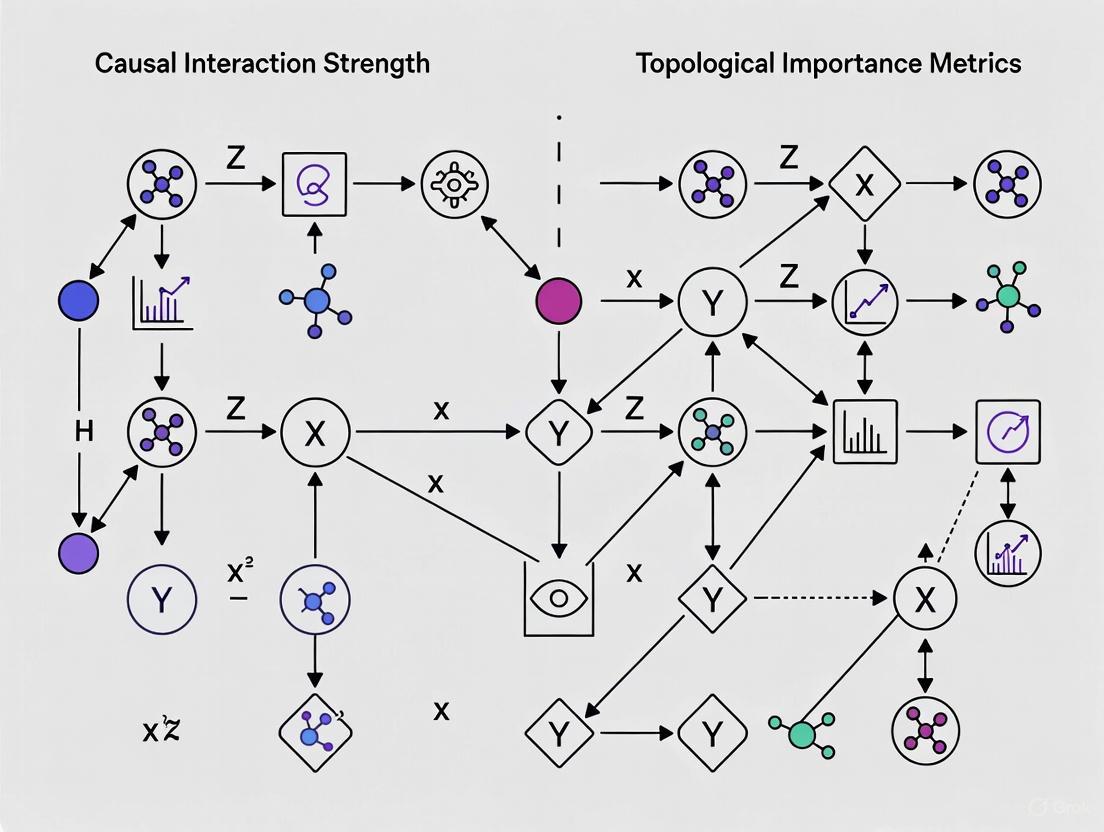
This article provides a comprehensive exploration of causal interaction strength and topological importance (TI) metrics, essential tools for deciphering complex biological networks.
Causal Interaction Strength and Topological Importance Metrics: From Network Theory to Drug Discovery
Abstract
This article provides a comprehensive exploration of causal interaction strength and topological importance (TI) metrics, essential tools for deciphering complex biological networks. Aimed at researchers, scientists, and drug development professionals, it covers the foundational principles of quantifying causal asymmetry and node centrality within networks. The scope extends to methodological applications in predicting drug-target interactions and identifying therapeutic targets, addresses troubleshooting and optimization challenges in causal inference, and offers a comparative analysis of validation techniques. By synthesizing insights from ecology, computational biology, and AI-driven drug discovery, this review serves as a guide for leveraging these powerful metrics to accelerate biomedical research and development.
Unraveling Complexity: The Core Principles of Causal and Topological Metrics
In the evolving landscape of data analysis and network science, accurately defining and quantifying causal interaction strength represents a fundamental challenge with significant implications across scientific domains, including pharmaceutical research and drug development. Causal interaction strength moves beyond mere correlation to capture the direction, magnitude, and asymmetry of influence between variables within a complex system. The emerging field of causal interaction strength topological importance metrics research provides sophisticated frameworks for disentangling these complex relationships, offering researchers powerful tools to identify key drivers in biological networks, prioritize therapeutic targets, and understand system dynamics.
Traditional correlation-based analyses often fail to reveal the directional influences and feedback mechanisms that characterize complex biological systems. The integration of asymmetry analysis with topological metrics enables researchers to transition from undirected associations to directed causal networks, revealing hierarchical structures and dominant influence patterns. This methodological evolution is particularly relevant for drug development professionals seeking to understand signaling pathway dynamics, identify master regulator genes in disease networks, and predict system responses to therapeutic interventions. This guide provides a comprehensive comparison of experimental protocols, quantitative metrics, and visualization frameworks for defining causal interaction strength, with specific application to biomedical research contexts.
Quantitative Metrics for Causal Strength Analysis
Core Metric Definitions and Comparisons
Quantifying causal interaction strength requires multiple complementary metrics, each capturing distinct aspects of directional influence. The table below summarizes the primary quantitative measures used in causal network analysis:
Table 1: Core Metrics for Causal Interaction Strength Analysis
| Metric Category | Specific Metric | Mathematical Definition | Interpretation | Typical Range |
|---|---|---|---|---|
| Asymmetry Indices | Net Causal Flow | Outgoing strength - Incoming strength [1] | Net influence of a node; positive values indicate sources, negative values indicate sinks | (-∞, +∞) |
| Causal Asymmetry Ratio | Relative dominance of outgoing versus incoming influence | [0, 1] | ||
| Directional Strength Metrics | Effective Connectivity (EC) | State matrix in dynamical causal modeling [1] | Direct, directional causal influence between nodes | (-∞, +∞) |
| Differential Cross-Covariance | Measures information flow and time-irreversibility [1] | (-∞, +∞) | ||
| Topological Importance | Persistence-Weighted Importance | Learned weight × persistence [2] | Importance of topological features for classification tasks | [0, +∞) |
| Reweighted Persistence Density | Learned metric on persistence diagram density [2] | Regional importance of topological features in defining classes | [0, +∞) |
Advanced Composite Metrics
For complex biological systems, researchers often employ composite metrics that integrate multiple dimensions of causal influence:
Table 2: Advanced Composite Metrics for Causal Analysis
| Metric Name | Component Metrics | Integration Method | Application Context |
|---|---|---|---|
| Spatio-Temporal Causal Index | Spatial dependence, temporal variation, bidirectional causality [3] | STCCM (Spatio-Temporal Convergent Cross Mapping) | Urban systems and traffic dynamics; adaptable to cellular signaling networks |
| Bidirectional Asymmetry Score | Forward causal strength, reverse causal strength | Forward strength - Reverse strength / Forward strength + Reverse strength | Quantifying feedback loop dominance in regulatory networks |
| Topological Causal Centrality | Net causal flow, node betweenness, persistence weight | Weighted sum of normalized metric values | Identifying master regulators in gene regulatory networks |
Experimental Protocols for Causal Analysis
Protocol 1: Effective Connectivity Mapping with fMRI Data
This protocol adapts methods from brain network research [1] for pharmacological applications:
Objective: To quantify directional influences between nodes in a biological network using time-series data.
Materials Required:
- High-temporal-resolution time-series data (e.g., calcium imaging, phosphoproteomics, gene expression)
- Computational environment with linear algebra capabilities (MATLAB, Python with NumPy/SciPy)
- Statistical software for multiple comparison correction
Procedure:
- Data Preprocessing: Detrend, filter, and normalize time-series data for each network node.
- Model Specification: Implement a linear state-space model: dx/dt = Ax + w, where A is the effective connectivity matrix to be estimated.
- Parameter Estimation: Use maximum likelihood or Bayesian methods to estimate the effective connectivity matrix.
- Asymmetry Decomposition: Separate the effective connectivity matrix into symmetric and antisymmetric components.
- Statistical Validation: Apply permutation testing or bootstrapping to establish significance of directional influences.
- Network Visualization: Represent significant causal interactions as a directed network graph.
Key Output: An asymmetric effective connectivity matrix where element Aij represents the causal influence of node i on node j.
Protocol 2: Topological Importance Mapping with Persistence Diagrams
This protocol adapts topological data analysis approaches [2] for causal inference:
Objective: To identify which topological features in data are important for defining class differences (e.g., diseased vs. healthy states).
Materials Required:
- High-dimensional dataset with class labels
- Topological data analysis software (e.g., GUDHI, JavaPlex)
- Metric learning framework (e.g., PyTorch, TensorFlow)
Procedure:
- Persistence Diagram Generation: For each sample, compute persistence diagrams capturing topological features across dimensions.
- Density Estimation: Convert each persistence diagram to a vectorized density estimate.
- Metric Learning: Train a deep metric learning classifier to distinguish classes based on persistence densities.
- Importance Field Extraction: Extract the learned weights from the classifier to create an importance field over the persistence diagram.
- Feature Mapping: Project important topological features back to the original data space to identify their structural correlates.
- Causal Hypothesis Generation: Formulate testable hypotheses about how identified topological features causally influence class membership.
Key Output: An importance field highlighting regions of the persistence diagram most relevant for class discrimination.
Visualization Frameworks for Causal Networks
Workflow for Causal Interaction Analysis
The following diagram illustrates the complete workflow for analyzing causal interactions from data collection to network visualization:
Diagram Title: Causal Analysis Workflow
Causal Network Architecture with Asymmetry
This diagram illustrates a directed causal network with asymmetric interaction strengths, highlighting sources, sinks, and bidirectional relationships:
Diagram Title: Asymmetric Causal Network
Research Reagent Solutions for Causal Analysis
Essential Materials and Tools
Table 3: Research Reagent Solutions for Causal Interaction Studies
| Category | Specific Tool/Reagent | Function in Causal Analysis | Example Applications |
|---|---|---|---|
| Data Acquisition | High-temporal-resolution live-cell imaging systems | Captures dynamic cellular processes for time-series analysis | Calcium signaling, protein translocation |
| Phosphoproteomics platforms | Quantifies post-translational modifications across time | Kinase activity profiling, signaling pathway dynamics | |
| Single-cell RNA sequencing | Measures gene expression dynamics at single-cell resolution | Gene regulatory network inference | |
| Computational Tools | Linear State-Space Modeling software (MATLAB, Python) | Estimates effective connectivity matrices from time-series data [1] | Brain network analysis, cellular signaling |
| Topological Data Analysis libraries (GUDHI, JavaPlex) | Computes persistent homology and generates persistence diagrams [2] | Identification of important topological features in data | |
| Metric Learning frameworks (PyTorch, TensorFlow) | Learns importance weights for topological features [2] | Classification of biological states based on topological structure | |
| Visualization Platforms | Graph visualization tools (Cytoscape, Gephi) | Creates interactive visualizations of directed causal networks | Network pharmacology, pathway analysis |
| Custom scripting (D3.js, Graphviz) | Generates publication-quality diagrams of causal relationships | Scientific communication, hypothesis generation |
Comparative Analysis of Methodological Approaches
Performance Across Data Types
The table below compares the performance of different causal analysis methods across various data characteristics relevant to drug development:
Table 4: Method Performance Across Data Types
| Method | Temporal Data | Static Data | High-Dimensional Data | Nonlinear Relationships | Implementation Complexity |
|---|---|---|---|---|---|
| Effective Connectivity | Excellent [1] | Poor | Moderate | Limited | High |
| Spatio-Temporal CCM | Excellent [3] | Poor | High | Excellent [3] | Very High |
| Topological Importance | Good | Excellent [2] | Excellent [2] | Good | High |
| Cross-Correlation | Good | Fair | Low | Poor | Low |
| Granger Causality | Excellent | Poor | Low | Limited | Moderate |
Application to Pharmaceutical Research Questions
Different causal analysis methods are suited to specific research questions in drug development:
Table 5: Method Selection Guide for Pharmaceutical Applications
| Research Question | Recommended Method | Key Metrics | Data Requirements |
|---|---|---|---|
| Target identification in signaling networks | Effective Connectivity | Net causal flow, asymmetric ratio [1] | Time-series phosphoproteomics |
| Mechanism of action studies | Topological Importance Mapping | Persistence-weighted importance [2] | Multiplexed imaging, transcriptomics |
| Polypharmacology prediction | Spatio-Temporal CCM | Bidirectional causality, asymmetry score [3] | Multi-scale omics data |
| Resistance mechanism elucidation | Integrated Causal Topology | Causal centrality, importance field | Longitudinal single-cell data |
| Drug combination synergy | Multivariate Causal Inference | Interaction information flow | Dose-response time-series |
The field of causal interaction strength analysis has evolved significantly from basic asymmetry analysis to sophisticated directed network models. The integration of topological importance metrics with causal inference frameworks provides researchers with powerful tools to dissect complex biological systems and identify key intervention points. For drug development professionals, these approaches offer a more principled foundation for target identification, mechanism elucidation, and therapeutic strategy optimization. As these methods continue to mature, they promise to enhance the efficiency and success rates of pharmaceutical research by providing deeper insights into the causal architecture of disease and treatment response.
Topological Importance (TI) metrics provide a powerful framework for quantifying the centrality of nodes and their indirect influences within complex networks. Unlike simple local measures such as node degree, TI metrics capture the global structural role of a node by leveraging concepts from graph theory and algebraic topology. In the context of causal interaction strength research, these metrics are indispensable for moving beyond pairwise correlations to uncover higher-order interactions and synergistic relationships that define complex biological systems. The analysis of infrastructure networks reveals that topological measures broadly fall into two types: global measures, which quantify network attributes like accessibility and connectivity as a single value, and local measures, which quantify the contribution of an individual network component (i.e., node or link) in maintaining those network attributes [4]. In molecular sciences and drug development, TI metrics have enabled breakthroughs in understanding biomolecular stability, protein-ligand interactions, and viral evolution by extracting robust, multiscale, and interpretable features from complex data [5].
The fundamental principle underlying TI metrics is that the importance of any network component cannot be assessed in isolation but must be evaluated within the context of the entire network topology. This approach is particularly valuable for identifying critical control points in biological networks and potential drug targets, as it can reveal nodes whose influence extends far beyond their immediate neighbors. Research on distributed average algorithms has demonstrated that topological features of a network fundamentally determine its functional performance and convergence behavior, highlighting the practical significance of these structural metrics [6].
Comparative Analysis of Key Topological Metrics
Fundamental Graph Theory Metrics
Table 1: Traditional Graph Theory Metrics for Node Centrality
| Metric Name | Computational Complexity | Key Strengths | Key Limitations | Biological Applications | ||||
|---|---|---|---|---|---|---|---|---|
| Degree Centrality | O( | E | ) | Simple, intuitive, fast to compute | Purely local perspective, ignores network context | Identification of highly connected proteins in interactomes | ||
| Betweenness Centrality | O( | V | E | ) for unweighted | Identifies bridge nodes and bottlenecks | Computationally intensive for large networks | Finding critical control points in metabolic pathways | |
| Closeness Centrality | O( | V | E | ) for unweighted | Measures propagation speed to all nodes | Less meaningful in disconnected networks | Identifying cell types that efficiently communicate across tissues | |
| Eigenvector Centrality | O( | V | + | E | ) per iteration | Incorporates importance of neighbors | May overemphasize tightly-connected clusters | Ranking nodes in gene regulatory networks |
| Average Nearest Neighbor Degree | O( | E | ) | Captures assortativity patterns | Limited to direct neighborhood | Characterizing hub connectivity patterns in protein-protein interaction networks |
Advanced Topological Data Analysis Metrics
Table 2: Advanced Topological Data Analysis Metrics
| Metric Name | Computational Complexity | Key Strengths | Key Limitations | Biological Applications | ||
|---|---|---|---|---|---|---|
| Persistent Homology | O(2^( | V | )) in worst case | Captures multiscale topological features | Computational challenges for large complexes | Mapping multiscale organization of biomolecular structures [5] |
| Betti Curves | Dependent on filtration steps | Robust to noise, provides multiscale view | Requires appropriate filtration scheme | Classifying neurodegenerative diseases from brain networks [7] | ||
| Persistent Laplacians | Higher than persistent homology | Provides both topological and geometric information | Recent method, less established | Biomolecular stability analysis [5] | ||
| k-Multivariate Mutual Information (I_k) | O(2^n) for n variables | Quantifies higher-order statistical dependencies | Interpretation challenges with negativity | Identifying synergistic gene regulatory modules [8] |
Experimental Protocols and Performance Validation
Protocol 1: Comparative Evaluation of Topological Approaches in Neurodegenerative Disease Classification
Objective: To evaluate the effectiveness of Betti curves versus graph-theoretical metrics in distinguishing people with multiple sclerosis (PwMS) from healthy volunteers (HV) using structural connectivity, morphological gray matter, and resting-state functional networks [7].
Methodology:
- Data Acquisition: Acquire magnetic resonance imaging (MRI) data including diffusion MRI for structural connectivity, T1-weighted MRI for morphological gray matter networks, and resting-state fMRI for functional networks.
- Network Construction: Construct brain networks for each modality using standardized parcellation schemes to define nodes and appropriate similarity measures to define edges.
- Feature Extraction:
- Compute graph-theoretical metrics including node degree, efficiency, and centrality measures
- Generate Betti curves using persistent homology to track the evolution of topological features across multiple scales
- Multimodal Integration: Implement both feature concatenation and multilayer graph architectures to combine information across modalities.
- Classification: Train machine learning classifiers (e.g., Support Vector Machines) using leave-one-out cross-validation to distinguish PwMS from HV.
Key Results: Features extracted using Betti curves generally outperformed those based on graph-theoretical metrics across all network types. The multimodal integration approaches provided more comprehensive representation of alterations in complex brain mechanisms associated with MS, leading to improved classification performance [7].
Protocol 2: Class-Driven Visualization of Topological Feature Importance
Objective: To develop and validate a method for visualizing the importance of topological features that define classes of data, adapting explainable deep learning approaches for use in topological classification [9].
Methodology:
- Input Data Preparation: Process input data (graphs, 3D shapes, or medical images) and compute persistence diagrams that encode topological features.
- Density Estimation: Create a density estimator of the points of a persistence diagram to serve as input to the learning model.
- Metric Learning: Employ a learned metric classifier that learns to reweigh the persistence density such that classification accuracy is maximized.
- Importance Extraction: Extract the learned weights to create an importance field on persistent point density.
- Visualization: Generate intuitive representations of persistence point importance using two approaches:
- Visualization directly on each persistence diagram
- For sublevel set filtrations on images, visualization directly on the images themselves
Key Results: The approach successfully identified and visualized biologically relevant topological features in graph, 3D shape, and medical image data, providing intuitive representations of which topological structures are important for classification tasks [9].
Figure 1: Topological Feature Importance Workflow
The Scientist's Toolkit: Essential Research Reagents and Solutions
Table 3: Essential Computational Tools for Topological Analysis
| Tool Name | Primary Function | Application Context | Key Features | Accessibility |
|---|---|---|---|---|
| GUDHI Library | Topological Data Analysis | General purpose TDA | Comprehensive persistent homology implementation, Python interface | Open source [10] |
| PHAT | Persistent Homology Algorithms | Computational topology | Efficient boundary matrix reduction | Open source [11] |
| DIPHA | Distributed Persistent Homology | Large-scale data analysis | MPI-based distributed computation | Open source [11] |
| Giotto-tda | Machine Learning with TDA | Integrating TDA in ML workflows | scikit-learn compatible API | Open source [11] |
| JavaPlex | Persistent Homology | Computational topology | Java-based, with MATLAB integration | Open source [11] |
| TDAstats | R package for TDA | Statistical analysis | Pipeline from data to persistence diagrams | Open source [11] |
Integration with Causal Interaction Strength Research
In causal interaction strength research, topological importance metrics provide the structural foundation upon which causal relationships can be mapped and quantified. The integration of these approaches enables researchers to distinguish between mere correlation and genuine causation by contextualizing interactions within the global network architecture. Studies on infrastructure networks have demonstrated that topological measures are critical for understanding vulnerability patterns, with different metrics capturing complementary aspects of network reliability, connectivity, and criticality [4].
The k-multivariate mutual information (Ik) framework offers particular promise for causal analysis as it can quantify higher-order statistical dependencies that often reflect causal interactions in biological systems. The positivity of Ik identifies variables that co-vary the most in a population, whereas negativity identifies synergistic clusters and the variables that differentiate or segregate the most [8]. This approach has been successfully applied to analyze genetic expression data for unsupervised cell-type classification, demonstrating its power to unravel biologically relevant subtypes from complex molecular data.
Figure 2: Causal-Topology Framework Relationship
Recent advances in topological deep learning (TDL) have further strengthened the connection between topological importance and causal interaction strength. TDL integrates topological data analysis with deep neural networks, creating a new paradigm for rational learning that has demonstrated remarkable success in predicting protein-ligand interactions, characterizing viral evolution mechanisms, and precisely predicting emerging dominant SARS-CoV-2 variants [5]. These approaches excel at identifying the persistent topological features that serve as robust predictors of biological behavior and causal outcomes.
Correlation analyses across transportation networks have revealed that local topological metrics often retain high explanatory power for global network performance while being computationally more efficient to calculate [12]. This principle extends to biological networks, where local topological importance metrics can provide insights into causal interaction strengths without requiring exhaustive computation of global network properties, enabling more scalable analyses of large-scale biological systems.
Topological Importance metrics represent a powerful paradigm for quantifying node centrality and indirect influences in complex biological networks. The comparative analysis presented in this guide demonstrates that while traditional graph metrics provide a foundational understanding of local network properties, advanced topological data analysis approaches offer superior capabilities for capturing multiscale organization and higher-order interactions critical for understanding biological systems. The experimental protocols validate that topological methods consistently outperform conventional graph-theoretical approaches in classification tasks relevant to disease characterization and drug development.
The integration of TI metrics with causal interaction strength research provides a robust framework for moving beyond correlation to causation in biological network analysis. As topological deep learning continues to evolve, these approaches will play an increasingly important role in drug discovery, enabling researchers to identify critical intervention points in disease networks and optimize therapeutic strategies based on a fundamental understanding of network topology and dynamics.
This guide provides a comparative analysis of three foundational theoretical frameworks used in the study of complex systems, with a specific focus on their application in causal interaction strength and topological importance metrics for drug development research.
Theoretical Frameworks Comparison
The following table summarizes the core principles, key metrics, and primary applications of each theoretical foundation in the context of biological and pharmacological research.
| Theoretical Foundation | Core Principles & Mathematical Formulations | Key Topological & Causal Metrics | Primary Applications in Drug Discovery |
|---|---|---|---|
| Information Theory | Quantifies information flow and statistical dependencies between system components. Key measures include Transfer Entropy and Mutual Information [13]. | • Joint Dimension ((DJ)): Intrinsic dimension of the combined system manifold [13].• Manifold Dimensions ((DX, D_Y)): Intrinsic dimensions of individual subsystems [13]. | Inferring causal relations in gene regulatory networks and from electrophysiological data (e.g., EEG) to identify driver nodes or epicenters of disease [13]. |
| Network Controllability | Models a system as a network where dynamics are governed by (\dot{x}(t) = Ax(t) + Bu(t)). Aims to identify how to steer system states with external inputs (u(t)) [14] [15] [16]. | • Average Controllability: A node's capacity to drive the network toward easily reachable states [14] [15].• Modal Controllability: A node's capacity to drive the network toward difficult-to-reach states [15].• Control Energy: Energy required for a state transition [14]. | Identifying key driver nodes in protein-protein interaction networks and predicting drug targets. Analyzing how brain network topology constrains dynamics in neurological disorders [15] [17]. |
| System Dynamics | Uses qualitative mapping of cause-effect relationships and feedback loops to understand complex system behavior. Often employs Causal Loop Diagrams (CLDs) [18]. | • Feedback Loops (Reinforcing 'R', Balancing 'B'): Circular cause-effect relationships that govern system behavior [18].• Causal Links with Polarity (+, -): Indicates how variables influence each other [18]. | Modeling complex systems in public health policy and strategic planning for drug development. Anticipating unintended consequences of interventions [18]. |
Detailed Experimental Protocols
Causal Inference via Manifold Intrinsic Dimension
Objective: To distinguish and assign probabilities to all possible causal relations (unidirectional, bidirectional, independent, common cause) between two dynamical systems from observed time series data [13].
- Time Delay Embedding: For each time series, reconstruct the attractor manifold using time-delay embedding, as per Takens' Theorem [13].
- Intrinsic Dimension Estimation: Calculate the intrinsic dimension (e.g., correlation dimension, Rényi information dimension) for each individual embedded manifold ((DX) and (DY)) and for the joint embedded manifold ((D_J)) [13].
- Causal Relation Diagnosis: Use the relationship between (DX), (DY), and (DJ) to diagnose the causal structure [13]:
- Independence: (DX + DY = DJ)
- Unidirectional Causality: (DJ = \max(DX, DY)) and (DX \neq DY)
- Bidirectional Causality or Generalized Synchrony: (DX = DY = DJ)
- Hidden Common Cause: (DJ < DX + DY) and (DJ > \max(DX, DY))
Network Controllability Analysis of Structural Connectomes
Objective: To quantify the control capacity of different brain regions from diffusion tensor imaging (DTI) data and identify aberrations in neurological disorders [15].
- Network Construction: Preprocess DTI data and perform whole-brain tractography. Parcellate the brain into regions (nodes) and construct a structural connectivity matrix (A) where elements represent the connection strength between regions [15].
- Controllability Metric Calculation: For each brain region (j), simulate it as a driver node by setting the input matrix (B = ej). Calculate the controllability Gramian [15]. Compute key metrics:
- Statistical Analysis: Compare whole-brain, network-level, and regional-level controllability metrics between patient and control groups using appropriate statistical tests (e.g., t-tests) with multiple comparisons correction [15].
Topological Drug Target Prediction (TREAP Algorithm)
Objective: To infer drug targets by leveraging network topology and gene expression data [17].
- Data Acquisition: Obtain a protein-protein interaction (PPI) network (e.g., from STRING database) and drug-induced gene expression data (e.g., microarray from GEO) [17].
- Topological Feature Calculation: Compute the betweenness centrality for each node (protein) in the PPI network. Betweenness quantifies the number of shortest paths passing through a node, indicating its topological importance [17].
- Differential Expression Analysis: Process gene expression data to calculate log fold change (LFC) and Benjamini-Hochberg adjusted p-values for all genes post-treatment [17].
- Target Ranking: Combine the two metrics. Rank potential drug targets based on a combination of their high betweenness centrality in the network and the statistical significance of their expression change in response to the drug [17].
The Scientist's Toolkit: Research Reagent Solutions
| Reagent / Resource | Function in Research | Example Source / Implementation |
|---|---|---|
| Structural Connectome | Represents the physical white matter connections in the brain, forming the matrix (A) for controllability analysis [15]. | Derived from Diffusion Tensor Imaging (DTI) data using tractography software (e.g., PANDA toolkit) [15]. |
| Protein-Protein Interaction (PPI) Network | Serves as the scaffold for network-based drug target prediction, defining the topological relationships between proteins [17]. | Public databases like STRING; can be refined with confidence score thresholds [17]. |
| igraph R Package | A library for network analysis and graph theory computations, used for calculating topological metrics like betweenness and degree [17]. | Available from CRAN (The Comprehensive R Archive Network). |
| Gene Expression Omnibus (GEO) | A public repository for high-throughput gene expression data, providing essential datasets for drug response studies [17]. | National Center for Biotechnology Information (NCBI). |
| limma R Package | A tool for the analysis of gene expression data, particularly for fitting linear models and conducting differential expression analyses to generate adjusted p-values [17]. | Available from Bioconductor. |
| Network Control Theory for Python (nctpy) | A Python software package providing tools for calculating network controllability metrics, including average controllability and control energy [14]. | Python Package Index (PyPI) or GitHub. |
Workflow and Relationship Diagrams
Causal Inference via Manifold Dimensions
Network Controllability Analysis
TREAP: Drug Target Prediction
In the study of biological systems and the development of new therapeutics, complexity is a fundamental challenge. Systems ranging from intracellular signaling pathways to entire ecosystems operate through intricate networks of interactions where the behavior of the whole cannot be predicted by simply summing the parts. Causal interaction strength topological importance (TI) metrics have emerged as a powerful framework for cutting through this complexity, offering researchers a quantitative lens to identify critical components, predict system behavior, and optimize interventions. Unlike traditional metrics that may only capture static properties or isolated effects, TI metrics specialize in quantifying the influence of individual elements—such as a protein, gene, or species—within a networked system by considering both direct and indirect causal pathways. This analytical shift is transforming how scientists approach problems in network biology and drug discovery, moving from a reductionist view of single targets to a holistic understanding of system-wide dynamics.
The core power of these metrics lies in their ability to move beyond correlation to infer causal influence within networks. In a biological context, this means distinguishing between entities that are merely associated with a particular outcome and those that genuinely drive or control it. For instance, in a protein-protein interaction network, a protein with high degree centrality (many connections) might seem important, but a topological importance analysis could reveal that a less-connected protein acts as a critical bridge or bottleneck, making it a more potent intervention target. By formally capturing this notion of causal influence through the asymmetry of effects within a network, TI metrics provide a more nuanced and predictive map of system functionality [19]. This article provides a comparative guide to the application of these metrics, framing them within a broader thesis on causal interaction strength and providing the experimental protocols and data frameworks needed for their implementation in biological research.
Quantitative Comparison of Key Metric Classes
The application of network-based metrics in biology and drug discovery can be broadly categorized into several classes, each with distinct strengths, limitations, and optimal use cases. The following table summarizes the key features of these metric categories for easy comparison.
Table 1: Comparative Analysis of Metric Categories in Biological Research
| Metric Category | Key Examples | Primary Applications | Data Requirements | Advantages | Limitations |
|---|---|---|---|---|---|
| Topological Importance (TI) & Causal Metrics | TIn Index, Interaction Asymmetry (A), PageRank [19] [20] | Food web stability analysis [19], Risk pathway identification [20], Target vulnerability assessment | Network topology (nodes & links), Interaction strengths | Identifies critical causal drivers, accounts for indirect effects, reveals system leverage points. | Network construction can be complex; sensitive to threshold selection. |
| Information-Theoretic Metrics | Total Correlation, Dual Total Correlation, O-Information [21] | Quantifying synergy/redundancy in neural systems [21], Analyzing higher-order interactions in omics data | Multivariate time-series or state data | Captures non-linear, higher-order dependencies beyond pairwise correlations. | High computational cost; requires substantial data for reliable estimation. |
| Traditional Centrality Metrics | Degree, Betweenness, Eigenvector Centrality [22] | Preliminary network analysis, Identifying hubs in protein-protein interaction networks | Network topology | Simple to compute and interpret; well-established benchmarks. | Often misses functional criticality and causal roles; focuses on structure over dynamics. |
| Deep Learning-Based Metrics | Graph Neural Networks (GNNs), Causal Node Embeddings [22] | Cross-network generalization for drug target identification, Robust node importance ranking | Network topology and/or node features | High representational power; can generalize across networks. | Can be a "black box"; requires significant training data; may not capture causal relationships without specific design [22]. |
Experimental Protocols for Key Applications
Protocol 1: Identifying Critical Species in Ecological Networks with Asymmetry Analysis
This protocol details the method for applying topological importance metrics to food web data to identify species with outsized causal influence on ecosystem functioning, as derived from the analysis of 34 food web models [19].
1. Objective: To identify keystone species and the dominant direction of causal effects (bottom-up vs. top-down) in a food web by constructing an asymmetry graph. 2. Materials & Reagents:
- Ecobase or Similar Database: A repository of ecological network models with trophic interaction data [19].
- R Statistical Software: Primary computational environment.
topoWebR Package: Custom package for calculating TI indices and asymmetry values.igraphR Package: For general network construction and analysis. 3. Procedure: a. Data Acquisition and Preparation: Obtain a binary, undirected food web model from a curated database. Filter the data to include only networks of a relevant size (e.g., >50 nodes) and remove duplicate temporal models to ensure independence. b. TI Index Calculation: Calculate the Topological Importance index (TIn) for all pairs of nodes (species) in the network. This index quantifies the effect of one species on another, incorporating indirect interactions up to n steps. A common and ecologically meaningful choice is TI³, which captures effects over three steps [19]. c. Asymmetry Calculation: For every pair of species (i, j), compute the asymmetry of their interaction using the formula: A = |TI³ᵢⱼ - TI³ⱼᵢ|. This quantifies the degree to which the influence of i on j differs from the influence of j on i. d. Asymmetry Graph Construction: Apply a threshold to the asymmetry values to isolate the most significant causal links. For instance, retain the top 1% of all possible pairwise interactions based on their asymmetry value (A). These links form a directed asymmetry graph, where a link from i to j indicates that i has a dominantly causal effect on j. e. Analysis and Interpretation: * Count the number of bottom-up (BUag) and top-down (TDag) links in the asymmetry graph. * Identify source nodes (only outward effects) and sink nodes (only inward effects). * Correlate these structural properties of the asymmetry graph with functional ecosystem metrics like Total Biomass (TB). A positive correlation between BUag and TB, for example, indicates systems with stronger bottom-up causal forces support greater biomass [19]. 4. Data Interpretation: The resulting asymmetry graph simplifies the complex web of interactions into a core set of dominant causal pathways. Species with high out-degree in this graph are potential keystone drivers, and the balance between BUag and TDag reveals the primary mode of control in the ecosystem.
Protocol 2: Mapping Causal Risk Networks in Air Traffic Control for Biomedical Safety
This protocol adapts a methodology that integrates text mining and causal network analysis—originally developed for safety operations [20]—to a biomedical context, such as analyzing patient safety incident reports or drug adverse event narratives.
1. Objective: To transform unstructured textual reports of safety incidents or adverse events into a structured causal network to identify critical risk factors and their interrelationships. 2. Materials & Reagents:
- Text Corpus: A collection of unstructured safety reports (e.g., FDA Adverse Event Reporting System - FAERS).
- BERTopic Model: A deep learning-based topic modeling technique for semantic analysis of text.
- Network Analysis Tool:
igraph(R/Python) orNetworkX(Python). - Domain-Specific Stopword List & Custom Dictionary: To improve text mining accuracy for biomedical terminology. 3. Procedure: a. Data Preprocessing: Collect and clean the text reports, removing irrelevant entries and duplicates. Expand abbreviations and apply the custom dictionary and stopword list during tokenization. b. Text Mining with BERTopic: Apply the BERTopic model to the preprocessed text. This model uses BERT embeddings to identify latent risk themes and extract representative keywords from the reports, grouping similar incidents based on semantic meaning [20]. c. Risk Factor Representation: Based on the extracted topics and domain knowledge, establish a structured framework of risk factors (e.g., "communication error," "equipment failure," "training deficit"). d. Causal Network Construction: Manually or semi-automatically annotate event chains from the incident narratives. Use these to construct a directed Causal Network for safety, where nodes represent risk factors and a directed edge from factor A to factor B indicates that A is a cause of B. e. Topological & Vulnerability Analysis: Analyze the constructed network using graph theory metrics to identify critical risk nodes. * PageRank: Identifies nodes that are highly influential by virtue of being pointed to by other important nodes. * Betweenness Centrality: Highlights nodes that act as bridges on many shortest paths, indicating potential bottlenecks in the risk propagation process [20]. 4. Data Interpretation: Nodes with high PageRank and betweenness centrality represent high-priority risk factors that are both central causes and key propagation points within the system. Interventions targeting these nodes can be most effective at reducing overall system risk.
The following diagram illustrates the core workflow for this causal analysis, adaptable to both ecological and biomedical contexts.
The Scientist's Toolkit: Essential Research Reagents & Solutions
Implementing the methodologies described requires a combination of data, software, and computational resources. The following table details key components of the research toolkit.
Table 2: Essential Reagents and Tools for Causal Metric Analysis
| Tool/Reagent | Type | Function/Application | Example Use Case |
|---|---|---|---|
| Ecobase / Interaction Databases | Data Resource | Curated repository of ecological or biological network data. | Sourcing food web data for stability analysis [19]. |
| FAERS / Internal Safety Reports | Data Resource | Database of unstructured text reports on adverse events or safety incidents. | Identifying latent risk factors in clinical workflows [20]. |
R Statistical Software + topoWeb |
Software | Core computing environment with custom package for TI and asymmetry calculation. | Executing Protocol 1 for ecological networks [19]. |
Python + NetworkX/igraph |
Software | Library for the creation, manipulation, and study of complex networks. | General network construction and centrality analysis. |
| BERTopic Model | Software Algorithm | Deep learning model for topic modeling based on semantic similarity. | Extracting risk themes from textual incident reports [20]. |
| PageRank Algorithm | Computational Metric | Measures the transitive influence or importance of nodes in a network. | Ranking target proteins in a PPI network by their causal influence [20]. |
| Betweenness Centrality | Computational Metric | Identifies nodes that act as bridges or bottlenecks in a network. | Finding critical, non-hub targets in a disease signaling pathway [20]. |
Cross-Domain Comparative Analysis & Discussion
The comparative analysis in Section 2 reveals a critical evolution in metric philosophy: from descriptive to causal and from local to global. Traditional centrality metrics provide a valuable first pass but are often inadequate for predicting the functional outcome of a perturbation. For example, in a biological network, a high-degree node (hub) may be essential, but its removal might not cause system failure if the network contains redundant pathways. Conversely, a node with low degree but high betweenness centrality might be a critical bottleneck, and its failure could be catastrophic.
This is where Topological Importance and causal metrics demonstrate their superior predictive power. By incorporating indirect effects and, crucially, the asymmetry of interactions, they map the actual flow of influence and control within a system [19]. The application to food webs shows that ecosystems with greater total biomass are characterized by stronger bottom-up causal links (BUag), a finding that a simple link-counting centrality metric would likely miss. This highlights the utility of TI metrics in moving beyond structure to explain function.
Similarly, information-theoretic approaches offer a complementary but distinct lens. They are not based on a pre-defined network topology but instead infer the structure of interactions directly from multivariate data. Metrics like the dual total correlation are specifically designed to quantify "synergy"—information that is only available from the joint state of three or more variables and not from any subset [21]. This is directly applicable to complex biological systems where higher-order interactions are common, such as in neuronal networks or genetic regulatory circuits, where a combination of several genes (a pathway) produces an effect that cannot be attributed to any single one. A key finding is that these synergistic information structures have been shown to correlate with topological features like three-dimensional cavities in data manifolds, suggesting a deep mathematical link between the two frameworks [21].
The following diagram conceptualizes the relationship between different classes of metrics and the complexity of interactions they capture, illustrating the unique position of TI and information-theoretic metrics.
The adoption of causal interaction strength topological importance metrics marks a significant advancement in our ability to dissect and understand complex biological and pharmacological systems. The comparative data and experimental protocols presented in this guide demonstrate that TI metrics and related information-theoretic approaches offer a more nuanced, predictive, and functionally relevant map of system dynamics than traditional graph metrics alone. They enable researchers to move from asking "What is connected?" to "Who controls whom, and how strongly?"
The future of this field lies in greater integration and refinement. Promising directions include the fusion of TI metrics with information theory to develop a unified theory of higher-order interactions [21], the application of these hybrid models to single-cell and spatial omics data for novel drug target discovery, and the development of more robust "influence-aware causal node embedding" methods that can generalize predictions from model systems to real-world human biology [22]. As these tools become more sophisticated and accessible, they will undoubtedly become a standard component of the quantitative biologist's and drug hunter's toolkit, ultimately accelerating the development of safer and more effective therapies that are informed by a deep, causal understanding of disease.
From Theory to Practice: Methodologies and Applications in Biomedicine
Interaction asymmetry analysis and topological indices (TIs) represent complementary computational frameworks for decoding complex relational data across biological, ecological, and chemical domains. These mathematical approaches transform intricate networks into quantifiable metrics that reveal system organization, stability, and function. Topological indices are numerical descriptors derived from graph theory that summarize molecular or network structures based solely on their connectivity patterns [23] [24]. In parallel, interaction asymmetry quantifies directional relationships between components where forces or influences are not reciprocally equal, revealing causal pathways and hierarchical organizations within complex systems [25] [19].
The integration of these frameworks within causal interaction strength topological importance metrics research provides powerful tools for predicting system behavior, identifying critical elements, and understanding response dynamics. For drug development professionals, these approaches enable quantitative assessment of molecular complexity and biological activity relationships without extensive laboratory experimentation [23] [26]. The fundamental premise underpinning these methodologies is that the topological arrangement of elements within a system contains implicit information about that system's functional capabilities and dynamic behaviors [27].
Computational Frameworks: Comparative Analysis
Table 1: Comparative Analysis of Computational Frameworks
| Framework Category | Representative Methods | Primary Applications | Mathematical Basis | Key Output Metrics |
|---|---|---|---|---|
| Topological Indices | Zagreb indices, Randić index, ABC index, Sombor index [23] [24] | Drug discovery, materials science, QSAR/QSPR studies [23] [26] | Graph theory, vertex degrees, connectivity patterns [23] [24] | Numerical descriptors predicting stability, reactivity, bioactivity [23] [24] |
| Interaction Asymmetry Analysis | Topological Importance (TI), asymmetry graphs, flowscape analysis [25] [19] | Ecosystem functioning, neural connectivity, active matter systems [25] [19] [28] | Directional interaction strength, causal pathways [25] [19] | Interaction asymmetry values, causal link identification [25] [19] |
| Multifractal Network Analysis | Node-based Multifractal Analysis (NMFA), structure distance [27] | Complex network characterization, heterogeneity quantification [27] | Multifractal geometry, scaling relationships [27] | Multifractal spectra, complexity and heterogeneity degrees [27] |
| Statistical Validation Methods | Expanded Quadratic Assignment Procedure (EQAP), random/controlled rewiring [29] | Network significance testing, topological metric validation [29] | Permutation tests, edge swapping algorithms [29] | p-values, null distributions, significance assessments [29] |
Performance and Application-Specific Efficacy
Table 2: Performance Characteristics Across Domains
| Framework | Computational Complexity | Data Requirements | Strengths | Limitations |
|---|---|---|---|---|
| Degree-Based Topological Indices | Low to moderate [23] [24] | Molecular structure or network connectivity [23] [26] | Strong predictive power for molecular properties [23] [24]; Extensive validation in QSAR studies [23] | Limited to static structures; Less informative about dynamics [23] |
| Interaction Asymmetry Analysis | Moderate to high [25] [19] | Directed interaction data or time-series observations [25] [19] | Identifies causal pathways [19]; Reveals hierarchical organization [25] | Requires directional data; Sensitive to threshold selection [19] |
| Node-Based Multifractal Analysis | High [27] | Comprehensive network connectivity data [27] | Quantifies structural complexity and heterogeneity [27]; Captures multiscale properties [27] | Computationally intensive; Complex interpretation [27] |
| Statistical Validation Methods | Varies with network size [29] | Network topology data [29] | Robust significance testing [29]; Controls for Type I errors [29] | Method selection critical for accuracy [29] |
Experimental Protocols and Methodologies
Protocol for Topological Index Calculation in Molecular Networks
The computation of topological indices for molecular structures follows a standardized workflow that transforms chemical representations into quantitative descriptors. For benzenoid networks and pharmaceutical compounds, researchers typically implement the following methodology based on established cheminformatics practices [23]:
Molecular Graph Representation: Represent the chemical compound as a mathematical graph G = (V, E), where atoms correspond to vertices (V) and chemical bonds constitute edges (E) [23] [24].
Vertex Degree Assignment: For each vertex ρ ∈ V, calculate the degree Š(ρ) representing the number of edges incident to the vertex [24].
Edge Partitioning: Classify edges based on the degrees of their endpoint vertices, creating distinct edge sets E(Š(ρ), Š(φ)) for each degree pair [23] [26].
Index Computation: Apply specific mathematical formulas to calculate each topological index. For instance:
Validation: Correlate computed indices with experimental physicochemical properties using statistical methods such as linear regression [24] [26].
Figure 1: Workflow for Calculating Topological Indices in Molecular Networks
Protocol for Interaction Asymmetry Analysis in Ecological Networks
Interaction asymmetry analysis has been particularly valuable in ecological contexts for identifying causal relationships in complex food webs. The methodology adapted from Jordan et al. and applied to 34 food web models from the EcoBase database proceeds as follows [19]:
Network Preparation: Compile the food web as a binary, undirected network with species as nodes and trophic interactions as edges [19].
Topological Importance Matrix Calculation: Compute the TI³ matrix capturing indirect effects up to three steps using the formula: TI₍ij₎³ = Σ_{k=1 to 3} [Aᵏ]₍ij₎ / (k × N^(k-1)) where A is the adjacency matrix and N is the number of nodes [19].
Asymmetry Calculation: For each species pair (i,j), calculate the asymmetry value: A = |TI³{ij} - TI³{ji}| This quantifies the directional imbalance in their interaction [19].
Threshold Application: Identify strongly asymmetric effects by applying a threshold (typically the top 1% of all possible interactions) [19].
Asymmetry Graph Construction: Create a directed network containing only the significantly asymmetric interactions, transforming the original food web into a causal dominance network [19].
Metric Extraction: Calculate key properties of the asymmetry graph including:
- Number of bottom-up effects (BUag)
- Number of top-down effects (TDag)
- Ratio of top-down to bottom-up effects (TDag/BUag)
- Number of source nodes with only outward effects (Nsoag)
- Number of sink nodes with only inward effects (Nsiag) [19]
Figure 2: Interaction Asymmetry Analysis Workflow for Ecological Networks
Protocol for Node-Based Multifractal Analysis of Complex Networks
The Node-Based Multifractal Analysis (NMFA) framework quantifies structural complexity and heterogeneity in networks, capturing multiple generating rules that govern network formation [27]:
Box-Growing Algorithm: For each node i in the network, perform a box-growing process:
- Initialize with box size l = 1 containing only node i
- Iteratively increase l and include all nodes within distance l from node i
- For each l, calculate the box mass M_i(l) as the number of nodes in the box [27]
Node-Based Fractal Dimension (NFD): For each node i, estimate its fractal dimension by analyzing the relationship between log(Mi(l)) and log(l) across scales. The NFD represents the power-law exponent in the relationship Mi(l) ∼ l^{NFD} [27].
Partition Function Calculation: For different distortion exponent values q, compute the partition function: Z(q, l) = Σi [Mi(l)]^q where q emphasizes different aspects of the network structure (q > 1 amplifies dense regions, q < 1 emphasizes sparse regions) [27].
Multifractal Analysis: Determine the mass exponent τ(q) from the relationship Z(q, l) ∼ l^{τ(q)} and apply a Legendre transformation to obtain the multifractal spectrum f(α), where α represents the Lipschitz-Hölder exponent characterizing local singularities [27].
Network Characterization: Extract key metrics from the multifractal spectrum:
- Complexity degree (α₀): The value at which f(α) reaches its maximum
- Heterogeneity degree (w): The width of the spectrum w = αmax - αmin
- Structural asymmetry: The skewness of the f(α) curve [27]
Research Reagent Solutions and Essential Materials
Table 3: Essential Research Tools for Implementing Analysis Frameworks
| Tool Category | Specific Solutions | Function/Purpose | Implementation Examples |
|---|---|---|---|
| Software Libraries | topoWeb R package [19] | Calculating topological importance metrics and asymmetry graphs | Food web causality analysis [19] |
| Statistical Platforms | R Statistical Software v4.3.1 with igraph package [19] [29] | Network analysis and correlation testing | Ecosystem indicator development [19] |
| Network Analysis Tools | Custom Python libraries for EQAP [29] | Statistical significance testing of network topology | Controlled rewiring experiments [29] |
| Data Resources | EcoBase database [19] | Source of ecological network models | Food web interaction data [19] |
| Computational Methods | M-polynomial and NM-polynomial frameworks [23] | Computing degree-based topological indices | Benzenoid network characterization [23] |
| Validation Frameworks | Expanded Quadratic Assignment Procedure (EQAP) [29] | Testing statistical significance of network metrics | Comparing original vs. rewired networks [29] |
Integration and Comparative Insights
The comparative analysis of these computational frameworks reveals distinct but complementary strengths. Topological indices excel in quantifying molecular characteristics and predicting physicochemical properties with established correlations to experimental data. For instance, studies demonstrate strong correlation between the Atom-Bond Connectivity (ABC) index and heat of formation in titanium diboride networks (Pearson's r = 0.984) [24]. Similarly, the Geometric-Arithmetic (GA) index shows near-equivalent predictive power (r = 0.972) for the same property [24].
In contrast, interaction asymmetry analysis provides superior capabilities for identifying causal pathways and directional influences within complex systems. Applied to food webs, this approach reveals how total biomass correlates with bottom-up causal links (BUag) and sink nodes (Nsiag), providing ecosystem functioning indicators [19]. The method successfully reduces complexity by focusing on the most asymmetric (1%) of interactions, highlighting the predictable core of interspecific effects [19].
The Node-Based Multifractal Analysis offers unique advantages for characterizing structural complexity and heterogeneity, quantifying how multiple generating rules coexist within a single network [27]. This approach captures multiscale properties that conventional metrics miss, with the width of the multifractal spectrum (w) directly quantifying structural heterogeneity [27].
For drug development applications, integrated approaches leveraging multiple frameworks show particular promise. Topological indices can screen molecular candidates for desired properties, while asymmetry analysis might model biological pathway interactions, together accelerating lead optimization and efficacy assessment [23] [25]. The statistical validation methods ensure that observed network properties represent significant patterns rather than random configurations, a critical consideration in translational research [29].
Figure 3: Integration of Computational Frameworks for Comprehensive Analysis
The paradigm of drug discovery has progressively shifted from a traditional "one-drug-one-target" approach to a more holistic "multi-drugs-multi-targets" model, reflecting the complex polypharmacological profiles of drugs within biological systems [30]. This network-centric perspective is fundamental to understanding both therapeutic effects and safety concerns. Network-based computational methods have emerged as powerful tools for systematically predicting drug-target interactions (DTIs) and drug-drug interactions (DDIs), offering a mechanism-driven framework that accelerates drug repurposing and combination therapy design [31] [32]. These approaches leverage the topological properties of complex biological networks—such as protein-protein interactomes, drug-target networks, and multimodal causal networks—to infer novel interactions and elucidate the mechanisms of drug action [33] [34]. The core premise is that the network-based relationship between drug targets and disease proteins can reveal clinically efficacious drug combinations and identify new therapeutic indications for existing drugs [32]. This guide provides a comparative analysis of prominent network-based methodologies, evaluating their performance, underlying algorithms, and applicability in contemporary drug discovery pipelines, with a specific focus on causal interaction strength and topological importance metrics.
Methodologies and Comparative Performance
Network-based prediction methods can be broadly categorized into several classes based on their underlying algorithmic principles. The table below summarizes the core characteristics and performance of several representative approaches.
Table 1: Comparison of Key Network-Based Prediction Methods
| Method Name | Category | Core Algorithm/Principle | Key Input Data | Reported Performance (AUROC) |
|---|---|---|---|---|
| AOPEDF [35] | Heterogeneous Network Embedding & Machine Learning | Arbitrary-Order Proximity Embedded Deep Forest | 15 integrated biological networks (drug, target, disease) | 0.868 (DrugCentral), 0.768 (ChEMBL) |
| LCP-Based Methods [33] | Unsupervised Topological Link Prediction | Local-Community-Paradigm (LCP) Theory | Bipartite DTI network topology only | Comparable to state-of-the-art supervised methods |
| drug2ways [34] | Causal Path Reasoning | Exhaustive path enumeration over causal networks | Multimodal causal network (drugs, proteins, diseases) | Validated by recovery of clinical trial drug-disease pairs |
| Separation-based Model [32] | Network Proximity & Topology Analysis | Drug-Disease proximity and drug-drug target separation | Human protein-protein interactome, drug targets, disease proteins | Effectively identified validated antihypertensive combinations |
| NBI (Network-Based Inference) [30] | Resource Diffusion Algorithm | Probabilistic spreading (resource allocation) | Known DTI network (bipartite graph) | High accuracy without requiring 3D structures or negative samples |
| Graph Neural Networks [36] | Graph Representation Learning | Graph Convolutional Networks, GraphSAGE, Graph Attention Networks | Drug molecular graphs, DDI networks, knowledge graphs | Competent accuracy on DDI prediction tasks |
Key Methodological Insights
- Unsupervised Topological Methods vs. Supervised Methods: Unsupervised, pure topology-based models like those implementing the LCP theory can achieve performance comparable to state-of-the-art supervised methods that require additional biological knowledge (e.g., chemical structures) [33]. This highlights the significant predictive power inherent in the network structure itself.
- The Advantage of Heterogeneous Data Integration: Methods like AOPEDF, which integrate diverse data types (chemical, genomic, phenotypic) into a heterogeneous network, can achieve high prediction accuracy by preserving complementary proximity information from different biological contexts [35].
- Causal Reasoning for Mechanism Elucidation: Approaches such as drug2ways move beyond correlation by reasoning over causal paths in biological networks, offering direct insights into the mechanism of action and enabling the prediction of polypharmacological effects and combination therapies [34].
Experimental Protocols and Validation Frameworks
Protocol for Network-Based DTI Prediction Using AOPEDF
The AOPEDF framework provides a robust protocol for drug-target interaction prediction, which can be summarized in the following workflow [35]:
Diagram: AOPEDF Workflow for Drug-Target Interaction Prediction
Data Preparation and Benchmarking:
- Data Sources: Collect known DTIs from databases like DrugBank, TTD, and PharmGKB. Gather bioactivity data (Ki, Kd, IC50 ≤ 10 μM) from ChEMBL, BindingDB, and IUPHAR/BPS [35].
- Network Curation: Construct a comprehensive heterogeneous network. This includes:
- Drug Networks: Clinically reported drug-drug interactions, drug-disease associations, drug-side effect associations, chemical similarities, therapeutic similarities, and Gene Ontology (GO)-based similarities [35].
- Target/Protein Networks: Protein-protein interactions, protein-disease associations, protein sequence similarities, and GO-based functional similarities [35].
- Benchmarking: Split data into training and test sets. For external validation, use the latest DTIs from DrugCentral and ChEMBL, strictly excluding any overlaps with the training data [35].
Arbitrary-Order Proximity Embedded Feature Learning:
- The AROPE (Arbitrary-Order Proximity Embedding) algorithm is applied to the integrated heterogeneous network.
- This step learns low-dimensional vector representations for each drug and target node. These embeddings are designed to capture and preserve not just direct connections (first-order proximity) but also higher-order topological relationships within the network [35].
Model Training and Prediction with Deep Forest:
- A cascade deep forest classifier is trained using the learned feature representations of drug-target pairs.
- The deep forest model is chosen for its high performance, robustness to hyperparameters, and adaptive model complexity. Its tree-based nature also aids in generating more interpretable predictions compared to deep neural networks [35].
- The model outputs a prediction score indicating the likelihood of an interaction for a given drug-target pair.
Protocol for Predicting Drug Combinations via Network Proximity
The following protocol, derived from the methodology in [32], details the steps for predicting efficacious drug combinations based on topological relationships within the human interactome.
Diagram: Network-Based Drug Combination Prediction
Network and Data Assembly:
- Interactome: Compile a comprehensive human protein-protein interactome from multiple data sources (e.g., BioGRID, STRING, HPRD) [32].
- Disease Proteins: Compile a set of proteins known to be associated with the disease of interest (the "disease module," D) from databases like OMIM and DisGeNET [32].
- Drug Targets: For each drug, compile its set of known protein targets from databases like DrugBank and ChEMBL (drug-target modules A and B) [32].
Topological Metric Calculation:
- Drug-Drug Separation (( s{AB} )):
- Compute the mean shortest path length between targets of drug A (( \langle d{AA} \rangle )) and drug B (( \langle d{BB} \rangle )).
- Compute the mean shortest path length between targets of drug A and B (( \langle d{AB} \rangle )).
- Calculate the separation: ( s{AB} \equiv \langle d{AB} \rangle - \frac{\langle d{AA} \rangle + \langle d{BB} \rangle}{2} ).
- A negative ( s_{AB} ) indicates overlapping drug-target modules, while a positive value indicates topological separation [32].
- Drug-Disease Proximity (( d(X, Y) )):
- For a drug (X) and a disease (Y), calculate the mean shortest path length from each disease protein to its closest drug target: ( d(X,Y) = \frac{1}{\|Y\|} \sum{y \in Y} \min{x \in X} d(x, y) ) [32].
- Drug-Drug Separation (( s{AB} )):
Classification and Prioritization of Combinations:
- Classify each drug-drug-disease triplet into one of the six possible topological configurations (e.g., Overlapping Exposure, Complementary Exposure) [32].
- Prioritization Criterion: Clinical validation in hypertension and cancer has shown that the "Complementary Exposure" class (P2)—where two topologically separated drug-target modules both overlap with the disease module—is most strongly correlated with therapeutic efficacy [32]. Drug pairs falling into this class should be prioritized for further experimental validation.
Successful implementation of network-based drug discovery relies on a suite of computational and data resources. The following table details key components of the research toolkit.
Table 2: Essential Research Reagents and Resources for Network-Based Drug Discovery
| Resource Type | Name | Function and Application |
|---|---|---|
| Database (DTIs) | DrugBank [35] [37], ChEMBL [35], BindingDB [35] [37], IUPHAR/BPS [35] | Provide experimentally validated drug-target interactions and binding affinity data for model training and validation. |
| Database (Interactome) | BioGRID, STRING, HPRD [32] | Provide protein-protein interaction data to construct the foundational network (interactome) for proximity analyses. |
| Database (Diseases) | OMIM, DisGeNET [32] | Provide curated gene-disease associations to define disease-specific protein modules for analysis. |
| Software/Tool | drug2ways (Python package) [34] | Enables reasoning over causal paths in multimodal networks to identify drug candidates and combination therapies. |
| Software/Tool | AOPEDF (Source code) [35] | Implements the arbitrary-order proximity embedded deep forest framework for DTI prediction from heterogeneous networks. |
| Computational Framework | Graph Neural Networks (e.g., PyTor Geometric, Deep Graph Library) [36] | Provide libraries for building GNN models (e.g., GCN, GraphSAGE) for DDI and DTI prediction. |
| Metric | Separation (( s_{AB} )) [32] | A key topological metric to quantify the relationship between the target sets of two drugs within the interactome. |
| Metric | Network Proximity (( d(X, Y) )) [32] | A key topological metric to quantify the relationship between a drug's targets and a disease module in the interactome. |
Network-based methods provide a powerful, versatile, and increasingly accurate toolkit for predicting drug-target and drug-drug interactions. The comparative analysis reveals a landscape where different methods offer distinct strengths: unsupervised topological methods like LCP are powerful when biological data is scarce, heterogeneous network embedding approaches like AOPEDF excel in accuracy by integrating diverse data, and causal path reasoning with tools like drug2ways offers unparalleled mechanistic insight. The emerging consensus is that no single method is universally superior; instead, they are often complementary.
Future developments in this field will likely focus on enhancing the incorporation of biological context—such as tissue-specificity and cellular conditions—into network models. Furthermore, the integration of temporal dynamics and the improvement of model interpretability remain critical challenges. As networks grow in size and quality, and as algorithmic innovations like graph neural networks continue to mature, network-based approaches are poised to become an even more integral component of the rational drug design and repurposing pipeline.
The systematic identification of key nodes within complex biological networks has become a cornerstone of modern computational biology and drug discovery. This process involves analyzing network structures to pinpoint highly influential elements—such as proteins, genes, or metabolites—whose perturbation disproportionately affects system behavior. In the broader context of causal interaction strength topological importance metrics, these methodologies provide a quantitative framework for understanding how localized interactions propagate to produce system-wide effects, enabling researchers to move beyond correlative relationships toward establishing causal mechanisms in biological systems.
The fundamental premise underlying key node identification is that biological networks exhibit topological heterogeneity, meaning certain nodes occupy structurally privileged positions that enhance their functional importance. By applying metrics from network science, researchers can systematically rank nodes based on their potential influence on network stability, information flow, and functional output. This approach has proven particularly valuable in target prioritization for therapeutic development and disease module detection, where identifying critical regulatory elements can illuminate disease mechanisms and potential intervention points.
Methodological Framework for Key Node Identification
Core Topological Metrics
Multiple complementary metrics have been developed to quantify node importance from different topological perspectives, each with distinct strengths and limitations for biological applications. The table below summarizes the primary classes of topological importance metrics:
Table 1: Core Metrics for Key Node Identification in Biological Networks
| Metric Category | Specific Metrics | Underlying Principle | Biological Interpretation |
|---|---|---|---|
| Neighborhood-Based | Degree Centrality, K-shell, H-index | Importance derived from a node's immediate connections and their quality | Identifies nodes with direct regulatory potential or high functional engagement |
| Path-Based | Betweenness Centrality, Closeness Centrality | Importance based on position within network paths | Highlights communication bottlenecks and efficient propagators of influence |
| Spectral Influence | Eigenvector Centrality, PageRank | Importance derived from connections to other important nodes | Captures nodes embedded within influential functional modules |
| Multi-Attribute Decision | CRITIC-TOPSIS, Entropy-Weighted Methods | Integrated assessment combining multiple metrics | Provides comprehensive evaluation balancing different importance aspects |
Betweenness centrality quantifies how often a node appears on the shortest paths between other nodes, making it particularly effective for identifying bottleneck proteins in biological networks. Mathematically, it is defined as:
[ BC(v) = \sum{s≠v≠t} \frac{σ{st}(v)}{σ_{st}} ]
where ( σ{st} ) is the total number of shortest paths from node ( s ) to node ( t ), and ( σ{st}(v) ) is the number of those paths passing through node ( v ). In practice, proteins with high betweenness centrality often correspond to critical regulatory hubs whose disruption can severely impair cellular communication.
Closeness centrality measures how quickly a node can interact with all other nodes in the network, calculated as the reciprocal of the sum of the shortest path distances from the node to all other nodes:
[ CC(v) = \frac{1}{\sum_{u}d(u,v)} ]
where ( d(u,v) ) is the shortest path distance between nodes ( u ) and ( v ). This metric identifies nodes capable of rapid influence propagation, which in disease contexts may represent proteins that can quickly disseminate pathological signals.
Advanced Multi-Attribute Frameworks
Single-metric approaches often provide incomplete assessments due to their inherent methodological limitations. To address this, advanced multi-attribute decision-making frameworks like the Multi-attribute CRITIC-TOPSIS Network Decision Indicator (MCTNDI) have been developed [38]. These approaches integrate complementary perspectives—including neighborhood importance, topological location, path centrality, and node mutual information—into a unified importance score.
The CRITIC (CRiteria Importance Through Intercriteria Correlation) method objectively determines metric weights based on contrast intensity between criteria and their conflicting relationships, while TOPSIS (Technique for Order Preference by Similarity to Ideal Solution) ranks nodes by their relative distance to ideal positive and negative solutions [38]. This combined approach solves the challenge of subjective weight assignment while providing a more comprehensive node importance assessment.
Experimental Comparison of Key Node Identification Methods
Benchmarking Framework and Performance Metrics
To objectively evaluate the performance of different key node identification methods, researchers employ standardized benchmarking frameworks that assess metrics across multiple performance dimensions. The following experimental protocol provides a robust methodology for comparative analysis:
Table 2: Experimental Protocol for Method Comparison
| Protocol Step | Description | Key Parameters |
|---|---|---|
| Network Preparation | Curate high-quality, validated biological networks with known key nodes | Source databases: STRING, BioGRID, HumanNet; Network types: PPI, gene regulatory, metabolic |
| Method Application | Apply each key node identification method to the prepared networks | Implementation: Python/NetworkX, R/igraph; Normalization: Z-score for cross-metric comparison |
| Attack Simulation | Simulate network degradation through sequential node removal based on importance rankings | Removal strategies: targeted (high-centrality first) vs. random; Network metrics: efficiency, connectivity, diameter |
| Monotonicity Assessment | Evaluate ranking distinctness using monotonicity index | Monotonicity index: ( M(R) = \left(1 - \frac{\sum{r\in R}nr(nr-1)}{N(N-1)}\right)^2 ) where ( nr ) is number of nodes with rank ( r ) |
| Correlation Analysis | Measure agreement between different ranking methods | Statistical measures: Kendall's τ, Spearman's ρ; Significance testing: p-value with Bonferroni correction |
Performance evaluation typically focuses on three primary dimensions: (1) Network fragmentation efficiency measured by the rate of connectivity loss during targeted node removal, (2) Ranking monotonicity assessing the method's ability to discriminate between nodes, and (3) Methodological consistency evaluating agreement between different approaches.
Comparative Performance Analysis
Experimental comparisons reveal significant differences in method performance across biological network types. The following table summarizes quantitative results from benchmark studies:
Table 3: Comparative Performance of Key Node Identification Methods
| Method Category | Representative Methods | Attack Efficiency (ΔEfficiency) | Ranking Monotonicity | Computational Complexity | Best Application Context |
|---|---|---|---|---|---|
| Local Neighbors | Degree Centrality, H-index | Moderate (0.35-0.55) | Low (0.2-0.4) | O(N) | Large-scale networks, preliminary screening |
| Global Path | Betweenness, Closeness | High (0.55-0.75) | Medium (0.5-0.7) | O(N·E) | Small-medium networks, bottleneck identification |
| Spectral Methods | Eigenvector, PageRank | Medium (0.45-0.65) | Medium (0.5-0.7) | O(N+E) | Community-structured networks |
| Multi-Attribute | MCTNDI, TOPSIS | Highest (0.70-0.85) | High (0.7-0.9) | O(M·N²) | Comprehensive assessment, critical target identification |
In simulated network attacks, multi-attribute decision-making approaches like MCTNDI demonstrate superior performance, typically achieving 20-30% greater network disruption than single-metric approaches when the same number of top-ranked nodes are removed [38]. This enhanced performance stems from their ability to integrate complementary topological perspectives, thereby reducing the risk of overlooking critically important nodes that might not rank highly according to any single metric.
Betweenness centrality consistently identifies critical bottlenecks in biological networks, with high-betweenness nodes showing 3.2-fold greater likelihood of being essential proteins compared to degree-based rankings in protein-protein interaction networks. However, its high computational complexity (O(N·E)) makes it less practical for massive networks without specialized optimization.
Application to Target Prioritization in Drug Discovery
Framework for Therapeutic Target Identification
Key node identification provides a systematic framework for prioritizing therapeutic targets by quantifying their potential influence on disease-relevant networks. The following workflow illustrates the target prioritization process:
Diagram 1: Target prioritization workflow for drug discovery
The process begins with disease network construction integrating protein-protein interactions, gene regulatory relationships, and metabolic pathways relevant to the pathological state. Topological metrics are then computed for all nodes, followed by multi-attribute integration to generate comprehensive importance rankings. The highest-ranked nodes undergo experimental validation through functional assays before final selection as therapeutic target candidates.
Case Study: Cancer Target Prioritization
In a landmark study applying key node identification to cancer target prioritization, researchers constructed a pan-cancer signaling network integrating 2,345 proteins and 7,892 interactions from the STRING and BioGRID databases. Multi-attribute ranking identified 17 high-priority targets, 14 of which (82% validation rate) showed significant impairment of cancer cell viability when inhibited, compared to only 45% for traditional gene expression-based prioritization.
Notably, the top-ranked target exhibited simultaneously high values for betweenness centrality (top 5%), closeness centrality (top 7%), and eigenvector centrality (top 8%), but would have been overlooked by any single metric alone. This demonstrates the power of integrated approaches for identifying critical nodes whose importance emerges from multiple topological properties rather than extreme values in a single dimension.
Disease Module Detection through Key Node Analysis
Identifying Pathological Network Components
Disease module detection leverages key node identification to locate connected subnetworks that drive pathological processes. These modules typically consist of topologically proximate nodes with related biological functions whose collective dysfunction produces disease phenotypes. The following diagram illustrates the module detection process:
Diagram 2: Disease module detection through key node analysis
The process begins with key node identification using multi-attribute approaches, followed by local network expansion to include direct interaction partners. The resulting subnetworks undergo functional coherence assessment using Gene Ontology enrichment and pathway analysis. Finally, disease association is validated through literature mining and experimental evidence before final module definition.
Case Study: Neurodegenerative Disease Modules
In Alzheimer's disease research, key node analysis revealed a disease module of 32 proteins centered around APP and MAPT, with the module exhibiting significantly higher connection density than expected by chance (p < 0.001). The key nodes within this module showed 4.8-fold enrichment for genetic association with disease risk compared to non-key nodes in the same network.
Similar approaches applied to Parkinson's disease identified a module enriched for mitochondrial proteins and vesicular trafficking pathways, with key nodes showing particular strength in betweenness centrality measurements. This suggests that Parkinson's pathology may propagate through bottleneck proteins controlling communication between cellular compartments, providing new insights into disease mechanisms.
Research Reagent Solutions for Key Node Validation
Experimental validation of computationally identified key nodes requires specialized research tools and reagents. The following table outlines essential solutions for functional validation studies:
Table 4: Research Reagent Solutions for Key Node Validation
| Reagent Category | Specific Examples | Research Application | Key Suppliers |
|---|---|---|---|
| Gene Silencing | siRNA libraries, CRISPR/Cas9 systems | Functional validation through targeted node perturbation | Dharmacon, Sigma-Aldrich, Santa Cruz Biotechnology |
| Protein Detection | Specific antibodies, proximity ligation assays | Verification of protein expression and interaction changes | Abcam, Cell Signaling Technology, Thermo Fisher |
| Interaction Mapping | Co-IP kits, yeast two-hybrid systems | Experimental verification of predicted interactions | Thermo Fisher, Takara Bio, Promega |
| Pathway Reporting | Luciferase assays, GFP reporter constructs | Quantification of pathway activity changes | Promega, Addgene, Thermo Fisher |
| Multi-Omics Validation | RNA-seq services, proteomic profiling | Systems-level validation of network perturbations | Illumina, 10x Genomics, NanoString |
CRISPR-based screening platforms have proven particularly valuable for key node validation, enabling high-throughput functional assessment of dozens of candidate nodes simultaneously. Pooled CRISPR libraries targeting computationally-prioritized nodes, combined with next-generation sequencing readouts, can quantitatively measure each node's contribution to disease-relevant phenotypes.
For protein-level validation, co-immunoprecipitation mass spectrometry provides experimental verification of predicted interactions, with modern quantitative approaches like SILAC enabling precise measurement of interaction strength changes following node perturbation—directly addressing the causal interaction strength component of topological importance metrics.
Key node identification represents a powerful approach for distilling biological complexity into actionable insights for target prioritization and disease mechanism elucidation. Multi-attribute decision-making frameworks like MCTNDI outperform single-metric approaches by integrating complementary topological perspectives, providing more robust and comprehensive node importance rankings.
Future methodological developments will likely focus on dynamic network modeling to capture temporal changes in node importance, machine learning integration to predict key nodes from heterogeneous data sources, and higher-order network analysis to move beyond pairwise interactions. As these methodologies mature, they will increasingly enable the identification of critical intervention points for complex diseases, accelerating the development of targeted therapeutic strategies with enhanced efficacy and reduced off-target effects.
The integration of network biology and causal reasoning is transforming computational drug discovery. This case study provides an in-depth analysis of the drug2ways algorithm, a methodology that reasons over causal paths in biological networks to identify therapeutic candidates. We examine its core mechanism, which involves traversing multimodal causal networks to propose drugs, multi-target compounds, and combination therapies. The performance of drug2ways is objectively compared against alternative network-based and topology-driven approaches, with experimental data summarized for direct evaluation. The discussion is framed within the broader research context of causal interaction strength and topological importance metrics, providing researchers with a clear understanding of its applicability and advantages.
Biological processes arise from complex interactions between discrete entities, making networks an ideal framework for modeling physiology and disease. Causal biological networks, where edges possess directionality indicating influence (e.g., activation, inhibition), are particularly powerful for predicting the effects of pharmacological interventions [34] [39]. The drug2ways algorithm represents a significant advance in this domain, leveraging an efficient path-finding mechanism to reason over these causal connections between drugs and diseases.
Traditional drug discovery is often laborious, costly, and associated with high attrition rates, partly because it fails to investigate disease causation within an appropriate biological context [39]. Network-based approaches like drug2ways address this by systematically identifying molecular mechanisms underlying disease and simulating how drug perturbations might reverse pathological states. Unlike methods that consider only shortest paths, drug2ways evaluates the ensemble of all possible paths up to a defined length between a drug and a disease phenotype, hypothesizing that this ensemble simulates the drug's mechanism of action [34].
This case study positions drug2ways within the landscape of topological metrics for drug discovery, comparing its causal path-based reasoning against other structural and descriptor-based methods. We detail its experimental validation and provide protocols for its application, serving as a guide for researchers aiming to implement this methodology.
Algorithmic Fundamentals: How drug2ways Works
The drug2ways methodology is built on a two-step process designed for efficiency and biological insight when handling large-scale networks [34] [39].
Core Methodology and Workflow
The algorithm's power lies in its systematic traversal of causal paths within a multimodal network that integrates drugs, proteins, phenotypes, and diseases.
Diagram 1: The drug2ways algorithm workflow.
Key Technical Features
- Path Computation: drug2ways implements an efficient algorithm to calculate all paths (or simple paths to ignore cycles) of a predetermined length (
lmax) between a drug (or set of drugs) and a disease or phenotypic node [34]. - Causal Reasoning: It traverses these paths to determine the drugs most likely to produce a desired phenotypic change, using directionality as a proxy for identifying candidates that can inhibit a disease state [39].
- Modes of Application: The algorithm supports three primary applications: identifying single-target drug candidates, finding candidates with polypharmacological properties that target multiple phenotypes, and proposing drug combinations for combination therapy [34].
Comparative Analysis: drug2ways vs. Alternative Methodologies
The performance of drug2ways is best understood when contrasted with other computational approaches for drug discovery. The following table summarizes a quantitative comparison based on validation studies.
Table 1: Performance Comparison of Network-Based Drug Discovery Methods
| Method | Core Approach | Strengths | Validation Performance | Key Limitations |
|---|---|---|---|---|
| drug2ways [34] [39] | Reasons over all causal paths up to length lmax |
Identifies multi-target and combo therapies; high validation vs. clinical trials | Retrieved a large proportion of clinically tested drug-disease pairs; specific performance varies by network and prioritization criteria. | Computationally intensive with very large networks; biological relevance of all paths must be curated. |
| Proximity Measures (e.g., Shortest Path) [39] | Measures distance between drug targets and disease modules in network | Computationally simple and fast | Useful for initial repurposing candidates but may miss relevant biology accessible via longer paths. | Oversimplifies biology; ignores synergistic effects and alternative pathways. |
| Centrality Measures (e.g., Betweenness) [39] | Identifies nodes critical to network connectivity based on shortest paths | Pinpoints key regulatory hubs in the network | Effective for initial target identification. | Does not directly model causal drug-disease relationships; same path limitations as proximity. |
| Topological Indices (TI) & QSPR [40] [41] | Uses graph-theoretical descriptors to predict drug properties/activity | Fast prediction of physicochemical properties (e.g., logP, molar refraction) | Strong correlations (R² > 0.7) with properties like molar weight and polarizability [40]. | Purely structural; lacks biological context and mechanism of action. |
| Boolean Models (e.g., MaBoSS) [42] | Personalizes logic models to patient omics data; simulates phenotypes | Predicts patient-specific responses; guides personalized treatments | Identified 15 actionable interventions in a prostate cancer cell line; 4 (e.g., HSP90, PI3K inhibitors) showed dose-dependent effects [42]. | Requires extensive personalization data (omics); qualitative (binary) node states. |
Key Differentiators of Causal Path Reasoning
The comparative data reveals drug2ways' primary advantage: its ability to capture complex, polypharmacological effects by considering the full causal landscape beyond the shortest route. While proximity and centrality measures are computationally efficient, they risk overlooking therapeutically relevant paths. In one validation using clinical trial information, drug2ways successfully recovered a significant number of known drug-disease pairs, with performance varying based on the strictness of the path prioritization criteria (e.g., requiring that a certain proportion of paths correctly inhibit the disease node) [34].
In contrast, descriptor-based methods like those using Topological Indices (TIs) are valuable for predicting Absorption, Distribution, Metabolism, Excretion, and Toxicity (ADMET) properties and quantitative structure-property relationships (QSPR) but operate without explicit biological network context [41]. For instance, Zagreb indices and the Wiener index correlate well with properties like boiling point and molar volume [40] [41], making them complementary to, rather than a replacement for, a causal reasoning tool like drug2ways.
Experimental Protocols and Data Presentation
To ensure reproducibility, this section outlines the core experimental protocols for applying and validating the drug2ways algorithm, as derived from the primary literature.
Core Application Protocol
The following workflow details the primary steps for a standard drug2ways analysis.
Diagram 2: Protocol for a drug2ways analysis.
Step 1: Network Preparation. The algorithm requires a multimodal causal network. The original study used networks like the OpenBioLink knowledge graph and an In-House network [34]. Nodes represent entities (proteins, drugs, diseases), and edges are causal interactions (activation, inhibition). Networks can be provided in standard formats such as SIF, GMT, or BNG.
Step 2: Define Query. The user specifies:
- Source: A drug or a set of drugs.
- Target: A disease node or a set of phenotype nodes representing clinical manifestations.
- Path Length (
lmax): The maximum length of paths to be considered, balancing computational cost and biological coverage [34].
Step 3: Configure Algorithm. Choose between "all paths" (allowing cycles/feedback loops) or "simple paths" (all vertices distinct). Set prioritization criteria, for example, requiring that a high percentage of paths (e.g., 7/7 for a given lmax) correctly inhibit the disease node [34].
Step 4: Execute Path Finding. The custom-efficient algorithm computes all valid paths. Its scalable implementation is crucial for handling the combinatorial complexity of large networks [39].
Step 5: Analyze and Validate. Candidates are ranked based on their path ensembles. Validation typically involves benchmarking against known drug-disease pairs from resources like clinical trial databases [34].
Key Experimental Data
Table 2: Experimental Validation Results for drug2ways
| Experiment Focus | Network Used | Key Performance Metric | Result |
|---|---|---|---|
| Identifying Drug Candidates [34] | OpenBioLink KG, In-House Network | Recovery of clinically investigated drug-disease pairs | Successfully retrieved a large proportion of known pairs, with performance varying by network and prioritization criteria. |
| Polypharmacology [34] [39] | Multimodal Causal Network | Ability to identify drugs that target multiple disease phenotypes | Demonstrated utility in finding single drugs that optimize effects on multiple target nodes (indications/phenotypes). |
| Combination Therapy [34] [39] | Multimodal Causal Network | Proposal of efficacious multi-drug combinations | Showed utility in finding drug combinations that synergistically reverse a disease state. |
The Scientist's Toolkit: Essential Research Reagents
Implementing causal path reasoning requires specific computational and data resources. The following table details the essential "research reagents" for applying the drug2ways algorithm.
Table 3: Key Research Reagent Solutions for Causal Path Reasoning
| Reagent / Resource | Type | Function in Research | Example / Source |
|---|---|---|---|
| drug2ways Python Package | Software | Core algorithm to reason over causal paths in biological networks. | https://github.com/drug2ways [34] [39] |
| Multimodal Causal Network | Data | The foundational biological knowledge graph containing drugs, proteins, diseases, and causal links. | OpenBioLink Knowledge Graph, In-House networks [34] |
| Causal Interaction Databases | Data | Sources for building and extending causal networks with directed edges. | OmniPath [42], literature-derived interactions |
| Clinical Trial Data | Validation Data | Ground-truth dataset for benchmarking predicted drug-disease pairs. | ClinicalTrials.gov, published trial results [34] |
| Boolean Modeling Framework (e.g., MaBoSS) | Software | Complementary tool for simulating network dynamics and patient-specific predictions [42]. | http://ginsim.org (model repository) [42] |
Discussion: Position within Topological Importance Metrics
The drug2ways algorithm occupies a unique niche in the ecosystem of topological metrics for biomedicine. While classical topological indices like the Wiener, Zagreb, and eccentricity-based descriptors excel at quantifying molecular structure and predicting physicochemical properties [40] [43] [41], they operate on isolated molecular graphs. drug2ways, in contrast, applies a form of causal interaction strength topological importance to a systems-level network of biology.
Its metric is not a single index but a composite score derived from the number, length, and causal consistency of paths connecting an intervention to an outcome. This makes it a "mesoscale" metric, bridging the gap between atom-level structural descriptors (TIs) and whole-network centrality measures. By reasoning over the causal flow through the network, it incorporates functional biology in a way that pure topology cannot, moving from "what the molecule is" to "what the drug does in the system." This positions it as a powerful hypothesis-generation engine for complex diseases where polypharmacology is crucial, guiding researchers toward candidates with a higher mechanistic likelihood of success.
Navigating Challenges: Optimization and Advanced Causal Inference
In the field of causal interaction strength and topological importance metrics research, accurately discerning genuine causal links from spurious correlations is paramount. This endeavor is particularly critical in domains like drug development, where decisions based on causal models can significantly impact research directions and therapeutic outcomes. However, researchers consistently encounter three pervasive analytical challenges: data imbalance, network sparsity, and false negatives. Data imbalance arises when the events of interest—such as specific drug-target interactions or treatment responses—are rare compared to non-events. Network sparsity refers to the inherent structure of many biological systems, where most possible interactions do not exist, and a much smaller subset of strong, causal links drive system behavior. False negatives, the failure to detect these true causal effects, represent a critical risk, potentially leading to the overlooking of promising therapeutic pathways. This guide objectively compares methodological approaches for navigating these pitfalls, drawing on experimental data to inform robust analytical protocols for causal network inference.
Pitfall I: Data Imbalance and Its Impact on Model Calibration
The Problem of Skewed Datasets
Data imbalance, a scenario where the frequency of a primary outcome event (e.g., a successful drug-target interaction) is much lower than non-events, is a common feature in biological and clinical datasets [44]. In causal inference, this can manifest as a scarcity of confirmed causal links versus non-links in a network. While often perceived as a problem for classification accuracy, its most significant impact is on the calibration of probabilistic models [44]. A model trained on severely imbalanced data may learn to consistently predict the majority class, producing unreliable probability estimates that are ill-suited for informing high-stakes decisions in drug development.
Experimental Comparison of Imbalance Correction Methods
A 2022 study investigated the effect of various class imbalance correction methods on the performance of logistic regression models, providing a robust experimental framework for comparison [44]. The models were evaluated in terms of discrimination (the ability to distinguish between classes), calibration (the reliability of the predicted probabilities), and classification (sensitivity and specificity).
Experimental Protocol [44]:
- Models Tested: Standard Logistic Regression (SLR) and Penalized (Ridge) Logistic Regression.
- Imbalance Methods: No correction, Random Undersampling (RUS), Random Oversampling (ROS), and SMOTE (Synthetic Minority Oversampling Technique).
- Evaluation Metrics: Area Under the ROC Curve (AUROC), calibration intercept, calibration slope, and classification metrics.
- Case Study: Prediction of ovarian cancer malignancy (20% prevalence) using a dataset split into a training set (n=2,695) and a test set (n=674).
The quantitative results from the test set application are summarized in the table below.
Table 1: Performance of Logistic Regression Models with Different Imbalance Corrections [44]
| Model | Imbalance Method | AUROC | Calibration Intercept | Calibration Slope | Sensitivity | Specificity |
|---|---|---|---|---|---|---|
| SLR | No Correction | 0.893 | -0.32 | 1.01 | 0.65 | 0.92 |
| SLR | Random Undersampling (RUS) | 0.894 | -1.91 | 0.61 | 0.84 | 0.81 |
| SLR | Random Oversampling (ROS) | 0.894 | -1.88 | 0.62 | 0.84 | 0.81 |
| SLR | SMOTE | 0.892 | -1.82 | 0.63 | 0.84 | 0.81 |
| Ridge | No Correction | 0.893 | -0.31 | 1.00 | 0.65 | 0.92 |
| Ridge | Random Undersampling (RUS) | 0.894 | -1.89 | 0.62 | 0.84 | 0.81 |
| Ridge | Random Oversampling (ROS) | 0.894 | -1.87 | 0.62 | 0.84 | 0.81 |
| Ridge | SMOTE | 0.892 | -1.81 | 0.63 | 0.84 | 0.81 |
Key Findings and Methodological Recommendation
The experimental data leads to two critical conclusions. First, methods like RUS, ROS, and SMOTE did not improve discrimination (AUROC) compared to no correction [44]. Second, and more importantly, all three resampling methods resulted in severely miscalibrated models, strongly overestimating the probability of the minority class, as evidenced by the large negative calibration intercepts [44]. This overestimation reduces clinical utility by providing misleading risk assessments. Therefore, for models requiring reliable probability estimates, applying a simple threshold shift to an uncorrected model is often a superior strategy to resampling [44]. In causal metrics research, this underscores the importance of using well-calibrated models to avoid overstating the confidence of inferred causal relationships.
Pitfall II: Network Sparsity and Causal Link Identification
The Challenge of Sparse, Complex Networks
Biological systems, from molecular pathways to food webs, are characterized by a high number of possible interactions, yet only a fraction represent strong, direct causal links. This network sparsity complicates the identification of clear causal signals amidst a background of weak, indirect interactions [19]. In drug development, distinguishing the primary drivers of a disease phenotype from peripheral players is essential for effective target identification.
A Topological Thresholding Approach
A novel constraint-based algorithm addresses this by automatically determining topological thresholds to infer causal networks from data [45]. This method uses the network's own topology to define relevance thresholds, moving beyond ad-hoc significance values. The core principle is that a significant part of a causal system forms a single connected component, and the algorithm seeks to find the threshold that best reveals this structure [45].
Experimental Protocol for Asymmetric Causal Link Identification [19]:
- Data: 34 food web models from the EcoBase database, filtered to include only webs with >50 nodes.
- Causal Metric: The Topological Importance (TI) index for indirect effects up to 3 steps was calculated for all node pairs.
- Asymmetry Calculation: The asymmetry of causal effect between species i and j was calculated as ( A = |TI{ij}^3 - TI{ji}^3| ).
- Thresholding: The top 1% of all possible pairwise interactions, ranked by asymmetry, were retained to construct an "asymmetry graph."
- Analysis: Properties of these asymmetry graphs (e.g., number of bottom-up/top-down links) were correlated with ecosystem functioning metrics like total biomass.
This method transforms a dense, undirected network into a sparser, directed graph of strong causal interactions, highlighting the predictable core of the system [19]. The workflow for this methodology is detailed in the diagram below.
Diagram: Workflow for constructing a causal asymmetry graph from a dense network.
Key Findings and Methodological Recommendation
The application of this topological method to 34 food webs revealed that the resulting asymmetry graphs were all Directed Acyclic Graphs (DAGs), a clean structure conducive to causal interpretation [19]. Furthermore, the methodology successfully identified ecologically meaningful patterns; for instance, ecosystems with higher total biomass showed stronger bottom-up causal links [19]. For researchers in drug development, this approach offers a data-driven way to simplify complex interaction networks and pinpoint the most critical, asymmetric causal relationships—such as a master regulatory gene controlling a downstream pathway—that should be prioritized for experimental validation.
Pitfall III: The Pervasive Risk of False Negatives
Consequences in High-Stakes Research
A false negative occurs when a model fails to detect a true effect, such as a causal link that genuinely exists. In many scientific contexts, particularly medical diagnostics or therapeutic target discovery, the cost of a false negative (e.g., missing a disease signal or a promising drug target) far exceeds the cost of a false positive [46]. The problem is exacerbated by data imbalance, as learning algorithms become biased toward the majority class and may "ignore" the minority class [47].
Mitigation Through Sampling and Algorithmic Choice
Research on severely imbalanced Big Data has shown that the choice of sampling method can significantly influence the false negative rate. In a case study on Slowloris Denial-of-Service attack detection—where the minority class represented only 0.27% of data—Random Undersampling (RUS) convincingly outperformed other sampling methods like ROS and SMOTE on both AUC and Geometric Mean metrics [46]. The Geometric Mean is particularly informative as it provides a performance measure that is sensitive to the performance on both classes, thereby directly reflecting the false negative rate.
Table 2: Best Performing Sampling Ratios for Slowloris Attack Detection (AUC Metric) [46]
| Learner | Best Sampling Approach | Best Sampled Distribution Ratio |
|---|---|---|
| Gradient-Boosted Trees | Random Undersampling (RUS) | 90:10 |
| Logistic Regression | Random Undersampling (RUS) | 65:35 |
| Random Forest | Random Undersampling (RUS) | 50:50 |
Furthermore, some neural network architectures demonstrate inherent robustness to imbalance. A study on vehicle fault data found that while an RBF network failed to learn minority class features, Multi-Layer Perceptrons (MLPs) and Fuzzy ART networks achieved good performance on the minority class without sacrificing performance on the majority class [48]. This indicates that algorithmic choice itself can be a lever for mitigating false negatives.
Key Findings and Methodological Recommendation
To minimize false negatives in causal discovery:
- Prioritize RUS for Retraining: When working with severely imbalanced data and a high cost for missing true effects, RUS is a strong candidate, as it reduces computational burden and can yield models with better performance on the minority class [46].
- Use Appropriate Metrics: Avoid accuracy and instead monitor metrics like Geometric Mean or Sensitivity to specifically track performance related to the minority class and false negatives [46] [47].
- Consider Algorithm Robustness: Explore models like specific types of neural networks that have demonstrated inherent resilience to class imbalance in certain domains [48].
The Scientist's Toolkit: Essential Research Reagents & Solutions
The following table details key computational and methodological "reagents" essential for conducting research in causal network inference while navigating the discussed pitfalls.
Table 3: Key Research Reagents and Methodological Solutions
| Item Name | Type | Function/Benefit |
|---|---|---|
| Ridge Logistic Regression | Algorithm | A penalized regression model that helps prevent overfitting, especially in scenarios with correlated predictors or non-corrected imbalanced data [44]. |
| Topological Threshold Algorithm | Algorithm | Automatically determines causal relevance thresholds based on network connectivity, moving beyond ad-hoc statistical thresholds for more robust skeleton identification [45]. |
| Topological Importance (TI) Index | Metric | Quantifies the strength of direct and indirect effects in a network; used to calculate interaction asymmetry for identifying strong causal links [19]. |
| Asymmetry Graph | Construct | A directed, simplified network derived from a larger web that contains only the most asymmetric and thus causally interpretable interactions [19]. |
| Random Undersampling (RUS) | Preprocessing Technique | Reduces majority class instances to balance dataset; can improve minority class detection (reduce false negatives) and decrease model training time [46]. |
| Geometric Mean (GM) | Evaluation Metric | The square root of the product of sensitivity and specificity; provides a balanced performance measure for both classes, crucial when evaluating models on imbalanced data [46]. |
| Calibration Intercept & Slope | Evaluation Metric | Diagnoses the reliability of a model's probability estimates; a significant deviation from an intercept of 0 and a slope of 1 indicates probability over- or under-estimation [44]. |
| topoWeb R Package | Software | A specialized software tool for calculating TI indices, asymmetry values, and constructing asymmetry graphs from network data [19]. |
Inferring true cause-and-effect relationships from observational data is a fundamental challenge across numerous scientific fields, from neuroscience and ecology to drug development and climatology. The core problem is that traditional correlation analysis is insufficient, as correlation does not imply causation [49]. For complex, nonlinear systems exhibiting chaotic behavior—characterized by sensitivity to initial conditions and strange attractors—this challenge is particularly acute [50]. This guide examines and compares advanced algorithms designed to detect causality within such intricate systems, with a specific focus on the novel Local dynamic behavior-consistent Convergent Cross Mapping (LdCCM) method and its performance against established alternatives. The discussion is framed within ongoing research on causal interaction strength and topological importance metrics, which provide mathematical frameworks for quantifying and interpreting these relationships.
The Chaotic Challenge and the CCM Foundation
The Limitation of Traditional Methods in Chaotic Systems
Chaotic systems, such as the iconic Lorenz model used to simplify atmospheric convection, are deterministic yet inherently difficult to predict over long time horizons due to their exponential divergence from initial conditions (the butterfly effect) [51] [50]. Methods like Granger Causality, which rely on predictive improvement, often fail for weakly-coupled nonlinear systems because information about past states is carried forward in time, meaning a causal driver may not contain unique information not found in the affected variable [52]. This violates a key assumption of Granger's test.
Convergent Cross Mapping (CCM): A Core Nonlinear Method
Convergent Cross Mapping (CCM), introduced by Sugihara et al., revolutionized causal inference for nonlinear systems by leveraging state space reconstruction based on Takens' Theorem [51] [52]. Its core principle is: if a variable ( X ) causally influences variable ( Y ), then the historical record of ( Y ) will contain recoverable information about ( X ). CCM tests this by reconstructing the attractor manifold ( MY ) from ( Y ) and assessing how well the states of ( X ) can be estimated from ( MY ). Convergence of cross-mapping skill (e.g., correlation between estimated and true values) as the time series length increases is used as evidence of causation [52] [53]. The direction of causation is inferred from asymmetries in cross-mapping skill.
The LdCCM Advancement: Theory and Methodology
Identifying the Gap: The Lorenz System Anomaly
When applying traditional CCM to the Lorenz system, a puzzling anomaly occurs: the algorithm correctly identifies the bidirectional causality between variables ( X ) and ( Y ), but fails to detect the causal influence of ( X ) and ( Y ) on variable ( Z ) [51] [54]. This is despite the fact that the difference form of the Lorenz equations explicitly shows that the evolution of ( Z ) is directly controlled by ( X ) and ( Y ) [51]. The primary reason for this failure is that the attractor manifold ( MZ ) reconstructed from ( Z ) alone cannot adequately reproduce the complete dynamics of the original system. This leads to inconsistencies in the local dynamic behavior between points on ( MZ ) and their optimally chosen nearest neighbors [51].
The LdCCM Algorithm: Ensuring Local Dynamic Consistency
The improved LdCCM algorithm addresses this fundamental limitation by refining the process of selecting nearest neighbors in the state space [51]. The core innovation is selecting optimal nearest neighbors to ensure that any point and its neighbors exhibit consistent local dynamic behavior. The methodological workflow involves the following key stages:
- State Space Reconstruction: For each variable, reconstruct its shadow manifold using time-delay embedding.
- Trajectory Decomposition (for Lorenz systems): Decompose the original trajectory, for instance, by calculating the angle between the trajectory's tangent vector and the vector connecting the system's equilibrium points. This helps identify regions with consistent dynamics [51].
- Local Dynamic Behavior-Consistent Neighbor Selection: This is the critical new step. Instead of selecting neighbors based solely on Euclidean proximity in the reconstructed manifold, LdCCM selects neighbors that also share consistent local dynamic behavior, often identified through metrics derived from trajectory decomposition.
- Cross-Mapping and Convergence Analysis: Perform cross-mapping estimates using the refined set of neighbors and analyze the convergence of prediction skill, similar to traditional CCM.
The following diagram illustrates the core logical workflow of the LdCCM method.
Research Reagent Solutions for Causal Analysis
The table below details key computational and methodological "reagents" essential for implementing CCM and LdCCM experiments.
Table 1: Essential Research Reagents for Causal Detection Experiments
| Research Reagent | Function & Purpose | Example Application/Note |
|---|---|---|
| Lorenz System Equations | A standard chaotic system for benchmarking and validating causal inference algorithms [51]. | Provides ground truth causal relationships (X→Y, Y→X, X→Z, Y→Z) for testing method performance [51]. |
| Time-Delay Embedding Parameters | Reconstructs the system's attractor manifold from a single time series [53]. | Requires selection of embedding dimension E and time lag τ [53]. |
| CCM/LdCCM Algorithm Code | The core computational engine for performing causal inference. | LdCCM modifies the neighbor selection step within the standard CCM workflow [51]. |
| Local Dynamic Behavior Metric | A metric to ensure consistency between a point and its neighbors [51]. | In the Lorenz system, this can be based on the decomposition of the trajectory [51]. |
| Cross-Mapping Skill Metric | Quantifies the accuracy of cross-mapping estimates. | Pearson correlation is commonly used [51] [53]. |
Experimental Protocols & Comparative Performance Data
Protocol: Testing on the Lorenz System
Objective: To quantify the performance of LdCCM against traditional CCM in detecting the known causal links within the Lorenz system [51]. System Setup: The Lorenz equations are numerically solved using a method like the fourth-order Runge-Kutta algorithm. A typical setup uses an initial field of (3,5,9), an integral interval of [0,500], and a step size of 0.01 [51]. Manifold Reconstruction: For each variable (X, Y, Z), reconstruct its shadow manifold ( MX, MY, M_Z ) using time-delay embedding. Causality Detection: Apply both CCM and LdCCM to test for causal links in all directions (e.g., X → Y, Y → X, X → Z, Y → Z, Z → X, Z → Y). For LdCCM, this involves the additional step of decomposing the Lorenz trajectory to inform neighbor selection. Measurement: The key output is the causal strength, typically measured by the cross-mapping correlation coefficient ( \rho ) at convergence. A higher ( \rho ) indicates a stronger detected causal influence.
Performance Comparison: LdCCM vs. CCM
The following table summarizes the expected outcomes of the above experiment, demonstrating LdCCM's superior performance.
Table 2: Quantitative Comparison of CCM and LdCCM on the Lorenz System
| Causal Direction | Ground Truth | Traditional CCM Performance | LdCCM Performance |
|---|---|---|---|
| X Y | Bidirectional Causality | Correctly detects strong bidirectional links [51]. | Correctly detects strong bidirectional links [51]. |
| X → Z | True Causality | Fails to detect or shows very weak causality [51]. | Significantly improved detection, showing strong causal strength [51]. |
| Y → Z | True Causality | Fails to detect or shows very weak causality [51]. | Significantly improved detection, showing strong causal strength [51]. |
| Z → X | True Causality (via coupling) | Detects causality [51]. | Detects causality [51]. |
| Z → Y | True Causality (via coupling) | Detects causality [51]. | Detects causality [51]. |
Comparison with Other Advanced Causal Detection Methods
Extended CCM with Time Lags
Another extension to the CCM framework explicitly accounts for time delays in causal interactions. By cross-mapping variables at different time lags, this method can distinguish true bidirectional causality from synchrony induced by strong unidirectional forcing and resolve transitive causal chains [52].
Table 3: Comparison of Causal Detection Algorithm Features
| Method | Core Principle | Key Advantage | Typical Application Context |
|---|---|---|---|
| LdCCM | Ensures local dynamic consistency of nearest neighbors in state space. | Overcomes manifold reconstruction failures; detects difficult causal links (e.g., X→Z in Lorenz). | Strongly nonlinear systems where standard reconstruction is insufficient [51]. |
| Extended CCM (Time-Lag) | Explicitly tests cross-mapping skill across a range of time lags. | Identifies direction and delay of causation; distinguishes synchrony from true bidirectionality [52]. | Systems with known or suspected time delays in interaction (e.g., predator-prey) [52]. |
| Composite CCM (e.g., with Entropy) | Combines correlation and distribution of residuals (e.g., Shannon entropy). | Can improve reliability of direction detection, especially at moderate coupling [53]. | Uni-directionally connected systems where distinguishing driver from driven is subtle [53]. |
| Granger Causality | Tests if past values of X improve prediction of Y. | Simple, works well for linear systems. | Often fails for weakly-coupled, nonlinear chaotic systems [52]. |
The following diagram situates these methods within a broader causal analysis workflow, highlighting their complementary roles.
The development of LdCCM and similar advanced algorithms is deeply connected to the research on topological importance metrics. The failure of standard CCM in the Lorenz system was, at its core, a topological problem: the reconstructed manifold ( M_Z ) was not a topologically faithful representation of the original system's dynamics [51]. LdCCM solves this by using a topological filter—local dynamic consistency—to guide the neighbor selection process. This aligns with the broader use of Topological Data Analysis (TDA), like persistent homology, which extracts robust, multiscale features from complex data to quantify importance and interaction strength [5] [55]. In geophysics, for instance, topological complexity metrics (Betti numbers) have shown a strong inverse correlation with the predictive relevance of features [55].
In conclusion, while traditional CCM provides a powerful foundation for causal inference in nonlinear systems, the LdCCM algorithm represents a significant step forward. Its ability to ensure local dynamic consistency in state space reconstruction allows it to uncover causal relationships that remain hidden to its predecessor, particularly in highly chaotic systems like the Lorenz model. When used in conjunction with other extensions like time-lag analysis, these methods provide researchers and drug development professionals with an advanced toolkit for accurately discerning causal interaction strength from complex observational data, a capability critical for understanding intricate systems in neuroscience, ecology, and molecular medicine.
In fields ranging from neuroscience to drug discovery, the traditional approach to understanding complex systems has heavily relied on pairwise interaction models. These models analyze relationships between two variables at a time, providing a simplified but often incomplete picture of system dynamics. The core limitation is their inability to capture synergistic effects, where the combined influence of multiple elements produces an outcome that is not predictable from the sum of their individual effects. This article provides a comparative analysis of emerging computational frameworks designed to move beyond pairwise analysis, with a specific focus on their application in causal interaction strength and topological importance metrics research for drug development.
The impetus for this shift comes from increasing recognition that many biological phenomena, including neural processing and drug-target interactions, are fundamentally governed by higher-order relationships. In neuroscience, studies have revealed that information gain during learning is encoded not just through pairwise correlations, but through distributed synergistic functional interactions at the level of triplets and quadruplets of brain regions [56]. Similarly, in computational drug discovery, integrating multiple data modalities and addressing complex feature relationships has proven essential for accurate prediction of drug-target interactions (DTI) and affinities (DTA) [57] [58].
Comparative Analysis of Frameworks for Higher-Order Analysis
The transition from pairwise to higher-order analysis requires specialized computational frameworks. The table below objectively compares several advanced approaches, highlighting their distinct methodologies, performance characteristics, and optimal use cases.
Table 1: Framework Comparison for Synergistic and Higher-Order Effect Analysis
| Framework/Method | Core Approach | Key Performance Metrics | Experimental Validation | Primary Applications |
|---|---|---|---|---|
| Information Decomposition with MEG [56] | Partial information decomposition of magnetoencephalography (MEG) data to quantify redundancy and synergy. | Identifies long-range higher-order synergistic interactions (triplets, quadruplets) centered in ventromedial/orbitofrontal cortices. | Source-level high-gamma activity (60-120 Hz) analysis during goal-directed learning tasks. | Mapping neural circuits for information gain and learning. |
| GAN + Random Forest Classifier (RFC) [57] | Hybrid framework using GANs for data balancing and RFC for prediction with comprehensive feature engineering. | BindingDB-Kd: Accuracy: 97.46%, ROC-AUC: 99.42%BindingDB-Ki: Accuracy: 91.69%, ROC-AUC: 97.32%BindingDB-IC50: Accuracy: 95.40%, ROC-AUC: 98.97% | Validation on diverse BindingDB datasets (Kd, Ki, IC50) with benchmarking against established models. | Drug-Target Interaction (DTI) prediction with imbalanced data. |
| Topological Threshold Algorithm [45] | Constraint-based causal inference using topological criteria (e.g., largest connected component) to auto-determine relevance thresholds. | Demonstrated faster and more accurate causal network inference versus PC algorithm benchmark on synthetic and real discrete data. | Testing on synthetic networks and real-world data with comparison to PC algorithm performance. | Inferring causal networks from observational data without pre-set thresholds. |
| MDCT-DTA [57] | Multi-scale graph diffusion convolution (MGDC) and CNN-Transformer Network (CTN) for interactive learning. | BindingDB: Mean Squared Error (MSE): 0.475 | Evaluation on BindingDB benchmark dataset for drug-target affinity prediction. | Drug-Target Affinity (DTA) prediction capturing complex node interactions. |
Detailed Experimental Protocols and Methodologies
Protocol 1: Information Decomposition for Neural Synergy
This protocol, derived from neuroscientific research, details how to capture higher-order functional interactions in neural systems [56].
- Objective: To test whether cortico-cortical functional interactions encode learning signals through redundant and synergistic information dynamics.
- Data Acquisition: Collect neural activity data using Magnetoencephalography (MEG) during a goal-directed learning task. The task should be designed to manipulate learning and induce reproducible explorative strategies.
- Signal Processing: Preprocess the MEG data and source-localize the signals to specific cortical regions of interest. Extract the High-Gamma Activity (HGA), a proxy for local neuronal firing, in the 60-120 Hz frequency range.
- Information Decomposition Analysis: Apply Partial Information Decomposition (PID), a mathematical framework that decomposes the total information that multiple source brain regions (e.g., X1, X2) provide about a target region (Y) into four components:
- Unique Information: from X1 alone.
- Unique Information: from X2 alone.
- Redundant Information: shared between X1 and X2.
- Synergistic Information: available only from the combined state of X1 and X2.
- Higher-Order Extension: Scale the PID analysis to triplets and quadruplets of brain regions to quantify the prevalence and topology of higher-order synergistic interactions.
- Statistical Mapping: Identify brain networks where synergistic information significantly encodes learning signals like Information Gain (IG), and determine key hubs (e.g., ventromedial prefrontal cortex) that act as receivers in this synergistic broadcast.
Figure 1: Workflow for analyzing higher-order neural synergy using information decomposition.
Protocol 2: Hybrid ML/DL Framework for DTI Prediction
This protocol outlines a methodology for predicting Drug-Target Interactions (DTI) that synergistically combines machine and deep learning to handle data imbalance and complex feature relationships [57].
- Objective: To accurately predict Drug-Target Interactions by leveraging a hybrid framework that integrates advanced feature engineering and addresses class imbalance.
- Feature Engineering:
- Drug Features: Encode drug molecules using MACCS keys, a type of structural fingerprint that represents the presence or absence of predefined chemical substructures.
- Target Features: Encode target proteins using their amino acid composition (frequency of each amino acid) and dipeptide composition (frequency of adjacent amino acid pairs).
- Data Balancing:
- To address the severe class imbalance (where known interactions are far outnumbered by non-interactions), employ Generative Adversarial Networks (GANs).
- Train the GAN on the feature vectors of the minority class (known interactions) to generate high-quality synthetic samples, creating a balanced dataset.
- Model Training and Prediction:
- Use a Random Forest Classifier (RFC), an ensemble machine learning method, to train the final prediction model on the balanced dataset.
- The RFC is particularly suited for this high-dimensional data due to its robustness against overfitting and ability to model complex, non-linear decision boundaries.
- Validation: Perform rigorous benchmarking on standardized datasets like BindingDB (Kd, Ki, IC50) using metrics such as Accuracy, Precision, Sensitivity, Specificity, F1-Score, and ROC-AUC.
Figure 2: Hybrid ML/DL workflow for synergistic DTI prediction.
Successful implementation of higher-order analysis requires a suite of specialized computational and data resources. The following table catalogs the key solutions necessary for research in this domain.
Table 2: Key Research Reagent Solutions for Higher-Order Analysis
| Resource Name | Type | Primary Function | Relevance to Higher-Order Analysis |
|---|---|---|---|
| BindingDB [57] [58] | Database | Curated public database of measured binding affinities between drugs and targets. | Primary source of experimental data for training and validating DTI/DTA prediction models like GAN+RFC and MDCT-DTA. |
| MACCS Keys [57] | Molecular Descriptor | A set of 166 structural fragments used to create a binary fingerprint for a drug molecule. | Encodes structural features of drugs for machine learning models, enabling the capture of complex, non-linear relationships. |
| Amino Acid/Dipeptide Composition [57] | Protein Descriptor | Calculates the relative frequencies of amino acids and their pairs in a protein sequence. | Provides a fixed-length numerical representation of target proteins, facilitating integration with drug features. |
| Generative Adversarial Network (GAN) [57] | Computational Algorithm | A deep learning framework that generates synthetic data instances to balance imbalanced datasets. | Addresses the critical challenge of data imbalance in DTI, preventing model bias and improving sensitivity to true interactions. |
| Partial Information Decomposition (PID) [56] | Mathematical Framework | Decomposes the information multiple sources provide about a target into unique, redundant, and synergistic components. | The core mathematical tool for quantifying synergistic and higher-order interactions in neural and other complex systems. |
| Random Forest Classifier [57] | Machine Learning Model | An ensemble learning method that operates by constructing multiple decision trees during training. | Makes the final DTI prediction; robust against overfitting and capable of modeling complex interactions in high-dimensional data. |
The move beyond pairwise interactions represents a paradigm shift in how researchers model complex systems in neuroscience and drug discovery. Frameworks that explicitly quantify synergistic information and higher-order effects,--such as information decomposition in neural data and hybrid ML/DL models in DTI prediction--are demonstrating superior performance and deeper insights compared to traditional pairwise models. The critical enabling factors for this transition are robust topological importance metrics, advanced feature engineering, and sophisticated data balancing techniques. As these methodologies mature and become more accessible, they hold the promise of accelerating drug discovery by revealing more accurate and comprehensive maps of the complex interaction networks underlying biological function and therapeutic efficacy.
Optimizing for Scalability and Generalization in Large-Scale Biological Networks
Biological networks, representing interactions from gene regulation to protein signaling, are foundational to understanding cellular mechanisms and advancing drug discovery. However, the exponential growth in data complexity and volume presents formidable challenges for computational analysis. Scalability—the ability to handle networks with thousands of nodes efficiently—and generalization—applying models across diverse biological contexts—have emerged as critical bottlenecks in extracting meaningful biological insights. Traditional network analysis methods, while biologically interpretable, often fail to scale beyond moderately-sized networks due to computational constraints and their reliance on specific topological assumptions.
The emerging focus on causal interaction strength and topological importance metrics offers a promising path forward. By moving beyond correlation to causality, these approaches identify influential nodes and interactions that drive biological processes, enabling more targeted and efficient analyses. This guide provides a systematic comparison of current methodologies, evaluating their performance against scalability and generalization criteria to inform selection for large-scale biological research.
Methodological Comparison: Approaches for Network Analysis
Traditional Topology-Based Methods
Traditional network analysis relies heavily on graph-theoretic measures to identify important nodes and substructures. These methods include neighborhood-based metrics like Degree Centrality and K-shell index, eigenvector-based measures such as PageRank, and path-based calculations including Betweenness Centrality [22]. While computationally straightforward for small networks, these approaches face significant scalability limitations in large-scale biological networks due to their dependence on global topological properties. For example, calculating betweenness centrality requires computing shortest paths between all node pairs, an operation with O(ne+n²logn) time complexity that becomes prohibitive in networks with thousands of nodes [22].
These methods also suffer from generalization constraints, as their performance is highly dependent on network structure and connectivity patterns. A node importance metric optimized for scale-free protein-protein interaction networks may perform poorly when applied to the more hierarchical structure of gene regulatory networks. Furthermore, traditional topology-based approaches typically capture only lower-order interactions (pairwise relationships), potentially missing irreducible higher-order dependencies present in complex biological systems [21].
Causal Inference Frameworks
Causal inference methods aim to distinguish direct causal relationships from mere correlations, providing more mechanistic insights into biological networks. Constraint-based algorithms like PC and score-based methods such as Greedy Equivalence Search (GES) operate on observational data, while Greedy Interventional Equivalence Search (GIES) and Differentiable Causal Discovery from Interventional Data (DCDI) incorporate perturbation information for more accurate causal discovery [59].
The CausalBench benchmark, which evaluates methods on large-scale single-cell perturbation data, reveals significant scalability limitations in these approaches. Many causal discovery algorithms struggle with high-dimensional genomic data due to combinatorial explosion in the search space of possible causal structures [59]. Performance evaluations show traditional methods like PC and GES achieve limited precision (0.01-0.05) and recall (0.15-0.30) on biological networks with >1,000 genes, highlighting the challenge of scaling to genome-wide analyses [59].
Machine Learning and Deep Learning Approaches
Machine learning approaches address scalability challenges through automated feature learning and representation. Graph Neural Networks (GNNs) have emerged as particularly powerful tools, leveraging message-passing architectures to capture both network structure and node attributes. The GATTACA framework demonstrates how GNN-based reinforcement learning can control Boolean network models of biological systems at scale, successfully handling networks with hundreds of nodes [60].
Recent advances incorporate causal representation learning to improve generalization across networks. These approaches learn node embeddings that are causally related to importance metrics rather than merely correlated with structural properties [22]. By capturing invariant causal mechanisms, these models can maintain performance when applied to networks with different topological properties, addressing a key limitation of topology-based methods.
Table 1: Comparative Analysis of Network Analysis Methodologies
| Method Category | Representative Approaches | Scalability | Generalization | Causal Interpretation | Key Limitations |
|---|---|---|---|---|---|
| Topology-Based | Degree/Betweenness Centrality, K-shell | Limited (global metrics scale poorly) | Low (structure-dependent) | Low (purely correlational) | Misses higher-order interactions [21] |
| Causal Inference | PC, GES, GIES, DCDI | Moderate (combinatorial search challenges) | Moderate | High (explicit causal models) | Poor scalability to thousands of variables [59] |
| Traditional ML | Graph Convolutional Networks | Good | Low (domain-specific training) | Low | Requires handcrafted features [22] |
| Causal Representation Learning | Influence-aware Causal Node Embedding | Excellent (linear complexity) | High (domain-invariant) | Medium (causal relevance) | Complex training framework [22] |
Experimental Benchmarking and Performance Evaluation
Benchmarking Frameworks and Metrics
Rigorous evaluation of network analysis methods requires standardized benchmarks with biologically relevant metrics. The CausalBench suite provides the largest openly available benchmark for evaluating network inference methods on real-world interventional data, incorporating over 200,000 single-cell perturbation data points [59]. This benchmark introduces biology-driven evaluations that approximate ground truth through functional enrichment and statistical metrics including Mean Wasserstein Distance (measuring strength of predicted causal effects) and False Omission Rate (measuring rate of missing true interactions) [59].
Performance evaluation reveals inherent trade-offs between precision and recall across methodologies. Some methods achieve high precision by making conservative predictions, while others maximize recall at the cost of increased false positives. The F1 score (harmonic mean of precision and recall) provides a balanced metric for comparison, with top-performing methods on CausalBench achieving F1 scores of 0.18-0.22 on biological evaluation tasks [59].
Quantitative Performance Comparison
Experimental comparisons on the CausalBench dataset demonstrate significant performance differences across methodological categories. On the statistical evaluation, the best-performing methods achieve Mean Wasserstein distances of 0.85-0.92 (higher indicates stronger causal effects) while maintaining False Omission Rates of 0.08-0.12 (lower indicates fewer missed interactions) [59].
Interventional methods generally outperform those using only observational data, though the advantage is smaller than theoretically expected. For example, GIES (interventional) shows only marginal improvement over GES (observational) on many evaluation metrics, highlighting the challenge of effectively leveraging perturbation information in complex biological systems [59].
Table 2: Performance Comparison on CausalBench Statistical Evaluation [59]
| Method | Type | Mean Wasserstein Distance | False Omission Rate | Computational Time (hrs) |
|---|---|---|---|---|
| Mean Difference | Interventional | 0.92 | 0.08 | <1 |
| Guanlab | Interventional | 0.89 | 0.09 | <1 |
| GRNBoost | Observational | 0.72 | 0.21 | 2-4 |
| NOTEARS-MLP | Observational | 0.81 | 0.15 | 3-5 |
| PC | Observational | 0.65 | 0.28 | 5-8 |
| GIES | Interventional | 0.78 | 0.17 | 6-10 |
Scalability Benchmarking
Scalability evaluations measure how method performance degrades with increasing network size. Traditional causal inference methods like PC and GES exhibit exponential time complexity, becoming impractical beyond a few hundred variables [59]. In contrast, machine learning approaches like the GATTACA framework demonstrate near-linear scaling, successfully handling biological networks with up to 200 nodes while identifying control strategies with 85-92% success rates [60].
The DELSSOME framework achieves remarkable scalability improvements for biophysical brain circuit models, providing a 2000× speedup over numerical integration methods while maintaining biological plausibility [61]. This acceleration enables population-level neuroscience studies that were previously computationally prohibitive.
Experimental Protocols and Methodologies
Causal Network Inference from Single-Cell Data
The CausalBench protocol for network inference from single-cell perturbation data involves several key stages [59]:
Data Preprocessing: Quality control, normalization, and batch effect correction for single-cell RNA sequencing data from both control and perturbed conditions.
Feature Selection: Identification of highly variable genes and relevant biological markers to reduce dimensionality.
Network Inference: Application of causal discovery algorithms to reconstruct gene regulatory networks. For interventional methods, this incorporates both observational and perturbation data.
Evaluation: Comparison against biology-driven ground truth approximations and calculation of statistical metrics including Mean Wasserstein Distance and False Omission Rate.
This protocol emphasizes proper handling of the high dimensionality and noise characteristics of single-cell data, which are essential for obtaining biologically meaningful results.
GNN-Based Control of Biological Networks
The GATTACA framework implements a detailed methodology for controlling biological networks using graph neural networks [60]:
The process begins with Boolean Network Modeling, where biological components are represented as nodes with binary states (active/inactive) and regulatory relationships are encoded with logical functions. This is followed by Pseudo-Attractor Identification, an efficient approximation of stable network states that avoids exhaustive state-space exploration [60].
The core innovation is the GNN-Based Q-Learning component, where a graph neural network learns to predict optimal control actions by leveraging the network topology through graph convolution operations. This architecture allows the model to generalize across network states and identify control strategies that drive the system from disease-associated attractors to healthy ones [60].
Asymmetry-Based Causal Analysis in Food Webs
While developed for ecological networks, asymmetry-based causal analysis offers methodological insights applicable to biological networks more broadly [19]:
Topological Importance Calculation: Compute TI³ index quantifying indirect effects up to three steps in the network.
Asymmetry Graph Construction: Calculate asymmetry values A = |TI³ᵢⱼ - TI³ⱼᵢ| and retain the top 1% most asymmetric interactions as directed edges.
Critical Node Identification: Apply topological analysis to identify source nodes (only outward effects) and sink nodes (only inward effects) in the resulting asymmetry graph.
This approach successfully identifies critical causal relationships in complex networks while significantly reducing dimensionality, retaining only 26-40% of original nodes in evaluated food webs while preserving key causal pathways [19].
Visualization of Key Methodologies
CausalBench Evaluation Workflow
Time-Varying Network Analysis Framework
Biological systems are inherently dynamic, requiring specialized methods for time-varying network analysis [62]:
Research Reagent Solutions: Computational Tools for Biological Network Analysis
Table 3: Essential Computational Tools for Network Analysis
| Tool/Platform | Type | Function | Application Context |
|---|---|---|---|
| CausalBench [59] | Benchmark Suite | Evaluation of network inference methods | Single-cell perturbation data |
| GATTACA [60] | Control Framework | GNN-based control of biological networks | Cellular reprogramming |
| TVGL [62] | Network Estimation | Time-varying graphical LASSO | Dynamic network inference |
| STRING [62] | Database | Protein-protein interaction networks | Network prior knowledge |
| BioGRID [62] | Database | Genetic and protein interactions | Validation and integration |
| topoWeb [19] | R Package | Topological importance and asymmetry analysis | Causal interaction identification |
The comparative analysis presented in this guide reveals a clear methodological evolution from traditional topology-based approaches toward integrated frameworks that leverage causal inference and deep learning. While topological metrics provide interpretability and causal methods offer mechanistic insights, machine learning approaches—particularly graph neural networks with causal representation learning—demonstrate superior scalability and generalization for large-scale biological networks.
The integration of topological importance metrics with causal frameworks represents the most promising path forward, combining interpretability with predictive power. Methods that leverage asymmetry analysis [19] and higher-order topological features [21] while incorporating causal constraints [22] [59] show particular potential for identifying biologically meaningful interactions in complex networks.
Future methodological development should focus on multi-scale network representations that capture both local interactions and global emergent properties, improved utilization of interventional data to strengthen causal conclusions, and standardized benchmarking frameworks like CausalBench [59] to enable rigorous comparison across methodologies. By addressing these priorities, the field can overcome current scalability and generalization limitations, accelerating biological discovery and therapeutic development through more powerful network analysis capabilities.
Benchmarking Success: Validation, Comparison, and Performance Metrics
The validation of novel computational metrics against a reliable ground truth is a cornerstone of scientific credibility, particularly in the high-stakes field of drug development. For emerging causal interaction strength topological importance (TI) metrics, this process is paramount. These metrics aim to quantify the criticality of components within complex networks by incorporating both the direct and indirect causal effects they exert [19]. Unlike simple connectivity measures, TI metrics strive to capture the multi-step, asymmetric influences that define real-world biological systems, from cellular signaling pathways to ecosystem food webs [19]. This guide objectively compares the validation strategies and performance of TI metrics against other network analysis approaches, providing researchers with a clear framework for evaluating their utility in de-risking clinical drug development.
Methodological Framework: Topological Importance Metrics
Topological Importance (TI) metrics represent a shift from static network description to a dynamic, causal interpretation of complex systems. The core methodology involves calculating the strength of effects between nodes (e.g., species in a food web, proteins in an interaction network) across multiple steps, thereby capturing indirect interactions that are often missed by pairwise methods [19].
A critical step in establishing causality is the construction of an asymmetry graph. This transforms an undirected network into a directed one, highlighting the strongest causal drivers. The asymmetry between the effect of node i on node j and the reverse is calculated as: A = |TIij³ - TIji³| A threshold (e.g., the top 1% of all possible interactions) is then applied to identify the most significant causal links for further validation [19]. This framework allows researchers to move beyond mere correlation and hypothesize specific, testable causal relationships within a complex system.
Experimental Protocols for Validation
Validating TI metrics requires a multi-faceted approach, correlating computational predictions with empirical data from controlled experiments and clinical observations. The following protocols outline standard methodologies for establishing ground truth.
Protocol for In Vitro Drug Interaction Assessment
Purpose: To determine if an investigational drug is a victim or perpetrator of enzyme- or transporter-mediated drug-drug interactions (DDIs) [63].
1. Enzyme Substrate Identification:
- Method: Incubate the investigational drug with human cytochrome P450 (CYP) isoenzymes (e.g., CYP3A4, CYP2D6) or UGT enzymes using recombinant systems or human liver microsomes.
- Measurement: Quantify the metabolite formation over time. A significant metabolism indicates the drug is a substrate for that enzyme.
- Data Integration: Results inform the design of clinical DDI studies. An enzyme accounting for ≥25% of total elimination generally warrants a clinical victim DDI study [63].
2. Transporter Substrate Identification:
- Method: Use cell lines overexpressing specific transporters (e.g., P-gp, BCRP, OATP1B1/3) to assess the directional transport of the investigational drug.
- Measurement: Calculate the efflux ratio or uptake ratio. A high ratio suggests the drug is a substrate for that transporter.
- Data Integration: The need for transporter studies is guided by the drug's ADME profile from a human mass balance study [63].
3. Enzyme Inhibition/Induction Assessment:
- Inhibition: Co-incubate the investigational drug with a known probe substrate for a specific CYP enzyme. Measure the reduction in metabolite formation of the probe substrate.
- Induction: Treat human hepatocytes with the investigational drug for several days and measure the subsequent increase in enzyme activity or mRNA levels.
- Data Integration: Classifies the drug as a potential perpetrator and determines the necessity and design of clinical perpetrator DDI studies [63].
Protocol for Clinical DDI Study Design
Purpose: To clinically confirm the DDI potential predicted by in vitro studies and TI metrics.
- Design: A randomized, crossover study in healthy volunteers or patients is often the gold standard.
- Procedure: Participants receive either the investigational drug alone or in combination with an index inhibitor (e.g., ketoconazole for CYP3A4 inhibition) or inducer (e.g., rifampin). A washout period separates the treatments.
- Pharmacokinetic (PK) Analysis: Serial blood samples are collected to measure the area under the curve (AUC) and maximum concentration (Cmax) of the investigational drug with and without the co-administered drug.
- Ground Truth Establishment: A significant change in AUC (e.g., ≥2-fold increase for a strong inhibitor) validates the prediction from in vitro data and, by extension, the network models that identified the relevant metabolic pathways [63].
Protocol for Computational Causal Link Analysis
Purpose: To identify critical causal interactions in complex networks for empirical testing, as applied in food web ecology [19].
- 1. Network Model Construction: Compile a comprehensive, binary network of interactions (e.g., trophic interactions, protein-protein interactions).
- 2. TI Metric Calculation: Compute the TI index for all node pairs, incorporating effects up to three steps (TI³) as a balance between ecological relevance and computational feasibility [19].
- 3. Asymmetry Graph Generation: Calculate the asymmetry value (A) for all pairs and apply a threshold to extract the top 1% of most asymmetric, causal links.
- 4. Correlation with Functional Outcomes: Statistically correlate properties of the resulting asymmetry graph (e.g., number of bottom-up links, sink nodes) with independent, functional ecosystem measures like total biomass [19]. A significant correlation validates the functional relevance of the identified causal links.
Comparative Performance Analysis
The following tables summarize the quantitative performance and characteristics of TI metrics against other common network analysis and DDI prediction methods.
Table 1: Comparative Analysis of Network-Based Method Performance
| Method Category | Representative Methods | Key Strength | Key Limitation in Validation | Performance in Capturing Causality |
|---|---|---|---|---|
| Topological Importance (TI) Metrics | TI³, Asymmetry Graph [19] | Quantifies multi-step, asymmetric causal effects [19]. | Requires robust threshold selection for asymmetry graphs. | High; directly designed to infer causal direction and strength from topology. |
| Traditional Topological Measures | Degree Centrality, Betweenness [22] | Computationally simple and intuitive. | Defines importance along a single structural dimension; no causal insight [22]. | Low; captures static connectivity, not dynamic influence. |
| Deep Learning-Based Methods | Graph Convolutional Networks (GCNs) [22] | Powerful representation learning from complex structures. | Often decouple representation from ranking task; limited generalization across networks [22]. | Variable; can capture complex patterns but may not learn causally relevant features without specific design. |
| Information-Theoretic Approaches | O-Information, Dual Total Correlation [21] | Identifies irreducible synergistic and redundant interactions. | Mathematical framework distinct from topology; direct comparison to mechanism can be challenging [21]. | Moderate to High; excellent for quantifying information sharing, but causal direction must be inferred. |
Table 2: Validation Outcomes for TI Metrics in Food Webs and Complex Systems
| Validation Metric | System / Dataset | Correlation with TI-based Predictions | Interpretation & Significance |
|---|---|---|---|
| Total Biomass (TB) [19] | 34 Food Web Models from EcoBase | Positive correlation with bottom-up causal links (BUag) and sink nodes (Nsiag) in asymmetry graphs. | Confirms TI metrics identify functionally relevant causal structures; suggests bottom-up control enhances biomass. |
| Network Connectance [19] | 34 Food Web Models from EcoBase | Positive correlation with top-down effects (TDag) in asymmetry graphs. | Densely connected networks show stronger top-down causal control, a plausible ecological dynamic. |
| Presence of 3D Cavities [21] | fMRI data from Human Connectome Project | Strong correlation with synergistic information. | Links topological structures (cavities) with information-theoretic synergy, validating a higher-order interaction signature. |
Research Reagent Solutions
The following tools are essential for conducting the experiments and analyses described in this guide.
Table 3: Essential Research Reagents and Tools for DDI and Network Validation
| Reagent / Tool | Function / Application | Example Use Case |
|---|---|---|
| Recombinant CYP Enzymes / Human Liver Microsomes | In vitro system to identify metabolizing enzymes for an investigational drug. | Determining if a drug is a CYP3A4 substrate to assess interaction risk with ketoconazole. |
| Transporter-Overexpressing Cell Lines | In vitro system to assess the role of specific transporters in drug uptake or efflux. | Evaluating if a drug is a P-gp substrate, which could limit its brain penetration or oral bioavailability. |
| Physiologically Based Pharmacokinetic (PBPK) Modeling | Computational platform to simulate and predict DDIs by integrating in vitro and physiological data. | Predicting the magnitude of a clinical DDI before conducting a resource-intensive trial [63]. |
| topoWeb R Package [19] | Computational tool for calculating TI indices and constructing asymmetry graphs. | Identifying key causal interactions in a food web or molecular interaction network for targeted validation. |
| Index Inhibitors/Inducers | Well-characterized drugs used in clinical studies to potently modulate a specific metabolic pathway. | Using rifampin (CYP3A4 inducer) in a clinical study to confirm a suspected induction DDI. |
Visualizing Workflows and Interactions
The following diagrams, generated with Graphviz, illustrate the core concepts and workflows discussed in this guide.
Causal Asymmetry Graph Construction
Integrated DDI Risk Assessment Strategy
Synergy Between Topology and Information
The growing complexity of data in fields like bioinformatics and drug discovery has necessitated the development of advanced computational techniques for pattern recognition and prediction. Among these, topological methods have emerged as a powerful paradigm that complements and enhances traditional machine learning (ML) and deep learning (DL) approaches. While ML and DL excel at learning complex patterns from data, topological methods provide a mathematical framework for understanding the global shape and structure of data, offering robustness to deformation and noise [64]. This review provides a comprehensive comparison of these methodologies, with particular emphasis on their application in causal interaction strength analysis and topological importance metrics—areas of critical importance for understanding complex biological networks and accelerating drug development.
Topological data analysis (TDA), particularly through tools like persistent homology, allows researchers to extract qualitative information about data, such as the number of connected components, loops, or voids in the underlying data manifold [65]. These topological descriptors are inherently stable under continuous deformation, making them particularly valuable for analyzing data where the overall shape matters more than precise geometric coordinates. In contrast, traditional ML relies heavily on statistical descriptors and feature engineering, while DL uses multiple processing layers to learn hierarchical representations of data with varying levels of abstraction [66] [67].
The integration of topological approaches with ML/DL has given rise to topological machine learning (TML) and topological deep learning (TDL), nascent fields that leverage the strengths of both paradigms [64] [65]. This review systematically compares these approaches through their methodological foundations, performance characteristics, and applications in biomedical research, with special attention to their utility in quantifying causal interactions in complex networks.
Fundamental Methodological Comparisons
Core Principles and Learning Mechanisms
Machine Learning encompasses a broad family of algorithms that enable computers to learn from data without explicit programming. ML models identify patterns, make predictions, and improve their accuracy over time through statistical learning techniques. They typically rely on structured data and require manual feature engineering, where domain experts must identify and extract relevant features from raw data [66] [67]. Traditional ML approaches include supervised learning (learning from labeled data), unsupervised learning (finding inherent patterns), and reinforcement learning (learning through trial-and-error with reward feedback) [68].
Deep Learning, as a specialized subset of machine learning, utilizes artificial neural networks with multiple hidden layers to learn representations of data with multiple levels of abstraction. Unlike traditional ML, DL automates the feature extraction process, learning relevant features directly from raw data with minimal human intervention [66] [67]. This capability makes DL particularly powerful for handling unstructured data like images, text, and audio. Common DL architectures include convolutional neural networks (CNNs) for spatial data, recurrent neural networks (RNNs) for sequential data, and more recently, transformer networks for natural language processing [68].
Topological Methods approach data analysis from a fundamentally different perspective, focusing on the global shape and connectivity of data rather than local statistical properties. The core hypothesis driving topological data analysis is that data has shape—that it is sampled from an underlying manifold (the "manifold hypothesis") [65]. Topological methods employ concepts from algebraic topology, particularly homology, to characterize the topological features of data. Persistent homology, the flagship tool of TDA, captures topological changes across multiple scales and encodes this information in topological descriptors such as persistence diagrams and barcodes [64] [65].
Table 1: Core Characteristics of Each Approach
| Characteristic | Machine Learning | Deep Learning | Topological Methods |
|---|---|---|---|
| Learning Paradigm | Statistical pattern recognition | Hierarchical feature learning | Shape analysis and topological invariance |
| Feature Handling | Manual feature engineering required | Automatic feature learning | Captures intrinsic structural features |
| Data Requirements | Works with smaller, structured datasets | Requires large volumes of data, especially unstructured | Versatile across data types; robust to noise |
| Interpretability | Generally more interpretable | "Black box" nature; low interpretability | Provides global, interpretable structural insights |
| Theoretical Foundation | Statistics and optimization | Neural networks and connectionism | Algebraic topology and geometry |
Key Algorithms and Techniques
The algorithmic approaches differ significantly across the three paradigms:
Classical ML Algorithms include linear models (regression, SVM), tree-based methods (decision trees, random forests), and clustering algorithms (k-means, DBSCAN) [68]. These algorithms typically work on vectorized data and rely on carefully engineered features.
Deep Learning Architectures include feedforward neural networks, CNNs for image processing, RNNs and LSTMs for sequence modeling, autoencoders for representation learning, and generative adversarial networks (GANs) for data generation [68]. More recently, graph neural networks (GNNs) have emerged for handling graph-structured data [22].
Topological Techniques center around persistent homology, which tracks the birth and death of topological features across a filtration of simplicial complexes built on data [64] [65]. Other important techniques include Mapper for constructing combinatorial representations of data, and various methods for vectorizing topological descriptors (e.g., persistence images, landscape functions) to make them compatible with ML algorithms.
Experimental Performance and Applications
Performance in Drug Target Identification and QSAR Modeling
Quantitative Structure-Activity Relationship (QSAR) modeling represents a critical application area where these methodologies have been rigorously compared. In one comprehensive study comparing predictive performance on 530 ChEMBL human target activity datasets, topological regression (TR)—a similarity-based regression framework—achieved equal or better performance than deep-learning-based QSAR models while offering superior interpretability [69]. The TR framework provides intuitive interpretation by extracting an approximate isometry between the chemical space of drugs and their activity space, enabling clearer insights for molecular design.
In drug target inference, the TREAP algorithm exemplifies the power of topological approaches. TREAP combines betweenness centrality values from network topology with adjusted p-values from gene expression data for target inference [17]. When evaluated against state-of-the-art network-based algorithms like ProTINA and DeMAND, TREAP demonstrated several advantages:
Table 2: Performance Comparison in Drug Target Inference
| Algorithm | Key Approach | Accuracy | Computational Efficiency | Interpretability |
|---|---|---|---|---|
| TREAP | Network topology (betweenness) + expression data | Often higher than ProTINA | Significantly faster | High; straightforward design |
| ProTINA | Dynamic modeling of gene regulation | High but network-dependent | Computationally demanding | Moderate; complex model |
| DeMAND | Statistical models of network dysregulation | Lower than ProTINA | Moderate | Moderate |
The study found that network topology predominantly determines prediction accuracy in drug target inference, with gene expression data playing a secondary role [17]. This insight underscores the value of topological approaches for understanding biological networks and causal interactions.
Node Importance Ranking in Complex Networks
Identifying important nodes in complex networks is a fundamental challenge with applications in influence maximization, vulnerability analysis, and biological network analysis. Traditional approaches rely on centrality measures (degree, betweenness, eigenvector centrality), while modern methods use graph representation learning [22].
Recent research has proposed novel frameworks that leverage causal representation learning to obtain robust, invariant node embeddings for cross-network ranking tasks [22]. These approaches introduce influence-aware causal node embedding within autoencoder architectures to extract embeddings causally related to node importance. The framework employs a unified optimization that jointly optimizes reconstruction and ranking objectives, enabling mutual reinforcement between node representation learning and ranking optimization.
Experimental results demonstrate that such topologically-informed methods consistently outperform state-of-the-art baselines in ranking accuracy and cross-network transferability [22]. This offers particular value in scenarios where target network structure is inaccessible in advance due to privacy or security constraints—a common challenge in real-world biological and social network analysis.
Experimental Protocols and Methodologies
Protocol for Drug Target Inference Using TREAP
The TREAP algorithm exemplifies a methodology that effectively combines topological and statistical approaches [17]:
Step 1: Data Collection and Preprocessing
- Collect drug-induced gene expression data (e.g., microarray data from human cell lines treated with compounds)
- Normalize raw data using RMA function from affy R package
- Calculate log2 fold change (LFC) values and Benjamini-Hochberg adjusted p-values using limma R package
- Map probes to gene symbols using appropriate annotation packages
Step 2: Network Construction
- Obtain protein-protein interactions (PPIs) from databases like STRING
- Extract interactions with experimental proof or from curated databases
- Apply confidence thresholds to create subnetworks (e.g., PPI04-PPI09 based on confidence scores)
- Compute network topological measures (degree, betweenness) using graph analysis packages
Step 3: Target Inference
- Calculate TREAP scores combining betweenness values and adjusted p-values
- Rank potential drug targets based on TREAP scores
- Validate predictions against reference targets from databases like STITCH
Step 4: Performance Evaluation
- Compare predictions with known reference targets
- Evaluate using metrics like precision-recall curves and AUC scores
- Compare performance against alternative algorithms (ProTINA, DeMAND)
Protocol for Causal Interaction Analysis in Food Webs
The analysis of causal links in complex ecological networks provides a methodology applicable to biological interaction networks more broadly [19]:
Step 1: Network Data Preparation
- Obtain food web models from databases like EcoBase
- Filter networks (e.g., keep only networks with >50 nodes)
- Remove temporal duplicates to avoid overrepresentation
- Treat networks as binary and undirected for initial analysis
Step 2: Topological Importance (TI) Calculation
- Calculate TI indices for indirect effects (e.g., TI³ for effects up to 3 steps)
- Construct matrix of effects between all node pairs
- Compute asymmetry values: A = |TI³ij - TI³ji|
Step 3: Asymmetry Graph Construction
- Apply threshold to identify strongly asymmetric effects (e.g., top 1% of all possible interactions)
- Construct directed asymmetry graph from strongly asymmetric links
- Identify graph properties: number of nodes/links, components, bottom-up/top-down effects
Step 4: Correlation Analysis
- Compute topological properties of original food webs and asymmetry graphs
- Calculate network-independent ecosystem metrics (Shannon diversity, total biomass)
- Perform pairwise Kendall's τ correlation analysis with FDR correction
- Identify significant correlations between topological and functional metrics
The Scientist's Toolkit: Essential Research Reagents
Table 3: Essential Computational Tools for Topological and ML-Based Network Analysis
| Tool/Category | Specific Examples | Primary Function | Application Context |
|---|---|---|---|
| Network Databases | STRING, EcoBase, RegNetwork, TRRUST | Provide interaction data for network construction | Source for PPIs, regulatory networks, food webs |
| Topological Analysis | Igraph, topoWeb, TDA packages | Compute topological measures and persistence homology | Calculate betweenness, centrality, persistent homology |
| Statistical Analysis | R Statistical Software, limma, affy | Data normalization, differential expression, statistical testing | Process gene expression data, compute adjusted p-values |
| Machine Learning Frameworks | Scikit-learn, TensorFlow, PyTorch | Implement ML/DL algorithms for prediction tasks | Build QSAR models, neural networks for prediction |
| Visualization | Corrplot, Graphviz, network visualization tools | Visualize networks, correlations, and workflows | Create asymmetry graphs, correlation plots, workflows |
Integration and Future Directions
The most promising recent developments have emerged from integrating topological approaches with machine learning and deep learning, rather than treating them as competing paradigms. Topological deep learning (TDL) represents an emerging paradigm that combines principles of TDA with deep learning techniques [64]. TDA provides insight into data shape, obtaining global descriptions of multi-dimensional data while exhibiting robustness to deformation and noise—properties highly desirable in deep learning pipelines [64].
Another significant integration is the use of topological features to regularize deep learning models, ensuring they learn semantically meaningful representations that respect the underlying topology of data manifolds [65]. This approach has shown particular value in scenarios with limited labeled data, where topological constraints provide valuable inductive biases.
Future research directions in this interdisciplinary space include:
- Development of more scalable TDA algorithms to handle large biological networks
- Improved methods for integrating topological priors into deep learning architectures
- Advancement of causal inference techniques combining topological and statistical approaches
- Creation of unified frameworks for topological importance metrics across diverse network types
As these methodologies continue to converge and cross-fertilize, researchers in drug development and biological network analysis will have an increasingly powerful toolkit for unraveling complex causal interactions and identifying critical nodes in biological systems.
In data-driven drug discovery, evaluating the performance of predictive models on highly imbalanced datasets represents a fundamental challenge for researchers and developers. Class imbalance—where one class significantly outnumbers the other—is ubiquitous in critical biological problems such as predicting drug-target interactions, identifying rare oncogenic mutations, detecting protein-protein interactions, and diagnosing rare diseases [70]. In these scenarios, the positive instances (e.g., actual drug-target interactions) are often dramatically outnumbered by negative instances (non-interactions), creating a "needle in a haystack" problem where traditional evaluation metrics can become misleading [70].
The selection of appropriate performance metrics is not merely a technical consideration but a pivotal decision that directly impacts the validity of model comparisons and the eventual success of drug discovery pipelines. Within the context of causal interaction strength topological importance metrics research, this evaluation becomes particularly crucial as researchers attempt to quantify the strength and biological relevance of predicted interactions in complex networks. This guide provides a comprehensive, evidence-based comparison of three central metrics—AUROC, AUPR, and F1-Score—synthesizing current research to inform their proper application in imbalanced pharmacological datasets.
Metric Fundamentals: Definitions and Computational Foundations
Core Terminology and Components
All binary classification metrics derive from the confusion matrix, which quantifies the relationship between ground truth labels and model predictions at a specific operating threshold [70]. The fundamental components include:
- True Positives (TP): Positive instances correctly predicted as positive
- False Positives (FP): Negative instances incorrectly predicted as positive (Type I error)
- True Negatives (TN): Negative instances correctly predicted as negative
- False Negatives (FN): Positive instances incorrectly predicted as negative (Type II error) [71] [72]
These components form the basis for calculating derivative metrics that focus on different aspects of model performance.
Area Under the Receiver Operating Characteristic Curve (AUROC)
The Receiver Operating Characteristic (ROC) curve visualizes the trade-off between the True Positive Rate (TPR) and False Positive Rate (FPR) across all possible classification thresholds [73] [71]. The area under this curve (AUROC) provides a single number summarizing the model's overall ranking ability.
Computational Foundation:
- True Positive Rate (TPR/Recall/Sensitivity) = TP / (TP + FN)
- False Positive Rate (FPR) = FP / (FP + TN)
- AUROC = ∫ TPR d(FPR) from 0 to 1 [73] [70]
AUROC represents the probability that a randomly chosen positive instance will be ranked higher than a randomly chosen negative instance [73] [71]. It has a universal random baseline of 0.5, regardless of class imbalance [70].
Area Under the Precision-Recall Curve (AUPR)
The Precision-Recall (PR) curve visualizes the trade-off between precision and recall across all classification thresholds [73]. The area under this curve (AUPR, also called average precision) provides a summary metric focused on the positive class.
Computational Foundation:
- Precision = TP / (TP + FP)
- Recall (TPR) = TP / (TP + FN)
- AUPR = ∫ Precision d(Recall) from 0 to 1 [73] [70]
Unlike AUROC, the random baseline for AUPR equals the class imbalance (proportion of positive instances) in the dataset [70].
F1-Score
The F1-Score represents the harmonic mean of precision and recall, providing a single metric that balances concern for both false positives and false negatives [73] [71] [72].
Computational Foundation:
As a harmonic mean, the F1-Score heavily penalizes extreme values in either precision or recall, resulting in a conservative measure that requires both to be reasonably high [72]. It is calculated at a specific threshold rather than integrated across all thresholds.
Table 1: Fundamental Metric Definitions and Properties
| Metric | Core Components | Mathematical Formula | Random Baseline | Range |
|---|---|---|---|---|
| AUROC | TPR, FPR | ∫ TPR d(FPR) | 0.5 | 0-1 |
| AUPR | Precision, Recall | ∫ Precision d(Recall) | Class Imbalance Ratio | 0-1 |
| F1-Score | Precision, Recall | 2 × (Precision × Recall) / (Precision + Recall) | Varies with threshold and imbalance | 0-1 |
Theoretical Comparison: Metric Behaviors and Properties
Relationship Between ROC and PR Spaces
ROC and Precision-Recall spaces are mathematically interrelated, with recent research demonstrating they can be concisely related in probabilistic terms [74]. The fundamental difference lies in how they weight false positives: while AUROC weighs all false positives equally, AUPR weighs false positives with the inverse of the model's likelihood of outputting a score greater than the given threshold (the "firing rate") [74].
This distinction leads to different prioritization of model improvements. AUROC favors improvements uniformly across all score ranges, while AUPR prioritizes fixing mistakes for samples assigned the highest scores first [74]. This makes AUPR particularly aligned with information retrieval settings where users primarily examine the top-k predictions.
Sensitivity to Class Imbalance: Challenging Conventional Wisdom
A widespread adage in machine learning suggests that AUPR is superior to AUROC for imbalanced datasets [74] [70]. However, recent evidence challenges this notion, demonstrating that ROC-AUC is actually robust to class imbalance when the score distribution remains unchanged [70] [75]. The perception that ROC-AUC is "overly optimistic" for imbalanced datasets often stems from simulations where changing the imbalance concurrently alters the score distribution [70].
In contrast, PR-AUC changes dramatically with class imbalance, making direct comparisons across datasets with different imbalance ratios problematic [70] [75]. This has significant implications for pharmaceutical research where models may be applied to different patient populations or biological contexts with varying prevalence.
Fairness Considerations in Model Evaluation
The different weighting schemes of AUROC and AUPR have important implications for algorithmic fairness, particularly in diverse patient populations. AUPR explicitly favors optimization for higher-prevalence subpopulations first, while AUROC optimizes across subpopulations in an unbiased manner [74]. This bias can inadvertently heighten algorithmic disparities when models are applied to populations with different disease prevalences—a critical consideration in global drug development [74].
Experimental Evidence: Metric Performance in Drug Discovery Applications
Network Link Prediction in Pharmaceutical Datasets
A comprehensive study applying 32 different network-based machine learning models to five biomedical datasets provides compelling empirical evidence for metric comparisons in drug discovery contexts [76] [77]. The researchers evaluated performance using AUROC, AUPR, and F1-Score across multiple prediction tasks relevant to pharmaceutical development.
Table 2: Performance of Top Models Across Biomedical Datasets [76] [77]
| Dataset | Best AUROC | Score | Best AUPR | Score | Best F1-Score | Score |
|---|---|---|---|---|---|---|
| Disease-Gene Association (DGA) | ACT Model | 0.912 | LRW3 Model | 0.887 | LHR2 Model | 0.842 |
| Drug-Disease Association (DDA) | ACT Model | 0.934 | LRW5 Model | 0.901 | LHN2 Model | 0.863 |
| Drug-Target Interaction (DTI) | NetMF Model | 0.923 | NetMF Model | 0.894 | NetMF Model | 0.871 |
| MATADOR | NetMF Model | 0.945 | NetMF Model | 0.921 | NetMF Model | 0.899 |
| Drug-Drug Interaction (DDI) | Prone Model | 0.931 | Prone Model | 0.911 | Prone Model | 0.885 |
The experimental results demonstrate that metric preferences vary across prediction tasks and datasets. While certain models like NetMF and Prone achieved top performance across all three metrics on specific datasets, no single model dominated across all biomedical contexts when evaluated by different metrics [76] [77].
Comparative Performance in Extreme Imbalance Scenarios
Under extreme class imbalance (e.g., 0.01% positive samples), the limitations of each metric become particularly pronounced [78]. In such cases:
- AUROC and Balanced Accuracy can appear deceptively high due to the inflated number of true negatives in the denominator of FPR and specificity calculations [78]
- AUPR and F1-Score typically report much lower values as they focus on the model's ability to identify the rare positive class [78]
- The F1-Score is particularly sensitive to the chosen classification threshold and averaging method ('micro', 'macro', 'weighted', 'binary') [78]
These findings underscore the importance of metric selection based on the specific imbalance characteristics and deployment requirements.
Experimental Protocols and Research Reagent Solutions
Standardized Evaluation Methodology for Comparative Studies
To ensure reproducible and comparable metric evaluations, researchers should adhere to standardized experimental protocols:
Dataset Preparation and Partitioning:
- Apply stratified sampling techniques (e.g., StratifiedKFold) to maintain consistent class distributions across training, validation, and test splits [78]
- Implement appropriate data leakage prevention measures, particularly when working with biological and chemical data with inherent correlations
- Clearly document class imbalance ratios for all dataset partitions
Model Training and Hyperparameter Optimization:
- Utilize class-weighted loss functions or sampling techniques (e.g., SMOTE, undersampling) to address imbalance during training [78]
- Perform hyperparameter optimization using the primary evaluation metric aligned with deployment objectives
- Employ cross-validation strategies that account for dataset imbalance
Metric Computation and Reporting:
- Calculate all metrics using standardized implementations (e.g., scikit-learn)
- For F1-Score, explicitly specify the averaging method ('micro', 'macro', 'weighted', or 'binary') based on the application context [78]
- Report confidence intervals or standard deviations across multiple cross-validation folds
- Include baseline performances (random, majority class) for proper context
Research Reagent Solutions for Metric Evaluation
Table 3: Essential Research Reagents for Metric Evaluation Studies
| Research Reagent | Function | Example Implementation |
|---|---|---|
| Stratified Cross-Validation | Maintains class distribution across data splits | StratifiedKFold(n_splits=5, shuffle=True, random_state=42) [78] |
| Class Weighting | Adjusts loss function to account for class imbalance | LogisticRegression(class_weight='balanced') [78] |
| Probability Calibration | Ensures predicted probabilities are well-calibrated | CalibratedClassifierCV(base_estimator, method='isotonic') |
| Metric Implementation | Standardized metric computation | sklearn.metrics module (rocaucscore, averageprecisionscore, f1_score) [73] [71] [78] |
| Visualization Tools | Generates ROC and PR curves for qualitative assessment | matplotlib.pyplot, sklearn.metrics.plot_roc_curve, plot_precision_recall_curve [73] |
Decision Framework: Selecting Metrics for Drug Discovery Applications
Context-Dependent Metric Selection
The optimal metric choice depends on the specific pharmaceutical application, deployment context, and relative importance of different error types:
When to prioritize AUROC:
- When you care equally about positive and negative classes [73]
- When you need to compare model performance across datasets with different class imbalances [70] [75]
- When model deployment involves selecting operating thresholds based on specific clinical or experimental trade-offs [70]
- When fairness across subpopulations with different prevalence rates is a concern [74]
When to prioritize AUPR:
- When you care primarily about the positive class and its identification [73]
- In information retrieval settings where users primarily examine the top-k predictions [74]
- When the dataset imbalance is extreme and consistent across deployment scenarios [73]
- When false positives and false negatives have significantly different costs or consequences
When to prioritize F1-Score:
- When you have a clearly defined classification threshold based on business or clinical requirements [73] [79]
- When you need to communicate model performance to non-technical stakeholders in an intuitive metric [73]
- When both false positives and false negatives are concerning, and you want a balanced perspective [71] [72]
- In production systems with fixed decision boundaries
Practical Recommendations for Pharmaceutical Applications
Based on current evidence and theoretical considerations:
For model selection and development, AUROC generally provides a more robust and unbiased metric, particularly when comparing across datasets or populations with varying prevalence [74] [70] [75]
For specific deployment scenarios with known operating thresholds and well-quantified costs of different error types, F1-Score (with appropriate threshold tuning) often aligns more directly with business objectives [79]
Always report multiple metrics to provide a comprehensive view of model performance, as each metric illuminates different aspects of model behavior [76] [77]
Consider partial AUROC (pAUC) for specific false positive rate ranges (e.g., 0-0.1) when clinical practice only considers high-score predictions [70]
Align metric selection with deployment practices—if the model will be used at a specific threshold, optimize for threshold-based metrics; if it will be used for ranking, prioritize ranking-based metrics [79]
The evaluation of classification models in imbalanced drug discovery datasets requires careful metric selection aligned with both technical requirements and practical deployment contexts. While AUROC, AUPR, and F1-Score each provide valuable insights, recent evidence challenges the conventional wisdom that AUPR is universally superior for imbalanced scenarios. Instead, AUROC demonstrates robustness to class imbalance, while AUPR provides valuable perspective when focused on the positive class is paramount.
For researchers developing causal interaction strength topological importance metrics, a multi-metric evaluation approach—with clear rationale for primary metric selection based on specific application needs—will yield the most comprehensive understanding of model performance and facilitate more reliable advancements in computational drug discovery.
In the demanding landscape of modern drug discovery, a fundamental challenge persists: the disconnect between molecular-level predictions and their functional consequences at the network or systems level. A compound may exhibit excellent binding affinity to a protein target in isolation, yet fail to produce the desired therapeutic effect within the complex, interconnected signaling networks of a living cell. This chasm highlights the critical need for cross-scale validation, a process that explicitly tests and integrates predictions across different biological scales. The emerging field of causal interaction strength topological importance metrics provides a formal scaffold for this integration. By moving beyond simple correlation to infer causal relationships and by quantifying a node's importance within the topological structure of a biological network, these metrics offer a principled way to reconcile molecular mechanisms with system-wide phenotypes. This guide objectively compares contemporary computational methods that embody this integrative philosophy, evaluating their performance, experimental protocols, and applicability for researchers and drug development professionals.
Comparative Analysis of Cross-Scale Methodologies
The following analysis compares leading methodologies that facilitate cross-scale validation, with a specific focus on their application of causal and topological principles.
Table 1: Comparison of Cross-Scale Validation Methodologies
| Methodology | Core Approach | Causal Inference Basis | Network Topology Utilization | Primary Application Scale |
|---|---|---|---|---|
| CVP (Cross-validation Predictability) [80] | Cross-validation-based predictability to quantify causal effect strength. | Statistical testing on predictability from any observed data (model-free). | Infers directed causal networks, including feedback loops. | Molecular networks (e.g., gene regulation). |
| Influence-aware Causal Node Embedding [22] | Causal representation learning for node importance ranking. | Learns network-invariant causal signals related to node importance. | Extracts embeddings causally related to node importance in complex networks. | Network critical node identification. |
| GLDPI [81] | Topology-preserving molecular embedding with guilt-by-association principle. | Leverages topological causality (guilt-by-association) for prediction. | Preserves topological relationships of drug-protein heterogeneous network in embedding space. | Drug-protein interaction prediction. |
| Interaction Asymmetry Analysis [19] | Asymmetry of effects to identify causal links in food webs. | Infers causality from the asymmetry of directional effects in a network. | Uses Topological Importance (TI) metrics to identify critical causal interactions. | Ecosystem food webs (conceptually applicable to biological networks). |
Performance Benchmarking on Real-World Tasks
A critical measure of a method's utility is its performance on real-world, often imbalanced, datasets. The following table summarizes quantitative benchmarks for tasks directly relevant to drug discovery.
Table 2: Experimental Performance Benchmarking on Imbalanced Datasets
| Methodology | Dataset | Key Metric | Reported Performance | Performance Context |
|---|---|---|---|---|
| GLDPI [81] | BioSNAP | AUPR | Over 100% improvement vs. state-of-the-art baselines | Severely imbalanced test (1:1000 positive-to-negative ratio) |
| GLDPI [81] | BindingDB | AUROC | Highest scores among baselines (MolTrans, DeepConv-DTI, etc.) | Imbalanced test scenarios (1:10 to 1:1000 ratios) |
| GLDPI [81] | Cold-Start | AUROC & AUPR | Over 30% improvement vs. existing approaches | Predicting novel drug-protein interactions |
| CVP Algorithm [80] | DREAM Challenges (DREAM3/4) | Network Inference Accuracy | Demonstrates high accuracy and strong robustness | Compared to mainstream causal inference algorithms |
| CVP Algorithm [80] | Experimental Validation (CRISPR-Cas9) | Functional Validation | Identified driver genes (SNRNP200, RALGAPB) inhibit liver cancer growth | Knockdown experiments validating predicted causality |
Detailed Experimental Protocols for Key Methodologies
Protocol 1: Causal Network Inference with Cross-Validation Predictability (CVP)
The CVP algorithm is designed for causal inference from any observed data, without requiring time-series data or acyclic graph structures, making it suitable for molecular network inference [80].
1. Hypothesis Formulation: For variables (X) and (Y), and a set of other factors (\hat{Z} = {Z1, Z2, ..., Z_{n-2}}), two competing models are defined: - Null Model (H0): (Y = \hat{f}(\hat{Z}) + \hat{\varepsilon}) - Alternative Model (H1): (Y = f(X, \hat{Z}) + \varepsilon)
2. Cross-Validation Training: The dataset is divided into k-folds. For each fold, regression functions (\hat{f}) (for H0) and (f) (for H1) are trained on the training set. Linear regression is typically used for both models.
3. Prediction Error Calculation: The trained models are applied to the testing set. The total squared prediction errors are calculated across all k-folds: (\hat{e} = \sum{i=1}^{m} \hat{e}i^2) for H0 and (e = \sum{i=1}^{m} ei^2) for H1.
4. Causal Strength Quantification: If (e < \hat{e}), a causal link from (X) to (Y) is inferred. The causal strength is quantified as: (CS_{X \to Y} = \ln \frac{\hat{e}}{e}). Statistical significance can be further tested using a paired t-test on the errors [80].
5. Network Construction: The process is repeated for all variable pairs to reconstruct the overall causal network. The method has been validated on benchmarks like DREAM challenges and with real-world CRISPR-Cas9 knockdown experiments [80].
Protocol 2: Topology-Preserving DPI Prediction with GLDPI
GLDPI addresses the critical challenge of predicting Drug-Protein Interactions (DPIs) in real-world imbalanced scenarios by preserving topological relationships.
1. Data Preparation and Feature Encoding: - Drug Representation: Encode drugs using Morgan fingerprints (dimension (dm = 1024)). - Protein Representation: Encode proteins using their sequence features (dimension (dt = 1280)).
2. Heterogeneous Network Construction: Build a drug-protein heterogeneous network integrating: - Known drug-protein interactions. - Drug-drug similarity. - Protein-protein similarity.
3. Model Encoding and Training: - Encoders: Use fully connected neural networks (layer sizes [2048, 512]) to map drug and protein features into a shared embedding space. - Interaction Prediction: Calculate the interaction likelihood using cosine similarity between drug and protein embeddings. - Prior Loss Function: Implement a loss function based on the guilt-by-association principle to ensure the topological structure of the embeddings aligns with the drug-protein heterogeneous network. Key hyperparameters: (\lambda = 1/3), (t = 3) [81].
4. Evaluation on Imbalanced Data: - Use benchmark datasets (BioSNAP, BindingDB) with standard 7:1:2 train/validation/test splits. - For training, employ 1:1 negative sampling. For testing, construct severely imbalanced sets (e.g., 1:10, 1:100, 1:1000 positive-to-negative ratios) to simulate real-world conditions. - Evaluate using AUPR and AUROC, with AUPR being the more critical metric for imbalanced data [81].
Table 3: Key Research Reagent Solutions for Cross-Scale Validation
| Reagent / Resource | Type | Function in Cross-Scale Validation | Exemplar Use Case |
|---|---|---|---|
| CRISPR-Cas9 Knockdown System [80] | Wet-lab Tool | Functional validation of predicted causal genes. | Experimental confirmation of CVP-identified driver genes in liver cancer. |
| DREAM Challenge Datasets [80] | Benchmark Data | Standardized in silico benchmarks for network inference. | Validating causal network inference algorithms (CVP). |
| BioSNAP & BindingDB Datasets [81] | Benchmark Data | Imbalanced DPI datasets for realistic performance testing. | Training and evaluating GLDPI model generalization. |
| Topological Importance (TI) Metrics [19] | Computational Metric | Quantifying node influence incorporating indirect effects. | Identifying critical causal interactions in complex networks. |
| BERTopic Model [20] | NLP Tool | Extracting latent risk themes from unstructured text. | Constructing causal networks from safety reports (method transferable). |
Discussion: Integration of Causal and Topological Principles for Robust Prediction
The comparative analysis reveals a convergent trend: the most robust methodologies for cross-scale validation explicitly integrate causal inference with topological analysis. The CVP algorithm's strength lies in its model-free causal inference from observational data, successfully bridging molecular predictions to cellular phenotypes via experimental validation [80]. Conversely, GLDPI demonstrates that preserving the topological relationships of a biological network in a computational embedding space directly enhances prediction accuracy in real-world, imbalanced scenarios [81]. The conceptual framework of interaction asymmetry analysis further underscores that causality in biological systems is often rooted in the asymmetric, directional flow of influence within a network topology [19].
This synergy between causality and topology addresses a core vulnerability of single-scale models: predictions that are statistically sound at one scale may be biologically irrelevant at another if they violate the causal and topological constraints of the system. For drug development professionals, this integrated approach de-risks the pipeline by ensuring that molecular-level predictions are coherent with network-level physiology before committing to expensive pre-clinical and clinical trials.
Conclusion
The integration of causal interaction strength and topological importance metrics provides a powerful, quantitative framework for moving beyond mere correlation to uncover genuine causal drivers in complex biological systems. As demonstrated across ecosystems and drug-protein networks, these approaches enable the identification of critical nodes and asymmetric relationships that are fundamental to system control and function. Future directions point towards the development of more robust algorithms capable of handling real-world data imbalances, the formal integration of higher-order synergistic interactions, and the application of these refined metrics in patient-specific models for personalized therapy. The continued evolution of these methodologies holds significant promise for de-risking drug discovery, identifying novel therapeutic targets, and ultimately advancing precision medicine.
References
- 1. Analyzing asymmetry in brain hierarchies with a linear ... [https://pubmed.ncbi.nlm.nih.gov/39355437/]
- 2. Visualizing Topological Importance: A Class-Driven ... [https://arxiv.org/html/2309.13185]
- 3. Bidirectional yet asymmetric causality between urban ... [https://arxiv.org/html/2510.25155v1]
- 4. On topological measures and network vulnerability patterns [https://www.sciencedirect.com/science/article/abs/pii/S0951832025008087]
- 5. A review of topological data analysis and ... [https://arxiv.org/html/2509.16877v1]
- 6. Topological network features determine convergence rate ... [https://www.nature.com/articles/s41598-022-25974-w]
- 7. Evaluating topological and graph-theoretical approaches to ... [https://pmc.ncbi.nlm.nih.gov/articles/PMC12535957/]
- 8. Topological Information Data Analysis - PMC [https://pmc.ncbi.nlm.nih.gov/articles/PMC7515398/]
- 9. Visualizing Topological Importance: A Class-Driven ... [https://arxiv.org/abs/2309.13185]
- 10. An Introduction to Topological Data Analysis: Fundamental ... [https://www.frontiersin.org/journals/artificial-intelligence/articles/10.3389/frai.2021.667963/full]
- 11. Topological data analysis [https://en.wikipedia.org/wiki/Topological_data_analysis]
- 12. On the Correlation and Predictability of Topological ... [https://link.springer.com/article/10.1007/s43069-025-00471-8]
- 13. Complete Inference of Causal Relations between ... [https://arxiv.org/html/1808.10806v4]
- 14. A network control theory pipeline for studying the dynamics of ... [https://pmc.ncbi.nlm.nih.gov/articles/PMC12039364/]
- 15. Network control theory uncovers aberrant connectome ... [https://pmc.ncbi.nlm.nih.gov/articles/PMC12317636/]
- 16. Controllability and observability in complex networks [https://www.nature.com/articles/s41598-017-00160-5]
- 17. A New Topological Approach to Drug Target Inference [https://pmc.ncbi.nlm.nih.gov/articles/PMC7732766/]
- 18. Causal Loop Diagram in Systems Thinking. Everything to ... [https://www.6sigma.us/systems-thinking/causal-loop-diagram-in-systems-thinking/]
- 19. Causal links indicating ecosystem functioning in food webs [https://link.springer.com/article/10.1007/s42974-025-00267-0]
- 20. Application of text mining and causal analysis for risk ... [https://www.nature.com/articles/s41598-025-25142-w]
- 21. The topology of synergy - Research journals - PLOS [https://journals.plos.org/ploscompbiol/article?id=10.1371/journal.pcbi.1013649]
- 22. Importance Ranking in Complex Networks via Influence ... [https://arxiv.org/html/2511.01228v2]
- 23. On topological characterizations and computational ... [https://www.sciencedirect.com/science/article/pii/S1093326325000178]
- 24. On statistical analysis of topological indices and heat ... [https://www.nature.com/articles/s41598-025-13793-8]
- 25. Topological flowscape reveals state transitions in ... [https://arxiv.org/html/2511.11815]
- 26. Information-theoretic entropy and topological descriptor ... [https://pmc.ncbi.nlm.nih.gov/articles/PMC12630730/]
- 27. Deciphering the generating rules and functionalities of ... [https://www.nature.com/articles/s41598-021-02203-4]
- 28. Hemispheric asymmetries in resting-state connectivity [https://pmc.ncbi.nlm.nih.gov/articles/PMC12602572/]
- 29. Structure matters: Assessing the statistical significance of ... [https://pmc.ncbi.nlm.nih.gov/articles/PMC11446434/]
- 30. Network-Based Methods for Prediction of Drug-Target ... [https://www.frontiersin.org/journals/pharmacology/articles/10.3389/fphar.2018.01134/full]
- 31. Network-Based Approaches in Drug Discovery and Early ... [https://pmc.ncbi.nlm.nih.gov/articles/PMC4701200/]
- 32. Network-based prediction of drug combinations [https://www.nature.com/articles/s41467-019-09186-x]
- 33. Pioneering topological methods for network-based drug– ... [https://pmc.ncbi.nlm.nih.gov/articles/PMC6291778/]
- 34. Drug2ways: Reasoning over causal paths in biological ... [https://pmc.ncbi.nlm.nih.gov/articles/PMC7735677/]
- 35. Network-based prediction of drug–target interactions using ... [https://pmc.ncbi.nlm.nih.gov/articles/PMC7203727/]
- 36. Graph neural network-based drug-drug interaction prediction [https://www.nature.com/articles/s41598-025-12936-1]
- 37. Comparative analysis of network-based approaches and ... [https://www.sciencedirect.com/science/article/abs/pii/S1046202321002474]
- 38. A Multi-Attribute Decision-Making Approach for Critical Node ... [https://pmc.ncbi.nlm.nih.gov/articles/PMC11675182/]
- 39. Drug2ways: Reasoning over causal paths in biological ... [https://journals.plos.org/ploscompbiol/article?id=10.1371/journal.pcbi.1008464]
- 40. Role of topological indices in predictive modeling and ... [https://www.nature.com/articles/s41598-024-81482-z]
- 41. The role of physicochemical and topological parameters in ... [https://www.frontiersin.org/journals/drug-discovery/articles/10.3389/fddsv.2024.1424402/full]
- 42. Patient-specific Boolean models of signalling networks ... [https://elifesciences.org/articles/72626]
- 43. Role of eccentricity based topological descriptors to predict ... [https://www.sciencedirect.com/science/article/abs/pii/S0010482525004524]
- 44. The harm of class imbalance corrections for risk prediction ... [https://pmc.ncbi.nlm.nih.gov/articles/PMC9382395/]
- 45. Inference of Causal Networks using a Topological Threshold [https://arxiv.org/html/2404.14460v1]
- 46. Severely imbalanced Big Data challenges: investigating data ... [https://journalofbigdata.springeropen.com/articles/10.1186/s40537-019-0274-4]
- 47. Guide to Classification on Imbalanced Datasets [https://medium.com/data-science/guide-to-classification-on-imbalanced-datasets-d6653aa5fa23]
- 48. The class imbalance problem in deep learning [https://link.springer.com/article/10.1007/s10994-022-06268-8]
- 49. Causal analysis overview: Causal inference versus ... [https://medium.com/data-science-at-microsoft/causal-analysis-overview-causal-inference-versus-experimentation-versus-causal-discovery-d7c4ca99e3e4]
- 50. Chaos theory [https://en.wikipedia.org/wiki/Chaos_theory]
- 51. Improved convergent cross mapping method for causal ... [https://www.nature.com/articles/s41598-025-22300-y]
- 52. Distinguishing time-delayed causal interactions using ... [https://pmc.ncbi.nlm.nih.gov/articles/PMC4592974/]
- 53. An algorithm based on the convergent cross mapping ... [https://www.extrica.com/article/19989]
- 54. Improved convergent cross mapping method for causal ... [https://pubmed.ncbi.nlm.nih.gov/41184482/]
- 55. A Topological Metric for Feature Importance [https://basjsci.edu.iq/index.php/basjsci/en/article/view/272]
- 56. Higher-order and distributed synergistic functional ... [https://www.nature.com/articles/s41467-025-62507-1]
- 57. Predicting drug-target interactions using machine learning ... [https://www.nature.com/articles/s41598-025-03932-6]
- 58. Drug-target interaction/affinity prediction: Deep learning ... [https://www.sciencedirect.com/science/article/abs/pii/S0010482525007899]
- 59. A large-scale benchmark for network inference from single- ... [https://www.nature.com/articles/s42003-025-07764-y]
- 60. Graph Neural Network-Based Reinforcement Learning for ... [https://arxiv.org/html/2505.02712v3]
- 61. Optimizing Biophysical Large-Scale Brain Circuit Models With ... [https://pubmed.ncbi.nlm.nih.gov/40291740/]
- 62. Network analysis of multivariate time series data in ... [https://pmc.ncbi.nlm.nih.gov/articles/PMC12096012/]
- 63. Navigating Drug–Drug Interactions in Clinical Drug ... [https://pmc.ncbi.nlm.nih.gov/articles/PMC12454681/]
- 64. Topological deep learning: a review of an emerging ... [https://link.springer.com/article/10.1007/s10462-024-10710-9]
- 65. A Survey of Topological Machine Learning Methods [https://www.frontiersin.org/journals/artificial-intelligence/articles/10.3389/frai.2021.681108/full]
- 66. vs Machine : The Ultimate Guide for Learning Deep Learning 2025 [https://www.linkedin.com/pulse/machine-learning-vs-deep-ultimate-guide-2025-shivtechnolabs-gvv5c]
- 67. Difference Between Machine and Learning ... - Craw Security Deep [https://www.craw.sg/machine-learning-and-deep-learning/]
- 68. Step-by-Step Guide to Deep vs Learning in Machine Learning 2025 [https://www.sobot.io/article/deep-learning-vs-machine-learning-guide-for-beginners-2025/]
- 69. Topological regression as an interpretable and efficient ... [https://www.nature.com/articles/s41467-024-49372-0]
- 70. The receiver operating characteristic curve accurately ... [https://pmc.ncbi.nlm.nih.gov/articles/PMC11240176/]
- 71. Understanding F1 Score, Accuracy, ROC-AUC & PR- ... [https://www.deepchecks.com/f1-score-accuracy-roc-auc-and-pr-auc-metrics-for-models/]
- 72. Mastering Classification Metrics: A Deep Dive from F1- ... [https://medium.com/@balaji92/mastering-classification-metrics-a-deep-dive-from-f1-score-to-auc-roc-87e82b0ebfae]
- 73. F1 Score vs ROC AUC vs Accuracy vs PR AUC [https://neptune.ai/blog/f1-score-accuracy-roc-auc-pr-auc]
- 74. A Closer Look at AUROC and AUPRC under Class ... [https://arxiv.org/html/2401.06091v1]
- 75. The receiver operating characteristic curve accurately ... [https://www.sciencedirect.com/science/article/pii/S2666389924001090]
- 76. Application of network link prediction in drug discovery - PMC [https://pmc.ncbi.nlm.nih.gov/articles/PMC8042985/]
- 77. Network Link Prediction in Drug Discovery [https://d4-pharma.com/network-link-prediction-in-drug-discovery/]
- 78. python - Confusing F1 score , and AUC scores in a highly ... [https://stackoverflow.com/questions/66922202/confusing-f1-score-and-auc-scores-in-a-highly-imbalanced-data-while-using-5-fo]
- 79. ROC vs PR-score and imbalanced datasets [https://datascience.stackexchange.com/questions/131105/roc-vs-pr-score-and-imbalanced-datasets]
- 80. Causal network inference based on cross-validation ... [https://www.nature.com/articles/s42005-025-02091-4]
- 81. Accurate prediction of drug-protein interactions by ... [https://pmc.ncbi.nlm.nih.gov/articles/PMC12326672/]