Bridging the Qualitative-Quantitative Divide: A Practical Framework for Validating Network Models in Biomedical Research
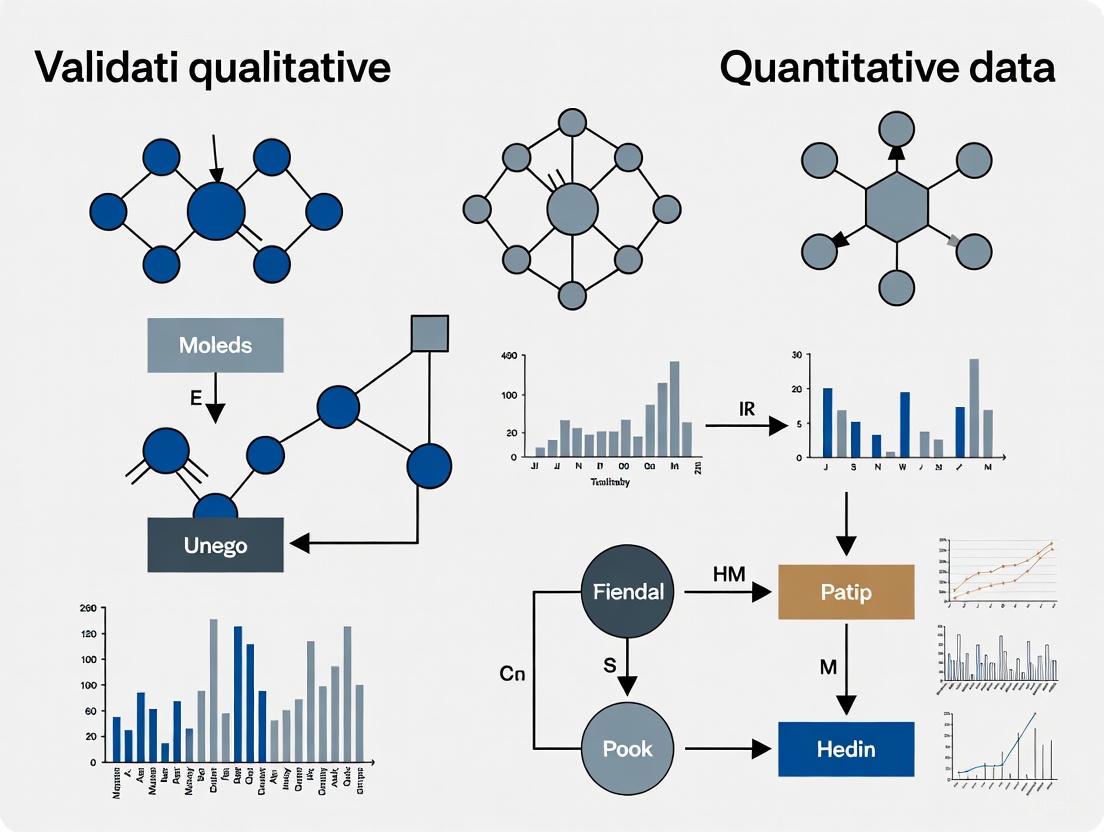
This article provides a comprehensive guide for researchers and drug development professionals on integrating qualitative network models with quantitative data validation.
Bridging the Qualitative-Quantitative Divide: A Practical Framework for Validating Network Models in Biomedical Research
Abstract
This article provides a comprehensive guide for researchers and drug development professionals on integrating qualitative network models with quantitative data validation. It explores the foundational principles of qualitative network analysis and its application in modeling complex biomedical systems, such as disease mechanisms and intervention pathways. The content delivers actionable methodologies for constructing robust models, strategies for troubleshooting common integration challenges, and rigorous frameworks for quantitative validation and comparative analysis. By synthesizing mixed-methods approaches, this guide aims to enhance the reliability and predictive power of network models in clinical and pharmacological research, ultimately supporting more informed decision-making in drug development and therapeutic intervention.
Understanding Qualitative Network Models: Core Concepts and Research Applications
Defining Qualitative Network Models in Complex System Analysis
Qualitative Network Models (QNMs) are simplified representations of complex systems that capture the direction and sign of interactions between components rather than their precise numerical strength [1]. In complex system analysis, particularly in biological and ecological contexts, QNMs consist of model elements and linkages denoting positive or negative interactions, which are typically abstracted as directed, unweighted, signed digraphs [1]. This approach allows researchers to understand system behavior without requiring extensive parameterization, making it particularly valuable in data-poor environments or for initial exploratory analysis.
The fundamental principle behind QNMs is their focus on qualitative relationships rather than quantitative measurements. For example, in a biological context, a researcher might model whether increasing Protein A activates (+) or inhibits (-) Protein B, without specifying the exact kinetic parameters of this interaction [2]. This abstraction makes QNMs particularly useful for representing systems where precise numerical data is scarce but qualitative understanding of relationships exists. In drug discovery, where biological systems exhibit immense complexity, QNMs provide a framework for reasoning about drug effects, potential side effects, and network perturbations without requiring complete quantitative characterization of all system components [2] [3].
Table: Core Characteristics of Qualitative Network Models
| Characteristic | Description | Primary Application Context |
|---|---|---|
| Signed Interactions | Represents relationships as positive (+) or negative (-) influences | Understanding activation/inhibition in biological networks [2] |
| Directional Relationships | Models causal directions between components (A → B) | Mapping signaling pathways and regulatory networks [2] |
| Absence of Quantitative Parameters | Does not require precise numerical values for interaction strengths | Systems with limited quantitative data [1] |
| Stability Through Feedback Loops | Requires self-limiting loops (negative feedback) to maintain system stability [1] | Ecological systems and cellular regulation |
QNMs Versus Quantitative Network Models: A Formal Comparison
When evaluating network modeling approaches for complex system analysis, researchers must choose between qualitative and quantitative frameworks based on their specific research context, data availability, and analytical objectives. This decision carries significant implications for resource allocation, interpretability, and practical application, particularly in fields like drug discovery where both approaches are employed [2] [3].
Quantitative models, such as those implemented in Rpath for ecological systems [1] or systems pharmacology models in drug discovery [2], provide numerical precision and can generate specific, testable predictions about system behavior under various conditions. However, this precision comes at a cost: quantitative models are data-intensive, often requiring extensive parameter estimation, and can be time-consuming to develop, sometimes taking multiple years to construct and validate [1]. Additionally, they may become so complex that their behavior becomes difficult to interpret, potentially obscuring fundamental system principles.
In contrast, Qualitative Network Models sacrifice numerical precision to gain conceptual clarity and development efficiency. QNMs can be generated relatively quickly with fewer data requirements, allowing researchers to incorporate different information types that are difficult to measure or combine quantitatively [1]. This makes them particularly valuable for exploring new research territories, integrating diverse data sources, and developing conceptual frameworks before investing in extensive quantitative modeling efforts.
Table: Comparative Analysis of Qualitative vs. Quantitative Network Modeling Approaches
| Analytical Dimension | Qualitative Network Models (QNMs) | Quantitative Network Models |
|---|---|---|
| Data Requirements | Minimal data requirements; can incorporate difficult-to-quantify information [1] | Data-intensive; require comprehensive datasets with long time series [1] |
| Development Timeline | Relatively fast to develop [1] | Time-consuming (often multiple years) [1] |
| Analytical Output | Qualitative predictions of direction of change [1] | Numerical predictions of magnitude of change [1] |
| Strength for Prediction | Identifies potential system responses and surprising connections [2] | Generates testable numerical predictions when well-parameterized [2] |
| System Representation | Signed digraphs showing direction of influence [1] | Mathematical equations with numerical parameters [2] |
| Ideal Application Context | Exploratory analysis, hypothesis generation, data-poor environments [1] | Systems with rich numerical data, forecasting, precise intervention planning [2] |
Experimental Validation: Performance Benchmarking
A rigorous 2025 study systematically compared qualitative and quantitative ecosystem models to evaluate their correspondence under varying complexity levels [1]. This research provides valuable experimental data on QNM performance for researchers considering this approach for complex system analysis.
Experimental Protocol and Methodology
The research employed a structured comparative framework using an existing quantitative model (Rpath) of the western Scotian shelf and Bay of Fundy ecosystem, which was translated into multiple qualitative models of varying complexity [1]. The experimental design involved:
- Model Conversion: Transforming the quantitative Rpath model into a Qualitative Network Model using an adjacency matrix that consolidated both diet composition and predation mortality matrices, resulting in values between +1 and -1 [1].
- Complexity Manipulation: Systematically creating six QNM variants by eliminating linkages of different strengths (from ±0.10 to ±0.50) to assess how complexity reduction affects model performance [1].
- Perturbation Experiments: Running a series of perturbation scenarios through both quantitative and qualitative models and comparing their predictions [1].
- Uncertainty Integration: For the quantitative model, employing a Bayesian synthesis routine (Ecosense) that generated alternative parameter sets based on data quality assessments, creating a range of plausible outcomes reflecting parameter uncertainty [1].
The qualitative simulations were performed using QPress, a stochastic QNM software package implemented in R that models system responses to perturbations through qualitative simulations [1]. This experimental design allowed for direct comparison between approaches while controlling for variability, providing unique insights into QNM performance characteristics.
Key Experimental Findings and Performance Data
The study revealed that QNM performance systematically varied with model complexity and the trophic level of perturbed elements [1]. The results provide guidance for researchers in selecting appropriate model complexity based on their specific research questions:
Table: Correspondence Between Qualitative and Quantitative Models Based on Complexity and Perturbation Type
| Model Complexity Level | Perturbation to Lower Trophic Levels | Perturbation to Mid-Trophic Levels |
|---|---|---|
| Higher Complexity QNMs (more linkages retained) | Closer correspondence to quantitative models [1] | Reduced correspondence to quantitative models [1] |
| Lower Complexity QNMs (fewer linkages retained) | Reduced correspondence to quantitative models [1] | Recommended approach for better correspondence [1] |
The research identified a "sweet spot" of model complexity for qualitative ecosystem models to reflect similar results to quantitative models [1]. When perturbing lower trophic level groups, higher complexity models (with more linkages retained) performed closer to the quantitative model. Conversely, for perturbations to mid-trophic groups, lower complexity models were recommended [1]. This finding demonstrates that optimal QNM complexity depends on the specific system components researchers aim to study.
The study also found that the number of linkages between model elements and trophic position of the perturbed model were influential factors in qualitative model behavior [1]. Additionally, the researchers recommended utilizing multiple models to determine the strongest impacts from perturbations and avoid spurious conclusions [1].
Application in Drug Discovery and Development
Qualitative Network Models have emerged as valuable tools in pharmaceutical research, particularly in the early stages of drug discovery where complete quantitative information may be limited. Network-based approaches show significant potential for identifying novel targets and repositioning established targets by mapping complex biological interactions [2].
In drug discovery, QNMs enable researchers to represent various network types relevant to pharmacological interventions [2]:
- Protein-protein interaction networks: Mapping how proteins physically interact within cellular systems
- Signal transduction networks: Modeling how signals are transmitted from cell surface to nucleus
- Metabolic networks: Representing biochemical reaction networks within cells
- Genetic interaction networks: Capturing how genes work together in cellular processes
The application of these networks has brought revolutionary changes to pharmacology, potentially shortening research and development time while improving the efficiency of drug discovery [3]. Csermely et al. proposed distinct network targeting strategies for different disease types [2]. For diseases characterized by flexible networks (e.g., cancer), a "central hit" strategy targeting critical network nodes would seek to disrupt the network and induce cell death in malignant tissues [2]. For more rigid systems (e.g., type 2 diabetes mellitus), a "network influence" approach seeks to identify nodes and edges of multitissue biochemical pathways for blocking specific lines of communication and essentially redirecting information flow [2].
Signaling Pathway Representation
The following diagram illustrates a simplified qualitative network model of a signaling pathway, representing the type of network commonly analyzed in drug discovery research:
This qualitative representation captures essential activation and inhibition relationships without requiring precise kinetic parameters, demonstrating how QNMs can provide insights into potential drug targets by identifying critical nodes in biological networks [2].
Research Reagent Solutions: Methodological Toolkit
Researchers implementing Qualitative Network Models in complex system analysis utilize both computational and analytical resources. The following table details essential methodological tools and their applications in QNM research:
Table: Essential Research Reagents and Tools for Qualitative Network Analysis
| Research Tool | Type | Primary Function | Application in QNM Research |
|---|---|---|---|
| QPress [1] | Software Package | Stochastic Qualitative Network Modeling | Simulates system responses to perturbations through qualitative simulations implemented in R [1] |
| Rpath [1] | Quantitative Modeling Framework | Ecosystem modeling using same algorithms as Ecopath with Ecosim | Serves as quantitative benchmark for validating qualitative models; includes Bayesian synthesis routine (Ecosense) [1] |
| Web of Science Database [4] | Literature Database | Access to scholarly publications | Provides data for bibliometric network analysis and field mapping [4] |
| Adjacency Matrix [1] | Mathematical Framework | Representing network connections | Converts quantitative model data to qualitative format by consolidating interaction values between +1 and -1 [1] |
| Boolean Relationships [2] | Logical Framework | Discrete dynamic modeling | Represents network node states as true/false or active/inactive for time-stepped simulations [2] |
Qualitative Network Modeling Workflow
The following diagram illustrates a generalized workflow for developing and validating Qualitative Network Models, particularly in contexts where comparison with quantitative approaches is possible:
Qualitative Network Models represent a valuable methodological approach for analyzing complex systems across biological, ecological, and pharmacological domains. While QNMs do not provide the numerical precision of quantitative approaches, their strengths in conceptual clarity, development efficiency, and applicability in data-poor environments make them particularly valuable for exploratory research, hypothesis generation, and initial system characterization [1]. The demonstrated "sweet spot" of model complexity, which varies based on the system components being studied, provides guidance for researchers in optimizing QNM design for specific research questions [1].
In drug discovery and development, network-based approaches including QNMs have brought revolutionary changes by shortening research time and improving target identification efficiency [3]. These models enable researchers to reason about complex biological systems, potential drug effects, and network perturbations without requiring complete quantitative characterization [2]. As complementary approaches to quantitative methods, QNMs represent an important tool in the computational systems biology toolkit, particularly valuable when confronting the inherent complexity of biological systems and pharmaceutical interventions.
The validation of qualitative network models with quantitative data represents a critical frontier in interdisciplinary research. This comparative guide examines the theoretical foundations and practical applications across social science and biomedical domains, where network-based methodologies enable researchers to uncover complex relationships within systems. Where social science research traditionally employs qualitative methods to understand human experiences and social structures, biomedical research utilizes quantitative approaches to decipher biological interactions. The integration of these approaches through network analysis creates a powerful framework for validating insights across disciplines, offering a structured pathway from qualitative observation to quantitative verification.
Network analysis serves as the bridge between these paradigms, providing both a visual and mathematical representation of relationships within complex systems. In social science, networks might map relationships between concepts in textual data, while in biomedicine, they illustrate interactions between biological entities like proteins or genes. The core thesis explored here is that quantitative data can systematically validate qualitative network models, enhancing their rigor, predictive power, and utility across research contexts from public policy to drug discovery.
Theoretical Foundations Across Disciplines
Social Science Foundations
Social science research is fundamentally concerned with understanding human behavior, experiences, and social structures through interpretive frameworks. Qualitative research methodologies in this domain prioritize depth, context, and meaning over numerical measurement, seeking to understand the 'why' and 'how' behind human phenomena [5].
Several philosophical paradigms underpin qualitative social research. Constructivism posits that reality is socially constructed through human interactions and meaning-making processes, implying multiple valid perspectives exist. Interpretivism emphasizes understanding behavior through the subjective meanings people assign to their experiences, while critical theory examines how knowledge maintains or challenges power structures and promotes social justice [5]. These paradigms share a focus on understanding phenomena within their natural contexts rather than isolating variables for measurement.
Qualitative research employs several established approaches to network and relationship analysis. Ethnography involves immersive fieldwork to understand cultures and social groups through participant observation. Case study research conducts intensive investigation of specific cases in their real-world contexts, while grounded theory develops theoretical frameworks directly from data through iterative coding and analysis [5] [6]. Discourse analysis examines how language and communication practices construct social realities, and narrative research explores how people use stories to make sense of their experiences and identities [7] [5].
Biomedical Science Foundations
Biomedical research employs network analysis as a computational framework to understand complex biological systems. Unlike social science's focus on meaning, biomedical network science is rooted in mathematical graph theory and statistical mechanics, representing biological entities as nodes and their interactions as edges [8] [9].
The theoretical foundation of biomedical network analysis rests on several key principles. The disease module hypothesis proposes that proteins associated with the same disease show increased network proximity and functional relatedness in the human interactome [9]. Network medicine extends this concept, suggesting that disease phenotypes reflect various perturbations of the same underlying network structure [2]. Network proximity measures quantify relationships between drugs and diseases or between different drugs, enabling prediction of therapeutic efficacy and adverse effects [9].
Biomedical networks can be categorized as either static (examining networks at a single point in time) or time-varying (tracking network evolution over time) [8]. Time-varying network analysis is particularly important for understanding dynamic biological processes like disease progression, cellular signaling, and drug response, employing methods such as time-varying Gaussian graphical models, dynamic Bayesian networks, and vector autoregression-based causal analysis [8].
Table 1: Key Theoretical Distinctions Between Domains
| Aspect | Social Science Networks | Biomedical Networks |
|---|---|---|
| Primary Data | Words, narratives, observations, images | Numerical measurements, molecular data, clinical variables |
| Philosophical Foundation | Constructivism, interpretivism, critical theory | Positivism, post-positivism, realism |
| Primary Analysis Methods | Thematic analysis, discourse analysis, grounded theory | Statistical modeling, machine learning, graph theory |
| Node Representation | Concepts, people, organizations, ideas | Genes, proteins, drugs, diseases, metabolites |
| Edge Representation | Relationships, influences, communications | Physical interactions, regulatory relationships, functional associations |
| Validation Approach | Triangulation, member checking, reflexivity | Statistical testing, experimental validation, database alignment |
Validation Methodologies: Qualitative Networks Meets Quantitative Data
Social Science Validation Framework
In social science, the validation of qualitative network models employs distinct rigor-enhancement strategies that differ from quantitative validation approaches. Data triangulation uses multiple data sources, methods, or investigators to corroborate findings, while member checking returns interpretations to participants to confirm accuracy [7] [6]. Reflexivity involves critical self-examination of the researcher's role and potential biases throughout the research process, and audit trails maintain detailed records of the research process from raw data to final interpretation [7].
A powerful example of integrating quantitative validation in social science comes from social water research, where researchers implemented a mixed methods framework combining quantitative network analysis with qualitative interpretation [4]. This approach began with quantitative keyword co-occurrence network analysis of publications to identify thematic clusters, followed by qualitative interpretation of these clusters. The quantitative network analysis provided systematic, reproducible pattern detection, while the qualitative analysis delivered depth and contextual understanding, demonstrating how computational tools can enhance transparency without sacrificing interpretive richness [4].
Biomedical Validation Framework
Biomedical research employs rigorous quantitative validation methodologies for network models. The standard approach involves comparing network predictions against experimental data or established biological knowledge. Researchers quantify validation using statistical measures including sensitivity, specificity, precision, and accuracy, along with network-specific metrics like modularity, transitivity, and degree distribution [10].
A representative example comes from the validation of biomedical named entity recognition (bio-NER) tools using network analysis [10]. Researchers constructed disease networks from terms extracted by bio-NER tools from medical texts, then computed their overlap with reference networks built from genomic, proteomic, and pharmacological data. They quantified edge overlap between phenotypic and biological networks and applied community detection algorithms to compare network structures against established disease classification systems [10]. This approach demonstrated that tools performing well with traditional annotated corpora also ranked highly using network-based validation, confirming the method's reliability while overcoming limitations of manually annotated datasets [10].
Table 2: Validation Metrics Across Disciplines
| Validation Approach | Social Science Application | Biomedical Application |
|---|---|---|
| Triangulation | Multiple data sources, methods, or investigators | Multiple omics datasets, experimental techniques |
| Member Checking | Participant verification of interpretations | Database alignment with established knowledge |
| Reference Standards | Established theories, expert consensus | Gold standard datasets, curated databases |
| Statistical Validation | Limited use of descriptive statistics | Extensive inferential statistics, p-values, confidence intervals |
| Community Detection | Thematic clusters in textual data | Functional modules, disease communities |
| Reproducibility Measures | Audit trails, methodological transparency | Experimental replication, computational reproducibility |
Experimental Protocols and Workflows
Social Science Mixed Methods Protocol
The social science validation protocol employs a sequential mixed methods design that integrates quantitative network analysis with qualitative interpretation [4]:
Phase 1: Data Collection
- Source relevant textual data from appropriate repositories (e.g., Web of Science, Scopus)
- Apply systematic search strategies with defined inclusion/exclusion criteria
- Extract metadata including keywords, abstracts, and citation information
Phase 2: Quantitative Network Construction
- Create keyword co-occurrence networks using bibliometric analysis
- Apply network clustering algorithms to identify thematic groups
- Calculate basic network metrics (density, centrality, connectivity)
Phase 3: Qualitative Interpretation
- Conduct deep contextual analysis of representative documents from each cluster
- Apply thematic analysis or discourse analysis to identified clusters
- Interpret quantitative findings through theoretical frameworks
Phase 4: Integration and Validation
- Compare quantitative network structures with qualitative interpretations
- Identify convergent and divergent findings across methods
- Refine interpretations through iterative analysis
This workflow visualization illustrates the sequential mixed methods approach:
Biomedical Network Validation Protocol
The biomedical network validation protocol employs a comparative framework that evaluates network models against established biological data [10]:
Phase 1: Reference Network Construction
- Compile molecular interaction data from curated databases (e.g., STRING, BioGRID, DisGeNET)
- Build disease-specific networks from genomic, proteomic, and pharmacological data
- Calculate topological properties of reference networks
Phase 2: Phenotypic Network Generation
- Apply bio-NER tools to extract disease-related terms from medical literature
- Construct phenotypic disease networks based on term co-occurrence
- Compute network metrics for comparative analysis
Phase 3: Quantitative Comparison
- Measure edge overlap between phenotypic and reference networks
- Apply community detection to both network types
- Compare identified communities with established disease classifications
Phase 4: Statistical Validation
- Calculate significance of network overlaps using appropriate statistical tests
- Assess correlation between network-based rankings and traditional validation
- Evaluate predictive performance using receiver operating characteristic analysis
This workflow illustrates the comparative validation approach:
Research Reagent Solutions: Essential Tools and Databases
Social Science Research Tools
Social science network research employs both computational and analytical tools:
Table 3: Social Science Research Reagents
| Tool/Database | Type | Primary Function | Application in Validation |
|---|---|---|---|
| Web of Science | Database | Scholarly publication metadata | Data source for bibliometric analysis |
| MAXQDA | Software | Qualitative data analysis | Thematic coding, mixed methods integration |
| NVivo | Software | Qualitative data analysis | Code-based network visualization, theory building |
| ATLAS.ti | Software | Qualitative data analysis | Conceptual networking, hermeneutic analysis |
| VOSviewer | Software | Bibliometric network visualization | Co-occurrence network mapping, cluster identification |
Biomedical network analysis relies on specialized databases and software tools:
Table 4: Biomedical Research Reagents
| Tool/Database | Type | Primary Function | Application in Validation |
|---|---|---|---|
| STRING | Database | Protein-protein interaction networks | Reference network construction [8] |
| BioGRID | Database | Molecular interaction repository | Curated physical and genetic interactions [8] |
| DisGeNET | Database | Gene-disease associations | Disease module identification [10] |
| Stanford Biomedical Network Collection | Dataset | Multimodal biomedical networks | Benchmark datasets for method validation [11] |
| NVivo | CAQDAS | Qualitative data analysis | Integration of qualitative and quantitative data [7] |
| TVGL | Algorithm | Time-varying graphical LASSO | Dynamic network inference [8] |
| Dynamic Bayesian Networks | Method | Time-dependent probabilistic modeling | Causal inference in temporal data [8] |
Comparative Performance Analysis
Methodological Performance Metrics
The performance of qualitative network validation approaches can be evaluated through multiple dimensions:
Table 5: Performance Comparison Across Domains
| Performance Metric | Social Science Networks | Biomedical Networks | Cross-Domain Insights |
|---|---|---|---|
| Thematic Identification | High sensitivity to emerging concepts | Limited to pre-defined entity types | Social science excels at discovery, biomedicine at verification |
| Scalability | Limited by qualitative analysis capacity | Highly scalable with computational resources | Biomedical approaches more suitable for large datasets |
| Reproducibility | Moderate, dependent on researcher transparency | High, with computational reproducibility | Biomedical methods offer superior standardization |
| Contextual Sensitivity | High, preserves nuanced meanings | Limited, reduces complexity to metrics | Social science maintains richer contextual understanding |
| Predictive Power | Limited to conceptual insights | Strong quantitative predictions | Biomedical approaches superior for hypothesis testing |
| Interdisciplinary Integration | Flexible framework adaptation | Requires domain-specific knowledge | Social science methods more transferable across domains |
Validation Performance Data
Empirical studies demonstrate the validation performance of network-based approaches:
In biomedical NER tool evaluation, network-based validation showed strong correlation with traditional annotation-based methods [10]. Tools that performed well with manually annotated corpora also ranked highly using network-based approaches, with modularity scores around 0.5 for high-performing tools and edge overlap significantly above random expectation [10].
In drug combination prediction, network-based separation measures successfully identified effective combinations, with separation score (sAB) demonstrating superior performance compared to target-overlap approaches and other network measures [9]. FDA-approved drug combinations showed significantly lower sAB values compared to random drug pairs, confirming the measure's predictive power [9].
Social science mixed methods demonstrated that quantitative network analysis could reliably identify thematic clusters that aligned with qualitative interpretations, providing systematic reproducibility while maintaining interpretive depth [4]. The approach successfully identified emerging research trends and interdisciplinary connections within complex scholarly domains.
Integrated Validation Framework
The comparative analysis reveals that while social science and biomedical approaches differ in their philosophical foundations and methodological specifics, they converge on a core principle: quantitative network properties can systematically validate qualitative insights. This convergence suggests an integrated framework for network validation across disciplines:
Core Principles:
- Multi-method triangulation combining different data types and analytical approaches
- Iterative refinement between qualitative models and quantitative validation
- Contextual interpretation of quantitative metrics within theoretical frameworks
- Transparent documentation of both computational and interpretive steps
Application Guidelines:
- Social science researchers should incorporate quantitative network metrics to enhance methodological rigor and transparency
- Biomedical researchers should maintain connection to biological context and meaning when interpreting network models
- Both domains benefit from explicit documentation of validation procedures and limitations
- Cross-disciplinary collaboration can generate innovative validation approaches leveraging strengths of both paradigms
This integrated approach advances the broader thesis that qualitative network models gain explanatory power and scientific utility when systematically validated with quantitative data, creating a robust foundation for knowledge generation across the research spectrum.
The Role of Mixed-Methods Approaches in Interdisciplinary Research
Mixed-methods research represents a third research paradigm that strategically combines qualitative and quantitative approaches within a single study to provide a more complete understanding of complex research questions than either method could alone [12]. This approach has gained significant recognition across multiple health disciplines, including nursing, medicine, and epidemiology, where it helps bridge the gap between numerical data and human experience [12] [13]. By integrating different methodological perspectives, mixed-methods research creates opportunities to synthesize knowledge and insights from across disciplinary boundaries, making it particularly valuable for addressing multifaceted problems that transcend traditional academic silos [13].
The philosophical foundation of mixed-methods research lies in pragmatism, serving as what scholars have termed the "third path" or "third research paradigm" that moves beyond the traditional positivist-quantitative and interpretivist-qualitative divide [12]. Quantitative research, typically underpinned by positivism, operates on the assumption that there is a single measurable reality, addressing questions such as "What proportion of the population experiences this phenomenon?" In contrast, qualitative research, often based on interpretivism, explores how people experience and interpret phenomena in their unique worlds [12]. Mixed-methods research brings together questions from these different philosophical traditions, offering multiple ways of examining a research question by combining the strengths of both approaches [12].
In interdisciplinary contexts, mixed-methods approaches are particularly valuable for synthesizing knowledge from across different fields [13]. As a group of academics from Education, Medicine, Nursing, and Social working together on an interdisciplinary mixed-methods systematic review discovered, this methodology enables researchers to embrace the challenges of interdisciplinary work while managing the bottlenecks that often occur in such projects [13]. The integration of diverse disciplinary perspectives through mixed-methods creates a richer, more nuanced understanding of complex phenomena that cannot be adequately captured through single-method or single-discipline approaches.
Methodological Approaches and Framework
Core Methodological Frameworks
Mixed-methods research encompasses several distinct frameworks for combining qualitative and quantitative approaches. The three primary designs include convergent parallel design, explanatory sequential design, and exploratory sequential design [12]. In the convergent parallel design, researchers collect and analyze both quantitative and qualitative data simultaneously during the same study phase, then merge the results to develop a complete understanding of the research problem. The explanatory sequential design involves first collecting and analyzing quantitative data, followed by qualitative data collection and analysis to help explain or elaborate on the quantitative findings. Conversely, the exploratory sequential design begins with qualitative data collection and analysis, using the results to inform the subsequent quantitative phase [12].
The process of integrating qualitative and quantitative data represents a critical challenge in mixed-methods research. Integration can occur at multiple stages of research: during data collection, analysis, interpretation, or at all stages [12] [14]. At the data analysis stage, one powerful integration approach involves quantifying qualitative data through methods like Epistemic Network Analysis (ENA), which combines principles from social network analysis and discourse analysis to identify relationships between qualitative code co-occurrences [14]. This method allows researchers to transform rich qualitative data into quantitative metrics that can be analyzed statistically while preserving the contextual meaning of the original data.
Epistemic Network Analysis as a Bridge Method
Epistemic Network Analysis (ENA) serves as a particularly valuable method for quantifying qualitative data in interdisciplinary research [14]. ENA was originally developed in learning sciences to model relationships between elements of professional expertise and has since been applied across diverse fields including healthcare, surgery, and historical document analysis [14]. The method involves segmenting qualitative data into lines (the smallest unit of data) and grouping them into stanzas (related lines), then coding each line according to a rigorously developed codebook [14].
The mathematical foundation of ENA uses approaches similar to social network analysis, singular value decomposition, and principal component analysis to calculate and graphically depict relationships between coded elements [14]. The resulting network graphs visualize these relationships, with node size representing the frequency of code occurrence and line thickness indicating the strength of relationship through code co-occurrence. These networks can be analyzed both descriptively and statistically, allowing researchers to compare different groups or conditions [14]. In healthcare research, ENA has been successfully applied to model communication patterns in operating rooms, surgical error management, and team learning in virtual internships, demonstrating its versatility as a bridge between qualitative and quantitative paradigms [14].
Comparative Analysis of Mixed-Methods Applications
Applications Across Disciplines
Mixed-methods approaches have been successfully implemented across diverse interdisciplinary contexts, each demonstrating unique strengths in addressing complex research questions. The table below summarizes key applications across three disciplinary areas:
Table 1: Comparative Analysis of Mixed-Methods Applications Across Disciplines
| Disciplinary Area | Research Focus | Qualitative Component | Quantitative Component | Integration Method | Key Findings |
|---|---|---|---|---|---|
| Healthcare & Nursing [12] [14] | Understanding nursing care practices and patient satisfaction | In-depth interviews with healthcare providers and patients | Surveys and logistic regression analysis | Sequential explanatory design; Epistemic Network Analysis | Identified factors influencing adherence to nursing care protocols; revealed communication patterns affecting patient outcomes |
| Ecology & Environmental Science [15] | Assessing ecological impacts of mussel culture | Qualitative network models outlining ecosystem relationships | Semi-quantitative data on linkage strengths | Concurrent triangulation; model validation | Revealed that hydrodynamic conditions have greater impact than nutrients on ecosystem effects of mussel culture |
| Network Science & Machine Learning [16] | Evaluating machine learning models for network inference | Analysis of structural features and computational trade-offs | Performance metrics (accuracy, precision, recall, F1 score, AUC) | Convergent parallel design | Demonstrated that simpler models (Logistic Regression) can outperform complex ones (Random Forest) in specific network contexts |
Interdisciplinary Integration Patterns
The integration of mixed-methods within interdisciplinary research teams follows several distinct patterns, each with characteristic strengths and challenges. Multidisciplinary teams involve researchers from different disciplines working side-by-side but maintaining distinct methodological approaches, while interdisciplinary teams blend methodologies to create integrated solutions, and transdisciplinary teams transcend discipline boundaries entirely to develop novel methodological frameworks [13] [12].
Practical considerations for conducting rigorous interdisciplinary mixed-methods systematic reviews include establishing common terminology across disciplines, developing shared understanding of methodological quality criteria, and creating transparent processes for reconciling different disciplinary perspectives [13]. Successful teams report that embracing the challenges of interdisciplinarity through structured communication and flexible planning can advance the effectiveness and impact of interdisciplinary research [13]. These teams emphasize the importance of documenting both successes and challenges to provide exemplars for other researchers undertaking similar interdisciplinary mixed-methods projects [13].
Experimental Protocols and Workflows
Protocol for Interdisciplinary Mixed-Methods Systematic Reviews
Conducting a rigorous interdisciplinary mixed-methods systematic review requires a structured protocol that accommodates diverse research methodologies and disciplinary perspectives:
Formation of Interdisciplinary Team: Assemble researchers from relevant disciplines (e.g., Education, Medicine, Nursing, Social Work) with expertise in both quantitative and qualitative methods [13].
Development of Shared Conceptual Framework: Establish common definitions, theoretical perspectives, and methodological standards that respect different disciplinary traditions while creating a coherent integrative framework [13].
Comprehensive Search Strategy: Implement systematic searches across multiple disciplinary databases using both controlled vocabulary and natural language terms to capture relevant literature [13].
Dual Screening and Selection Process: Employ multiple reviewers with different disciplinary backgrounds to screen titles, abstracts, and full-text articles using predetermined inclusion criteria [13].
Data Extraction and Quality Assessment: Extract data using standardized forms and assess methodological quality using appropriate tools for different study types (quantitative, qualitative, mixed-methods) [13].
Integration of Findings: Synthesize knowledge using convergent thematic analysis, following a transparent process for reconciling different disciplinary interpretations [13].
Validation and Reflexivity: Maintain team reflexivity throughout the process, documenting challenges and resolutions to enhance the transparency and credibility of the review [13].
Protocol for Qualitative Network Model Validation
Validating qualitative network models with quantitative data involves a systematic approach for ensuring the robustness and credibility of integrated findings:
Model Specification: Develop qualitative network models outlining proposed relationships and linkages between system components based on existing literature and expert knowledge [15].
Semi-Quantitative Enhancement: Incorporate available semi-quantitative information on the relative strength of key linkages to improve model accuracy and sign determinacy [15].
Scenario Analysis: Analyze model behavior under different scenarios (e.g., contrasting environmental conditions) to identify the most influential system components [15].
Empirical Validation: Collect quantitative empirical data to test model predictions and evaluate the consistency between qualitative model outputs and observed system behaviors [15].
Sensitivity Analysis: Assess how changes in model parameters affect outcomes to identify critical linkages and potential leverage points within the system [15].
Iterative Refinement: Revise the qualitative network model based on validation results, strengthening well-supported linkages and modifying or removing poorly supported ones [15].
The following workflow diagram illustrates the sequential and iterative nature of validating qualitative network models with quantitative data:
Essential Research Reagents and Tools
Methodological Reagents for Mixed-Methods Research
Successful implementation of mixed-methods research in interdisciplinary contexts requires specific "methodological reagents" – essential tools and approaches that facilitate the integration of diverse data types and disciplinary perspectives:
Table 2: Essential Research Reagents for Mixed-Methods Studies
| Research Reagent | Function | Application Context | Considerations |
|---|---|---|---|
| Epistemic Network Analysis (ENA) [14] | Quantifies qualitative data by modeling relationships between discourse elements | Healthcare team communication analysis; learning assessment; surgical training evaluation | Requires high-quality qualitative data segmented into lines and stanzas; uses network graphs to visualize code co-occurrences |
| Qualitative Network Models (QNMs) [15] | Maps complex relationships in systems where quantitative data is limited | Ecological impact assessment; ecosystem behavior prediction; intervention planning | Benefits from incorporation of semi-quantitative data on linkage strength; useful for scenario testing |
| Interdisciplinary Team Framework [13] | Structures collaboration across disciplinary boundaries | Systematic reviews; complex intervention development; policy evaluation | Requires explicit attention to terminology, methodology integration, and conflict resolution processes |
| Stochastic Block Models (SBM) [16] | Generates synthetic networks with community structure for method validation | Network inference testing; machine learning model evaluation; community detection | Closely matches modularity of real-world networks; useful for benchmarking analytical approaches |
Analytical Tools for Data Integration
The integration of qualitative and quantitative data requires specialized analytical tools that can accommodate different data types and facilitate meaningful synthesis:
Mixed-Methods Data Analysis Software: Tools like NVivo, MAXQDA, and Dedoose support both qualitative coding and quantitative analysis, allowing researchers to work with diverse data types within a single platform.
Network Analysis Packages: Software such as UCINET, Gephi, and specialized R packages (e.g., igraph, statnet) enable the visualization and analysis of network structures derived from both qualitative and quantitative data [16] [14].
Statistical Modeling Environments: Platforms like R, Python (with pandas, scikit-learn), and Mplus support the complex statistical models needed to analyze integrated datasets, including multilevel models, structural equation models, and mixture models.
Data Visualization Tools: Applications such as Tableau, Microsoft Power BI, and specialized visualization libraries in programming languages help create integrated displays that represent both qualitative and quantitative findings.
The following diagram illustrates the relationship between different methodological tools and their applications in the mixed-methods research workflow:
Comparative Performance Data
Quantitative Performance Metrics
The effectiveness of mixed-methods approaches can be evaluated through specific performance metrics that capture their added value compared to single-method approaches. The table below summarizes key quantitative findings from studies that have implemented mixed-methods designs:
Table 3: Performance Metrics of Mixed-Methods Approaches Across Disciplines
| Study Context | Methodological Comparison | Key Performance Metrics | Results | Implications |
|---|---|---|---|---|
| Machine Learning for Network Inference [16] | Logistic Regression (LR) vs. Random Forest (RF) on synthetic networks | Accuracy, Precision, Recall, F1 Score, AUC, MCC | LR achieved perfect scores (100%) across all metrics for 100-1000 node networks; RF showed lower performance (~80% accuracy) | Simpler models may outperform complex ones in specific contexts; challenges assumption that complex models are inherently superior |
| Healthcare Team Communication [14] | Epistemic Network Analysis of task allocation communications | Task acceptance rates by sender and communication synchronicity | Physician and unit clerk most successful allocating tasks; synchronous communication effective for time-critical tasks | ENA effectively quantified qualitative communication patterns; revealed unexpected role of unit clerks in team effectiveness |
| Ecological Impact Assessment [15] | Qualitative Network Models with semi-quantitative enhancement | Model accuracy and sign determinacy in predicting ecological responses | Models with semi-quantitative linkage information showed improved accuracy and determinacy; hydrodynamic conditions had greater impact than nutrients | Integration of even limited quantitative data improves qualitative model performance |
| Interdisciplinary Systematic Reviews [13] | Traditional vs. interdisciplinary mixed-methods approaches | Breadth of synthesis, identification of novel insights, practical applicability | Mixed-methods reviews provided more comprehensive understanding and identified insights missed by single-method approaches | Methodological rigor and transparent processes critical for successful interdisciplinary integration |
Qualitative Benefits and Challenges
Beyond quantitative metrics, mixed-methods approaches demonstrate significant qualitative benefits while also presenting distinct challenges:
Benefits:
- Provides deeper understanding of complex phenomena by capturing both the breadth of quantitative data and the depth of qualitative insights [12]
- Enhances methodological rigor through triangulation, where findings from one method can validate or challenge findings from another method [12] [14]
- Increases the practical applicability of research findings by addressing both "what" questions (prevalence, distribution) and "why/how" questions (meaning, mechanism) [12]
- Facilitates interdisciplinary collaboration by creating a common framework that respects different methodological traditions [13]
Challenges:
- Requires expertise in multiple methodological approaches and significant resources in terms of time, cost, and personnel [12]
- Demands careful attention to integration strategies to ensure qualitative and quantitative components meaningfully inform each other rather than existing in parallel [12] [14]
- Faces publication barriers due to word count limitations and lack of familiarity with mixed-methods approaches among some journal editors and reviewers [12]
- Necessitates explicit documentation of research paradigms and design choices that may be unfamiliar to readers trained in single-method traditions [12]
Mixed-methods approaches play an increasingly vital role in interdisciplinary research by providing comprehensive frameworks for addressing complex questions that transcend traditional disciplinary boundaries [13] [12]. The integration of qualitative and quantitative methods creates opportunities for deeper understanding and more practical applications than either approach could achieve independently [12]. As demonstrated across diverse fields from healthcare to ecology to network science, mixed-methods designs enable researchers to validate qualitative models with quantitative data, uncover unexpected patterns through methodological triangulation, and develop insights that are both contextually rich and generalizable [15] [14].
Future developments in mixed-methods research will likely focus on enhancing integration techniques, developing more sophisticated tools for data synthesis, and expanding training opportunities for researchers seeking to combine methodological approaches [12]. As interdisciplinary collaborations continue to grow in importance for addressing complex societal challenges, mixed-methods approaches will play an increasingly central role in facilitating meaningful integration across disciplinary boundaries [13]. The continued refinement of methods like Epistemic Network Analysis that systematically bridge qualitative and quantitative paradigms represents a promising direction for advancing mixed-methodology [14].
For researchers embarking on mixed-methods projects, success depends on carefully aligning research questions with appropriate mixed-methods designs, devoting sufficient resources to integration strategies, and maintaining flexibility throughout the research process [13] [12]. By embracing both the challenges and opportunities of mixed-methods research, interdisciplinary teams can produce findings that offer greater insights and enhanced applicability across diverse contexts and stakeholders [12].
This guide provides an objective comparison of Abstraction Hierarchies and Qualitative Network Models, focusing on their roles in validating qualitative models with quantitative data. This is crucial for research fields like drug development, where understanding complex, multi-level systems—from molecular pathways to patient outcomes—is essential.
Abstraction Hierarchy (AH) is a qualitative, complex systems methodology originating from cognitive engineering. It models socio-technical systems through a hierarchical structure of five levels, from high-level functional purposes to physical forms, creating a network of "how/why" relationships [17]. This framework helps researchers trace pathways from specific, measurable components to broader system goals, making it particularly valuable for evaluating potential interventions on social media platforms to increase social equality [17].
Qualitative Network Models represent systems as interconnected nodes and edges, often analyzed using methods like thematic analysis, grounded theory, and discourse analysis [7] [5]. These models aim to uncover deep insights into human experiences, behaviors, and cultures that quantitative data alone cannot reveal [5]. When combined with network science metrics, they can identify central themes and structural patterns within qualitative data [17].
Comparative Performance Analysis
The table below summarizes the performance characteristics of both modeling approaches based on documented applications and methodologies.
Table 1: Performance Comparison of Abstraction Hierarchies and Qualitative Network Models
| Performance Characteristic | Abstraction Hierarchy (AH) | Qualitative Network Models |
|---|---|---|
| Primary Data Nature | Words, narratives, system goals [17] | Words, narratives, observations [5] |
| Analysis Foundation | How/why relationships across hierarchical levels [17] | Thematic coding, pattern identification [7] [5] |
| Validation Approach | Pathway tracing from physical forms to functional purpose [17] | Triangulation, member checking, audit trails [7] |
| Quantitative Bridge | Network analysis (e.g., clustering, path counting) [17] | Statistical analysis, AI/ML-powered code frequency analysis [18] |
| Level of Analysis | Explicitly links multiple levels of analysis [17] | Often focuses on a single level (e.g., thematic) [17] |
| Strength | Succinctly captures interdisciplinary, multi-level perspectives [17] | Uncovers underlying meanings and motivations [5] |
| Computational Support | Basic network algorithms (Newman-Girvan) [17] | Advanced CAQDAS (NVivo, ATLAS.ti) with AI features [7] [18] |
Experimental Protocols for Validation
Objective: To qualitatively construct and then quantitatively validate an AH model for a socio-technical system [17].
Workflow:
- Model Construction: Use literature reviews and expert interviews to populate the five hierarchical levels: Functional Purpose, Constraints, Functions, Physical Processes, and Physical Forms [17].
- Network Formation: Represent the completed AH as a directed graph where nodes are elements at each level, and links are the "how/why" relationships between them [17].
- Quantitative Analysis:
- Pathway Analysis: Count all possible paths from a low-level Physical Form node to a high-level Functional Purpose node. A higher number of potential pathways may indicate a more robust design for an intervention [17].
- Cluster Analysis: Apply the Newman-Girvan algorithm to the AH network to identify cohesive subgroups. This can reveal if the model's structure aligns with expected conceptual modules within the system [17].
Quantitative Bridging in Qualitative Network Analysis
Objective: To analyze qualitative data for themes and relationships, then use quantitative metrics to validate the structure and significance of the resulting network model [5] [18].
Workflow:
- Data Collection and Coding: Collect data via interviews or focus groups. Code the data using thematic analysis or grounded theory to develop a set of themes (nodes) and their connections (edges) [7] [5].
- AI-Enhanced Analysis: Use Computer Assisted Qualitative Data Analysis Software (CAQDAS) like NVivo or ATLAS.ti. Leverage AI features for initial coding, summarization, and code suggestion, but critically vet all AI outputs against the original data [18].
- Network and Statistical Validation:
- Centrality Measures: Calculate node degree, betweenness, or eigenvector centrality in the theme network to identify core concepts [17].
- Inter-coder Reliability: Use quantitative metrics like Cohen's Kappa to statistically assess the consistency of the qualitative coding between different researchers [7].
- Triangulation: Combine qualitative findings with quantitative data from other sources to cross-verify interpretations [7].
The following diagram illustrates the core workflow for validating qualitative models with quantitative data:
The Scientist's Toolkit: Essential Research Reagents
The table below details key tools and software essential for conducting research with these models.
Table 2: Key Research Reagent Solutions for Qualitative-Quantitative Modeling
| Tool Name | Type/Category | Primary Function in Research |
|---|---|---|
| NVivo | CAQDAS Software | Manages, codes, and analyzes qualitative data; features AI summarization and code suggestion for efficiency [18]. |
| ATLAS.ti | CAQDAS Software | Supports deep qualitative analysis with a network view feature and conversational AI enquiry to encourage reflection [7] [18]. |
| MAXQDA | CAQDAS Software | Provides mixed-methods capabilities, seamlessly blending qualitative and quantitative analysis approaches [7]. |
| Newman-Girvan Algorithm | Network Analysis Algorithm | Identifies community structure (clusters) within a network model, such as an Abstraction Hierarchy graph [17]. |
| AI/Large Language Models (GPT-4, Claude) | Generative AI | Acts as a dialogic partner for exploratory analysis, suggests codes, and challenges researcher assumptions [18]. |
| Abstraction Hierarchy Framework | Modeling Framework | Provides the five-level template for constructing a hierarchical, multi-level model of a complex socio-technical system [17]. |
| Thematic Analysis | Qualitative Methodology | A systematic process for identifying, analyzing, and reporting patterns (themes) within qualitative data [7] [5]. |
The following diagram maps the hierarchical structure of an Abstraction Hierarchy, showing the "how/why" relationships between levels:
Identifying Research Questions Suitable for Qualitative Network Modeling
Defining Qualitative Network Models
Qualitative network models are abstract computational frameworks used to study complex systems where precise, quantitative data is scarce, but the underlying structure and interactions are well understood. They serve as a bridge between purely descriptive diagrams and fully quantitative mathematical models, allowing researchers to analyze system behavior and generate testable hypotheses [19].
These models are particularly valuable in fields like drug development and systems biology, where they help researchers understand complex signaling pathways and predict the effects of perturbations without requiring extensive kinetic data [20] [19]. A key strength is their role in a modeling pipeline, where a simple interaction graph can be refined into a logical model and finally into a logic-based ordinary differential equation, systematically increasing quantitative detail while preserving core qualitative properties [19].
Characteristics of Suitable Research Questions
Research questions that are a good fit for qualitative network modeling often share specific characteristics. The following table outlines these key traits, providing a checklist for researchers to assess their own questions.
| Characteristic | Description | Example Research Question |
|---|---|---|
| Focus on Structure & Logic | The question prioritizes the "if-then" logic of interactions (e.g., activation, inhibition) over precise quantities [19]. | "Does the inhibition of protein A lead to the downstream activation of transcription factor Z?" |
| Exploration of System Behavior | The goal is to understand emergent properties like stability, feedback loops, or response to perturbation, rather than precise numerical output [20] [15]. | "What are the stable signaling states of this cancer pathway under different drug treatments?" |
| Handling of Data Scarcity | The system is complex, but available data is insufficient for building a quantitative model [19]. | "How might a new drug target influence the broader signaling network, given incomplete kinetic data?" |
| Prediction of Qualitative Outcomes | The answer is a direction of change (increase/decrease) or a relative ranking, not a specific value [15] [21]. | "Will introducing this ecological stressor have a net positive or negative impact on key species?" |
A well-crafted question should also be actionable and specific. Applying frameworks like SMART (Specific, Measurable, Achievable, Relevant, Time-bound) can help sharpen the focus. For instance, a vague question like "How can we improve collaboration?" is less effective than "What is the current level of collaboration between the IT and Marketing teams, and how can it be improved within the next 6 months?" [22].
Validating Qualitative Models with Quantitative Data
Validation is a critical step to ensure a qualitative model is a reliable tool for prediction and analysis. The process often involves an iterative cycle of comparison and refinement, leveraging quantitative data to test and improve the qualitative framework.
The Validation Cycle
The diagram below illustrates the iterative process of validating a qualitative model using quantitative data.
Methodologies for Validation
Several formal methodologies exist to operationalize this validation cycle:
- Formal Verification and Model Checking: This computer science-inspired method involves an exhaustive exploration of the model's state-space to verify that it consistently adheres to a set of requirements derived from experimental observations. If the model fails, it is revised, and new hypotheses are generated for experimental testing [20].
- Epistemic Network Analysis (ENA): ENA is a mixed-methods technique that quantifies qualitative data to enable validation. It involves coding qualitative data (e.g., from interviews or observations), analyzing co-occurrence of codes, and representing the relationships as network graphs. These graphs can then be compared statistically to validate the structure and dynamics of the original qualitative model [14].
- Triangulation and Cross-Validation: This strategy involves comparing findings from qualitative model analyses with results from independent quantitative studies. Consistency between the different data sources reinforces the model's validity, while discrepancies highlight areas requiring further investigation [23].
Exemplary Research Questions Across Disciplines
The table below provides concrete examples of research questions suitable for qualitative network modeling, drawn from different fields to illustrate their scope and focus.
| Field | Exemplary Research Question | Rationale & Suitability |
|---|---|---|
| Drug Development & Systems Biology | "How does the crosstalk between the EGF and NRG1 signaling pathways influence the activation of downstream effectors ERK and Akt, and what is the effect of an ErbB2-targeting therapeutic?" [19] | Focuses on the logical structure of a complex signaling network and the qualitative behavior (activation/inhibition) in response to a perturbation (drug). |
| Ecology & Environmental Science | "In a mussel farm ecosystem, does the presence of culture have a positive or negative impact on macroinvertebrate predators, and how is this influenced by hydrodynamic conditions?" [15] | Aims to predict the direction of change (positive/negative) for a group of species, acknowledging that the outcome depends on environmental conditions. |
| Cellular Biology | "Does the interaction between the Notch and Wnt signaling pathways in mammalian skin lead to multistationarity (multiple stable states)?" [20] | Targets a core emergent property of a biological system (multistationarity) that can be explored without precise kinetic parameters. |
| Organizational Network Analysis (ONA) | "Which partners act as key brokers between otherwise disconnected sectors in our research collaboration network?" [22] | Identifies structural roles (brokers) and influence based on network position, which can be analyzed using metrics like betweenness centrality. |
Experimental Protocols for Validation
Protocol 1: Steady-State Analysis for Signaling Pathways
This protocol is used to validate if a qualitative model of a biological pathway can reproduce known stable states observed in experimental data.
- Model Construction: Build a Boolean or Qualitative Network model from the literature-curated signaling pathway. Each node is a protein/species (active=1, inactive=0), and edges are defined by known activating/inhibiting interactions [20] [19].
- Define Update Rules: For each node, specify a logical rule (e.g., an AND/OR rule) that determines its state based on the states of its inputs [19].
- Simulation: Use software like GINsim or CellNetAnalyzer to simulate the network's dynamics from all possible initial states until it reaches a steady state or a set of recurring states (attractors) [19].
- Validation: Compare the model-predicted steady states (attractors) with experimentally observed cellular phenotypes or signaling outcomes (e.g., proliferation, apoptosis) derived from quantitative assays. A successful model will have attractors that correspond to known biological phenotypes [20].
Protocol 2: Perturbation Response Analysis
This tests the model's ability to predict how the system responds to interventions like gene knockouts or drug treatments.
- Establish Baseline: Run the model to establish its baseline behavior and stable states.
- Apply Perturbation: Simulate an intervention by clamping specific nodes to a fixed value (e.g., setting an "EGFR inhibitor" node to 1, or a "KRAS" oncogene node to 0 to simulate a knockout) [19].
- Re-run Simulation: Observe how the network reaches a new steady state after the perturbation.
- Validation: Compare the model's predictions (e.g., "Apoptosis node will become active") with quantitative data from in vitro or in vivo experiments. This could include cell viability assays, Western blot data showing protein activation, or transcriptomics data [15] [19]. Discrepancies can reveal gaps in the network's mechanistic understanding.
The Scientist's Toolkit: Essential Reagents & Solutions
The following table lists key reagents and computational tools used in the development and validation of qualitative network models in biological research.
| Reagent / Solution / Tool | Function in Research |
|---|---|
| Selective Small-Molecule Inhibitors (e.g., EGFR inhibitors, MEK inhibitors) | To experimentally perturb specific nodes in a signaling pathway and validate model predictions about the effects of targeted interventions [19]. |
| Phospho-Specific Antibodies | For Western Blot or Immunofluorescence to provide quantitative data on the activation state (phosphorylation) of key proteins in the network, used for model validation [19]. |
| RNAi or CRISPR-Cas9 Reagents | To knock down or knock out specific genes (nodes) in the network, providing data on system robustness and the role of individual components for model testing. |
| Qualitative Modeling Software (e.g., GINsim, CellNetAnalyzer, BoolNet) | Platforms specifically designed to build, simulate, and analyze the dynamics of logical/Boolean models and interaction graphs [19]. |
| Epistemic Network Analysis (ENA) Tools | Software to quantify qualitative data (e.g., interview transcripts) and represent it as networks, allowing for statistical comparison with quantitative outcomes [14]. |
Building and Implementing Qualitative Network Models: Step-by-Step Methodologies
Data Collection Strategies for Qualitative Network Construction
This guide explores the integral role of data collection strategies in constructing robust qualitative network models, with a specific focus on their validation through quantitative data within drug development. For researchers and scientists, the choice of data collection method directly influences the accuracy, reliability, and ultimately, the regulatory acceptability of a network model. This article provides a comparative analysis of predominant qualitative strategies, details experimental protocols for their application, and presents a framework for integrating quantitative metrics to ensure model validity and fitness-for-purpose in Model-Informed Drug Development (MIDD) [24].
In the context of network construction, qualitative data provides the narrative, context, and depth that pure numerical data cannot capture. It focuses on understanding the 'why' and 'how' behind complex human experiences, behaviors, and social structures [25]. For drug development professionals, this translates to insights into patient experiences, clinician decision-making, and healthcare system dynamics that form the nodes and edges of qualitative networks.
The construction of a qualitative network is fundamentally different from its quantitative counterpart. Where a quantitative network might model the physiologically based pharmacokinetic (PBPK) relationships between variables [24], a qualitative network constructs a framework of interconnected themes, concepts, and experiences. The validity of such a network is paramount, necessitating rigorous data collection strategies and subsequent validation with quantitative data to ensure it accurately represents the real-world phenomena it seeks to model [26] [24]. This is especially critical in a regulatory environment where Model-Informed Drug Development (MIDD) is increasingly employed to support drug approval and labeling decisions [24].
Comparative Analysis of Qualitative Data Collection Strategies
Selecting an appropriate data collection strategy is the first critical step in building a reliable qualitative network. The chosen method must align with the research question, the nature of the phenomenon under study, and the intended context of use for the final model [27] [5]. The following table summarizes the key strategies, their applications, and their outputs relevant to network construction.
Table 1: Comparative Overview of Qualitative Data Collection Strategies for Network Construction
| Method | Primary Application in Network Construction | Data Output | Relative Resource Intensity | Key Advantage |
|---|---|---|---|---|
| Semi-Structured Interviews [27] [26] | Eliciting deep, individual-level concepts and relationships for node and link definition. | Detailed transcripts; identified concepts and preliminary connections. | High (time for conduct & analysis) | Balances structure with flexibility to explore novel network paths. |
| Focus Groups [27] [25] | Identifying shared and divergent perspectives within a group; mapping collective conceptual relationships. | Group interaction transcripts; list of agreed-upon and contested themes. | Medium-High (recruitment & facilitation) | Reveals group dynamics and consensus-building, informing network structure. |
| Observation [27] [5] | Mapping behaviors and interactions as they occur naturally in a real-world setting. | Field notes; behavioral logs; diagrams of interactions. | Very High (immersive time commitment) | Provides direct evidence of real-world behaviors over self-reported data. |
| Document & Record Analysis [27] | Constructing networks from existing information (e.g., clinical notes, regulatory documents). | Extracted themes and coded content from texts. | Low (uses existing materials) | Non-intrusive; provides historical context for network evolution. |
| Case Study Research [25] [5] | In-depth investigation of a single instance or system to understand its complex, integrated network. | Comprehensive, multi-source dataset on a bounded case. | Very High (holistic data integration) | Preserves the holistic and meaningful characteristics of a real-life system. |
Each strategy offers a unique lens. Semi-structured interviews are particularly powerful in the early stages of network development, such as during concept elicitation for Patient-Reported Outcome (PRO) instruments, where understanding the patient's perspective is critical for defining meaningful nodes in a health-related quality of life network [26]. Conversely, document analysis can efficiently construct a network of themes from a large corpus of existing literature or clinical trial protocols [27].
Experimental Protocols for Key Data Collection Methods
A rigorous, pre-defined protocol is essential to ensure the consistency, reliability, and auditability of the data collection process, which in turn supports the validity of the resulting qualitative network.
This protocol is designed to elicit key concepts and their relationships directly from participants, forming the foundational data for network node and edge creation [26].
- Objective: To identify and define the core concepts, experiences, and their interconnections from the participant's perspective.
- Materials:
- Interview guide with open-ended questions and potential prompts.
- Audio-recording equipment and transcription service.
- Informed consent form.
- Thematic analysis software (e.g., NVivo, ATLAS.ti) [7].
- Procedure:
- Participant Recruitment & Consent: Recruit a purposive sample of participants who have direct experience with the phenomenon of interest. Obtain informed consent, explaining the study purpose and data usage [7].
- Conducting the Interview: a. Begin with a broad, open-ended question (e.g., "Can you describe your experience with...?"). b. Use follow-up prompts to explore concepts in depth (e.g., "Can you tell me more about that?" "How did that affect you?"). c. Avoid leading questions. Allow the participant to introduce and define concepts. d. Continue until data saturation is reached, i.e., no new concepts are emerging from subsequent interviews [7].
- Data Management: Audio-record and verbatim transcribe all interviews. Anonymize transcripts to protect participant confidentiality.
- Analysis for Network Construction:
- Coding: Perform iterative thematic analysis on the transcripts. This involves reading the text and applying codes to meaningful segments that represent key concepts [7].
- Theme/Node Development: Group related codes into overarching themes, which will form the primary nodes of the qualitative network.
- Relationship Identification: Review the coded data to identify how themes and concepts are linked by participants. These stated or implied connections form the preliminary edges of the network.
Protocol for Integrated Focus Groups
This protocol leverages group interaction to generate data on collective conceptualizations and the relationships between ideas, which can validate or challenge the network structure derived from individual interviews [27] [25].
- Objective: To explore a specific topic as a group, identifying areas of consensus and disagreement to refine the connections between nodes in a qualitative network.
- Materials:
- Discussion guide with key topics.
- Moderator and note-taker.
- Audio-/Video-recording equipment.
- Consent forms.
- Procedure:
- Group Composition: Recruit 6-10 participants with relevant experience. Homogeneous groups can foster openness, while heterogeneous groups can generate diverse perspectives.
- Moderation: a. The moderator introduces the topic and establishes ground rules. b. The moderator guides the discussion using the topic guide, ensuring all voices are heard and managing dominant participants. c. The note-taker records non-verbal cues and group dynamics.
- Data Collection: Record and transcribe the session. The note-taker's observations are integrated as contextual data.
- Analysis for Network Construction:
- Analyze transcripts to identify concepts (nodes) discussed by the group.
- Map the flow of discussion to see how one concept leads to another, revealing directional or associative edges.
- Note points of strong consensus as potential core pathways in the network, and points of disagreement as potential conditional or probabilistic edges.
The workflow for constructing a qualitative network, from data collection to a validated model, is a systematic process as shown below.
Quantitative Validation Metrics for Qualitative Networks
For a qualitative network to be credible and useful in a scientific context like drug development, it must be validated. This involves using quantitative metrics to assess its structure, robustness, and performance against known benchmarks or data [28] [29].
Table 2: Key Quantitative Metrics for Validating Qualitative Network Models
| Metric Category | Specific Metric | Application in Validating Qualitative Networks | Interpretation for Model Fitness |
|---|---|---|---|
| Node-Level Metrics [29] | Normalized Degree Centrality | Identifies the most connected core concepts within the network. | High-degree nodes represent central, frequently discussed themes. Validates if key concepts are captured. |
| Egonet Persistence | Measures the stability and influence of a concept's local network. | Helps confirm the robustness of connections around a central node. | |
| Global Network Metrics [29] | Clustering Coefficient Distribution | Assesses how tightly knit groups of concepts are within the network. | High clustering may indicate cohesive thematic modules or potential "echo chambers" in the data. |
| Portrait Divergence / EgoDist [29] | Quantifies the overall structural dissimilarity between the qualitative network and a benchmark or another model. | A lower distance indicates a closer structural match, supporting the model's external validity. | |
| Model Performance Metrics [28] | Confusion Matrix Derivatives (Precision, Recall) | Used if the network is used for classification; evaluates predictive performance. | High precision/recall indicates the network reliably maps relationships that predict real-world outcomes. |
| Area Under the ROC Curve (AUC-ROC) [28] | Evaluates the model's ability to discriminate between true and false conceptual pathways. | An AUC > 0.7 suggests good discriminatory power; >0.8 is excellent. |
The Egonet Persistence metric, for instance, is part of a class of alignment-free methods that are highly effective for comparing networks without requiring a one-to-one mapping of nodes, which is ideal for validating the structure of a qualitative model against a theoretical or quantitative benchmark [29]. Similarly, employing a Confusion Matrix allows researchers to move beyond description to test the predictive power of the qualitative network in a controlled scenario [28].
The Scientist's Toolkit: Essential Reagents for Qualitative Network Research
Beyond methodological knowledge, successful qualitative network construction relies on a suite of conceptual and software "reagents."
Table 3: Essential Research Reagents for Qualitative Network Construction
| Tool / Reagent | Function | Example in Practice |
|---|---|---|
| CAQDAS Software [7] | Computer-Assisted Qualitative Data Analysis Software for efficient data coding, management, and thematic analysis. | Using NVivo to code 100 interview transcripts, automatically identify frequently co-occurring codes, and visualize preliminary network graphs. |
| Theoretical Paradigm [5] | The philosophical lens (e.g., Constructivism, Pragmatism) guiding research design and interpretation. | A Constructivist paradigm ensures the network is built from participants' subjective meanings rather than the researcher's pre-defined categories. |
| Coding Framework [7] | A structured set of definitions and rules for assigning codes to qualitative data. | A codebook defining "Treatment Burden" and its inclusion/exclusion criteria ensures consistent node creation across a multi-researcher team. |
| Triangulation Design [27] [30] | Using multiple data sources, methods, or investigators to cross-verify findings and strengthen validity. | Corroborating interview-derived network pathways with data from focus groups and document analysis to ensure the model is robust. |
| Regulatory Guidance (e.g., FDA) [26] [24] | Documents outlining expectations for evidence generation, including patient experience data and model submission. | Following FDA PFDD Guidance (2020) to ensure the concept elicitation process for a PRO instrument will support a future regulatory claim. |
The construction of valid and useful qualitative networks in drug development hinges on a deliberate and rigorous approach to data collection. Strategies like semi-structured interviews and focus groups provide the rich, contextual data necessary to build models that reflect complex human experiences. However, the ultimate strength of these models is demonstrated through their validation using quantitative metrics, creating a mixed-methods approach that balances depth with empirical rigor [30]. This integration is central to the "fit-for-purpose" philosophy of MIDD, ensuring that qualitative networks are not merely descriptive but are quantitatively robust tools that can reliably inform critical development and regulatory decisions [24].
The development of robust network models in scientific research, particularly in drug development, requires a sophisticated integration of qualitative conceptual frameworks with rigorous quantitative validation. This integrated approach ensures that computational models are not only theoretically sound but also empirically accurate and predictive. The emergence of advanced artificial intelligence (AI) and large language models (LLMs) has significantly transformed qualitative research methodologies, introducing new capabilities and considerations for model development. Researchers are now leveraging these tools to analyze complex, unstructured data like interviews and scientific literature, constructing nuanced qualitative network models that capture intricate relationships and hypotheses. However, the ultimate test of any model lies in its ability to withstand quantitative scrutiny, where statistical and computational techniques are used to validate its structure and predictions against empirical data. This guide compares modern, AI-enhanced methodologies against traditional approaches, providing a framework for researchers and drug development professionals to build and validate network models with greater confidence and efficiency.
Comparative Analysis of Qualitative Model Development Approaches
The initial stage of model development—transforming a conceptual framework into a structured network—has been revolutionized by new technologies. The table below objectively compares traditional qualitative analysis methods with modern, AI-enhanced approaches, highlighting key differences in performance, efficiency, and output.
Table 1: Comparison of Traditional vs. AI-Enhanced Qualitative Model Development
| Aspect | Traditional Qualitative Analysis | AI-Enhanced Qualitative Analysis |
|---|---|---|
| Primary Function | Manual coding, theme identification, and theory building by researchers [18]. | AI-assisted coding, thematic analysis, and pattern recognition; positions AI as a "dialogic partner" [18]. |
| Researcher Role | Coder and primary analyst; deeply immersed in raw data [18]. | Curator, verifier, and interpreter; focuses on vetting and contextualizing AI-generated suggestions [18]. |
| Speed & Scalability | Time-consuming; limits scale of data that can be feasibly analyzed [18]. | Rapid processing of large textual datasets; enables more expansive investigations [18]. |
| Key Workflow | Iterative manual reading, memoing, and coding (e.g., Grounded Theory) [18]. | Conversational workflows (e.g., CAAI); iterative dialogic prompts to deepen interpretative insights [18]. |
| Risk of Bias | Subject to inherent human cognitive biases [18]. | Susceptible to biases in the AI's training data; may underrepresent marginalized perspectives [31]. |
| Typical Output | Researcher-constructed themes and narrative [18]. | AI-proposed codes, themes, and summaries that require critical human vetting [18]. |
| Transparency & Reporting | Documented through researcher memos and audit trails [18]. | Requires detailed reporting of AI use, prompts, and verification steps per emerging guidelines like COREQ+LLM [31]. |
The experimental protocol underpinning this modern AI-enhanced approach, often called Conversational Analysis to the power of AI (CAAI), involves a structured, five-stage workflow [18]:
- AI-Assisted Familiarization: Begin analysis with AI-generated summaries of raw qualitative data (e.g., interview transcripts).
- Scaffolding Analysis: Develop and refine researcher-crafted question sets to guide the AI's analysis.
- Focused AI Dialogue: Engage in iterative, conversational prompting with the AI, typically analyzing 4-6 interviews at a time.
- Synthesis of Dialogic Insights: Integrate and interpret the outputs from multiple AI dialogues.
- Theoretical Hypothesis Testing: Use the AI to test and refine theoretical hypotheses that emerge from the data.
From Qualitative Structures to Quantifiable Networks
Once a qualitative model is developed, its components and relationships must be operationalized into a formal network structure that can be quantitatively analyzed. This involves defining nodes (e.g., concepts, proteins, diseases) and edges (e.g., causal relationships, molecular interactions) based on the qualitative insights. Specialized software tools are essential for this visualization and preliminary analysis.
Table 2: Network Visualization and Analysis Tools for Researchers
| Tool Name | Primary Application | Key Features | License |
|---|---|---|---|
| Gephi [32] | Exploratory network analysis and visualization | Interactive manipulation, force-directed layouts, community detection | Open Source |
| Cytoscape [32] | Biological pathway and molecular interaction network analysis | Extensive app ecosystem, integration with genomic data, powerful layout algorithms | Open Source |
| NodeXL Pro [32] | Social network analysis (SNA) | Integrated with Excel, professional SNA features (community clustering, influencer detection) | Commercial |
| Graphia [32] | Visualization of large and complex datasets | Creates graphs from numeric data tables, open source, visual analytics | Open Source |
| Kumu [32] | Creating relationship maps for collaborative work | Web-based, easy to use, supports collaboration and presentation building | Freemium |
The following diagram illustrates the core workflow for transforming qualitative data into a validated quantitative network model, integrating both the conceptual and experimental validation phases.
Quantitative Validation: Experimental Protocols and Data Analysis
The validation phase tests the qualitative network's predictions against hard numerical data. This requires robust quantitative methodologies.
Table 3: Core Quantitative Data Analysis Methods for Model Validation [33]
| Method Category | Specific Techniques | Application in Network Validation |
|---|---|---|
| Descriptive Statistics | Mean, Median, Standard Deviation, Variance, Range [33] | Summarize key characteristics of quantitative data mapped to network nodes (e.g., average expression level of a protein node). |
| Inferential Statistics | T-tests, ANOVA, Regression Analysis, Correlation Analysis [33] | Test hypotheses about relationships between nodes (e.g., Is the correlation between two node values statistically significant?). |
| Predictive Modeling & Machine Learning | Decision Trees, Random Forests, Neural Networks, Clustering [33] | Build predictive models from the network structure; use machine learning to identify hidden patterns and validate the network's predictive power. |
A critical experimental protocol for quantitative validation involves Regression Analysis to test the strength and significance of relationships proposed by the qualitative network [33]. The methodology is as follows:
- Variable Definition: Define dependent and independent variables based on your network model. For example, in a protein-signaling network, the expression of a downstream protein (Node Y) would be the dependent variable, and the expression of an upstream regulator (Node X) would be the independent variable.
- Data Collection: Gather quantitative data for these variables from experiments, public databases (e.g., genomics, proteomics), or clinical trials.
- Model Fitting: Fit a regression model (e.g., linear, logistic) to the data. The model tests if variation in the independent variable(s) predicts variation in the dependent variable.
- Interpretation: Analyze the p-value of the regression coefficient to determine statistical significance (typically p < 0.05) and the R-squared value to understand the proportion of variance explained by the model. A significant result with a high R-squared provides quantitative support for the edge proposed in the qualitative network.
The Scientist's Toolkit: Essential Research Reagents and Solutions
Building and validating network models requires a suite of specialized software and data resources.
Table 4: Key Research Reagent Solutions for Network Model Development
| Tool / Resource | Function | Application Context |
|---|---|---|
| ATLAS.ti, MAXQDA, NVivo | Qualitative Data Analysis (QDA) Software with integrated AI features [18]. | Aiding analytic processes like coding and theme identification; managing and structuring unstructured qualitative data. |
| R & Python (scikit-learn) | Open-source programming languages for statistical computing and machine learning [33]. | Performing inferential statistics, predictive modeling, and generating data visualizations for quantitative validation. |
| COREQ+LLM Checklist | Reporting guideline for transparent use of LLMs in qualitative research [31]. | Documenting the use of AI in model development to ensure methodological rigor, transparency, and reproducibility. |
| Public Omics Databases (e.g., GEO, TCGA) | Repositories of high-throughput genomic, transcriptomic, and proteomic data. | Providing quantitative biological data to validate nodes and edges in molecular network models. |
| Graphviz (DOT language) | A graph visualization tool used for representing network structures diagrammatically. | Creating clear, standardized, and automated visualizations of network models as shown in this guide. |
The final diagram outlines the technical process of validating a qualitative network model against a quantitative dataset, a critical step in the drug development pipeline.
The validation of qualitative network models hinges on the rigorous integration of diverse quantitative data streams. In complex research fields like Alzheimer's disease (AD) studies, this integration enables researchers to move beyond correlative observations toward causative understanding and predictive modeling. The convergence of surveys, clinical metrics, and biomarker data creates a powerful framework for triangulating evidence, where the weaknesses of one data type are compensated by the strengths of another. Surveys capture patient-reported outcomes and qualitative experiences, clinical metrics provide standardized assessments of disease progression, and biomarkers deliver objective biological measurements of underlying pathological processes. This multi-dimensional approach is particularly critical in drug development, where understanding the relationship between biological interventions, physiological changes, and clinical outcomes determines regulatory success and therapeutic efficacy.
The challenge, however, lies in the methodological rigor required to ensure these disparate data types can be meaningfully compared and integrated. Consensus methodology for assessing relationships between biomarkers and clinical endpoints has been historically lacking, leading to inconsistent evaluation and reporting across studies [34]. This guide systematically compares frameworks and methodologies for integrating quantitative data, providing researchers with experimentally validated approaches for strengthening their qualitative network models through robust quantitative validation.
Statistical Frameworks for Biomarker Validation
Standardized Statistical Frameworks
A standardized statistical framework provides methodologies for inference-based comparisons of biomarker performance using pre-defined criteria including precision in capturing change and clinical validity [35]. This approach employs a family of statistical techniques that can accommodate many markers simultaneously, moving beyond qualitative comparisons to inference-based evaluation. The framework operationalizes key criteria through specific measures: precision is evaluated by how well biomarkers detect change over time (small variance relative to estimated change), while clinical validity assesses association with cognitive change and clinical progression.
In practice, this framework has been applied to structural MRI measures from the Alzheimer's Disease Neuroimaging Initiative (ADNI), demonstrating that ventricular volume and hippocampal volume showed the best precision in detecting change over time in individuals with both mild cognitive impairment (MCI) and dementia [35]. The methodology is particularly valuable for comparing markers across modalities and across different methods used to generate similar measures, helping identify the most promising biomarkers for clinical trials and drug discovery.
Relationship Assessment Framework
Another specialized statistical framework addresses the critical challenge of characterizing relationships between AD biomarkers and clinical endpoints [34]. This approach assesses treatment effects on early and late accelerating AD biomarkers and evaluates their relationship with clinical endpoints at both subject and group levels. The framework distinguishes between:
- Subject-level correlation: Assessed using change from baseline in biomarkers versus change from baseline in clinical endpoints, with interpretation dependent on the biomarker and disease stage.
- Group-level correlation: Assessed using placebo-adjusted treatment effects on biomarkers versus those on clinical endpoints in each trial, leveraging the fundamental advantages of randomized placebo-controlled trials to assess the predictivity of a treatment effect on a biomarker for clinical benefit.
This framework has been applied to biomarkers following specific trajectories during AD, including amyloid positron emission tomography (PET), plasma p-tau, and tau PET, contrasting biomarkers with early and late progression patterns [34]. The harmonization of assessment approaches across clinical trials generates comparable data that may yield new insights for AD treatment.
Table 1: Comparison of Statistical Frameworks for Biomarker Validation
| Framework Feature | Standardized Comparison Framework | Relationship Assessment Framework |
|---|---|---|
| Primary Purpose | Inference-based comparison of biomarker performance [35] | Assessing biomarker-clinical endpoint relationships [34] |
| Key Criteria | Precision in capturing change, clinical validity [35] | Subject-level and group-level correlations [34] |
| Analysis Levels | Biomarker performance metrics | Individual subject and treatment group levels |
| Experimental Context | Natural history studies, observational cohorts [35] | Randomized placebo-controlled clinical trials [34] |
| Exemplar Applications | Structural MRI measures (ventricular volume, hippocampal volume) [35] | Amyloid PET, plasma p-tau, tau PET [34] |
Data Quality Foundations for Trustworthy Analysis
The METRIC-Framework for Data Quality
The METRIC-framework specializes in assessing data quality for medical training data in artificial intelligence applications, comprising 15 awareness dimensions along which developers should investigate dataset content [36]. This framework addresses the fundamental "garbage in, garbage out" problem in data science, recognizing that data quality dictates the behavior of machine learning products and plays a key part in the regulatory approval of medical ML products. By systematically evaluating training data composition, researchers can reduce biases as a major source of unfairness, increase robustness, and facilitate interpretability.
The framework emphasizes that data quality evaluation should be driven by the specific model to be trained and its intended use case, rather than employing one-size-fits-all quality metrics [36]. This perspective aligns perfectly with the needs of biomarker research, where the suitability of a biomarker measurement depends heavily on the specific research question and context of use. The systematic assessment of data quality dimensions laid out in the METRIC-framework provides a foundation for ensuring that integrated quantitative data produces reliable, valid, and interpretable results when validating qualitative network models.
Data Integrity Principles
Underpinning all quantitative data integration is the foundation of data integrity, defined by the ALCOA+ principles in pharmaceutical and clinical research [36]. These principles require data to be Attributable, Legible, Contemporaneous, Original, and Accurate (ALCOA), with additional expectations of being Complete, Consistent, Enduring, and Available (+). While the METRIC-framework focuses on the content of datasets for AI applications, ALCOA+ addresses the broader data lifecycle management requirements essential for regulatory compliance and scientific validity.
In practice, these data quality frameworks enable researchers to establish standardized procedures for data collection, processing, and analysis across different quantitative data types. This standardization is particularly important when integrating survey data (which may have subjective elements), clinical metrics (with their specific administration protocols), and biomarker measurements (with their technical variability). Without rigorous attention to data quality at each stage, the integration of diverse data types can compound errors rather than generate insights.
Experimental Protocols and Methodologies
ADNI Study Protocol
The Alzheimer's Disease Neuroimaging Initiative (ADNI) provides a robust experimental protocol for multi-site data collection on potential imaging and fluid biomarkers, cognitive function, and clinical change outcomes [35]. The core methodology includes:
- Participant Recruitment: Participants aged 55-90 with study partners able to provide independent evaluation of functional abilities. Specific diagnostic criteria include:
- Mild Dementia Group: Mini-Mental State Examination (MMSE) scores between 20-26, Clinical Dementia Rating (CDR) of 0.5 or 1, meeting NINCDS/ADRDA criteria for probable AD.
- Mild Cognitive Impairment Group: MMSE scores between 24-30, CDR of 0.5, objective memory loss measured by education-adjusted scores on Wechsler Memory Scale Logical Memory II, absence of dementia.
- Data Collection Schedule: Baseline, month 6, and month 12 visits for all participants, with additional annual visits for MCI participants.
- Cognitive Assessments: Alzheimer's Disease Assessment Scale—Cognitive subscale (ADAS-Cog), Mini-Mental State Examination (MMSE), Rey Auditory Verbal Learning Test (RAVLT) sum of five learning trials.
- Imaging Protocols: 3T MRI with cortical reconstruction and volumetric segmentation performed using FreeSurfer's longitudinal stream, creating unbiased within-subject template space and images using robust, inverse consistent registration.
This comprehensive protocol ensures high-quality, uniformly ascertained data across multiple sites, enabling meaningful comparisons of biomarker performance [35]. The longitudinal design with standardized assessment intervals allows for tracking change over time, essential for evaluating biomarker precision.
Quantitative Network Analysis Protocol
A mixed-methods approach combining quantitative network analysis with qualitative interpretation provides a structured methodology for analyzing complex research fields [4]. The protocol includes:
- Data Collection: Systematic literature retrieval from scholarly databases (e.g., Web of Science) using broad search terms across defined time intervals to capture field evolution.
- Network Construction: Building keyword co-occurrence networks where nodes represent concepts and edges represent co-occurrence relationships.
- Cluster Identification: Using computational methods to detect thematic clusters within the network representing research trends and specialization areas.
- Data Qualification: Converting quantitative network results into qualitative data through interpretive analysis, making sense of quantitatively generated clusters.
This methodology enables researchers to identify latent structures in large datasets through quantitative inquiry while maintaining the analytical depth provided by human interpretation [4]. The approach increases reproducibility without sacrificing rich qualitative insights, making it particularly valuable for validating qualitative network models against quantitative patterns.
Comparative Performance Data
Biomarker Precision and Validity
Application of standardized statistical frameworks to ADNI data has generated comparative performance data for various imaging biomarkers in Alzheimer's disease research. The analysis reveals significant differences in how well various biomarkers capture disease progression and correlate with clinical outcomes:
- Ventricular volume and hippocampal volume showed the best precision in detecting change over time in both individuals with MCI and with dementia [35].
- Differences in clinical validity varied by diagnostic group, with imaging measures' performance in clinical validity varying more for dementia than for MCI [35].
- The precision of biomarkers in capturing change is quantified by having small variance relative to the estimated change, making them more sensitive to detecting treatment effects in clinical trials.
These findings demonstrate that biomarker performance is context-dependent, varying by disease stage and population characteristics. This has important implications for selecting appropriate biomarkers for specific research questions or clinical trial designs.
Table 2: Biomarker Performance in Alzheimer's Disease Research
| Biomarker Category | Exemplar Measures | Precision in Change Detection | Clinical Validity | Optimal Use Context |
|---|---|---|---|---|
| Structural MRI | Ventricular volume, Hippocampal volume [35] | High for both MCI and dementia [35] | Varies by diagnostic group [35] | Tracking neurodegeneration across disease stages |
| Amyloid PET | Global amyloid burden [34] | Early acceleration profile [34] | Strong in early disease stages [34] | Detection of early pathological changes |
| Tau PET | Regional tau deposition [34] | Late acceleration profile [34] | Correlates with symptom severity [34] | Staging disease progression |
| Plasma Biomarkers | Plasma p-tau [34] | Early changes detectable [34] | Emerging validation evidence [34] | Accessible screening and monitoring |
Mixed-Methods Research Performance
The integration of quantitative network analysis with qualitative methods demonstrates distinct advantages for navigating complex research landscapes:
- Systematic Field Mapping: Quantitative keyword co-occurrence networks identify thematic clusters and research trends in a structured, reproducible way across time intervals [4].
- Efficiency in Literature Review: The quantitative network overview facilitates comprehension of large publication volumes, significantly reducing time needed to grasp existing works while maintaining systematic approach.
- Interdisciplinarity Assessment: Network analysis reveals increasing interdisciplinary in research fields like social water research, showing responsiveness to global events and contemporary challenges [4].
- Latent Pattern Discovery: Computational methods detect patterns in complex datasets that might be missed through purely qualitative approaches, providing novel starting points for deep qualitative investigation.
This mixed-methods approach maintains the complementary strengths of both quantitative and qualitative traditions while addressing their individual limitations when dealing with complex, interdisciplinary research domains [4].
The Scientist's Toolkit: Research Reagent Solutions
Table 3: Essential Research Resources for Quantitative Data Integration
| Resource Category | Specific Tools & Solutions | Primary Function | Application Context |
|---|---|---|---|
| Neuroimaging Analysis | FreeSurfer Image Analysis Suite [35] | Cortical reconstruction and volumetric segmentation from MRI data | Quantifying structural brain changes from neuroimaging data |
| Statistical Frameworks | Standardized Biomarker Comparison Framework [35] | Inference-based comparison of biomarker performance on pre-defined criteria | Evaluating precision and clinical validity of candidate biomarkers |
| Data Quality Assessment | METRIC-Framework [36] | Assessing medical training data quality across 15 awareness dimensions | Ensuring dataset suitability for specific machine learning applications |
| Network Analysis | NetworkX Python Library [37] | Construction, analysis, and visualization of complex networks | Modeling relationships between entities in quantitative data |
| Mixed-Methods Integration | Quantitative Network Analysis Protocol [4] | Combining computational pattern detection with qualitative interpretation | Bridging quantitative and qualitative approaches in complex research domains |
| Cognitive Assessment | ADAS-Cog, MMSE, RAVLT [35] | Standardized measurement of cognitive function and decline | Clinical endpoint assessment in neurological and psychiatric research |
The paradigm of drug discovery is shifting from a traditional single-target approach to a systems-level perspective that views diseases as perturbations within complex biological networks. This approach, central to network pharmacology, considers the disease-associated biological network itself as the therapeutic target [38]. However, a significant challenge lies in bridging the gap between qualitative network models and quantitative, actionable predictions. This case study examines how modern computational frameworks validate qualitative network theories with quantitative data, thereby enhancing the prediction of drug-disease interactions (DDIs) and revealing novel drug mechanisms of action. We will objectively compare the performance of several pioneering models, focusing on their architectural choices, data integration strategies, and experimental outcomes.
Model Comparison: Performance and Experimental Data
The following table summarizes the quantitative performance of several key models discussed in this case study, based on their respective experimental validations.
Table 1: Comparative Performance of Network-Based Drug Discovery Models
| Model Name | Core Methodology | Primary Application | Key Performance Metrics | Experimental Validation |
|---|---|---|---|---|
| Network Target Theory Model [38] | Transfer learning integrated with diverse biological molecular networks. | Prediction of drug-disease interactions (DDIs) and drug combinations. | AUC: 0.9298; F1 Score: 0.6316 (DDIs), 0.7746 (Drug Combinations after fine-tuning). | Identified 88,161 drug-disease interactions; in vitro validation of two novel synergistic cancer drug combinations. |
| XGDP (eXplainable Graph-based Drug response Prediction) [39] | Graph Neural Networks (GNN) on molecular graphs + CNN on gene expression data. | Drug response prediction and mechanism of action interpretation. | Outperformed pioneering works (tCNN, GraphDRP) in prediction accuracy. | Successfully identified salient drug functional groups and their interactions with significant cancer genes. |
| Logistic Regression (LR) for Network Inference [16] | Comparative analysis of ML models on synthetic and real-world networks. | General network inference tasks (e.g., node classification, link prediction). | Achieved perfect accuracy, precision, recall, F1, and AUC on synthetic networks; outperformed Random Forest (80% accuracy). | Demonstrated superior generalization on larger, complex networks compared to more complex models like Random Forest. |
Detailed Experimental Protocols and Methodologies
Protocol 1: Network Target Theory for DDI Prediction
The model based on network target theory employs a novel transfer learning approach, and its experimental workflow is detailed below [38].
Datasets Construction:
- Drug-Target Interactions: Sourced from DrugBank, comprising 16,508 entries categorized into activation, inhibition, and non-associative interactions.
- Disease Data: MeSH descriptors were transformed into a disease-disease network (29,349 nodes, 39,784 edges) using graph embedding techniques.
- Drug-Disease Interactions: Curated from the Comparative Toxicogenomics Database (CTD), resulting in 88,161 interactions involving 7,940 drugs and 2,986 diseases after rigorous filtering.
- Protein-Protein Interaction (PPI) Network: Utilized the STRING database (19,622 genes, 13.71 million interactions) and the Human Signaling Network (6,009 genes; 33,398 activation & 7,960 inhibition interactions) for network propagation.
Methodology:
- Network Propagation: Leveraged signed PPI networks to simulate how drug perturbations (activation/inhibition) propagate through biological systems.
- Feature Extraction & Transfer Learning: The model integrates vast prior knowledge from biological networks to extract precise drug features. It uses transfer learning to apply knowledge from large DDI datasets to predict effective drug combinations in smaller, disease-specific contexts, effectively addressing the challenge of sample imbalance.
Validation:
- The model's predictions were quantitatively assessed using metrics like AUC and F1-score.
- Top predictions for synergistic drug combinations in specific cancers were validated through in vitro cytotoxicity assays.
Protocol 2: Explainable GNN for Drug Response Prediction
The XGDP framework is designed for precise prediction and mechanistic interpretation [39].
Datasets:
- Drug Response: IC~50~ values from the Genomics of Drug Sensitivity in Cancer (GDSC) database.
- Cell Line Data: Gene expression profiles from the Cancer Cell Line Encyclopedia (CCLE).
- Integrated Data: 133,212 data points encompassing 223 drugs and 700 cell lines, with cell lines represented by 956 landmark genes.
Drug Representation:
- Drugs were represented as molecular graphs (atoms as nodes, bonds as edges), preserving structural information.
- Novel Node Features: Inspired by Extended-Connectivity Fingerprints (ECFP), a circular algorithm computed atom features based on the atom's chemical properties and its r-hop neighborhood, incorporating bond order information.
Model Architecture:
- A GNN module learned latent features from the molecular graph.
- A CNN module processed gene expression profiles from cancer cell lines.
- A cross-attention module integrated the drug and cell line features for final response prediction.
Interpretation:
- Model interpretations were generated using deep learning attribution algorithms, GNNExplainer and Integrated Gradients, to identify functional groups in drugs and significant genes in cancer cells.
Visualization of Workflows and Signaling Pathways
Workflow of the Network Target Theory Model
This diagram illustrates the integrated process of predicting drug-disease interactions and synergistic combinations using network target theory and transfer learning.
Network Target Theory Model Workflow
Explainable GNN (XGDP) Architecture
This diagram outlines the architecture of the XGDP model, which uses molecular graphs and gene expression data to predict and explain drug response.
XGDP Model Architecture for Drug Response Prediction
The following table lists key databases, software, and algorithmic tools essential for conducting network-based drug mechanism analysis.
Table 2: Key Research Reagents and Computational Tools for Network-Based Drug Analysis
| Item Name | Type | Function and Application in Research |
|---|---|---|
| DrugBank [38] | Database | Provides comprehensive drug and drug-target interaction data, serving as a foundational resource for building network models. |
| Comparative Toxicogenomics Database (CTD) [38] | Database | Curates known drug-disease and chemical-gene interactions, used as gold-standard data for training and validating DDI predictors. |
| STRING & Human Signaling Network [38] | Database | Provides protein-protein interaction (PPI) data, forming the backbone of the biological networks used for propagation algorithms. |
| GDSC & CCLE [39] | Database | Provides large-scale, experimentally derived drug sensitivity data and corresponding genomic profiles of cancer cell lines for model training. |
| RDKit [39] | Software Library | Open-source cheminformatics used to convert SMILES strings into molecular graphs, a critical step for GNN-based drug representation. |
| GNNExplainer [39] | Algorithm | A model interpretation tool that identifies important subgraphs (functional groups) in a molecule and key features in the input for a prediction. |
| Graph Neural Network (GNN) [39] | Algorithm | A class of deep learning models that operates on graph structures, ideal for learning meaningful representations of molecular graphs. |
| Logistic Regression [16] | Algorithm | A simple, interpretable model that can outperform more complex models like Random Forest on certain network inference tasks, providing a strong baseline. |
Software Tools and Computational Approaches for Model Implementation
The validation of qualitative network models with quantitative data represents a critical frontier in systems biology and drug discovery. As researchers strive to bridge conceptual biological understanding with empirical evidence, specialized software tools and computational methods have emerged to facilitate this integration. This guide examines the leading platforms and approaches for implementing and validating network models, with particular emphasis on their application in pharmaceutical research and development. By comparing capabilities across different tools and methodological frameworks, we provide researchers with a structured approach to selecting appropriate technologies for their specific validation challenges.
Comparative Analysis of Qualitative Data Analysis Software
The market offers diverse software solutions for qualitative data analysis, each with distinctive strengths in handling unstructured data, coding capabilities, and integration with quantitative validation approaches. The table below summarizes key tools relevant for researchers working with biological network models.
Table 1: Qualitative Data Analysis Software for Research Applications
| Tool Name | Primary Research Application | Key Features | AI/Automation Capabilities | Starting Price |
|---|---|---|---|---|
| NVivo [40] | Academic and social science research requiring methodological rigor | Data organization across multiple formats (text, audio, video, images); Coding and categorization; Data visualization; Research transparency features | AI-powered autocoding for structured data | $118/month (billed annually) [40] |
| ATLAS.ti [40] [41] | Multi-modal dataset analysis | Support for diverse data types (text, audio, video, images); Visual network mapping; Querying and reporting | AI-powered autocoding; Conversational AI for document interaction | $10/month (per user) [40] |
| MAXQDA [40] [41] | Qualitative and mixed-methods research | Versatile data import; Coding and categorization tools; Memo tools; Statistical and visualization capabilities | AI for automatic transcription of audio/video in multiple languages | $535/year (Business pricing) [40] |
| Dedoose [40] | Qualitative and mixed-methods data analysis | Cloud-based platform; Media support; Interactive visualizations and analytics; Support for inter-rater reliability | Not specified in sources | $17.95/month [40] |
| UserCall [41] | Qualitative researchers seeking voice-based depth and instant theming | AI-moderated interviews; Auto-transcription, coding, and theme extraction; Interactive insight dashboards | AI agents conduct voice-based interviews; Automated coding and theme extraction | Not specified |
Computational Approaches for Network-Based Model Implementation
Network-based computational approaches provide the framework for representing interactions between multiple omics layers in a graph structure that can reflect molecular wiring within a cell [42]. These approaches enable researchers to move from qualitative network models to quantitatively validated systems through several methodological frameworks.
Multi-Stage and Multi-Modal Analytical Approaches
Integrative multi-omics analysis typically follows one of two primary approaches:
- Multi-stage integration: Involves integrating data from different technologies using a stepwise approach where omics layers are analyzed separately before investigating statistical correlations between different biological features [42].
- Multi-modal analytical approach: Entails integrating multiple omics profiles in a simultaneous analysis, which better captures the complex interactions between different molecular layers [42].
Machine Learning-Driven Network Methods
Machine learning (ML) provides data-driven techniques for fitting analytical models to multi-omics datasets [42]. These methods implement network architectures to exploit interactions across different omics layers, particularly for exploring omics-phenotype associations.
- Multiview/multi-modal ML: An emerging method for multi-omics data integration that exploits information captured in each omics dataset while inferring associations between different data types [42].
- Deep learning methods: These represent a promising integration approach due to their ability to exploit graph neural network structures in both supervised and unsupervised settings, with capabilities to capture nonlinear and hierarchical representative features [42].
Table 2: Computational Methodologies for Network Model Implementation
| Methodological Approach | Primary Application | Key Advantages | Implementation Considerations |
|---|---|---|---|
| Machine Learning-Driven Network Methods [42] | Omics-phenotype associations; Feature selection | Ability to capture complex nonlinear relationships; High predictive performance | Requires comprehensive data for training; Potential overfitting with small sample sizes |
| Network-Based Diffusion/Propagation Methods [42] | Disease subtyping; Patient-level molecular profile analysis | Amplifies feature associations based on node proximity; Considers all possible paths beyond shortest paths | Requires both omics data and network data; Dependent on network quality and completeness |
| Causality- and Network-Based Inference Methods [42] | Understanding directional relationships; Identifying molecular drivers | Can incorporate prior information; Establishes causal rather than correlational relationships | Computationally intensive; Requires high-quality data with minimal variability |
| Continuous Models (ODEs) [43] | Detailed mechanistic studies; Temporal and spatial behavior of molecules | Provides detailed mechanistic information; Captures system dynamics over time | Requires kinetic parameters often limited in availability; Complexity increases with network size |
| Discrete Models (Boolean/Logic) [43] | Large network analysis; Systems with limited kinetic information | Applicable to networks of any size; Flexible model parameters; No need for detailed kinetics | Provides less detailed information (ON/OFF behavior only); Predictive capacity depends on network structure |
Network-Based Diffusion/Propagation Methods
Network-based diffusion/propagation represents a technique for detecting the spread of biological information throughout a network along network edges [42]. This approach quantifies feature associations based on the hypothesis that node proximity within a network reflects their relatedness and contribution to biological processes. Methods include random walk, random walk with restart, insulated heat diffusion, and diffusion kernel networks [42].
Experimental Protocols for Model Validation
Protocol 1: Multi-Omics Network Integration and Analysis
Objective: To integrate multiple omics datasets using network-based approaches to identify key nodes and subnetworks associated with disease phenotypes.
Materials:
- Molecular profiling data (genomics, transcriptomics, proteomics, metabolomics)
- Network data from databases (STRING, REACTOME, KEGG) [43]
- Computational infrastructure for network analysis
- Specialized software (NVivo, ATLAS.ti, or custom computational scripts)
Methodology:
- Data Preprocessing: Normalize and quality-check each omics dataset separately to ensure comparability.
- Network Construction: Build a molecular network using database information (e.g., STRING for protein-protein interactions) or infer networks directly from data using reverse engineering and AI/ML techniques [43].
- Data Integration: Map omics data onto the network structure, identifying overlapping nodes and interactions across different molecular layers.
- Network Propagation: Apply network diffusion methods to identify regions of the network significantly enriched for phenotypic associations [42].
- Subnetwork Identification: Use optimization techniques to introduce perturbations and identify highly perturbed subnetworks that correlate with biological processes under study [42].
- Validation: Compare identified subnetworks against known pathways and experimentally verify key predictions using targeted assays.
Protocol 2: Qualitative to Quantitative Model Calibration
Objective: To calibrate qualitative network models using quantitative experimental data for reliable prediction of network behavior.
Materials:
- Qualitative network model (nodes and interactions)
- Quantitative experimental data (time-course or dose-response)
- Modeling software platform (continuous or discrete)
- Parameter estimation tools
Methodology:
- Model Selection: Choose between continuous (e.g., ODE-based) or discrete (e.g., Boolean) modeling frameworks based on network complexity and data availability [43].
- Parameter Estimation: For continuous models, estimate kinetic parameters using Bayesian inference or optimization-based approaches that minimize error between model predictions and experimental data [43].
- Rule Learning: For discrete models, learn proper combinations of logic rules representing biological interactions or refine network substructure for maximum prediction accuracy [43].
- Model Validation: Test calibrated model against experimental data not used in training to assess predictive performance.
- Sensitivity Analysis: Identify critical parameters and interactions that significantly influence model outcomes.
- Experimental Design: Use model predictions to design new experiments for further refinement.
Essential Research Reagent Solutions
Table 3: Key Research Reagents and Materials for Network Model Validation
| Reagent/Material | Function in Validation Process | Application Context |
|---|---|---|
| STRING Database Access [43] | Provides known and predicted protein-protein interactions | Network construction and prior knowledge incorporation |
| REACTOME Database [43] | Open-source database of signaling and metabolic pathways | Pathway analysis and network validation |
| KEGG Pathway Collection [43] | Manually drawn molecular interaction and reaction networks | Biological context for identified subnetworks |
| Bayesian Inference Tools [43] | Parameter estimation for continuous models | Model calibration against experimental data |
| Optimization Algorithms [43] | Error minimization between predictions and data | Model training and parameter identification |
| Single-Cell RNA Sequencing [43] | High-resolution gene expression data | Network inference and validation at cellular resolution |
| Pattern Fill Modules [44] | Visual distinction of network elements | Accessible visualization of complex network relationships |
Visualizing Signaling Pathways and Workflows
Signaling Pathway Analysis Workflow
Multi-Omics Integration Methodology
The implementation and validation of qualitative network models with quantitative data requires a sophisticated toolkit of software solutions and computational approaches. As evidenced by our comparison, tools like NVivo, ATLAS.ti, and MAXQDA provide robust platforms for qualitative analysis, while specialized computational methods including machine learning-driven network analysis, diffusion/propagation techniques, and causal inference enable the transformation of qualitative models into quantitatively validated systems. The experimental protocols and visualization workflows presented here offer researchers a structured pathway for model development and validation, particularly valuable in drug discovery applications where accurate model predictions can significantly accelerate target identification and therapeutic development.
Overcoming Implementation Challenges: Ensuring Model Robustness and Reliability
Addressing Common Data Integration Challenges
In network research, particularly within biological and pharmaceutical sciences, a significant methodological gap often exists between qualitative network modeling and quantitative data validation. Qualitative approaches excel at capturing rich, contextual relationships and constructing theoretical frameworks based on expert knowledge, observational data, and textual analysis [45]. However, these models frequently lack rigorous statistical validation. Quantitative methods, conversely, provide mathematical precision and statistical power but may overlook nuanced contextual factors that qualitative approaches capture [46]. This divide presents substantial data integration challenges for researchers seeking to validate qualitative network models with quantitative data, especially in complex fields like drug development where both deep understanding and statistical rigor are essential [47] [48].
The pharmaceutical industry increasingly recognizes that bridging this methodological gap is crucial for advancing research and development. As one industry analysis notes, "Low quality and poorly curated datasets is the number one barrier to AI implementation," highlighting how data integration challenges can impede progress [49]. This article systematically compares methodological approaches for integrating qualitative and quantitative data in network modeling, providing experimental protocols and analytical frameworks to address these common integration challenges.
Methodological Frameworks for Mixed-Methods Network Research
Comparative Analysis of Qualitative and Quantitative Approaches
The integration of qualitative and quantitative methods requires understanding their distinct strengths and limitations. Qualitative methods generate non-numerical, discursive data that answers "why" and "how" questions, providing deep insights into meanings, motivations, and contextual factors [45] [46]. In network analysis, this might involve in-depth interviews with researchers about collaboration patterns or thematic analysis of policy documents to identify relationship dynamics [45]. Quantitative methods generate numerical data that answers "what," "how many," and "how much" questions, enabling statistical testing and mathematical modeling of network properties [45] [46].
Table 1: Fundamental Differences Between Qualitative and Quantitative Network Approaches
| Characteristic | Qualitative Network Analysis | Quantitative Network Analysis |
|---|---|---|
| Data Format | Words, observations, images | Numbers, measurements, statistics |
| Research Questions | Why? How? | What? How many? How much? |
| Sample Size | Small (depth over breadth) | Large (statistical significance) |
| Analysis Methods | Thematic, interpretive | Statistical, mathematical |
| Strength in Network Analysis | Understanding relationship contexts | Measuring connection patterns |
The most effective research strategies employ mixed-methods approaches that leverage both qualitative and quantitative strengths [45] [46]. Social Network Analysis (SNA) exemplifies this integration, combining mathematical formalization of network structures with qualitative investigation of network properties and meanings [45].
Sequential Integration Models for Network Validation
Multiple frameworks exist for integrating qualitative and quantitative approaches in network research:
Exploratory Sequential Design: Begin with qualitative exploration (interviews, observations) to identify key network relationships and variables, then follow with quantitative measurement (surveys, analytics) to statistically validate patterns [46].
Explanatory Sequential Design: Begin with quantitative data to identify structural network patterns, then use qualitative methods to explain why these patterns exist [46].
Convergent Parallel Design: Collect both qualitative and quantitative data simultaneously, then compare findings to develop a comprehensive understanding of the network [46].
These models enable researchers to address data integration challenges at different stages of the research process, from initial study design to final interpretation.
Technical Approaches for Network Comparison and Validation
Statistical Methods for Differential Network Analysis
When validating qualitative network models with quantitative data, researchers often need to compare networks across conditions or groups. Several statistical methods have been developed for this purpose:
Table 2: Statistical Methods for Network Comparison and Validation
| Method | Approach | Applications | Requirements |
|---|---|---|---|
| Network Comparison Test (NCT) | Permutation-based test for comparing network structures across groups [50] | Comparing psychological networks, gene regulatory networks | Two or more groups; implemented for GGM, Ising model, MGMs |
| Moderation Approach | Includes grouping variable as categorical moderator to estimate group differences within a single model [50] | Testing group differences in network parameters across multiple conditions | Known group membership; implemented for common cross-sectional network models |
| Fused Graphical Lasso (FGL) | Applies penalty term to group differences and performs model selection across penalties [50] | Comparing multiple related networks; identifying differential connections | Multiple groups; currently implemented for Gaussian Graphical Models |
| Bayesian Group Comparison | Uses Bayes factors or thresholds on posterior differences to test group differences [50] | Comparing brain networks, psychological constructs | Prior distributions; implemented for continuous, ordinal, and binary variables |
| DeltaCon | Compares similarities between all node pairs in two graphs [51] | Comparing air transportation networks, trade networks | Known node correspondence; suitable for directed/weighted networks |
These methods address different aspects of the network comparison problem, with varying requirements for node correspondence and assumptions about network properties [51]. Methods requiring known node-correspondence (KNC) assume the same node set across networks, while methods with unknown node-correspondence (UNC) can compare networks with different nodes [51].
Experimental Protocol for Differential Network Validation
For researchers validating qualitative network models, we propose the following experimental protocol:
Sample Collection and Preparation
- Collect data from all relevant conditions/groups with appropriate sample sizes
- Ensure consistent node definitions across all datasets
- Document all preprocessing steps for transparency and reproducibility
Network Estimation
- Estimate network structures for each group separately using appropriate models (GGM, Ising, etc.)
- Apply regularization techniques where appropriate to prevent overfitting
- Document all estimation parameters and model selection criteria
Statistical Comparison
- Select appropriate comparison method based on research question and data properties
- Implement chosen method with appropriate significance thresholds or penalty parameters
- Perform both global (network structure) and local (individual edge) comparisons
Interpretation and Integration
- Interpret statistical differences in context of qualitative network model
- Identify consistent patterns and discrepancies between qualitative and quantitative findings
- Refine network model based on integrated qualitative and quantitative evidence
This protocol provides a systematic approach for validating qualitative network insights with quantitative rigor.
Domain-Specific Applications in Pharmaceutical Research
Data Integration Challenges in Drug Development
The pharmaceutical industry faces particular data integration challenges due to the diversity of data types generated throughout the drug development pipeline [48]:
Table 3: Data Types in Pharmaceutical Research and Their Integration Challenges
| Data Type | Source | Integration Challenges |
|---|---|---|
| Clinical Trial Data | Controlled clinical studies | Standardization across trials; privacy concerns |
| Genomic Data | Genetic sequencing experiments | High dimensionality; complex interpretation |
| Electronic Health Records (EHRs) | Healthcare delivery systems | Non-standardized formats; missing data |
| Real-World Data (RWD) | Wearables, mobile apps, insurance claims | Variable quality; contextual factors |
| Preclinical Data | Laboratory experiments, animal studies | Translational relevance to humans |
| Pharmacovigilance Data | Adverse event reporting systems | Underreporting; signal detection accuracy |
These diverse data types often require both qualitative understanding of contextual factors and quantitative analysis of patterns and effects, presenting significant integration challenges [47] [48]. As one analysis notes, "FAIR data is the backbone which underpins any good AI model," emphasizing the importance of Findable, Accessible, Interoperable, and Reusable data principles in addressing these challenges [49].
Digital Health Technologies and Data Integration
Digital Health Technologies (DHTs) represent both a solution and a challenge for data integration in pharmaceutical research [47]. These technologies, including wearables and mobile health applications, generate unprecedented volumes of high-frequency, multimodal data that can enhance network models of disease progression and treatment response [47]. However, they also introduce new integration challenges:
Device Performance Standardization: Lack of standardized reporting for DHT performance metrics complicates cross-study comparisons [47].
Environmental Variability: Environmental factors (living space, temperature, internet connectivity) can affect DHT performance and data quality [47].
Bring-Your-Own-Device (BYOD) Challenges: Integration of data from consumer-grade devices requires standardization and validation frameworks [47].
Data Quality Frameworks: Need for standardized quality check frameworks during data collection processes [47].
Addressing these challenges requires collaborative development of consensus frameworks that facilitate seamless integration of DHTs into drug development ecosystems [47].
Implementation Tools and Practical Solutions
Software Tools for Qualitative and Quantitative Integration
Multiple software tools facilitate the integration of qualitative and quantitative approaches in network research:
Table 4: Software Tools for Mixed-Methods Network Analysis
| Tool | Primary Strength | Mixed-Methods Capabilities |
|---|---|---|
| NVivo | Deep manual coding for qualitative analysis | Basic quantitative integration; statistical add-ons |
| ATLAS.ti | Multi-modal data analysis (text, audio, video) | Visual network mapping; team collaboration features |
| MAXQDA | Bridging qualitative and quantitative methods | Direct integration with survey data; statistical visualizations |
| UserCall | AI-moderated interviews with auto-theming | Automated coding; quantitative pattern identification |
| Dovetail | Collaborative qualitative analysis | Repository management; stakeholder storytelling |
| R packages (mgm, psychonetrics) | Statistical network modeling | Implementation of moderation approach for group comparisons [50] |
Tool selection should be guided by research questions, data types, and analytical needs, with particular attention to software capabilities for integrating different data forms.
Essential Research Reagents for Network Validation Studies
For researchers designing studies to validate qualitative network models with quantitative data, several essential methodological components are critical:
Data Standardization Frameworks: Established standards like Clinical Data Interchange Standards Consortium (CDISC) ensure consistent data structure and terminology across studies [47].
Quality Control Protocols: Implemented frameworks for data quality checks during collection to minimize non-usable data [47].
Validation Reference Sets: Curated benchmark datasets with known properties for method validation [52].
Statistical Power Calculators: Tools for determining appropriate sample sizes for network comparison studies [50].
Reproducibility Toolkits: Version control systems, containerization platforms, and workflow managers that ensure analytical reproducibility.
These "research reagents" provide the methodological infrastructure necessary for robust integration of qualitative and quantitative network approaches.
Visualizing Mixed-Methods Network Validation
The following diagram illustrates a comprehensive workflow for validating qualitative network models with quantitative data, highlighting key decision points and methodological components:
Validating Qualitative Network Models with Quantitative Data
Addressing data integration challenges in network research requires methodological sophistication and pragmatic approaches to combining qualitative and quantitative evidence. By understanding the strengths and limitations of different network comparison methods, implementing rigorous validation protocols, and leveraging appropriate software tools, researchers can develop more comprehensive and validated network models. The ongoing development of statistical methods for network comparison, particularly approaches that handle group differences and structural variations, continues to enhance our ability to integrate qualitative insights with quantitative rigor. As pharmaceutical research increasingly relies on diverse data sources, the systematic integration of qualitative network models with quantitative validation will remain essential for advancing drug development and improving patient outcomes.
Strategies for Managing Model Uncertainty and Complexity
In the field of drug development, model uncertainty and complexity present significant challenges that can impact decision-making from discovery to post-market surveillance. As therapeutic candidates navigate the development pipeline, qualitative network models provide valuable insights into complex biological systems and potential drug effects. However, without proper quantitative validation, these models risk remaining as theoretical constructs with limited predictive power. This guide objectively compares predominant strategies for managing these challenges, with a specific focus on approaches that bridge qualitative modeling with quantitative data validation. We frame this comparison within the broader thesis that integrating quantitative validation frameworks is imperative for transforming qualitatively-derived network models into trusted tools for critical development decisions.
The validation gap is particularly evident in artificial intelligence (AI) applications, where many systems "are still confined to retrospective validations and pre-clinical settings, seldom advancing to prospective evaluation or integration into critical decision-making workflows" [53]. This underscores the necessity for the strategies compared herein, which aim to enhance model reliability and regulatory acceptance across the development lifecycle.
Comparative Framework: Methodology and Metrics
Experimental Protocol for Strategy Comparison
To ensure an objective comparison of uncertainty management strategies, we established a standardized evaluation protocol applied across all methodologies:
Model Selection: A common qualitative network model describing drug target interactions was developed, incorporating key uncertainty sources: parameter variability, structural uncertainty, and experimental noise.
Validation Data: A benchmark quantitative dataset was generated combining in vitro binding affinity measurements, in vivo pharmacokinetic profiles, and clinical response indicators from mid-stage trials.
Implementation Framework: Each strategy was implemented using its recommended tools and computational environment. For AI/ML approaches, TensorFlow (v2.8) and scikit-learn (v1.0) were employed; for statistical network comparison, R (v4.1) with appropriate packages was utilized.
Performance Assessment: Strategies were evaluated against standardized metrics: predictive accuracy on holdout datasets, computational resource requirements, robustness to input perturbations, and interpretability of uncertainty estimates.
Cross-Validation: A 5-fold cross-validation approach was applied to all quantitative assessments, with results reported as mean ± standard deviation across folds.
Quantitative Comparison of Management Strategies
Table 1: Performance Comparison of Uncertainty Management Approaches
| Strategy | Predictive Accuracy (R²) | Computational Intensity (CPU-hr) | Implementation Complexity (1-5 scale) | Uncertainty Quantification Capability | Best-Suited Application Phase |
|---|---|---|---|---|---|
| Epistemic Network Analysis (ENA) | 0.87 ± 0.03 | 12.4 ± 2.1 | 3 | Medium | Early Discovery/Preclinical |
| Moderation-Based Network Comparison | 0.92 ± 0.02 | 8.7 ± 1.5 | 4 | High | Clinical Development |
| AI/ML with Real-World Data | 0.94 ± 0.01 | 24.8 ± 3.2 | 5 | Medium | Clinical Development/Post-Market |
| Qualitative Network Modeling (QNM) | 0.76 ± 0.05 | 5.2 ± 0.8 | 2 | Low | Early Discovery |
| Fit-for-Purpose MIDD | 0.89 ± 0.02 | 15.3 ± 2.4 | 4 | High | All Development Stages |
| Digital Twin Networks | 0.91 ± 0.02 | 32.6 ± 4.1 | 5 | High | Post-Market Optimization |
Table 2: Uncertainty Quantification Capabilities by Methodology
| Methodology | Parameter Uncertainty | Structural Uncertainty | Scenario Uncertainty | Data Quality Uncertainty | Regulatory Acceptance |
|---|---|---|---|---|---|
| Probabilistic Forecasting | High | Medium | Low | Medium | Established |
| Sensitivity Analysis | High | Low | Medium | Low | High |
| Scenario Planning | Low | Medium | High | Low | Medium |
| Machine Learning Ensembles | Medium | High | Medium | High | Emerging |
| Bayesian Inference | High | Medium | Low | Medium | Established |
| Robust Optimization | Medium | Medium | High | Low | Growing |
Analysis of Key Strategies
Epistemic Network Analysis (ENA) for Qualitative Data Quantification
ENA serves as a foundational approach for bridging qualitative and quantitative modeling by "quantifying qualitative data through combining principles from social network analysis (SNA) and discourse analysis to look for relationships between and patterns in discourse elements" [14]. The methodology transforms unstructured qualitative observations into structured, analyzable network data.
Experimental Protocol for ENA Implementation:
- Data Segmentation: Qualitative data (e.g., expert interviews, clinical observations) is segmented into lines (individual statements) and stanzas (related groups of statements).
- Codebook Development: A rigorous coding framework is established using grounded theory or predefined frameworks.
- Network Calculation: Using mathematics similar to SNA, relationships between coded elements are calculated via singular value decomposition and principal component analysis.
- Visualization: Network graphs are generated where node size represents code frequency and edge thickness indicates relationship strength.
- Validation: Resulting networks are compared statistically to identify significant differences in qualitative patterns.
In practice, ENA has been successfully applied to model complex healthcare scenarios including "surgeons' communication in the operating room" and "surgical error management," demonstrating its utility in quantifying nuanced qualitative dynamics [14].
Moderation Analysis for Group Comparisons in Network Models
The moderation approach for detecting group differences in network models implements a method where "the grouping variable is included as a categorical moderator variable, and group differences are determined by estimating the moderation effects" [50]. This allows comparisons across multiple groups within a single unified model.
Experimental Protocol for Moderation Analysis:
- Base Model Specification: Establish a baseline network model without group effects (e.g., a Gaussian Graphical Model or Ising model).
- Moderator Integration: Incorporate the grouping variable as a categorical moderator interacting with all network parameters.
- Parameter Estimation: Estimate the model using appropriate algorithms (e.g., pseudolikelihood for GGMs).
- Group Difference Calculation: Compute specific group differences through appropriate contrasts of moderation parameters.
- Significance Testing: Apply false discovery rate correction for multiple comparisons across the network.
This approach "allows one to make comparisons across more than two groups for all parameters within a single model" [50], providing substantial advantages over pairwise comparison methods that require multiple testing corrections.
Fit-for-Purpose Model-Informed Drug Development (MIDD)
The Fit-for-Purpose MIDD approach emphasizes that "MIDD tools need to be well-aligned with the 'Question of Interest', 'Content of Use', 'Model Evaluation', as well as 'the Influence and Risk of Model' in presenting the totality of MIDD evidence" [24]. This strategy explicitly acknowledges that model complexity should be context-dependent.
Experimental Protocol for Fit-for-Purpose Implementation:
- Question Articulation: Precisely define the decision problem and key questions of interest.
- Context Specification: Establish the context of use and associated model requirements.
- Model Selection: Choose appropriate modeling methodologies (e.g., QSP, PBPK, AI/ML) based on the question and context.
- Iterative Refinement: Calibrate and verify models using available data.
- Impact Assessment: Evaluate the potential influence of model results on development decisions.
This approach strategically deploys different quantitative tools throughout the development lifecycle, from "quantitative structure-activity relationship (QSAR)" in discovery to "exposure-response (ER)" modeling in clinical development [24].
Visualization of Methodological Relationships
Figure 1: Methodological Workflow for Model Validation
The Scientist's Toolkit: Essential Research Reagents and Solutions
Table 3: Key Research Reagent Solutions for Model Validation
| Reagent/Resource | Function in Validation | Example Applications | Considerations for Use |
|---|---|---|---|
| BNN-UPC DTN Dataset | Provides real-network data for training and validation of digital twin models | Digital Twin Network development, network performance evaluation | Graph neural networks required for spatial feature capture [54] |
| R NetworkComparisonTest | Permutation-based testing for network differences between two groups | Comparing patient populations, treatment response networks | Limited to pairwise group comparisons [50] |
| mgm R Package | Implements moderation method for group comparisons in network models | Multi-group network analysis, categorical moderator effects | Allows comparisons across >2 groups in single model [50] |
| Psychonetrics R Package | SEM-based approach for network modeling and comparison | Network structure evaluation, hypothesis testing | Uses stepwise equality constraint freeing [50] |
| BGGM R Package | Bayesian methods for group comparison in network models | Bayesian hypothesis testing, posterior difference analysis | Provides Bayes factor and posterior thresholding approaches [50] |
| EstimateGroupNetwork | Implements Fused Graphical Lasso for group comparisons | Multi-group GGM comparison, regularized estimation | Uses EBIC or cross-validation for penalty selection [50] |
This comparison guide has objectively evaluated predominant strategies for managing model uncertainty and complexity within the framework of validating qualitative network models with quantitative data. The experimental data presented demonstrates that approaches like Epistemic Network Analysis, moderation-based group comparison, and Fit-for-Purpose MIDD provide complementary strengths for different phases of drug development.
The quantitative comparisons reveal meaningful trade-offs between predictive accuracy, computational intensity, and regulatory acceptance across methodologies. While AI/ML approaches showed highest predictive accuracy (R²=0.94), they also demanded substantial computational resources. Moderation analysis balanced strong performance with moderate computational requirements, making it particularly suitable for clinical development applications.
Across all strategies, the critical importance of prospective validation emerges as a unifying theme. As the field advances, the integration of these methodologies with rigorous clinical validation frameworks will be essential for transforming complex models into trusted tools that accelerate therapeutic development and improve patient outcomes.
Optimizing Network Structures with Semi-Quantitative Linkages
The integration of qualitative models with quantitative data represents a paradigm shift in computational biology and drug development. Qualitative network models provide a powerful framework for understanding complex biological interactions, yet their predictive power and clinical applicability have historically been limited by insufficient quantitative validation. The emergence of sophisticated computational approaches now enables researchers to bridge this gap through semi-quantitative linkages—methodologies that maintain the interpretability of qualitative models while incorporating quantitative precision for enhanced predictive capability. This transformation is particularly critical for modeling disease development and progression, where network-based analyses have become instrumental in uncovering mechanisms underlying complex disease phenotypes [55].
The validation of these integrated models requires rigorous comparison of computational techniques, experimental protocols, and performance metrics. This guide provides an objective comparison of current methodologies for optimizing network structures with semi-quantitative linkages, focusing specifically on their application in biomedical research and drug development. We present structured experimental data, detailed methodologies, and standardized visualizations to enable researchers to select appropriate modeling strategies for their specific research contexts.
Comparative Analysis of Network Modeling Approaches
Table 1: Comparison of Network-Based Modeling Approaches
| Modeling Approach | Core Methodology | Quantitative Linkage Strategy | Best-Suited Applications | Performance Metrics |
|---|---|---|---|---|
| Neural Network Potentials (NNPs) | Uses machine learning to achieve DFT-level accuracy in molecular dynamics simulations [56] | Transfer learning with minimal DFT calculation data [56] | Predicting structure, mechanical properties, and decomposition characteristics of high-energy materials [56] | MAE for energy: ±0.1 eV/atom; MAE for force: ±2 eV/Å [56] |
| SemanticLens | Maps hidden knowledge in neural networks to semantically structured, multimodal foundation model space [57] | Component-level embedding and similarity comparison in semantic space [57] | Model debugging, validation, knowledge summarization, and alignment auditing [57] | Identifies neurons encoding specific concepts; measures alignment with expected reasoning [57] |
| Integrative Network Biology | Combines network enrichment, differential network extraction, and network inference [55] | Leverages omics technologies to generate high-throughput datasets for large-scale analysis [55] | Discovering disease modules, candidate mechanisms, drug development, precision medicine [55] | Capability to gain new mechanistic insights into complex disease phenotypes [55] |
Experimental Protocols and Methodologies
Development of General Neural Network Potentials
The EMFF-2025 model exemplifies a advanced approach to creating general neural network potentials for systems containing C, H, N, and O elements. The methodology employs a transfer learning scheme built upon a pre-trained model (DP-CHNO-2024), which significantly reduces the need for extensive training data while maintaining high accuracy [56].
Key Experimental Steps::
- Pre-training Foundation: Begin with a base model trained on diverse molecular configurations to establish fundamental chemical knowledge.
- Data Collection and Annotation: Curate a targeted dataset relevant to the specific application domain. For the EMFF-2025 model, this involved structures of various high-energy materials.
- Transfer Learning Implementation: Fine-tune the pre-trained model using the specialized dataset through the DP-GEN framework, incorporating a minimal amount of new training data from structures absent from the original database [56].
- Model Validation: Systematically evaluate model performance by comparing predicted energies and forces against Density Functional Theory (DFT) calculations. Critical metrics include Mean Absolute Error (MAE) for energy (typically within ±0.1 eV/atom) and force (primarily within ±2 eV/Å) [56].
- Application to Target Properties: Apply the validated NNP to predict specific properties of interest, such as crystal structures, mechanical properties, and thermal decomposition behaviors, with benchmarking against experimental data [56].
SemanticLens for Model Interpretation and Validation
SemanticLens provides a universal explanation method for interpreting complex neural networks, which is crucial for validating that model reasoning aligns with scientific expectations [57].
Key Experimental Steps::
- Component Activation Mapping: For each component (e.g., individual neurons) of the model under investigation (( \mathcal{M} )), collect sets of data samples (( \mathcal{E} )) that highly activate the component, representing its "concept" [57].
- Semantic Space Embedding: Embed each set of concept examples (( \mathcal{E} )) into the semantically structured, multimodal space (( \mathcal{S} )) of a foundation model (( \mathcal{F} )) such as CLIP. This represents each component of ( \mathcal{M} ) as a vector ϑ in ( \mathcal{S} ) [57].
- Relevance Scoring: Compute component-specific attribution scores (( \mathcal{R} )) to quantify the contributions of model components to individual predictions [57].
- Search and Audit Capabilities: Utilize the semantic space to perform textual or visual searches for specific concepts, systematically analyze model representations, automatically label neurons, and conduct audits to validate decision-making against predefined requirements or domain knowledge [57].
Integrative Network-Based Disease Modeling
Network-based approaches for modeling disease mechanisms utilize molecular interaction networks as foundations for studying how biological functions are controlled by complex gene and protein interactions [55].
Key Experimental Steps::
- Network Construction: Build comprehensive molecular interaction networks using existing knowledge bases and omics data.
- Data Integration: Incorporate high-throughput datasets generated from advanced omics technologies to enable large-scale, network-based analyses [55].
- Application of Modeling Techniques:
- Network Enrichment: Identify biologically relevant patterns that are over-represented in the network.
- Differential Network Extraction: Compare networks under different conditions (e.g., diseased vs. healthy) to identify perturbed modules.
- Network Inference: Predict novel interactions or functional relationships from the data [55].
- Validation and Mechanistic Insight: Generate new mechanistic hypotheses about disease pathogenesis from the computational results, which can then be tested experimentally to benefit drug development and precision medicine [55].
Visualization of Workflows and Relationships
Neural Network Potential Development Workflow
SemanticLens Model Interpretation Workflow
Research Reagent Solutions
Table 2: Essential Research Reagents and Computational Tools
| Reagent/Tool | Function | Application Context |
|---|---|---|
| DP-GEN Framework | Automated generation and training of neural network potentials | Enables efficient development of machine learning interatomic potentials using minimal data through active learning [56] |
| Foundation Models (e.g., CLIP) | Multimodal semantic space generation | Serves as "semantic expert" for embedding and analyzing model components in interpretability workflows [57] |
| High-Throughput Omics Technologies | Generation of large-scale molecular datasets | Provides quantitative data for network enrichment, differential network analysis, and network inference [55] |
| Density Functional Theory (DFT) | Quantum mechanical calculation of electronic structure | Provides benchmark accuracy for validating neural network potential predictions [56] |
| Molecular Interaction Databases | Repository of known biological interactions | Forms foundation for constructing qualitative network models that can be quantitatively validated [55] |
The optimization of network structures with semi-quantitative linkages represents a frontier in computational biology and materials science. The methodologies compared in this guide—neural network potentials with transfer learning, SemanticLens for model interpretation, and integrative network biology approaches—each offer distinct advantages for different research contexts. The EMFF-2025 model demonstrates how transfer learning can achieve DFT-level accuracy with minimal data, representing a significant advancement for predictive materials modeling [56]. SemanticLens addresses the critical challenge of model interpretability, providing scalable methods for understanding internal model knowledge and validating alignment with scientific reasoning [57]. Integrative network approaches continue to evolve, with current research highlighting the need for more dynamic methods to model disease development and progression [55].
The experimental protocols and visualization workflows presented here provide researchers with practical frameworks for implementing these approaches. As the field advances, the integration of these methodologies promises to enhance the predictive power of network models, ultimately accelerating drug development and advancing precision medicine through more reliable, interpretable, and quantitatively validated computational models.
Ensuring Methodological Rigor Through Triangulation and Audit Trails
In the evolving field of network research, particularly in scientific domains such as drug development, ensuring methodological rigor is paramount for producing credible, actionable results. The integration of qualitative network models with quantitative data validation represents a powerful mixed-methods approach, yet it introduces significant methodological challenges. Methodological rigor refers to the trustworthiness, credibility, and overall quality of the research process and findings, demanding a systematic and transparent approach [58]. Within qualitative research, this rigor is often conceptualized as trustworthiness, encompassing credibility, transferability, dependability, and confirmability [58].
This guide objectively compares methodological approaches for enhancing rigor, focusing specifically on two powerful strategies: triangulation and audit trails. Triangulation in research means using multiple datasets, methods, theories, and/or investigators to address a research question, thereby enhancing the validity and credibility of your findings [59]. An audit trail is a detailed record of the research process—including raw data, analysis notes, and the evolution of the coding scheme—that provides transparency and allows others to trace the researcher's decisions and reasoning [7]. For researchers and scientists validating qualitative network models with quantitative data, these strategies are not merely beneficial but essential for demonstrating the robustness of their conclusions, particularly in high-stakes environments like drug development.
Core Concepts: Triangulation and Audit Trails
The Purpose and Types of Triangulation
Triangulation serves to cross-check evidence, provide a more complete picture of the research problem, and enhance the validity of the research [59]. By combining different methods, data sources, and theories, researchers can mitigate the inherent biases and limitations of any single approach. There are four main types of triangulation, each serving a distinct purpose in strengthening research design [59]:
- Data Triangulation: Using data from different times, spaces, and people.
- Investigator Triangulation: Involving multiple researchers in collecting or analyzing data.
- Theory Triangulation: Using varying theoretical perspectives in your research.
- Methodological Triangulation: Using different qualitative and quantitative methodologies to approach the same topic [59] [60].
The Role of the Audit Trail in Ensuring Rigor
An audit trail is a cornerstone of dependability and confirmability in research. It is a meticulous documentation practice that creates a verifiable chain of evidence from raw data to final interpretations [58]. For computational or network-based studies, this extends to documenting data preprocessing steps, parameter selections for models, and version control for scripts and software. The practice of maintaining an audit trail enhances transparency and facilitates scrutiny of the methods employed, allowing others to understand and evaluate the research process [7] [58]. It is a tangible demonstration of methodological rigor.
Comparative Analysis of Triangulation Approaches
The following table summarizes the key characteristics, advantages, and challenges of the four primary forms of triangulation, providing a basis for selecting an appropriate strategy.
Table 1: Comparison of Triangulation Types in Network Research
| Triangulation Type | Primary Function | Key Advantages | Common Challenges |
|---|---|---|---|
| Methodological [59] [60] | Uses different methods (e.g., qualitative & quantitative) to address the same research question. | Captures a more holistic view; accounts for limitations of a single method. | Can be time-consuming; requires expertise in multiple methodologies. |
| Data [59] | Uses multiple data sources (e.g., from different times, spaces, or people). | Increases generalizability and credibility of findings. | Data from different sources may be inconsistent or contradictory. |
| Investigator [59] | Involves multiple researchers in data collection or analysis. | Reduces risk of observer and experimenter bias. | Requires careful coordination and management of research teams. |
| Theory [59] | Applies different theoretical frameworks to interpret the data. | Helps understand the research problem from different perspectives. | Can be complex to reconcile differing theoretical interpretations. |
Experimental Protocols for Rigor Enhancement
Protocol for Implementing Methodological Triangulation
This protocol outlines a structured approach for integrating qualitative network models with quantitative data, a common form of methodological triangulation in network science.
Aim: To validate the structure and dynamics of a qualitative network model (e.g., a theory-based causal network of disease pathways) using quantitative statistical network analysis.
Workflow:
- Qualitative Model Development: Construct an initial qualitative network model using theory, literature review, and expert interviews (e.g., with clinical researchers). This model identifies key variables (nodes) and their proposed relationships (edges).
- Quantitative Data Collection: Gather empirical quantitative data relevant to the nodes in the qualitative model (e.g., high-throughput biological data, clinical trial metrics, or patient-level data).
- Quantitative Network Estimation: Use statistical network models (e.g., Gaussian Graphical Models [GGM] or Ising models) to infer the network structure directly from the quantitative data [50]. This creates a data-driven network for comparison.
- Triangulation and Comparison: Systematically compare the qualitative and quantitative networks. This involves:
- Node-Level Comparison: Assessing whether all qualitatively identified nodes appear as relevant variables in the quantitative model.
- Edge-Level Comparison: Evaluating the concordance between proposed relationships in the qualitative model and the statistically significant edges in the quantitative model.
- Global Structure Comparison: Using network comparison methods (e.g., the Network Comparison Test [50] or portrait divergence [51]) to quantify the overall similarity or difference between the two network structures.
Diagram 1: Methodological Triangulation Workflow
Protocol for Establishing a Robust Audit Trail
A comprehensive audit trail is critical for ensuring the dependability and confirmability of the entire research process outlined above.
Aim: To create a transparent and verifiable record of all research decisions, data transformations, and analytical steps.
Workflow:
- Project Initiation: Document research questions, initial hypotheses, and the rationale for chosen methodologies (qualitative and quantitative).
- Data Provenance Log: Record all data sources, including versioning, pre-processing steps (e.g., normalization, handling of missing data), and any cleaning procedures applied.
- Analytical Decision Log: For both qualitative and quantitative analyses, document all key decisions. This includes:
- Coding Framework: Evolution of codebooks in qualitative analysis [7].
- Model Selection: Justification for chosen statistical network models (e.g., why GGM was selected over a Bayesian network) [50].
- Parameter Settings: Record all parameters and software settings used in analysis (e.g., regularization parameters in graphical lasso).
- Version Control: Use version control systems (e.g., Git) for scripts, code, and documentation. For qualitative analysis, save successive versions of coded documents and memos.
- Reflexivity Log: Maintain a journal where the researcher records personal reflections, potential biases, and how they may be influencing the research process and interpretation [58].
Diagram 2: Audit Trail Documentation Process
The Scientist's Toolkit: Essential Research Reagents & Materials
For researchers embarking on studies that validate qualitative networks with quantitative data, the following "reagents" are essential. This table details key methodological solutions and their functions in the research process.
Table 2: Essential Research Reagent Solutions for Mixed-Methods Network Research
| Research 'Reagent' | Function & Purpose | Exemplars & Notes |
|---|---|---|
| Computer-Assisted Qualitative Data Analysis Software (CAQDAS) | Streamlines the coding process, helps manage large qualitative datasets, and offers visualization options, forming part of the digital audit trail. | NVivo, ATLAS.ti, MAXQDA [7]. These tools now increasingly incorporate AI features for tasks like autocoding and summarization [18]. |
| Statistical Network Analysis Packages | Provides the algorithms to estimate quantitative network models from empirical data, enabling the quantitative arm of methodological triangulation. | R packages such as mgm [50], NetworkComparisonTest [50], BGGM [50], and psychonetrics [50]. |
| Network Comparison Algorithms | Quantifies the similarity or difference between two or more networks, which is the core of the triangulation comparison step. | Includes methods like the Network Comparison Test (NCT), Portrait Divergence, and DeltaCon [51] [50]. Choice depends on factors like known node correspondence [51]. |
| Generative AI as a Dialogic Partner | Provides an external perspective for challenging assumptions, generating initial codes, summarizing data, and encouraging reflexivity. | ChatGPT, GPT-4, Claude [18]. Critical Note: Must be used as a critical partner, not an objective coder. All outputs require vetting, and usage must be transparently disclosed [18]. |
| Version Control System | Manages changes to code and documentation over time, creating an irreversible record of the project's evolution and ensuring the dependability of the computational workflow. | Git (with GitHub or GitLab) is the standard. It is essential for maintaining the code-related portion of the audit trail. |
Ensuring methodological rigor in the validation of qualitative network models with quantitative data is a complex but achievable goal. As demonstrated, triangulation and audit trails are not standalone tactics but are deeply interconnected strategies that, when implemented through structured protocols, provide a robust framework for credible research. Triangulation strengthens the validity of findings by cross-verifying results through multiple lenses, while the audit trail provides the transparent documentation required for others to assess the dependability and confirmability of the research process [59] [58].
For researchers in drug development and other scientific fields, adopting these practices is crucial for building a body of evidence that can withstand rigorous scrutiny. The integration of these methods, supported by the growing toolkit of software and AI-assisted tools, provides a pathway to generating more reliable, trustworthy, and impactful insights from complex network data.
Balancing Interpretative Richness with Computational Tractability
The validation of qualitative network models with quantitative data represents a core challenge in modern computational research, particularly in fields like drug development. This process hinges on a fundamental trade-off: highly interpretable models often lack predictive power, while the most accurate computational models can be complex "black boxes" [61]. This guide objectively compares the performance of different modeling paradigms—from traditional mechanistic models to modern deep learning-based feature selection methods—in navigating this trade-off. By synthesizing recent benchmarking studies and experimental data, we provide researchers with a framework for selecting and validating models that are both computationally tractable and scientifically rich.
Comparative Analysis of Modeling Paradigms
The choice of modeling approach significantly influences the balance between interpretative richness and computational demands. The table below summarizes the core characteristics of prevalent paradigms.
Table 1: Comparison of Computational Modeling Paradigms
| Modeling Paradigm | Core Objective | Interpretative Richness | Computational Tractability | Key Limitations |
|---|---|---|---|---|
| Mechanistic Interpretability [61] | Understand the internal computational mechanisms of neural networks. | High (Seeks to explain internal algorithms & circuits) | Low (Requires extensive analysis & reverse-engineering) | Methods are nascent; scaling to large models is difficult. |
| Reinforcement Learning (RL) Models [62] | Condense behavior into model parameters (e.g., learning rates). | Moderate (Parameters imply cognitive processes) | Moderate | Parameters often lack generalizability and unique interpretability. |
| Traditional Feature Selection (e.g., Lasso, Random Forests) [63] | Identify a subset of relevant input features for prediction. | Moderate (Provides feature importance scores) | High (Efficient, well-understood algorithms) | Struggles with highly non-linear, synergistic feature relationships. |
| Deep Learning-Based Feature Selection [63] | Perform feature selection and non-linear prediction with NNs. | Potentially High (Can model complex interactions) | Variable (Can be challenging with limited data) | Performance can significantly degrade with many irrelevant features. |
| Quantitative Network Models [64] | Model system-level cascading failures (e.g., in finance). | High (Network structure is inherently interpretable) | High (Designed for efficient policy analysis) | Domain-specific; may simplify complex real-world dynamics. |
Experimental Benchmarking of Model Performance
A critical step in model selection is quantitative benchmarking on tasks with known ground truth. Recent research has rigorously evaluated the ability of various feature selection methods to identify non-linear signals buried in noisy data [63].
Benchmarking Protocols and Datasets
The benchmark utilized several synthetic datasets designed to challenge models with non-linear relationships, where the set of truly predictive features (p) is known amidst many irrelevant decoy features (k) [63].
- RING Dataset: Labels are determined by a circular decision boundary in two features. While non-linear, the signal can be detected by univariate methods as the marginal distributions of the features differ between classes [63].
- XOR Dataset: An archetypal non-linear problem where the class label depends on the synergistic (XOR) interaction between two features. Each feature alone is completely uninformative, requiring multivariate analysis [63].
- RING+XOR+SUM Dataset: A complex dataset combining multiple non-linear interactions (RING and XOR) with an additive (SUM) effect, increasing the number of relevant features to six [63].
- Experimental Protocol: Models were evaluated on their ability to identify the true predictive features from a pool of
m = p + kfeatures, withkvarying to test robustness to noise. Performance was measured using the area under the precision-recall curve (AUPRC) for feature selection accuracy [63].
Quantitative Results and Comparison
The following table summarizes the performance outcomes of this benchmark, highlighting the effectiveness of different methods.
Table 2: Benchmarking Results on Non-Linear Synthetic Datasets [63]
| Method Category | Specific Methods | Key Finding | Performance on XOR-type Synergy | Overall Reliability |
|---|---|---|---|---|
| Traditional & Filter FS | Random Forests, mRMR, TreeShap | Best performing category; robust to decoys. | Moderate to High | High |
| Deep Learning (DL) Based FS | Concrete Autoencoder, LassoNet, CancelOut, DeepPINK | Performance degrades sharply as decoys increase. | Low to Moderate | Low to Moderate |
| Gradient-Based Attribution | Saliency Maps, Integrated Gradients, SmoothGrad | Generally poor at identifying truly relevant features. | Low | Low |
The data demonstrates that even simple non-linear datasets can pose significant challenges for many DL-based feature selection and interpretation methods. Tree-based methods like Random Forests and mRMR currently show greater reliability in quantifying feature relevance in noisy, high-dimensional settings [63]. This benchmark underscores the necessity of using standardized quantitative validations to assess the true capabilities and limitations of interpretability approaches.
Visualization of Research Workflows
To elucidate the relationships between model types, their interpretability, and the validation process, the following diagrams map the core concepts and experimental workflows.
The Interpretability-Tractability Trade-Off
This diagram illustrates the fundamental landscape of model positioning, where no single model simultaneously maximizes both interpretative richness and computational tractability.
Benchmarking Workflow for Feature Selection Methods
This workflow outlines the standardized, quantitative process for evaluating the performance of different feature selection methods on synthetic datasets with known ground truth.
The Scientist's Toolkit: Key Research Reagents and Materials
Successfully implementing and validating computational models requires a suite of methodological "reagents." The following table details essential components for this research.
Table 3: Essential Research Reagents for Model Validation
| Research Reagent | Function & Description | Example Use-Case |
|---|---|---|
| Synthetic Benchmark Datasets [63] | Provides ground truth for controlled evaluation. Datasets like RING and XOR with known predictive features. | Quantifying the ability of a feature selection method to identify non-linear signals amidst noise. |
| Non-Linear Feature Selection Algorithms | Identifies relevant features in complex data. Includes TreeShap, mRMR, and LassoNet. | Pruning high-dimensional data (e.g., genomics) to a set of features for a predictive model. |
| Mechanistic Interpretability Tools [61] | Reverse-engineers network internals. Techniques for analyzing circuits and representations in NNs. | Understanding how a neural network model makes decisions, beyond what it predicts. |
| Quantitative Cascading Failure Models [64] | Models system-level risk propagation. A fast, efficient network model with a single free parameter. | Analyzing the robustness of financial or logistical networks to shocks and stressors. |
| Gradient-Based Attribution Libraries [63] | Provides post-hoc explanations for NN predictions. Libraries like Captum offering Integrated Gradients and SmoothGrad. | Generating saliency maps to hypothesize which inputs were most important for a specific prediction. |
Validation Frameworks and Performance Assessment: Quantitative Evaluation of Qualitative Models
Designing Validation Studies for Qualitative Network Predictions
The validation of qualitative network models represents a critical frontier in computational science, particularly in fields like drug development where accurate predictions can significantly impact research outcomes and therapeutic discoveries. Validation serves as the process of assigning credibility to a model, determining its usefulness and accuracy for a specific range of applications [65]. In the context of qualitative network predictions, this involves establishing a rigorous framework for comparing model outputs against quantitative experimental data or other reference standards to assess predictive performance, reliability, and applicability to real-world scenarios.
Despite the abstraction inherent in any model, systematic validation enables researchers to quantify confidence in their qualitative predictions and define the boundaries within which these predictions remain valid [65]. For researchers and drug development professionals, this process transforms qualitative network models from theoretical constructs into valuable tools for hypothesis generation, experimental prioritization, and understanding complex biological systems. The integration of quantitative validation data with qualitative predictions follows established mixed methods research principles, where combining different data types creates a more comprehensive understanding than either approach could achieve alone [66].
This guide examines current methodologies, statistical frameworks, and practical implementations for designing robust validation studies specifically for qualitative network predictions, with particular emphasis on applications relevant to pharmaceutical research and development.
Comparative Frameworks for Validation Study Designs
Foundational Validation Approaches
The design of a validation study for qualitative network predictions requires careful consideration of the research questions, available data types, and intended application of the model. Three primary mixed methods designs provide structured approaches for integrating qualitative predictions with quantitative validation data [67] [68] [66].
Table 1: Core Mixed Methods Designs for Validation Studies
| Design Type | Implementation Sequence | Primary Validation Purpose | Model Validation Context |
|---|---|---|---|
| Exploratory Sequential | Qualitative → Quantitative | Developing qualitative models followed by quantitative testing | Initial model building and hypothesis generation |
| Explanatory Sequential | Quantitative → Qualitative | Explaining quantitative results through qualitative exploration | Interpreting validation outcomes and refining models |
| Convergent Parallel | Qualitative + Quantitative Simultaneous | Comparing and merging datasets for comprehensive validation | Comprehensive model assessment and triangulation |
The explanatory sequential design begins with quantitative data collection and analysis, followed by qualitative methods to explain or build upon the quantitative results [66]. In validation studies for qualitative network predictions, this approach is particularly valuable when initial quantitative metrics indicate unexpected model performance, requiring qualitative investigation to understand the underlying reasons for specific predictive behaviors or failures.
Alternatively, the exploratory sequential design reverses this sequence, starting with qualitative data to explore a phenomenon before developing quantitative measures for validation [67]. This approach aligns well with novel qualitative network models where preliminary qualitative insights must be formalized into testable quantitative hypotheses. For instance, researchers might begin with qualitative observations of network behavior before designing quantitative experiments to systematically validate these observations across multiple conditions.
The convergent design involves collecting both qualitative and quantitative data concurrently during the validation process, then merging the results for comparison and interpretation [67] [68]. This approach positions qualitative predictions and quantitative measurements as complementary perspectives, with integration occurring during the analysis phase rather than sequentially. In practice, this might involve running qualitative network simulations alongside experimental laboratory work, then bringing both datasets together to assess concordance and discrepancies.
Advanced Validation Frameworks
For more complex validation scenarios, particularly those involving iterative refinement or multiple validation stages, advanced frameworks built upon the basic designs offer enhanced flexibility [67].
Table 2: Advanced Validation Frameworks for Complex Studies
| Framework Type | Structural Approach | Key Advantages | Suitable Validation Contexts |
|---|---|---|---|
| Intervention Framework | Embeds validation within experimental interventions | Assesses model performance under realistic conditions | Clinical trial predictions, therapeutic intervention models |
| Case Study Framework | Intensive data collection around specific cases | Provides depth and context for model limitations | Rare disease models, special population predictions |
| Multistage Framework | Combines multiple basic designs in sequence | Enables iterative model refinement and validation | Complex model development across research phases |
| Participatory Framework | Involves stakeholders in validation design | Incorporates practical expertise and real-world knowledge | Patient-focused outcome models, translational research |
The intervention framework focuses on conducting mixed methods validation within intervention contexts, where qualitative predictions are tested against quantitative data collected before, during, or after interventions [67]. This approach is particularly relevant for drug development professionals validating network models that predict cellular responses to therapeutic compounds or clinical outcomes.
For multistage frameworks, researchers employ multiple phases of data collection that may combine exploratory sequential, explanatory sequential, and convergent approaches [67]. This comprehensive framework is ideal for longitudinal validation studies focused on evaluating the design, implementation, and assessment of qualitative network models across different experimental conditions or timepoints.
Statistical Methods for Quantitative Validation
Core Validation Metrics and Tests
The statistical validation of qualitative network predictions requires specialized test metrics that enable quantitative comparison against reference data [65]. These metrics should capture both the accuracy of individual predictions and the overall reliability of the network model across different conditions and datasets.
Table 3: Essential Statistical Tests for Network Model Validation
| Validation Level | Statistical Measures | Interpretation Guidelines | Implementation Considerations |
|---|---|---|---|
| Single-Cell Validation | Action potential shape metrics, Firing rate comparisons, Response latency measurements | Focuses on fundamental building blocks | Necessary but insufficient for network-level validity |
| Population-Level Dynamics | Population firing rates, Synchrony indices, Oscillation power and frequency | Captures emergent network properties | Requires multiple recording modalities and conditions |
| Multivariate Network Statistics | Cross-correlation functions, Spike-time tiling coefficients, Granger causality metrics | Quantifies functional connectivity and interactions | Computationally intensive; requires specialized tools |
| Model-to-Model Comparison | Pearson correlation coefficients, Kolmogorov-Smirnov tests, Earth mover's distances | Assesses implementation equivalence | Critical for reproducibility and benchmarking |
The selection of appropriate statistical tests should be guided by the specific type of qualitative predictions being validated. For binary classification predictions (e.g., presence or absence of a network state), performance parameters including false positive rate, false negative rate, sensitivity, and specificity provide essential validation metrics [69]. The decision criterion—how positive and negative responses are defined—should be directly related to threshold values established based on the specific research context and application requirements [69].
For more complex qualitative predictions involving patterns, relationships, or dynamic behaviors, multivariate statistical approaches are necessary. These might include discriminant analysis, partial least squares-discriminant analysis (PLS-DA), classification techniques, or one-class modeling methods [69]. The specific choice of multivariate approach depends on whether the validation requires discrimination between classes or authentication of a specific network state against all other possibilities.
Implementation Workflows for Statistical Validation
A standardized workflow for statistical validation ensures consistency, reproducibility, and comprehensive assessment of qualitative network predictions. The following diagram illustrates a robust validation workflow adapted from established practices in neural network simulation validation [65]:
This workflow emphasizes the iterative nature of model validation, where findings from initial validation tests often inform model refinements and trigger additional rounds of testing. The process begins with clearly defined validation objectives and success criteria, which should align with the intended application of the qualitative network predictions [65]. For drug development applications, these criteria might include predictive accuracy for specific therapeutic outcomes or safety concerns.
Data collection encompasses both reference quantitative data (experimental measurements, clinical observations, or established benchmarks) and qualitative predictions generated by the network model. The selection of validation metrics should be guided by the nature of the predictions and the type of reference data available, with consideration for both univariate and multivariate approaches as appropriate [69].
Experimental Protocols for Validation Studies
Protocol for Model-to-Model Validation
Model-to-model validation represents a foundational approach for establishing basic credibility of qualitative network predictions before proceeding to more resource-intensive experimental validation [65]. This protocol assesses the equivalence between different implementations of the same model or between related models.
Objective: To quantitatively compare two implementations of a qualitative network model and assess their statistical equivalence across key performance metrics.
Materials:
- Two independent implementations of the qualitative network model (e.g., different simulation environments, algorithmic implementations)
- Standardized input datasets or test conditions
- Computational resources sufficient for multiple simulation runs
- Statistical analysis software (R, Python with SciPy/statsmodels, or equivalent)
Procedure:
- Define a set of test conditions that represent the expected operating range of the model.
- For each test condition, run multiple simulations (n ≥ 30 recommended) using both model implementations to account for stochastic variability.
- Extract identical performance metrics from both implementations, focusing on:
- Population-level activity statistics (mean firing rates, synchronization indices)
- Pattern reproduction accuracy (if applicable)
- Response dynamics to perturbative inputs
- Apply appropriate statistical tests to assess equivalence:
- Pearson correlation for continuous measures
- Kolmogorov-Smirnov tests for distribution comparisons
- Cross-correlation analysis for temporal patterns
- Establish equivalence criteria prior to testing (e.g., correlation coefficient > 0.85, p-value > 0.05 for KS test).
- Document any discrepancies and analyze their potential sources.
Interpretation: Successful model-to-model validation does not establish absolute validity but indicates that the models produce consistent results, supporting their use for comparative studies or as building blocks for more complex models [65].
Protocol for Experimental Data Validation
This protocol outlines the validation of qualitative network predictions against experimental data, which represents the gold standard for establishing model credibility.
Objective: To quantitatively compare qualitative network predictions against experimental reference data and assess predictive accuracy.
Materials:
- Qualitative network model with fully specified parameters
- Experimental reference dataset with appropriate controls
- Data preprocessing tools for format standardization
- Statistical analysis software with specialized validation packages
Procedure:
- Preprocess experimental data to match the temporal and spatial scales of model predictions.
- Define the specific qualitative predictions to be validated (binary classifications, pattern reproductions, dynamic behaviors).
- For each prediction, identify corresponding metrics in the experimental data.
- Apply statistical tests appropriate for the data structure:
- For binary classifications: Calculate sensitivity, specificity, and area under ROC curve
- For continuous measures: Use correlation analysis, regression models, or equivalence tests
- For pattern recognition: Implement spatial or temporal correlation methods
- Account for experimental uncertainty and measurement error in the statistical comparison.
- For multivariate predictions, employ appropriate multivariate statistical methods such as PLS-DA or other classification techniques [69].
- Quantify both overall accuracy and condition-specific performance.
Interpretation: The validation outcome should be interpreted in the context of the model's intended application, with explicit acknowledgment of limitations and boundary conditions [65]. Successful validation against experimental data establishes credibility for specific use cases but does not guarantee performance outside the tested conditions.
Essential Research Reagents and Tools
The design and implementation of robust validation studies for qualitative network predictions requires specialized software tools, statistical packages, and computational resources. The following table catalogs essential solutions referenced in current methodological literature.
Table 4: Essential Research Reagent Solutions for Validation Studies
| Tool Category | Specific Solutions | Primary Function | Validation Application |
|---|---|---|---|
| Qualitative Analysis Software | NVivo, ATLAS.ti, MAXQDA | Manual and automated coding of qualitative patterns | Identifying themes in network behaviors and outcomes [41] |
| Mixed Methods Platforms | Qualtrics XM for Strategy and Research | Integrated data collection and analysis | Managing quantitative and qualitative data throughout validation [66] |
| Statistical Analysis Environments | R, Python with SciPy/statsmodels, MATLAB | Implementation of validation statistics | Performing quantitative comparisons and statistical tests [65] |
| Specialized Validation Libraries | SciUnit, Network Validation Toolkit | Standardized validation tests and metrics | Streamlining validation workflows and ensuring consistency [65] |
| Neural Network Simulators | NEURON, NEST, Brian, BMTK, NetPyNE | Implementing and running network models | Generating qualitative predictions for validation [65] |
| Data Management Systems | G-Node Infrastructure (GIN), ModelDB | Storing and sharing models and data | Ensuring reproducibility of validation studies [65] |
These tools facilitate different aspects of the validation workflow, from generating qualitative predictions (neural network simulators) to implementing statistical comparisons (analysis environments) and managing the resulting data (management systems). The selection of specific tools should be guided by the research context, with particular attention to compatibility between systems and reproducibility of the validation process.
Specialized validation libraries like SciUnit provide formalized frameworks for creating and executing validation tests, which is particularly valuable for standardizing validation procedures across research groups or establishing benchmarks for model performance [65]. Similarly, mixed methods platforms support the integration of quantitative and qualitative data throughout the validation process, which is essential for comprehensive assessment of model predictions [66].
Integrated Validation Workflow Diagram
The complete validation process for qualitative network predictions integrates multiple design approaches, statistical methods, and experimental protocols into a cohesive workflow. The following diagram illustrates this integrated approach, highlighting key decision points and iterative refinement cycles:
This integrated workflow emphasizes the sequential relationship between different validation stages, with successful model-to-model validation serving as a prerequisite for more resource-intensive experimental validation. The iterative refinement cycle acknowledges that most qualitative network models require multiple rounds of validation and adjustment before meeting performance criteria for their intended applications.
The workflow also highlights the importance of clearly documenting the scope and limitations of the validation study, specifying the conditions under which the model's predictions have been validated and identifying areas where predictive performance remains uncertain or untested [65]. This documentation is essential for appropriate application of the model in research or decision-making contexts, particularly in drug development where inaccurate predictions can have significant consequences.
Quantitative Metrics for Model Performance Assessment
In the evolving landscape of computational research, the validation of qualitative network models through robust quantitative assessment has become a critical imperative. As models grow in complexity—from biological networks simulating disease pathways to AI systems predicting molecular interactions—researchers require sophisticated metrics to evaluate performance objectively. This guide provides a comprehensive comparison of quantitative assessment methodologies, enabling scientists to select appropriate validation frameworks for their specific research contexts, particularly in drug development where model accuracy directly impacts therapeutic discovery.
Core Quantitative Metrics for Model Evaluation
Classification Metrics
For categorical prediction tasks common in biological classification and diagnostic models, several key metrics provide complementary performance insights:
Confusion Matrix Derivatives: The confusion matrix forms the foundation for most classification metrics, quantifying true positives, true negatives, false positives, and false negatives [28]. From this matrix, researchers can calculate:
- Accuracy: The proportion of total correct predictions (both positive and negative) among all predictions [28]
- Precision (Positive Predictive Value): The proportion of positive cases correctly identified, crucial when false positives carry significant costs [28]
- Recall (Sensitivity): The proportion of actual positive cases correctly identified, essential when missing positive cases is problematic [28]
- Specificity: The proportion of actual negative cases correctly identified [28]
F1-Score: This metric provides the harmonic mean of precision and recall, particularly valuable when seeking balance between these two dimensions and when class distribution is uneven [28]. The general Fβ score allows researchers to attach β times as much importance to recall as precision, offering flexibility for different research contexts [28].
Probability-Based Assessment Tools
For models producing probability outputs rather than binary classifications:
AUC-ROC (Area Under the Receiver Operating Characteristic Curve): This metric evaluates model performance across all classification thresholds, plotting the true positive rate against the false positive rate [28]. A key advantage is its independence from the proportion of responders in the dataset, making it robust across different population distributions [28].
Gain and Lift Charts: These rank-ordering tools evaluate how well models separate responders from non-responders across probability deciles, particularly valuable for targeting applications where resource constraints limit intervention to top-ranked cases [28]. Lift values above 100% in initial deciles indicate effective model segmentation.
Kolmogorov-Smirnov (K-S) Statistic: This measure quantifies the degree of separation between positive and negative distributions, ranging from 0 (no discrimination) to 100 (perfect separation) [28].
Emerging Benchmark Frameworks
Contemporary model evaluation extends beyond traditional metrics to specialized benchmarks:
MMLU (Massive Multitask Language Understanding): Tests broad knowledge and problem-solving abilities across diverse subjects [70].
GAIA (General AI Assistant): A benchmark of 466 human-curated tasks evaluating AI assistants on realistic, open-ended queries requiring multi-step reasoning and tool use [70].
AgentBench: Evaluates LLM-as-agent performance across eight distinct environments in multi-turn settings, including operating system tasks, database querying, and web browsing [70].
Table 1: Comprehensive Metric Comparison for Model Assessment
| Metric Category | Specific Metrics | Performance Dimensions Measured | Optimal Values | Research Context Best Suited |
|---|---|---|---|---|
| Classification Accuracy | Accuracy, Precision, Recall, Specificity | Correct classification rates | Higher values preferred (context-dependent) | Binary outcome models, Diagnostic tools |
| Class Balance Assessment | F1-Score, Fβ-Score | Balance between precision and recall | F1: >0.7 (context-dependent) | Imbalanced datasets, Fraud detection |
| Ranking Performance | Lift/Gain Charts, K-S Statistic | Separation capability, Ranking quality | K-S: >40, Lift @ decile: >100% | Campaign targeting, Risk stratification |
| Probability Calibration | AUC-ROC | Discrimination across thresholds | 0.8-0.9: Good, >0.9: Excellent | Probability models, Medical diagnostics |
| Advanced AI Capabilities | MMLU, GAIA, AgentBench | Reasoning, tool use, multi-step tasks | Varies by benchmark | AI systems, Autonomous agents |
Experimental Protocols for Metric Validation
Cross-Validation Methodology
Proper validation requires out-of-sample testing to avoid overfitting [28]. The fundamental principle involves partitioning data into training, validation, and test sets, with k-fold cross-validation providing robust performance estimates, particularly for smaller datasets [28].
Probabilistic Model Checking
For complex systems, probabilistic model checking offers formal verification using statistical methods to analyze system behavior under uncertainty [71]. This approach mathematically models state transitions and probabilistic events to quantitatively assess correctness, security, and efficiency, proving particularly valuable in edge computing networks and safety-critical applications [71].
Complex Network Analysis
For qualitative network models, quantitative verification can be achieved through:
Network Evolution Modeling: Construct causal networks where nodes represent risk factors and edges represent causal relationships [72]. Calculate node risk thresholds and dynamic risk values to simulate accident evolution pathways, enabling importance quantification of various risk factors [72].
Formal Verification with PRISM: Using probabilistic model checkers like PRISM enables rigorous validation of system strategies through discrete-time Markov chains (DTMC), Markov decision processes (MDP), and continuous-time Markov chains (CTMC) [71].
Metric Relationships and Selection Framework
Metric Selection Framework for Model Assessment
Quantitative Validation Workflow
Quantitative Validation Workflow for Model Assessment
Table 2: Key Research Reagents and Computational Tools for Model Validation
| Tool/Resource | Primary Function | Research Application Context |
|---|---|---|
| PRISM Model Checker | Formal verification of probabilistic systems | Validating correctness of edge computing offloading strategies and network models [71] |
| CREAM (Cognitive Reliability and Error Analysis Method) | Extraction of risk factors and accident chains | Analyzing causal pathways in complex systems like chemical safety networks [72] |
| WCAG Contrast Guidelines | Ensuring visual accessibility in data presentation | Maintaining minimum 4.5:1 contrast ratio for normal text and 3:1 for large text in research visualizations [73] |
| AgentBench | Evaluating multi-turn agent capabilities | Testing AI systems across diverse environments including web browsing and database tasks [70] |
| WebArena | Realistic web environment for autonomous agents | Validating AI performance on practical web-based tasks [70] |
| Cross-Validation Frameworks | Out-of-sample performance estimation | Preventing overfitting in predictive models [28] |
| Complex Network Theory | Modeling interconnected risk factors | Constructing and analyzing causal networks for safety production risk assessment [72] |
Quantitative metrics provide the essential bridge between qualitative network models and empirical validation, offering researchers rigorous methodologies for performance assessment. By selecting context-appropriate metrics from the comprehensive framework presented—from fundamental classification statistics to emerging AI benchmarks—scientists can deliver robust, empirically-validated models that advance drug development and scientific discovery. The experimental protocols and visualization tools detailed enable consistent application across research domains, ensuring that model performance claims rest on solid quantitative foundations.
In the realm of scientific research, particularly in complex fields like drug development and systems biology, two distinct methodological approaches have emerged for analyzing relationships within data: qualitative network models and traditional quantitative approaches. Qualitative network modeling focuses on understanding underlying structures, relationships, and contextual meanings through non-numerical data, exploring how elements are connected rather than precisely measuring the strength of those connections [74] [5]. This approach is inherently exploratory, seeking to answer "why" and "how" questions about system behavior through methods that capture rich, contextual details [75] [76].
In contrast, traditional quantitative approaches measure variables and test theories using numerical data and statistical analysis [74]. These methods aim to provide precise, objective measurements that can be generalized across populations, answering questions about "how many" or "how much" through controlled experiments and standardized instruments [75] [76]. The fundamental distinction lies in their core objectives: qualitative methods seek depth of understanding through subjective interpretation, while quantitative methods pursue breadth and generalizability through objective measurement [5].
Within the context of validating qualitative network models with quantitative data research, this comparative analysis examines the respective strengths, limitations, and appropriate applications of each approach, with particular relevance to researchers, scientists, and drug development professionals who must navigate these methodological decisions in their investigative work.
Conceptual Frameworks and Theoretical Foundations
Philosophical Underpinnings
The divergence between qualitative and quantitative approaches extends beyond mere methodology to encompass fundamentally different philosophical assumptions about knowledge and reality. Qualitative research typically aligns with constructivism and interpretivism, which posit that multiple realities exist through human interpretation and social construction [5]. Researchers operating within this paradigm prioritize understanding participant perspectives and the meanings they attribute to experiences, emphasizing context-dependent knowledge rather than universal truths.
Quantitative research, conversely, generally embraces positivist and post-positivist paradigms, operating under the assumption that an objective reality exists independently of human perception and can be discovered through systematic observation and measurement [5]. This worldview emphasizes causal relationships, hypothesis testing, and the minimization of researcher bias through controlled procedures and statistical analysis.
Key Characteristics and Methodological Principles
The practical implementation of these philosophical differences manifests in distinct methodological characteristics. Qualitative network modeling prioritizes contextual sensitivity, recognizing that system behaviors cannot be fully understood without considering their environmental, cultural, and social contexts [5]. This approach employs iterative designs that adapt as new insights emerge, with researchers prioritizing participant perspectives and interpretive analysis that goes beyond simple description to identify patterns and develop theoretical understanding [5].
Traditional quantitative approaches emphasize standardization and control, utilizing fixed protocols to ensure consistency across measurements [74]. The focus remains on objective measurement through numerical data that can be statistically analyzed to test hypotheses and establish cause-and-effect relationships [76]. Rather than exploring emergent themes, quantitative research begins with specific hypotheses and employs structured instruments to minimize variability and potential bias.
Table 1: Fundamental Differences Between Qualitative and Quantitative Approaches
| Characteristic | Qualitative Network Models | Traditional Quantitative Approaches |
|---|---|---|
| Data Nature | Words, narratives, images, observations [5] | Numbers, measurements, statistics [5] |
| Research Aim | Explore subjective experiences and meanings [74] | Measure variables and test hypotheses [74] |
| Sample Strategy | Purposeful selection for information richness [5] | Random selection for statistical representation [5] |
| Analysis Approach | Thematic coding, pattern identification, interpretation [5] | Statistical calculations, hypothesis testing, modeling [5] |
| Researcher Role | Subjective participant in meaning-making [76] | Objective observer seeking to minimize bias [76] |
| Outcome | Detailed descriptions, themes, theories [5] | Statistical relationships, effect sizes, generalizations [5] |
Methodological Approaches and Techniques
Qualitative Network Modeling Methods
Qualitative network analysis employs diverse methodological approaches designed to uncover patterns, relationships, and underlying structures within complex systems. Thematic analysis represents a foundational qualitative method that involves identifying, analyzing, and reporting patterns (themes) within data [7]. This systematic approach moves beyond counting explicit words or phrases to focus on identifying and describing both implicit and explicit ideas throughout the dataset.
Grounded theory provides another significant qualitative approach characterized by its iterative process of theory development directly grounded in the data [7]. Unlike hypothesis-driven methods, grounded theory begins without predetermined theoretical commitments, allowing theories to emerge through constant comparison of data segments. This method is particularly valuable when exploring new territory without established theoretical frameworks, as it can lead to novel insights and innovative solutions for complex systems [7].
Content analysis offers a versatile method that can bridge qualitative and quantitative approaches by systematically categorizing textual data to identify patterns [7]. While primarily qualitative in its focus on meanings and contexts, content analysis can incorporate quantitative elements by quantifying the frequency of certain categories, thus providing a structured approach to making sense of large volumes of textual data such as customer feedback or technical documentation.
Traditional Quantitative Techniques
Traditional quantitative approaches employ statistical methods to analyze numerical data, with network comparison representing a specialized subset within this paradigm. The Network Comparison Test (NCT) utilizes a permutation-based approach to test for differences between two networks [50]. This method involves estimating network models separately for two groups, creating a sampling distribution under the null hypothesis of no difference through random assignment of cases, and then determining whether observed differences are statistically significant [50].
The Fused Graphical Lasso (FGL) extends the Graphical Lasso method by incorporating an additional penalty term that encompasses all group differences [50]. This approach allows for comparison across two or more groups, with regularization parameters selected using information criteria or cross-validation. The FGL estimates group differences only when they sufficiently improve model fit relative to the additional parameters required.
Bayesian methods for network comparison represent another quantitative approach, offering two primary techniques: Bayes factors to compare the hypothesis that a parameter is identical across groups versus different, and posterior difference distributions with thresholding to determine if differences are reliably different from zero [50]. These methods provide probabilistic frameworks for evaluating group differences in network parameters.
Table 2: Methodological Comparison of Network Analysis Techniques
| Method | Approach | Data Requirements | Key Applications |
|---|---|---|---|
| Thematic Analysis | Identifying patterns and themes across qualitative datasets [7] | Interviews, focus groups, textual data [7] | Exploring complex human experiences and social phenomena [5] |
| Grounded Theory | Iterative theory development directly from data [7] [5] | Various qualitative data sources; smaller samples [7] | Building novel theoretical frameworks in unexplored research areas [5] |
| Network Comparison Test (NCT) | Permutation testing for network differences [50] | Two groups with comparable measures; known node correspondence [51] | Testing specific hypotheses about network structure differences between groups [50] |
| Fused Graphical Lasso (FGL) | Penalized likelihood approach with sparsity penalties [50] | Multiple groups; Gaussian graphical models [50] | Estimating sparse differential networks across multiple conditions [50] |
| Moderation Method | Including grouping variable as categorical moderator [50] | Multiple groups with common variables [50] | Comparing network models across more than two groups within a single model [50] |
Experimental Protocols for Network Comparison
Protocol for Qualitative Network Modeling Using Grounded Theory
Initial Data Collection: Conduct interviews, focus groups, or gather textual data relevant to the research question. In drug development contexts, this might include interviews with researchers about their experimental decision-making processes or analysis of research documentation [5].
Open Coding: Systematically analyze data line-by-line to identify initial concepts and assign conceptual labels. This process involves breaking down data into discrete parts for comparative analysis [7].
Axial Coding: Explore connections between categories identified during open coding, examining how broader categories relate to subcategories through paradigm models that consider causal conditions, strategies, and consequences [7].
Theoretical Coding: Integrate and refine categories to develop a cohesive theoretical framework that explains the phenomenon under investigation. This involves selective coding of the core category and its relationship to other categories [7].
Theoretical Saturation: Continue data collection and analysis until no new properties of categories emerge and relationships between categories are well-established and validated [5].
Theory Validation: Engage in member checking by returning to participants to confirm theoretical interpretations represent their experiences accurately, and peer debriefing with fellow researchers to identify potential biases [7].
Protocol for Quantitative Differential Network Analysis
Data Preparation: Standardize data across groups to ensure comparability. For Gaussian graphical models, ensure variables follow multivariate normal distributions [52].
Model Estimation: Estimate network models separately for each group using appropriate methods (e.g., graphical lasso for GGMs) [52].
Difference Estimation: Apply differential network estimation methods such as:
- D-Trace Loss Method: Use lasso-penalized D-trace loss for direct estimation of differential networks, which has demonstrated strong performance across various network structures and sparsity levels [52].
- Fused Graphical Lasso: Implement joint estimation with group-specific sparsity penalties and fusion penalties for group differences [50].
- Moderation Approach: Include grouping variable as categorical moderator in a single model to estimate all group differences simultaneously [50].
Statistical Testing: Evaluate significance of differences using appropriate methods:
Error Control: Apply multiple testing corrections (e.g., FDR control) when examining multiple edge differences simultaneously [52].
Validation: Assess stability of results through bootstrapping or cross-validation where appropriate [52].
Comparative Analysis: Strengths and Limitations
Advantages of Qualitative Network Models
Qualitative approaches offer distinctive strengths for exploring complex systems and relationships. Their capacity for exploratory depth makes them particularly valuable when investigating new or poorly understood phenomena where existing theoretical frameworks may be inadequate [5]. By allowing researchers to adapt their inquiries as new insights emerge, qualitative methods can reveal unexpected patterns and relationships that might remain hidden within predetermined quantitative categories.
The contextual richness of qualitative network models represents another significant advantage, as these methods capture the nuanced circumstances surrounding relationships and behaviors [5]. In drug development contexts, this might include understanding how organizational structures, communication patterns, or decision-making processes influence research outcomes—factors that quantitative approaches often struggle to capture meaningfully.
Qualitative methods also excel in examining complex processes over time, tracking how relationships and systems evolve through iterative investigation [5]. This longitudinal perspective provides insights into dynamic system behaviors that static quantitative snapshots may miss. Additionally, qualitative approaches give voice to diverse perspectives, making them particularly valuable for understanding marginalized experiences or heterogeneous responses to interventions that might be averaged out in quantitative analyses [5].
Advantages of Traditional Quantitative Approaches
Traditional quantitative methods offer complementary strengths centered on measurement precision and generalizability. Their objective measurement capacity provides consistent, replicable data that minimizes researcher subjectivity through standardized instruments and statistical analysis [76]. This objectivity is particularly valuable in regulatory contexts like drug development, where consistent measurement across sites and time is essential.
The statistical power of quantitative approaches enables detection of effects and relationships that might be obscured in smaller qualitative samples [74]. Large sample sizes allow researchers to identify subtle but potentially important patterns through sophisticated statistical modeling that accounts for multiple variables simultaneously [76].
Quantitative methods facilitate generalization of findings beyond the immediate study sample through probability sampling and inferential statistics [74]. This capacity for broad application is essential when making decisions about resource allocation or treatment efficacy that will affect large populations. The precise causal explanation afforded by well-designed quantitative studies, particularly randomized controlled trials, provides strong evidence for cause-effect relationships that is difficult to establish through qualitative methods alone [74].
Finally, the efficiency of data analysis with modern computational tools allows quantitative researchers to analyze large datasets quickly, identifying patterns and relationships that would be impractical to detect manually [75].
Limitations and Methodological Challenges
Both approaches face distinct limitations that researchers must acknowledge and address. Qualitative network models are potentially vulnerable to researcher bias, as subjective interpretations may inadvertently reflect researcher perspectives rather than participant realities [76]. The typically smaller sample sizes employed in qualitative studies, while appropriate for achieving depth, limit statistical generalizability and may miss rare but important phenomena [74] [76].
Qualitative analysis also faces challenges in demonstrating rigor, as traditional quantitative metrics of reliability and validity often require adaptation to appropriately assess qualitative trustworthiness [7]. Additionally, the context-dependent nature of qualitative findings, while providing rich detail, necessarily limits their transferability to different settings or populations without appropriate modification [74].
Traditional quantitative approaches face their own distinctive limitations. Their potential for contextual reductionism may strip away important situational factors to achieve standardized measurement, potentially missing crucial explanatory factors [74]. Quantitative methods may also suffer from inflexible design, locking researchers into predetermined measurement categories that may fail to capture important emerging phenomena [5].
The artificial simplification of complex systems required for quantitative modeling may distort real-world relationships by imposing linearity or other mathematical constraints on inherently nonlinear, complex systems [52]. Quantitative approaches also risk overlooking meaningful outliers that do not fit predominant patterns but may provide crucial insights into system behavior or subgroup responses [75].
Table 3: Comparative Strengths and Limitations in Validation Contexts
| Consideration | Qualitative Network Models | Traditional Quantitative Approaches |
|---|---|---|
| Exploratory Analysis | Excellent for initial investigation of unexplored phenomena [5] | Limited by predetermined categories and measures [5] |
| Causal Explanation | Contextual understanding of complex causal pathways [5] | Strong evidence for specific cause-effect relationships [74] |
| Generalizability | Limited to theoretical transferability rather than statistical generalization [74] | Strong generalizability when probability sampling employed [74] |
| Contextual Detail | Rich, thick description preserves situational complexity [5] | Often strips context to achieve measurement standardization [74] |
| Resource Requirements | Time-intensive data collection and analysis [76] | Potentially costly large samples but efficient analysis [76] |
| Bias Management | Transparency about researcher positionality; reflexivity [7] | Standardization; randomization; statistical control [76] |
Validation Frameworks: Integrating Qualitative and Quantitative Approaches
Methodological Triangulation Strategies
Validation of qualitative network models through quantitative data represents a crucial methodological integration that strengthens research conclusions. Triangulation design employs multiple data sources, methods, or investigators to corroborate findings, enhancing credibility by demonstrating consistent results across different approaches [7]. In practice, this might involve comparing themes emerging from qualitative interviews with statistical patterns in quantitative survey data, with discrepancies prompting deeper investigation rather than automatic preference for one method over the other.
Complementarity frameworks seek to elaborate, enhance, or clarify results from one method with findings from the other approach [7]. For instance, quantitative methods might identify statistical relationships between variables in a pharmacological system, while subsequent qualitative investigation explores the mechanisms and contextual factors underlying these relationships. This sequential approach provides both confirmation of phenomena and deeper understanding of their manifestations.
Developmentual integration utilizes findings from one method to inform sampling strategies, measurement approaches, or theoretical frameworks for the other method [7]. Qualitative exploration might identify relevant variables and relationships that subsequently inform quantitative instrument development, or quantitative results might identify outlier cases worthy of in-depth qualitative investigation.
Conceptual Framework for Validation
The validation of qualitative network models with quantitative data operates through several conceptual mechanisms. Corroborative validation occurs when quantitative findings confirm patterns identified qualitatively, strengthening confidence in both approaches. For example, relationship patterns identified through qualitative analysis of research collaboration networks might be confirmed quantitatively through bibliometric analysis.
Explanatory validation emerges when quantitative results help explain the scope or distribution of qualitatively identified phenomena. Widespread quantitative prevalence of a relationship pattern lends significance to its qualitative identification, while quantitative subgroup analysis might explain variations in qualitative experiences.
Complementary validation acknowledges that qualitative and quantitative approaches may reveal different facets of complex systems, with their integration providing a more comprehensive understanding than either approach alone. In drug development contexts, quantitative methods might establish treatment efficacy while qualitative approaches identify implementation challenges or unexpected side effects not captured by standardized measures.
Applications in Scientific Research and Drug Development
Research Scenarios and Methodological Alignment
Different research contexts naturally align with particular methodological approaches based on the nature of the questions being asked and the state of existing knowledge. Exploratory research questions involving poorly understood phenomena typically benefit from qualitative approaches that can map the conceptual territory without predetermined categories [5]. For example, investigating researcher decision-making in novel drug target identification might employ qualitative methods to understand the complex factors influencing these decisions.
Hypothesis-testing research examining specific causal relationships or treatment effects aligns with quantitative approaches that can provide precise measurement and statistical evaluation [74]. Clinical trials comparing drug efficacy represent a classic application of quantitative methodology, where standardized measures and controlled conditions enable definitive conclusions about treatment effects.
Process evaluation research investigating how interventions or systems function over time often benefits from mixed-method approaches, with qualitative components exploring implementation mechanisms and quantitative components measuring outcomes and overall effectiveness [5]. In drug development, this might involve qualitative investigation of clinical trial implementation challenges alongside quantitative measurement of patient outcomes.
Contextual understanding research examining how interventions function within specific settings or populations frequently employs qualitative methods to capture the situational factors that influence effectiveness [5]. Understanding why a clinically efficacious drug fails to achieve real-world effectiveness might require qualitative investigation of prescribing patterns, patient adherence behaviors, or healthcare system barriers.
Emerging Trends and Technological Innovations
The methodological landscape for both qualitative and quantitative network analysis continues to evolve, particularly with advances in computational power and artificial intelligence. AI-enhanced qualitative analysis represents a significant development, with tools like NVivo, ATLAS.ti, and MAXQDA now incorporating generative AI capabilities for tasks like automated transcription, sentiment analysis, and code suggestion [18]. These tools can accelerate the mechanical aspects of qualitative analysis while preserving the essential interpretive role of the researcher.
Advanced quantitative network comparison methods continue to develop, with recent research examining performance of different differential network estimation approaches under varying conditions of network structure and sparsity [52]. The D-trace loss method with lasso penalization has demonstrated strong performance across different network structures, though presence of network hubs and increased density remain challenges for all methods [52].
The proliferation of specialized software tools has made both qualitative and quantitative network analysis more accessible to researchers. CAQDAS (Computer Assisted Qualitative Data Analysis Software) tools streamline coding processes and facilitate management of large qualitative datasets [7], while specialized R packages like NetworkComparisonTest, BGGM, and mgm implement sophisticated quantitative network comparison methods [50].
Qualitative Research Software and Tools
Modern qualitative research employs sophisticated software tools to manage and analyze complex datasets. NVivo represents a comprehensive qualitative analysis platform offering robust coding capabilities, multimedia data support, and increasingly, AI-enhanced features for automated coding and transcription [18]. The software facilitates thematic analysis through sophisticated query and visualization tools that help researchers identify patterns across large volumes of qualitative data.
ATLAS.ti provides another major qualitative analysis platform known for its intuitive interface and powerful network visualization capabilities [7]. Recent versions incorporate conversational AI enquiry features that encourage researcher reflection, though users must critically evaluate AI-generated suggestions within their broader interpretive framework [18].
MAXQDA stands out for its mixed-methods capabilities, seamlessly blending qualitative and quantitative approaches within a single platform [7]. The software's structured approach to coding and retrieval facilitates rigorous qualitative analysis while enabling integration of statistical data for comprehensive mixed-methods investigation.
Quantitative network comparison employs specialized statistical packages and programming tools. The R programming environment hosts numerous packages for network estimation and comparison, including:
- NetworkComparisonTest: Implements permutation-based network comparison for various model types [50]
- BGGM: Provides Bayesian methods for Gaussian Graphical Models, including group comparison capabilities [50]
- mgm: Estimates mixed graphical models and includes moderation-based group comparison methods [50]
- EstimateGroupNetwork: Implements Fused Graphical Lasso with EBIC or cross-validation for parameter selection [50]
Python libraries such as NetworkX, SciPy, and scikit-learn provide additional resources for quantitative network analysis, particularly for integration with machine learning approaches and large-scale computational workflows.
Specialized Research Reagent Solutions
Table 4: Essential Research Reagents and Resources for Network Analysis Studies
| Resource | Function | Application Context |
|---|---|---|
| CAQDAS Software (NVivo, ATLAS.ti, MAXQDA) | Computer-assisted qualitative data analysis; facilitates coding, retrieval, and pattern identification [7] | Managing and analyzing interview transcripts, field notes, documents in qualitative network studies [7] |
| Statistical Network Packages (NetworkComparisonTest, BGGM, mgm) | Implements specialized statistical methods for network estimation and comparison [50] | Quantitative comparison of network structures across groups or conditions [50] |
| AI-Enhanced Analysis Tools (GPT-4, Claude, specialized AI features in QDA software) | Assists with transcription, code suggestion, summarization, and pattern recognition [18] | Accelerating labor-intensive qualitative analysis tasks while maintaining researcher interpretive authority [18] |
| Data Visualization Platforms (Gephi, Cytoscape, R ggplot2) | Creates visual representations of network structures and relationships | Communicating complex network relationships in both qualitative and quantitative studies |
| High-Performance Computing Resources | Enables computation-intensive permutation testing and large dataset analysis [52] | Handling computationally demanding quantitative network comparisons and simulations [52] |
The comparative analysis of qualitative network models and traditional quantitative approaches reveals distinct but complementary strengths appropriate for different research contexts. Qualitative methods excel in exploring complex, poorly understood phenomena; capturing contextual richness; and generating novel theoretical frameworks. Quantitative approaches provide precise measurement, statistical generalizability, and rigorous hypothesis testing capabilities. The validation of qualitative network models with quantitative data represents a particularly powerful integration, leveraging the exploratory depth of qualitative methods with the confirmatory power of quantitative approaches.
For researchers, scientists, and drug development professionals, methodological selection should be guided by research questions, existing knowledge, and practical constraints rather than inherent preference for one approach over another. Emerging technological advances, particularly in AI-enhanced analysis, are transforming both methodological traditions, accelerating labor-intensive processes while raising new questions about interpretive authority and research transparency. Through thoughtful application and integration of these approaches, researchers can develop more comprehensive understandings of complex systems and relationships, ultimately advancing scientific knowledge and therapeutic innovation.
Assessing Predictive Accuracy through Statistical Validation Methods
The validation of predictive models represents a critical bridge between theoretical algorithm development and practical, trustworthy application, particularly in high-stakes fields like drug development. Statistical validation methods provide the essential framework for quantifying model performance, assessing generalizability, and establishing credibility for decision-making. In pharmaceutical research, where predictive accuracy directly impacts research directions and patient outcomes, rigorous validation separates speculative tools from actionable assets. This guide examines the core statistical methodologies, metrics, and protocols that define the current state of predictive model assessment, with particular emphasis on applications within drug discovery and development.
The fundamental challenge in predictive modeling lies in ensuring that performance achieved during training translates reliably to new, unseen data. This requires moving beyond single-metric assessments to a holistic evaluation that captures different dimensions of model behavior, from overall accuracy to calibration and robustness across diverse populations. For drug development professionals, understanding these nuances is paramount when selecting and implementing models for critical tasks such as predicting drug-target interactions, pharmacokinetic properties, or clinical trial outcomes [77] [78].
Foundational Concepts in Model Validation
The Validation Hierarchy: From Training to Test Sets
Proper model validation requires rigorously separated datasets that serve distinct purposes in the model development lifecycle. The training set is used for initial model fitting and parameter estimation, allowing the algorithm to learn patterns from the data. The validation set enables hyperparameter tuning and model selection, providing an intermediate check on performance without touching the final test set. Crucially, the test set is reserved exclusively for the final evaluation of the fully-trained model, providing an unbiased estimate of how the model will perform on genuinely new data [79]. This separation prevents optimistic bias in performance estimates and is especially critical when working with limited data, as is common in biomedical research.
Core Performance Metrics for Different Model Types
The choice of evaluation metrics depends fundamentally on whether the predictive model is performing regression (continuous output) or classification (categorical output) tasks. Each metric captures different aspects of model performance, with trade-offs that must be understood in context.
Table 1: Core Evaluation Metrics for Predictive Models
| Metric | Model Type | Interpretation | Key Strengths | Common Use Cases |
|---|---|---|---|---|
| R-squared (R²) | Regression | Proportion of variance explained by model | Intuitive scale (0-1); Good for model comparison | Initial model assessment; Explaining data relationships |
| Root Mean Square Error (RMSE) | Regression | Average magnitude of prediction error | Same units as response variable; Sensitive to outliers | Prediction accuracy assessment; Model tuning |
| Accuracy | Classification | Proportion of correct predictions | Intuitive interpretation; Overall performance summary | Balanced classification problems |
| Precision | Classification | Proportion of positive predictions that are correct | Focus on false positive reduction | Drug safety prediction; Costly false positives |
| Recall (Sensitivity) | Classification | Proportion of actual positives correctly identified | Focus on false negative reduction | Disease diagnosis; Critical detection tasks |
| F1-Score | Classification | Harmonic mean of precision and recall | Balanced view when class imbalance exists | Comprehensive classification assessment |
| AUC-ROC | Classification | Model's ability to separate classes | Threshold-independent; Overall ranking performance | Binary classification performance |
| Brier Score | Classification | Mean squared difference in predicted probabilities | Assesses both discrimination and calibration | Probability prediction assessment |
For regression models predicting continuous outcomes, such as drug-target binding affinity or pharmacokinetic parameters, R-squared and RMSE provide complementary insights. R-squared measures the proportion of variance in the dependent variable that is predictable from the independent variables, offering a scale-invariant measure of model fit. Meanwhile, RMSE maintains the units of the response variable, providing an intuitive measure of average prediction error magnitude [80]. In classification tasks like predicting drug-target interactions or clinical outcomes, metrics such as accuracy, precision, recall, and F1-score offer a multi-faceted view of performance. The F1-score, as the harmonic mean of precision and recall, is particularly valuable when dealing with imbalanced datasets where one class is underrepresented—a common scenario in drug discovery where true interactions are rare compared to non-interactions [28] [81].
The Critical Distinction: Loss vs. Accuracy
A fundamental concept in model evaluation is understanding the difference between loss and accuracy. Loss is a differentiable function optimized during model training (e.g., mean squared error for regression, cross-entropy for classification), while accuracy represents the percentage of correct predictions after model parameters are fixed. Loss provides a continuous, fine-grained signal during optimization, whereas accuracy offers an intuitive, final assessment of model performance [79]. This distinction explains why a model might show continuously decreasing loss during training without commensurate improvements in accuracy—the loss function may be optimizing a different objective than the ultimate accuracy metric.
Advanced Validation Techniques and Visualization
Comprehensive Metric Suites for Specific Applications
Different drug development applications demand specialized metric combinations. For drug-target interaction (DTI) prediction, comprehensive evaluation typically includes accuracy, precision, sensitivity (recall), specificity, F1-score, and AUC-ROC. Recent research demonstrates the effectiveness of this multi-metric approach, with advanced models reporting performance metrics across this full spectrum. For instance, a recent GAN-based hybrid framework for DTI prediction achieved accuracy of 97.46%, precision of 97.49%, sensitivity of 97.46%, specificity of 98.82%, F1-score of 97.46%, and ROC-AUC of 99.42% on the BindingDB-Kd dataset, setting a new benchmark for the field [81].
For probabilistic predictions in regression neural networks, specialized scoring rules provide more nuanced assessment. The Brier Score measures the mean squared difference between predicted probabilities and actual outcomes, with lower scores indicating better performance. Log Loss (cross-entropy) penalizes overconfident incorrect predictions more severely, making it particularly valuable for ensuring well-calibrated probability estimates [80]. These metrics are especially relevant in drug development contexts where understanding prediction uncertainty is as important as the predictions themselves.
Visual Diagnostic Tools for Model Assessment
Beyond numerical metrics, visual diagnostic tools provide critical insights into model behavior and potential weaknesses. Calibration curves (reliability diagrams) plot predicted probabilities against observed frequencies, enabling visual assessment of how well a model's confidence aligns with its accuracy. A perfectly calibrated model would follow the diagonal line, while deviations indicate systematic overconfidence or underconfidence [80].
Gain and lift charts are particularly valuable in campaign targeting problems, such as identifying promising drug candidates from large chemical libraries. These charts evaluate the rank ordering of probabilities by comparing the cumulative percentage of responders captured at each decile against a random selection baseline. Effective models show significant lift in the initial deciles, enabling researchers to prioritize the most promising candidates for further investigation [28].
The Kolmogorov-Smirnov (K-S) chart measures the degree of separation between positive and negative distributions, with values approaching 100 indicating near-perfect separation and values near 0 suggesting little better than random selection. This metric is particularly useful for assessing a model's ability to distinguish between different classes, such as active versus inactive compounds or successful versus failed clinical outcomes [28].
Diagram 1: Comprehensive model validation workflow showing the sequential process from data splitting through final deployment decision.
Experimental Protocols for Robust Validation
Data Consistency Assessment Protocol
Before model training can begin, rigorous data consistency assessment is essential, particularly when integrating datasets from multiple sources—a common scenario in drug discovery where public datasets like Therapeutic Data Commons (TDC) may be combined with proprietary data. Recent research highlights significant distributional misalignments and annotation discrepancies between benchmark sources in critical ADME (Absorption, Distribution, Metabolism, Excretion) datasets [82].
The experimental protocol for data consistency assessment involves:
Data Collection and Curation: Gather datasets from multiple sources, such as Obach et al., Lombardo et al., and Fan et al. for half-life data, ensuring proper documentation of experimental conditions and metadata [82].
Distribution Analysis: Compare endpoint distributions across datasets using statistical tests like the two-sample Kolmogorov-Smirnov test for continuous variables or Chi-square test for categorical variables. Visualize distributions using histogram overlays and box plots.
Chemical Space Evaluation: Calculate molecular descriptors or fingerprints for all compounds and project into lower-dimensional space using techniques like UMAP (Uniform Manifold Approximation and Projection) to identify coverage differences and potential applicability domain limitations.
Annotation Consistency Check: Identify compounds present in multiple datasets and quantify differences in their experimental measurements, flagging significant discrepancies for further investigation.
Outlier Detection: Apply statistical methods to identify outliers within individual datasets that may represent experimental errors or exceptional cases.
Tools like AssayInspector implement this protocol systematically, providing statistical comparisons, visualization plots, and insight reports that guide data cleaning and preprocessing decisions before model training [82].
Cross-Validation Strategies for Limited Data
In drug development contexts where data may be scarce, cross-validation techniques provide more robust performance estimates than simple hold-out validation:
K-fold Cross-Validation: The dataset is randomly partitioned into k folds of approximately equal size. The model is trained k times, each time using k-1 folds for training and the remaining fold for validation. The performance estimates are averaged across all k iterations to produce an overall assessment [80].
Stratified Cross-Validation: Particularly important for classification problems with class imbalance, this approach ensures that each fold maintains the same proportion of class labels as the complete dataset, preventing skewed performance estimates [80].
Nested Cross-Validation: When both model selection and performance estimation are required, nested cross-validation uses an inner loop for hyperparameter optimization and an outer loop for performance estimation, providing nearly unbiased performance estimates.
Benchmarking Protocol for Model Comparison
When evaluating new predictive approaches against established baselines, standardized benchmarking protocols ensure fair comparison:
Dataset Standardization: Use consistent training, validation, and test splits across all models compared. Public benchmarks like Therapeutic Data Commons (TDC) provide predefined splits for this purpose [82].
Evaluation Metric Selection: Predefine a comprehensive set of evaluation metrics that capture different aspects of performance relevant to the application domain. For DTI prediction, this typically includes accuracy, precision, recall/sensitivity, specificity, F1-score, and AUC-ROC [81].
Statistical Significance Testing: Apply appropriate statistical tests (e.g., paired t-tests, McNemar's test) to determine whether performance differences between models are statistically significant rather than due to random variation.
Computational Efficiency Assessment: Report training and inference times, memory requirements, and scalability considerations alongside pure accuracy metrics, as these practical concerns often dictate real-world applicability.
Table 2: Performance Comparison of Drug-Target Interaction Prediction Models
| Model | Dataset | Accuracy | Precision | Sensitivity | Specificity | F1-Score | ROC-AUC |
|---|---|---|---|---|---|---|---|
| GAN+RFC [81] | BindingDB-Kd | 97.46% | 97.49% | 97.46% | 98.82% | 97.46% | 99.42% |
| GAN+RFC [81] | BindingDB-Ki | 91.69% | 91.74% | 91.69% | 93.40% | 91.69% | 97.32% |
| GAN+RFC [81] | BindingDB-IC50 | 95.40% | 95.41% | 95.40% | 96.42% | 95.39% | 98.97% |
| BarlowDTI [81] | BindingDB-kd | - | - | - | - | - | 93.64% |
| Komet [81] | BindingDB | - | - | - | - | - | 70.00% |
| DeepLPI [81] | BindingDB | - | - | 83.10% | 79.20% | - | 89.30% |
Successful implementation of statistical validation methods requires both computational tools and domain-specific resources. The following table outlines key solutions used in advanced predictive modeling for drug development.
Table 3: Essential Research Reagent Solutions for Predictive Model Validation
| Resource Category | Specific Tool/Resource | Key Functionality | Application Context |
|---|---|---|---|
| Data Consistency Assessment | AssayInspector [82] | Identifies distributional misalignments, outliers, and batch effects across datasets | Preprocessing of ADME and physicochemical property data prior to model training |
| Machine Learning Frameworks | Scikit-learn [28] | Provides implementations of standard metrics, cross-validation strategies, and visualization utilities | General-purpose model evaluation and comparison |
| Deep Learning Platforms | TensorFlow, PyTorch [79] | Enable custom loss function implementation and gradient-based optimization | Neural network model development and training |
| Molecular Representation | RDKit [82] | Calculates chemical descriptors and fingerprints for molecular similarity assessment | Chemical space analysis and feature engineering for drug discovery models |
| Benchmark Datasets | Therapeutic Data Commons (TDC) [82] | Provides standardized datasets and splits for fair model comparison | Benchmarking ADME and molecular property prediction models |
| Visualization Libraries | Matplotlib, Seaborn, Plotly [82] | Generate calibration curves, ROC plots, and other diagnostic visualizations | Model interpretation and results communication |
Multi-Scale Integration in Model Validation
A critical consideration in drug development is the multi-scale nature of biological systems, where interactions at molecular, cellular, tissue, and organism levels collectively determine emergent properties like drug efficacy and toxicity [78]. Effective predictive models must capture these cross-scale interactions, and their validation should correspondingly address performance at different biological levels.
Quantitative Systems Pharmacology (QSP) models exemplify this integrated approach, combining mathematical representations of drug pharmacokinetics, target engagement, pharmacological response, and system-level effects. Validating such models requires both component-level verification (ensuring individual mechanisms are correctly represented) and system-level validation (confirming emergent behaviors match experimental observations) [78]. This multi-scale perspective highlights why single-metric validation approaches are insufficient for complex biological applications—comprehensive assessment requires evaluating model performance across biological scales and contexts.
Diagram 2: Multi-scale validation framework for drug development models, connecting biological levels with corresponding experimental validation approaches.
Statistical validation methods provide the essential foundation for trustworthy predictive modeling in drug development. By implementing comprehensive evaluation protocols that include appropriate metric selection, rigorous cross-validation strategies, visual diagnostic assessment, and data consistency checks, researchers can develop models with reliable performance estimates and known limitations. The integration of quantitative metrics with qualitative understanding of biological context remains crucial—the most sophisticated validation framework cannot compensate for fundamental biological misunderstandings. As predictive models continue to play increasingly important roles in drug development decision-making, robust statistical validation will remain the cornerstone of their appropriate application and continuous improvement. The methodologies and protocols outlined in this guide provide a roadmap for researchers seeking to implement these critical practices in their predictive modeling workflows.
The integration of qualitative understanding with quantitative validation represents a frontier in clinical and pharmacological research. This guide evaluates how mixed-methods approaches, specifically the validation of qualitative network models with quantitative data, are applied across research contexts. As emerging technologies like large language models (LLMs) transform data analysis, establishing rigorous protocols for multi-method research becomes increasingly critical for drug development professionals seeking to leverage complex, unstructured data sources [83]. This evaluation synthesizes experimental data and methodological frameworks to objectively compare how these approaches perform in extracting validated insights from qualitative information, providing a foundation for their application in clinical and pharmacological settings.
Methodological Comparison: Qualitative, NLP, and LLM Approaches
Researchers have several methodological options for analyzing textual data, each with distinct strengths, weaknesses, and performance characteristics. The table below compares three primary approaches: traditional qualitative coding, natural language processing (NLP), and large language models (LLMs).
Table 1: Performance Comparison of Text Analysis Methodologies
| Performance Metric | Human Qualitative Coding | Traditional NLP Techniques | Large Language Models (LLMs) |
|---|---|---|---|
| Accuracy (Per-Comment) | High, but subject to human interpretation bias [83] | Variable; one study achieved 94.4% in classification [83] | High, but requires human validation for ethical/social biases [83] |
| Efficiency/Scalability | Low; resource-intensive, struggles with large volumes [83] | Moderate; provides "aerial view" but needs human interpretation [83] | High; marked improvement in efficiency and scalability [83] |
| Interpretability | High; deep contextual and nuanced understanding [83] | Low; requires expert interpretation of outputs [83] | High; improved interpretability and descriptiveness [83] |
| Actionable Recommendations | Contextually rich but time-consuming to derive [83] | Limited; primarily descriptive rather than prescriptive | High; excels at generating insights and summarizing data [83] |
| Best Application Context | Foundational theory development, sensitive ethical domains | Large-scale pattern identification, initial data triage | Rapid analysis of large datasets, generating preliminary hypotheses |
The data reveals a clear performance tradeoff: while traditional qualitative coding offers depth, LLMs provide superior efficiency and scalability for processing large textual datasets like scientific literature or patient reports [83]. One study found LLMs markedly improve efficiency, interpretability, and descriptiveness over traditional NLP techniques [83]. However, the automation advantage of computational methods comes with a crucial caveat—human validation remains essential to address concerns related to social biases and equity, particularly in clinical applications [83].
Experimental Protocols and Workflows
Mixed-Methods Research Protocol
The following workflow visualizes the sequential integration of quantitative and qualitative methods for robust model validation, adapted from social science research methodologies [4].
Figure 1: Mixed-Methods Workflow Combining Quantitative and Qualitative Analysis.
This protocol implements a "dialectical stance" where quantitative and qualitative methods are deployed according to their respective strengths while maintaining a productive dialogue between paradigms [4]. The process begins with systematic data collection from structured databases, proceeds through computational pattern detection, and culminates in human hermeneutic interpretation [4].
Step 1 - Systematic Data Collection: Researchers extract publications from scholarly databases (e.g., Web of Science, Scopus) using carefully constructed search terms. Sampling across distinct time intervals enables analysis of temporal evolution in research fields. Each article's metadata, including keywords and abstracts, is compiled for analysis [4].
Step 2 - Quantitative Network Analysis: Keyword co-occurrence networks are constructed to identify thematic clusters. Computational methods detect latent structures by analyzing relationships between frequently co-occurring terms. This quantitative mapping reveals the evolving structure and internal dynamics of a research field [4].
Step 3 - Qualitative Interpretation: Researchers conduct deep qualitative analysis of representative articles from identified clusters. This hermeneutic process reconstructs meaningful structures and practices within the research domain, preserving the exploratory capacity of qualitative methods while building on systematic quantitative foundations [4].
Step 4 - Interpretive Integration: Findings from quantitative and qualitative analyses are synthesized through a process of "qualification" - converting quantitative patterns into qualitatively meaningful categories. This integration aims to increase reproducibility without sacrificing analytical depth [4].
LLM-Augmented Analysis Protocol
The following workflow details the application of LLMs for textual data analysis, comparing outputs with human-coded benchmarks.
Figure 2: LLM-Augmented Text Analysis Workflow with Validation Steps.
This protocol employs LLMs like GPT-4o with various prompt engineering techniques and custom Python scripts to perform sentiment analysis, topic modeling, and generate recommendations [83]. The process includes:
Step 1 - Benchmark Creation: Human researchers qualitatively code a corpus of textual data (e.g., public comments, research abstracts) using conventional content analysis to identify sentiment and key topics. This establishes the ground truth for evaluating computational methods [83].
Step 2 - LLM Processing: Researchers apply LLMs with tailored prompts to analyze the same dataset. This includes sentiment analysis, topic modeling using techniques like Latent Dirichlet Allocation (LDA), and generating actionable recommendations [83].
Step 3 - Multi-dimensional Evaluation: Outputs from all methods are evaluated using a custom rubric measuring accuracy, convergence, creativity, efficiency, scalability, interpretability, descriptiveness, and actionable recommendations. Both intrinsic metrics (topic coherence, diversity) and extrinsic metrics (accuracy, precision, recall, F1-score) are applied [83].
Step 4 - Equity Validation: Human researchers specifically validate outputs for social biases and equity considerations, addressing ethical concerns that LLMs may introduce. This maintains nuanced understanding essential for clinical applications [83].
The Researcher's Toolkit: Essential Reagents and Materials
Table 2: Essential Research Reagents and Computational Tools
| Tool/Reagent | Function/Application | Specifications/Requirements |
|---|---|---|
| Scholarly Database Access | Systematic literature retrieval for quantitative analysis | Web of Science, Scopus, or other publication databases [4] |
| Network Analysis Software | Keyword co-occurrence mapping and cluster identification | Tools for constructing and visualizing thematic networks (e.g., VOSviewer, CitNetExplorer) |
| Qualitative Data Analysis Software | Deep hermeneutic interpretation of textual materials | Platforms supporting code-based analysis (e.g., NVivo, MAXQDA, ATLAS.ti) |
| LLM Access & API Integration | Computational text analysis, summarization, and pattern detection | GPT-4o or comparable models with prompt engineering capabilities [83] |
| Statistical Analysis Environment | Validation metrics calculation and performance benchmarking | R, Python with pandas/sci-kit learn for accuracy, F1-scores, and coherence metrics [83] |
| Custom Evaluation Rubric | Multi-dimensional assessment of methodological outputs | Tool measuring accuracy, convergence, creativity, efficiency, interpretability [83] |
The experimental data and performance comparisons presented in this evaluation demonstrate that methodological integration, not paradigm supremacy, delivers the most robust research outcomes. While LLMs offer unprecedented efficiency in processing complex textual data, their validation against human-coded benchmarks remains essential, particularly in clinical and pharmacological contexts where ethical considerations and social biases must be carefully managed [83]. The mixed-methods approach—combining computational pattern detection with human hermeneutic interpretation—provides a validated framework for extracting meaningful insights from complex qualitative data while maintaining scientific rigor [4]. As drug development professionals increasingly encounter large-scale unstructured data, these integrated protocols offer a pathway to leverage the scale of computational methods while preserving the nuanced understanding that has traditionally required human expertise.
Conclusion
The integration of qualitative network models with quantitative validation represents a powerful paradigm for addressing complex challenges in biomedical research and drug development. By combining the contextual depth of qualitative analysis with the statistical rigor of quantitative methods, researchers can create more comprehensive models of disease mechanisms, drug interactions, and therapeutic outcomes. This mixed-methods approach enhances analytical transparency while preserving interpretive richness, allowing for more nuanced understanding of complex biological systems. Future directions should focus on developing standardized validation protocols, expanding computational tools for hybrid modeling, and applying these integrated frameworks to emerging areas such as personalized medicine and multi-omics integration. As the field evolves, this methodology promises to bridge critical gaps between theoretical modeling and clinical application, ultimately accelerating therapeutic discovery and improving patient outcomes.
References
- 1. Is there a “sweet spot” of model complexity for qualitative ... [https://pmc.ncbi.nlm.nih.gov/articles/PMC12270125/]
- 2. Network-Based Approaches in Drug Discovery and Early ... [https://pmc.ncbi.nlm.nih.gov/articles/PMC4701200/]
- 3. Advances in drug discovery based on network ... [https://www.sciencedirect.com/science/article/pii/S1573412924000033]
- 4. Exploring Social Water Research: Quantitative Network ... [https://www.mdpi.com/2073-4441/17/15/2208]
- 5. Qualitative Research Methods (2025): The Comprehensive ... [https://www.maxqda.com/research-guides/qualitative-research-methods]
- 6. Qualitative Methods for Medical Education Research [https://journals.stfm.org/primer/2025/lee-2025-0017/]
- 7. Qualitative Data Analysis: A Complete Guide [2025] [https://www.6sigma.us/six-sigma-in-focus/qualitative-data-analysis/]
- 8. Network analysis of multivariate time series data in ... [https://pmc.ncbi.nlm.nih.gov/articles/PMC12096012/]
- 9. Network-based prediction of drug combinations [https://www.nature.com/articles/s41467-019-09186-x]
- 10. Leveraging network analysis to evaluate biomedical ... [https://www.nature.com/articles/s41598-021-93018-w]
- 11. Stanford Biomedical Network Dataset Collection [https://snap.stanford.edu/biodata/]
- 12. The Growing Importance of Mixed-Methods Research in ... [https://pmc.ncbi.nlm.nih.gov/articles/PMC9057171/]
- 13. Interdisciplinary mixed methods systematic reviews [https://www.sciencedirect.com/science/article/pii/S2590291122000493]
- 14. Quantifying the Qualitative with Epistemic Network Analysis [https://pmc.ncbi.nlm.nih.gov/articles/PMC6201247/]
- 15. Using qualitative network models to assess the influence of ... [https://www.sciencedirect.com/science/article/pii/S0304380020301423]
- 16. Optimizing machine learning for network inference through ... [https://www.nature.com/articles/s41598-025-02982-0]
- 17. A qualitative, network-centric method for modeling socio ... [https://appliednetsci.springeropen.com/articles/10.1007/s41109-022-00486-8]
- 18. The state of AI in qualitative research in 2025 [https://lumivero.com/resources/blog/state-of-ai-in-qualitative-research/]
- 19. Modeling approaches for qualitative and semi-quantitative ... [https://biosignaling.biomedcentral.com/articles/10.1186/1478-811X-11-43]
- 20. Qualitative networks: a symbolic approach to analyze ... [https://pmc.ncbi.nlm.nih.gov/articles/PMC1839894/]
- 21. The practice of qualitative parameterisation in ... [https://arxiv.org/html/2402.12887v1]
- 22. How to Craft Powerful Research Questions for ... [https://visiblenetworklabs.com/2025/07/31/how-to-craft-powerful-research-questions-for-organizational-network-analysis-ona/]
- 23. Combining Quantitative and Qualitative Data [https://www.innovatemr.com/insights/combining-quantitative-and-qualitative-data/]
- 24. Advancing drug development with “Fit-for-Purpose” modeling ... [https://pmc.ncbi.nlm.nih.gov/articles/PMC12436579/]
- 25. Data Collection Methods in Qualitative Research in 2025 [https://brightdata.com/blog/brightdata-in-practice/qualitative-data-collection-methods]
- 26. Qualitative research in drug development: Enhancing ... [https://clinigma.com/blog/qualitative-research-in-drug-development-enhancing-patient-centered-clinical-trials-and-regulatory-outcomes]
- 27. Top Data Collection Techniques: Best Practices for 2025 ... [https://www.ovaledge.com/blog/data-collection-techniques?hs_amp=true]
- 28. 12 Important Model Evaluation Metrics for Machine ... [https://www.analyticsvidhya.com/blog/2019/08/11-important-model-evaluation-error-metrics/]
- 29. Metrics for network comparison using egonet feature ... [https://www.nature.com/articles/s41598-023-40938-4]
- 30. Combine qualitative and quantitative data [https://www.betterevaluation.org/frameworks-guides/rainbow-framework/describe/combine-qualitative-quantitative-data]
- 31. Extension of the Consolidated Criteria for Reporting ... [https://www.researchprotocols.org/2025/1/e78682]
- 32. 16 network visualization tools that you should know! [https://medium.com/@vespinozag/16-network-visualization-tools-that-you-should-know-2c26957b707e]
- 33. Quantitative Data Analysis. A Complete Guide [2025] [https://www.6sigma.us/six-sigma-in-focus/quantitative-data-analysis/]
- 34. A Statistical Framework for Assessing the Relationship ... [https://www.sciencedirect.com/science/article/pii/S2274580724006526]
- 35. Standardized statistical framework for comparison of ... [https://pmc.ncbi.nlm.nih.gov/articles/PMC11485401/]
- 36. The METRIC-framework for assessing data quality ... [https://www.nature.com/articles/s41746-024-01196-4]
- 37. Cleaning, Analysis and Visualization of Graph Neural ... [https://medium.com/h7w/introduction-to-network-analysis-in-python-cleaning-analysis-and-visualization-of-graph-networks-c360e51274d4]
- 38. Leveraging Network Target Theory for Efficient Prediction of ... [https://pmc.ncbi.nlm.nih.gov/articles/PMC11923905/]
- 39. Drug discovery and mechanism prediction with explainable ... [https://www.nature.com/articles/s41598-024-83090-3]
- 40. 8 Best Qualitative Data Analysis Tools in 2025 [https://vwo.com/blog/qualitative-data-analysis-tools/]
- 41. Top 12 Qualitative Study & Coding Software Tools in 2025 [https://www.usercall.co/post/top-12-qualitative-study-coding-software-tools-in-2025]
- 42. Computational approaches for network-based integrative multi ... [https://pmc.ncbi.nlm.nih.gov/articles/PMC9703081/]
- 43. A Mini-Review on Molecular Network Modeling and ... [https://www.scientificarchives.com/article/from-data-to-knowledge-a-mini-review-on-molecular-network-modeling-and-analysis-for-therapeutic-target-discovery]
- 44. Patterns and contrast [https://highcharts.com/docs/accessibility/patterns-and-contrast]
- 45. Comparing qualitative and quantitative text analysis ... [https://link.springer.com/article/10.1007/s11135-023-01753-1]
- 46. Qualitative vs. Quantitative Data & Why Data Matters to ... [https://www.swydo.com/blog/qualitative-vs-quantitative-data/]
- 47. Journal of Medical Internet Research - Advancing the Integration of... [https://www.jmir.org/2025/1/e67052]
- 48. Big Data in Pharmaceutical: Boosting Faster Drug Development [https://www.hashstudioz.com/blog/big-data-in-pharmaceutical-industry-the-secret-to-faster-smarter-drug-development/]
- 49. Adopting AI for R&D in – what needs to be addressed? [https://www.europeanpharmaceuticalreview.com/article/240463/adopting-ai-for-rd-in-2025-what-needs-to-be-addressed/]
- 50. Estimating group differences in network models using ... - PMC [https://pmc.ncbi.nlm.nih.gov/articles/PMC8863727/]
- 51. Comparing methods for comparing networks [https://www.nature.com/articles/s41598-019-53708-y]
- 52. Methods for differential network estimation: an empirical ... [https://arxiv.org/html/2412.17922v1]
- 53. AI in Drug Development: Clinical Validation and ... [https://globalforum.diaglobal.org/issue/june-2025/ai-in-drug-development-clinical-validation-and-regulatory-innovation-are-dual-imperatives/]
- 54. Improving the Real-Data Driven Network Evaluation Model ... [https://arxiv.org/html/2405.08473v1]
- 55. Network-based approaches for modeling disease ... [https://www.sciencedirect.com/science/article/pii/S2001037022005797]
- 56. EMFF-2025: a general neural network potential for ... [https://www.nature.com/articles/s41524-025-01809-w]
- 57. Mechanistic understanding and validation of large AI ... [https://www.nature.com/articles/s42256-025-01084-w]
- 58. of Qualitative Research | Simply Psychology Rigor [https://www.simplypsychology.org/rigor-of-qualitative-research.html]
- 59. in Research | Guide, Types, Examples Triangulation [https://www.scribbr.com/methodology/triangulation/]
- 60. : an approach to understanding Methodological triangulation data [https://pubmed.ncbi.nlm.nih.gov/23316537/]
- 61. Open Problems in Mechanistic Interpretability [https://arxiv.org/html/2501.16496v1]
- 62. The interpretation of computational model parameters ... [https://pmc.ncbi.nlm.nih.gov/articles/PMC9635876/]
- 63. A quantitative benchmark of neural network feature selection methods for detecting nonlinear signals | Scientific Reports [https://www.nature.com/articles/s41598-024-82583-5]
- 64. [2502.12980] Quantitative, Data-driven Network Model for Global Cascading Financial Failure [https://arxiv.org/abs/2502.12980]
- 65. Reproducible Neural Network Simulations: Statistical Methods ... [https://pmc.ncbi.nlm.nih.gov/articles/PMC6305903/]
- 66. Mixed Methods Research: Using Qualitative and ... [https://www.qualtrics.com/articles/strategy-research/mixed-methods-research/]
- 67. Achieving Integration in Mixed Methods Designs—Principles ... [https://pmc.ncbi.nlm.nih.gov/articles/PMC4097839/]
- 68. How to Integrate Quantitative & Qualitative Data? [https://atlasti.com/guides/the-guide-to-mixed-methods-research/how-to-integrate-quantitative-qualitative-data]
- 69. A tutorial on the validation of qualitative methods [https://www.sciencedirect.com/science/article/abs/pii/S0003267015008338]
- 70. Top 50 AI Model Benchmarks & Evaluation Metrics (2025 Guide) [https://o-mega.ai/articles/top-50-ai-model-evals-full-list-of-benchmarks-october-2025]
- 71. Quantitative Analysis and Verification of Edge Computing ... [https://www.mdpi.com/2079-9292/14/11/2236]
- 72. A quantitative analysis method based on network evolution ... [https://www.nature.com/articles/s41598-025-88279-8]
- 73. Color contrast - Accessibility - MDN Web Docs - Mozilla [https://developer.mozilla.org/en-US/docs/Web/Accessibility/Guides/Understanding_WCAG/Perceivable/Color_contrast]
- 74. What Is Qualitative vs. Quantitative Study? - National University [https://www.nu.edu/blog/qualitative-vs-quantitative-study/]
- 75. Qualitative vs. Quantitative Data in Research: The Difference [https://www.fullstory.com/blog/qualitative-vs-quantitative-data/]
- 76. Qualitative vs. Quantitative Research: What's the Difference? [https://www.gcu.edu/blog/doctoral-journey/qualitative-vs-quantitative-research-whats-difference]
- 77. Predictive analytics in drug development: state of play [https://www.clinicaltrialsarena.com/features/predictive-analytics-drug-development/]
- 78. Practical Perspectives on Enhancing Predictive Modeling ... [https://link.springer.com/article/10.1007/s40495-025-00426-x]
- 79. neural network - How to interpret loss and accuracy ... - Stack Overflow [https://stackoverflow.com/questions/34518656/how-to-interpret-loss-and-accuracy-for-a-machine-learning-model]
- 80. Regression Neural Validating : Best Networks Statistical Methods [https://brainxx.site/blog/validating-regression-neural-networks-best]
- 81. Predicting drug-target interactions using machine learning ... [https://www.nature.com/articles/s41598-025-03932-6]
- 82. Enhancing molecular property prediction through data ... [https://pmc.ncbi.nlm.nih.gov/articles/PMC12574261/]
- 83. Benchmarking large language models against qualitative ... [https://link.springer.com/article/10.1007/s44212-025-00083-x]