AI on the Front Lines: How Deep Learning and Satellite Data are Monitoring Deforestation and Glacier Melt
This article explores the transformative role of Artificial Intelligence (AI) in monitoring critical environmental changes, specifically deforestation and glacier retreat.
AI on the Front Lines: How Deep Learning and Satellite Data are Monitoring Deforestation and Glacier Melt
Abstract
This article explores the transformative role of Artificial Intelligence (AI) in monitoring critical environmental changes, specifically deforestation and glacier retreat. Aimed at researchers and scientists, it provides a comprehensive overview of the foundational concepts, cutting-edge methodologies, and practical applications of AI-powered tools. The scope includes an examination of deep learning models like vision transformers and YOLOv8 for predictive forecasting and real-time anomaly detection, a discussion of the challenges and optimization strategies in deploying these technologies, and a comparative analysis of their performance and validation. By synthesizing insights from recent case studies and benchmark datasets, this article serves as a technical guide to the current state and future trajectory of AI in environmental monitoring.
The Urgent Signal: Understanding the Scale of Deforestation and Glacier Loss
The accelerating loss of forests and glaciers represents a dual environmental crisis, driven by anthropogenic activities and climate change. Accurate quantification of this loss is critical for formulating effective mitigation and adaptation strategies. This document provides detailed application notes and protocols, framed within the context of a broader thesis on AI-powered tools, to equip researchers and scientists with methodologies for monitoring deforestation and glacier melting. We present structured quantitative data, experimental protocols for AI-driven monitoring, and essential toolkits to standardize research efforts in these critical domains.
Quantitative Data on Environmental Loss
The following tables consolidate the most current and authoritative data on global forest and glacier loss, providing a baseline for assessment and modeling.
Table 1: Global Forest Loss and Status (2024-2025 Data)
| Metric | Value | Source/Period | Context & Trends |
|---|---|---|---|
| Total Forest Area | 4.14 billion hectares | FAO FRA 2025 [1] | Covers ~32% of global land area [1] |
| Annual Deforestation | 10.9 million hectares/yr | FAO (2015-2025) [1] | Slowed from 17.6 million ha/yr (1990-2000) [1] |
| Net Forest Loss | 4.12 million hectares/yr | FAO (2015-2025) [1] | Fallen from 10.7 million ha/yr (1990s) [1] |
| 2024 Forest Loss | 8.1 million hectares | Forest Declaration 2025 [2] | 63% above trajectory needed for 2030 goal [2] |
| Humid Primary Tropical Forest Loss | Data for 2024 | Forest Declaration 2025 [2] | Spike in 2024, largely from climate-induced fires [2] |
| Forest Degradation | 8.8 million hectares (2024) | Forest Declaration 2025 [2] | Erodes ecosystem integrity and climate resilience [2] |
Table 2: Global Glacier Mass Loss (2000-2023 Data)
| Metric | Value | Source/Period | Context & Trends |
|---|---|---|---|
| Average Annual Mass Loss | -273 ± 16 Gigatonnes/yr | GlaMBIE (2000-2023) [3] | Equivalent to 0.75 ± 0.04 mm/yr of sea-level rise [3] |
| Total Mass Change | -6,542 ± 387 Gigatonnes | GlaMBIE (2000-2023) [3] | Contributed 18 ± 1 mm to global sea-level rise [3] |
| Peak Annual Loss (2023) | -548 ± 120 Gigatonnes | GlaMBIE [3] | Record annual mass loss [3] |
| Acceleration of Loss | 36 ± 10% Increase | GlaMBIE (2000-2011 vs 2012-2023) [3] | From -231 to -314 Gt/yr [3] |
| Cumulative Ice Loss (Reference Glaciers) | Equivalent to 27.3 meters of water | WGMS (1970-2023/24) [4] | 37th consecutive year of ice loss [4] |
| Recent Contribution to Sea-Level Rise | 1.5 ± 0.2 mm (2023) | Dussaillant et al., 2025 [4] | 6% of total loss since 1975/76 occurred in 2023 alone [4] |
AI-Powered Monitoring: Protocols and Workflows
Artificial Intelligence is transforming environmental monitoring by enabling the processing of vast geospatial datasets for near real-time detection and predictive forecasting.
Protocol for AI-Based Deforestation Risk Forecasting
This protocol outlines the methodology for proactive deforestation forecasting, as pioneered by Google's ForestCast [5].
- Objective: To predict the location and timing of future deforestation risk using a deep learning model based solely on satellite data, ensuring scalability and consistency across regions.
- Experimental Workflow:
- Input Data Acquisition:
- Source historical satellite imagery from Landsat and Sentinel-2 missions.
- Generate a "change history" input, a satellite-derived layer that identifies every pixel that has already been deforested and assigns a year to that event [5].
- Model Training:
- Employ a vision transformer-based model architecture, which processes entire tiles of satellite pixels to capture crucial spatial context and recent deforestation patterns [5].
- Train the model using satellite-derived labels of past deforestation. The change history input is found to be the most critical predictive factor [5].
- Risk Forecasting & Validation:
- The model outputs a tile of deforestation risk predictions.
- Validate model accuracy by comparing predictions against held-out historical data and benchmark against traditional models that rely on patchy geospatial data (e.g., roads, population density) [5].
- Input Data Acquisition:
- Application: The resulting risk forecasts enable governments, corporations, and communities to target conservation resources, enforcement, and incentives to high-risk areas before deforestation occurs [5].
Protocol for Glacier Calving Front Analysis
This protocol details the use of AI to analyze glacier retreat, specifically for marine-terminating glaciers, which are major contributors to ice loss [6].
- Objective: To automatically detect glacier calving fronts from a large volume of satellite imagery to track long-term and seasonal changes in glacier extent.
- Experimental Workflow:
- Data Collection:
- Compile over one million optical and radar satellite images from open-access sources like Google Earth Engine for the target glaciers (e.g., 149 in Svalbard) [6].
- AI Model Training:
- Train a deep learning model to interpret both optical and radar imagery, enabling it to identify the calving front under diverse environmental conditions and for various glacier types [6].
- Analysis and Time-Series Generation:
- Apply the trained model to the full satellite image archive to automatically map the position of the calving front in each image.
- Generate a time series of glacier front positions from 1985 to the present, allowing for analysis of seasonal cycles and long-term retreat trends [6].
- Data Collection:
- Key Findings: Application of this protocol in Svalbard revealed that 91% of glaciers have significantly shrunk since 1985, with 62% exhibiting seasonal advance-retreat cycles linked to ocean temperatures [6].
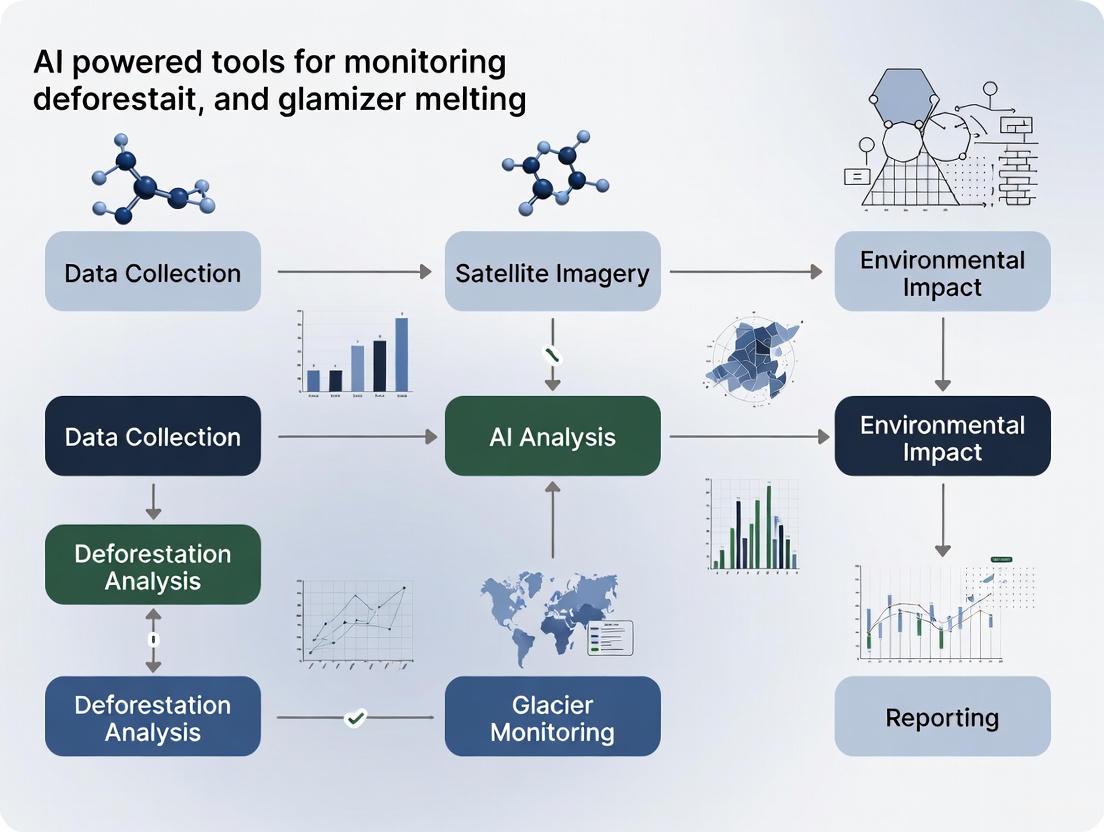
The workflow for these AI-powered monitoring approaches is summarized below.
The Scientist's Toolkit: Research Reagent Solutions
This section details essential materials, datasets, and platforms that function as "research reagents" for conducting experiments in AI-powered environmental monitoring.
Table 3: Essential Tools and Platforms for Environmental Monitoring Research
| Tool / Platform Name | Type | Primary Function in Research |
|---|---|---|
| Global Forest Watch (GFW) [7] | Interactive Web Platform | Provides access to near real-time deforestation alerts and over 65 global forest data sets for visualization and analysis. |
| Google Earth Engine [5] | Cloud Computing Platform | Offers a massive catalog of satellite imagery and geospatial data for scientific analysis and processing at scale. |
| Landsat & Sentinel-2 | Satellite Imagery | Source of multi-spectral optical imagery for tracking land cover change, including forest loss and glacier surface changes. |
| Synthetic Aperture Radar (SAR) \n(e.g., Capella SAR, TerraSAR-X) [8] | Satellite Imagery | Provides all-weather, day-and-night radar imagery capable of penetrating clouds, essential for monitoring in perpetually cloudy regions and measuring glacier surface deformation. |
| GLAD Alert System [7] | Deforestation Alert System | Delivers high-resolution, weekly alerts on tropical forest loss, enabling rapid detection and response. |
| Randolph Glacier Inventory (RGI) [4] | Glacier Database | A global inventory of glacier outlines, serving as a fundamental baseline for glacier mass balance studies. |
| Global Navigation Satellite System (GNSS) \n(e.g., Trimble GNSS) [8] | Ground-based Sensor | Provides highly precise, in-situ measurements of ice movement and position to validate satellite-based observations. |
| LiDAR \n(e.g., Terra LiDAR) [8] | Airborne/Drone-based Sensor | Generates high-resolution 3D models of glacier surface topography and forest structure for detailed volumetric change detection. |
Visualization: From Satellite Data to Actionable Insight
The logical pathway from raw data to actionable knowledge involves multiple steps of AI processing and analysis, which can be visualized as a flow of information through a structured pipeline.
Why Traditional Monitoring Methods Are Falling Short
Traditional methods for monitoring environmental changes, such as manual field surveys and basic satellite image analysis, are increasingly failing to meet contemporary research demands. These conventional approaches are characterized by significant limitations in spatial coverage, temporal resolution, and processing efficiency, creating critical gaps in our understanding of rapidly evolving climate impacts. In deforestation research, manual interpretation of satellite imagery remains labor-intensive and often fails to provide real-time alerts, resulting in delayed intervention [9]. Similarly, in glaciology, fieldwork in remote, harsh environments like the Arctic is challenging, expensive, and logistically constrained, severely limiting the scale and frequency of data collection [6]. The sheer volume of data now available from modern satellite constellations—millions of images—has outpaced the capacity of manual analysis methods [6] [10]. This procedural bottleneck hinders the timely detection of abrupt changes, such as illegal logging events or glacial calving fronts, ultimately compromising the responsiveness of scientific and policy interventions. The transition to advanced, AI-powered monitoring frameworks is therefore not merely an enhancement but a fundamental necessity for producing actionable, timely, and accurate environmental data.
Quantitative Analysis: Traditional vs. AI-Enhanced Monitoring
The limitations of traditional monitoring methods and the advantages of AI-driven approaches are quantitatively evident across several performance metrics. The following table synthesizes key findings from recent studies to facilitate a direct comparison.
Table 1: Performance Comparison of Traditional and AI-Enhanced Monitoring Methods
| Monitoring Focus | Traditional Method & Key Limitation | AI-Enhanced Approach & Documented Improvement |
|---|---|---|
| Global Glacier Mass Change | Relies on sparse, inhomogeneous data from ~500 in-situ glaciers, leading to assessment challenges [3]. | A community effort (GlaMBIE) homogenized data from 35 teams, finding a 36±10% increase in mass loss rate from 2000-2011 to 2012-2023 [3]. |
| Deforestation Anomaly Detection | Manual satellite image processing is slow; by the time loss is identified, "irreversible environmental damage has already occurred" [9]. | A YOLOv8-LangChain framework achieved a 24% increase in recall and significantly reduced false positives, enabling real-time alerts [9]. |
| Calving Front Monitoring | Manual delineation of glacier fronts from satellite images is impractical across millions of images and hundreds of glaciers [6]. | A deep learning model automatically mapped 149 marine-terminating glaciers from over 1 million satellite images, revealing 91% have retreated since 1985 [6] [10]. |
| Forest Carbon Sequestration | Data gaps and a lack of capacity, especially in the Global South, hinder accurate carbon accounting [11]. | AI models (e.g., MATRIX) harness data from 1.8 million global forest plots to provide precise, transparent estimates of aboveground biomass growth [11]. |
Experimental Protocols for AI-Powered Environmental Monitoring
Protocol 1: Real-Time Deforestation Anomaly Detection
This protocol details the methodology for implementing a real-time deforestation detection system using the integrated YOLOv8 and LangChain agent framework as described by Scientific Reports [9].
- Objective: To automatically detect indicators of deforestation (e.g., tree stumps, logging machinery) in satellite or drone imagery and generate geolocated alerts.
- Materials and Reagents:
- Satellite/Drone Imagery: High-resolution optical or SAR imagery. Sources include Sentinel-2, Landsat-8, or commercial providers.
- Computing Infrastructure: GPU-accelerated workstation or cloud instance for model training and inference.
- Software Framework: Python with PyTorch/TensorFlow for YOLOv8, and LangChain for building agentic AI.
- Geographic Information System (GIS): For visualizing and reporting alerts (e.g., ArcGIS, QGIS).
- Step-by-Step Procedure:
- Data Curation and Annotation: Collect a large dataset of satellite images. Annotate images, drawing bounding boxes around deforestation indicators (e.g., "treestump," "bulldozer," "logpile").
- Model Training and Optimization:
- Partition the annotated dataset into training, validation, and test sets (e.g., 70/15/15 split).
- Train the YOLOv8 object detection model on the training set. Monitor metrics like
box_lossandcls_loss. - Validate the model on the validation set, using mean Average Precision (mAP50) as the primary accuracy metric.
- LangChain Agent Integration:
- Develop a LangChain agent equipped with contextual rules (e.g., "ignore single vehicles in established roads").
- The agent receives initial predictions from YOLOv8 and performs dynamic threshold adjustment to reduce false positives.
- Implement a reinforcement learning-based feedback loop where the agent's adjustments are rewarded or penalized based on accuracy.
- Deployment and Alerting:
- Deploy the integrated model in a live inference pipeline that processes incoming satellite imagery.
- The LangChain agent generates finalized predictions and triggers a GIS-based reporting module.
- The system outputs actionable alerts with geographic coordinates, confidence scores, and timestamps.
Protocol 2: AI-Based Glacier Calving Front Dynamics
This protocol outlines the procedure for using a deep learning model to track the retreat of marine-terminating glaciers, as applied to Svalbard [6] [10].
- Objective: To automatically delineate glacier calving fronts from long-term satellite imagery archives to analyze retreat patterns.
- Materials and Reagents:
- Satellite Imagery Archive: Multi-decadal optical (Landsat, Sentinel-2) and radar (Sentinel-1) imagery. The study used open-access data from Google Earth Engine [6].
- Model Architecture: A deep learning model, such as a U-Net variant, suited for semantic segmentation.
- Ground-Truth Data: A subset of images with manually digitized calving fronts for model training and validation.
- Step-by-Step Procedure:
- Data Acquisition and Preprocessing:
- Use Google Earth Engine to compile a time series of over one million satellite images for the target glaciers from 1985 to the present.
- Preprocess images: apply cloud masking for optical data, and calibrate and filter radar data.
- Model Training:
- Train the deep learning model to perform semantic segmentation, teaching it to identify the boundary between ice and ocean in both optical and radar images.
- The model is trained to be robust to various conditions, including different seasons and lighting.
- Inference and Time-Series Analysis:
- Apply the trained model to the entire historical image archive for each of the 149 glaciers.
- The model automatically outputs the pixel location of the calving front for each available image date.
- Trend Calculation and Visualization:
- Calculate the annual and seasonal advance/retreat distance for each glacier front from the time-series of positions.
- Aggregate data to identify regional patterns, correlate retreat rates with ocean temperature data, and pinpoint peak retreat years (e.g., the widespread retreat in 2016 [6]).
- Data Acquisition and Preprocessing:
Visualization of AI Workflows
The integration of AI into environmental monitoring follows a structured pipeline from data acquisition to actionable insight. The following diagram illustrates the core workflow.
Figure 1: Generalized AI Environmental Monitoring Workflow.
Table 2: Essential Research Reagent Solutions for AI-Powered Monitoring
| Research 'Reagent' | Type/Function | Application in Protocol |
|---|---|---|
| YOLOv8 Model | Object Detection Algorithm | Rapidly identifies deforestation indicators in imagery [9]. |
| LangChain Agent | Agentic AI Framework | Provides contextual reasoning and dynamic threshold adjustment to refine object detection [9]. |
| U-Net Architecture | Semantic Segmentation Model | Precisely delineates glacier calving fronts pixel-by-pixel in satellite images [6] [12]. |
| Google Earth Engine | Cloud-Based Geospatial Platform | Provides access to and processing of massive satellite imagery archives [6]. |
| Sentinel-2 Imagery | Multi-Spectral Satellite Data | Primary data source for optical monitoring of land cover and glaciers [12]. |
| Sentinel-1 Imagery | Synthetic Aperture Radar (SAR) Data | Enables monitoring through cloud cover, critical for tropical and polar regions [9] [12]. |
| MATRIX Model | AI Model for Forest Biomass | Estimates forest growth and carbon sequestration potential from global plot data [11]. |
The evidence is clear: traditional monitoring methods are fundamentally inadequate for addressing the scale and urgency of contemporary environmental challenges. The quantitative data and experimental protocols outlined herein demonstrate that AI-powered tools are not merely incremental improvements but represent a paradigm shift. By overcoming the critical shortfalls in speed, scale, and accuracy, AI enables a transition from retrospective documentation to proactive, predictive monitoring. This new capacity is vital for safeguarding vital resources, such as the freshwater supplied by glaciers to over two billion people [13] [14] and the carbon sequestration services of the world's forests [11]. The integration of AI into the environmental scientist's toolkit is therefore an essential step toward building a resilient and sustainable future.
Application Note 1: Proactive Deforestation Risk Forecasting
Background and Rationale
Forests play a critical role in storing carbon, regulating rainfall, and harboring terrestrial biodiversity. However, the world continues to lose forests at an alarming rate, with one recent year recording a loss of 6.7 million hectares of tropical forest—a record high and double the amount lost the previous year [5]. Traditionally, satellite data has provided essential measurement of this loss reactively, documenting damage after it has occurred. The paradigm shift to a proactive approach involves forecasting where deforestation is likely to happen, enabling interventions before forests are lost [5].
Table: Key Quantitative Data for Deforestation Forecasting
| Metric | Reactive Monitoring (Historical) | Proactive Forecasting (AI-Powered) |
|---|---|---|
| Primary Function | Measuring past and present forest loss [5] | Predicting future areas of deforestation risk [5] |
| Temporal Resolution | Near real-time (after loss occurs) [15] | Forward-looking (risk assessment for future timeframes) [5] |
| Key AI Input Data | Satellite imagery (Landsat, Sentinel-2) [15] | Satellite imagery plus "change history" of pixel-level deforestation over time [5] |
| Spatial Application | Consistent across regions [15] | Consistent and scalable across regions (e.g., tropical forests in Latin America and Africa) [5] |
Experimental Protocol: Deforestation Risk Modeling with a "Pure Satellite" Approach
Application: Training a deep learning model to predict pixel-level deforestation risk.
Materials and Workflow:
- Data Acquisition: Source satellite imagery and derived data products.
- Data Preparation: Structure the data into tiles of satellite pixels for model input. The model is designed to receive an entire tile as input to capture crucial spatial context and the pattern of recent deforestation fronts [5].
- Model Training:
- Architecture: Employ a custom model based on vision transformers, optimized for processing spatial data [5].
- Process: Train the model using historical satellite-derived labels of deforestation. The model learns to associate the input tile data (including change history) with subsequent deforestation events [5].
- Validation & Benchmarking: Evaluate model performance by its ability to accurately predict tile-to-tile variation in deforestation amounts and, within a tile, identify the pixels most likely to be deforested next. Compare accuracy against previous methods that rely on patchy geospatial data like roads [5].
Application Note 2: AI-Powered Glacier Dynamics and Calving Monitoring
Background and Rationale
Glaciers, particularly in vulnerable regions like the Arctic, are highly sensitive to climate change. The Svalbard archipelago, for instance, is warming up to seven times faster than the global average [16]. The complete melting of Svalbard's glaciers could raise global sea levels by 1.7 cm, making accurate monitoring of their dynamics vital [16]. A key process driving ice loss in marine-terminating glaciers is calving, where large chunks of ice break off into the ocean. Understanding this process is essential for predicting future glacier mass loss and subsequent sea-level rise [16].
Table: AI-Driven Insights into Glacier Retreat
| Parameter | Svalbard-Wide Analysis (1985-2023) | Seasonal Dynamics |
|---|---|---|
| Scope of Retreat | 91% of marine-terminating glaciers significantly retreated [16] | 62% of glaciers exhibit seasonal retreat-advance cycles [16] |
| Total Area Lost | >800 km² (Larger than New York City) [16] | Seasonal changes often exceed annual changes [16] |
| Annual Rate of Loss | ~24 km²/year (Nearly twice the size of Heathrow Airport) [16] | Retreat is triggered almost immediately by ocean warming in spring [16] |
| Extreme Event (2016) | Calving rates doubled in response to extreme warming and record rainfall [16] | N/A |
Experimental Protocol: Large-Scale Glacier Calving Front Mapping with AI
Application: Using an AI model to automatically map glacier calving fronts from decades of satellite imagery to analyze retreat rates and patterns.
Materials and Workflow:
- Data Collection: Compile a massive dataset of millions of satellite images of the target glaciers over the study period (e.g., 1985-2023 for a Svalbard study) [16].
- Model Training:
- Task: Train a deep learning model, such as a U-Net or DeepLab derivative, for semantic segmentation [12]. The model is tasked with identifying the precise boundary (calving front) between ice and ocean in each image.
- Advantage: This AI method is highly scalable and reproducible, overcoming the labour-intensity and potential inconsistency of manual digitization by human researchers [16].
- Trend Analysis: Use the AI-generated time series of calving front positions to calculate rates of retreat, identify seasonal patterns, and correlate these changes with external climate data such as ocean and air temperature records [16].
- Physical Insight Generation: Combine machine learning with high-resolution satellite and airplane data, constrained by known physics, to derive new constitutive models that describe the ice's viscosity and resistance to flow. This can reveal fundamental physics, such as the anisotropic nature of ice in extension zones, which is not captured in standard lab-derived models [17].
Visualization: Proactive Environmental Monitoring Workflow
The following diagram illustrates the integrated workflow for transitioning from reactive monitoring to proactive forecasting in both deforestation and glacier research.
The Scientist's Toolkit: Essential Research Reagents & Materials
Table: Key Resources for AI-Powered Environmental Monitoring
| Research 'Reagent' | Function / Application | Specifications & Notes |
|---|---|---|
| Optical Satellite Imagery (Landsat-8, Sentinel-2) | Primary data source for land cover classification, change detection (deforestation), and glacier mapping [12] [5]. | Affected by cloud cover. Provides multispectral data crucial for analyzing vegetation health and ice surfaces [12]. |
| Synthetic Aperture Radar (SAR) Data (Sentinel-1) | Complementary data source for all-weather, day-and-night monitoring, penetrating cloud cover [12]. | Vital for continuous monitoring in perennially cloudy regions like the tropics or polar winters [12]. |
| 'Change History' Data Layer | A satellite-derived input mapping the history of pixel-level changes (e.g., past deforestation). Serves as the most critical predictive feature for deforestation risk models [5]. | A small but information-dense input that captures trends and moving fronts of environmental change [5]. |
| Deep Learning Model Architectures (Vision Transformers, U-Net) | Core analytical engines. Vision transformers are used for scalable deforestation prediction [5], while U-Net is widely used for semantic segmentation tasks like mapping glacier calving fronts [12]. | Model choice depends on the task (prediction vs. segmentation). Computational demands can be high [12] [5]. |
| High-Resolution Airplane & Satellite Radar | Provides detailed topography and ice thickness data for building high-fidelity geophysical models of ice sheets [17]. | Used to validate and inform AI models, connecting large-scale patterns with physical processes [17]. |
| Physics-Informed Deep Learning Framework | A methodology that integrates physical laws (e.g., laws of ice flow) as constraints within the machine learning model during training [17]. | Ensures model outputs are not just data-driven but also physically plausible, leading to more robust and interpretable discoveries [17]. |
Application Notes: AI for Deforestation and Glacier Monitoring
The integration of deep learning and computer vision with remote sensing is transforming environmental monitoring, enabling precise, large-scale, and automated analysis of deforestation and glacier retreat [18]. These technologies provide researchers with the tools to understand and quantify environmental change with unprecedented accuracy and speed.
Deforestation Monitoring
Global Deforestation Drivers (2001-2022) Deep learning models, particularly convolutional neural networks (CNN), have become essential for automatically detecting deforestation and classifying its drivers from satellite imagery [19]. A significant global dataset developed by the World Resources Institute and Google Deep Mind utilizes an artificial intelligence (AI) algorithm called ResNet to determine the reasons for forest loss at a one-kilometer spatial resolution, distinguishing between seven primary drivers [20].
Table 1: Global Drivers of Tree Cover Loss (2001-2022)
| Driver Category | Percentage of Global Tree Cover Loss |
|---|---|
| Permanent Agriculture | 34.8 ± 2.6% |
| Wildfires | 49.5% (of 2024 tropical primary forest loss) |
| Logging | 26.3% (in Asia) |
| Shifting Cultivation | Data from source |
| Hard Commodities | Data from source |
| Settlements and Infrastructure | Data from source |
| Other Natural Disturbances | Data from source |
Table 2: Regional Deforestation Drivers in Asia
| Driver | Percentage |
|---|---|
| Wildfires | 65.4% |
| Logging | 26.3% |
| Permanent Agriculture | 2.5% |
For specific regions like the Amazon, U-Net models applied to Sentinel-1 radar data have achieved high accuracy, with Forest (Fo) and Deforestation (De) classes reaching F1-Scores of 0.97 and 0.92, respectively [21]. However, in geographically complex and fragmented landscapes like India, a 1 km spatial resolution may be insufficient, necessitating a multi-pronged approach that combines satellite data with additional field observations and biophysical data for a comprehensive understanding [20].
Glacier Monitoring
AI is critical for mapping glaciers and understanding climate change impacts. A deep learning model called GlaViTU (Glacier-VisionTransformer-U-Net) has demonstrated performance that matches expert-level delineation accuracy for global glacier mapping [22].
Table 3: GlaViTU Model Performance by Glacier Type
| Glacier Type | Region Example | Model Performance (Intersection over Union) |
|---|---|---|
| Debris-Rich Areas | High-Mountain Asia | >0.75 |
| General/Previously Unobserved | Various | >0.85 |
| Clean-Ice-Dominated | Various | >0.90 |
The application of AI to study marine-terminating glaciers in Svalbard, Norway, has revealed that 91% of glaciers have significantly shrunk since 1985, with the peak retreat rate occurring in 2016 during an unusual warm period [6]. These models are trained on both optical and radar satellite imagery, enabling them to identify calving fronts under diverse environmental conditions with high accuracy [6].
Experimental Protocols
Protocol 1: Deforestation Driver Classification using ResNet
Objective: To train a deep learning model for identifying and classifying drivers of deforestation from satellite imagery at a 1 km spatial resolution.
Materials:
- Satellite imagery (e.g., from Landsat or Sentinel-2)
- High-resolution 1 km grid cells with at least 0.5% tree cover loss, visually interpreted by experts (for training data)
- Population and biophysical data inputs
- Computational resources (GPU recommended)
Methodology:
- Data Preparation: Assemble a global dataset of satellite images. Define training samples as 1 km grid cells with at least 0.5% tree cover loss. These samples must be visually interpreted and labeled by domain experts according to the seven driver classes [20].
- Model Training: Train a ResNet-based deep learning model. Inputs include satellite imagery along with relevant population and biophysical data. The model learns to associate spatial patterns with a specific driver class (e.g., permanent agriculture, wildfires, logging) [20].
- Model Refinement: Address the challenge of regional variations in driver patterns (e.g., different types of logging) by collecting additional, diverse training data to improve the model's recognition capabilities across different geographies [20].
- Analysis: Apply the trained model to analyze satellite imagery from 2001-2022 to determine the dominant driver of tree cover loss for each 1 km grid cell globally [20].
Deforestation Analysis Workflow
Protocol 2: Multi-Temporal Glacier Calving Front Detection
Objective: To automatically detect and track the calving fronts of marine-terminating glaciers over multiple decades using a deep learning model.
Materials:
- Over 1 million satellite images (optical and radar) from sources like Google Earth Engine, spanning from 1985 to present [6]
- Reference glacier inventory data (e.g., GLIMS, Randolph Glacier Inventory) [22]
- Computational resources for deep learning
Methodology:
- Model Training: Train a deep learning model to automatically detect calving fronts from a massive dataset of satellite images. The model must be trained on both optical and radar imagery to function under various environmental conditions and for different glacier types [6].
- Inference and Tracking: Apply the trained model to analyze the entire time series of satellite imagery for each of the 149 studied glaciers in Svalbard. The model outputs the position of the calving front for each available image date [6].
- Time-Series Analysis: Calculate retreat and advance rates by tracking the change in the calving front position over time. Analyze the data for seasonal patterns (summer retreat, winter advance) and long-term trends [6].
- Correlation with Climate Variables: Correlate the timing and magnitude of glacier retreat with ocean temperature data and atmospheric events (e.g., atmospheric blocking) to understand the climatic drivers of ice loss [6].
Glacier Monitoring Workflow
Protocol 3: Global Glacier Mapping with GlaViTU
Objective: To produce accurate, globally scalable glacier outlines using a hybrid convolutional-transformer deep learning model.
Materials:
- Open satellite imagery (optical and SAR)
- Auxiliary data: Digital Elevation Models (DEMs), thermal data, and interferometric SAR (InSAR) data [22]
- A benchmark tile-based dataset covering 9% of glaciers worldwide, structured into 10x10 km2 tiles [22]
Methodology:
- Data Compilation: Construct a comprehensive dataset from public satellite images and glacier inventories. The dataset should cover diverse glacierized environments and be organized into non-overlapping tiles for model development and testing [22].
- Model Architecture: Implement GlaViTU, a hybrid convolutional-transformer model designed to capture both local image features and long-range dependencies [22].
- Multi-Strategy Training: Explore different training strategies, including a global strategy (one model for all regions) and a regional strategy (one model per region), to achieve high generalization across space, time, and different satellite sensors [22].
- Validation and Accuracy Assessment: Validate the model's performance on an independent test dataset. Assess spatial, temporal, and cross-sensor generalization. Compare the automated outlines against human expert uncertainties in terms of area and distance deviations [22]. Report calibrated confidence metrics for the glacier extents to make predictions more reliable and interpretable [22].
The Scientist's Toolkit: Essential Research Reagents & Materials
Table 4: Key Resources for AI-Based Environmental Monitoring
| Category / Item | Function in Research |
|---|---|
| Satellite Imagery | |
| Landsat & Sentinel-2 | Provides high-resolution optical imagery for visual analysis of forest cover and glacier surfaces [12] [19]. |
| Sentinel-1 | Provides Synthetic Aperture Radar (SAR) data, which penetrates cloud cover, for monitoring in all weather conditions [12] [21]. |
| AI Models & Architectures | |
| U-Net | A dominant deep learning architecture for semantic segmentation, used for precisely delineating deforestation patches or glacier boundaries [12] [19] [21]. |
| ResNet | Used for classifying deforestation drivers by extracting complex features from satellite imagery [20]. |
| Vision Transformer (ViT) | Captures long-range dependencies in images, improving model performance in complex landscapes [22]. |
| Data Platforms | |
| Google Earth Engine | Provides open-access to a massive catalog of satellite imagery and geospatial data for large-scale analysis [6]. |
| Global Forest Watch | Platform providing data and alerts on forest change, incorporating AI-based driver classification [20]. |
| Reference Data | |
| GLIMS & Randolph Glacier Inventory | Provide baseline glacier outlines for model training and validation [22]. |
| Expert Visual Interpretations | Critical for creating accurate labeled datasets to train and validate deep learning models [20]. |
| Computational Tools | |
| Python with DL Frameworks | (e.g., TensorFlow, PyTorch) for developing, training, and deploying deep learning models [19]. |
| Google Colaboratory | Online Jupyter notebook environment with AI integrations to assist in writing Python code for data science [23]. |
Inside the Toolbox: AI Models and Real-World Applications in Environmental Monitoring
Application Note: Deep Learning for Proactive Forest Conservation
Deforestation represents a critical threat to global biodiversity, climate stability, and ecosystem services. Traditional satellite-based monitoring systems provide essential but retrospective insights, documenting loss only after it has occurred [5]. This reactive paradigm limits opportunities for prevention and early intervention. The ForestCast framework introduces a transformative approach by applying deep learning to forecast deforestation risk, enabling proactive conservation and resource allocation before losses happen [5] [24]. This shift from documenting past events to anticipating future vulnerabilities marks a significant advancement in environmental monitoring, aligning with broader applications of AI in tracking ecological changes such as glacier melt and other climate-critical phenomena [25].
Technical Innovation: The ForestCast Benchmark
ForestCast establishes the first publicly available benchmark dataset and deep learning benchmark for deforestation risk forecasting [5] [26]. Its innovation lies in addressing the core challenges of previous forecasting methods, which relied on patchily-available input maps (e.g., roads, population density) that were often inconsistent, difficult to scale, and quickly outdated [5]. In contrast, ForestCast adopts a "pure satellite" approach, deriving all inputs from satellite data, ensuring consistency, global applicability, and future-proofing through continuously updated satellite data streams [5] [24].
The following table summarizes the core quantitative findings from the ForestCast development and benchmarking.
Table 1: Key Performance Metrics of the ForestCast Deep Learning Approach
| Metric Category | Specific Metric | Reported Performance / Value |
|---|---|---|
| Model Architecture | Primary Model Type | Vision Transformers (ViT) [5] [24] |
| Spatial Resolution | Input/Output Resolution | 1 km² (30m minimum mapping unit cited in related research) [5] [21] |
| Input Data Efficacy | Most Predictive Input | Change History (performance indistinguishable from full satellite data) [5] [26] |
| Comparative Accuracy | Benchmarking | Matched or exceeded accuracy of methods using specialized inputs (e.g., roads) [5] |
| Related Model Performance | U-Net (SAR-based) | Highest Overall Accuracy: 0.95; IoU: 0.66 [21] |
| Related Model Performance | U-Net (SAR-based) - Forest Class F1-Score | 0.97 [21] |
| Related Model Performance | U-Net (SAR-based) - Deforestation Class F1-Score | 0.92 [21] |
Experimental Protocol: Deforestation Risk Forecasting
Data Acquisition & Preprocessing
This protocol details the methodology for training and deploying a ForestCast-style deep learning model.
Objective: To acquire and preprocess all necessary satellite data for training a deforestation risk forecasting model.
Materials & Reagents:
- Hardware: High-performance computing cluster with GPUs (e.g., NVIDIA A100/T4), sufficient storage for petabyte-scale satellite data.
- Software: Python 3.8+, Google Earth Engine API, TensorFlow/PyTorch, Rasterio, GDAL.
- Data Sources:
Procedure:
- Define Region of Interest (ROI): Select a focal area (e.g., Southeast Asia, Amazon basin) and a time frame for model training (e.g., 2000-2020).
- Acquire Satellite Imagery: For the ROI and time frame, download multispectral satellite imagery (e.g., Landsat Surface Reflectance Tier 1) at a consistent spatial resolution. Cloud masking is essential.
- Generate "Change History" Input: Process annual forest cover data to create a "change history" raster. This single image summarizes past deforestation by assigning each pixel the year it was deforested; pixels that remain forested are assigned a background value [5]. This is the most critical input.
- Assemble Additional Inputs (Optional):
- Generate Deforestation Labels: Using the forest cover change data, create binary rasters (0: no deforestation, 1: deforestation) for a future target year (e.g., predict 2021 deforestation using data up to 2020). This serves as the ground-truth label for supervised learning.
- Tiling & Normalization: Split all input rasters and label rasters into smaller, manageable tiles (e.g., 256x256 pixels). Normalize pixel values for each input band to a common scale (e.g., 0-1).
Model Training & Optimization
Objective: To train a vision transformer model to predict pixel-wise deforestation risk.
Procedure:
- Model Selection: Implement a Vision Transformer (ViT) architecture. The model should be designed to ingest a full tile of input data and output a corresponding tile of probability scores [5].
- Data Partitioning: Randomly split the data tiles into training (70%), validation (15%), and test (15%) sets, ensuring tiles from the same geographic area are contained within a single split to prevent data leakage.
- Loss Function & Compilation: Use a loss function suitable for binary segmentation, such as Binary Cross-Entropy or a combined Dice-Focal loss, to handle class imbalance. Select the AdamW optimizer.
- Model Training: Train the model on the training set, using the validation set for epoch-to-performance monitoring. Employ early stopping and reduce-learning-rate-on-plateau callbacks to prevent overfitting and stabilize training.
- Hyperparameter Tuning: Systematically tune key hyperparameters using a framework like Optuna [21]. The table below details the parameters and their search spaces.
Table 2: Hyperparameter Tuning for Deforestation Forecasting Models
| Hyperparameter | Search Space / Value | Function / Impact on Model |
|---|---|---|
| Learning Rate | 1e-5 to 1e-3 (log scale) | Controls step size during weight updates; critical for convergence. |
| Batch Size | 32, 64, 128 | Impacts training stability and GPU memory usage. |
| Patch Size | 16, 32 | Size of image patches for Vision Transformer input. |
| Transformer Layers | 6, 12, 24 | Number of transformer encoder blocks; impacts model capacity. |
| Attention Heads | 8, 16 | Number of self-attention heads per layer. |
| Hidden Dimension | 384, 768, 1024 | Dimensionality of the feature embeddings. |
| Dropout Rate | 0.1 to 0.3 | Prevents overfitting by randomly dropping units during training. |
Model Evaluation & Inference
Objective: To rigorously evaluate model performance and generate deforestation risk forecasts.
Procedure:
- Quantitative Evaluation: Run the trained model on the held-out test set. Calculate performance metrics, including:
- Area Under the Curve (AUC) of the Receiver Operating Characteristic (ROC) curve.
- Pixel-wise Accuracy, Precision, and Recall.
- Intersection over Union (IoU) for the deforestation class.
- Benchmarking: Compare the model's performance against baseline methods, such as Random Forest models or models that only use static driver maps, to establish its relative advantage [26].
- Risk Map Generation (Inference): To create a new forecast, deploy the trained model on preprocessed, most-recent input data for the target area. The model output is a georeferenced raster where each pixel's value represents the predicted probability of deforestation within the forecast period (e.g., the next year).
- Validation: Where possible, collaborate with in-country partners for ground-truthing to validate the model's predictions against real-world observations [27].
The following workflow diagram illustrates the complete experimental protocol.
The Scientist's Toolkit: Essential Research Reagents & Materials
The successful implementation of a deforestation forecasting system requires a suite of data, computational tools, and software. This table details the essential "research reagents" for this field.
Table 3: Key Research Reagents and Materials for Deforestation Forecasting
| Category | Item / Solution | Function / Application in Research |
|---|---|---|
| Satellite Data Sources | Landsat Archive (USGS) | Provides multi-decadal, medium-resolution optical imagery for historical analysis and change detection. [5] |
| Sentinel-2 Archive (ESA) | Delivers high-resolution optical imagery with a 5-day revisit cycle, beneficial for detailed monitoring. [5] [24] | |
| Sentinel-1 SAR (ESA) | Supplies Synthetic Aperture Radar data, which penetrates cloud cover, enabling monitoring in perpetually cloudy regions. [21] | |
| Benchmark Datasets | Global Forest Change (Hansen et al.) | The foundational, global dataset for training and validating forest extent and change models. [5] |
| ForestCast Southeast Asia Benchmark | The first public benchmark dataset specifically for training and evaluating deep learning deforestation risk models. [26] | |
| Software & Libraries | TensorFlow / PyTorch | Core open-source libraries for building and training deep learning models. |
| Google Earth Engine API | A cloud-computing platform for planetary-scale geospatial analysis, ideal for data access and preprocessing. [5] | |
| GDAL / Rasterio | Essential libraries for processing and manipulating geospatial raster data formats. | |
| Model Architectures | Vision Transformers (ViT) | State-of-the-art architecture used in ForestCast, effective at capturing long-range dependencies in image data. [5] |
| U-Net (with ResNet backbone) | A convolutional network commonly used for semantic segmentation tasks, effective in related LULC studies. [21] | |
| Validation Tools | QGIS with Deforisk Plugin | An open-source GIS application and plugin used for mapping deforestation risks and validating model outputs on a national scale. [27] |
| Ground Control Points (GCPs) | In-situ field measurements used to validate and calibrate remote sensing-based model predictions. [21] |
Integrated Analysis & Future Perspectives
The application of deep learning, particularly vision transformers, marks a paradigm shift in how we approach forest conservation. The core insight from ForestCast—that a simple, satellite-derived "change history" is a powerfully predictive input—simplifies the modeling challenge and enhances scalability [5] [26]. This approach effectively captures the spatial dynamics of deforestation fronts and trends over time.
The methodologies detailed here for forests are directly transferable to the parallel crisis of glacier melting research. The same "pure satellite" philosophy can be applied, using historical glacier extent and velocity maps as a key input to forecast future ice loss. AI models can similarly process raw satellite imagery (optical and SAR) to predict calving events, thinning rates, and the expansion of glacial lakes, thereby providing critical early warnings for communities downstream [25].
For researchers, the path forward involves scaling these models globally, improving temporal resolution for near-real-time risk assessment, and integrating multimodal data. The public release of benchmarks like ForestCast is crucial for fostering collaboration, ensuring reproducibility, and accelerating innovation in the vital field of AI-powered environmental forecasting [5] [26]. The ultimate goal is to transform these risk forecasts into actionable intelligence, empowering governments, corporations, and local communities to protect vulnerable ecosystems before they are lost.
The integration of artificial intelligence (AI) into environmental monitoring represents a paradigm shift in how we protect fragile ecosystems. This document details the application of a novel AI framework that synergizes the real-time object detection capabilities of YOLOv8 (You Only Look Once) with the advanced reasoning and dynamic adjustment capacities of LangChain-based Agentic AI for the detection of illegal logging activities. This approach is designed to overcome the limitations of traditional monitoring methods, which often suffer from delayed detection, sparse coverage of vast and inaccessible forest areas, and high resource demands [9]. The core innovation lies in the creation of a closed-loop system where YOLOv8 provides rapid, visual identification of logging indicators—such as tree stumps, logging machinery, and unauthorized human presence—from satellite and drone imagery, while the LangChain agent introduces a layer of contextual reasoning, dynamic threshold adjustment, and reinforcement-learning-based feedback [9]. This enables the system to not only detect potential threats but also to learn from its environment and improve its performance over time, reducing false positives and increasing recall. Framed within a broader thesis on AI for environmental protection, this methodology establishes a scalable, interpretable, and real-time approach that can be adapted for monitoring other critical phenomena, such as glacier melting.
Quantitative Performance Analysis
The performance of object detection models is quantitatively assessed using a standard set of metrics that evaluate both accuracy and efficiency. The following table summarizes the key metrics used to evaluate the YOLO model within the proposed framework, based on established guidelines for YOLO performance evaluation [28].
Table 1: Key Object Detection Performance Metrics for Model Evaluation
| Metric | Definition | Interpretation in Illegal Logging Context |
|---|---|---|
| Precision (P) | Proportion of true positive detections among all positive predictions [28]. | Measures the model's accuracy in avoiding false alarms; high precision means most alerts are actual logging activity. |
| Recall (R) | Proportion of true positives detected among all actual positives [28]. | Measures the model's ability to find all instances of illegal logging; high recall means few logging events are missed. |
| mAP50 | Mean Average Precision at an IoU threshold of 0.50 [28]. | Evaluates detection accuracy under "easy" criteria, where a predicted bounding box only needs to overlap 50% with a ground truth box. |
| mAP50-95 | Average mAP over IoU thresholds from 0.50 to 0.95 in steps of 0.05 [28]. | A comprehensive metric for detection performance across varying levels of difficulty, from "easy" to "strict". |
| F1 Score | Harmonic mean of precision and recall [28]. | Provides a single score that balances the trade-off between false positives (precision) and false negatives (recall). |
| IoU | Intersection over Union; measures the overlap between predicted and ground truth bounding boxes [28]. | Quantifies the accuracy of object localization (e.g., how precisely the bounding box encapsulates a logging truck). |
In a specific application for deforestation anomaly detection, the integration of a LangChain agent with a YOLOv8 model demonstrated significant operational improvements, even with a modest baseline mAP50. The following table summarizes the reported experimental outcomes [9].
Table 2: Experimental Outcomes of YOLOv8 and LangChain Agent Integration for Deforestation Detection
| Performance Aspect | Reported Outcome | Significance |
|---|---|---|
| Training Performance | Steady improvements with boxloss, clsloss, and distribution focal loss reduced by >50% [9]. | Indicates effective model convergence and learning from the training dataset. |
| Baseline mAP50 | Approximately 0.07 [9]. | Suggests a challenging detection environment or dataset, highlighting the need for post-processing enhancement. |
| Recall Enhancement | Increase of up to 24% compared to baseline YOLO models [9]. | The LangChain agent's dynamic adjustment successfully helped the system identify more true instances of logging activity. |
| False Positives | Notable reduction through reinforcement-learning-based feedback [9]. | Improved the operational efficiency of the system by minimizing unnecessary alerts, a critical feature for field deployment. |
Experimental Protocols
Data Acquisition and Preprocessing Protocol
Objective: To collect and prepare a multimodal dataset suitable for training and validating the YOLOv8 model for illegal logging indicator detection. Materials: Access to satellite imagery providers (e.g., Sentinel, Landsat) or UAV/drone platforms; computing infrastructure with adequate GPU resources; data annotation software (e.g., LabelImg, CVAT). Procedure:
- Data Collection: Acquire multispectral and RGB imagery from target forested regions. Data should encompass diverse conditions (seasons, weather, lighting) and contain examples of both positive instances (logging equipment, stumps, roads) and negative instances (undisturbed forest, natural clearings) [9].
- Data Annotation: Annotate all collected images by drawing bounding boxes around target objects. Each bounding box must be labeled with the correct class (e.g., "treestump", "loggingtruck", "excavator"). This creates the ground truth data [28] [29].
- Data Augmentation: Apply a suite of augmentation techniques to the training dataset to improve model robustness. This should include, but not be limited to:
- Geometric transformations: Rotation (±15°), scaling (0.8x - 1.2x), shearing, and horizontal flipping.
- Color space adjustments: Variations in brightness, contrast, and saturation.
- Noise injection: To simulate sensor noise and varying image quality.
- Dataset Splitting: Divide the fully annotated and augmented dataset into three subsets: a training set (~70%), a validation set (~15%), and a held-out test set (~15%). The test set must remain completely unseen during the training process to provide an unbiased evaluation.
Model Training and Validation Protocol
Objective: To train the YOLOv8 object detection model and perform iterative validation. Materials: Preprocessed and split dataset; computing environment with CUDA-enabled GPU; Ultralytics YOLOv8 Python library. Procedure:
- Model Selection & Initialization: Choose an appropriate YOLOv8 model variant (e.g., YOLOv8s for a balance of speed and accuracy) [29]. Initialize the model with pre-trained weights from a large-scale dataset like COCO to leverage transfer learning.
- Hyperparameter Configuration: Define the training hyperparameters in a configuration file. Key parameters include:
- Initial learning rate (e.g., 0.01)
- Batch size (dependent on GPU memory)
- Number of epochs (e.g., 100-300)
- Optimizer (e.g., AdamW)
- Image size (e.g., 640x640 pixels)
- Training Loop: Execute the training process. The model will iteratively process batches from the training set, compute the loss (e.g., box loss, classification loss), and update its weights via backpropagation.
- Validation and Metric Tracking: After each epoch, validate the model on the validation set. Use the
model.val()function to compute key performance metrics, including Precision, Recall, mAP50, and mAP50-95 [28]. Monitor these metrics for convergence and potential overfitting. - Visual Analysis: Regularly inspect the visual outputs generated during validation, such as the validation batch predictions (
val_batchX_pred.jpg) and precision-recall curves (PR_curve.png). This provides an intuitive understanding of model performance and failure modes [28].
LangChain Agent Integration and Deployment Protocol
Objective: To integrate the trained YOLOv8 model with a LangChain agent for dynamic alert refinement and to deploy the full system for real-time monitoring.
Materials: Trained YOLOv8 model (.pt file); LangChain framework; access to a Large Language Model (LLM) API (e.g., OpenAI, Anthropic); GIS software or APIs (e.g., ArcGIS, Google Maps API).
Procedure:
- Agent Design: Construct a LangChain agent equipped with tools that allow it to:
- Call the YOLOv8 Model: Process new images and receive initial detection results.
- Access Contextual Data: Query GIS databases for land ownership status, protected area boundaries, and historical imagery [9].
- Adjust Confidence Thresholds: Dynamically raise or lower the confidence threshold for detections based on the location's risk profile (e.g., lower thresholds in protected areas) [9].
- Feedback Loop Implementation: Implement a reinforcement learning (RL) feedback mechanism where the agent's decisions (e.g., to issue an alert) are rewarded or penalized based on ground-truth verification from field reports or expert analysis. This allows the agent to learn and improve its decision-making policy over time [9].
- Alert Generation: Program the agent to synthesize the YOLO detections, contextual data, and its learned policy to generate actionable, geolocated alerts. These alerts should include the image, detected objects, confidence scores, and map coordinates for the event.
- System Deployment: Deploy the integrated system on a cloud server or edge device. Connect it to a continuous stream of imagery from satellite APIs or drone feeds. The system should be configured to run inference at a specified interval (e.g., daily) and automatically route confirmed alerts to relevant authorities or research teams.
Workflow Visualization
The following diagram illustrates the integrated workflow of the YOLOv8 and LangChain agent system for generating real-time illegal logging alerts.
The Scientist's Toolkit: Research Reagent Solutions
For researchers aiming to replicate or build upon this framework, the following table details the essential "research reagents" – the key software, data, and hardware components required.
Table 3: Essential Research Reagents for AI-Powered Deforestation Monitoring
| Tool / Component | Type | Function in the Experimental Protocol |
|---|---|---|
| YOLOv8/X/Nano | Software Model | Provides the core, high-speed object detection capability for identifying logging-related objects in imagery [29]. |
| LangChain Framework | Software Library | Enables the creation of an intelligent agent that can orchestrate tools, manage context, and make reasoned decisions [9]. |
| Global Forest Watch | Data Platform | An open-access source of satellite-based forest change data, useful for initial analysis, validation, and sourcing training imagery [30]. |
| Sentinel-2 / Landsat 8 | Satellite Imagery | Provides frequent, medium-to-high-resolution multispectral optical imagery for monitoring large forested areas [31]. |
| ICEYE SAR Satellite | Satellite Imagery | Supplies Synthetic Aperture Radar (SAR) data, capable of penetrating cloud cover, enabling all-weather, day-and-night monitoring [30]. |
| CUDA-enabled GPU | Hardware | (e.g., NVIDIA RTX Series) Accelerates the model training and inference processes, making real-time or near-real-time analysis feasible. |
| LabelImg / CVAT | Software Tool | Open-source graphical image annotation tools used for manually drawing bounding boxes to create the ground truth dataset for model training. |
| GIS Software (e.g., QGIS) | Software Platform | Used to manage and analyze spatial data, such as protected area boundaries and land tenure, which provides critical context for the LangChain agent [9]. |
The accelerating retreat of glaciers is a primary driver of global sea-level rise and a key indicator of climate change. Accurately monitoring glacier dynamics, specifically the position of calving fronts and overall mass balance, is therefore critical for climate modeling and mitigation efforts. Traditional methods of manual delineation from satellite imagery are no longer feasible at a global scale given the vast volumes of data now available. This Application Note details how artificial intelligence (AI), specifically deep learning, is being deployed to automate and enhance the precision of mapping glacier calving fronts and extents, thereby providing researchers with scalable, consistent, and high-temporal-resolution data essential for contemporary glaciology.
Technical Specifications & Performance Benchmarks
Deep learning models for glacier mapping are typically evaluated on their accuracy in delineating glacier boundaries and calving fronts against manual expert interpretations. The following table summarizes the performance and key attributes of several state-of-the-art approaches.
Table 1: Performance Benchmarks of AI Models for Glacier Mapping
| Model Name | Primary Task | Reported Performance Metric | Key Innovation | Region of Validation |
|---|---|---|---|---|
| GlaViTU [22] | Glacier extent mapping | IoU >0.85 (clean ice); >0.75 (debris-rich areas) | Hybrid Convolutional-Transformer architecture for global scalability | Global (11 diverse regions) |
| CISNet [32] | Calving front extraction | - | Dual-branch network using change information between image pairs to guide segmentation | Antarctica, Greenland, Alaska |
| U-Net-based System [33] | Calving front delineation | Mean error of 59.3 ± 5.9 m vs. manual extraction | Fully automated processing system applied to multi-spectral Landsat imagery | Antarctic Peninsula |
| Deep Learning Model [6] | Calving front detection | - | Model trained on both optical and radar images for diverse conditions | Svalbard (149 glaciers) |
Key: IoU = Intersection over Union, a metric where 1 represents a perfect match between the predicted and reference area.
Experimental Protocols & Workflows
This section outlines standardized protocols for implementing AI-based glacier monitoring, from data preparation to model application.
Protocol 1: Automated Calving Front Delineation using a U-Net-Based System
This protocol, adapted from Loebel et al. (2025), describes an end-to-end workflow for generating a high-temporal-resolution calving front product [33].
Data Acquisition & Pre-processing:
- Input Data: Acquire Level-1 multi-spectral imagery from satellites such as Landsat-8 or Landsat-9.
- Tiling: Crop the satellite scenes into smaller, manageable tiles (e.g., 512 x 512 pixels) centered on the glacier's last known calving front position.
- Resolution Standardization: Ensure all input bands are resampled to a unified ground sampling distance (e.g., 30 meters).
Model Architecture & Training:
- Model: Employ a U-Net-based convolutional neural network. The encoder (contracting path) captures contextual features, while the decoder (expanding path) enables precise localization.
- Training Data: Train the model on a dataset of thousands of manually delineated calving fronts from reference glaciers (e.g., initially trained on 869 Greenland glaciers, then fine-tuned with 252 Antarctic Peninsula fronts).
- Loss Function: Use a loss function suitable for segmentation, such as a combination of cross-entropy and Dice loss, to handle class imbalance.
Inference & Post-processing:
- Prediction: Feed new, pre-processed satellite tiles into the trained model. The output is a probability map indicating the likelihood of each pixel being part of the calving front.
- Vectorization: Convert the probability map into a single-pixel-wide line vector representing the calving front position.
- Quality Control: Implement an automated confidence filter based on the prediction probability to remove low-confidence results, followed by optional manual verification for a subset of data.
Validation:
- Compare the AI-derived calving fronts against a held-out set of manually delineated fronts. Calculate the mean distance deviation (e.g., 59.3 meters) as the primary accuracy metric [33].
Protocol 2: Global Glacier Extent Mapping with GlaViTU
This protocol, based on the work presented in Nature Communications, is designed for mapping entire glacier outlines across diverse global environments [22].
Data Compilation:
- Input Features: Compile a multi-modal dataset including:
- Optical Satellite Imagery (e.g., Landsat, Sentinel-2)
- Synthetic Aperture Radar (SAR) Data (e.g., backscatter, interferometric coherence)
- Digital Elevation Models (DEMs)
- Reference Labels: Use existing glacier inventories (e.g., GLIMS, Randolph Glacier Inventory) for supervised training.
- Input Features: Compile a multi-modal dataset including:
Model Training Strategy:
- Architecture: Utilize the GlaViTU (Glacier-VisionTransformer-U-Net) model, which combines the local feature extraction power of CNNs with the global contextual understanding of Vision Transformers [22].
- Training Strategy: Adopt a "global strategy" where a single model is trained on data from multiple, globally distributed regions to ensure strong generalization.
Prediction and Uncertainty Quantification:
- Inference: Apply the trained model to new satellite acquisitions to generate glacier extent maps.
- Confidence Calibration: The model reports a calibrated confidence score for each pixel's classification. This allows users to identify areas of high uncertainty (e.g., debris-covered ice, mountain shadows) and filter results accordingly [22].
Workflow Visualization: AI-Assisted Glacier Monitoring
The following diagram illustrates the logical workflow and data flow for a generalized AI-based glacier monitoring system, integrating the protocols described above.
The Scientist's Toolkit: Essential Research Reagents & Materials
Successful implementation of the aforementioned protocols relies on specific computational tools and datasets, which function as the essential "research reagents" in this digital domain.
Table 2: Essential Research Reagents for AI-Based Glacier Mapping
| Reagent / Resource | Type | Function & Application | Example / Source |
|---|---|---|---|
| Multi-spectral Satellite Imagery | Data | Provides optical data for visualizing glacier surfaces and boundaries across different wavelengths. | Landsat [33], Sentinel-2 [22] |
| Synthetic Aperture Radar (SAR) Data | Data | Enables glacier monitoring regardless of cloud cover or polar darkness; backscatter and coherence are key features. | Sentinel-1 [22], COSMO-SkyMed [34] |
| Benchmark Datasets | Data | Publicly available, labeled datasets for training and fairly comparing different AI models. | CaFFe (Calving Fronts) [32], Custom Benchmark Datasets [22] |
| Geospatial Computing Platform | Software/Platform | Cloud-based platform for storing, processing, and analyzing large volumes of satellite imagery. | Google Earth Engine [6] |
| Deep Learning Framework | Software | Open-source libraries used to build, train, and deploy deep learning models. | PyTorch, TensorFlow |
| Pre-trained Glacier Models | Model | Models like GlaViTU [22] or published U-Net variants [33] provide a starting point for transfer learning, reducing computational cost and time. | Model weights shared on repositories like GitHub or Zenodo. |
Concluding Remarks
The integration of AI into glaciology marks a methodological shift, transforming our capacity to observe the cryosphere. The protocols and tools detailed herein enable the production of consistent, high-frequency, and accurate datasets on glacier calving fronts and extents at a global scale. This data is indispensable for refining mass balance calculations, improving ice dynamic models, and constraining projections of future sea-level rise. As these AI tools continue to evolve and become more accessible, they will form the backbone of robust monitoring systems, empowering scientists and policymakers to make informed decisions based on the most current understanding of a rapidly changing planet.
The accelerating crises of deforestation and glacier melting demand monitoring solutions that are both expansive in scale and precise in detail. Integrated geospatial platforms represent a paradigm shift in environmental science, merging the macro-scale perspective of satellites with the micro-scale resolution of drones through the power of Artificial Intelligence (AI). These systems are transitioning environmental monitoring from reactive observation to proactive forecasting and precise intervention. This convergence is particularly crucial for tracking two of the most pressing symptoms of climate change: the rapid loss of forests, which account for nearly 10% of global anthropogenic greenhouse-gas emissions [5], and the alarming retreat of glaciers, which have contributed approximately 18 mm to global sea-level rise since 2000 [3].
Platforms such as MORFO's AI Suite, FlyPix AI, and Google's Geospatial AI ecosystem are at the forefront of this transformation. They enable a multi-scalar approach to observation, allowing researchers to detect continental-scale trends while simultaneously inspecting individual seedlings or glacial crevasses. The integration of AI and machine learning (ML) is the core engine of this revolution, automating the analysis of massive geospatial datasets—including optical imagery, synthetic aperture radar (SAR), LiDAR, and topographic data—to generate actionable insights with unprecedented speed and accuracy [35] [36]. This document provides detailed application notes and experimental protocols for leveraging these integrated platforms in deforestation and glacier melting research, providing researchers with the methodological foundation to implement these tools in their own conservation and climate studies.
This section details the core architecture, data sources, and primary functions of the leading integrated AI platforms for environmental monitoring. A thorough understanding of each platform's capabilities and specialties is essential for selecting the appropriate tool for specific research objectives in deforestation and glaciology.
MORFO AI Suite
The MORFO AI Suite is a specialized platform designed to revolutionize large-scale forest restoration and monitoring. Its primary goal is to make reforestation more efficient, accurate, and cost-effective by overcoming the limitations of traditional satellite imagery and manual fieldwork [37]. The suite is composed of several integrated tools that function as a cohesive system for forest management:
- MORFO Dash: A central dashboard that consolidates all project monitoring data, providing interactive reports and visualizations for over 20 key performance indicators (KPIs), including hectares restored, carbon sequestration, and biodiversity metrics [37] [38].
- Cover Drone ID: Utilizes ultra-high-resolution drone imagery (0.3 cm/pixel) to create detailed land cover maps, analyze landscapes, track forest cover, identify watercourses, and detect vegetation changes [37].
- Tree Drone ID: Focuses on monitoring mature trees (≥5 years old), using drone-captured images to identify tree species and assess their health, height, and canopy size for long-term biodiversity tracking [37] [38].
- Seedling Drone ID: A breakthrough tool that identifies and tracks tree species with high accuracy from just six months after planting, a critical window for restoration success that traditional satellites cannot monitor [37] [38].
- Seedling Picture ID: A ground-based complement to Seedling Drone ID that allows field teams to gather detailed data on seedling health, enriching the overall dataset [37].
- Soil Insights: Analyzes soil conditions to generate a Quality Index, determining the suitability of the soil for supporting healthy forest growth [37] [38].
FlyPix AI
FlyPix AI is a geospatial analytics platform that leverages AI to simplify complex image analysis for environmental monitoring, including glacier tracking. Its key value proposition is providing fast, actionable insights through a user-friendly, no-code interface, making advanced geospatial analysis accessible to researchers without extensive technical expertise [8]. The platform is characterized by its flexibility and compatibility with multiple data sources:
- AI-Powered Analytics: Employs advanced algorithms for precise ice mass classification, glacier retreat detection, and structural assessments of glacial features like crevasses [8].
- Multi-Source Data Compatibility: Supports and integrates data from UAVs (drones), various satellite constellations, and LiDAR sensors, offering flexibility for different monitoring applications and scales [8].
- Automated Change Detection: Streamlines the tracking of glacier dynamics, including ice loss, surface movement, and anomaly identification, which is crucial for long-term climate research [8].
- Visualization Tools: Generates heatmaps and 3D models to enhance the visual analysis of glacial topography and changes over time [8].
Google Geospatial AI
Google's Geospatial AI ecosystem represents a planetary-scale approach to Earth observation. As of 2025, it integrates several powerful models and platforms into a unified stack for real-time geospatial reasoning, predictive modeling, and natural language interfaces [35]. Its components are foundational for global-scale environmental analysis:
- Gemini 2.5 Multimodal Reasoning Engine: Processes user inquiries in natural language, along with vector data and satellite imagery, to perform tasks like land cover classification, change detection, and rapid map creation [35].
- AlphaEarth: A climate-aware AI model developed by DeepMind that uses physics-informed machine learning to forecast key climate variables, including glacial melt and sea-level rise, by learning from decades of global climate data [35].
- Google Earth Engine 2.0: The computational backbone, optimized for serverless GPU acceleration and hosting a massive catalog of satellite imagery (e.g., Landsat, Sentinel, MODIS) for analysis [35].
- Specialized AI Models: Google has also developed targeted models for forest monitoring, such as the "Natural Forests of the World 2020" map, which uses a multi-modal temporal-spatial vision transformer (MTSViT) to distinguish natural forests from tree plantations with 92.2% accuracy [36]. The "ForestCast" model further represents a shift from monitoring to forecasting, using a deep learning model based on vision transformers to predict deforestation risk purely from satellite data history [5].
Table 1: Comparative Analysis of Integrated AI Monitoring Platforms
| Feature | MORFO AI Suite | FlyPix AI | Google Geospatial AI |
|---|---|---|---|
| Primary Focus | Forest restoration & biodiversity monitoring [37] | General-purpose geospatial analysis (e.g., glaciers, infrastructure) [8] | Planetary-scale Earth observation & forecasting [35] |
| Core Data Sources | Ultra-high-resolution (0.3 cm/pixel) drone imagery, ground pictures, soil data [37] [38] | UAV/drone imagery, satellite data, LiDAR [8] | Landsat, Sentinel, MODIS, PlanetScope, real-time climate sensor data [35] |
| Key AI Capabilities | Species recognition, seedling tracking, soil quality indexing, biodiversity KPIs [37] [38] | Ice mass classification, change detection, 3D modeling, automated anomaly tracking [8] | Natural language querying (Gemini), climate forecasting (AlphaEarth), deforestation risk prediction (ForestCast) [35] [5] |
| Typical Outputs | Species-level maps, soil quality index, carbon sequestration reports, canopy health [37] | Glacier retreat maps, surface change detection, ice fracture reports, elevation profiles [8] | Global forest type maps, deforestation risk forecasts, climate impact simulations, real-time disaster maps [35] [36] [5] |
| Implementation Scale | Project-level (e.g., 23 projects in Latin America) [37] | Local to regional-scale studies [8] | Global to regional-scale analysis [35] [36] |
Application Notes for Deforestation Monitoring
The following section outlines specific methodologies and experimental protocols for using integrated platforms to combat deforestation, from establishing baselines to predicting future risk.
Application Note: Establishing a "Natural Forest" Baseline with Google's AI
1. Research Objective: To create a high-resolution, globally consistent baseline map of natural forests as of 2020 to support compliance with deforestation-free regulations (e.g., EUDR) and accurate conservation monitoring [36].
2. Experimental Protocol:
- Platform & Model: Google's Geospatial AI stack, specifically the MTSViT (multi-modal temporal-spatial vision transformer) model used for the "Natural Forests of the World 2020" map [36].
- Input Data Preparation:
- Satellite Imagery: Collect a time series of Sentinel-2 satellite imagery over the target area for the year 2020. The model analyzes seasonal spectral signatures [36].
- Topographical Data: Source elevation and slope data for the same region to provide contextual information [36].
- Geographical Coordinates: Define the area of interest with precise coordinates.
- Methodology:
- The AI model is not fed a single snapshot but analyzes a 1280 x 1280 meter patch of land over the course of a year.
- It processes the multi-temporal satellite data, topographical data, and geographical context simultaneously.
- For each 10 x 10 meter pixel within the patch, the model estimates the probability that it represents a natural forest based on learned spectral, temporal, and texture signatures. Natural forests exhibit complex, heterogeneous patterns compared to the uniform signatures of plantations [36].
- Outputs & Validation:
- Output: A seamless, 10-meter resolution global probability map where each pixel is classified as likely being a natural forest or not [36].
- Validation: The map achieved a best-in-class accuracy of 92.2% when validated against an updated, independent global dataset originally designed for forest management studies [36].
Application Note: Early-Stage Reforestation Tracking with MORFO
1. Research Objective: To accurately monitor the survival, health, and species distribution of seedlings (6 months to 5 years post-planting) in a large-scale reforestation project to enable early interventions and ensure biodiversity goals are met [37] [38].
2. Experimental Protocol:
- Platform & Tool: MORFO AI Suite, specifically the Seedling Drone ID and Seedling Picture ID tools [37] [38].
- Input Data Acquisition:
- Drone Flight Planning: Design a flight plan over the restoration site to ensure complete coverage. Flights must be conducted at a low altitude to capture imagery at 0.3 cm/pixel resolution [37].
- Image Capture: Execute drone flights at regular intervals (e.g., every 6 months). For ground-truthing, field teams use the Seedling Picture ID tool to capture close-up photographs of a representative sample of seedlings [37].
- Methodology:
- The high-resolution drone imagery is processed by the AI-powered Seedling Drone ID tool.
- The model identifies individual seedlings and classifies them by species. The current model can identify approximately 10 species with high accuracy for six of them, with continuous improvements underway [38].
- Data from Seedling Picture ID is used to validate and refine the drone-based identifications, enhancing the model's accuracy and providing additional on-the-ground health metrics [37].
- Outputs & Integration:
- Output: Detailed maps showing the spatial distribution and species composition of the young forest. Survival rates and health indicators are generated for the entire project area.
- Integration: All data is fed into the MORFO Dash dashboard, where it is synthesized with other KPIs like hectares restored and estimated carbon sequestration, providing a holistic view of project progress [37] [38].
Application Note: Forecasting Deforestation Risk with ForestCast
1. Research Objective: To proactively predict pixel-level deforestation risk over a 1-year horizon to enable preventative actions by governments, companies, and communities [5].
2. Experimental Protocol:
- Platform & Model: Google's ForestCast deep learning model, a vision transformer-based system designed for scalable forecasting [5].
- Input Data - "Pure Satellite" Approach:
- Primary Input: Change History. A satellite-derived raster layer that identifies every pixel that has been deforested in recent years and timestamped with the year of loss. This is the most critical input, capturing trends and moving deforestation fronts [5].
- Supplementary Inputs (Optional): Raw satellite imagery from Landsat and Sentinel-2 can be included, though the model's performance is largely driven by the change history data alone [5].
- Methodology:
- The model receives an input tile of satellite pixels, allowing it to understand the spatial context of the landscape and recent deforestation patterns.
- It processes this information through its transformer architecture and outputs a corresponding tile of probability scores, where each score represents the forecasted risk of deforestation for that pixel.
- This approach is scalable, consistent across different regions, and future-proof, as it relies on continuously updated satellite data streams [5].
- Outputs & Application:
- Output: A high-resolution risk map highlighting areas of emerging deforestation threat.
- Application: This forecast is not a prediction of an inevitable future but a tool designed to change the outcome. Agencies can channel conservation incentives to high-risk areas, companies can audit supply chains proactively, and indigenous communities can deploy patrols to protect vulnerable lands [5].
Diagram 1: AI workflows for deforestation monitoring, showing the transformation of diverse data sources into actionable insights through specialized AI models.
Application Notes for Glacier Monitoring
The protocols below detail how integrated platforms leverage a suite of sensors and AI to track glacier mass balance, dynamics, and their downstream impacts.
Application Note: Regional Glacier Mass Balance Assessment
1. Research Objective: To derive a homogenized, multi-method estimate of regional glacier mass changes over time (e.g., 2000-2023) to refine sea-level rise projections and understand climate impacts [3].
2. Experimental Protocol:
- Data Synthesis Framework: This protocol follows the community-driven approach of the Glacier Mass Balance Intercomparison Exercise (GlaMBIE), which synthesizes data from four primary methods [3].
- Input Data Collection & Homogenization:
- Glaciological Method: Collect in-situ point measurements from stake networks and snow pits on a subset of glaciers for seasonal-to-annual mass balance [3].
- DEM Differencing: Source multi-temporal Digital Elevation Models (DEMs) from optical or radar satellites to calculate volume changes for all glaciers in a region over multi-annual periods [3].
- Altimetry: Utilize data from laser (e.g., ICESat-2) or radar altimeters to obtain high-temporal-resolution elevation changes along tracks [3].
- Gravimetry: Use data from missions like GRACE/GRACE-FO to measure regional mass changes directly, albeit at a coarse spatial resolution [3].
- Homogenization: Convert all datasets to common units (Gigatonnes, Gt) and temporal scales (annual), accounting for regional glacier area changes and differences in density assumptions [3].
- Methodology:
- Separate the temporal variability from the long-term trend for each homogenized dataset.
- Combine the average temporal variability from glaciological data with the long-term trends from DEM differencing.
- Create separate time series for altimetry and gravimetry.
- Fuse the three resulting time series (Glaciological+DEM, Altimetry, Gravimetry) into a single, robust regional estimate [3].
- Outputs & Findings:
- Output: A consolidated time series of annual mass changes at regional and global scales. For example, GlaMBIE found global glaciers lost 273 ± 16 Gt yr⁻¹ from 2000-2023, a rate that increased by 36% in the latter half of the period [3].
- Uncertainty: Total uncertainty is propagated from input data errors, homogenization corrections, and the spread among the different methods [3].
Application Note: High-Resolution Glacier Dynamics with FlyPix AI
1. Research Objective: To monitor specific glacier dynamics—such as surface velocity, ice loss, and crevasse formation—at a high resolution for hazard assessment and process-level understanding [8].
2. Experimental Protocol:
- Platform: FlyPix AI platform.
- Input Data Acquisition:
- Primary Data: Acquire very-high-resolution (VHR) optical imagery from drones or satellites (e.g., WorldView from Maxar) for the target glacier [8].
- Supplementary Data: LiDAR data from drones (e.g., Terra LiDAR) or aircraft for high-precision 3D topographic mapping [8]. SAR data from satellites (e.g., Capella SAR, TerraSAR-X) for all-weather, day-and-night monitoring, crucial for radar interferometry to detect surface deformation [8].
- Methodology:
- AI-Powered Analytics: Upload multi-temporal datasets to the FlyPix AI platform.
- Change Detection: The AI algorithms automatically classify ice masses, track the retreat of the glacier terminus, and identify new crevasses or ice fractures [8].
- Velocity & Elevation Tracking: Using feature tracking or interferometry (on SAR data), the platform can measure ice flow velocities. By comparing sequential LiDAR-derived 3D models, it calculates changes in ice thickness and volume [8].
- Outputs:
- Output: Detailed maps of glacier retreat, ice velocity, surface deformation, and mass loss.
- Visualization: Generation of heatmaps and 3D models to visually communicate glacier evolution and pinpoint areas of significant change, such as unstable ice shelves or rapidly thinning sectors [8].
Application Note: Incorporating Glacier Melt into Climate Models
1. Research Objective: To properly account for anomalous freshwater fluxes from melting ice sheets in climate model simulations to improve the accuracy of ocean circulation and regional climate projections [39].
2. Experimental Protocol:
- Context: For phases of the Coupled Model Intercomparison Project (CMIP), most climate models have not included interactive ice sheets. This protocol provides a standardized forcing dataset [39].
- Input Data Products:
- Methodology & Implementation:
- Definitions: Clearly define the flux types and the model's ocean domain boundary (e.g., whether it includes sub-ice-shelf cavities) [39].
- Implementation: The freshwater fluxes are incorporated as an external forcing in climate models that lack interactive ice sheets. The fluxes can be added as a mass source term in the ocean model's surface freshwater flux, distributed appropriately vertically and horizontally near the ice margins [39].
- Recommendations: Follow the specific implementation guidelines provided for different CMIP experiment types (e.g., historical simulations, future projections) to ensure model intercomparability [39].
- Impact: This forcing leads to more robust simulation of sea surface temperatures, sea ice extent, and regional sea-level trends, particularly in the Southern Ocean and North Atlantic, where meltwater impacts stratification and circulation [39].
Table 2: Glacier Monitoring Methods & Tools
| Monitoring Method | Spatial Resolution | Temporal Resolution | Key Measurable Parameters | Example Tools & Platforms |
|---|---|---|---|---|
| DEM Differencing [3] | Glacier-scale (m to km) | Multi-annual | Glacier volume change, regional mass balance | Maxar WorldView, Airbus TerraSAR-X |
| Altimetry [3] | Sparse linear tracks | Monthly to annual | Elevation change along tracks | ICESat-2, CryoSat-2 |
| Gravimetry [3] | Regional (100s of km) | Monthly | Direct regional mass change | GRACE/GRACE-FO missions |
| Synthetic Aperture Radar (SAR) [8] | Meter-scale | Days to weeks | Surface velocity, deformation, all-weather imaging | Capella SAR, TerraSAR-X, Spire SAR |
| Drone-based LiDAR & Photogrammetry [8] | Sub-meter to cm-scale | On-demand | High-resolution 3D topography, surface features | FlyPix AI, Terra LiDAR, Trimble GNSS |
Diagram 2: Integrated glacier monitoring workflow, from multi-source data fusion for mass balance to AI-driven dynamics analysis and climate model integration.
The Scientist's Toolkit: Essential Research Reagents & Materials
This section catalogs the critical "research reagents"—the key datasets, platforms, and instruments—that form the foundational toolbox for modern AI-powered environmental research.
Table 3: Essential Research Reagents for AI-Powered Environmental Monitoring
| Category & Item | Specifications / Examples | Primary Function in Research |
|---|---|---|
| Satellite Imagery & Data | ||
| Sentinel-2 (ESA) [35] [36] | 10-60m resolution, multi-spectral | Provides global, recurring optical imagery for land cover classification, change detection, and time-series analysis. |
| Landsat (NASA/USGS) [35] [5] | 30m resolution, long-term archive | Offers a multi-decadal historical record for benchmarking change and training AI models on long-term trends. |
| SAR Satellites (Capella, TerraSAR-X) [8] | X-band, C-band; all-weather, day/night | Enables measurement of surface deformation (via interferometry) and monitoring in perpetually cloudy regions. |
| Platforms & AI Models | ||
| Google Earth Engine [35] | Petabyte-scale catalog, cloud computing | Provides a centralized platform for accessing satellite data and running large-scale geospatial analyses without local compute. |
| MORFO Seedling Drone ID [37] [38] | 0.3 cm/pixel resolution, species recognition | Enables precise monitoring of early-stage reforestation success at the individual seedling level. |
| Google ForestCast [5] | Vision Transformer, pure satellite input | Shifts monitoring from reactive to proactive by forecasting deforestation risk from historical satellite data. |
| Field & Aerial Sensors | ||
| UAV/Drone Platforms [37] [8] | Multi-spectral, RGB, and LiDAR payloads | Captures ultra-high-resolution data for validating satellite findings and conducting detailed site-specific studies. |
| LiDAR Sensors [40] [8] | Airborne (e.g., Terra LiDAR) or terrestrial | Generates high-precision, 3D point clouds of vegetation and terrain structure for biomass and topographic analysis. |
| GNSS Receivers (e.g., Trimble) [8] | High-precision GPS/GLONASS | Provides ground control points for georeferencing drone/satellite data and measures precise glacier movement. |
| Data Products & Benchmarks | ||
| Natural Forests 2020 Map [36] | 10m resolution, 92.2% accuracy | Serves as a critical baseline for distinguishing natural forests from plantations for regulatory compliance and conservation. |
| GlaMBIE Mass Balance Data [3] | Homogenized regional time series (2000-2023) | Provides a community-vetted, multi-method benchmark of glacier mass change for calibrating models and impact studies. |
| CMIP Freshwater Forcing [39] | Standardized ice sheet flux datasets | Allows climate modelers to consistently account for meltwater from ice sheets in ocean and climate simulations. |
Navigating the Challenges: Data, Models, and Deployment Hurdles
Application Note: AI-Powered Monitoring of Environmental Change
The Data Gap Challenge in Environmental Monitoring
Effective environmental monitoring for deforestation and glacier research has traditionally faced two significant data challenges: persistent cloud cover that obscures optical satellite data and a scarcity of monitoring resources in the Global South, where many critical ecosystems are located [41]. These limitations create substantial gaps in observational data, hindering accurate tracking of environmental changes, timely intervention in forest loss, and precise measurement of glacial retreat.
Artificial intelligence, combined with multi-sensor satellite data, is now overcoming these historical limitations. AI models can integrate complementary data sources and reconstruct missing information, enabling consistent monitoring despite individual data stream interruptions. This technical advancement is particularly crucial for the Global South, where ground-based monitoring infrastructure is often sparse, and cloud cover can be frequent [41].
Quantitative Impact of Data Gaps and Recent Solutions
The following table summarizes key quantitative data on environmental change and the performance of emerging AI-powered monitoring technologies:
Table 1: Environmental Change Metrics and AI Monitoring Performance
| Metric | Region/System | Value | Source/Context |
|---|---|---|---|
| Annual Tropical Forest Loss (2024) | Global | 6.7 million hectares [41] | Double the previous year's loss |
| Glacier Mass Loss (2022-2024) | Global (all 19 regions) | Largest three-year loss on record [42] | All glacier regions experienced net mass loss |
| Glacier Contribution to Sea-Level Rise | Global (2000-2023) | 18 mm [42] | Exposes 200,000-300,000 more people to annual flooding per mm |
| Monitoring Accuracy (FROM-GLC Plus 3.0) | Global land cover mapping | 70.52% average accuracy [43] | AI framework using multimodal data |
| Deforestation Alert Confidence Threshold | Global Forest Watch | 0.75 confidence mask [41] | Masks lower-confidence alerts to avoid false accusations |
Protocol for AI-Driven Deforestation Risk Forecasting
This protocol outlines the methodology for implementing the "ForestCast" deep learning approach to proactively forecast deforestation risk using a pure satellite data input strategy [5].
Experimental Workflow
The following diagram illustrates the end-to-end workflow for forecasting deforestation risk:
Detailed Methodology
Data Acquisition and Pre-processing
- Satellite Imagery Collection: Source raw satellite imagery from Landsat and Sentinel-2 satellites. These provide global coverage with spatial resolutions suitable for detecting forest change [5].
- Change History Map Generation: Create a foundational "change history" input by analyzing historical satellite imagery to identify every pixel that has been deforested in the past, tagging each with the year of deforestation occurrence. This serves as a highly information-dense input [5].
- Atmospheric Correction: Apply standard atmospheric correction algorithms to raw satellite imagery to minimize interference from haze, aerosols, and varying illumination conditions.
- Temporal Stacking: Process multiple images over time to improve signal quality and reduce noise [41].
Model Training and Prediction
- Input Tile Preparation: The model receives an entire tile of satellite pixels as input, which is crucial for capturing the spatial context of the landscape and recent deforestation patterns visible in the change history [5].
- Vision Transformer Architecture: Implement a custom model based on vision transformers, which is particularly effective at capturing spatial relationships and patterns across the input tile.
- Training Regimen: Train the model using satellite-derived labels of confirmed deforestation events. The model learns to associate specific spatial patterns in the input data with subsequent deforestation.
- Risk Prediction: The trained model outputs a tile-worth of predictions in a single pass, generating a detailed map that forecasts the location and relative risk of future deforestation.
The Scientist's Toolkit: Deforestation Forecasting
Table 2: Essential Research Reagents for Deforestation Forecasting
| Research Reagent | Function | Specifications/Alternatives |
|---|---|---|
| Landsat Imagery | Provides historical and current optical imagery for land cover analysis and change detection. | 30m spatial resolution, 16-day revisit frequency [5]. |
| Sentinel-2 Imagery | Delivers high-resolution multispectral data for detailed vegetation analysis. | 10-60m spatial resolution, 5-day revisit frequency [5]. |
| Google Earth Engine | Cloud computing platform for processing large spatial datasets. | Enables access to petabyte-scale satellite imagery catalog [5]. |
| Change History Maps | Tracks historical deforestation patterns, serving as the most informative input for forecasting models. | Generated from analysis of multi-decadal Landsat archive [5]. |
| Vision Transformer Model | Deep learning architecture that processes entire image tiles to capture spatial context for prediction. | Custom implementation as described in ForestCast benchmark [5]. |
Protocol for Glacial Lake and Calving Front Monitoring
This protocol details methods for monitoring two critical indicators of glacier health: glacial lake formation and marine-terminating glacier calving front positions, with specific adaptations for challenging conditions in the Global South.
Experimental Workflow
The following diagram illustrates the workflow for monitoring glacial changes using AI and satellite data:
Detailed Methodology
Data Acquisition and Pre-processing for Glacier Regions
- Multi-Sensor Data Collection: Acquire both optical (Sentinel-2, Landsat-8) and Synthetic Aperture Radar (Sentinel-1) imagery. SAR data is crucial as it penetrates cloud cover and operates independently of daylight, overcoming key limitations in cloudy mountain regions [12] [41].
- Topographic Data Integration: Incorporate digital elevation models (DEMs) to account for terrain effects and accurately identify glacial lake boundaries in complex mountain topography.
- Temporal Compositing: Generate multi-temporal image stacks to distinguish permanent water bodies from transient snowmelt or seasonal water accumulation.
- Geometric and Radiometric Correction: Apply terrain correction and radiometric calibration to SAR data, and atmospheric correction to optical imagery.
AI Model Implementation for Glacier Features
- Glacial Lake Detection: Implement deep learning models, particularly U-Net and DeepLab derivatives, which have demonstrated strong performance in segmenting water bodies from satellite imagery. These models are trained to identify glacial lakes based on spectral signatures in optical imagery and backscatter characteristics in SAR data [12].
- Calving Front Detection: For marine-terminating glaciers, train deep learning models to automatically delineate calving fronts under diverse environmental conditions. The model should be trained on both optical and radar imagery to ensure robustness across different seasons and weather conditions [6].
- Change Detection Analysis: Apply the trained models to time-series of satellite imagery to track changes in glacial lake extent and calving front positions over time. This analysis can reveal seasonal patterns and long-term trends critical for understanding glacier dynamics [6].
- Hazard Assessment: For glacial lakes, classify lakes based on their potential for outburst floods (GLOFs) by integrating additional data on lake volume, dam characteristics, and surrounding topography.
The Scientist's Toolkit: Glacial Change Monitoring
Table 3: Essential Research Reagents for Glacial Change Monitoring
| Research Reagent | Function | Specifications/Alternatives |
|---|---|---|
| Sentinel-1 SAR | All-weather, day-and-night monitoring capability crucial for cloudy mountain regions. | C-band SAR, 5-20m resolution, 6-12 day revisit time [12]. |
| Sentinel-2 Multispectral | High-resolution optical imagery for detailed analysis of glacial features and water bodies. | 10-60m spatial resolution, 13 spectral bands [12]. |
| U-Net Deep Learning Model | Semantic segmentation architecture for precise delineation of glacial lakes and calving fronts. | Particularly effective with limited training data [12]. |
| Google Earth Engine | Cloud platform providing access to extensive satellite archives and processing capabilities. | Essential for processing large volumes of glacier imagery [6]. |
| Topographic Data (DEM) | Provides elevation context essential for analyzing glacier morphology and lake hazard potential. | SRTM, ALOS AW3D30, or ArcticDEM for polar regions. |
Concluding Remarks
The AI-powered protocols detailed in this document demonstrate a transformative capacity to overcome the traditional data gaps that have hampered environmental monitoring in the Global South and cloud-prone regions. By leveraging multi-sensor satellite data and advanced deep learning models, researchers can now generate consistent, accurate, and timely information on deforestation risks and glacial dynamics. These capabilities mark a critical advancement in our ability to monitor, understand, and respond to some of the most pressing environmental challenges of our time.
The monitoring of critical environmental processes like deforestation and glacier dynamics has traditionally relied on optical satellite imagery. However, the limitations of optical sensors—particularly their inability to penetrate cloud cover and their dependence on daylight—create significant data gaps in the often cloudy polar and tropical regions where these changes occur. The integration of Synthetic Aperture Radar (SAR) and multi-spectral data presents a transformative approach, overcoming these limitations and providing a continuous, all-weather monitoring capability. When powered by artificial intelligence (AI), these diverse data streams enable researchers to achieve unprecedented accuracy and scalability in tracking environmental change, from detecting illegal logging in the Amazon to measuring glacial lake expansion in the Himalayas.
SAR and Multi-Spectral Data Fundamentals
Synthetic Aperture Radar (SAR)
SAR is an active remote sensing technology that transmits microwave radiation and records the backscattered signal to create high-resolution images. Unlike optical sensors, SAR does not depend on sunlight and can penetrate clouds, rain, and smoke, making it uniquely suited for persistent monitoring [44]. Key advantages include:
- All-Weather, Day-and-Night Imaging: Provides reliable data acquisition regardless of time or atmospheric conditions [44] [45].
- Surface Penetration: Longer wavelength SAR can partially penetrate vegetation canopies and dry surfaces, providing information about sub-surface structure.
- Sensitivity to Texture and Moisture: The backscattered signal is influenced by surface roughness, geometry, and dielectric properties (e.g., water content).
Multi-Spectral Data
Multi-spectral sensors measure reflected solar radiation across specific wavelength bands in the electromagnetic spectrum, including those beyond visible light (e.g., near-infrared, short-wave infrared). This data provides:
- Spectral Signatures: Different materials (e.g., vegetation, water, soil) absorb and reflect light in characteristic ways, allowing for precise classification of land cover.
- Vegetation Health Indices: Derived metrics, such as the Normalized Difference Vegetation Index (NDVI), are proxies for plant health and biomass.
The Case for Data Fusion
No single sensor provides a complete picture. Data fusion integrates SAR and multi-spectral data to leverage their complementary strengths. For instance, SAR's structural information about a forest canopy can be combined with multi-spectral data on chlorophyll activity to not only identify deforestation but also assess its potential impact on ecosystem health. A study on a West African forest demonstrated that fusing UAV LiDAR (structural) and multi-spectral (spectral) data into an Integrated Disturbance Index (IDI) significantly outperformed single-sensor approaches, achieving 95% overall accuracy in detecting forest disturbance levels [46].
Application Note 1: AI-Driven Deforestation Monitoring
Background and Challenge
Deforestation accounts for approximately 10% of global carbon emissions and jeopardizes the livelihoods of millions [44]. Illegal activities, such as logging, mining, and land clearance for agriculture, are often difficult to detect with conventional optical methods due to persistent cloud cover in tropical rainforests and the rapid pace of destruction [44]. AI-powered monitoring systems that leverage SAR and multi-spectral data are essential for timely detection and intervention.
Quantitative Sensor Comparison
The table below summarizes the key sensors and data types used in modern deforestation monitoring.
Table 1: Key Data Sources for AI-Powered Deforestation Monitoring
| Data Source | Type | Key Strengths | Common Use Cases in Deforestation | Relevant Platforms / Examples |
|---|---|---|---|---|
| Sentinel-1 | SAR (C-Band) | All-weather, day/night; sensitive to vegetation structure and water content; open data. | Detection of forest loss, road construction, and canopy disturbance. | ESA Copernicus |
| ICEYE | SAR (X-Band) | Very high revisit frequency (daily); high-resolution; commercial data. | Persistent monitoring of illegal logging and mining activities [44]. | ICEYE Constellation |
| Sentinel-2 | Multi-spectral | High revisit rate (5 days); multiple spectral bands; open data. | Land cover classification, vegetation health assessment, change detection. | ESA Copernicus |
| Landsat 8/9 | Multi-spectral | Long historical archive; thermal infrared bands. | Long-term deforestation trend analysis. | NASA/USGS |
| UAV LiDAR | Active Laser | Very high-resolution 3D forest structure. | Fine-scale assessment of disturbance severity and biomass estimation [46]. | Commercial UAVs |
Experimental Protocol: Deforestation Detection and Alert System
This protocol outlines a methodology for establishing a near-real-time deforestation monitoring system.
Objective: To automatically detect and alert relevant stakeholders of deforestation events within a target area of interest (AoI) with high temporal frequency and accuracy.
Materials and Reagents:
- Software: Python environment with libraries (e.g., TensorFlow/PyTorch, GDAL, Rasterio, Scikit-learn), GIS software (e.g., QGIS).
- Computing: Access to cloud computing resources (e.g., Google Earth Engine, AWS) for handling large satellite datasets.
- Data: Time-series stack of Sentinel-1 SAR and Sentinel-2 multi-spectral imagery for the AoI.
Procedure:
- Data Acquisition and Pre-processing:
- Define the AoI and time period.
- Download all available Sentinel-1 (Ground Range Detected, GRD) and Sentinel-2 (Level-2A) imagery. Pre-process Sentinel-1 data for thermal noise removal, radiometric calibration, and terrain correction to generate sigma nought (σ°) backscatter coefficients. Pre-process Sentinel-2 data for atmospheric correction.
- Feature Extraction:
- For SAR data: Calculate the mean and standard deviation of backscatter intensity (VV, VH polarizations) over rolling windows.
- For optical data: Calculate spectral indices (e.g., NDVI, Normalized Difference Moisture Index - NDMI) from the multi-spectral bands.
- AI Model Training (Supervised Learning):
- Training Data: Use a globally consistent natural forest map for 2020 as a baseline [47]. Generate training labels of "deforested" and "forest" pixels from historical high-resolution data.
- Model Architecture: Train a multi-temporal Deep Learning model (e.g., a U-Net variant) that takes as input stacked features from both SAR and optical data over a sequence of time steps [47].
- Training: The model learns to segment the landscape, identifying pixels that transition from "forest" to "deforested."
- Inference and Change Detection:
- Feed new, incoming satellite data into the trained model.
- The model outputs a binary change map highlighting pixels with a high probability of deforestation.
- Alert Generation and Validation:
- Apply a size and persistence filter to the change map to reduce false positives (e.g., ignore single-pixel changes or those not persistent in subsequent images).
- Automatically generate alerts with geographic coordinates for ground verification teams.
Application Note 2: Glacier Melt and Glacial Lake Dynamics
Background and Challenge
The rapid worldwide formation and expansion of glacial lakes increases the risk of catastrophic Glacial Lake Outburst Floods (GLOFs), which threaten downstream communities and infrastructure [12]. Monitoring these remote and often cloud-covered regions requires sensors that can operate independently of weather and daylight. AI models that fuse multi-sensor data are crucial for understanding glacier dynamics and associated hazards.
Quantitative Sensor Comparison
The table below summarizes the key sensors and data types used in cryospheric research.
Table 2: Key Data Sources for AI-Powered Glacier and Glacial Lake Monitoring
| Data Source | Type | Key Strengths | Common Use Cases in Cryosphere | Relevant Platforms / Examples |
|---|---|---|---|---|
| Sentinel-1 | SAR (C-Band) | All-weather monitoring; capable of measuring ice velocity via interferometry (InSAR). | Glacier velocity, terminus position, surface wetness. | ESA Copernicus |
| TerraSAR-X / Capella SAR | SAR (X-Band) | High-resolution; detailed surface feature tracking. | Fine-scale velocity mapping, crevasse detection. | Airbus / Capella Space |
| Sentinel-2 & Landsat | Multi-spectral | Spectral delineation of water, ice, and rock; long archive. | Mapping glacial lake extents, debris cover on ice. | ESA Copernicus / NASA USGS |
| ERA5 | Climate Reanalysis | Historical and near-real-time global weather data. | Providing physical drivers (temperature, precipitation) for melt models [48]. | ECMWF |
| ICESat-2 | LiDAR (Spaceborne) | High-precision elevation data. | Measuring glacier thinning and mass balance. | NASA |
Experimental Protocol: Physics-Informed Glacier Melt Estimation
This protocol describes a methodology for creating a AI model that estimates glacier melt by combining satellite data and physical constraints.
Objective: To develop a deep learning system that provides near-real-time estimates of glacier melt rates by fusing SAR, multi-spectral, and climate data, while adhering to known physical laws.
Materials and Reagents:
- Software: Python with Deep Learning libraries (e.g., PyTorch), geospatial data processing libraries.
- Data: Time-series of Sentinel-1 SAR backscatter, Sentinel-2 surface reflectance, and ERA5 climate data (2m temperature, rainfall) over a glacier of interest.
- Ground Truth: In-situ melt data (if available) from ablation stakes or other sensors for model validation.
Procedure:
- Data Stacking and Alignment:
- Collect and spatially align all data sources (SAR, optical, climate) over a common grid and time period.
- For each glacier pixel, create a multi-dimensional time-series data cube containing SAR backscatter, optical indices (e.g., NDSI for snow), and temperature/precipitation data.
- AI Model Architecture Design:
- Spatial Feature Encoder: Use a Convolutional Neural Network (CNN) to extract spatial patterns from satellite imagery [48].
- Temporal Feature Encoder: Use a Long Short-Term Memory (LSTM) network or Transformer to model temporal dependencies in the data stream [48].
- Feature Fusion and Prediction: Fuse the spatial and temporal features with the climate data in a fully connected network to predict a daily melt rate.
- Integration of Physical Constraints:
- Implement a "physicist-in-the-loop" by incorporating hard constraints into the model's loss function or output layer [48]. For example, the model can be penalized if it predicts significant melt on days when temperatures are well below freezing (
if temperature < -10: return "Think again, AI!").
- Implement a "physicist-in-the-loop" by incorporating hard constraints into the model's loss function or output layer [48]. For example, the model can be penalized if it predicts significant melt on days when temperatures are well below freezing (
- Model Training and Validation:
- Train the model on a multi-year dataset.
- Validate the model against held-out ground truth data or independent melt models. Quantify performance using metrics like Root Mean Square Error (RMSE) and report prediction uncertainty.
- Deployment and Interpretation:
- Deploy the trained model to generate melt maps from new data.
- Use attention mechanisms within the model to help interpret the "why" behind the predictions, such as identifying whether a high melt rate was driven by elevated temperatures or reduced albedo [48].
The Scientist's Toolkit: Essential Research Reagents and Materials
The following table details key datasets, algorithms, and software tools that constitute the essential "reagents" for conducting research in this field.
Table 3: Essential Research Reagents for AI-Powered Environmental Monitoring
| Reagent / Material | Type | Function / Application | Example Source / Reference |
|---|---|---|---|
| Global Natural Forest Map (2020) | Baseline Dataset | Provides a 10m resolution baseline for distinguishing natural forests from plantations, crucial for deforestation monitoring [47]. | [47] |
| Sentinel-1 SAR GRD Data | Satellite Data | The primary source for cloud-penetrating, day-and-night radar imagery for change detection. | ESA Copernicus Open Access Hub |
| Sentinel-2 Multi-spectral Data | Satellite Data | Provides high-resolution optical imagery with spectral bands essential for vegetation and water analysis. | ESA Copernicus Open Access Hub |
| U-Net and DeepLabV3+ | AI Algorithm | Deep learning architectures for semantic segmentation, widely used for land cover and feature mapping [12]. | Open-source (TensorFlow, PyTorch) |
| Physics-Informed Neural Network (PINN) | AI Algorithm | A class of models that incorporate physical laws (e.g., energy balance) as constraints to improve scientific consistency [48]. | Research Implementations |
| Google Earth Engine | Computing Platform | A cloud-based platform for planetary-scale geospatial analysis, providing access to a massive catalog of satellite data. | |
| Integrated Disturbance Index (IDI) | Analytical Method | A fused index combining structural (LiDAR) and spectral data to accurately assess forest disturbance severity [46]. | [46] |
In the critical fields of deforestation monitoring and cryospheric research, the deployment of artificial intelligence (AI) has become indispensable for processing vast amounts of geospatial data. However, a significant challenge persists: the inherent trade-off between model accuracy and computational demands. High-accuracy models, such as deep convolutional neural networks and vision transformers, often require substantial processing power, memory, and energy, which can limit their practical deployment for real-time or large-scale environmental monitoring. This application note delineates protocols and strategies for optimizing this balance, ensuring that AI tools are both scientifically rigorous and operationally viable for researchers and scientists.
The drive towards computationally efficient models is not merely a technical pursuit but a practical necessity. In deforestation monitoring, the ability to forecast risk enables proactive interventions, while in glacier research, tracking glacial lake dynamics is essential for predicting outburst floods. The computational efficiency of models directly impacts the scalability, update frequency, and ultimately, the effectiveness of these conservation and research efforts.
The table below synthesizes key performance metrics from recent studies, highlighting the balance achieved between accuracy and computational demands in environmental AI applications.
Table 1: Computational Efficiency and Accuracy Metrics of Environmental AI Models
| Model / Application | Key Architecture Features | Accuracy / Performance | Computational Load | Inference Time | Platform Suitability |
|---|---|---|---|---|---|
| ForestCast (Deforestation Forecasting) [5] | Vision Transformer (ViT), "pure satellite" data input | Matched or exceeded previous methods using specialized inputs | Efficient tile-based processing; scalable to large regions | Not Explicitly Stated | Cloud and large-scale server deployment |
| RTCMNet (Cotton Monitoring - Analogous Protocol) [49] | Lightweight CNN with Multi-Scale Convolutional Attention (MSCA) | Defoliation: 0.96 Acc.; Boll-opening: 0.92 Acc. | 0.35 M parameters (94% fewer than DenseNet121) | 33 ms (97% reduction vs. DenseNet121) | UAVs, edge devices, mobile hardware |
| Glacial Lake Monitoring (Deep Learning Models) [12] | U-Net, DeepLab derivatives (CNN-based) | High accuracy in static lake mapping | Computationally demanding; limited by data and model transferability | Not Explicitly Stated | Workstation; research servers |
Detailed Experimental Protocols for Efficient Model Deployment
Protocol 1: Scalable Deforestation Risk Forecasting
This protocol outlines the methodology for developing a deep learning-powered deforestation forecasting system, emphasizing a scalable, satellite-only data approach [5].
- Objective: To proactively forecast deforestation risk at scale using a deep learning model that relies solely on satellite data inputs for consistency and future-proofing.
- Input Data Preparation:
- Satellite Imagery: Source raw optical data from Landsat and Sentinel-2 satellites at a resolution of 1km² or finer.
- Change History: Compute a derived input layer identifying each pixel that has been deforested historically, including the year of occurrence. This serves as a dense, informative feature.
- Training Labels: Use satellite-derived historical deforestation maps as ground-truth labels for model training and evaluation.
- Model Architecture and Training:
- Model: Implement a custom vision transformer (ViT) model designed to process entire tiles of satellite pixels. This architecture is selected to capture the crucial spatial context of the landscape and recent deforestation patterns.
- Input: Feed the model a tile encompassing the satellite data and change history.
- Output: The model generates a corresponding tile of deforestation risk predictions.
- Training: Train the model using the input tiles and historical deforestation labels to learn the complex relationships between satellite observations and future forest loss.
- Computational Optimization Strategy:
- Focus on Change History: The protocol found the change history to be the most informative input. A model using only this input achieved accuracy indistinguishable from models using full, raw satellite data, significantly reducing data processing overhead [5].
- Tile-based Prediction: Processing entire tiles in one pass, rather than pixel-by-pixel, enhances scalability for large regions.
Protocol 2: Lightweight Model Design for Edge Deployment
This protocol details the development of a lightweight deep learning model for real-time monitoring on unmanned aerial vehicles (UAVs), as demonstrated in agricultural monitoring and directly applicable to glacier and forest research [49].
- Objective: To create a high-accuracy deep learning model for real-time phenotyping (e.g., defoliation rate) that is deployable on resource-constrained UAV platforms.
- Model Architecture (RTCMNet):
- Backbone: A lightweight convolutional neural network (CNN) backbone.
- Multi-Scale Convolutional Attention (MSCA): Integrate MSCA modules to enhance feature extraction across different receptive fields. This module combines 3x3 and 5x5 convolutional kernels with local softmax normalization to approximate multi-head self-attention efficiently [49].
- Efficient Feature Fusion: Employ a strategy to merge features from different scales and depths within the network without excessive parameters.
- Dual Classifiers: Utilize parallel classifiers for multi-task learning (e.g., simultaneous defoliation and boll-opening rate estimation), sharing feature extraction computational costs.
- Training and Optimization:
- Dataset: Construct a targeted UAV imagery dataset with expert-verified annotations.
- Loss Function: Employ a combined loss function catering to all tasks.
- Optimization: Techniques like knowledge distillation or pruning can be explored post-initial training to further compress the model.
- Computational Optimization Strategy:
- Parameter Reduction: The core strategy is to design an architecture that drastically reduces parameters (e.g., to 0.35 million) compared to dense networks.
- Inference Speed: The use of efficient convolutions and avoidance of heavy transformers ensure rapid inference (e.g., 33 ms), which is critical for real-time operation [49].
Workflow Visualization for Efficient Environmental AI
The following diagram illustrates the standard workflow and logical progression for developing and deploying a computationally efficient AI model for environmental monitoring, incorporating the optimization strategies from the protocols.
Figure 1: Workflow for Developing Efficient Environmental AI Models
The Scientist's Toolkit: Key Research Reagents & Materials
For researchers embarking on the development of computationally efficient AI models for environmental monitoring, the following "reagents" and tools are essential.
Table 2: Essential Research Reagents and Computational Tools
| Tool / Material | Function in Research | Application Example |
|---|---|---|
| Sentinel-2 & Landsat Imagery | Primary source of optical satellite data for model input and training label generation. | Base input for the ForestCast model and global forest type maps [5] [36]. |
| UAV (Drone) Platforms | Enables high-resolution, on-demand data acquisition for specific areas of interest and model validation. | Used for constructing the real-time cotton monitoring dataset and is equally vital for localized glacier lake studies [49]. |
| Vision Transformer (ViT) Architecture | A deep learning model that effectively captures global context in images, beneficial for landscape-scale analysis. | Custom ViT used in ForestCast for processing tiles of satellite imagery [5]. |
| Lightweight CNN Architectures | Neural networks designed for low parameter count and fast inference, ideal for edge deployment. | The RTCMNet model is built on a lightweight CNN for UAV deployment [49]. |
| Multi-Scale Convolutional Attention (MSCA) | A module that enhances feature extraction across receptive fields without the high cost of standard attention. | Integrated into RTCMNet to maintain accuracy while drastically reducing computational load [49]. |
| Change History Data Layer | A derived data product summarizing historical land cover change, providing highly informative context. | The most important input for the ForestCast model, enabling high accuracy with simpler data streams [5]. |
| Global Forest Type Maps | A high-resolution baseline map distinguishing natural forests from other tree cover. | Serves as a critical validation tool and input for deforestation monitoring and policy compliance [36]. |
Ensuring Model Robustness and Transferability Across Diverse Ecosystems
Application Notes
The deployment of AI-powered tools for monitoring environmental crises like deforestation and glacier melting requires models that are both robust and transferable across diverse and shifting global ecosystems. Current research demonstrates a strategic pivot from static, region-specific models to dynamic, scalable systems that leverage consistent, global data streams to ensure widespread applicability.
The Scalable Satellite Data Paradigm for Deforestation Forecasting
A primary challenge in deforestation forecasting is the reliance on patchy, non-standardized geospatial data (e.g., roads, economic indicators) that are difficult to update and apply consistently across different regions [5]. A transformative approach is the development of a "pure satellite" model, which uses only satellite-derived inputs for consistent global application [5].
The ForestCast model utilizes a custom vision transformer architecture that processes entire tiles of satellite pixels. This design is crucial for capturing the spatial context of a landscape, such as the patterns of recent deforestation activity that often signal future risk [5]. Surprisingly, the most critical input for accurate prediction was the "change history" – a satellite-derived map showing previously deforested pixels and their timestamps. A model using only this compact, information-dense input achieved accuracy on par with models using full, raw satellite data [5]. This method matches or exceeds the accuracy of previous approaches that relied on specialized maps, enabling proactive conservation efforts.
Community-Driven Data Homogenization for Glacier Mass Balance
Assessing global glacier mass change has been historically hampered by the heterogeneity of data from different observation methods—including glaciological measurements, digital elevation model (DEM) differencing, altimetry, and gravimetry—each with unique spatial and temporal limitations [3]. The Glacier Mass Balance Intercomparison Exercise (GlaMBIE) represents a landmark community effort to overcome these barriers.
GlaMBIE collected, homogenized, and combined 233 regional estimates from about 450 data contributors to create a unified global assessment [3]. The five-step methodology involved:
- Homogenization of all datasets to common spatial, temporal, and unit domains.
- Separation of the temporal variability from the long-term trend for each dataset.
- Combination of the average temporal variability and long-term trends for each region.
- Integration of the time series from different methods into single regional estimates.
- Aggregation of regional estimates into a global time series [3].
This rigorous, standardized protocol produced a refined baseline revealing that from 2000 to 2023, glaciers lost 273 ± 16 gigatonnes of mass annually, a rate that increased by 36 ± 10% between the first and second halves of that period [3]. This community framework is vital for calibrating model ensembles and narrowing projection uncertainties.
Towards Cross-Ecosystem AI Platforms
Emerging platforms are now attempting to build inherent transferability by designing AI systems that can query and analyze diverse ecosystems. Global Nature Watch is an AI-powered system that uses agents, similar to ChatGPT, but trained on trusted, peer-reviewed data about ecosystems, carbon, and biodiversity [50]. This allows users to ask complex, cross-ecosystem questions in plain language, such as analyzing trends across forests, grasslands, and disturbances in a specific region [50]. The system selects relevant datasets, aligns timelines, runs analyses, and generates reports, demonstrating a move towards generalizable AI tools for holistic planetary monitoring.
Table 1: Key Quantitative Findings from AI and Community Environmental Models
| Model / Initiative | Primary Function | Key Performance Metric | Quantitative Finding |
|---|---|---|---|
| ForestCast [5] | Deforestation Risk Forecasting | Predictive Accuracy | Matches or exceeds accuracy of models relying on specialized, non-satellite input maps. |
| GlaMBIE [3] | Glacier Mass Change Assessment | Annual Mass Loss (2000-2023) | -273 ± 16 Gt yr⁻¹ (equivalent to 0.75 ± 0.04 mm yr⁻¹ of sea-level rise) |
| GlaMBIE [3] | Glacier Mass Change Assessment | Rate of Acceleration (2000-2023) | 36 ± 10% increase in mass loss from first half (2000-2011) to second half (2012-2023) of the period. |
| Global Glacier Mass [42] | Glacier Mass Change Assessment | Total Mass Loss (2024 Hydrological Year) | 450 billion tons (Fourth most negative year on record) |
Experimental Protocols
Protocol 1: Training and Evaluating a Pure-Satellite Deforestation Forecasting Model
This protocol outlines the methodology for developing a deep learning model to predict deforestation risk using exclusively satellite-derived data.
1. Data Acquisition and Preprocessing
- Input Data: Source historical satellite imagery from consistent global data streams, specifically Landsat and Sentinel-2 [5].
- Change History Labeling: Generate a "change history" input layer. This is a raster map where each pixel indicates whether it has been deforested and the year the deforestation occurred. This serves as a highly information-dense input [5].
- Deforestation Labels: Use satellite-derived labels of historical deforestation (e.g., from Global Forest Watch) as the ground truth for model training and evaluation [5].
2. Model Architecture and Training
- Model Selection: Implement a custom model based on a vision transformer (ViT) architecture [5]. This architecture is selected for its ability to capture long-range dependencies and spatial context within an entire tile of satellite pixels.
- Input Processing: Feed the model with multi-channel input tiles containing the raw satellite data and the derived change history.
- Output: Configure the model to output a full tile's worth of deforestation risk predictions in a single pass, enabling scalability to large regions [5].
3. Validation and Benchmarking
- Benchmark Dataset: Create a public benchmark dataset containing the input, training, and evaluation data to ensure reproducibility and community-led improvement [5].
- Performance Comparison: Evaluate the model's performance by comparing its predictions against held-out test data and the accuracy of previous state-of-the-art methods that rely on assembled geospatial inputs [5].
Protocol 2: Implementing Anomalous Freshwater Fluxes in Climate Models
This protocol details the procedure for incorporating observation-based freshwater fluxes from ice sheets into climate model simulations, a critical process for robustly projecting impacts on ocean circulation and sea level.
1. Data Product Application
- Source Data: Obtain the data products of absolute and anomalous freshwater mass fluxes from the Greenland and Antarctic ice sheets, as developed for CMIP7 [39].
- Define Flux Components: Clearly distinguish and implement the different processes that contribute to the total freshwater flux [39]:
- Iceberg Melt: Freshwater addition from the melting of calved icebergs.
- Sub-Shelf Melt: Net melt at the bottom of floating ice shelves.
- Runoff: Melted ice and snow from the surface that flows into the ocean.
- Domain Specification: Identify the model's ocean boundary. For models that do not resolve sub-ice-shelf cavities or narrow fjords, the flux must be applied at the model's ice-front or fjord-mouth boundary, not the actual grounding line [39].
2. Model Integration and Forcing
- Forcing Implementation: Introduce the freshwater flux data as an external forcing to the ocean model component. This is the recommended approach for models that do not include interactive ice sheet components [39].
- Vertical/Horizontal Distribution: For iceberg melt, implement a parameterization that distributes the freshwater flux vertically and horizontally according to the model's representation of iceberg drift and melt processes [39].
3. Simulation and Evaluation
- Experimental Runs: Conduct historical simulations with and without the inclusion of the anomalous freshwater fluxes.
- Impact Assessment: Evaluate the model's performance by comparing the simulated ocean properties (e.g., sea surface temperature, salinity, sea ice concentration) and regional sea level trends against observational data to quantify the improvement from including these forcings [39].
The Scientist's Toolkit: Research Reagent Solutions
Table 2: Essential Data and Tools for AI-Powered Ecosystem Monitoring
| Research 'Reagent' | Function / Definition | Application in Monitoring |
|---|---|---|
| Landsat & Sentinel-2 Imagery | Multispectral satellite imagery providing consistent, global Earth observation data. | Serves as the foundational raw input for "pure satellite" models like ForestCast for forecasting deforestation risk [5]. |
| Change History Maps | Satellite-derived raster layers identifying the location and timing of past deforestation events. | Acts as a highly information-dense input for predictive models, capturing trends and moving deforestation fronts [5]. |
| GlaMBIE Community Dataset | A homogenized and combined dataset of global glacier mass changes from multiple observational methods. | Provides a refined baseline for calibrating models, validating projections, and understanding regional glacier loss [3]. |
| Vision Transformer (ViT) | A deep learning architecture that models long-range dependencies in image data using self-attention mechanisms. | The core model architecture for ForestCast, enabling it to process entire tiles of satellite data for contextual understanding [5]. |
| Anomalous Freshwater Flux Data | Data products quantifying freshwater mass fluxes from ice sheet melt and discharge into the ocean. | Used to force climate models, enabling more robust simulation of ocean circulation, stratification, and sea level trends [39]. |
| Global Nature Watch AI | An AI agent system trained on trusted ecological, carbon, and biodiversity data. | Allows for cross-ecosystem querying and analysis in plain language, enhancing transferability of insights [50]. |
Benchmarking Success: Validating AI Tools and Comparing Methodologies
In the critical fields of deforestation and glacier melt research, artificial intelligence (AI) has emerged as a transformative tool for monitoring environmental change at a global scale. The reliability and reproducibility of these AI-powered tools are fundamentally dependent on the public datasets and benchmarks that underpin them. This protocol outlines the application of these foundational resources, providing a framework for researchers to conduct reproducible, comparable, and impactful science. Standardized benchmarks allow for the meaningful evaluation of different AI models, accelerate methodological progress, and provide transparent evidence for policymakers.
Public Datasets for Deforestation Monitoring
The application of AI for tracking deforestation relies on satellite imagery and carefully curated benchmark datasets that standardize the task of predicting and detecting forest loss.
Table 1: Key Public Datasets for AI-powered Deforestation Monitoring
| Dataset Name | Spatial Resolution | Key Metrics | Primary Application | Notable Features |
|---|---|---|---|---|
| ForestCast Benchmark [5] | 1 km² | Tile-to-tile variation in deforestation; pixel-level risk | Deforestation risk forecasting | First deep learning benchmark for proactive risk forecasting; pure satellite data inputs [5]. |
| Tropical Moist Forests (TMF) [51] | 30 m (10 m beta) | Deforestation area; degradation events; valid observations count | Historical change mapping (1990-present) | Uses Landsat & Sentinel-2; distinguishes degradation from deforestation; long-term time series [51]. |
| OpenForestMonitor [9] | High-Resolution | Mean Average Precision (mAP); recall | Real-time anomaly detection | Web-based system; uses YOLOv8 and LangChain agents for real-time alerts [9]. |
Experimental Protocol: Deforestation Risk Forecasting
Application Note: This protocol describes the methodology for training and evaluating a deep learning model for proactive deforestation risk forecasting, based on the ForestCast benchmark.
Materials:
- Computing Environment: GPU-enabled workspace (e.g., Google Colab) with Python and deep learning libraries (PyTorch/TensorFlow).
- Data: ForestCast benchmark dataset, including satellite imagery and change history labels [5].
- Software: Google Earth Engine API for data access; model training scripts.
Procedure:
- Data Acquisition: Access the ForestCast benchmark dataset. The primary input is a "change history" map, a satellite-derived layer identifying previously deforested pixels and the year of loss [5].
- Data Preprocessing: Partition the data into training, validation, and test sets, ensuring temporal independence (e.g., train on earlier years, test on later years).
- Model Training:
- Configure a Vision Transformer (ViT) model to accept a tile of satellite pixels as input.
- Train the model to output a corresponding tile of deforestation risk scores.
- The training objective is to minimize the difference between predicted risk and actual future deforestation, as recorded in the benchmark labels.
- Model Evaluation:
- Evaluate the model's performance on the held-out test set.
- Key metrics include the model's ability to predict tile-to-tile variation in deforestation amount and, within tiles, to identify the pixels at highest risk [5].
- Validation: Compare model performance against state-of-the-art benchmarks. The ForestCast pure satellite model has been shown to match or exceed the accuracy of previous methods that relied on specialized, non-scalable input maps like roads [5].
Workflow for forecasting deforestation risk using AI.
Public Datasets for Glacier Melt Analysis
AI-driven analysis of glacier retreat relies on satellite-derived elevation models and imagery to track mass loss and calving front positions over time.
Table 2: Key Data Sources for AI-powered Glacier Melt Analysis
| Data Source / Study | Key Measured Variable | Temporal Coverage | Primary Finding | Relevance to AI Benchmarks |
|---|---|---|---|---|
| Glacier Mass Loss [52] | Mass change (Gt/year) | 2000-2019 | 267 Gt/year lost globally (2000-2019), a 36% acceleration in the 2010s [52]. | Serves as validation data for AI model outputs. |
| US Glacier Mass Balance [53] | Mass change (m w.e.) | 1952-2019 | Long-term thinning trend relative to 1965 [53]. | Provides long-term, ground-truthed data for model calibration. |
| Svalbard Calving Front Study [6] | Calving front position | 1985-Present | 91% of Svalbard's marine-terminating glaciers significantly shrank since 1985 [6]. | Methodology creates a benchmark for calving front detection. |
Experimental Protocol: Calving Front Detection with Deep Learning
Application Note: This protocol details the use of a deep learning model to automatically delineate glacier calving fronts from satellite imagery, enabling the analysis of retreat rates over decades.
Materials:
- Data: >1 million optical and radar satellite images from platforms like Sentinel-2 and Landsat, accessed via Google Earth Engine [6].
- Software: Python with deep learning frameworks; geospatial libraries (e.g., GDAL).
Procedure:
- Data Collection: Assemble a time series of satellite images (optical and SAR) for the target glaciers from public archives.
- Data Labeling: Manually annotate the calving front position in a subset of images to create ground truth data for training and testing.
- Model Training:
- Train a deep learning model (e.g., a U-Net convolutional neural network) for semantic segmentation.
- The model learns to identify the boundary between glacier ice and open ocean or ice-mix in the imagery.
- Inference & Time Series Analysis:
- Apply the trained model to the entire stack of satellite images to extract calving front positions for each date.
- Measure the retreat or advance of the front over time, calculating metrics like annual retreat rate.
- Validation: Compare AI-derived calving front positions against manually digitized fronts to calculate accuracy metrics (e.g., mean distance error). The model can then be applied to analyze regional trends, such as the impact of ocean temperature or atmospheric blocking events on retreat rates [6].
Workflow for analyzing glacier retreat using AI.
The Scientist's Toolkit: Essential Research Reagents
Table 3: Key Research Reagent Solutions for AI Environmental Monitoring
| Reagent / Resource | Function | Application in Protocol |
|---|---|---|
| Google Earth Engine | Cloud-based platform for planetary-scale geospatial analysis [5] [6]. | Provides access and computational power for processing large satellite image archives. |
| Landsat & Sentinel-2 Imagery | Medium-resolution satellite imagery providing global, multi-decadal coverage [5] [51]. | Primary data source for mapping forest cover and glacier extent over time. |
| Deep Learning Framework (e.g., PyTorch, TensorFlow) | Open-source libraries for building and training neural network models. | Used to develop and train custom models for deforestation and glacier change detection. |
| Vision Transformer (ViT) Model | Neural network architecture that processes images as sequences of patches [5]. | Core engine for the ForestCast benchmark, capturing spatial context in satellite tiles. |
| Convolutional Neural Network (CNN) | Neural network architecture optimized for image recognition tasks [9]. | Used for tasks like object detection (YOLO) and semantic segmentation (U-Net) in imagery. |
| Croissant Metadata Format | Machine-readable format for documenting datasets [54]. | Ensures dataset is findable, accessible, interoperable, and reusable (FAIR principles). |
The establishment of robust, public benchmarks is not merely a technical exercise but a cornerstone of credible and actionable environmental science. The protocols outlined here for deforestation forecasting and glacier retreat analysis demonstrate how standardized datasets enable the development, validation, and comparative assessment of AI tools. By adhering to these frameworks and utilizing the provided toolkit, the research community can advance towards more reproducible, transparent, and effective monitoring of our changing planet.
In the realm of artificial intelligence (AI) applications for environmental monitoring, the performance of predictive models directly impacts the quality of scientific insights and conservation decisions. Accuracy, precision, and recall represent three fundamental metrics that researchers use to quantitatively evaluate how well AI models identify deforestation patterns and glacial changes from complex remote sensing data [55] [56]. These metrics provide distinct yet complementary views of model performance, each addressing different aspects of the detection challenge. In critical environmental applications, a model with high precision might be favored for monitoring deforestation to minimize false alarms when deploying limited conservation resources, whereas a model with high recall could be prioritized for glacial lake detection to ensure no potential hazards are missed [12] [5].
The integration of these metrics into the evaluation framework for AI-powered environmental tools provides researchers with a standardized approach for comparing model effectiveness across different geographical regions, temporal scales, and sensor types. For deforestation monitoring, where models must distinguish between legitimate forest loss and seasonal changes or sensor artifacts, these metrics help validate model reliability [57] [5]. Similarly, in glacier research, where accurately delineating debris-covered ice from surrounding terrain presents significant challenges, precision and recall metrics offer insights into model limitations and strengths [58] [22]. Understanding the interplay and trade-offs between these metrics enables environmental scientists to select, refine, and deploy AI models that align with specific research objectives and operational constraints in conservation contexts.
Core Metric Definitions and Formulae
Fundamental Concepts and Mathematical Foundations
At the core of AI model evaluation lies the confusion matrix, a tabular representation that categorizes predictions against known ground truth values. This matrix divides predictions into four key categories: True Positives (TP), where the model correctly identifies positive cases; False Positives (FP), where the model incorrectly labels negative cases as positive; True Negatives (TN), where the model correctly identifies negative cases; and False Negatives (FN), where the model misses positive cases [55] [56]. From these fundamental categories, the three primary metrics derive their meaning and computational structure.
Accuracy measures the overall correctness of a model across all categories, representing the proportion of true results (both true positives and true negatives) in the total population. It is calculated as: Accuracy = (TP + TN) / (TP + TN + FP + FN) [55] [56]. While accuracy provides a valuable high-level overview of model performance, it can be misleading in cases of class imbalance, where one category significantly outnumbers others. For example, in regions with minimal deforestation, a model that rarely predicts deforestation might achieve high accuracy while failing to detect actual forest loss events [56].
Precision, also known as positive predictive value, quantifies the reliability of positive predictions by measuring the proportion of true positives among all instances labeled as positive. It is calculated as: Precision = TP / (TP + FP) [55] [56]. In environmental monitoring contexts, precision reflects how trustworthy a model's alerts are – a high precision means that when the model flags an area as deforested or a glacier as retreating, it is likely correct. This is particularly valuable when follow-up investigations require significant resources.
Recall, also called sensitivity or true positive rate, measures the model's ability to identify all relevant positive instances from the dataset. It is calculated as: Recall = TP / (TP + FN) [55] [56]. Recall indicates completeness – how many of the actual deforestation patches or glacial changes the model successfully detects. In safety-critical applications like glacial lake outburst flood prediction, high recall is often prioritized to ensure potentially hazardous changes are not overlooked [12].
Table 1: Fundamental Performance Metrics and Their Formulae
| Metric | Formula | Interpretation | Primary Focus |
|---|---|---|---|
| Accuracy | (TP + TN) / (TP + TN + FP + FN) | Overall correctness | General model effectiveness |
| Precision | TP / (TP + FP) | Reliability of positive predictions | False positive minimization |
| Recall | TP / (TP + FN) | Completeness of positive detection | False negative minimization |
| F1-Score | 2 × (Precision × Recall) / (Precision + Recall) | Balance between precision and recall | Harmonic mean for class imbalance |
The F1-Score: Integrating Precision and Recall
The F1-Score represents the harmonic mean of precision and recall, providing a single metric that balances both concerns. This is particularly valuable in environmental monitoring where both false alarms and missed detections carry consequences. The F1-Score is calculated as: F1-Score = 2 × (Precision × Recall) / (Precision + Recall) [55]. Unlike the arithmetic mean, the harmonic mean penalizes extreme values, resulting in a lower score when either precision or recall is particularly low. This makes the F1-Score especially useful for evaluating model performance on imbalanced datasets common in environmental applications, such as detecting rare deforestation events in largely forested regions or identifying small glacial changes across extensive ice fields [57] [22].
Application to Deforestation Monitoring
Performance Metrics in Deforestation Detection Systems
In deforestation monitoring, AI models process satellite and aerial imagery to identify indicators of forest loss, such as tree stumps, logging machinery, and unauthorized human presence [57]. The evaluation of these models requires careful consideration of precision and recall trade-offs based on the specific application context. A study on real-time deforestation anomaly detection using YOLOv8 and LangChain-based Agentic AI demonstrated how these metrics guide model improvement, with the integration enabling dynamic threshold adjustment and reinforcement-learning-based feedback that increased recall by up to 24% compared to baseline YOLO models [57]. This recall improvement significantly enhanced the system's ability to identify actual deforestation events while managing false positive rates.
The practical implications of these metrics extend to operational decision-making. For example, a deforestation monitoring system deployed to guide regulatory enforcement might prioritize high precision to ensure limited investigative resources are directed toward confirmed deforestation events. Conversely, a system designed for early detection of illegal logging in protected areas might emphasize high recall to minimize missed violations, accepting that some false alarms will occur. Google's ForestCast initiative, which focuses on forecasting deforestation risk, emphasizes the importance of these metrics in evaluating predictive models that use satellite imagery to identify areas vulnerable to future forest loss [5].
Table 2: Performance Metrics in Deforestation Detection Models
| Model/System | Reported Accuracy | Reported Precision | Reported Recall | Application Context |
|---|---|---|---|---|
| YOLOv8-LangChain Framework [57] | Not specified | Improved via dynamic threshold adjustment | Increased by up to 24% | Real-time deforestation anomaly detection |
| ForestCast (Google) [5] | High (matches previous approaches) | Implicitly high through accurate risk prediction | Implicitly high through comprehensive risk identification | Deforestation risk forecasting |
| Global Forest Watch [57] | Not specified | Not specified | Not specified | Near-real-time deforestation alerts |
Experimental Protocol for Deforestation Model Evaluation
Objective: To quantitatively evaluate the performance of an AI model for detecting deforestation using satellite imagery through accuracy, precision, and recall metrics.
Materials and Equipment:
- Satellite imagery dataset (e.g., Landsat, Sentinel-2) with multi-temporal coverage of forested regions
- Ground truth data for deforestation events (verified through field surveys or expert interpretation)
- Computing infrastructure with GPU acceleration for deep learning model inference
- Python environment with scikit-learn, TensorFlow/PyTorch, and geospatial libraries (GDAL, Rasterio)
Procedure:
- Data Preparation: Collect and preprocess satellite imagery, including atmospheric correction, cloud masking, and radiometric normalization. Create labeled datasets where each region is classified as "deforested" or "forest" based on ground truth validation [57] [5].
- Model Inference: Apply the deforestation detection model to the preprocessed satellite imagery to generate deforestation probability maps. Apply an optimal threshold to convert probabilities into binary deforestation predictions [57].
- Metric Calculation: Compare model predictions against ground truth data to populate the confusion matrix. Calculate accuracy, precision, and recall using standard formulae [55] [56].
- Spatial Analysis: Evaluate metric variation across different forest types, topographies, and deforestation drivers to identify model strengths and limitations [57].
- Temporal Validation: Assess performance consistency across different seasons and years to evaluate temporal robustness, particularly important for distinguishing permanent deforestation from seasonal changes [5].
Diagram 1: Deforestation model evaluation protocol workflow
Application to Glacier Monitoring
Performance Metrics in Glacier Mapping and Change Detection
Glacier monitoring presents unique challenges for AI models, including distinguishing debris-covered ice from surrounding terrain, handling cloud cover in optical imagery, and accurately delineating glacier boundaries in shadowed topographic positions [58] [22]. Performance metrics for glacier mapping models must account for these complexities while providing actionable insights for model refinement. The GlaViTU (Glacier-VisionTransformer-U-Net) model, developed for globally scalable glacier mapping, demonstrated how these metrics validate model performance against expert delineation, achieving an Intersection over Union (IoU) >0.85 on previously unobserved images in most cases, though this dropped to >0.75 for debris-rich areas such as High-Mountain Asia [22].
The selection of appropriate metrics in glacier research depends on the specific application. For glacier inventory creation, where complete enumeration of glaciers in a region is essential, high recall ensures minimal omission errors. In contrast, for mass balance studies that depend on accurate glacier area quantification, high precision becomes more critical to avoid overestimation from false positives. Research indicates that deep learning models like U-Net, DeepLab, and vision transformers have demonstrated notable efficacy in glacier mapping applications, with performance metrics providing the necessary benchmarking for comparing architectural approaches [58] [22].
Table 3: Performance Metrics in Glacier Mapping Models
| Model/System | Evaluation Metric | Reported Performance | Limitations/Context |
|---|---|---|---|
| GlaViTU [22] | Intersection over Union (IoU) | >0.85 (clean ice), >0.75 (debris-rich areas) | Approaches or matches expert delineation accuracy |
| GlacierNet [58] | Accuracy | Not specified | Modified SegNet architecture applied in Karakoram and Nepal Himalayas |
| Random Forest [58] | Accuracy | Good correspondence with manual outlines | Applied to multi-source data (optical, SAR, thermal, DEM) |
| DeepLabv3+ [58] | Accuracy | Superior performance in comparative studies | Compared with other convolutional models |
Experimental Protocol for Glacier Mapping Evaluation
Objective: To assess the performance of AI models for glacier mapping using multisource satellite data (optical, SAR, DEM) through accuracy, precision, and recall metrics.
Materials and Equipment:
- Multisource remote sensing data (optical imagery, SAR data, digital elevation models)
- Reference glacier outlines from validated inventories (e.g., GLIMS, RGI) or expert delineation
- High-performance computing environment for processing large-scale geospatial data
- Specialized software for geospatial analysis and model evaluation (e.g., GIS applications, Python geospatial libraries)
Procedure:
- Data Compilation: Acquire and preprocess multisource satellite data, including radiometric calibration of optical imagery, terrain correction of SAR data, and quality assessment of DEMs [58] [22].
- Reference Data Preparation: Obtain high-quality glacier outlines from existing inventories or create new reference data through expert manual digitization. Ensure temporal alignment between reference data and input imagery [22].
- Model Application: Execute the glacier mapping model on preprocessed satellite data to generate glacier probability maps and binary glacier extent predictions [22].
- Comprehensive Metric Calculation: Compare model predictions against reference data using multiple metrics including accuracy, precision, recall, and IoU. Evaluate performance separately for different glacier types (clean ice vs. debris-covered) and topographic settings [58] [22].
- Cross-Validation: Implement spatial and temporal cross-validation to assess model generalizability across different geographic regions and time periods [22].
- Uncertainty Quantification: Estimate mapping uncertainty through confidence metrics and compare with human expert uncertainties in terms of area and distance deviations [22].
Diagram 2: Glacier mapping model evaluation protocol workflow
Key Research Reagent Solutions for Environmental AI
Implementing robust evaluation protocols for AI models in environmental monitoring requires specialized data sources, computational frameworks, and validation tools. The resources below represent essential components for researchers working in deforestation and glacier monitoring applications.
Table 4: Essential Research Resources for Environmental AI Evaluation
| Resource Category | Specific Tools/Datasets | Application in Environmental AI | Key Features/Benefits |
|---|---|---|---|
| Satellite Imagery Sources | Landsat Series, Sentinel-2 (Optical), Sentinel-1 (SAR) [12] [58] | Primary input data for deforestation and glacier mapping | Multispectral capabilities, regular temporal coverage, global scale |
| Reference Datasets | GLIMS (Global Land Ice Measurements from Space), RGI (Randolph Glacier Inventory) [58] [22] | Ground truth for glacier mapping model training and validation | Expert-derived glacier outlines, global coverage |
| Reference Datasets | Global Forest Watch, Google Earth Engine deforestation maps [57] [5] | Validation data for deforestation detection models | Near-real-time forest change alerts, historical baselines |
| Computational Frameworks | TensorFlow, PyTorch, Keras [58] | Deep learning model development and training | Open-source, extensive community support, GPU acceleration |
| Evaluation Libraries | scikit-learn, torchmetrics, specialized geospatial validation tools [59] | Calculation of accuracy, precision, recall, and related metrics | Standardized implementations, integration with ML workflows |
| Visualization & Analysis | GIS software (QGIS, ArcGIS), Python geospatial libraries (GDAL, Rasterio) | Spatial analysis of model performance, result interpretation | Geospatial data handling, map production, spatial pattern analysis |
The rigorous evaluation of AI models through accuracy, precision, and recall metrics provides an essential foundation for advancing environmental monitoring capabilities. As demonstrated in both deforestation and glacier research applications, these metrics offer distinct yet complementary insights that guide model selection, refinement, and appropriate application based on specific research objectives and operational constraints. The experimental protocols outlined for both domains provide standardized methodologies that enable reproducible performance assessment and meaningful cross-study comparisons.
Future developments in environmental AI will likely enhance these evaluation frameworks through integrated multi-metric approaches, automated validation pipelines, and uncertainty-aware performance assessment. The continued refinement of evaluation methodologies will support the development of more reliable, transparent, and actionable AI tools for addressing critical environmental challenges. By maintaining focus on these fundamental performance metrics while adapting to emerging technologies and applications, researchers can ensure that AI systems deliver meaningful scientific insights and support effective conservation decision-making in an era of rapid environmental change.
The escalating crises of deforestation and glacier melting demand advanced monitoring tools for effective environmental research and policy-making. This case study provides a comparative analysis of two distinct methodological paradigms: ForestCast, a deep learning-powered proactive deforestation forecasting system, and Traditional Geospatial Models that have formed the backbone of environmental monitoring for decades. Framed within a broader thesis on AI-powered tools for monitoring deforestation and glacier melting, this analysis examines their data requirements, methodological architectures, performance metrics, and applicability for researchers and scientists. The comparison reveals how artificial intelligence is fundamentally transforming our approach from reactive documentation of environmental loss to proactive risk prediction and management.
Methodology Comparison: Core Architectural Principles
ForestCast: AI-Powered Forecasting Framework
ForestCast represents a transformative shift in environmental monitoring by applying a "pure satellite" deep learning approach to predict deforestation risk rather than merely document past loss. Developed through a collaboration between Google DeepMind and Google Research, this framework utilizes a custom model based on vision transformers that processes entire tiles of satellite pixels in a single pass, enabling scalable predictions across large regions [5]. The model's primary input is a "change history" layer that identifies previously deforested pixels with timestamps, creating an information-dense foundation for recognizing trends and moving deforestation fronts [5]. This architecture allows the system to generate high-resolution risk forecasts at a 30-meter scale across entire continents, providing a consistent, future-proof methodology that can be regularly updated with new satellite data [5] [60].
Traditional Geospatial Models: Established Monitoring Approaches
Traditional geospatial models for deforestation monitoring typically rely on a multi-source data integration approach, combining specialized geospatial information on various driving factors such as roads, population density, economic indicators, and policy enforcement data [5]. These models often employ object-based image analysis (OBIA) and cellular automaton techniques for land cover classification and change detection [9]. For glacier monitoring, traditional approaches include feature tracking techniques like COSI-Corr (Co-Registration of Optically Sensed Images and Correlation) and IMCORR for deriving glacier surface velocity from sequential satellite or UAV imagery [61]. These methods typically require assembling patchily available input maps that are often region-specific, inconsistently updated, and difficult to scale globally [5].
Table 1: Core Methodological Comparison
| Aspect | ForestCast | Traditional Geospatial Models |
|---|---|---|
| Primary Approach | "Pure satellite" deep learning with vision transformers | Multi-source data integration with specialized input maps |
| Key Innovation | Proactive risk forecasting using change history | Reactive change detection through time-series analysis |
| Data Foundation | Satellite imagery (Landsat, Sentinel-2) and change history | Combined satellite data, ground surveys, road maps, population data |
| Processing Architecture | Vision transformers processing entire image tiles | Object-based image analysis (OBIA), feature tracking algorithms |
| Scalability | Highly scalable across regions with consistent methodology | Limited by data availability and regional specificity |
| Update Frequency | Readily updated with new satellite data | Constrained by update cycles of multiple input datasets |
Performance and Accuracy Assessment
Deforestation Forecasting and Detection Capabilities
ForestCast has demonstrated the ability to match or exceed the accuracy of traditional methods that rely on specialized inputs like roads, successfully predicting tile-to-tile variation in deforestation amounts and identifying high-risk pixels within tiles [5]. Surprisingly, the model achieved accuracy metrics indistinguishable from full models using only the change history input, highlighting the exceptional predictive value of historical deforestation patterns [5]. In comparison, traditional approaches show varied performance levels: for example, feature-level fusion of SAR and optical data achieved 88-89.3% accuracy in mapping deforestation in Guyana, while object-based image analysis (OBIA) on Landsat images for Vietnamese mangrove forests achieved over 82% accuracy [9]. A YOLOv8-LangChain agent framework for real-time deforestation anomaly detection demonstrated a 50% reduction in training losses but with a modest mean Average Precision (mAP50 ≈ 0.07), though it increased recall by up to 24% compared to baseline models [9].
Glacier Monitoring Applications
While ForestCast specifically targets deforestation, the AI principles it embodies are being applied to glacier research through other platforms. Traditional glacier monitoring relies heavily on techniques like COSI-Corr, IMCORR, CARST (Cryosphere and Remote Sensing Toolkit), and GIV (Glacier Image Velocimetry) for deriving surface velocity measurements [61]. These methods show varying performance characteristics depending on surface conditions, with studies documenting velocity measurements ranging from 0.14 ± 0.05 m/day on the Baishui River Glacier No. 1 to nearly 30 m/day on the Petermann Glacier in Greenland [61]. Recent advances in 3D glacier visualization using daily high-resolution PlanetScope satellite imagery have enabled more precise tracking of seasonal dynamics, revealing lag times in glacier response to climate conditions - 45 days for Viedma and Skamri Glaciers versus nearly immediate response for La Perouse Glacier [62].
Table 2: Quantitative Performance Metrics
| Metric | ForestCast | Traditional Geospatial Models |
|---|---|---|
| Deforestation Prediction Accuracy | Matches or exceeds traditional methods using specialized inputs | 82-90% accuracy range across various methodologies [9] |
| Temporal Resolution | Near real-time risk forecasting | Varies from days to years depending on methodology |
| Spatial Resolution | 30-meter scale predictions | 10-30 meter resolution for satellite-based approaches [36] |
| False Positive Management | Dynamic threshold adjustment through AI | Rule-based filtering and manual calibration |
| Recovery of Historical Trends | Limited to satellite era | Can incorporate historical aerial photography and field data |
Experimental Protocols and Workflows
Protocol 1: ForestCast Deforestation Risk Assessment
Purpose: To generate proactive deforestation risk forecasts at regional scales using deep learning and satellite data.
Materials and Equipment:
- Landsat and Sentinel-2 satellite imagery archives
- Historical deforestation change layers
- Cloud computing infrastructure with GPU acceleration
- Vision transformer model architecture
- Geographic Information System (GIS) software for output visualization
Procedure:
- Data Acquisition: Collect multi-temporal satellite imagery (Landsat and Sentinel-2) for the target region over a 5+ year historical period [5].
- Change History Calculation: Process satellite imagery to identify deforested pixels and assign timestamps of loss events, creating a temporal change database [5].
- Tile Preparation: Segment the study area into standardized tiles compatible with the vision transformer architecture, incorporating both raw satellite data and change history layers [5].
- Model Training: Train the vision transformer model on historical sequences of satellite data and change patterns to recognize precursors to deforestation events [5].
- Risk Forecasting: Apply the trained model to current satellite data to generate probability maps of future deforestation risk at 30-meter resolution [5].
- Validation: Compare forecasts against subsequently observed deforestation using held-out test regions and calculate accuracy metrics [5].
Troubleshooting Tips:
- If model accuracy plateaus, incorporate additional temporal context by extending the historical reference period.
- For regions with persistent cloud cover, consider integrating SAR data despite the "pure satellite" paradigm.
- Address spatial autocorrelation in accuracy assessment by using spatially separated training and validation datasets.
Protocol 2: Traditional Geospatial Deforestation Monitoring
Purpose: To detect and quantify deforestation using multi-source geospatial data and change detection algorithms.
Materials and Equipment:
- Multi-spectral satellite imagery (Landsat, Sentinel-2, or commercial high-resolution)
- Ancillary geospatial data (road networks, population density, land use maps)
- Image processing software (e.g., ArcGIS, QGIS, ERDAS Imagine)
- Ground reference data for validation
- Object-based image analysis (OBIA) platform
Procedure:
- Data Collection: Acquire cloud-free satellite imagery for multiple time points and compile ancillary geospatial datasets relevant to deforestation drivers [9] [63].
- Pre-processing: Perform radiometric and atmospheric correction, image registration, and mosaicking as needed [63].
- Change Detection: Apply algorithms such as spectral index differencing (e.g., NDVI), change vector analysis, or classification comparison to identify forest loss areas [9].
- Accuracy Assessment: Collect stratified random sample of reference points through expert interpretation of high-resolution imagery or field verification [63].
- Error Characterization: Quantify errors of commission and omission, and assess spatial patterns of uncertainty [63].
- Trend Analysis: Calculate deforestation rates and patterns, and correlate with driving factors from ancillary datasets [9].
Troubleshooting Tips:
- If cloud cover obscures analysis, consider integrating SAR data capable of penetrating cloud cover.
- When facing mixed pixels in medium-resolution imagery, employ spectral unmixing techniques or upgrade to high-resolution data sources.
- For inaccurate change detection in seasonal forests, normalize for phenological cycles using multi-temporal image stacks.
Protocol 3: Glacier Velocity Monitoring Using Feature Tracking
Purpose: To quantify glacier surface velocity (GSV) using remote sensing feature tracking techniques for mass balance and dynamics assessment.
Materials and Equipment:
- Sequential very-high-resolution satellite imagery (e.g., PlanetScope) or UAV imagery
- Feature tracking software (COSI-Corr, IMCORR, CARST, or GIV)
- Ground control points or GPS measurements for validation
- Digital elevation models for topographic correction
Procedure:
- Image Acquisition: Capture overlapping very-high-resolution imagery of the target glacier with appropriate temporal baselines (days to years depending on velocity) [61].
- Pre-processing: Orthorectify imagery using DEMs, perform radiometric normalization, and co-register image pairs with sub-pixel accuracy [61].
- Feature Tracking: Apply selected algorithm (COSI-Corr recommended for sub-pixel accuracy) to identify and track surface features between image pairs [61].
- Velocity Field Generation: Convert displacement measurements to velocity vectors, applying directional filters and outlier removal [61].
- Accuracy Assessment: Calculate uncertainty using stable off-glacier areas and compare with ground measurements where available [61].
- Interpretation: Analyze velocity patterns in context of glacier morphology, climate data, and mass balance measurements [61].
Troubleshooting Tips:
- For low-contrast glacier surfaces, apply image enhancement techniques to improve feature detection.
- When persistent cloud cover limits optical imagery, consider using SAR-based offset tracking.
- For complex terrain, incorporate flow routing algorithms to distinguish actual ice motion from other displacements.
Visualization and Workflow Diagrams
Diagram 1: ForestCast AI workflow for deforestation risk forecasting.
Diagram 2: Traditional geospatial workflow for deforestation monitoring.
Research Reagents and Essential Materials
Table 3: Research Reagent Solutions for Environmental Monitoring
| Research Reagent | Function | Example Applications |
|---|---|---|
| Satellite Imagery (Landsat, Sentinel-2) | Primary data source for land cover analysis | Deforestation detection, vegetation monitoring, change history development [5] |
| Synthetic Aperture Radar (SAR) | All-weather, day-night surface monitoring | Cloud-penetrating forest mapping, glacier velocity measurements [9] |
| PlanetScope Constellation | Daily high-resolution global imagery | Glacier dynamics, rapid change detection, small-scale disturbance monitoring [62] |
| Unmanned Aerial Vehicles (UAVs) | Very high-resolution spatial data collection | Local-scale validation, detailed glacier morphology, inaccessible area monitoring [61] |
| Forest Inventory & Analysis (FIA) Data | Ground reference for model validation | Accuracy assessment, biomass estimation, species distribution modeling [63] |
| GIS Software Platforms | Spatial data integration and analysis | Multi-layer analysis, map production, spatial statistics calculation [64] |
| Global Forest Watch Platform | Near real-time forest monitoring | Deforestation alerts, transparency initiatives, policy support [64] |
Discussion and Research Implications
The comparative analysis reveals fundamental differences in philosophical approach between ForestCast's proactive forecasting paradigm and traditional geospatial models' reactive monitoring capabilities. ForestCast represents a significant advancement in temporal predictive capacity, enabling stakeholders to intervene before deforestation occurs rather than documenting loss after the fact [5]. This shift from descriptive analytics to prescriptive forecasting has profound implications for conservation effectiveness, potentially moving the field from documenting ecological tragedies to preventing them.
However, traditional geospatial models maintain advantages in interpretative depth and causal understanding of deforestation drivers. By incorporating diverse data sources on socioeconomic factors, infrastructure development, and policy contexts, traditional approaches provide richer insights into why deforestation occurs in specific locations [9] [63]. This explanatory power remains essential for designing targeted interventions beyond simply identifying high-risk areas. Furthermore, the established validation frameworks and accuracy assessment protocols developed for traditional geospatial models provide critical methodological rigor that must be maintained as AI approaches advance [63].
For glacier research, the feature tracking techniques represent a mature methodology with well-understood limitations and uncertainties [61]. The integration of UAV-based monitoring with traditional satellite approaches demonstrates how hybrid methodologies can overcome the limitations of either approach alone, particularly in complex alpine environments with persistent cloud cover and challenging accessibility [61]. The emerging application of AI computer vision techniques to glacier monitoring promises similar advances to those demonstrated by ForestCast in deforestation forecasting, potentially enabling predictive modeling of glacier response to climate forcing.
The integration of these methodological paradigms offers the most promising path forward. ForestCast's pure satellite approach achieves remarkable scalability but could be enhanced by selectively incorporating the most reliable elements of traditional models where available [5]. Similarly, traditional monitoring programs can leverage AI-derived risk forecasts to optimize resource allocation for ground verification and targeted intervention. This synergistic approach maximizes the respective strengths of both paradigms while mitigating their individual limitations.
This case study comparison elucidates the transformative potential of AI-powered tools like ForestCast while acknowledging the continued relevance of traditional geospatial models in environmental research. ForestCast demonstrates how deep learning architectures applied to satellite data streams can fundamentally reorient conservation from reactive documentation to proactive intervention, predicting deforestation risk with accuracy comparable to traditional methods but with superior scalability and temporal consistency [5]. Meanwhile, traditional geospatial models provide indispensable capabilities for detailed process understanding, model validation, and monitoring in contexts where AI approaches may face data limitations or require causal explanation.
For researchers and scientists addressing the interconnected challenges of deforestation and glacier melting, the optimal strategy involves thoughtful integration of both paradigms. The AI-powered forecasting capabilities of systems like ForestCast enable more efficient targeting of conservation resources, while traditional geospatial approaches provide the methodological foundation for validation and deeper mechanistic understanding. As both approaches continue to evolve—with AI systems incorporating more diverse data streams and traditional models leveraging computational advances—their convergence promises enhanced capacity to monitor, understand, and ultimately protect critical Earth systems. This methodological progression mirrors the broader transformation of environmental science into an increasingly predictive discipline capable of informing effective stewardship in the Anthropocene.
Application Notes: Scope and Performance in Environmental Monitoring
AI-powered monitoring technologies are critical for addressing climate change. Satellite-based systems provide global, macro-scale insights, while drone-based platforms offer ultra-high-resolution, localized data. This analysis compares their applications in deforestation and glacier research, highlighting complementary strengths.
Table 1: Quantitative Performance Comparison of Monitoring Technologies
| Performance Metric | Satellite AI (e.g., ForestCast) | Drone-Based Monitoring (e.g., MORFO) |
|---|---|---|
| Spatial Resolution | 30 meters (for carbon mapping) [65] | 0.3 cm/pixel (Cover Drone ID) [37] |
| Deforestation Prediction Accuracy | Matches or exceeds previous methods based on roads/population data [5] | Enables seedling monitoring 6 months after planting [37] |
| Key Data Inputs | Landsat & Sentinel-2 satellite imagery, "change history" data [5] | Drone-captured RGB, multispectral, and soil sensor data [37] |
| Reforestation Success Tracking | Tracks large-scale canopy cover changes [65] | 80% reported seedling sprout success rate in pilots [66] |
| Primary Scale of Operation | Global, consistent application [5] | Project-level, targeting hard-to-reach or rugged terrains [37] [66] |
| Operational Frequency | Consistent, future-proofed via ongoing satellite data streams [5] | On-demand, with rapid deployment cycles (e.g., 4 flights over 3 months) [67] |
Experimental Protocols for Deforestation and Reforestation Monitoring
Protocol: Satellite-Based Deforestation Risk Forecasting (ForestCast)
This protocol details the methodology for proactive deforestation risk assessment using a pure satellite data approach [5].
2.1.1 Research Reagent Solutions
Table 2: Essential Materials for Satellite AI Deforestation Forecasting
| Item Name | Function/Description |
|---|---|
| Landsat & Sentinel-2 Imagery | Provides raw, multi-spectral satellite data for model input [5]. |
| "Change History" Input | A derived satellite product identifying previously deforested pixels and their timestamps; the most information-dense input [5]. |
| Vision Transformer Model | A custom deep learning architecture that processes entire tiles of pixels to capture spatial context and output scalable predictions [5]. |
| Deforestation Labels | Satellite-derived ground truth data used to train and evaluate the model [5]. |
| Public Benchmark Dataset | Released training and evaluation data to ensure transparency, repeatability, and community development [5]. |
2.1.2 Workflow Diagram: Satellite AI Forecasting
Protocol: Drone-Based Reforestation Monitoring (MORFO AI Suite)
This protocol describes the integrated use of drone and AI tools for high-resolution restoration monitoring [37].
2.2.1 Research Reagent Solutions
Table 3: Essential Materials for Drone-Based Forest Monitoring
| Item Name | Function/Description |
|---|---|
| Heavy-Lift UAV / Drone | Carrier for high-resolution cameras and sensors; enables access to difficult terrain [37]. |
| Multispectral & RGB Cameras | Capture ultra-high-resolution (0.3 cm/pixel) imagery for land cover and tree analysis [37]. |
| MORFO Dash | Central dashboard consolidating over 20 KPIs (hectares restored, carbon, biodiversity) for decision-making [37]. |
| Seedling Drone ID | AI tool for monitoring seedling health and survival from 6 months post-planting [37]. |
| Soil Insights Tool | AI tool that analyzes soil conditions and generates a Quality Index for planting optimization [37]. |
2.2.2 Workflow Diagram: MORFO Reforestation Monitoring
Experimental Protocols for Glacier Monitoring
Protocol: Satellite-Based Glacier and Glacial Lake Analysis
This protocol outlines the use of satellite constellations and AI for large-scale cryospheric monitoring [12] [62] [68].
3.1.1 Workflow Diagram: Satellite Glacier Monitoring
Protocol: Drone-Based Subsurface Glacier Mapping
This protocol details the use of UAV-mounted Ground Penetrating Radar (GPR) for high-resolution 4D mapping of internal glacier structures [67].
3.2.1 Research Reagent Solutions
Table 4: Essential Materials for Drone-Based Glacier Mapping
| Item Name | Function/Description |
|---|---|
| Heavy-Lift UAV with RTK GPS | Provides a stable, precisely positioned platform for geophysical sensors in dangerous terrain [67]. |
| Ground Penetrating Radar (GPR) | An 80 MHz antenna for deep-ice imaging, detecting structures tens of meters below the surface [67]. |
| Flight Planning Software (e.g., UgCS) | Enables automated flight paths with True Terrain Following for consistent data collection [67]. |
| 4D Dataset (3D over time) | Time-series of high-density GPR surveys (e.g., 1 m line spacing) to quantify dynamic change [67]. |
3.2.2 Workflow Diagram: Drone GPR Glacier Survey
Conclusion
The integration of AI into environmental monitoring marks a critical advancement in our ability to understand and respond to the crises of deforestation and glacier melt. The key takeaways from this analysis reveal a field moving from descriptive mapping to predictive forecasting and real-time intervention, powered by sophisticated deep learning models and diverse data streams. For the research community, this underscores a future direction focused on closing persistent data gaps, improving model generalizability, and fostering open-source collaboration through shared benchmarks. The implications extend beyond ecology; the precision and scalability of these AI tools offer a foundational methodology that can inform broader environmental health research, potentially creating new paradigms for tracking climate-related risks to public health and ecosystem stability. The future of conservation is increasingly data-driven, and AI is the essential lens bringing it into focus.
References
- 1. Global deforestation slows, but forests remain under ... [https://www.fao.org/newsroom/detail/global-deforestation-slows--but-forests-remain-under-pressure--fao-report-shows/en]
- 2. Forest Declaration Assessment 2025 [https://forestdeclaration.org/resources/forest-declaration-assessment-2025/]
- 3. Community estimate of global glacier mass changes from ... [https://www.nature.com/articles/s41586-024-08545-z]
- 4. Climate change: mountain glaciers [https://www.climate.gov/news-features/understanding-climate/climate-change-mountain-glaciers]
- 5. Forecasting the future of forests with AI [https://research.google/blog/forecasting-the-future-of-forests-with-ai-from-counting-losses-to-predicting-risk/]
- 6. AI sheds light on glacier retreat in the high Arctic [https://www.arcticwwf.org/the-circle/stories/ai-sheds-light-on-glacier-retreat-in-the-high-arctic/]
- 7. Global Forest Watch: Forest Monitoring, Land Use ... [https://www.globalforestwatch.org/]
- 8. Best Glacier Monitoring Tools for Accurate Tracking [https://flypix.ai/glacier-monitoring-tools/]
- 9. Real-time deforestation anomaly detection using YOLO ... [https://www.nature.com/articles/s41598-025-23617-4]
- 10. AI Sheds New Light on Glacier Retreat in Svalbard [https://arcticportal.org/ap-library/news/3750-ai-sheds-new-light-on-glacier-retreat-in-svalbard-a-stark-warning-for-the-arctic]
- 11. Mobilizing AI to monitor forest growth and carbon ... [https://ag.purdue.edu/news/2025/09/mobilizing-ai-to-monitor-forest-growth-and-carbon-sequestration.html]
- 12. Monitoring earth's glacial lakes from space with machine ... [https://www.sciencedirect.com/science/article/pii/S2666017225000835]
- 13. UNESCO and WMO Launch the International Year of ... [https://wmo.int/media/news/unesco-and-wmo-launch-international-year-of-glaciers-preservation-2025]
- 14. Climate Emergency: 2025 designated as the International ... [https://carbonimpacts.info/article/ocean-679a6cf4708b5]
- 15. in Combating AI : Transforming the Way We Protect Our... Deforestation [https://www.omdena.com/ai-in-deforestation]
- 16. We built an AI model that analysed millions of images ... [https://theconversation.com/we-built-an-ai-model-that-analysed-millions-of-images-of-retreating-glaciers-what-it-found-is-alarming-247715]
- 17. AI reveals new insights into the flow of Antarctic ice [https://sustainability.stanford.edu/news/ai-reveals-new-insights-flow-antarctic-ice]
- 18. Artificial intelligence in environmental monitoring [https://www.sciencedirect.com/science/article/pii/S2773049224000278]
- 19. Deforestation detection using deep learning-based ... [https://www.frontiersin.org/journals/forests-and-global-change/articles/10.3389/ffgc.2024.1300060/full]
- 20. Satellite data and AI identify deforestation drivers [https://india.mongabay.com/2025/08/satellite-data-and-ai-identify-deforestation-drivers/]
- 21. Deep learning models to map deforestation based on ... [https://www.sciencedirect.com/science/article/pii/S2666017225000859]
- 22. Globally scalable glacier mapping by deep learning ... [https://www.nature.com/articles/s41467-024-54956-x]
- 23. Data Analysis and Visualization with Generative AI: Tools [https://guides.library.georgetown.edu/c.php?g=1438029&p=10678251]
- 24. Satellite-Powered AI Could Help Prevent Future Forest Loss [https://tmv.in/article/satellitepowered-ai-could-help-prevent-future-forest-loss-date=2025-11-16]
- 25. Using Vision AI to Monitor Climate Change [https://www.ultralytics.com/blog/using-vision-ai-to-monitor-climate-change-and-its-impact-in-2025]
- 26. Forecasting Deforestation Risk at Scale with Deep Learning [https://eartharxiv.org/repository/view/10674/]
- 27. Forecasting the risks of deforestation: building national ... [https://www.cirad.fr/en/cirad-news/news/2025/mapping-deforestation-risks-on-a-country-scale]
- 28. Performance Metrics Deep Dive - Ultralytics YOLO Docs [https://docs.ultralytics.com/guides/yolo-performance-metrics/]
- 29. Performance Evaluation of YOLOv8, YOLOv9, YOLOv10, ... [https://www.mdpi.com/2076-3417/15/6/3154]
- 30. Deforestation Monitoring Tools and Software for 2025 [https://eudr.co/nl/deforestation-monitoring-solutions-sowtware-and-tools/]
- 31. Data and Methods | Global Forest Review [https://gfr.wri.org/data-methods]
- 32. CISNet: Change information guided semantic ... [https://www.sciencedirect.com/science/article/abs/pii/S0924271625003120]
- 33. Calving front positions for 42 key glaciers of the Antarctic ... [https://essd.copernicus.org/articles/17/65/2025/]
- 34. Three Students Among the Many Making Advances in AI [https://www.egr.uh.edu/parameters/2025-spring/three-students-among-many-making-advances-ai]
- 35. Google Geospatial AI: Mapping Earth Smarter in 2025 [https://www.geowgs84.ai/post/google-geospatial-ai-mapping-earth-smarter-in-2025]
- 36. Separating natural forests from other tree cover with AI for ... [https://research.google/blog/separating-natural-forests-from-other-tree-cover-with-ai-for-deforestation-free-supply-chains/]
- 37. 6 AI tools by Morfo to enhance forest monitoring [https://www.morfo.rest/article/6-ai-tools-developed-by-morfo-to-revolutionize-large-scale-forest-monitoring]
- 38. MORFO SeedlingID: Revolutionizing Forest Restoration ... [https://www.morfo.rest/article/introducing-morfo-seedlingid-a-breakthrough-in-forest-restoration-monitoring]
- 39. Datasets and protocols for including anomalous freshwater ... [https://gmd.copernicus.org/articles/18/8333/2025/]
- 40. Understanding Glacier Monitoring: Methods, Importance ... [https://flypix.ai/glacier-monitoring/]
- 41. Environmental AI Satellites Spot Deforestation in Real Time [https://www.aicerts.ai/news/environmental-ai-satellites-spot-deforestation-in-real-time/]
- 42. Glacier melt will unleash avalanche of cascading impacts [https://wmo.int/news/media-centre/glacier-melt-will-unleash-avalanche-of-cascading-impacts]
- 43. AI-driven mapping captures daily global land changes [https://fox5sandiego.com/business/press-releases/ein-presswire/862627739/ai-driven-mapping-captures-daily-global-land-changes]
- 44. Deforestation monitoring | SAR data [https://www.iceye.com/sar-data/use-cases/deforestation-monitoring]
- 45. Synthetic aperture radar for a changing planet: A 25-year ... [https://www.sciencedirect.com/science/article/pii/S1574954125004868]
- 46. Integrating UAV LiDAR and multispectral data to assess ... [https://www.sciencedirect.com/science/article/pii/S1574954124004187]
- 47. a 2020 baseline for deforestation and degradation monitoring [https://www.nature.com/articles/s41597-025-06097-z]
- 48. AI vs the Melting Ice: How I Taught Neural Networks to ... [https://medium.com/@anamikakt19/ai-vs-the-melting-ice-how-i-taught-neural-networks-to-save-glaciers-b4d83795125e]
- 49. UAV-Based Defoliation and Boll-Opening Rate Assessment [https://www.mdpi.com/2077-0472/15/19/2095]
- 50. AI, Meet Nature — From Land & Carbon Lab Director Craig ... [https://landcarbonlab.org/insights/ai-meet-nature]
- 51. Tropical Moist Forests product - Data Access [https://forobs.jrc.ec.europa.eu/TMF/data]
- 52. The extent of glacier melt measured from space [https://www.polytechnique-insights.com/en/columns/space/the-extent-of-glacier-melt-measured-from-space/]
- 53. Glaciers: change of mass of US glaciers [https://ourworldindata.org/grapher/mass-us-glaciers]
- 54. NeurIPS 2025 Datasets & Benchmarks Track Call for Papers [https://neurips.cc/Conferences/2025/CallForDatasetsBenchmarks]
- 55. 4 Powerful Metrics For Testing AI Model Performance [2025] [https://medium.com/demohub-tutorials/accuracy-vs-precision-what-they-really-mean-in-ai-53d6036efb07]
- 56. Why Precision, Recall, & Accuracy Are Key Annotation ... [https://www.cvat.ai/resources/blog/precision-recall-accuracy-annotation-quality-metrics]
- 57. Real-time deforestation anomaly detection using YOLO and ... [https://pmc.ncbi.nlm.nih.gov/articles/PMC12618696/]
- 58. Application of Artificial Intelligence in Glacier Studies [https://www.mdpi.com/2073-4441/16/16/2272]
- 59. AI Model Testing: The Ultimate Guide in 2025 [https://smartdev.com/ai-model-testing-guide/]
- 60. Mapping, modeling, and understanding nature with AI [https://deepmind.google/blog/mapping-modeling-and-understanding-nature-with-ai/]
- 61. Comparison of remote sensing feature tracking techniques ... [https://www.sciencedirect.com/science/article/abs/pii/S2352938525003349]
- 62. New 3D glacier visualizations provide insights into a hotter Earth [https://engineering.osu.edu/news/2025/07/new-3d-glacier-visualizations-provide-insights-hotter-earth]
- 63. An effective assessment protocol for continuous geospatial ... [https://www.sciencedirect.com/science/article/abs/pii/S0034425710001501]
- 64. Top Geospatial Solutions for Deforestation Monitoring and ... [https://flypix.ai/blog/deforestation-monitoring-solutions-sowtware-and-tools/]
- 65. Transforming forest carbon tracking with AI | Stanford Report [https://news.stanford.edu/stories/2025/11/ai-satellites-benefits-forests-ecosystems-climate-change]
- 66. How Seed-Planting Drones Are Restoring Forests [https://advexure.com/blogs/news/reforestation-by-air-how-seed-planting-drones-are-restoring-forests?srsltid=AfmBOoqmhkhroTZkv2EGXlVVTf7KLihhDSSiKAOggLUZK8PBmL2HtBPt]
- 67. Drone GPR Mapping Reveals Glacier Cavity Growth and ... [https://www.sphengineering.com/news/news-drone-based-gpr-glacier-mapping-switzerland]
- 68. Glaciers in danger: satellites underscore extent of climate ... [https://www.airbus.com/en/newsroom/stories/2025-07-glaciers-in-danger-satellites-underscore-extent-of-climate-emergency]